

You need to register for Portuguese VAT (IVA) only when your company is legally the debtor of Portuguese IVA. The usual triggers are imports, B2C sales from Portuguese stock, intra-EU acquisitions where the seller has to register, or any deal where Portuguese law puts the tax burden on you rather than your buyer. Map your transaction flow first, then check the Portal das Finanças or talk to a fiscal representative before you file anything.
TL;DR:
- Most foreign companies only need to register for Portuguese VAT if importing goods, selling directly to consumers from local stock, or handling ownership transfer in call-off stock arrangements.
- B2B services typically do not require registration because reverse-charge rules let the Portuguese buyer self-account for VAT, avoiding the need for non-resident registration.
- Registration is mandatory after customs clearance for imports, or when making B2C sales from Portuguese inventory, with the process involving formal declarations and potential appointment of a fiscal representative.
- A fiscal representative carries joint liability for your VAT obligations and should be carefully vetted, especially if you lack a permanent establishment in Portugal.
- Companies often mistake registration requirements, risking audits or liabilities by assuming all cross-border activities automatically trigger registration when many services or transactions do not.
Table of Contents
- Who Counts as a Taxable Person for Registo IVA Empresa Estrangeira?
- When Does Portugal Actually Require IVA Registration?
- How Do You Register for VAT as a Foreign Company in Portugal?
- When Is a Fiscal Representative Mandatory?
- What Ongoing VAT Obligations Come After Registration?
- What Mistakes Do Foreign Companies Make With Portuguese VAT?
- What I’d Tell You if You Called Me Before Registering
- A Practical Alternative to Registering Before You’ve Even Hired Anyone
- Sources
- FAQ
Who Counts as a Taxable Person for Registo IVA Empresa Estrangeira?
Under Portugal’s VAT code (CIVA), a “taxable person” is any entity carrying out an independent economic activity involving the supply of goods or services, regardless of where it’s incorporated. A non-resident taxable person is simply a foreign entity that trips this test without having a permanent establishment in Portugal. That distinction, resident versus non-resident, drives every registration decision that follows.
Most B2B services fall under reverse-charge rules. If you’re a UK software company invoicing a VAT-registered client in Lisbon, that client self-accounts for the VAT on their own return. You issue an invoice without Portuguese VAT and add a note referencing the reverse-charge mechanism. No registo iva empresa estrangeira needed in that scenario.
Imports and B2C sales work differently, because there’s no VAT-registered buyer on the other end capable of self-accounting.
- Reverse-charge applies: consulting, software licensing, marketing services sold B2B to a Portuguese VAT number holder.
- Registration usually required: importing goods into Portugal for resale, selling directly to Portuguese consumers, or holding local inventory.
- Gray zone: call-off stock and consignment arrangements, where ownership timing at the point of sale decides the outcome, according to practitioner guidance from the VAT Association.
The reverse-charge exception is why so many companies register unnecessarily. If your buyer is VAT-registered and the transaction is a service, you are often off the hook entirely.
When Does Portugal Actually Require IVA Registration?
Registration obligations cluster around a handful of predictable events. Here’s the sequence most foreign companies encounter, roughly in order of how often they trip a compliance review:
- Importing goods into Portugal. Once you clear customs as the importer of record, you’re generally the party liable for import VAT, which usually means registering before goods move.
- Intra-EU acquisitions where the rules assign you the debtor role. If you’re the one bringing goods into Portugal from another EU member state and the transaction rules don’t let the buyer self-account, the obligation lands on you.
- B2C sales from Portuguese stock. Selling directly to Portuguese consumers, whether through a website, marketplace, or local retail arrangement, from inventory physically in Portugal, requires registration. There’s no VAT-registered counterparty to shift the liability to.
- Call-off stock arrangements. Ownership at the moment of sale, not at the moment of shipment, determines whether you’re on the hook. Get this wrong and you either register too early or discover an unregistered liability years later.
- Crossing SME exemption thresholds. The SME transfrontier exemption (the EX suffix) lets small cross-border sellers skip standard registration if they notify the Autoridade Tributária in advance and stay under the turnover conditions it sets.
- E-commerce volume that suits OSS instead. If you’re selling to consumers across several EU countries, the One-Stop-Shop scheme can replace multiple local registrations with a single filing, changing the registration math entirely.
Companies that get burned usually assumed one of these triggers didn’t apply to them, then found out during an audit that it did.
How Do You Register for VAT as a Foreign Company in Portugal?
Registration runs through a formal declaration, not an informal application, and the paperwork matters more than most guides suggest. Here’s the practical sequence.
- Confirm you actually need to register. Revisit the reverse-charge and trigger-event tests above before filing anything. Filing when you didn’t need to create ongoing compliance obligations you’ll have to unwind later.
- Submit the declaration of commencement of activity. Companies already registered in a business registry must file no later than 15 days after that registration, while some non-resident cases run on a longer 90-day timeline, according to gov.pt’s official VAT guidance. Non-resident legal entities without a permanent establishment file through a specific declaration procedure for non-resident legal persons.
- Gather your documentation. You’ll typically need company registration documents from your home jurisdiction, proof of your existing VAT or tax ID number where applicable, and a power of attorney if a representative is filing on your behalf. Portal das Finanças publishes the underlying IRIVADI form and technical instructions that list every required field.
- Appoint a fiscal representative if your structure requires one. Get this in writing, with the representative’s contact details ready to include on the declaration itself.
- File through Portal das Finanças or your local tax office. Submission channels vary slightly depending on whether you’re filing directly or through a representative.
- Verify the number once issued. Cross-check your new PT VAT number in VIES and confirm it’s active on the AT portal before invoicing anyone.
What to have ready before you start:
- Certificate of incorporation or equivalent, translated if requested.
- Existing VAT/tax identification number from your home country.
- Signed power of attorney, if using a representative.
- A one-page summary of your transaction flow (what you’re selling, to whom, and where goods physically sit).
Processing generally takes a few weeks once the file is complete, according to practical registration checklists from Taxenlight, though incomplete documentation is the most common cause of delay. Once you’re registered, invoicing and your first periodic return obligations start immediately, not after some grace period.
When Is a Fiscal Representative Mandatory?
Non-EU, third-country companies without a permanent establishment in Portugal generally must appoint a fiscal representative before they can register. EU-resident companies usually have the option to register directly, without one, though many choose a representative anyway for practical reasons.
The representative isn’t just a mailbox. Under Portuguese rules, they carry joint and several liability for your VAT obligations, which means choosing one carelessly creates real counterparty risk on both sides.
What appointing a representative actually involves:
- Signing a power of attorney that spells out the scope of their authority.
- Providing the representative’s contact and tax details for inclusion on your declaration.
- Notifying your Portuguese buyers or partners of the representative’s role, particularly if invoices will reference their details.
- Agreeing in writing on who handles filings, payments, and communication with the Autoridade Tributária day to day.
Pro Tip: Don’t treat the fiscal representative appointment as a formality to rush through. Because they share liability for your VAT position, vet them the way you’d vet a co-signer on a loan, not a mail-forwarding service.
What Ongoing VAT Obligations Come After Registration?
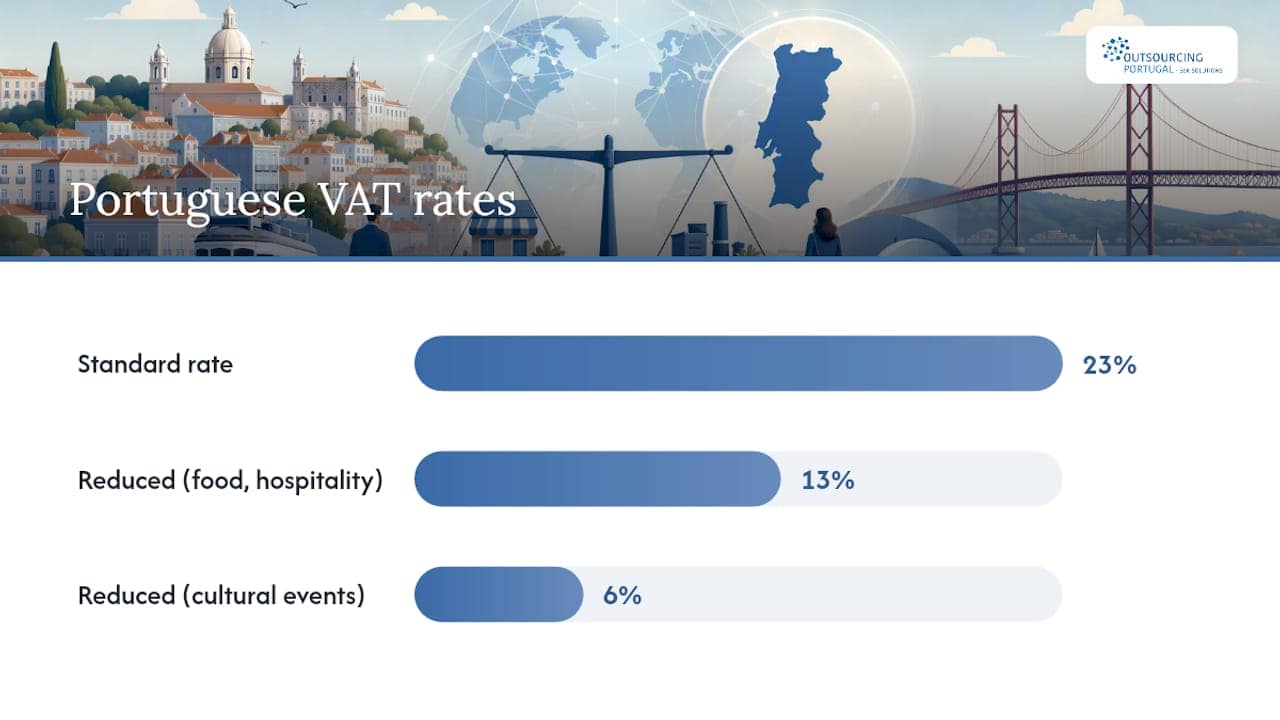
Portugal applies a standard VAT rate of 23%, with reduced rates of 13% and 6% for specific goods and services like certain food items, hospitality, and cultural events. Most B2B cross-border services stay outside these rates entirely under reverse-charge, but once you’re registered for local transactions, getting the rate right on every invoice matters.
Ongoing compliance breaks down into a few recurring tasks:
- Invoice content. Every invoice for a Portuguese transaction needs your PT VAT number, the applicable rate or reverse-charge reference, and your fiscal representative’s details where relevant.
- Periodic returns. Registered entities file VAT returns on a monthly or quarterly cadence depending on turnover, with payment due alongside each filing.
- SAF-T reporting. Portugal requires standardized accounting file (SAF-T) submissions from registered businesses, which means your invoicing software needs to generate Portuguese-compliant export files, not just PDFs.
- OSS as an alternative. If your registration need comes from EU-wide e-commerce rather than a single Portuguese trigger, the One-Stop-Shop scheme can replace this whole local filing cycle with one consolidated EU return, according to the European Commission’s national VAT rules for Portugal.
Digital services sold to non-EU customers but “used and enjoyed” in Portugal can also fall under Portuguese VAT even without a physical presence, a rule that surprises companies used to treating digital sales as location-agnostic.
What Mistakes Do Foreign Companies Make With Portuguese VAT?
The single most expensive mistake is registering when you didn’t have to. Companies see “foreign” and “Portugal” together and assume VAT registration is automatic, then spend a year filing returns for transactions that should have been reverse-charged from the start. Practitioner guidance consistently flags this as the top avoidable error.
- Registering “just in case” instead of confirming the debtor test first.
- Mishandling call-off stock by tracking shipment date instead of the ownership-transfer moment.
- Skipping written confirmation of a buyer’s VAT status before assuming reverse-charge applies.
- Letting representative communication lapse, which creates audit red flags even when the underlying tax position is correct.
Pro Tip: Before you file anything, write a one-paragraph description of exactly how goods or services move from you to your Portuguese counterparty. If you can’t clearly state who owns what and when, you’re not ready to decide on registration yet.
For companies whose only Portuguese presence is a handful of hired employees rather than product sales, an Employer of Record arrangement often sidesteps the registration question entirely, since payroll tax and employment compliance run through the EOR’s existing structure instead of yours.

What I’d Tell You if You Called Me Before Registering
Most companies that call about registo iva empresa estrangeira don’t need to register at all. They need a clearer read on whether their buyer qualifies for reverse-charge. Product sellers with local stock almost always need registration; pure B2B service exporters almost never do. My first-three-step advice: confirm your debtor status against the CIVA test, decide whether a fiscal representative or an EOR route fits your actual footprint, then file only once you’re certain. Skipping straight to paperwork is how companies end up registered, liable, and still confused about why.
— Paulo
A Practical Alternative to Registering Before You’ve Even Hired Anyone
If your Portuguese footprint is really about people, not product, VAT registration might be the wrong problem to solve first. Some service providers run payroll, tax remittance, and employment compliance for companies hiring in Portugal without them setting up a local entity or VAT registration just to bring a few employees onto the books.
This route tends to make the most sense for market testing, small project teams, or companies still deciding whether Portugal earns a permanent setup. Instead of appointing a fiscal representative and filing periodic VAT returns for what amounts to a payroll operation, the EOR structure absorbs those obligations directly, and you keep control of the hiring decisions. If you’re weighing registration against a faster path to hiring, check the Employer of Record Portugal services page and see whether it fits your timeline better than a standalone VAT filing would.
Sources
Start with gov.pt’s VAT guidance, the non-resident declaration procedure, the IRIVADI form instructions, and VIES to verify your number once issued. For tax filing support beyond registration, an accountant specializing in cross-border compliance can help interpret how these forms apply to your specific transaction flow.
- Ofício-circulado n.º 25065/2025 — SME transfrontier exemption guidance (Portugal)
- Portugal VAT and non-resident taxable persons — VAT Association (practitioner guidance)
FAQ
Are Foreign Companies Exempt From VAT in Portugal?
No blanket exemption exists. Foreign companies avoid Portuguese VAT registration only when reverse-charge applies (typically B2B services to a VAT-registered Portuguese buyer) or when they qualify for the SME transfrontier exemption after notifying the Autoridade Tributária.
How Do I Get an Intra-Community VAT Number in Portugal?
You submit a declaration of commencement of activity through Portal das Finanças or, for non-resident entities without a permanent establishment, through the specific non-resident declaration procedure; once approved, your number is valid for intra-EU transactions and verifiable in VIES.
How Do I Register Invoices Issued Abroad?
Invoices issued abroad for reverse-charge B2B transactions don’t require Portuguese VAT registration; you record them in your home-country accounting with a reverse-charge reference, while invoices tied to registered Portuguese activity must be reported through your periodic VAT return and SAF-T submission.
What Is Intra-Community VAT and How Does It Work in Cross-Border Deals?
Intra-community VAT rules determine which party in an EU cross-border transaction accounts for VAT: for B2B services, the buyer usually self-accounts under reverse-charge, while for goods, the party responsible for the acquisition (often based on who arranges transport and holds ownership at the relevant moment) typically registers and pays.
Does Hiring Employees in Portugal Trigger VAT Registration?
Hiring employees alone doesn’t create a VAT registration obligation, since employment and payroll taxes run on a separate track from VAT; companies in this position often use an Employer of Record to handle payroll compliance without touching VAT registration at all.