

If your company hires developers, designers or other creators in Portugal, ownership of what they produce depends on three things: who the creator is, what kind of work it is, and what the contract says. Portuguese law gives some default answers, but they differ between software, copyright works and inventions, and they can be changed in writing. The safe approach is to settle ownership in the contract before the first line of code is written, whether the team is an outsourced supplier, individual contractors or employees hired through an Employer of Record (EOR).
This guide explains the defaults, where they differ, which clauses to put in an outsourcing or remote-team contract, and how to protect confidential information and pre-existing IP.
TL;DR
- A partial transfer of economic rights must be in a written document with notarised signatures, stating the rights transferred and the conditions of use (time, place and price), or it is void (CDADC, article 43). A total and definitive transfer requires a public deed identifying the work and the price (article 44). Software created by employees or on commission follows the presumption in Decree-Law 252/94.
- For software, Portuguese law presumes that the recipient (the employer or the commissioning client) holds the rights, unless the contract says otherwise or the purpose of the contract points elsewhere.
- Patents and designs created within the employer’s business generally belong to the employer, but the inventor may be owed remuneration based on the invention’s importance.
- Trade secrets are protected only if you take real confidentiality measures, so an NDA and access controls are part of the IP plan.
- Do not rely on defaults. Define pre-existing IP, assignment, licences, subcontractors and open-source use in the contract.
Table of Contents
- The starting point: the creator owns, unless the contract says otherwise
- Software: the default favours the recipient, but write it down anyway
- Copyright works other than software: design, content, documentation
- Inventions and patents
- The three engagement models compared
- What the contract should say
- Protecting confidential information and trade secrets
- Duration of the rights
- Practical steps when building a team in Portugal
- Our perspective
- How we can help
- FAQ
- Sources
The starting point: the creator owns, unless the contract says otherwise
Un Portugal, copyright initially belongs to the intellectual creator of the work (Copyright and Related Rights Code, articles 11 and 14). EU directives harmonise many copyright rules but, apart from software, leave initial ownership largely to national law.. This differs from the US approach, where certain employee works belong to the employer from creation. If your legal team is used to US-style “work made for hire” thinking, that is the first assumption to drop.
Portuguese practice follows the same logic. According to the Legal 500 guide to IP in Portugal, the rightsholder is, as a general rule, the intellectual creator unless agreed otherwise. For commissioned or employee-created work, the holder may be fixed by contract, and without an agreement the creator is presumed to hold the rights.
The practical consequence is simple: a company that pays for work does not automatically own every right in it. The contract decides.
Which laws apply
Two codes do most of the work. According to the Legal 500 technology outsourcing chapter for Portugal, the Copyright and Related Rights Code governs works, including computer programmes and databases, while the Industrial Property Code governs industrial property rights such as patents, designs and trademarks. Personal data in the project falls under the GDPR, supplemented in Portugal by Law 58/2019.
The national body for industrial property is the Instituto Nacional da Propriedade Industrial (INPI), which attributes and protects industrial property rights nationally and internationally. Copyright, by contrast, does not depend on registration.
The same Legal 500 chapter notes that Portuguese general law has no specific rules on the contractual terms of outsourcing, apart from sector-specific rules that may apply depending on the activity and the parties. In other words, your contract is the main tool you have, and it has to be complete.
Software: the default favours the recipient, but write it down anyway
Most outsourcing work in Portugal is software, and here the default is more favourable to the customer than for other creative work.
Under article 3(3) of Decree-Law No. 252/94, copyright in computer programmes made for hire is presumed to be held by the recipient, unless otherwise stipulated or inconsistent with the purposes of the contract. The same guide says that if software is developed for a customer, the customer owns the copyright absent an agreed contractual position.
For employees, the position is parallel. A Lexology guide to IP rights for fintech businesses in Portugal states that, unless stipulated otherwise, rights in software created by an employee within the employment relationship belong to the employer, and this extends to programmes made to order. The DLA Piper expansion guide adds that this applies where the programme is created in the exercise of the employee’s functions or following the employer’s instructions.
Two cautions follow from the wording itself:
- The presumption yields to contrary agreement. A supplier’s standard terms may say the supplier keeps the rights and licenses them to you.
- The presumption yields to the purposes of the contract. If the scope of work is vague, you may end up arguing about what the parties meant.
So the default is a safety net, not a plan.
Copyright works other than software: design, content, documentation
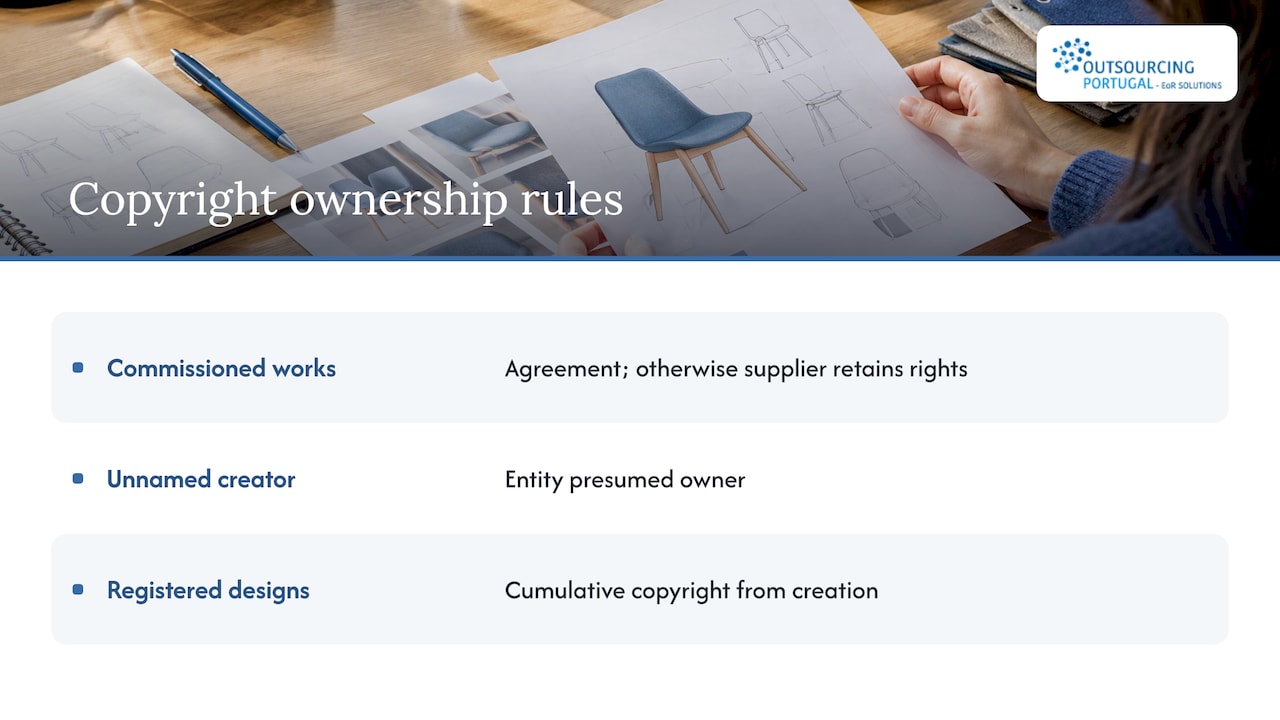
Outside software, the protection is weaker for the commissioning company. For commissioned works, the Legal 500 technology outsourcing chapter says copyright allocation is determined by agreement and, without one, rights remain with the supplier. That covers material you might not think of as IP at first: brand assets, UX/UI design files, technical documentation, training content, marketing copy and databases.
The DLA Piper guide notes one more rule: where the creator’s name is not on the work, it is presumed that the copyright belongs to the entity for which the work was created. In specific circumstances, the creator may also be entitled to special remuneration on top of the agreed pay. Do not build a strategy on a presumption about whose name appears on a file. Build it on an assignment clause.
Designs have an additional layer. Under article 194 of the Industrial Property Code, a registered design may also benefit from cumulative copyright protection from its creation. If your outsourced team designs a product interface or a physical product, check ownership under both regimes.
Inventions and patents
The rule for industrial property is more employer-friendly. The Legal 500 IP guide says that where an employment contract covers inventiveness, the invention belongs to the employer, and if that inventiveness is not specifically compensated, the employee is entitled to remuneration according to the invention’s importance. The regime applies, with necessary adaptations, to commissioned inventions.
Under article 58 of the Industrial Property Code, where the employment contract provides for inventive activity, the invention belongs to the employer. Where an invention falls within the company’s field but outside that remit, the employer only has a statutory right of option to acquire it, against remuneration to the inventor. If you expect your Portugal team to produce patentable work, the employment or services contract should say how that work is compensated, so that the question does not return after the invention is valuable.
The three engagement models compared
The model you choose changes who you need to sign with and what the default risk looks like. The table summarises what the sources above support.
| Model | Default position on software | Default position on other copyright works | What to secure in writing |
|---|---|---|---|
| Employees (directly or through an EOR) | Employer, unless otherwise agreed | Creator presumed, unless agreed otherwise | Assignment of economic rights, invention remuneration terms, confidentiality |
| Independent contractor | Recipient presumed for programmes made to order, unless agreed otherwise | Remains with the creator absent agreement | Full assignment or licence with scope, duration and territory |
| Outsourcing supplier or agency | Recipient presumed for commissioned software, unless agreed otherwise | Supplier keeps rights absent agreement | Assignment from the supplier, plus flow-down from its staff and subcontractors |
With an outsourcing supplier the chain matters. If the supplier’s own developers have not assigned their rights to the supplier, the supplier cannot give them to you. Ask for the chain to be documented, not just promised.
If you are weighing the models, our guide to in-house versus outsourced development covers the wider decision, and the page on hiring remote software developers through an EOR explains the employment route.
What the contract should say
A partial transfer of economic rights must be in a written document with notarised signatures, stating the rights transferred and the conditions of use (time, place and price), or it is void (CDADC, article 43). A total and definitive transfer requires a public deed identifying the work and the price (article 44). Software created by employees or on commission follows the presumption in Decree-Law 252/94. and should clearly define its scope, duration and territorial extent. A one-line clause saying “all IP belongs to the client” is therefore the weakest version you can sign. A solid agreement covers the following.
- Definitions of IP types. Name copyright in software and databases, related rights, trademarks, designs, patents and trade secrets. The Legal 500 chapter lists these as the rights technology outsourcing can create or use.
- Assignment or licence. State whether rights vest in the supplier or the customer, or are licensed on an exclusive or non-exclusive basis. The same guide notes this is the typical point of negotiation in custom software and in AI projects trained on customer data.
- Scope, duration and territory. Say what is transferred (all uses, or specific ones), for how long and where. Silence invites dispute.
- Pre-existing IP. Each side keeps what it already owns. List the supplier’s tools, libraries and frameworks, and grant you a licence to use them with the deliverables.
- Moral and invention remuneration. Moral rights (e.g. the right to be named as author and to object to distortion of the work) cannot be waived or assigned under Portuguese law (CDADC, articles 9 and 56); contracts can regulate how they are exercised but not transfer them.
- Subcontractors and staff. Require the supplier to have written assignments from everyone who works on your project, and to pass on the confidentiality duties.
- Open-source software. Require disclosure of any open-source components used and their licences, so that nothing in the deliverable forces you to publish proprietary code. This is standard contract practice rather than a Portuguese legal rule, so tailor it to your product.
- Data protection. Where personal data is involved, service providers will most likely act as processors, which requires the article 28 GDPR elements in the contract, or the parties act as joint controllers, which requires article 26 elements, according to the Lexology GTDT Digital Business chapter on Portugal.
- Governing law and dispute route. Name the law and forum, and have Portuguese counsel review the IP clauses.
For a Portuguese-law contract, have a Portuguese qualified lawyer check the assignment wording. The formal requirements for transferring rights are where generic templates most often fall short.
Protecting confidential information and trade secrets
Not everything valuable can be registered. Source code logic, pricing models, customer lists and product roadmaps are often best protected as trade secrets. Under article 313 of the Industrial Property Code, as applied in a Coimbra Court of Appeal decision, information qualifies as a trade secret if it is not accessible or easily accessible to the public, has pecuniary value, and is protected by measures intended to keep it confidential.
The third condition is within your control. A trade secret you do not actively protect may not qualify. The Legal 500 IP guide notes that trade secrets have unlimited duration, which is a strong reason to protect them properly, since they last for as long as they stay secret.
Practical measures include:
- a signed NDA before technical information is shared (see our NDA checklist and model clauses for Portugal);
- role-based access to repositories, documents and customer data;
- marking confidential material as such;
- device and account rules for remote workers;
- exit procedures that recover credentials, files and equipment.
If you also want to restrict what a departing team member does next, the rules are strict. Our article on when a non-compete clause is valid in Portugal explains the conditions, so you do not rely on a clause that a court would not enforce.
Duration of the rights
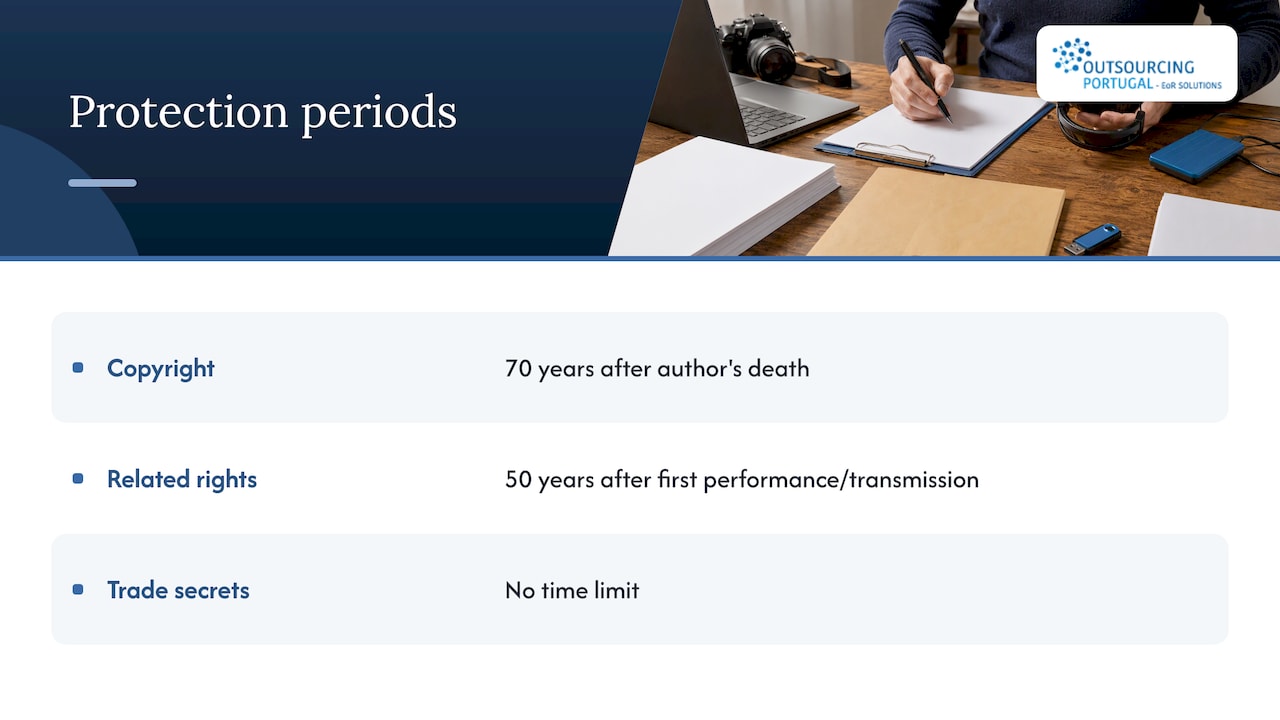
Knowing how long protection lasts helps you value what you commission. According to the Legal 500 IP guide, copyright in Portugal expires 70 years after the author’s death, related rights generally last 50 years from the performance, first fixation or first broadcast, extended to 70 years for performances fixed in phonograms that are published or communicated to the public (CDADC, article 183), and trade secrets last without a time limit. That is why the duration of your licence or assignment should be set deliberately: a licence limited to a few years can leave you without rights while the work is still protected.
Practical steps when building a team in Portugal
The sources above give the legal rules. The steps below turn them into a sequence, drawn from the rules and from standard contracting practice.
- Map what will be created. Software, designs, content, data, possible inventions. Each category has a different default.
- Choose the engagement model. Employees, contractors or a supplier, using the table above.
- Sign the IP and confidentiality terms before work begins. Rights assigned after the fact are harder to document, and the formal writing requirement applies.
- Set up a record. Keep dated deliverables, version-control history, signed assignments and subcontractor lists in one place.
- Control access. Give each person only what the role requires and log it.
- Plan the exit. Handover of code, documentation and credentials should be written into the contract.
- Review annually. When the project scope changes, the assignment wording may need to follow.
An outsourced team that works across borders also raises employment questions that sit next to IP. Our legal compliance guide for employment outsourcing in Portugal covers those, and the Portugal telework law guide is useful if your people work from home, since the written agreement for remote work is a natural place to record IP and confidentiality duties.
Our perspective
Most IP disputes we see described in outsourcing arrangements do not start with bad faith. They start with a contract that was silent, copied from another country, or signed after the work had begun.
Our view is that the cleanest route for an international company is to put the people who create the work in a clear employment relationship, with Portuguese-law contracts that already include IP assignment, confidentiality and invention terms. That is the reason we offer Employer of Record services: your team works to your direction, and the paperwork that fixes who owns what is part of the hiring process from day one.
Where a company prefers a supplier model, we help it ask the right questions: who signed what, down the chain, and what the licence covers. We handle Portuguese HR, payroll and legal processes in English, so the IP terms sit alongside the rest of the employment framework instead of living in a separate document nobody reads.
Ownership is easiest to settle before the first deliverable. Once there is a valuable product, it becomes a negotiation.
Paulo
How we can help
If you want to build a team in Portugal without setting up a local entity, our Employer of Record service handles hiring, onboarding, payroll and compliance with Portuguese employment law, with English-speaking support. Because your people are employed under Portuguese contracts, IP and confidentiality terms can be built into the employment documentation from the start.

For technical teams, our nearshore Portugal services cover software development, cloud and DevOps, UX/UI and mobile. If you would rather talk through your situation first, contact our team.
FAQ
Who owns software written by a developer in Portugal for a foreign company?
By default, Portuguese law presumes that the recipient of the programme holds the rights, meaning the employer or the commissioning client, unless the contract says otherwise or the purposes of the contract point elsewhere. A supplier’s terms often say otherwise, so read the IP clause before you sign. Put a written assignment in place regardless.
Does a contractor keep copyright in designs and content?
Absent an agreement, rights in commissioned works that are not software generally remain with the supplier, according to the Legal 500 outsourcing chapter. If you need to own or freely use the material, the contract must transfer the rights in writing, with scope, duration and territory.
Do I have to pay an employee extra for an invention?
Possibly. In Portugal an invention made under an employment contract that covers inventiveness belongs to the employer, but if that work is not specifically compensated, the employee is entitled to remuneration in proportion to the invention’s importance. Agree the compensation terms in the contract, and ask a Portuguese IP lawyer to confirm the wording.
Is an NDA enough to protect a trade secret?
An NDA helps, but the law also asks for measures that keep the information confidential, as article 313 of the Industrial Property Code describes. Combine the NDA with access controls, marking of confidential material and an exit procedure.
Does the same rule apply to a remote team working from home?
Where the people are employees, the employer-side defaults apply to what they create within their role. The written telework agreement is a good place to restate IP and confidentiality duties. For freelancers, use a separate assignment.
Sources
- Legal 500 Country Comparative Guides 2026: Portugal technology outsourcing
- The Legal 500 Country Comparative Guide: IP in Portugal
- Legal 500 Country Comparative Guides 2025: Portugal TMT
- Acórdão do Tribunal da Relação de Coimbra (trade secrets)
- Lexology: IP rights for fintech businesses in Portugal
- DLA Piper: Intellectual property in the employment context
- Lexology GTDT Digital Business 2024: Portugal
- Bird & Bird: convergence of IP, data and AI regulation in Portugal
- gov.pt: Instituto Nacional da Propriedade Industrial
- EU freelance contract IP ownership overview