

To hire employees abroad, you either set up a legal entity in the country, engage contractors, or use an Employer of Record (EOR), a local company that becomes the legal employer while your person works day to day for you. For a first hire, or a team you want running quickly, an EOR is usually the fastest compliant route. We are a Lisbon-based EOR, so this guide uses Portugal as the worked example, and the principles apply wherever you hire.
TL;DR
- There are three main ways to engage someone abroad: employ directly through a local entity, use a contractor, or use an Employer of Record.
- The real risks are misclassification, a taxable local presence and missed payroll or social security obligations, not the hiring itself.
- In Portugal, employer social security is 23.75% and employee social security is 11%, so budget above gross salary.
- With an EOR in Portugal, once a candidate is selected and the offer agreed, we can hire within 2 days.
- Start with the country’s rules, then pick the arrangement. Not the other way round.
Table of Contents
- What hiring employees abroad actually means
- The three ways to employ someone in another country
- The risks that catch companies out
- How to hire an employee abroad, step by step
- Worked example: hiring in Portugal
- Hiring remote employees globally: one country at a time
- Our approach to hiring in Portugal
- Our perspective
- FAQ
- Sources
What hiring employees abroad actually means
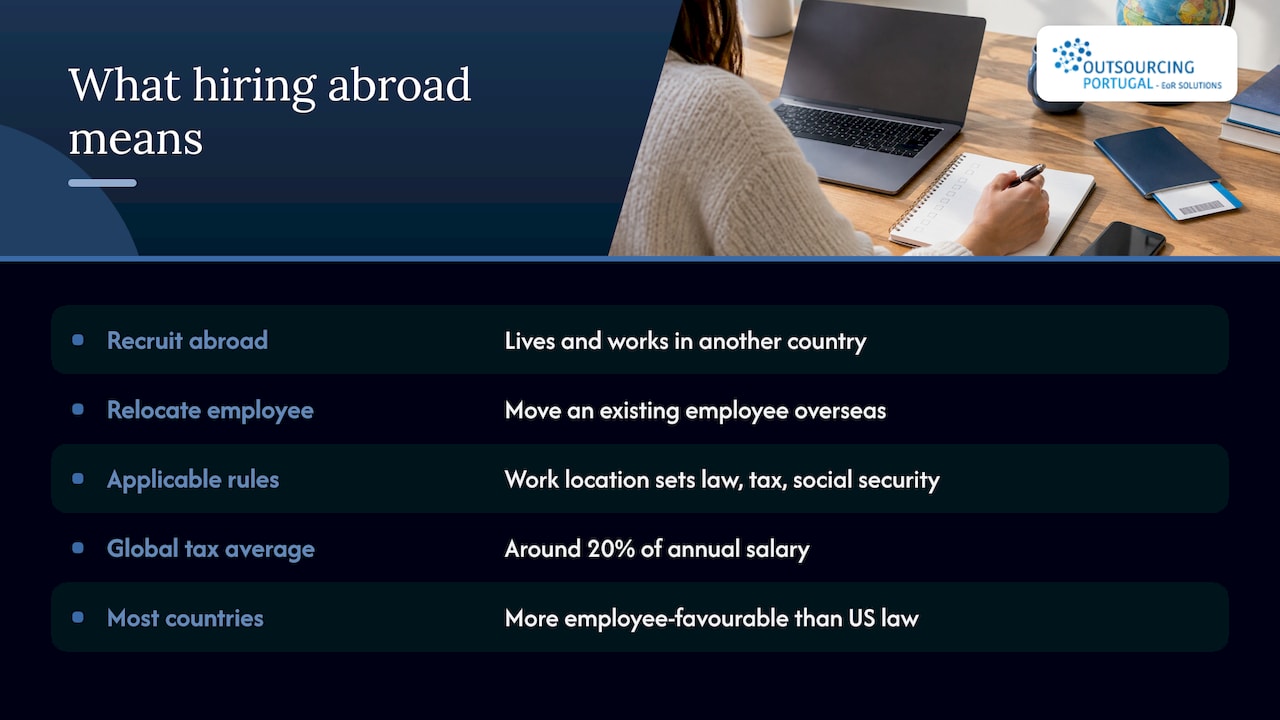
Hiring abroad covers two situations that are often mixed up. In the first, you recruit someone who lives and works in another country, perhaps remotely for a team elsewhere. In the second, you move an existing employee overseas. This article is about the first: building a team in a country where you have no company.
The central point is that the employee’s place of work decides which employment law, tax and social security rules apply, not where your head office sits. Cornell University’s global operations guidance notes that employment taxes average around 20 percent of annual salary globally, and that most countries have employment laws more favourable to employees than US law, with mandated contract terms, paid leave, termination limits and severance. Even a UK, EU or US founder with years of HR experience is therefore starting from a different rulebook.
The three ways to employ someone in another country
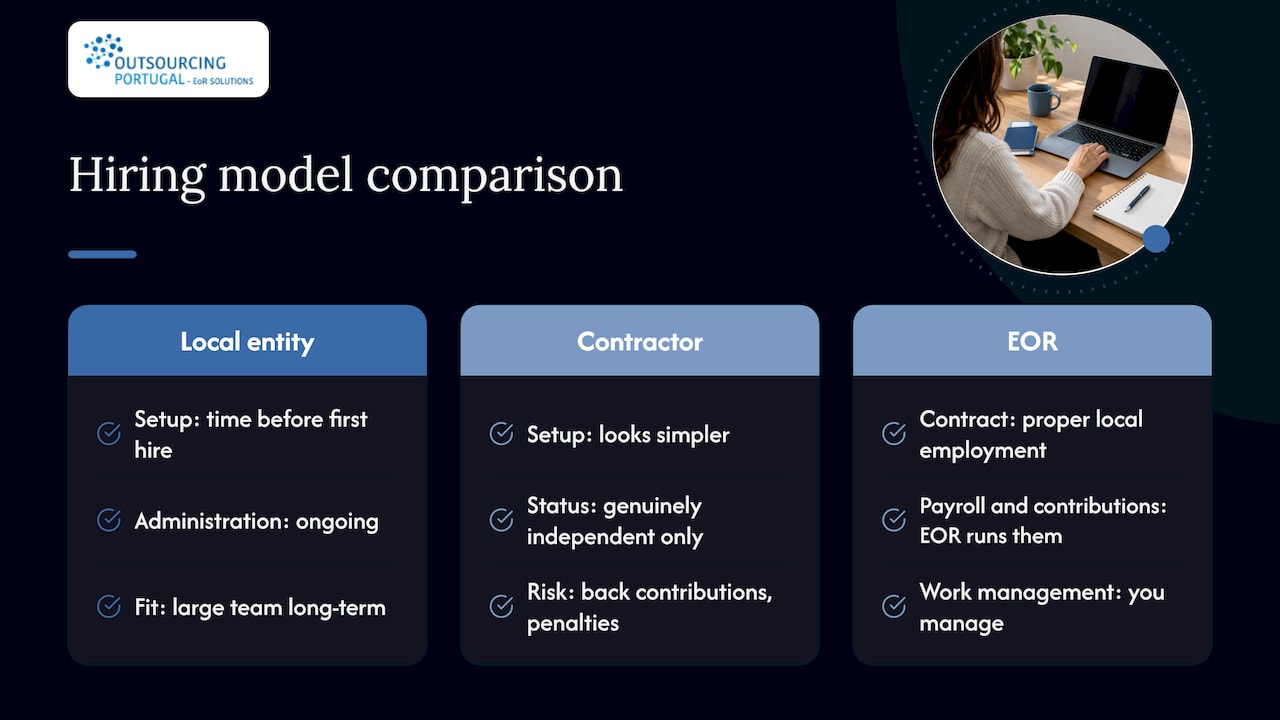
Lawyers at Ogletree describe three options for a country where you have no staff: employ directly, engage a contractor, or engage through an employer of record or similar third party. Which fits depends on the country’s laws and what matters most to you. Here is how they compare in practice.
| Own local entity | Contractor | Employer of Record | |
|---|---|---|---|
| Who is the legal employer | You, through your entity | Nobody: the person is self-employed | The EOR |
| Setup effort | Incorporation, tax and social security registration, payroll set-up | Contract only | Employment contract and onboarding by the EOR |
| Misclassification risk | Low | High if the person works like an employee | Low |
| Best for | Larger, long-term teams | Genuine project-based, independent work | First hires, testing a market, small and growing teams |
| Ongoing admin | Yours, or outsourced | Invoices | Payroll, contributions and HR administration handled by the EOR |
Why an Employer of Record usually comes first
An entity is the right long-term home for a large team, but it takes time and ongoing administration before your first person can start. A contractor looks simpler, but it only works when the person is genuinely independent. If they work set hours, under your direction, in your tools, local authorities may treat them as an employee, with back contributions and penalties as the consequence.
An EOR avoids both problems. The person has a proper local employment contract, the EOR runs payroll and contributions, and you manage the work. Our Employer of Record service in Portugal works this way, and it also leaves the door open: if your Portuguese team grows, we also support setting up your own legal entity.
The risks that catch companies out
A taxable presence you did not plan for
Employing someone abroad can create a permanent establishment, which means your company becomes taxable in that country. The Partos guideline on contracting abroad lists the triggers: an employee working from a home office the company can dispose of, or someone who habitually concludes contracts on the company’s behalf. The consequences include corporate income tax and employer withholding obligations in that country. Sales roles are the classic case.
Registration and payroll obligations
Rules differ sharply by country, so there is no universal checklist. A foreign company with no local presence employing staff in France must declare and pay social contributions and file a declaration before each hire. In the Netherlands, posted workers still trigger wage tax and minimum wage and leave rules.
Cross-border social security
Within the EEA and Switzerland, an employee who works in two or more countries generally stays insured in their country of residence if they work at least 25% of their time there, and a posted worker needs an A1 declaration in advance, as explained by Partos. Getting this wrong means paying contributions twice or in the wrong place.
If you are sending UK staff abroad
This is a different case from hiring locally, but it is often confused with it. HMRC states that UK employers must continue to deduct PAYE Income Tax for employees working abroad and, where the destination is outside the EU/EEA, Switzerland and countries with a social security agreement, National Insurance for the first 52 weeks. Someone hired locally in another country does not fall under this rule.
How to hire an employee abroad, step by step
The EU’s Recruiting in Europe guide for employers sets out what to check before and after recruiting: costs and risks, work permit needs, and social security and health insurance transfer before, then local registration and settling in after. Here is that sequence as a working routine.
- Define the role and the duration. A permanent role points to employment. A defined, independent project may suit a contractor.
- Check the person’s right to work. EU, EEA and Swiss citizens can work in Portugal freely, registering their residence (CRUE) if they stay more than three months. Non-EU candidates generally need a visa or residence permit, and the process takes time. We support visa and immigration for our clients’ hires.
- Cost the hire fully. Add employer social security and statutory extras to gross salary. In Portugal that means 23.75% on top. More on this below.
- Choose the employment arrangement. Use the comparison table above. Most companies hiring one to ten people start with an EOR.
- Recruit. Find the candidate yourself or use local recruitment. We offer local recruitment alongside the employment side.
- Issue a compliant local contract. It must reflect local rules on probation, notice, leave and termination, not your home templates.
- Register and onboard. Notify Social Security of the hire before the employee starts, take out mandatory workers’ compensation insurance, join the wage guarantee fund (FGCT), and arrange benefits, equipment and a first-day plan. With us, once the candidate is selected and the offer agreed, we can hire within 2 days.
- Run payroll and reporting every month. Deadlines are fixed: in Portugal the monthly social security declaration is due by the 10th and contributions are paid between the 10th and the 20th of the following month, and late filing costs money. Keep payroll controls tight too; payroll fraud investigations show how problems surface when records and approvals are loose.
Worked example: hiring in Portugal
Portugal is a popular choice for UK, EU and US companies because of its educated, multilingual workforce, competitive labour costs and a time zone close to London. Here is what a hire looks like.
The numbers that matter
- Employer social security: 23.75% of gross salary.
- Employee social security: 11% of gross salary, withheld through payroll.
- National minimum wage in 2026: €920 gross per month, up from €870 in 2025. It is set annually by the government, so check the figure for the year of the hire.
An illustration. Take a gross monthly salary of €3,000, paid 14 times a year (12 months plus holiday and Christmas allowances), so €42,000 gross per year. Employer social security at 23.75% adds €712.50, so the monthly employer cost before any benefits is €3,712.50. The employee’s 11% is €330, deducted from their pay. Annual employer cost before benefits: €51,975 (€42,000 + 23.75%). Income tax withholding comes on top for the employee and depends on their personal situation. This is simple arithmetic on the rates above, not a quote.
Salary structure also matters. We design tailored salary packages with tax optimisation, so that what you spend reaches the employee efficiently within the rules. For the legal framework behind Portuguese contracts, see our guide to EU employment law and hiring compliance in Portugal, and for monthly mechanics, our overview of international payroll in Portugal.
Which roles suit Portugal
- Software and cloud teams. See our nearshore Portugal services for development, DevOps, UX/UI and mobile teams.
- Sales and business development. We provide sales outsourcing, including SDR and BDR teams and full-cycle sales.
- Support and operations roles. Portugal’s multilingual workforce suits customer-facing teams that serve several European markets.
Hiring remote employees globally: one country at a time
Companies hiring across many countries often look for one global platform. The legal reality is that every employee is governed by their own country’s rules, so quality comes from local knowledge. That is why we only work in Portugal. We are a Portugal-only specialist, and our support is personal and human: you deal with people who know Portuguese employment practice, not a ticket queue. Our parent, HRB Solutions Group, has been in the market for 20 years, and we have hired 500+ people.
Our approach to hiring in Portugal
We offer an Employer of Record service for international companies that want to hire in Portugal without opening a local entity. We handle hiring, onboarding, payroll, benefits, legal and tax compliance, and HR support, with English-speaking support throughout. Pricing is one competitive monthly fee, so you can budget the cost of each hire clearly. See the Employer of Record page for the full scope, or the payroll services page if payroll is your first need.
If you already know the role and the candidate, contact our team and we will walk you through the Portuguese contract, payroll and start date.
Our perspective
Most hiring problems abroad do not come from the hire. They come from the order of decisions: a company picks a contractor agreement because it is quick, then discovers months later that the person is in practice an employee.
We think the cleaner route is to settle the legal employer first. In Portugal, that means a local contract, correct social security at 23.75% for the employer and 11% for the employee, and payroll that runs on schedule from the first month.
We built Outsourcing Portugal around one country on purpose. Portuguese employment law, payroll and immigration are what we do every day, backed by the 20 years of HRB Solutions Group. That lets us give personal support, structure tailored salary packages with tax optimisation, and move fast once an offer is agreed.
Start with an EOR, learn the market, and decide on your own entity when the team justifies it. We support both.
Outsourcing Portugal Team
FAQ
Can I hire an employee abroad without setting up a company there?
Yes, in many countries. You can use an Employer of Record, which employs the person locally on your behalf. Some countries also let a foreign company register as an employer directly, but this carries its own tax and permanent establishment considerations. In Portugal, our EOR service means you do not need a local entity to start.
Is it better to hire a contractor or an employee abroad?
It depends on how the person works. A genuinely independent specialist on a defined project may be a contractor. Someone who works your hours, on your team and long term is in substance an employee, and should be employed. Misclassification can lead to back contributions and penalties.
How much does it cost to hire an employee in Portugal?
Beyond gross salary, employer social security is 23.75%. The employee’s 11% is withheld from their pay. Benefits and any service fees come on top. With us, you pay one competitive monthly fee, and you can ask our team for the fee for your hire.
How quickly can I hire someone abroad?
Setting up your own entity can take a long time. With an EOR the contract and onboarding are much quicker. At Outsourcing Portugal, once a candidate is selected and the offer is agreed, we can hire within 2 days. Non-EU candidates also need immigration steps, which we can support.
Sources
- Considerations When Employing Workers in a Country Where the Company Has No Employees (Ogletree)
- Hiring for International Work (Cornell Global Operations)
- Guideline contracting outside the Netherlands (Partos)
- Information required by law (URSSAF, foreign companies)
- Posting employees to the Netherlands (business.gov.nl)
- Employees working abroad (GOV.UK)
- Recruiting in Europe: a guide for employers (European Labour Authority)
- Government increases minimum wage to 920 euros in 2026 (Portuguese Government)
Recommended
- Remote Work in Portugal for a Foreign Company: How It Works
- Best Outsourcing Tools for International Hiring in 2026
- Cross-border employment in Portugal: HR manager’s guide
- Portugal Labor Compliance: 4 Must Do Steps for Foreign Hires
Disclaimer: This article is for general information only and does not constitute legal, tax, or employment advice. Laws and regulations change often. Please consult a qualified professional before making decisions. For Employer of Record services in Portugal, contact Outsourcing Portugal.