
TL;DR:
- Hiring international businesses must navigate Portugal’s complex labor laws to ensure compliance from day one.
- Effective recordkeeping, staff training, and proactive audits are essential to meet ACT inspection priorities in 2026.
Hiring local employees in Portugal as an international business means operating inside one of Europe’s more detailed labor frameworks. Knowing how to ensure labor compliance from day one is not optional. Miss a working-time record, misclassify a contractor, or skip a mandatory payslip component, and you are looking at fines, back payments, and regulatory scrutiny that can derail operations fast. This guide cuts through the complexity with Portugal-specific strategies, covering what the regulators are actually checking in 2026, what documents you must have in order, and how to build a compliance process that holds up under inspection.
Table of Contents
- Key Takeaways
- How to ensure labor compliance: Portugal’s regulatory framework
- Documentation and digital recordkeeping best practices
- Executing compliance policies through training and audits
- Monitoring compliance and preparing for ACT inspections
- My honest take on labor compliance in Portugal
- How Outsourcing-portugal helps you stay compliant
- FAQ
Key Takeaways
| Point | Details |
|---|---|
| Know the ACT’s 2026 priorities | Inspectors are targeting working time, gender pay gaps, contract regularity, and the private security sector. |
| Build audit-proof records | Digital working-time systems beat spreadsheets; records must be kept for at least five years. |
| Train before you need to | Managers and HR teams need regular updates on Portuguese labor law, not just onboarding orientation. |
| Run internal audits proactively | Identify contract, wage, and scheduling gaps before ACT inspectors do, then fix them immediately. |
| Use local compliance expertise | An Employer of Record or specialist partner removes structural compliance risk for international companies. |
How to ensure labor compliance: Portugal’s regulatory framework
Portugal’s labor law sits on a dense foundation. The Código do Trabalho (Labor Code) governs the relationship between employer and employee, and it is supplemented by sector-specific collective bargaining agreements that carry legal weight. For international companies, the complexity multiplies because those agreements vary by industry and can override certain general provisions in the employee’s favor.
The Autoridade para as Condições do Trabalho, known as the ACT, is the national labor inspectorate. It has broad powers: unannounced visits, document requests, employee interviews, and the authority to impose fines or refer cases for criminal prosecution. Understanding what the ACT focuses on in any given year is one of the most underrated labor law compliance tips available to HR teams.
For 2026, the ACT inspection priorities include four headline areas:
- Working-time organization: Verification that records exist, are accurate, and reflect actual hours worked, including overtime and rest periods.
- Gender pay equality: Cross-checking compensation data for unjustified pay disparities between male and female employees in similar roles.
- Contract regularity: Identifying false service provision contracts and fraudulent internship arrangements used to avoid employment obligations.
- Private security sector: A dedicated national action targeting undeclared work and false service contracts in this regulated industry.
Penalties for violations scale with severity. Undeclared work, for example, carries some of the heaviest fines in the Portuguese system. Beyond financial cost, a formal ACT finding becomes part of your compliance record, which can affect future bids, licensing, and your ability to access public contracts.
Documentation and digital recordkeeping best practices
If the ACT arrives at your office, the first thing they will ask for is documentation. That means your working-time records, employment contracts, payroll data, and recruitment files need to be organized, complete, and immediately accessible. This is where most international companies struggle, not because they are non-compliant in intent, but because their systems were not built for Portuguese regulatory standards.
Here is what you must maintain at minimum:
- Signed employment contracts that reflect the applicable collective bargaining agreement
- Shift schedules and daily working-time records for every employee
- Payslips with mandatory legal components, including social security contributions
- Recruitment documentation to defend against claims of discriminatory hiring
- Records of rest periods, overtime approvals, and holiday entitlement
Portuguese law requires five-year record retention for working-time data. That is not a suggestion. It is a baseline for audit readiness and legal defense in disputes.
The recordkeeping format matters just as much as the content. Audit-proof records must be complete, legible, and supported by a methodology the ACT can follow and verify. Informal spreadsheets do not meet this standard. They introduce version errors, can be edited without trace, and fail to demonstrate the integrity required during inspection.
| Recordkeeping method | Audit readiness | GDPR risk level | ACT acceptance |
|---|---|---|---|
| Manual paper timesheets | Low | Low | Conditional |
| Basic spreadsheets | Low | Medium | Rarely accepted |
| Dedicated compliance software | High | Low (with privacy design) | Consistent |
| Integrated HR and payroll platform | High | Lowest (with proper config) | Strongly preferred |
Pro Tip: When selecting digital time-tracking software, confirm it logs changes with timestamps and user IDs. This audit trail is exactly what ACT inspectors look for when assessing whether records were manipulated.
One area that catches international employers off guard is telework monitoring. Privacy-by-design principles apply directly to remote working-time registration. Monitoring tools that are invasive or track productivity beyond what is proportionate violate Portuguese employment law and can trigger GDPR liability. Speaking of GDPR, non-compliance with employee data processing rules can mean fines up to 4% of global turnover. That figure alone justifies a proper data privacy review of your HR systems. For a structured starting point, the hiring compliance checklist from Outsourcing-portugal covers the legal requirements you need to address before onboarding Portuguese staff.
Executing compliance policies through training and audits
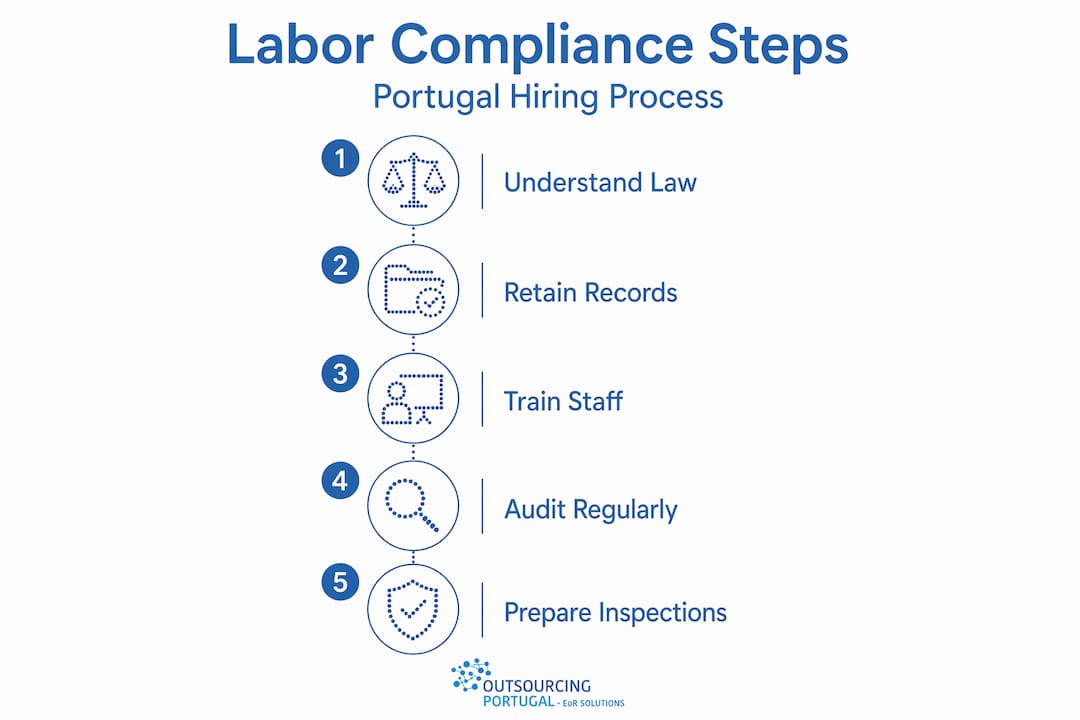
Good documentation systems mean nothing if your managers do not know how to use them or what the rules actually require. Ensuring workforce compliance is an organizational discipline, not a one-time setup task. The gap between knowing the law and applying it daily sits directly in how your HR team and line managers have been trained.
Start with a clear HR policy framework that reflects Portuguese law specifically. A global employee handbook adapted with a local addendum is not sufficient. Your Portuguese-law policies should cover:
- Working hours and overtime: Portugal’s standard working week is 40 hours. Overtime is legal but must be compensated at specific premium rates and recorded separately.
- Rest and break entitlements: Employees are entitled to minimum rest periods between shifts and daily break requirements that vary by contract type.
- Discrimination and harassment: Policies must align with the Código do Trabalho provisions on equal treatment, with complaint procedures that employees can actually access.
- Disciplinary procedures: Any disciplinary action, including termination, must follow a defined process with written notice and response rights.
- Working-time recording responsibilities: Managers need to understand that they are personally accountable for ensuring their team’s records are complete and submitted on time.
Compliance training content should address hours, breaks, discrimination, complaint processes, and documentation to maintain awareness across the workforce. This is not orientation material. It is ongoing. Portuguese labor law updates regularly through legislative changes and new collective bargaining rounds. Your managers need scheduled refreshers, not just onboarding coverage.
Regular internal audits are the operational core of any employment law compliance guide. Running internal audits focused on contract, wage, and scheduling gaps before inspections occur is the standard recommended by employment law specialists. Structure your audits quarterly, with a full review annually. Each audit should produce a written report, document the gaps found, and record the remediation steps taken with completion dates.
Pro Tip: Assign audit ownership to a specific role, not a team. When everyone is responsible, no one is. A named compliance lead in Portugal reduces gaps and creates a single point of accountability that also serves as your ACT contact point during inspections.
Compliance training programs play a measurable role in reducing legal claims. Beyond legal protection, they signal to your Portuguese workforce that your organization operates with integrity, which directly affects retention in a competitive talent market.
Monitoring compliance and preparing for ACT inspections
Ongoing compliance monitoring is where most international companies under-invest. They get the contracts right, set up the payroll system, and then assume the work is done. ACT inspections are not limited to companies with known violations. They follow sector-based national action plans, which means your business can be selected simply because of the industry you operate in.

Building a compliance matrix is one of the most effective labor regulation best practices for managing this risk. A compliance matrix maps your specific obligations by employment category, sector, and risk level. For example, a company with both full-time employees and workers on fixed-term contracts needs separate tracking columns, because the rules on renewal limits, notice periods, and termination rights differ significantly.
Key areas to track in your compliance matrix include:
- Wage equality monitoring: Regular pay analysis by gender and function to identify and close unjustified gaps before the ACT does.
- Contract classification reviews: Quarterly checks on freelance, fixed-term, and service contracts to verify they meet the legal criteria for that classification. Misclassified workers are among the ACT’s top enforcement targets.
- Working-time adherence: Real-time monitoring of overtime accumulation and rest period compliance, particularly for shift workers.
- Mandatory workplace notices: Required labor law postings must be current, visible, and updated when regulations change.
For companies in the private security sector, the 2026 ACT national action creates a specific obligation to prepare evidence of proper employment contracts for all security personnel, proof of mandatory licensing, and documentation that compensation meets sector collective agreement standards. The same logic applies to any sector with a dedicated ACT action plan.
When preparing for an inspection, treat readiness as documentation readiness. ACT inspectors will not accept verbal explanations. They review paper and digital trails. Have a protocol that lets you pull any employee’s complete file, including contract, working-time records, payslips, and training logs, within minutes. The payroll solutions for compliance covered by Outsourcing-portugal offer a strong model for integrating these records into a single auditable system. You can also get detailed guidance from compliance program management resources on documenting your internal processes in a format ACT inspectors can follow.
My honest take on labor compliance in Portugal
I have seen international companies walk into Portugal with strong HR teams and genuinely good intentions, and still find themselves with compliance gaps six months in. The common thread is not ignorance of the rules. It is assuming that what works in their home market translates cleanly.
What I have learned is that Portugal-specific compliance requires a mindset shift, not just a checklist update. The ACT operates differently from most labor inspectorates in Northern Europe or North America. It is methodical, well-resourced, and increasingly data-driven. The 2026 focus on gender pay gaps and contract classification reflects a regulator that is getting more sophisticated, not less.
The technology piece matters, but only if it is implemented with privacy compliance built in from the start. I have seen well-meaning companies deploy time-tracking tools that generated GDPR exposure they did not even know about. The interaction between employment law and data protection in Portugal is tighter than most companies expect.
My strongest advice is this: treat your first internal audit as a genuine discovery exercise. Go into it expecting to find problems, because you will. The businesses that do best long-term are the ones that find and fix their own gaps before an inspector does. That is not pessimism. It is how compliance actually protects business continuity and reputation over time.
— Paulo
How Outsourcing-portugal helps you stay compliant
Managing Portuguese labor law from abroad is genuinely difficult, even with a strong internal HR team. The combination of the Código do Trabalho, sector-specific collective agreements, ACT inspection cycles, GDPR obligations, and payroll complexity creates a compliance burden that grows with every hire.
Outsourcing-portugal provides Employer of Record and payroll services specifically designed for international companies hiring in Portugal without a local entity. This means your contracts, payslips, working-time records, and social security filings are managed by specialists who know what the ACT looks for and how to structure your documentation accordingly. From onboarding to ongoing compliance support, the team handles the details that create legal exposure when managed at a distance. If you are building a team in Portugal or reviewing your current compliance posture, this is where a local partner makes a concrete difference.
FAQ
What are the ACT’s main inspection priorities in 2026?
The ACT’s 2026 national inspection actions focus on working-time organization, gender pay equality, contract regularity (including false service contracts), and undeclared work, with a dedicated action targeting the private security sector.
How long must employers in Portugal keep working-time records?
Portuguese law requires working-time records to be stored for a minimum of five years, accessible for ACT audits or use in employment disputes.
What is the risk of GDPR non-compliance in employee data management?
Non-compliance with GDPR in employee data processing can result in fines of up to 4% of global annual turnover or €20 million, whichever is higher.
Can spreadsheets be used for working-time tracking in Portugal?
Spreadsheets are generally not considered audit-proof by ACT standards. They are prone to errors and lack the change-tracking integrity that inspectors require. Dedicated digital systems are strongly preferred.
How does an Employer of Record help with labor compliance in Portugal?
An Employer of Record takes on the legal employer role in Portugal, managing contracts, payroll, working-time records, and regulatory filings in line with Portuguese law, removing structural compliance risk from international businesses that hire locally without a registered entity.