
Office team collaborating on talent acquisition

What is talent acquisition and how it drives success

Many HR managers believe talent acquisition is simply another term for recruitment. In reality, it represents a comprehensive strategic framework that aligns workforce planning with business objectives, particularly critical for multinational corporations expanding into Portugal’s dynamic market. For companies seeking to build remote teams while maintaining full compliance, understanding this distinction becomes essential. This article explores what talent acquisition truly means, the unique challenges multinationals face in Portugal, and proven strategies to succeed in remote hiring while ensuring legal compliance.

Table of Contents

Key Takeaways

PointDetails
Strategic talent acquisitionTalent acquisition is a holistic approach that aligns workforce planning with business goals to create sustainable competitive advantages.
Portugal compliance focusIn Portugal, talent acquisition must navigate labor laws, employee protections, and termination procedures to ensure full legal compliance for remote hires.
Remote hiring practicesRemote hiring expands talent pools but requires robust sourcing, virtual assessments, digital onboarding, and cross border compliance processes.
Employer of recordAdopting EoR services can simplify compliance and payroll when hiring remote workers across borders.
Build talent communityProactively engaging potential candidates through content, webinars, and events creates a ready pipeline before openings.

Understanding talent acquisition: definition and strategic importance

Talent acquisition represents a holistic and strategic approach to sourcing, attracting, selecting, and retaining skilled employees. Unlike traditional recruitment, which focuses on filling immediate vacancies, talent acquisition encompasses long-term workforce planning, employer brand development, candidate experience optimization, and employee retention strategies. This comprehensive framework aligns hiring initiatives with broader business objectives, creating sustainable competitive advantages for organizations operating in global markets.

For multinational corporations, talent acquisition serves as a critical driver of business growth and operational excellence. The strategic nature of this function enables companies to anticipate future skill requirements, build talent pipelines proactively, and adapt quickly to changing market conditions. When organizations expand to Portugal, they gain access to a highly educated, multilingual workforce with strong technical capabilities, making strategic talent acquisition even more valuable.

The distinction between recruitment and talent acquisition becomes particularly important in remote hiring scenarios. Recruitment typically operates reactively, responding to immediate needs with short-term solutions. Talent acquisition, conversely, takes a proactive stance, continuously engaging with potential candidates, nurturing relationships, and building employer brand awareness. This ongoing engagement proves essential when competing for top talent in competitive markets like Portugal’s thriving tech sector.

Remote hiring introduces additional complexity requiring strategic adjustments:

  • Sourcing strategies must leverage digital platforms and global networks effectively
  • Candidate assessment processes need virtual interview protocols and remote skills evaluation
  • Onboarding programs require comprehensive digital resources and cultural integration support
  • Compliance frameworks must address cross-border employment regulations and tax implications

Pro Tip: Build a talent community before you need to hire. Engage potential candidates through content marketing, webinars, and networking events to create a ready pipeline when positions open.

Talent acquisition challenges in Portugal for multinational corporations

Multinational corporations face distinct obstacles when implementing talent acquisition strategies in Portugal, particularly regarding legal compliance and remote work arrangements. Portuguese labor law establishes comprehensive employee protections, mandatory benefits, and specific termination procedures that differ significantly from regulations in other jurisdictions. Hiring in Portugal requires navigating complex labor laws and ensuring full legal compliance for remote employees, making expert guidance essential for success.

Hiring team reviewing résumés in Lisbon office

Cultural considerations significantly impact talent attraction and retention effectiveness. Portuguese professionals value work-life balance, career development opportunities, and organizational culture alignment when evaluating employment opportunities. Companies that fail to recognize these preferences risk losing top candidates to competitors who better understand local expectations. Additionally, communication styles, decision-making processes, and management approaches require cultural adaptation to build effective remote teams.

Competition for skilled multilingual talent has intensified as more international companies recognize Portugal’s advantages. Portugal’s tech industry continues expanding rapidly, creating high demand for software developers, data scientists, and digital marketing specialists. English proficiency among Portuguese professionals ranks among Europe’s highest, making them particularly attractive for multinational operations requiring cross-border collaboration.

Remote hiring amplifies operational challenges that require systematic solutions:

  • Contract management must comply with Portuguese employment law while accommodating remote work arrangements
  • Payroll processing requires accurate calculation of social security contributions, tax withholdings, and mandatory benefits
  • Benefits administration must meet local standards including health insurance, meal allowances, and vacation entitlements
  • Performance management needs clear metrics and regular communication protocols for distributed teams

“The complexity of Portuguese labor regulations combined with remote work compliance creates significant risk exposure for companies without local expertise. Even minor errors in contract terms or payroll calculations can result in substantial penalties and reputational damage.”

Time zone differences, while minimal between Portugal and other European markets, can complicate coordination with operations in Asia or the Americas. Organizations must establish clear communication protocols, overlapping work hours, and asynchronous collaboration tools to maintain productivity. Contact outsourcing Portugal experts to navigate these challenges effectively and build compliant remote teams.

Effective talent acquisition strategies for remote hiring and compliance in Portugal

Successful talent acquisition in Portugal requires systematic approaches addressing both remote work logistics and legal compliance requirements. Organizations should implement structured processes that balance speed with thoroughness, ensuring quality hires while maintaining regulatory adherence.

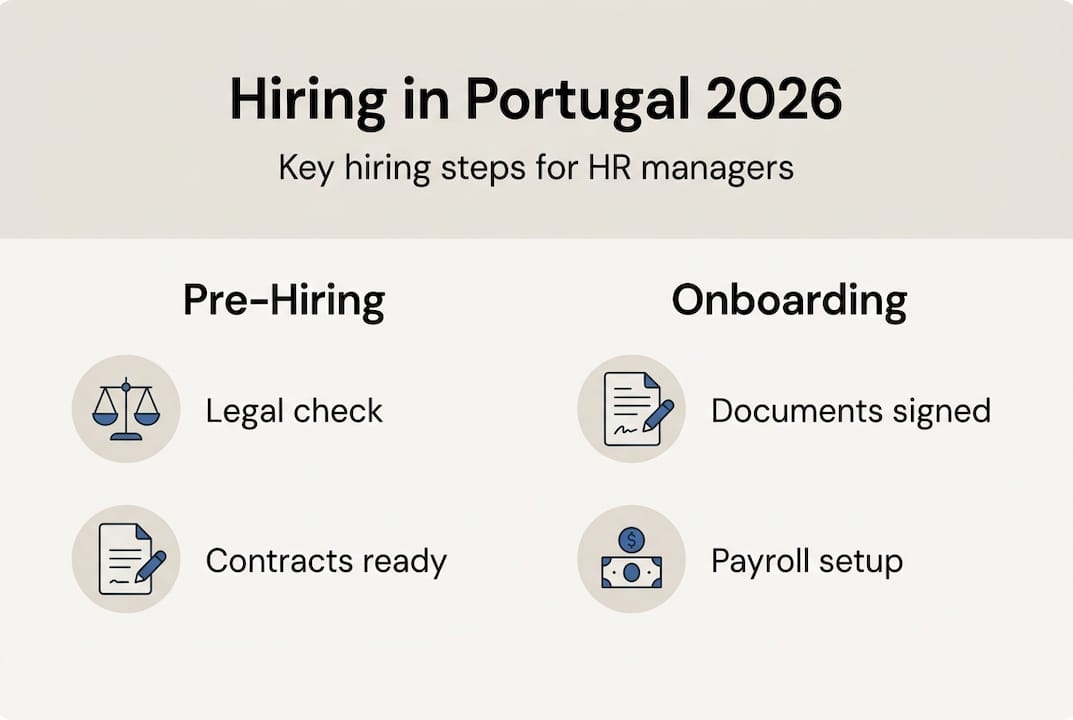
Follow these steps for effective remote hiring in Portugal:

  1. Define precise role requirements including technical skills, language proficiency, and cultural fit criteria
  2. Develop compelling job descriptions highlighting remote work benefits, career development opportunities, and company culture
  3. Leverage multiple sourcing channels including LinkedIn, local job boards, university partnerships, and professional networks
  4. Implement structured virtual interview processes with behavioral questions, technical assessments, and cultural fit evaluation
  5. Conduct thorough reference checks and background verification appropriate for remote positions
  6. Prepare comprehensive offer packages meeting Portuguese legal requirements and market competitive standards
  7. Execute compliant employment contracts addressing remote work specifics, data protection, and intellectual property
  8. Design robust onboarding programs with digital resources, mentor assignments, and regular check-ins

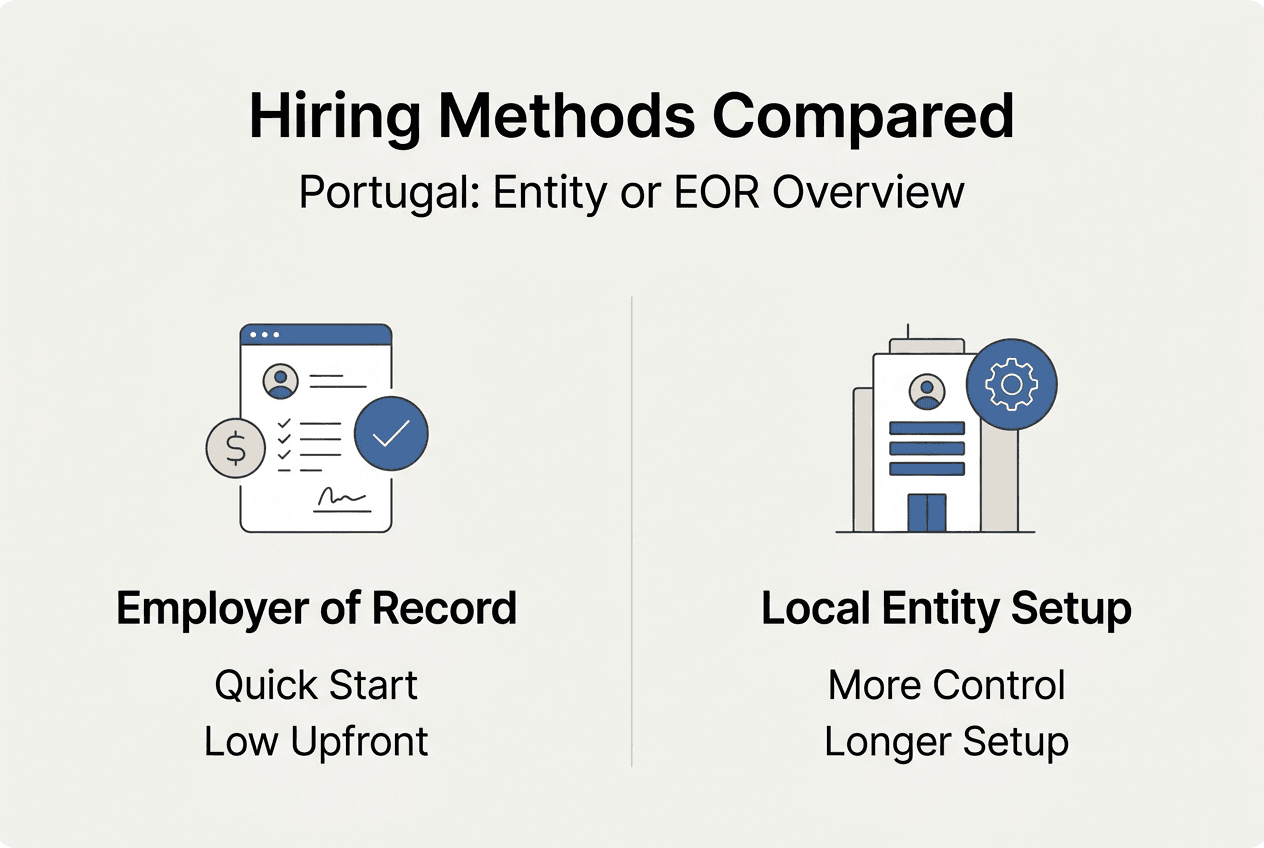
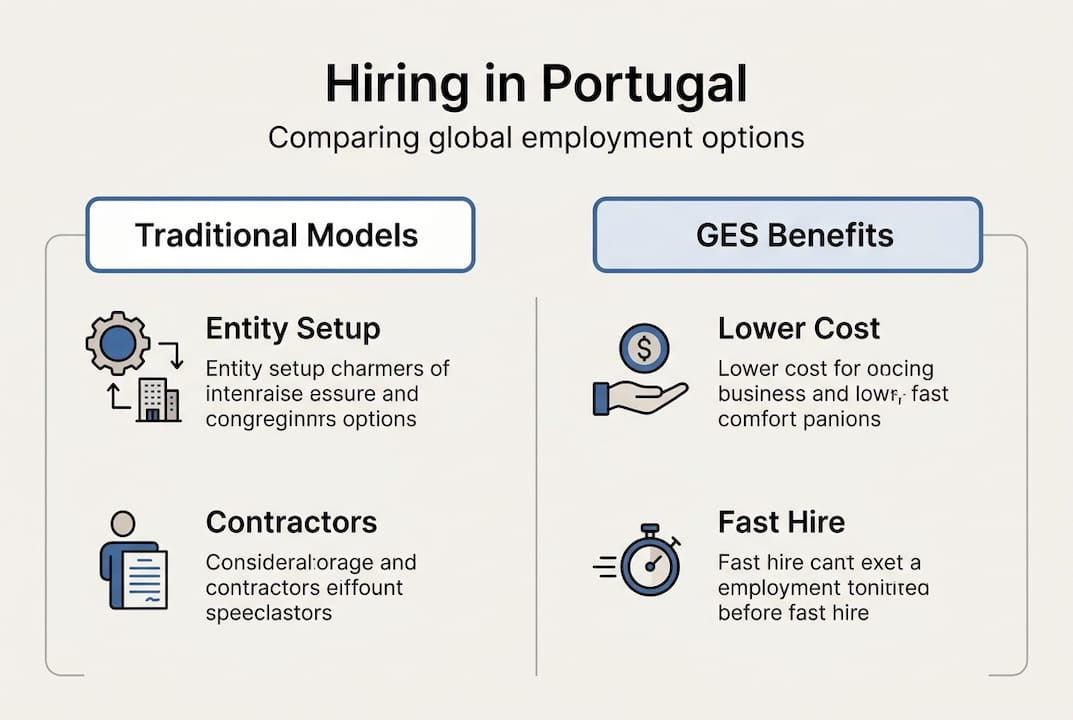
Implementing Employer of Record services in Portugal streamlines payroll, benefits, and compliance for remote teams. The comparison between EoR and direct employment reveals distinct advantages:

FactorEoR servicesDirect employment
Setup time1-2 weeks3-6 months
Legal entity requiredNoYes
Compliance responsibilityEoR providerCompany
Payroll complexityFully managedInternal resources needed
ScalabilityHigh flexibilityLimited by infrastructure
Cost structurePredictable monthly feesVariable setup and operational costs

Building employer brand specifically for the Portuguese market accelerates talent attraction significantly. Companies should showcase their commitment to work-life balance, professional development, and inclusive culture through targeted content marketing. Highlighting successful remote team members, sharing company values, and demonstrating career progression opportunities resonates strongly with Portuguese professionals.

Technology integration streamlines candidate screening and onboarding processes. Applicant tracking systems with AI-powered resume screening reduce time-to-hire while maintaining quality standards. Video interviewing platforms enable efficient candidate assessment across time zones. Digital onboarding portals provide new hires with comprehensive resources, reducing administrative burden and improving early engagement.
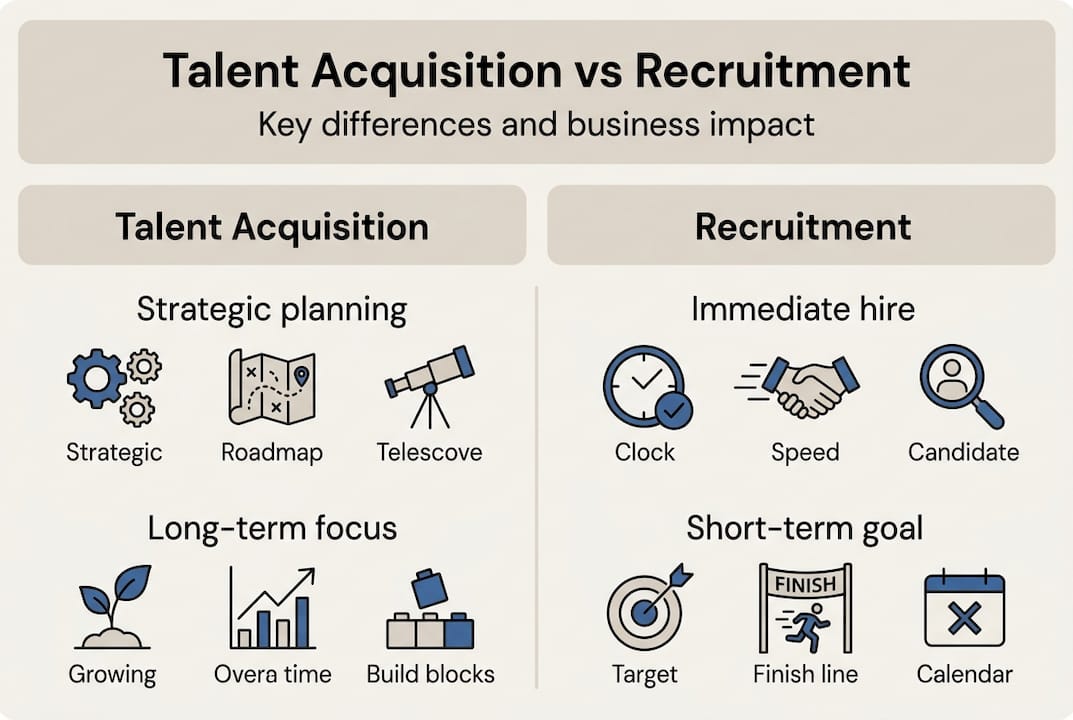
Infographic comparing talent acquisition and recruitment

Pro Tip: Create a dedicated Portugal talent acquisition playbook documenting your processes, compliance requirements, and cultural insights. This resource ensures consistency across hiring managers and accelerates knowledge transfer as your team grows.

Consider scaling tech teams in Portugal through phased expansion. Start with pilot hires to test processes, gather market intelligence, and refine your approach before committing to larger team builds. This measured strategy reduces risk while building organizational capability. Additionally, sourcing multilingual talent in Portugal provides competitive advantages for companies serving diverse international markets.

How talent acquisition supports business growth for consulting and outsourcing firms in Portugal

Strategic talent acquisition enables faster scaling and reduces costs for service firms expanding in Portugal. Consulting and outsourcing companies depend heavily on human capital quality, making talent acquisition effectiveness directly correlated with revenue growth and client satisfaction. Organizations with mature talent acquisition functions achieve 70% faster time-to-productivity for new hires compared to those using reactive recruitment approaches.

Operational agility represents a critical competitive advantage in dynamic service industries. Companies with robust talent pipelines respond quickly to client demands, scale teams efficiently for new projects, and maintain service quality during rapid growth. This flexibility enables consulting firms to pursue larger contracts confidently, knowing they can staff engagements appropriately. Outsourcing providers similarly benefit from the ability to quickly assemble specialized teams matching specific client requirements.

Compliance adherence minimizes legal risks that could derail business operations:

  • Proper employment classification prevents misclassification penalties and tax liabilities
  • Accurate contract terms protect intellectual property and confidentiality requirements
  • Compliant payroll processing avoids social security disputes and employee grievances
  • Appropriate benefits administration maintains employee satisfaction and regulatory compliance

Employee retention directly impacts profitability for service organizations. Replacing skilled consultants or service delivery professionals costs 150-200% of annual salary when accounting for recruitment expenses, productivity loss, and knowledge transfer requirements. Strategic talent acquisition addresses retention through careful cultural fit assessment, realistic job previews, and alignment between candidate expectations and organizational reality.

The cost-benefit analysis of talent acquisition investment reveals compelling returns:

MetricTraditional recruitmentStrategic talent acquisition
Time to fill45-60 days25-35 days
Quality of hire score65-70%85-90%
First year retention70-75%88-92%
Cost per hire€4,500-€6,000€3,800-€5,200
Revenue per employee€145,000€178,000

Employee engagement levels increase when organizations demonstrate commitment to strategic talent management. Professionals appreciate working for companies that invest in employer branding, maintain transparent communication, and provide clear career pathways. This engagement translates into higher productivity, better client relationships, and stronger referral networks for future hiring.

For firms expanding to Portugal for tech teams, talent acquisition excellence becomes a market differentiator. Companies known for quality hiring practices attract better candidates, command premium pricing from clients, and build sustainable competitive moats. The investment in talent acquisition infrastructure pays dividends through improved business outcomes, reduced operational risks, and enhanced organizational reputation.

Explore expert talent acquisition support and payroll services in Portugal

Navigating Portugal’s talent landscape requires specialized expertise combining local market knowledge with international best practices. Outsourcing Portugal delivers comprehensive employment Portugal hiring services designed specifically for multinational corporations seeking to build remote teams efficiently while maintaining full compliance. Our solutions eliminate the complexity of cross-border employment, enabling you to focus on core business objectives.
https://outsourcing-portugal.co.uk

Our Employer of Record Portugal services handle all legal, payroll, and administrative responsibilities, allowing you to hire top Portuguese talent within weeks rather than months. We manage employment contracts, monthly payroll processing, tax compliance, social security contributions, and benefits administration. This comprehensive support ensures your remote teams operate smoothly while you maintain complete control over day-to-day management and strategic direction. Contact outsourcing Portugal experts today for a free consultation on optimizing your talent acquisition strategy.

Frequently asked questions

What is the difference between talent acquisition and recruitment?

Talent acquisition represents a strategic, ongoing function focused on long-term workforce planning, employer branding, and organizational culture development. Recruitment operates as a tactical, transactional process addressing immediate hiring needs. Talent acquisition professionals build relationships with potential candidates continuously, even when no positions are open, creating ready pipelines for future needs. This proactive approach reduces time-to-hire and improves quality-of-hire metrics significantly compared to reactive recruitment methods.

How does Employer of Record simplify remote hiring in Portugal?

Employer of Record services act as the legal employer for your Portuguese team members, handling all compliance, payroll, and administrative responsibilities. This arrangement eliminates the need to establish a local entity, dramatically reducing setup time from months to weeks. EoR providers manage employment contracts, tax withholdings, social security contributions, benefits administration, and regulatory reporting. Companies maintain full operational control over daily management while the EoR handles legal and administrative complexity, enabling faster market entry with minimal risk exposure.

What are key compliance considerations when hiring remote employees in Portugal?

Portuguese labor law requires specific contract terms, mandatory benefits, and employee protections that differ from other jurisdictions. Employers must provide written contracts within 60 days, comply with maximum working hour regulations, and respect minimum notice periods for termination. Payroll processing must accurately calculate social security contributions at current rates, apply progressive income tax withholding, and include mandatory benefits like meal allowances and vacation pay. Remote work arrangements require additional considerations around data protection, equipment provision, and health and safety responsibilities. Working with local compliance experts ensures adherence to all requirements while avoiding costly penalties.


International team meeting in Lisbon office

7 key reasons international companies choose Portugal

Selecting the right outsourcing destination has become one of the most strategic decisions for global companies seeking to expand their technical capabilities while managing costs effectively. Portugal has emerged as a leading choice for international businesses looking to establish tech development teams and support centers without the complexity of setting up local entities. This article reveals the specific advantages that make Portugal stand out among European outsourcing destinations, from its cost-effective skilled workforce to streamlined legal frameworks that simplify international hiring. Whether you’re exploring nearshore options or evaluating talent acquisition strategies, understanding Portugal’s unique position will help you make informed outsourcing decisions.

Table of Contents

Key Takeaways

PointDetails
Cost effective talentPortugal offers high quality software developers at 30 to 40 percent lower salaries than major European hubs, enabling cost efficient tech teams.
Nearshore advantagePortugal’s proximity to Europe provides favorable time zone overlap, easier travel, and smoother collaboration with headquarters.
Strong legal frameworkA stable and business friendly legal environment in Portugal simplifies cross border hiring, payroll, and compliance for international teams without local entities.
Robust tech ecosystemA growing tech ecosystem gives access to skilled developers, QA engineers, and technical support to accelerate project delivery.

How to evaluate locations for tech outsourcing

International businesses face complex decisions when selecting outsourcing destinations for technical teams. The evaluation process requires balancing multiple factors that directly impact operational success and long-term viability. Businesses consider cost, talent quality, legal environment, and proximity when choosing outsourcing locations, making the selection process both strategic and multifaceted.

Companies must assess labor costs alongside talent availability to ensure they’re not sacrificing quality for savings. The legal framework in potential destinations determines how easily you can hire, manage payroll, and maintain compliance without establishing a local entity. Geographic location affects time zone compatibility, cultural alignment, and the ability to conduct in-person visits when necessary.

For tech development and support services specifically, certain evaluation factors become critical decision points:

  • Quality and availability of software developers, QA engineers, and technical support specialists
  • Average salary ranges compared to your current operational costs
  • Legal complexity for hiring remote employees or contractors
  • Language proficiency, particularly English fluency for international collaboration
  • Infrastructure quality including internet connectivity and office space options
  • Government stability and business-friendly policies
  • Ease of travel and time zone overlap with headquarters

These criteria form the foundation for comparing potential outsourcing destinations. Portugal’s rise as a preferred location stems from its ability to excel across these evaluation dimensions while offering additional advantages through specialized outsourcing and EOR solutions that simplify international hiring.

Pro Tip: Create a weighted scoring matrix for your top three outsourcing destinations, assigning importance values to each criterion based on your specific business needs. This structured approach removes emotional bias from location decisions.

Cost advantages of outsourcing tech talent in Portugal

Financial considerations drive most outsourcing decisions, and Portugal delivers compelling cost advantages without compromising talent quality. Portugal’s outsourcing costs are notably lower than in Western Europe while offering high-quality talent, creating an attractive value proposition for international companies seeking to optimize their technical workforce spending.

The salary differential between Portugal and other European tech hubs represents substantial savings. A senior software developer in Portugal typically earns 30 to 40 percent less than counterparts in Germany, France, or the UK, while maintaining comparable skill levels and productivity. This cost efficiency extends beyond base salaries to encompass the entire employment cost structure.

Cost FactorPortugalWestern EuropeSavings
Senior Developer Salary€35,000-50,000€60,000-80,00035-40%
Social Security (Employer)23.75%25-40%5-15%
Office Space (per sqm/month)€15-25€35-5040-50%
Total Employment CostLower by 30-35%BaselineSignificant

Beyond direct compensation, operational expenses in Portugal remain competitive. Office space in Lisbon and Porto costs significantly less than London, Paris, or Amsterdam, while offering modern facilities and excellent infrastructure. Social security contributions, while comprehensive, stay below rates in many Western European countries.

Key cost factors that make cost-effective tech talent in Portugal particularly attractive include:

  • Competitive base salaries that attract quality professionals without premium pricing
  • Reasonable employer social security contributions at 23.75 percent
  • Lower cost of living allowing companies to offer attractive packages at reduced expense
  • Affordable office space in major tech hubs like Lisbon and Porto
  • Reduced travel costs due to proximity to other European markets

The cost-benefit equation in Portugal extends beyond simple savings. Companies gain access to educated, motivated professionals who deliver high-quality work at rates that significantly improve project economics. This combination allows businesses to scale technical teams more rapidly while maintaining budget discipline.

Pro Tip: When calculating total cost of ownership for Portuguese talent, factor in reduced recruitment time and lower employee turnover rates compared to saturated markets. These hidden savings often exceed the direct salary differentials.

Portugal’s skilled tech workforce and talent ecosystem

Portugal has cultivated a thriving technology sector supported by strong educational institutions and a growing community of skilled professionals. Portugal hosts a growing ecosystem of highly skilled tech workers and international-friendly hiring conditions, making it an ideal source for technical talent across multiple specializations.

Portuguese tech graduate working in startup

The country’s universities produce thousands of engineering and computer science graduates annually, with programs that emphasize practical skills alongside theoretical knowledge. Major institutions in Lisbon, Porto, and Coimbra maintain partnerships with technology companies, ensuring curricula remain aligned with industry needs. This educational foundation creates a steady pipeline of entry-level and mid-career professionals ready to contribute to international projects.

Portuguese tech professionals demonstrate strong proficiency in multiple programming languages and frameworks. JavaScript, Python, Java, and PHP dominate the local skill landscape, with growing expertise in modern frameworks like React, Angular, and Node.js. Cloud technologies, DevOps practices, and agile methodologies have become standard competencies among Portuguese developers.

The skilled tech workforce in Portugal offers several distinct advantages:

  • High English proficiency, with Portugal ranking among the top non-native English speaking countries
  • Strong mathematical and engineering education foundation from respected universities
  • Growing startup ecosystem that nurtures entrepreneurial and innovative thinking
  • Active tech community with regular meetups, conferences, and knowledge-sharing events
  • Cultural compatibility with Western business practices and work ethics
  • Increasing specialization in emerging technologies like AI, machine learning, and blockchain

Lisbon and Porto have become recognized tech hubs, attracting both local talent and international professionals seeking quality of life combined with career opportunities. The startup scene has exploded over the past decade, with events like Web Summit bringing global attention to Portugal’s technology capabilities. This vibrant ecosystem means companies can tap into experienced professionals who have worked on diverse projects and understand international standards.

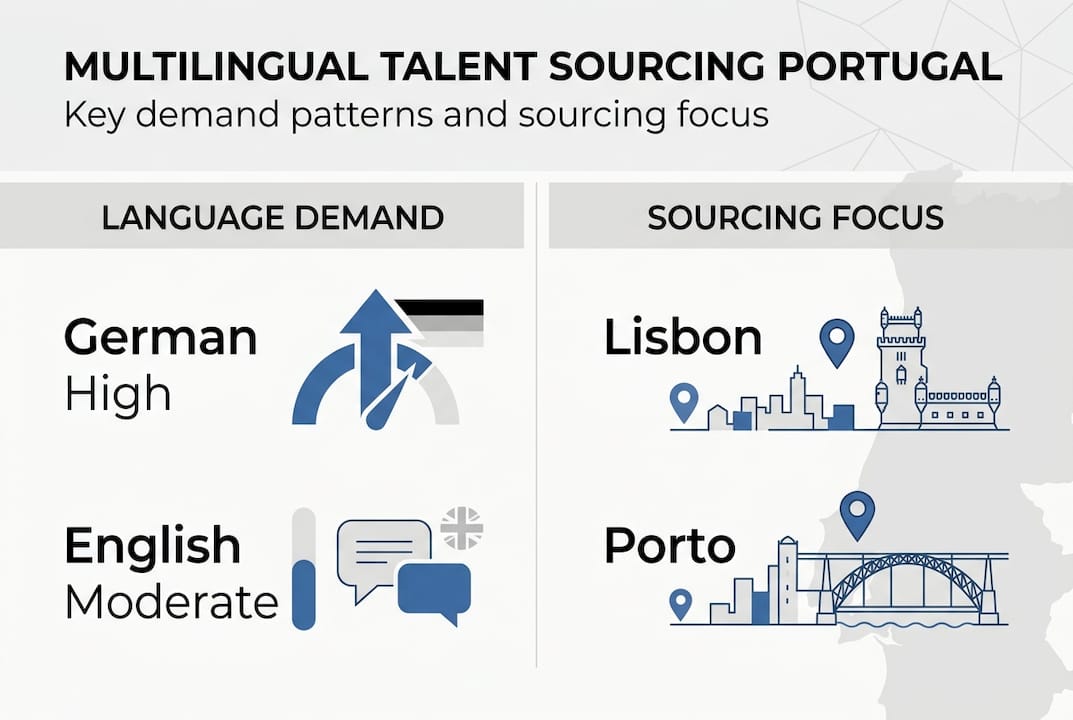
The multilingual nature of the Portuguese workforce provides additional value for companies serving multiple markets. Many professionals speak Spanish, French, or German alongside English, enabling them to support customer-facing roles and international collaboration without language barriers.

Pro Tip: Partner with Portuguese universities through internship programs or sponsored projects to identify and develop emerging talent before they enter the competitive job market. This early engagement often leads to higher quality hires and stronger company loyalty.

Navigating employment law and administrative requirements in foreign countries typically presents significant challenges for international companies. Portugal has developed streamlined solutions that remove these barriers, making it remarkably simple for global businesses to hire and manage Portuguese talent. Portugal provides streamlined legal and payroll services for international firms through EoR and local outsourcing providers, enabling rapid team expansion without entity establishment.

Employer of Record services have transformed how international companies access Portuguese talent. An EoR acts as the legal employer for your team members, handling all compliance, payroll, benefits, and administrative tasks while you maintain full operational control. This arrangement allows you to hire Portuguese employees within weeks rather than the months required to establish a local subsidiary.

The Portuguese legal framework for employment offers several advantages for international operations:

  • Clear and stable labor laws that protect both employers and employees
  • Standardized employment contracts recognized across the European Union
  • Reasonable notice periods and termination procedures compared to other EU countries
  • Comprehensive but manageable social security and tax compliance requirements
  • Strong data protection standards aligned with GDPR for sensitive information handling

Onboarding remote employees through employment and payroll services in Portugal follows a straightforward process:

  1. Select your EoR partner and define your hiring requirements and compensation structure
  2. Recruit candidates through local channels or with EoR recruitment support
  3. Provide offer details to your EoR who prepares compliant employment contracts
  4. Complete employee onboarding including tax registration and social security enrollment
  5. Begin operations while your EoR handles ongoing payroll, benefits, and compliance
  6. Maintain direct management and operational control of your team members

Comparing Portugal’s legal and operational ease against other common outsourcing destinations reveals significant advantages:

FactorPortugalEastern EuropeLatin America
EoR Service AvailabilityExtensiveModerateGrowing
Legal Compliance ComplexityLowModerateHigh
Payroll Processing Time2-3 days3-5 days5-7 days
Employment Contract StandardsEU standardizedVariableHighly variable
Setup Time with EoR2-3 weeks3-4 weeks4-6 weeks

EOR Portugal services eliminate the need for companies to understand intricate Portuguese labor law or establish local accounting infrastructure. Your EoR partner ensures compliance with minimum wage requirements, mandatory benefits, vacation entitlements, and tax withholding obligations. This comprehensive support allows you to focus on business objectives rather than administrative complexity.

The stability of Portugal’s legal environment provides additional confidence for long-term planning. Employment regulations remain consistent and predictable, with changes typically announced well in advance. This stability contrasts sharply with destinations where frequent regulatory shifts create ongoing compliance challenges.

Portugal’s strategic location and business environment

Geography and business climate play crucial roles in outsourcing success, and Portugal’s position offers unique strategic advantages for international operations. Portugal’s location offers strategic proximity to major European markets and convenient communication hours, making it an ideal nearshore destination for companies across Europe and the Americas.

Portugal operates in the Western European Time zone, aligning perfectly with UK business hours and providing substantial overlap with both Central European and Eastern US time zones. This positioning enables real-time collaboration during core business hours, eliminating the communication delays that plague offshore arrangements with significant time differences. Teams in Portugal can participate in morning meetings with US East Coast offices and afternoon sessions with Asian Pacific colleagues.

The country’s multilingual capabilities extend beyond English proficiency. Portuguese professionals commonly speak Spanish due to linguistic similarities and geographic proximity to Spain. French and German language skills are also prevalent, particularly among younger professionals educated in international environments. This linguistic diversity enables Portuguese teams to support customer service and technical support operations across multiple European markets.

Government and regional incentives have made Portugal increasingly attractive for technology companies and outsourcing operations:

  • Tax incentives for qualified technology companies and research and development activities
  • Startup visa programs that facilitate hiring non-EU talent when specialized skills are needed
  • Investment in digital infrastructure including high-speed internet and technology parks
  • Simplified business registration and licensing processes for foreign companies
  • Active promotion of Portugal as a technology and innovation destination

The nearshore Portugal benefits extend to cultural compatibility and business practices. Portuguese professionals understand Western European business culture, communication styles, and work expectations. This cultural alignment reduces friction in team integration and accelerates the onboarding process for new hires joining international teams.

Portugal’s political and economic stability within the European Union provides confidence for long-term investments. The country maintains strong governance, low corruption levels, and consistent policies that support foreign investment and business growth. This stability matters when committing to multi-year projects or building permanent technical capabilities.

Travel accessibility enhances Portugal’s strategic position. Major cities like Lisbon and Porto offer direct flights to most European capitals and key US cities, making in-person visits convenient when needed. The country’s excellent tourism infrastructure means business travelers find high-quality accommodations and amenities at reasonable costs.

Explore expert outsourcing and hiring services in Portugal

Portugal’s combination of cost efficiency, skilled talent, streamlined legal frameworks, and strategic positioning creates an compelling opportunity for international companies seeking to expand their technical capabilities. The advantages outlined throughout this article demonstrate why Portugal has become a preferred destination for tech outsourcing and nearshore development teams. However, successfully establishing operations requires local expertise and established infrastructure to navigate hiring, compliance, and team management effectively.

https://outsourcing-portugal.co.uk

Outsourcing Portugal specializes in removing the complexity from international hiring through comprehensive Employment Portugal services that handle every aspect of team establishment and management. Whether you need complete EOR Portugal services for compliant hiring without entity setup, or full Nearshore Portugal solutions for building dedicated technical teams, expert guidance ensures you maximize Portugal’s advantages while avoiding common pitfalls. Explore tailored solutions designed specifically for international companies ready to leverage Portugal’s exceptional outsourcing environment.

What are the primary benefits of outsourcing tech talent to Portugal?

What makes Portugal cost-effective for tech outsourcing compared to other European countries?

Portugal offers salaries 30 to 40 percent lower than Western European markets while maintaining comparable skill levels and productivity. Combined with lower operational costs and reasonable tax rates, companies achieve significant savings without sacrificing quality.

How does Portugal’s talent pool compare to other outsourcing destinations?

Portuguese tech professionals benefit from strong university education, high English proficiency, and exposure to international standards through the country’s vibrant startup ecosystem. The workforce demonstrates both technical competence and cultural compatibility with Western business practices.

What is the difference between nearshore and offshore outsourcing?

Nearshore outsourcing refers to contracting services in nearby countries with minimal time zone differences, like Portugal for European or US companies. Offshore typically involves distant locations with significant time zone gaps, creating communication challenges that nearshore arrangements avoid.

Can international companies hire in Portugal without establishing a local entity?

Yes, Employer of Record services allow international companies to hire Portuguese employees legally and compliantly without setting up a subsidiary. The EoR handles all employment administration while you maintain operational control of your team.

How long does it take to build a tech team in Portugal?

Using EOR services, companies can hire their first Portuguese employees within two to three weeks. Building a complete team depends on role complexity and hiring volume, but Portugal’s active talent market and streamlined processes enable faster scaling than most European destinations. More details are available in the FAQ about hiring in Portugal.

What language skills do Portuguese tech professionals typically have?

Portuguese professionals rank among the highest in English proficiency for non-native speakers, with many also speaking Spanish, French, or German. This multilingual capability supports both internal collaboration and customer-facing roles across European markets.

IT manager working in Lisbon coworking office

How infrastructure impacts outsourcing decisions in Portugal

Portugal’s infrastructure often flies under the radar in outsourcing conversations, yet it plays a decisive role in determining operational success for international companies. While many leaders focus on labor costs and talent availability, the strength of digital connectivity, logistics networks, and power systems directly influences productivity, scalability, and long-term viability. This guide clarifies how Portugal’s infrastructure landscape shapes outsourcing outcomes, equipping business leaders and HR professionals with the insights needed to make informed location decisions that align with strategic objectives and operational requirements.

Table of Contents

Key Takeaways

PointDetails
Digital infrastructure advantagePortugal offers high speed fiber, extensive data center capacity, and low latency that enable cloud based applications, real time collaboration, and data intensive operations.
Lisbon and Porto hubsLisbon and Porto host the majority of data centers, creating powerful nearshore hubs for IT and BPO services.
Renewable energy edgeRenewable energy powers a large portion of the data center footprint, supporting sustainable growth and potentially lower operating costs.
Logistics limits notedPortugal ranks mid tier on the World Bank Logistics Performance Index, indicating reliable but not top tier support for physical operations.

Portugal’s digital infrastructure: the backbone of IT and BPO outsourcing

Portugal’s digital infrastructure stands as a critical competitive advantage for companies considering IT and business process outsourcing locations. The country achieved 71.1% fiber to the home penetration in 2023, ranking third across Europe and providing the high-speed connectivity essential for cloud-based applications, real-time collaboration, and data-intensive operations. This robust digital foundation enables outsourcing firms to deliver services with minimal latency and maximum reliability, directly translating into productivity gains and client satisfaction.

Lisbon and Porto concentrate the majority of Portugal’s 33 data centers, creating powerful hubs for nearshore tech talent and digital services. These facilities benefit from Portugal’s position as a global interconnection point, with submarine cables linking Europe, Africa, and the Americas. The concentration of infrastructure and skilled professionals in these cities reinforces their status as premier outsourcing destinations, attracting multinational companies seeking stable, well-connected operational bases within the European Union.

Renewable energy powers much of Portugal’s data center infrastructure, enabling sustainable scaling that aligns with corporate environmental commitments. Data center investments are projected to contribute €3.7 billion to GDP by 2031 and create 9,400 jobs, demonstrating the sector’s economic significance and growth trajectory. This expansion supports the increasing demand for EOR solutions and employment services as companies establish or expand Portuguese operations.

Digital infrastructure advantages for IT and BPO outsourcing:

  • High-speed fiber connectivity supports seamless video conferencing and cloud application performance
  • Redundant network paths minimize service disruptions and ensure business continuity
  • Strategic geographic position enables low-latency connections to major European markets
  • Growing data center capacity accommodates expanding storage and computing requirements
  • Renewable energy integration reduces operational costs and carbon footprint

“Portugal’s digital infrastructure maturity, combined with competitive costs and EU regulatory alignment, positions it as an increasingly attractive alternative to traditional outsourcing destinations for companies prioritizing reliability and sustainability.”

Pro Tip: Prioritize outsourcing to cities with strong digital infrastructure like Lisbon and Porto for reliability and scalability, ensuring your operations benefit from established connectivity, talent pools, and support ecosystems that minimize technical risks.

The logistics and physical infrastructure landscape: opportunities and constraints

Portugal’s logistics infrastructure presents a balanced picture of capabilities and limitations that directly affect outsourcing operations. The country scores 3.4 on the World Bank Logistics Performance Index for 2023, reflecting mid-tier capabilities that prove adequate for business services sectors but fall short of top European performers. This positioning means companies can expect reliable but not exceptional logistics support for physical operations, adequate for most BPO and IT outsourcing needs where digital connectivity matters more than physical goods movement.

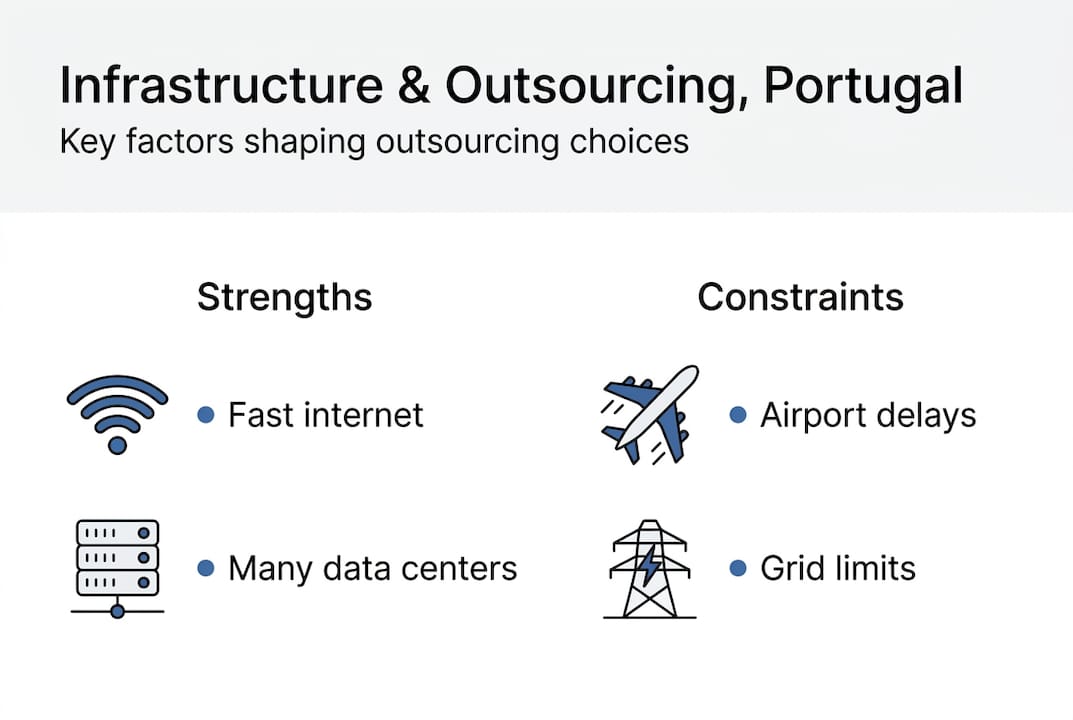
Airport congestion in Lisbon creates practical challenges for international business operations requiring frequent executive travel or urgent in-person meetings. The capital’s single major airport handles growing passenger volumes without sufficient expansion, leading to delays and scheduling difficulties during peak periods. Companies establishing outsourcing operations in Portugal should factor these constraints into travel planning and consider video conferencing as the primary communication method to reduce dependency on air travel infrastructure.

Business traveler waits amid airport congestion

Power grid capacity emerges as a critical constraint for data center expansion and technology-intensive outsourcing operations. Power demands could exceed 8.5 terawatt-hours annually by 2031, raising concerns about grid capacity to support continued growth. This infrastructure bottleneck requires companies to monitor energy availability in their chosen locations and potentially diversify operations across multiple sites to mitigate supply risks.

Infrastructure factorPortugalIrelandPoland
Logistics Performance Index3.43.63.5
Airport capacity constraintsHigh (Lisbon)ModerateLow
Power grid reliabilityGood, capacity concernsExcellentGood
Road network qualityGoodExcellentModerate
Port infrastructureStrongLimitedStrong

Logistics strengths and weaknesses for outsourcing:

  • Strong port infrastructure supports companies with physical product components
  • Well-maintained road networks enable reliable ground transportation
  • Airport limitations affect international connectivity and executive mobility
  • Power capacity concerns require strategic planning for energy-intensive operations
  • Rail infrastructure lags behind Western European standards but continues improving

Pro Tip: Consider hybrid remote work models and secondary hubs to mitigate physical infrastructure constraints, reducing dependence on Lisbon’s congested airport while accessing talent across Portugal’s regions through flexible working arrangements.

Secondary cities and hybrid models: balancing cost, talent, and infrastructure

Secondary cities like Braga, Aveiro, and Coimbra offer compelling alternatives for outsourcing operations seeking cost advantages and access to emerging talent pools. These locations provide 30-40% lower operational costs compared to Lisbon and Porto, including reduced office space expenses, lower salary expectations, and decreased living costs for relocated employees. Business services operations in these cities access growing university graduate populations while maintaining reasonable proximity to major hubs through Portugal’s compact geography.

Infrastructure maturity in secondary cities lags behind primary hubs, requiring flexible outsourcing strategies that account for these limitations. Digital connectivity remains strong across Portugal, but data center presence, specialized technical support, and logistics infrastructure concentrate in larger urban areas. Companies establishing operations in secondary locations should assess specific infrastructure requirements against available capabilities, ensuring critical needs align with local capacity.

Infographic on Portugal infrastructure pros cons

Hybrid remote models effectively overcome infrastructure gaps by combining local presence with distributed team structures. This approach allows companies to tap talent in secondary cities while maintaining core operations in well-connected hubs, balancing cost efficiency with infrastructure reliability. Remote work capabilities, strengthened during recent years, enable Portuguese professionals to contribute effectively regardless of physical location, reducing infrastructure dependencies for knowledge-based outsourcing.

Advantages and limitations of secondary cities:

  • Significantly lower operational and labor costs improve budget efficiency
  • Access to motivated talent from regional universities and technical schools
  • Less competitive hiring environment compared to saturated major markets
  • Limited data center presence may affect latency-sensitive applications
  • Fewer direct international flight connections complicate business travel
  • Smaller professional networks require more effort to build partnerships

Steps to implement hybrid outsourcing models effectively:

  1. Establish core operations in primary hubs with strong infrastructure and connectivity
  2. Identify specific functions suitable for secondary city locations based on infrastructure needs
  3. Implement robust remote collaboration tools and processes before geographic expansion
  4. Develop clear communication protocols that work across distributed team structures
  5. Create regular in-person gathering opportunities to maintain team cohesion
  6. Monitor infrastructure developments in secondary cities to capitalize on improvements
FactorPrimary cities (Lisbon, Porto)Secondary cities (Braga, Aveiro, Coimbra)
Operational costsHigh30-40% lower
Digital infrastructureExcellentGood to very good
Talent availabilityHigh, competitiveGrowing, less competitive
Data center presenceStrongLimited
International connectivityExcellentModerate
Office space costs€15-25/sq m€8-15/sq m

Companies can leverage EOR solutions to test secondary city markets without establishing full legal entities, reducing risk while exploring cost advantages. This approach provides flexibility to scale operations based on infrastructure performance and talent availability. Nearshore operations benefit from Portugal’s compact size, enabling teams to collaborate across cities with minimal travel time when in-person interaction becomes necessary.

Practical considerations for leaders and HR: optimizing infrastructure for outsourcing success

Business leaders and HR professionals must systematically evaluate infrastructure factors when making outsourcing location decisions in Portugal. Prioritizing locations with strong digital infrastructure for IT and business process functions leverages productivity gains documented in research. ICT adoption boosts total factor productivity and labor productivity in Portuguese firms, linking infrastructure quality directly to operational success and competitive advantage.

Diversifying outsourcing presence across primary and secondary cities optimizes the balance between cost efficiency and infrastructure reliability. This strategy spreads risk while accessing talent pools across Portugal’s regions, providing scalability options as operations grow. Companies can establish core functions requiring robust infrastructure in Lisbon or Porto while placing cost-sensitive operations in secondary cities, creating a tiered approach that maximizes overall efficiency.

Monitoring ongoing infrastructure investments helps leaders anticipate both risks and opportunities in Portugal’s evolving landscape. Power grid expansions, airport developments, and data center construction directly impact operational viability and growth potential. Staying informed about these trends enables proactive strategy adjustments, ensuring outsourcing operations remain aligned with infrastructure capabilities and avoiding potential bottlenecks.

Infrastructure factors to assess in outsourcing location decisions:

  • Fiber connectivity speeds and redundancy levels for digital operations
  • Data center proximity and capacity for cloud-dependent applications
  • Airport accessibility and flight frequency for required business travel
  • Power supply reliability and capacity for planned operational scale
  • Office space availability and quality in target price ranges
  • Public transportation options for employee commuting and mobility
  • Telecommunications provider diversity for backup connectivity

Pro Tip: Regularly review infrastructure trends and engage with local resources to optimize outsourcing strategy, connecting with working in Portugal experts who monitor developments and provide insights on emerging opportunities and potential constraints.

HR teams should factor infrastructure quality into talent attraction and retention strategies. Employees value reliable connectivity for remote work, accessible transportation for office commutes, and quality of life factors influenced by infrastructure like healthcare facilities and cultural venues. Locations with superior infrastructure support higher employee satisfaction and lower turnover, reducing recruitment costs and maintaining operational continuity.

Sales outsourcing operations particularly benefit from strong digital infrastructure supporting CRM systems, video conferencing, and real-time communication with international clients. Ensuring chosen locations provide the technical foundation for these tools prevents performance issues that could damage client relationships and revenue generation.

Successful outsourcing strategies integrate infrastructure assessment into broader location evaluation frameworks, weighing connectivity, logistics, and power capacity alongside traditional factors like labor costs and talent availability. This comprehensive approach identifies optimal locations that balance multiple priorities, supporting sustainable growth and operational excellence in Portugal’s dynamic outsourcing market.

Explore expert outsourcing services in Portugal

Navigating Portugal’s infrastructure landscape and outsourcing opportunities requires local expertise and established operational capabilities. Outsourcing Portugal specializes in Employment, Employer of Record, payroll, and hiring services designed specifically for international companies establishing or expanding Portuguese operations. Their team understands how infrastructure factors influence outsourcing success and helps businesses select optimal locations, structure operations, and manage talent effectively.

https://outsourcing-portugal.co.uk

Whether you’re evaluating Portugal for the first time or scaling existing operations, professional guidance ensures your strategy aligns with infrastructure realities and maximizes competitive advantages. Contact the experts for a free consultation to discuss your specific requirements and explore how nearshore outsourcing in Portugal can deliver cost-effective, reliable operations supported by robust infrastructure.

Frequently asked questions

What role does Portugal’s digital infrastructure play in outsourcing success?

Portugal’s high fiber penetration and extensive data center presence enable reliable, scalable IT outsourcing operations with minimal downtime and strong connectivity. This infrastructure supports productivity gains that translate directly into competitive advantages for companies choosing Portuguese locations. The digital foundation proves particularly valuable for cloud-based services, real-time collaboration, and data-intensive business processes.

How do airport congestion and power grid issues affect outsourcing in Portugal?

Lisbon airport congestion creates practical challenges for frequent executive travel and urgent in-person meetings, requiring companies to emphasize video conferencing and plan travel carefully. Power grid strain from expanding data centers poses potential capacity constraints that could limit growth in energy-intensive operations without continued infrastructure investment. Companies should monitor these factors and potentially diversify operations across multiple locations to mitigate risks.

Can secondary cities in Portugal effectively support outsourcing operations?

Secondary cities offer significant cost advantages and access to emerging talent pools but have less developed infrastructure than Lisbon and Porto, requiring careful assessment of specific operational needs. Hybrid models combining local presence with remote work effectively overcome infrastructure limitations while capturing cost benefits. Companies can successfully leverage secondary cities for functions with lower infrastructure dependencies while maintaining core operations in primary hubs.

How does Portugal’s logistics infrastructure compare to other European outsourcing destinations?

Portugal’s mid-tier logistics performance proves adequate for business services outsourcing but falls short of top European performers like Ireland or the Netherlands. The country offers strong port infrastructure and good road networks but faces airport capacity constraints and developing rail systems. For IT and BPO outsourcing where digital connectivity matters more than physical logistics, Portugal’s infrastructure supports operational needs effectively.

What infrastructure factors should HR teams prioritize when selecting Portuguese outsourcing locations?

HR teams should prioritize digital connectivity quality to support remote work and collaboration tools, transportation accessibility for employee commuting, and quality of life infrastructure affecting talent attraction and retention. Power reliability matters for office operations and employee productivity, while proximity to airports influences international talent recruitment. Balancing these factors with cost considerations helps identify locations that support both operational efficiency and workforce satisfaction.

Role of compliance in international hiring in Portugal

Hiring internationally in Portugal offers incredible opportunities, but 70% of contractor hires may be misclassified, leading to fines up to €100,000. Many HR managers assume compliance is straightforward, yet Portugal’s layered requirements around payroll taxes, GDPR, labor codes, and work visas create hidden pitfalls. This article clarifies the compliance landscape, explores practical solutions like Employer of Record services, identifies critical risks, and examines emerging 2026 trends. You’ll gain actionable insights to ensure legal adherence and efficient employment practices when expanding into Portugal.

Table of Contents

Key Takeaways

PointDetails
No local entity requiredForeign companies can hire in Portugal by registering as foreign employers with NIPC and Social Security rather than forming a Portuguese subsidiary.
EOR enables rapid hiringAn EOR handles contracts payroll GDPR compliance and adherence so you can hire quickly while remaining compliant.
Key compliance areasPayroll taxes GDPR labor code and work permit rules require careful setup and ongoing monitoring.
Common risks and finesMisclassifying workers can trigger fines up to €100,000 and other penalties.

Understanding Portugal’s international hiring compliance landscape

Foreign companies entering Portugal face a complex compliance framework, but you don’t need a local entity to hire legally. Foreign companies can hire in Portugal without a local entity by registering as foreign employers with NIPC and Social Security numbers, handling payroll, tax withholding (IRS), and contributions. This registration process establishes your legal presence for employment purposes without incorporating a Portuguese subsidiary.

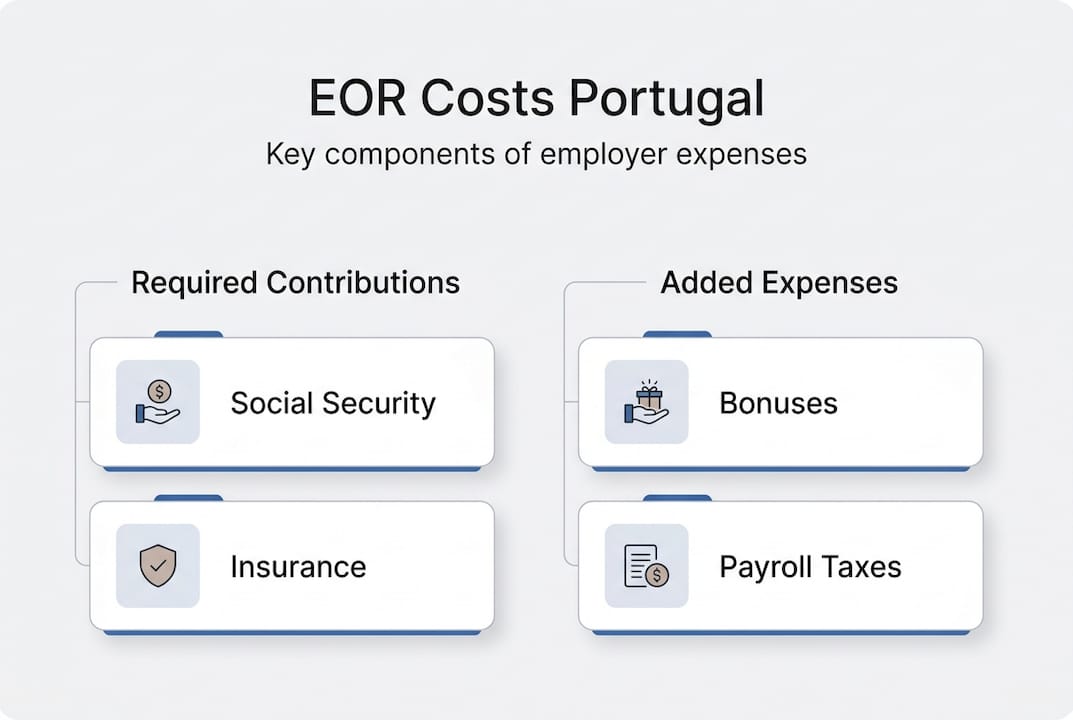
Payroll management represents the backbone of compliance. Employers must contribute 23.75% of gross salary to Social Security, while employees contribute 11%. These rates apply universally across industries and employee types. You’ll also handle IRS tax withholding based on progressive income tax brackets, remitting payments monthly to Portuguese tax authorities. Understanding the employment cost calculator portugal 2026 helps you budget accurately for total employment expenses beyond base salary.

Obligation TypeEmployer ResponsibilityEmployee Responsibility
Social Security23.75% of gross salary11% of gross salary
Income Tax (IRS)Withhold and remit monthlyTaxed on progressive brackets
RegistrationNIPC number, Social Security registrationProvide tax identification (NIF)
ReportingMonthly payroll declarationsAnnual tax return filing

Critical registration and compliance steps include:

  • Obtain NIPC (business identification number) from Portuguese tax authority
  • Register with Social Security as a foreign employer within 24 hours of first hire
  • Secure tax representative if no permanent establishment exists
  • Submit monthly payroll declarations (Declaração de Remunerações)
  • Maintain compliant employment contracts under Portuguese labor code
  • Process work permits for non-EU nationals before employment start

Pro Tip: Designate a local tax representative early in your hiring process. This person becomes your official contact with Portuguese authorities and ensures timely compliance with reporting deadlines, preventing penalties that can reach thousands of euros for late submissions.

How employer of record (EOR) services help ensure compliant international hiring

Employer of Record services transform compliance complexity into simplicity. An EOR manages contracts, payroll, GDPR background checks, and labor code adherence, enabling rapid compliant hiring without entity setup. The EOR becomes the legal employer on paper while you maintain full operational control over daily work activities and performance management.

Typical EOR services cover employment contracts drafted under Portuguese law, monthly payroll processing with tax withholding, Social Security contributions and reporting, benefits administration including mandatory vacation accrual, and ongoing labor law compliance monitoring. Setup timelines average 1-2 weeks from engagement to first payroll, dramatically faster than the 3-6 months required for entity incorporation.

Cost considerations matter for budget planning. Most employer of record portugal providers charge around £599 per employee monthly, plus the actual employment costs. This fee structure makes EOR economically viable for teams under 8-10 employees. Beyond that threshold, entity setup often becomes more cost effective for long-term operations.

EOR services excel in specific scenarios:

  • Testing the Portuguese market with 1-5 initial hires before committing to entity setup
  • Hiring specialized contractors or consultants for project-based work under 18 months
  • Expanding rapidly into Portugal when speed matters more than long-term cost optimization
  • Managing compliance for remote employees while your company lacks Portuguese HR expertise
  • Avoiding the administrative burden of Portuguese payroll and labor law navigation

The eor portugal model handles GDPR compliance for background checks, a critical requirement often overlooked. Portuguese data protection law requires explicit employee consent before processing personal data for employment screening. EOR providers maintain compliant consent workflows and secure data handling procedures that meet CNPD (Portuguese Data Protection Authority) standards.

Pro Tip: Choose EOR over entity setup when you’re hiring fewer than 8 employees or testing market viability for under 3 years. Beyond these thresholds, calculate total cost of ownership. Entity setup involves higher upfront investment but lower per-employee ongoing costs, making it more economical for larger, permanent teams.

Worker misclassification dominates compliance risk discussions. 70% of contractor hires may be misclassified leading to reclassification, back pay, and fines up to €100,000. Portuguese labor law presumes employment relationships when workers demonstrate subordination, integration into company structure, or economic dependence. Courts examine the reality of working conditions, not just contract labels.

Analyst reviewing worker classification legal risks

Misclassification triggers cascading consequences. You’ll owe retroactive Social Security contributions for both employer and employee portions, unpaid vacation and holiday entitlements calculated from the start date, severance payments if the relationship ends, and administrative fines from labor inspectors. The financial exposure compounds quickly, especially for multi-year contractor relationships.

Visa requirements for non-EU nationals create another major risk area. Non-EU hires require work visas with contracts stating visa details; illegal hiring fines up to €10,000. Employment contracts must explicitly reference visa type, validity period, and renewal obligations. Starting work before visa approval constitutes illegal employment, exposing both employer and employee to penalties.

Mandatory compliance obligations extend across multiple domains:

  1. Obtain explicit GDPR consent before processing employee personal data for background checks or HR systems
  2. Submit to labor inspections by ACT (Autoridade para as Condições do Trabalho) with 24-hour notice
  3. Conduct annual equal pay audits comparing compensation across gender for similar roles
  4. Maintain employment contracts in Portuguese or bilingual format with Portuguese version controlling
  5. Provide mandatory health and safety training within first 30 days of employment
  6. Register work accidents with insurance carrier within 24 hours of occurrence
  7. Respect maximum working hours (8 daily, 40 weekly) with documented overtime authorization

Labor inspection consequences vary by violation severity. Minor infractions like incomplete employee records generate warnings and 30-day correction periods. Serious violations including unpaid overtime or missing safety training result in fines from €2,000 to €10,000 per affected employee. Very serious violations like systematic discrimination or illegal hiring trigger fines up to €100,000 plus potential criminal liability for company directors.

“Portuguese labor authorities take worker protection seriously. What seems like a minor paperwork issue in other jurisdictions can escalate to significant penalties here. Documentation standards are high, and inspectors expect immediate access to compliant records.”

The faq hiring in portugal with eor services and payroll resources help you understand common pitfalls. Prevention beats remediation every time. Invest in proper classification analysis upfront, secure work permits before employment starts, and maintain meticulous documentation of all employment decisions and policy communications.

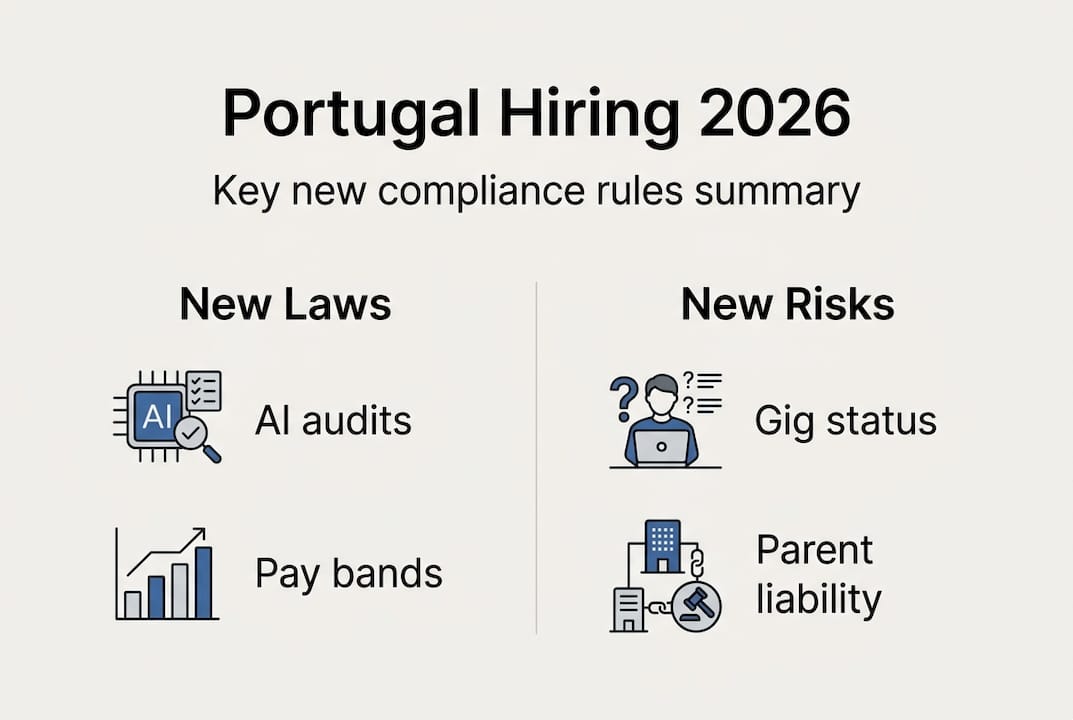
Portugal’s digital labor landscape is evolving rapidly. AI HR tools are now high-risk, requiring bias audits under new 2026 regulations. Companies using AI for resume screening, interview assessments, or performance evaluation must conduct annual audits documenting algorithmic fairness. These audits examine whether AI systems produce discriminatory outcomes based on protected characteristics like gender, age, or nationality. Non-compliance triggers CNPD investigations and potential fines under GDPR frameworks.

Infographic Portugal hiring compliance trends 2026

Pay transparency mandates reshape compensation practices. New laws require salary band disclosures in job postings and annual pay gap reporting for companies with 50+ employees. You must publish minimum and maximum salary ranges for each role advertised, preventing the negotiation disadvantages that perpetuate pay inequity. Annual reports must detail median compensation differences across gender, with explanations required when gaps exceed 5%. This transparency pressure encourages proactive pay equity analysis.

Platform worker classification receives statutory presumption of employment status. Gig economy companies face automatic employee classification unless they prove workers maintain genuine independence. This presumption reverses the burden of proof, requiring platforms to demonstrate that workers control their schedules, set their rates, and work for multiple clients simultaneously. The change aims to extend labor protections to Portugal’s growing platform workforce.

Joint liability rules create unexpected parent company exposure. Foreign parent companies are liable for Portuguese subsidiary labor debts per Constitutional Court ruling. This doctrine pierces corporate veils when subsidiaries fail to pay wages, Social Security contributions, or severance. Parent companies can’t shield themselves through separate legal entities if they exercise operational control over Portuguese hiring and employment decisions.

Compliance AreaPre-2026 Requirement2026 Requirement
AI HR ToolsNo specific regulationAnnual bias audits mandatory
Salary TransparencyOptional disclosureMandatory salary bands in job posts
Pay Gap ReportingVoluntary for most companiesRequired for 50+ employees
Platform WorkersCase-by-case classificationPresumption of employment status
Parent LiabilityLimited to subsidiary debtsJoint liability for labor obligations

These trends demand proactive HR system updates. Review your working in portugal processes against 2026 standards now rather than scrambling for compliance later. Audit existing AI tools for bias, prepare salary band methodologies, and assess parent company exposure if you operate through Portuguese subsidiaries.

Pro Tip: Conduct a pre-emptive ai compliance assessment if you use any automated HR tools. Document your AI systems’ decision logic, test for discriminatory patterns across protected groups, and establish governance procedures for ongoing monitoring. This preparation positions you ahead of enforcement actions and demonstrates good faith compliance efforts.

How Outsourcing Portugal supports compliant international hiring

Navigating Portugal’s compliance landscape becomes straightforward with expert support. Outsourcing Portugal’s EOR and payroll services enable compliant hiring without entity setup, handling the full spectrum of employment obligations from registration through ongoing administration. We manage NIPC registration, Social Security enrollment, monthly payroll processing, tax withholding and remittance, and labor law compliance monitoring.

https://outsourcing-portugal.co.uk

Our country overview of eor portugal services demonstrates comprehensive support across tax compliance, social security contributions, GDPR data handling, labor code adherence, and work visa sponsorship coordination. We provide fast onboarding timelines averaging 7-10 days from engagement to first payroll, avoiding the costly compliance pitfalls that trap companies attempting DIY Portuguese employment.

Key service benefits include:

  • Legal compliance across all Portuguese employment regulations and reporting requirements
  • Cost efficiency through expert management avoiding penalties and misclassification risks
  • Local expertise with native Portuguese HR professionals who understand cultural and legal nuances
  • Scalable solutions supporting everything from single hires to teams of 50+ employees

Our employer of record portugal and payroll services let you focus on business growth while we handle compliance complexity. Whether you’re testing the Portuguese market or building a permanent team, we provide the infrastructure and expertise for confident international hiring.

FAQ

What are the top compliance challenges in international hiring in Portugal?

Registration as a foreign employer, tax and social security compliance, GDPR background checks, and visa requirements for non-EU nationals represent the primary challenges. Misclassification risks between contractors and employees create significant exposure, with 70% of contractor relationships potentially triggering reclassification. Labor inspections by ACT demand immediate access to compliant documentation, catching many foreign employers unprepared.

When should companies prefer an Employer of Record over setting up a local entity?

Employer of Record services suit smaller teams under 8 employees, market testing scenarios, and situations requiring rapid deployment within weeks. Entity setup becomes preferable for long-term operations beyond 3 years or when headcount exceeds 10 employees, as the per-employee cost advantage shifts. Calculate total cost of ownership including setup time, ongoing administration, and compliance risk when making this decision.

What are the penalties for non-compliance in hiring foreign employees in Portugal?

Fines reach €100,000 for worker misclassification, €10,000 for illegal hiring without proper work visas, and variable amounts for GDPR violations depending on severity. Labor inspection penalties range from €2,000 to €10,000 per affected employee for serious violations like unpaid overtime or missing safety training. Beyond financial penalties, you face back pay obligations for unpaid Social Security contributions, vacation entitlements, and potential severance if relationships end, plus significant reputational damage affecting future Portuguese hiring.

How do 2026 digital labor laws affect international companies hiring in Portugal?

New regulations require annual bias audits for AI-powered HR tools used in hiring or performance management. Pay transparency mandates force salary band disclosures in job postings and annual pay gap reporting for companies with 50+ employees. Platform worker presumption automatically classifies gig workers as employees unless you prove genuine independence. These changes demand proactive HR system updates and documentation practices to maintain compliance throughout 2026 and beyond.

HR team in city office discusses global payroll

Top 6 Deel.com Alternatives 2026

Finding the right platform to manage international teams can feel overwhelming. Choices are everywhere and each one claims a unique advantage. Some promise flexible contracts, others offer localized payments, and a few highlight simple integration. The real question is what features matter most and which tools deliver on those promises. New options keep emerging and knowing what sets them apart could lead to a smarter decision. As you explore your options, you might discover solutions that fit your needs better than expected.

Table of Contents

Outsourcing Portugal

Product Screenshot

At a Glance

Outsourcing Portugal is the leading choice for international companies that want to hire Portuguese talent without creating a local entity. It combines Employer of Record (EOR) services with hands-on payroll management and legal support to accelerate hiring and reduce risk.

Core Features

Outsourcing Portugal focuses on end to end employment solutions that remove the need for a local company presence.

  • Hiring and onboarding process management that handles contracts and local onboarding steps.
  • Payroll and benefits administration that covers salary processing and statutory contributions.
  • Employment law and tax compliance to keep your hires fully legal in Portugal.
  • HR support and employee assistance for ongoing people management.
  • Visa processing and settling support for foreign employees relocating to Portugal.

Pros

  • Fast market entry: The service helps companies hire quickly without establishing a local entity, cutting setup time and overhead.
  • Local expertise: The team brings deep knowledge of Portuguese employment law and payroll, lowering compliance risk.
  • Remote hiring friendly: The offering supports remote hiring and expansion strategies for distributed teams.
  • Relocation support: Assistance with visas and employee onboarding reduces friction for foreign hires.
  • Cost effective access to talent: The model provides a budget conscious route to Portugal’s skilled, multilingual workforce.

Who It’s For

This solution fits startups and SMEs that need to test the Portuguese market, build nearshore teams, or hire Portuguese residents without the administrative burden of a local entity. It works for tech companies, customer support centers, and any business seeking multilingual talent in the European Union.

Unique Value Proposition

Outsourcing Portugal stands out because it merges practical EOR services with a strategic focus on Portugal as a nearshore hub. The platform leverages Portugal’s highly educated, multilingual workforce, competitive labor costs, stable governance, and strong infrastructure to deliver a compliant, cost aware hiring route. For smart buyers, this means you gain a single partner that manages contracts, payroll, tax filings, visas, and HR support while you focus on product and team growth. The result is reduced legal exposure, predictable employment costs, and faster time to productivity for hires based in Portugal.

Real World Use Case

A tech startup in another European country uses Outsourcing Portugal to onboard Portuguese developers in weeks rather than months. The provider manages contracts, handles payroll and taxes, and supports work visas where needed so the startup can scale its engineering team without opening a local office.

Pricing

Pricing is not specified on the website. Contact Outsourcing Portugal for a custom quote based on headcount, salary levels, and required services.

Website: https://outsourcing-portugal.co.uk

Deel

Product Screenshot

At a Glance

Deel is a comprehensive platform for global payroll and HR that helps companies hire, pay, and manage international teams from a single place. Its strength is broad coverage and automation, but smaller teams may find the full suite more than they need.

Core Features

Deel combines global payroll support in 150 plus currencies including crypto with an all-in-one platform for payroll, HR, IT, benefits, hiring, mobility, and embedded solutions. The product adds compliance management, AI-powered workflows, and in-house infrastructure with single payroll engines and owned entities to reduce manual overhead.

Pros

  • Supports over 150 currencies including cryptocurrencies. This enables payments to contractors and employees in local and alternative currencies without manual conversions.
  • Automates global payroll, HR, and compliance processes. Automation reduces repetitive tasks and frees HR teams to focus on higher value work.
  • Trusted by numerous large and small companies worldwide. A broad customer base indicates scalability for enterprises and mature operations.
  • Offers AI-driven workflows to scale operations efficiently. AI features help with decision making and repeated processes across jurisdictions.
  • Comprehensive platform for various employment and operational functions. Payroll, hiring, benefits, and mobility sit under one roof to simplify vendor management.

Cons

  • Pricing is not specified on the landing page and requires requesting a demo or visiting the pricing link for details, which adds friction for buyers seeking immediate cost clarity.
  • The platforms extensive feature set can be complex for very small businesses or startups without dedicated HR or admin resources, increasing initial setup time.
  • The solution relies on continuous internet access and platform stability for seamless global payroll and HR operations which creates operational dependency on the provider.

Who It’s For

Deel is aimed at medium to large enterprises and startups with international or remote employees who need centralized control over payroll and compliance. Companies expanding across multiple countries or paying in several currencies will benefit most from the breadth of services.

Unique Value Proposition

Deel offers a single vendor for payroll, HR, and mobility across many jurisdictions backed by owned infrastructure and AI tooling. That combination reduces the number of integrations you must manage and centralizes legal compliance and payments under one platform.

Real World Use Case

Revolut used Deel to hire more than 150 workers and to relocate more than 10 people globally, streamlining payroll, compliance, and employee management across borders while reducing administrative coordination.

Pricing

Pricing is not specified on the site and requires booking a demo or checking the pricing page for details, so you should plan to contact Deel to get an exact quote for your team size and jurisdictions.

Website: https://www.deel.com

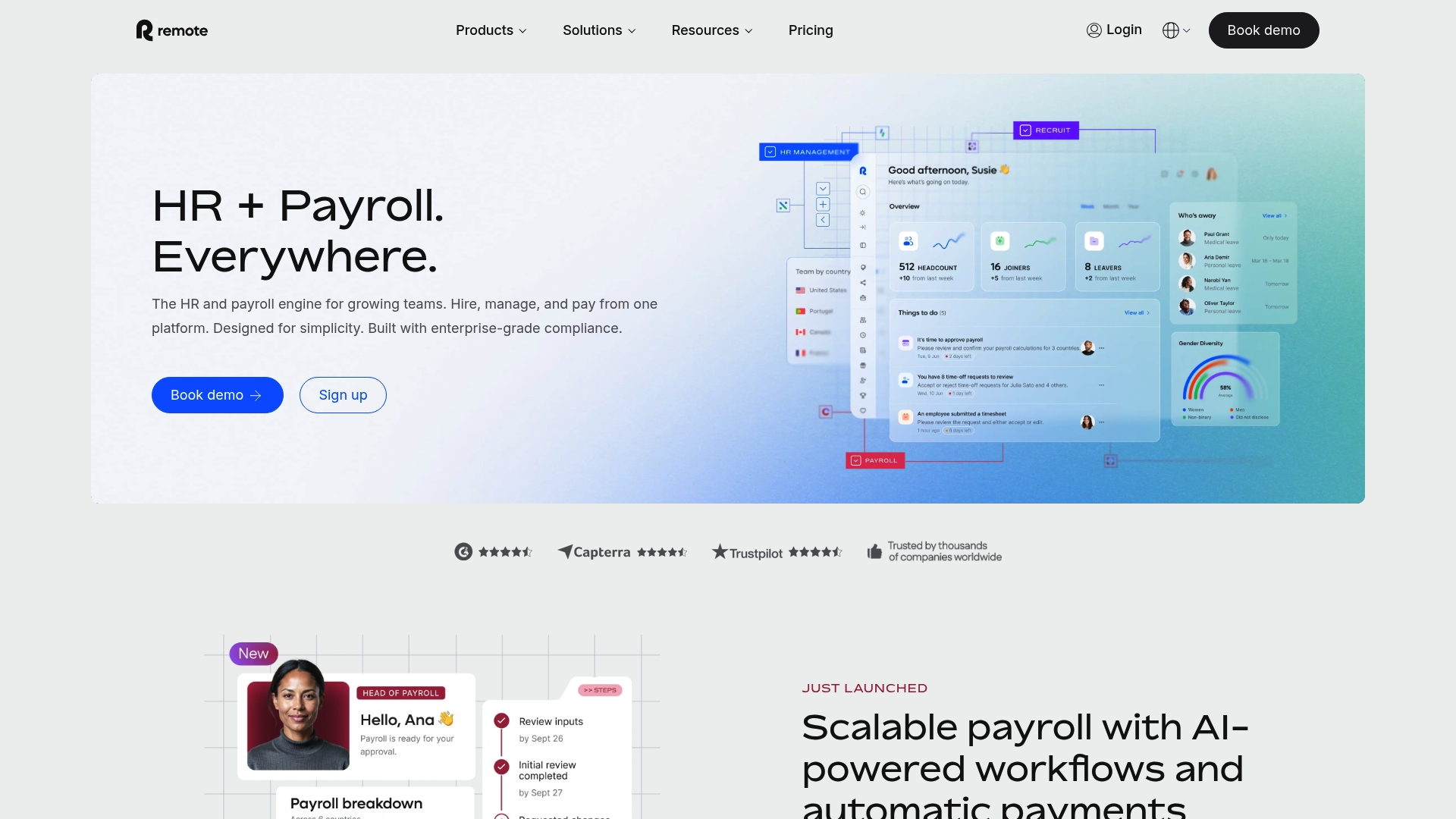
Remote.com

Product Screenshot

At a Glance

Remote.com provides a unified platform to hire, pay, and manage international talent with enterprise grade compliance and predictable workflows. It suits companies that need a single interface for payroll, Employer of Record, contractor management, and HR functions.

Core Features

Remote.com combines global payroll with AI powered workflows to automate payments and reduce manual steps. The platform offers Employer of Record services to hire without local entities and Contractor of Record for compliant contractor engagement. It also includes HR management capabilities such as HRIS, performance, benefits, surveys, and compensation, plus recruitment tools with AI sourcing and job board integrations.

Pros

  • End to end global HR solution: Remote.com centralizes payroll, EOR, contractor management, and HR modules in one platform so teams avoid juggling multiple vendors.

  • Transparent pricing posture: The company advertises predictable fees and no hidden charges, which helps finance teams forecast hiring costs accurately.

  • High compliance standards: Remote.com manages local labor law and compliance, reducing legal exposure when you hire across multiple jurisdictions.

  • Single interface for international hiring: You can onboard employees and contractors, run payroll, and manage benefits from the same dashboard to save time.

  • Positive market recognition: The platform reports strong customer reviews and industry awards that support its credibility with larger clients.

Cons

  • Complex feature set for small teams: The platform’s extensive capabilities may overwhelm small startups that only need occasional international hires.

  • Pricing clarity requires a demo or quote: Teams seeking precise cost comparisons must contact sales to get tailored pricing for some services.

  • Some features remain in development: Certain recruitment capabilities such as the full ATS are noted as upcoming and not yet generally available.

Who It’s For

Remote.com fits businesses that plan to hire multiple employees or contractors across countries and need tools to manage payroll, benefits, and compliance together. It appeals to growing startups, scale ups, and corporations that prefer vendor consolidation over point solutions.

Unique Value Proposition

Remote.com delivers a consolidated platform that reduces vendor overhead by combining payroll, EOR, contractor services, and HR tools. For teams focused on compliant global growth, the single vendor model simplifies operations and speeds up time to hire.

Real World Use Case

A technology startup hires developers in several countries and uses Remote.com to onboard staff, administer benefits, and run monthly payroll without forming local entities. The platform handles local compliance while the startup focuses on product development and market entry.

Pricing

Recruitment starts at $199 per month. Employer of Record services range from $599 to $699 per employee per month. Payroll is $29 per employee per month. Contractor management is $29 per contractor per month.

Website: https://remote.com

Papaya Global

Product Screenshot

At a Glance

Papaya Global is a SaaS platform that centralizes global payroll, payments, and workforce management for enterprise teams. It shines when you need unified controls across many jurisdictions while keeping compliance and payment rails tight.

Core Features

Papaya Global delivers a unified platform for payroll, payments, and workforce management with an emphasis on automation and compliance. Key capabilities include virtual IBAN accounts for global funding and payouts, fraud prevention for secure payments, optimized cross border payment rails, and comprehensive APIs for integration and automation.

The platform supports employee, contingent worker, contractor, and vendor payments, and claims coverage across 160 countries, which matters when your team spans Europe, the Americas, and Asia.

Pros

  • Wide global coverage: The platform supports payments in over 160 countries, which reduces the need to juggle multiple local providers.
  • Unified platform approach: Combining payroll, payments, and workforce management in one place simplifies reporting and reduces manual handoffs.
  • Real time payments and banking rails: Access to real time payments and Tier 1 banking rails speeds up payouts to international hires and vendors.
  • Strong compliance posture: Papaya Global adheres to standards such as SOC, ISO, and GDPR, which helps protect data and meets many corporate audit requirements.
  • Trusted by large customers: Adoption by more than 2000 finance and HR leaders suggests maturity for enterprise scale operations.

Cons

  • Information provided does not specify pricing details, which makes budget planning harder for procurement teams.
  • No detailed customer support or success metrics beyond trust statements, so evaluating service quality requires direct inquiry.
  • Limited information on user interface and ease of use features, which leaves questions about onboarding time and admin experience.

Who It’s For

Papaya Global is aimed at enterprise level companies with a global presence that need to manage payroll and payments across many countries. If your startup or SME is expanding into Portugal and Europe and you want a single vendor to handle payroll, contractor payments, and compliance, this platform fits that profile.

Unique Value Proposition

Papaya Global’s value is the combination of global payment rails, virtual IBAN capabilities, and API driven automation in one platform. For organizations that prioritize centralized control and regulatory coverage across borders, it reduces the number of vendors and reconciliation headaches.

Real World Use Case

A multinational corporation uses Papaya Global to run payroll and maintain compliance for remote workers in more than 50 countries. The company leverages real time payments and API integrations to connect HR systems and finance workflows for end to end processing.

Pricing

Pricing is not specified on the website, so you must contact Sales for quotes and contract details. Expect enterprise level pricing tied to countries covered and service scope.

Website: https://papayaglobal.com

Rippling

Product Screenshot

At a Glance

Rippling is a platform that centralizes HR, Payroll, IT, and Finance into a single system to reduce administrative friction for companies with distributed teams. Its strength is unified workforce management combined with deep data and AI capabilities, making it suitable for scaling operations.

Core Features

Rippling provides integrated capabilities across human resources, payroll, IT, and finance with tools for compliance, automation, and reporting. Key elements include:

  • Unified workforce management for HR, Payroll, IT, and Finance.
  • Workflow Studio for custom workflows and automation.
  • App Studio for building custom applications.
  • Real-time analytics and dashboards for decision making.
  • Global hiring and payroll solutions plus compliance management for cross border work.

These features work together so HR actions feed IT and Finance data without manual handoffs.

Pros

  • All core functions live in a single platform, reducing the number of systems your team must maintain and lowering overall complexity.

  • Deep integrations allow data sharing across HR, Payroll, IT, and Finance so reporting and approvals stay consistent across departments.

  • Workflow Studio and App Studio enable custom workflow and app creation so your company can adapt processes to local rules and internal needs.

  • Global HR and payroll capabilities broaden your hiring reach and support employment across multiple countries and states.

  • Strong automation features reduce repetitive manual tasks and free HR teams to focus on higher value work.

Cons

  • The interface can feel complex and will likely require dedicated training for HR and IT staff to use advanced features effectively.

  • Pricing is not listed publicly, which makes it hard for small businesses to gauge total cost before engaging sales to request a quote.

  • Implementation and data migration can present challenges when replacing multiple existing systems and consolidating data from legacy sources.

Who It Is For

Rippling fits mid sized to large businesses seeking a single platform to manage HR, IT, payroll, and finance, especially organizations with an expanding or global workforce. Companies with internal resources for implementation and customization will extract the most value.

Unique Value Proposition

Rippling’s main advantage is the combination of cross functional data with tools to customize workflows and build apps. That mix lets you automate end to end processes, enforce company policies, and keep compliance controls aligned across departments and geographies.

Real World Use Case

A rapidly growing company uses Rippling to onboard employees worldwide, automate payroll and benefits administration, and enforce security policies across departments. The result is faster onboarding, fewer manual payroll errors, and centralized compliance tracking across jurisdictions.

Pricing

Pricing information is not published on the website. Interested customers must contact Rippling to request a customized quote based on headcount and required modules.

Website: https://rippling.com

Oyster HR

Product Screenshot

At a Glance

Oyster HR is a global employment platform that combines Employer of Record services, payroll, contractor management, and HR advisory to help companies hire internationally without local entities. Its human-led support and B Corp status emphasize compliance and responsible growth.

Core Features

Oyster centers on Employer of Record services for hiring and paying full-time employees across borders and provides global payroll in multiple currencies. The platform also supports global contractor onboarding and payments, offers salary insights and benefits access, and includes People Partner Services for HR advisory and project-based support.

Pros

  • Comprehensive global employment solutions are available, covering EOR, payroll, and contractor management in a single platform. This reduces vendor fragmentation when you scale across countries.
  • High compliance standards mean Oyster handles local laws and regulations across its coverage, helping you avoid common legal pitfalls when hiring internationally.
  • Strong support and advisory services provide human guidance through People Partner Services, which is helpful for strategy and one-off HR projects.
  • Extensive country coverage spans 180+ countries, allowing broad geographic expansion from a single point of contact.
  • Flexible add-ons like benefits and visa sponsorship let you augment basic hiring with mobility and compensation features that matter to international talent.

Cons

  • Pricing may be on the higher end for small startups or small teams, which can challenge early-stage budgets and narrow margins.
  • Complex services might require a learning curve for new users, which increases onboarding time for HR and finance teams.
  • Limited detail on customization options in the provided content makes it hard to judge how deeply you can tailor legal or payroll workflows.

Who It’s For

Oyster fits medium to large enterprises, startups planning global expansion, HR teams, and founders who prefer a hands-on partner for compliant international employment. If your company needs to hire remote full-time talent across multiple countries without creating local entities, Oyster is relevant.

Unique Value Proposition

Oyster combines broad geographic reach with people-focused advisory. The mix of EOR, payroll, contractor management, and targeted HR projects positions it as a single partner for legal compliance, payroll operations, and people strategy as you expand internationally.

Real World Use Case

A tech startup uses Oyster to hire remote developers in multiple countries, run payroll in local currencies, and offer benefits without setting up local subsidiaries. Oyster handles compliance and visa sponsorship when mobility is required, enabling faster market entry and team growth.

Pricing

Oyster lists USD 699 per employee per month for Employer of Record. Contractor management is USD 29 per contractor per month. Global payroll is USD 29 per employee per month. US PEO is USD 114 per employee per month. People Partner Services are USD 300 per hour.

Website: https://oysterhr.com

Global HR and Payroll Solutions Comparison

Effectively compare leading platforms for global HR and payroll solutions with this comprehensive table summarizing their core features, benefits, pricing, and best use cases.

Product NameCore FeaturesProsConsPricing
Outsourcing PortugalEOR services, payroll & compliance, relocation support.Fast market entry, local expertise, remote hiring support.Pricing must be requested via quote.Custom quotations available.
DeelGlobal payroll, compliance automation, AI workflows.Currency support, automation, large customer base.Feature complexity may challenge smaller businesses.Demo booking required for pricing details.
Remote.comUnified global HR including payroll, EOR, contractor management.Transparent pricing, single interface, compliance standards.Some recruiting features are under development.$199+ monthly, varying by service.
Papaya GlobalGlobal payroll, real-time payments, workforce management.Tier 1 banking rails, compliance, real-time capabilities.Pricing details not publicly available; inquiry needed.Contact sales for pricing.
RipplingUnified platform for HR, Payroll, IT, Finance.End-to-end integration, workflow customization.Training required for advanced features, data migration challenges.Contact Rippling for quotes.
Oyster HRGlobal employment and HR advisory services, benefits integration.Broad international coverage, strong support.High price point for startups; onboarding complexity.$699/employee/month for EOR; add-ons priced separately.

Discover a Smarter Way to Hire in Portugal Without Local Setup

If you are exploring alternatives to Deel.com to expand your international team, the challenge of managing local payroll, compliance, and legal risks can feel overwhelming. Outsourcing Portugal offers a streamlined Employer of Record service designed specifically for companies wanting quick access to Portugal’s skilled multilingual workforce without the hassle of establishing a local entity. Our solutions handle hiring, onboarding, payroll processing, and full legal compliance so you can focus on growing your team smoothly.

https://outsourcing-portugal.co.uk

Take advantage of Portugal’s competitive labor market and stable business environment today. Visit Outsourcing Portugal to learn how our tailored employment outsourcing can accelerate your global expansion with complete peace of mind. Get started now and turn hiring challenges into growth opportunities.

Frequently Asked Questions

What are the main features to look for in Deel.com alternatives?

When considering alternatives to Deel.com, focus on features such as global payroll processing, compliance management, and Employer of Record services. Also, evaluate the ease of integration with existing systems and support for hiring remote teams.

How can I assess the compliance capabilities of a Deel.com alternative?

To assess compliance capabilities, review the platform’s adherence to local labor laws and tax regulations in the regions you wish to hire. Look for detailed documentation on compliance measures and ask for case studies that illustrate their effectiveness in managing international employment laws.

What factors should I consider when choosing a payroll solution?

Consider factors such as the number of currencies supported, automation capabilities, and the platform’s user interface. Additionally, evaluate customer support and how well the payroll solution integrates with other HR tools you may already use.

How does the pricing structure typically work for alternatives to Deel.com?

Pricing structures can vary, with options ranging from a per-employee monthly fee to custom quotes based on features selected. It’s vital to request a detailed pricing breakdown to understand all potential costs, including additional service fees for compliance or support.

Can alternatives to Deel.com help with onboarding remote employees?

Yes, many alternatives offer comprehensive onboarding solutions that streamline the hiring process for remote employees. Investigate how each platform manages contracts, local regulations, and training to ensure a smooth onboarding experience.

What should I expect in terms of customer support from Deel.com competitors?

Expect varying levels of customer support, with options like dedicated account managers, chat support, and extensive help centers. Choose a solution that provides responsive support during your peak hiring seasons to maintain operational efficiency.

Cost-effective hiring guide in Portugal for 2026

Hiring internationally involves balancing cost and compliance, and Portugal offers significant cost savings but with legal nuances to navigate. International companies expanding into Portugal in 2026 face the challenge of controlling employment expenses while meeting strict labor regulations. This guide covers key steps to hire effectively in Portugal, from understanding total employment costs and legal requirements to choosing between entity formation and Employer of Record solutions. You’ll learn how to budget accurately, ensure compliance, and retain talent without overspending.

Table of Contents

Key takeaways

PointDetails
Understanding total employment costsEmployer social security contributions, mandatory 13th and 14th month pays, and vacation days add approximately 26.63% to gross salary.
Legal compliance essentialsWritten employment contracts, day-one social security registration, and workplace accident insurance are legally required to avoid fines.
Entity setup vs Employer of RecordEOR offers speed and low upfront cost but less control, while entity setup provides more control with higher initial investment.
Onboarding and retention strategiesStructured onboarding, mandatory benefits, and career growth opportunities increase retention while controlling costs.
Expert support reduces riskPartnering with employment specialists ensures compliance and optimizes hiring expenses in Portugal’s complex labor market.

Understanding total employment costs in Portugal

Budgeting for Portugal hires requires understanding the full cost picture beyond base salary. Employer social security contributions are 23.75% on gross salary, with total payroll taxes reaching 26.63%. These mandatory contributions fund healthcare, pensions, and unemployment insurance.

Portuguese labor law mandates additional payments that significantly impact your total cost of workforce. Employees receive 13th and 14th month pays, effectively adding two extra salary payments annually. Workers are entitled to 22 working days of paid vacation plus 13 public holidays. These mandatory benefits increase your annual employment cost by roughly 16% beyond the monthly gross salary.

Salary ranges vary by role and seniority. Mid-level tech professionals in Lisbon earn between €30,000 and €45,000 annually, while senior developers command €50,000 to €70,000. When you factor in social security, mandatory pays, and benefits, a €40,000 annual salary translates to approximately €50,650 in total employer cost.

Using an employment cost calculator helps you estimate total hiring expenses accurately. These tools account for:

  • Base gross salary
  • Employer social security at 23.75%
  • Wage guarantee fund at 1%
  • Workplace accident insurance at approximately 1.88%
  • 13th and 14th month payments
  • Paid vacation and public holiday costs

Workplace insurance and the wage guarantee fund add smaller but necessary costs. Workplace accident insurance typically runs 1.88% of gross salary, covering injuries and occupational diseases. The wage guarantee fund protects employees if your company faces insolvency, costing about 1% of payroll.

Pro Tip: Always budget for the full loaded cost, not just base salary. Hidden costs like recruitment fees, onboarding time, and equipment can add another 10% to 15% in the first year.

Legal compliance starts with proper employment contracts. Written contracts are mandatory for fixed-term positions and non-EU employees, though best practice dictates written agreements for all hires. Contracts must specify salary, working hours, job duties, vacation entitlement, and notice periods. Probation periods cannot exceed 90 days for most roles, 180 days for highly technical or high-responsibility positions, or 240 days for senior management.

Social security and tax registrations must occur on the employee’s first working day. You’ll register with the Portuguese Social Security system and obtain a tax identification number for payroll withholding. Missing these deadlines triggers penalties and potential audits. Your registration obligations include:

  • Social security enrollment for employer and employee
  • Tax authority notification of new hire
  • Workplace accident insurance activation
  • Submission of employment contract to labor authorities if requested

Contractor misclassification represents a serious legal risk. Avoid verbal contracts or misclassifying contractors as employees to prevent fines and audits. Portuguese authorities scrutinize working relationships where contractors function as de facto employees. Red flags include exclusive work for one client, fixed working hours, use of company equipment, and lack of entrepreneurial risk. Misclassification can result in retroactive social security payments, fines up to €44,000, and back taxes.

Fixed-term contracts require valid justification under Portuguese law. You cannot use them for permanent operational needs. Valid reasons include temporary workload increases, seasonal work, replacing absent employees, or project-based assignments. Fixed-term contracts can run up to two years with a maximum of three renewals. Exceeding these limits automatically converts the contract to permanent employment.

Workplace protections extend beyond contracts and insurance. You must provide a safe working environment, respect maximum working hours of 40 per week, and honor minimum rest periods of 11 consecutive hours daily. Overtime requires employee consent and cannot exceed 200 hours annually per worker. Termination procedures follow strict rules, with notice periods ranging from 15 to 75 days based on tenure.

“Getting accurate employment contracts in Portugal right from the start protects both employer and employee, preventing costly disputes and ensuring smooth operations.”

Pro Tip: Partner with local legal experts or an EOR provider to navigate Portugal’s complex labor code. Small compliance errors can snowball into major financial and legal problems.

Choosing the best hiring approach: Entity setup vs Employer of Record

Your hiring strategy in Portugal hinges on choosing between forming a local entity or using an Employer of Record. Each approach offers distinct advantages depending on your scale, timeline, and control requirements.

EOR solutions provide speed and low upfront cost but less direct control. An EOR becomes the legal employer, handling payroll, taxes, benefits, and compliance while you manage day-to-day work. This model lets you hire within days rather than months, with no need to establish a Portuguese legal presence. EOR providers charge per-employee monthly fees, typically 8% to 15% of gross salary, making costs predictable and scalable.

Entity setup delivers maximum control and long-term cost savings but requires significant upfront investment. Forming a Portuguese subsidiary involves legal fees, registration costs, and ongoing accounting expenses. Setup takes three to six months and costs €5,000 to €15,000 initially. However, once established, your per-employee costs drop to actual salary plus taxes, eliminating EOR fees. This approach makes financial sense when hiring 10 or more employees or planning multi-year operations.

Infographic showing entity versus EOR hiring in Portugal

FactorEmployer of RecordLocal Entity Setup
Time to hire1 to 2 weeks3 to 6 months
Upfront costLow (minimal setup fees)High (€5,000 to €15,000+)
Ongoing cost per employee8% to 15% of gross salary monthlyAccounting and admin overhead only
Control over operationsLimited (EOR is legal employer)Full (you are legal employer)
Best forTesting market, small teams, quick scalingLong-term presence, large teams, maximum control

EOR suits companies testing the Portuguese market, hiring one to five employees, or needing immediate staffing. You avoid entity maintenance, local accounting, and administrative burden. The tradeoff is less control over HR policies, benefits customization, and employee relationships. EOR providers handle compliance, but you depend on their expertise and responsiveness.

Entity formation makes sense for established operations, hiring 10 or more staff, or requiring tight integration with corporate systems. You control every aspect of employment, from benefits design to performance management. Long-term, the cost per employee drops significantly compared to EOR fees. However, you assume full compliance responsibility and administrative overhead.

Hybrid approaches combine both models. Some companies use Employer of Record Portugal services initially, then transition to a local entity once headcount justifies the investment. Others maintain an entity for core staff while using EOR for contractors or specialized roles.

Key considerations when choosing include:

  • Planned headcount over 12 to 24 months
  • Budget for upfront vs ongoing costs
  • Need for control over HR policies and benefits
  • Internal capacity to manage Portuguese payroll and compliance
  • Timeline for becoming operational
  • Strategic commitment to the Portuguese market

Pro Tip: If you plan to hire more than eight employees within 18 months, entity setup typically becomes more cost effective than EOR. Run the numbers using your specific salary ranges and growth projections. For guidance on scaling tech teams in Portugal, compare both models against your expansion timeline.

Onboarding and retaining talent while maximizing cost efficiency

Effective onboarding sets the foundation for employee success and retention. Structure your onboarding to integrate new hires within the first 30 days. Start with pre-arrival preparation: send welcome packets, equipment, and access credentials before day one. On the first day, conduct orientation covering company culture, team introductions, and administrative setup. Week one should focus on role-specific training and early wins.

Your onboarding checklist should include:

  1. Employment contract signing and document collection
  2. Social security and tax registration completion
  3. Equipment provision (laptop, phone, software licenses)
  4. System access and security training
  5. Introduction to team members and key stakeholders
  6. Review of job responsibilities and performance expectations
  7. Assignment of initial projects or tasks

Mandatory benefits form the baseline of your compensation package. Beyond the legally required 22 vacation days, 13th and 14th month pays, and social security coverage, consider cost-effective additions. Meal allowances are tax-exempt up to €6.15 per working day in cash or €10.455 on a meal card. Transportation subsidies enjoy favorable tax treatment. Health insurance supplements the public system and costs €30 to €80 per employee monthly, significantly boosting perceived value.

Onboarding session with employee benefits guides

Employee engagement beyond salary drives retention in Portugal’s competitive talent market. Portuguese professionals value stability and benefits over high bonuses, especially in tech hubs Lisbon and Porto. Career development opportunities, clear advancement paths, and work-life balance matter more than aggressive compensation. Implement regular one-on-ones, skills training budgets, and flexible working arrangements to increase satisfaction without major cost increases.

Probation periods let you assess fit while respecting legal limits. Use the full 90-day probation for most roles or 180 days for senior positions to evaluate performance, cultural alignment, and skill match. Provide clear feedback and measurable objectives during probation. If the fit isn’t right, termination during probation requires minimal notice and no severance, reducing hiring risk.

Retention strategies balance cost control with employee motivation:

  • Offer clear career progression with defined promotion criteria
  • Provide annual salary reviews tied to performance and market rates
  • Create recognition programs celebrating achievements without major expense
  • Enable remote or hybrid work to improve work-life balance
  • Invest in professional development through courses, conferences, or certifications
  • Foster strong team culture through regular team events and communication

Portuguese employment law favors employee stability, making retention more cost effective than replacement. Turnover costs include recruitment fees (15% to 25% of annual salary), onboarding time, productivity loss, and knowledge transfer. Investing in retention through modest benefits and career development typically costs far less than replacing talent.

Pro Tip: Track retention metrics by hire source, department, and manager. Identify patterns in early turnover to refine your hiring and onboarding processes. High turnover in the first six months signals onboarding or role clarity issues, while departures after two years often relate to career growth limitations. For insights on attracting cost-effective tech talent in Portugal’s nearshore market, focus on stability and professional development over purely financial incentives.

How Outsourcing Portugal supports your hiring success

Navigating Portugal’s employment landscape becomes simpler with expert support. After mastering the fundamentals of cost-effective hiring, many international companies turn to specialized partners to implement their strategy efficiently.

https://outsourcing-portugal.co.uk

Outsourcing Portugal offers comprehensive employment services tailored to international firms expanding into Portugal. Their solutions span payroll management, Employer of Record services, entity formation support, and ongoing HR administration. Whether you’re hiring your first Portuguese employee or scaling to a full team, their expertise ensures compliance while controlling costs and accelerating time to productivity. Their EOR Portugal services handle the legal employer responsibilities, letting you focus on managing your team’s work rather than navigating Portuguese labor regulations. By partnering with specialists who understand both international business needs and local requirements, you reduce the risk of costly compliance errors while optimizing your hiring investment.

What is the total cost of hiring an employee in Portugal?

The total cost of hiring an employee in Portugal includes gross salary plus approximately 26.63% in payroll taxes and mandatory benefits. Employer social security contributions account for 23.75% of gross salary, while the wage guarantee fund and workplace accident insurance add roughly 2.88% combined. You must also budget for mandatory 13th and 14th month payments, which effectively add two months of salary annually, plus 22 working days of paid vacation and 13 public holidays. For a €40,000 annual salary, expect total employer costs around €50,650 when including all mandatory contributions and benefits.

Written employment contracts are mandatory for fixed-term positions and non-EU employees, though best practice recommends written agreements for all hires. Contracts must specify salary, working hours, job description, vacation entitlement, probation period, and termination notice requirements. You must register the employee with Portuguese Social Security and the tax authority on their first working day of employment. Verbal contracts should be avoided to prevent legal penalties and compliance issues. Additional required documentation includes proof of workplace accident insurance and, if applicable, work permits for non-EU nationals.

Should I use an Employer of Record or set up a local entity?

EOR is faster and simpler with less control, while entity setup offers more control but higher upfront effort and costs. EOR suits companies testing the Portuguese market, hiring one to five employees, or needing to become operational within weeks. You’ll pay 8% to 15% of gross salary monthly in EOR fees but avoid entity formation costs and administrative burden. Entity setup makes financial sense when hiring 10 or more employees or planning long-term operations, as per-employee costs drop significantly once the initial €5,000 to €15,000 setup investment is complete. Choose EOR for speed and cost certainty, or entity formation for maximum control and long-term savings.

How can I ensure compliance when hiring remote employees in Portugal?

Remote hires require written agreements covering equipment provision, data privacy, expense reimbursement, and working hour expectations to meet legal standards. Your remote work policy must specify who provides and maintains equipment, how you’ll handle internet and utility costs, and data security protocols. Portuguese labor law requires the same protections for remote workers as office-based employees, including maximum working hours, rest periods, and right to disconnect. Maintain clear documentation of remote work arrangements, conduct regular check-ins to ensure compliance with working time regulations, and provide remote workers with the same benefits and career opportunities as on-site staff to avoid discrimination claims.

How to source multilingual talent in Portugal efficiently

Hiring multilingual professionals in Portugal presents unique challenges for international companies seeking to expand or build nearshore teams. Despite Portugal’s reputation for a highly educated, multilingual workforce, sourcing candidates who speak specific languages like German, French, or Spanish requires strategic planning and local market knowledge. Many companies struggle to identify the right talent pools, navigate cultural nuances, and manage compliance requirements. This comprehensive guide walks you through proven strategies to efficiently find, recruit, and retain multilingual talent in Portugal, helping you avoid common pitfalls and accelerate your international growth.

Table of Contents

Key Takeaways

PointDetails
German talent shortfallPortugal faces a tight supply of German speakers, creating strong competition for these professionals.
Focus Lisbon and PortoLisbon is the primary talent hub, followed by Porto, so prioritizing these cities improves sourcing efficiency.
University partnershipsPartner with IST, Porto, Minho, and Nova to build long term candidate pipelines through campus events and internships.
Outsourcing and EOROutsourcing and Employer of Record services can accelerate access to pre vetted multilingual candidates while simplifying compliance.

Understanding the demand and talent landscape in Portugal

Portugal’s multilingual talent market presents both opportunity and challenge for international employers. As of April 2025, Germany faces a structural shortage for German-speaking talent with nearly two jobs per candidate, creating intense competition for these professionals. The market shows 23,457 open positions against only 12,500 qualified German-speaking candidates, illustrating the supply-demand imbalance you’ll encounter.

Geographic concentration significantly impacts your sourcing strategy. Lisbon hosts 55% of Portugal’s multilingual professionals, making it the primary target for recruitment efforts. Porto follows as the second-largest talent hub, while smaller cities offer limited pools of multilingual candidates. This urban concentration means your recruitment activities should prioritize these metropolitan areas for efficiency and results.

Top talent sources in Portugal:

  • Instituto Superior Técnico (IST) in Lisbon produces engineering and technical graduates
  • University of Porto offers strong programs in technology, business, and languages
  • University of Minho excels in engineering and computer science disciplines
  • Nova School of Business and Economics attracts internationally minded students

Understanding language demand patterns helps you allocate resources effectively. German speakers remain the most scarce and sought-after, followed by French and Spanish professionals. English proficiency is widespread among Portuguese graduates, making it a baseline rather than differentiator. Your recruitment timeline should account for these market realities, particularly if targeting niche language combinations.

Infographic shows language demand and sourcing regions

Pro Tip: Map your language requirements against regional talent density before launching campaigns. If you need German speakers, concentrate efforts in Lisbon where international companies have established presence and created language-specific communities.

Partnering with outsourcing Portugal EoR solutions can accelerate access to pre-vetted multilingual candidates while handling compliance complexities. These services maintain existing talent networks and understand regional availability patterns better than companies entering the market independently.

LanguageDemand LevelCandidate AvailabilityCompetition
GermanVery HighLowIntense
FrenchHighModerateStrong
SpanishHighModerateStrong
EnglishUniversalHighModerate

Preparing your recruitment strategy for multilingual talent in Portugal

Successful multilingual hiring starts with precise requirements definition. Specify exactly which languages your roles require and at what proficiency levels, using frameworks like CEFR (Common European Framework of Reference) to eliminate ambiguity. A customer service role might require C1 German and B2 English, while a technical position could accept B2 German with C1 English. This clarity prevents wasted effort screening unsuitable candidates.

Identify target institutions based on your industry and role requirements. Prioritize universities IST, Porto, and Minho and urban centers such as Lisbon and Porto for pipelines that align with your technical needs. Engineering roles benefit from IST and Minho partnerships, while business positions connect well with Nova and Católica graduates. Establish relationships through career fairs, sponsored projects, or internship programs to build long-term talent pipelines.

University career fair job seeker in Portugal

Understanding Portuguese employment law prevents costly mistakes during hiring. Portugal requires written employment contracts, mandates specific notice periods, and protects employees through strong labor regulations. Salary expectations vary by region and language skills, with Lisbon commanding premium rates. Research local compensation benchmarks for multilingual roles to ensure your offers remain competitive without overpaying.

Critical preparation steps:

  • Create multilingual job descriptions that resonate with Portuguese cultural values
  • Establish salary ranges based on role, language requirements, and location
  • Develop interview processes that fairly assess language proficiency
  • Prepare onboarding materials in relevant languages to support new hires
  • Build employer branding that highlights your company’s international culture

Cultural adaptation strengthens your employer value proposition. Portuguese professionals value work-life balance, career development opportunities, and organizational stability. Your recruitment messaging should emphasize these elements rather than purely financial compensation. Highlighting international exposure, language skill development, and clear advancement paths attracts quality multilingual candidates.

Pro Tip: Audit your current employer branding materials for cultural relevance before launching Portuguese recruitment. Generic international messaging often fails to resonate with local professionals who seek specific career benefits.

Consider whether to expand to Portugal for tech teams through direct entity establishment or leverage existing infrastructure through professional services. Direct hiring offers maximum control but requires significant legal and administrative setup. Outsourcing solutions provide faster market entry with reduced complexity, particularly valuable when testing Portuguese talent or building initial teams.

Executing multilingual talent sourcing effectively in Portugal

Multi-channel sourcing maximizes your candidate reach across Portugal’s fragmented talent market. LinkedIn remains the primary professional network, but Portuguese job boards like Net-Empregos and Sapo Emprego capture local candidates. University career portals connect you directly with recent graduates, while specialized recruitment agencies maintain databases of multilingual professionals actively seeking opportunities.

German-speaking talent requires targeted approaches given the high demand for German speakers drives international recruitment from German-speaking countries to Portugal. Partner with agencies specializing in German language recruitment or tap into German expat communities in Lisbon and Porto. Many German speakers in Portugal originally relocated for lifestyle reasons and actively seek roles leveraging their language skills.

Effective sourcing sequence:

  1. Launch targeted LinkedIn campaigns with Portuguese language ads highlighting your multilingual environment
  2. Post positions on local job boards with clear language requirements and competitive compensation
  3. Activate university partnerships through career services and alumni networks
  4. Engage specialized recruitment agencies for hard-to-fill language combinations
  5. Leverage employee referrals from existing Portuguese team members who understand the local market
  6. Attend job fairs and networking events in Lisbon and Porto to build brand awareness

Structured candidate evaluation ensures you select professionals who meet both language and technical requirements. Conduct initial screenings in the target language to verify proficiency claims, then assess technical skills through practical exercises or case studies. Cultural fit interviews help identify candidates who align with your organizational values and can thrive in international team environments.

Employer of Record services streamline the hiring process by managing contracts, payroll, and compliance requirements. This approach proves particularly valuable when scaling tech teams in Portugal without establishing a legal entity. EoR providers handle administrative complexity while you focus on candidate selection and team integration.

ApproachSpeed to HireSetup CostControl LevelBest For
Direct Hiring3-6 monthsHighMaximumLong-term presence
EoR Services2-4 weeksLowModerateMarket testing, rapid scaling
Recruitment Agency4-8 weeksModerateHighSpecialized roles

Pro Tip: Implement digital recruiting strategies for German talent that leverage social media targeting and content marketing to attract passive candidates who aren’t actively job searching.

Maintain consistent communication throughout the recruitment process to enhance candidate experience. Portuguese professionals expect timely feedback and transparent information about role expectations, compensation, and career development. Slow or unclear communication drives top candidates toward competing offers, particularly in the competitive German-speaking talent market.

Verifying hiring success and optimizing your approach

Tracking recruitment metrics reveals what works and what needs adjustment in your multilingual hiring process. Monitor time to hire from job posting to offer acceptance, measuring separately for different language requirements. German-speaking roles typically take longer to fill than English-only positions, so separate metrics prevent skewed analysis. Quality of hire assessments at 90 days and six months show whether candidates meet performance expectations.

New hire feedback provides invaluable insights into your recruitment and onboarding effectiveness. Conduct structured interviews at 30, 60, and 90 days to understand their experience from initial contact through integration. Ask specifically about language support, cultural adaptation, and whether the role matches what was communicated during recruitment. This feedback identifies gaps between your messaging and reality.

Key optimization areas:

  • Refine job descriptions based on which versions attract higher quality applicants
  • Adjust sourcing channel investment based on cost per quality hire metrics
  • Improve interview processes where candidate feedback indicates confusion or misalignment
  • Enhance onboarding programs to address common challenges multilingual hires face
  • Update compensation ranges when offer acceptance rates fall below targets

Retention programs tailored to multilingual employees strengthen long-term success. Create language-specific employee resource groups that provide community and networking opportunities. Offer continued language training to help professionals maintain or improve skills in less commonly used languages. Recognize cultural diversity through inclusive policies and celebrations that value different backgrounds.

“The most successful international employers in Portugal invest in localized retention strategies that go beyond salary. They create environments where multilingual professionals feel valued for their unique skills and cultural perspectives, leading to significantly lower turnover rates.”

Stay current on Portuguese employment law changes and market trends through professional services or legal counsel. Compliance requirements evolve, and salary expectations shift as more international companies enter the market. Regular FAQ on hiring with EoR and payroll in Portugal reviews ensure your practices remain competitive and legally compliant.

Benchmark your results against industry standards for multilingual hiring in Portugal. Time to hire for German speakers typically ranges from 8 to 12 weeks, while English-speaking technical roles fill in 4 to 6 weeks. If your metrics fall outside these ranges, investigate whether your compensation, employer branding, or sourcing strategies need adjustment.

Discover expert support for multilingual hiring in Portugal

Navigating Portugal’s multilingual talent market becomes significantly easier with experienced partners who understand local nuances and maintain established candidate networks. Outsourcing Portugal specializes in helping international companies access Portuguese talent through comprehensive Employer of Record and payroll services that eliminate setup complexity.

https://outsourcing-portugal.co.uk

Their employment Portugal EoR and payroll services handle everything from compliant contract creation to monthly payroll processing, allowing you to hire multilingual professionals without establishing a Portuguese entity. This approach proves especially valuable when testing market viability or building initial nearshore teams before committing to permanent infrastructure.

EOR Portugal services overview demonstrates how professional employment solutions accelerate your hiring timeline while ensuring full legal compliance. You gain access to pre-vetted multilingual candidates and benefit from established relationships with universities and recruitment networks across Lisbon and Porto.

For companies pursuing nearshore Portugal outsourcing, these services reduce administrative burden and compliance risk while expanding your talent reach. You focus on building great teams while experts handle the operational complexity of international employment.

FAQ

How do I find qualified multilingual candidates in Portugal?

Focus recruitment on Lisbon and Porto where 55% of multilingual professionals concentrate. Use targeted job boards, build university partnerships with IST and Porto, and engage specialized recruitment agencies for specific language needs. Outsourcing Portugal EoR solutions provide access to pre-vetted candidate networks and handle compliance requirements.

What languages are most in demand among talent pools in Portugal?

German speakers face the highest demand with Germany nearshore report cites a shortage of German-speaking talent in Portugal showing nearly two jobs per qualified candidate. French and Spanish professionals also command strong demand for customer service and business roles. English proficiency is widespread among Portuguese graduates, making it a baseline skill rather than differentiator in most technical and business positions.

How can Employer of Record services ease multilingual hiring in Portugal?

EoR providers handle legal employment contracts, payroll processing, tax compliance, and benefits administration so you can onboard multilingual talent within weeks instead of months. They eliminate the need to establish a Portuguese legal entity while ensuring full compliance with local labor laws. EOR Portugal services overview shows how these solutions simplify managing remote multilingual teams for international companies entering the Portuguese market.

What regions in Portugal have the highest concentration of multilingual talent?

Lisbon hosts 55% of Portugal’s multilingual talent, followed by Porto and other urban centers making these cities your primary recruitment targets. Smaller cities like Braga, Coimbra, and Faro offer limited multilingual candidate pools. Focus sourcing efforts on metropolitan areas where international companies have established presence and created language-specific professional communities that attract and retain multilingual talent.

Employer of record guide Portugal: Hire compliantly

Navigating Portugal’s employment regulations poses significant challenges for international businesses seeking to hire talent without establishing a local entity. Complex compliance requirements, strict termination procedures, and misclassification risks create barriers to efficient talent acquisition. An Employer of Record service removes these obstacles by legally employing workers on your behalf, managing payroll, ensuring regulatory compliance, and handling visa processing. This guide walks you through leveraging EOR services to build compliant teams in Portugal while minimizing legal exposure and administrative burden.

Table of Contents

Key Takeaways

PointDetails
Reduce misclassification riskAn EOR hires workers as employees from day one, preventing contractor misclassification and related penalties.
Remote work complianceThe EOR handles remote work contract clauses, equipment provisions, and expense reimbursements to meet Portuguese regulations.
Visa processing supportThe EOR manages visa requirements and applications to onboard international hires compliantly.
Total cost visibilityEmployer costs add 26 to 30 percent of gross salary, and the EOR discloses and manages these charges.

Understanding the employer of record model in Portugal

An Employer of Record acts as the legal employer for workers you select and manage day to day. The EOR holds the employment contract, processes payroll, withholds taxes, manages benefits, and ensures compliance with Portuguese labor law. You retain complete operational control over work assignments, performance management, and business objectives.

This model delivers crucial advantages over direct contractor arrangements. Contractor misclassification cases represent 70% of employment disputes in the UK, with similar risks extending to Portuguese operations. When you engage contractors who function as employees, Portuguese authorities can reclassify the relationship retroactively, triggering substantial penalties and back payments for social contributions.

Working with an employer of record Portugal provider eliminates this exposure entirely. The EOR establishes proper employment relationships from day one, including:

  • Formal employment contracts compliant with Portuguese labor code
  • Proper classification as employees with full statutory protections
  • Mandatory social security registrations and contributions
  • Accurate payroll processing with correct tax withholdings
  • Management of probation periods and termination procedures
  • Compliance with remote work regulations for distributed teams

Probation periods in Portugal typically last 90 days for most roles, extending to 180 or 240 days for senior positions or specific contract types. During probation, either party can terminate with minimal notice. After probation ends, termination requires just cause such as redundancy, performance issues meeting specific legal standards, or company restructuring. The EOR ensures you follow these procedures correctly, protecting both parties.

For remote work arrangements, Portuguese law mandates specific contract clauses, equipment provisions, and expense reimbursements. Your EOR manages these requirements automatically, ensuring contracts reflect current regulations and protecting you from non-compliance penalties.

Pro Tip: Before selecting an EOR provider, verify their track record handling Portuguese labor disputes and their specific expertise with your industry’s compliance requirements. Request case studies demonstrating successful resolution of complex employment situations.

Before engaging workers through an EOR, you need clarity on financial obligations and documentation requirements. Understanding these elements upfront prevents budget surprises and ensures smooth onboarding.

Employer costs in Portugal extend beyond gross salaries. Social charges and taxes add 26-30% to your total employment expense. The table below breaks down typical mandatory contributions:

Infographic of employer costs with contributions and extras

Cost ComponentEmployer RatePurpose
Social Security23.75%Pension, healthcare, unemployment insurance
Work Accident Insurance1-3%Occupational injury coverage
Compensation Fund1%Termination and redundancy reserves
Meal AllowanceVariableTax-advantaged daily subsidy
Holiday and Christmas Bonuses2 months salaryMandatory 13th and 14th month payments

These percentages apply to gross salary, making accurate budgeting essential. A €50,000 annual salary generates approximately €13,000 to €15,000 in additional employer costs.

For non-EU citizens, visa and work permit processing adds another layer of preparation. Your EOR handles applications through Portugal’s immigration system, but you must provide:

  • Job offer details and employment contract terms
  • Proof of business activity justifying the hire
  • Employee qualification documents and credentials
  • Housing arrangements or support letters

Processing times vary from 60 to 120 days depending on visa category and application volume. Starting this process early prevents delays in your hiring timeline.

Contract documentation requires specific elements under Portuguese law. Employment agreements must specify work location, remote work arrangements if applicable, probation period length, termination notice requirements, and just cause definitions. Your country overview of eor Portugal services provider drafts these contracts to meet all legal standards.

Termination procedures demand particular attention during preparation. Outside probation periods, you can only terminate for just cause, which Portuguese law defines narrowly. Acceptable reasons include:

  • Documented performance failures after formal warnings
  • Serious misconduct with clear evidence
  • Economic redundancy with proper justification
  • Company restructuring affecting the role

Improper termination triggers severance payments, potential reinstatement orders, and legal fees. Your EOR ensures any future terminations follow correct procedures from the contract’s inception.

Pro Tip: Build a 30% buffer into your hiring budget beyond gross salaries to cover employer contributions, bonuses, and EOR service fees. This prevents cash flow surprises and supports accurate financial planning. Review employment Portugal services for transparent cost breakdowns before committing to specific headcount targets.

Execution: How to engage and manage talent via an employer of record in Portugal

Once preparation is complete, engaging workers through your EOR follows a structured process that ensures compliance at every stage.

  1. Contract finalization begins with your EOR drafting employment agreements that reflect Portuguese labor law requirements. You provide job details, compensation structure, work arrangements, and any special terms. The EOR incorporates mandatory clauses covering probation, termination procedures, remote work provisions, and benefit entitlements. Both you and the employee review the contract before signing. The EOR registers the employment with Portuguese social security and tax authorities, creating the legal employer-employee relationship.

  2. Payroll management transfers to your EOR on the agreed schedule, typically monthly. You approve timesheets and any variable compensation. The EOR calculates gross pay, applies correct tax withholdings, deducts employee social security contributions, processes employer contributions, and transfers net pay to employee accounts. They generate payslips showing all deductions and file required reports with Portuguese authorities. This removes payroll administration from your team while ensuring accuracy.

  3. Termination procedures require careful execution to maintain compliance. Strict termination procedures and notices are legally required outside probation to avoid misclassification penalties. When separation becomes necessary, your EOR guides the process. For performance-based terminations, they help document warnings and improvement plans meeting legal standards. For redundancy situations, they prepare justification documentation and calculate severance entitlements. They handle notice periods, final pay calculations, and required filings with labor authorities.

  4. Remote employee management introduces additional compliance requirements. Portuguese law mandates written remote work agreements specifying work hours, communication expectations, equipment provision, and expense reimbursements. Your EOR ensures contracts include these elements and manages ongoing compliance. They track equipment assignments, process expense reimbursements according to legal limits, and maintain records demonstrating proper remote work management.

Compliance best practices throughout employment include:

  • Maintaining detailed records of all employment decisions and communications
  • Documenting performance discussions and any disciplinary actions
  • Ensuring remote work agreements reflect actual working arrangements
  • Processing contract amendments through your EOR for any role changes
  • Consulting your EOR before making termination decisions

Common mistakes that create legal exposure include treating EOR employees as contractors for operational purposes, making termination decisions without EOR consultation, failing to document performance issues before termination attempts, ignoring remote work compliance requirements, and processing payments outside the EOR payroll system. Each of these errors can trigger misclassification claims or labor law violations.

Your FAQ hiring in Portugal with EOR services resource provides detailed guidance on navigating specific situations that arise during employment.

Verification: Monitoring compliance and managing risks with EOR in Portugal

Ongoing compliance verification protects your business from the substantial penalties associated with employment law violations. Understanding risk profiles helps you appreciate the protection EOR services provide.

Contractor misclassification represents the most significant exposure for international businesses. Misclassification risk is high with contractors, with 70% of cases resulting in reclassification as employees. UK businesses have faced penalties exceeding £73,000 for misclassification, with similar enforcement trends emerging across the EU. Portuguese authorities examine working relationships for signs of employment disguised as contracting, including regular hours, single client dependency, use of company equipment, and integration into business operations.

The comparison below illustrates risk differences between employment models:

Risk FactorDirect ContractorEOR Employment
Misclassification ExposureHigh: 70% of disputes involve reclassificationEliminated: Proper employee status from start
Termination LiabilityHigh: No contract protections for improper separationManaged: EOR ensures just cause procedures
Payroll ComplianceYour responsibility: Errors trigger penaltiesEOR responsibility: Professional processing
Visa ManagementYour burden: Complex application processesEOR handled: Expert immigration support
Audit RiskDirect exposure to labor inspectionsShared: EOR manages responses and documentation

Your EOR conducts ongoing compliance monitoring through several mechanisms. They track regulatory changes affecting employment law and update contracts and procedures accordingly. They maintain audit-ready records of all employment actions, payroll transactions, and compliance filings. They monitor visa expiration dates for non-EU employees and initiate renewal processes proactively. They conduct periodic contract reviews ensuring terms reflect current working arrangements.

Employee checking HR compliance update on desktop

For non-EU employees, visa compliance demands particular attention. Work permits link to specific employers and roles. Any significant job changes may require permit amendments. Your EOR tracks these requirements and manages applications, preventing situations where employees work without proper authorization.

Best practices for maintaining compliance include:

  • Scheduling quarterly reviews with your EOR to discuss any workforce changes
  • Documenting all performance discussions and employment decisions
  • Consulting your EOR before implementing policy changes affecting Portuguese employees
  • Maintaining separate records for contractor relationships to demonstrate clear distinctions
  • Reviewing employee classifications annually to ensure roles haven’t evolved beyond contract terms

Regular compliance verification reduces legal exposure substantially. When authorities conduct inspections or employees raise disputes, proper documentation and procedures provide strong defenses. Your EOR’s expertise becomes particularly valuable during these situations, managing responses and protecting your interests.

Exploring nearshore Portugal outsourcing cost effective tech talent opportunities becomes significantly more viable when compliance risks are properly managed through professional EOR services.

Explore professional employer of record solutions in Portugal

Navigating Portugal’s employment landscape requires specialized expertise that most international businesses lack internally. Outsourcing Portugal delivers comprehensive EOR services designed specifically for companies expanding into Portuguese markets without local entities.

https://outsourcing-portugal.co.uk

Our team manages every aspect of compliant employment, from contract drafting and payroll processing to visa applications and termination procedures. We handle the 26-30% employer contribution burden transparently, ensuring you understand total employment costs upfront. Our compliance experts stay current with Portuguese labor law changes, updating your employment practices automatically.

For businesses testing Portuguese markets or building nearshore tech teams, our services eliminate the complexity and risk of direct hiring. We’ve helped hundreds of international companies establish compliant workforces, avoiding the misclassification penalties and termination disputes that plague businesses attempting direct contractor relationships.

Explore our full range of employment Portugal EOR, payroll, setup and hiring services to understand how we simplify Portuguese expansion. Review our country overview of eor Portugal services for detailed service descriptions. Contact our team to discuss your specific hiring needs and receive customized guidance on building your Portuguese workforce through our employer of record Portugal and payroll services.

Frequently asked questions

What is an employer of record and how does it differ from a contractor?

An EOR legally employs workers on your behalf, establishing formal employment relationships with full labor law protections. Contractors operate as self-employed individuals without employee benefits or protections. This distinction matters because Portuguese authorities reclassify contractor relationships that function as employment, triggering penalties and back payments. EOR employment eliminates misclassification risk entirely by establishing proper employee status from day one.

What termination rules must be followed when using an EOR in Portugal?

Termination outside probation periods requires just cause such as documented performance failures, serious misconduct, economic redundancy, or company restructuring. You must provide advance notice ranging from 15 to 75 days depending on tenure. Improper termination triggers severance payments, potential reinstatement orders, and legal penalties. Your EOR ensures you follow correct procedures, document justifications properly, and calculate any required severance accurately.

Can EOR services handle non-EU employee visas and work permits in Portugal?

Yes, professional EOR providers manage the complete visa application process for non-EU employees. They prepare documentation, submit applications to Portuguese immigration authorities, track processing status, and handle renewals before permits expire. This ensures your employees maintain legal work authorization throughout their employment. Processing typically takes 60 to 120 days, so early initiation prevents hiring delays. Learn more about comprehensive employment Portugal services covering visa management.

What are the typical employer costs when hiring through an EOR in Portugal?

Employer social charges and payroll taxes add approximately 26-30% above gross salaries. This includes 23.75% social security contributions, 1-3% work accident insurance, and mandatory holiday and Christmas bonuses equivalent to two months’ salary. A €50,000 annual salary generates roughly €13,000 to €15,000 in additional employer costs. Your EOR manages these contributions transparently, ensuring accurate budgeting. Review our country overview of eor Portugal services for detailed cost breakdowns specific to your hiring plans.

HR manager reviewing Portugal employment contracts

Why use global employment solutions for Portugal hiring

Many HR managers assume hiring employees directly in Portugal is straightforward and cost effective, especially when expanding into the European Union. The reality is far more complex. Direct foreign hiring often triggers hidden compliance costs, legal risks, and administrative burdens that can derail expansion plans. Global employment solutions let companies hire staff in Portugal without establishing a local legal entity, offering a strategic alternative that simplifies payroll, ensures compliance, and accelerates talent acquisition. This article explains why global employment solutions have become essential for multinational corporations and SMEs targeting Portuguese talent in 2026.

Table of Contents

Key takeaways

PointDetails
Compliant hiring without entity setupGES enables you to hire Portuguese employees legally without registering a local company or branch.
Reduced operational costsAvoiding entity setup, local HR infrastructure, and compliance overhead saves significant time and money.
Faster talent acquisitionGES providers handle administrative tasks, allowing new hires to onboard weeks or months sooner.
Mitigated legal and payroll risksExpert providers manage Portuguese labor laws, tax regulations, and benefits compliance on your behalf.

Understanding global employment solutions in Portugal

Global employment solutions encompass a range of services designed to help companies hire and manage employees in foreign markets without establishing a legal entity. In Portugal, this typically means partnering with an Employer of Record provider who becomes the legal employer of your staff. The EoR handles all statutory responsibilities including employment contracts, payroll processing, tax withholding, social security contributions, and benefits administration. You retain full operational control over day to day work, performance management, and strategic direction.

This model is particularly valuable in Portugal because the country’s labor laws require strict adherence to employment contracts, termination procedures, and worker protections. Getting started with employment Portugal through a GES provider means your company avoids navigating complex regulatory requirements alone. The provider ensures every employment contract complies with Portuguese civil code, manages mandatory benefits like vacation days and Christmas bonuses, and handles tax filings with local authorities.

Key components of GES in Portugal include:

  • Legal employer responsibilities managed by the EoR provider
  • Payroll processing with accurate tax and social security deductions
  • Employment contract drafting in Portuguese with full legal compliance
  • Benefits administration including health insurance and pension contributions
  • Ongoing regulatory monitoring to adapt to labor law changes

Pro Tip: When evaluating GES providers, verify they have a physical presence and legal registration in Portugal. Local expertise matters significantly for navigating regional labor regulations and building relationships with Portuguese tax authorities.

The distinction between GES and traditional outsourcing is crucial. GES providers become the legal employer, assuming liability and compliance responsibility. Traditional outsourcing might involve contractors or temporary staffing without the same legal protections. For HR managers expanding into Portugal, GES offers the security of full compliance combined with the flexibility to scale teams up or down based on business needs.

Key benefits of using global employment solutions for Portugal hiring

Employing globally through GES reduces costs by avoiding entity setup and local HR infrastructure. Establishing a Portuguese subsidiary typically requires legal fees, registration costs, office space, and dedicated local HR staff. These expenses can easily exceed €50,000 in the first year alone, not including ongoing operational overhead. GES eliminates these barriers, allowing you to hire your first Portuguese employee within weeks at a fraction of the cost.

Compliance represents another major advantage. Portuguese labor law includes strict protections for employees, including mandatory 22 days of paid vacation, Christmas and vacation bonuses equivalent to two months of salary, and complex termination procedures. GES providers ensure ongoing compliance with Portuguese labor laws and tax regulations, protecting your company from costly penalties and legal disputes. They monitor legislative changes, update employment contracts accordingly, and maintain accurate records for potential labor inspections.

Compliance officer posting Portugal labor law chart

Speed of hiring accelerates dramatically with GES. Traditional entity setup in Portugal can take three to six months, during which competitors may secure top talent. GES providers can onboard new employees in as little as two weeks, giving you immediate access to Portugal’s highly educated, multilingual workforce. This speed advantage is critical in competitive sectors like technology and customer service where talent moves quickly.

Risk reduction extends beyond compliance. GES providers assume legal liability as the employer of record, shielding your company from employment disputes, wrongful termination claims, and payroll errors. They maintain professional liability insurance and have established protocols for handling employee grievances. This risk transfer is particularly valuable for companies testing the Portuguese market or hiring small teams where dedicated legal resources are not cost effective.

“The administrative burden of managing international payroll and compliance can consume 30 to 40 percent of an HR team’s capacity. GES providers free that time for strategic initiatives like talent development and retention.”

Additional benefits include:

  • Access to local market knowledge and salary benchmarking data
  • Simplified multi country payroll consolidation for finance teams
  • Flexible scaling without long term real estate or infrastructure commitments
  • Enhanced employee experience through local language support and benefits expertise

For detailed cost comparisons, the employment cost calculator Portugal 2026 tool helps HR managers model total employment costs under different hiring scenarios. The EOR Portugal compliance FAQ addresses common questions about legal protections and regulatory requirements.

Comparing global employment solutions to traditional hiring models

Three primary models exist for hiring employees in Portugal: establishing a local entity, engaging independent contractors, or using global employment solutions. Each approach carries distinct advantages, costs, and risks that HR managers must evaluate based on company size, growth plans, and risk tolerance.

Direct entity hiring requires registering a Portuguese company or branch, obtaining tax identification numbers, and establishing local HR infrastructure. This model offers maximum control and long term cost efficiency for large, permanent operations. However, setup costs range from €30,000 to €100,000, timelines extend three to six months, and ongoing administrative burdens include corporate tax filings, statutory audits, and maintaining registered office space. Companies must also navigate Portuguese corporate governance requirements and appoint local directors in some cases.

The independent contractor model appears attractive for its simplicity and flexibility. Companies engage Portuguese contractors under service agreements, avoiding employment obligations. However, GES is more flexible than establishing a full local branch yet more compliant than using independent contractors. Portuguese authorities actively scrutinize contractor relationships for false self employment, which occurs when contractors function as de facto employees. Misclassification triggers back taxes, social security contributions, penalties, and potential criminal liability for company directors. Recent enforcement actions have targeted technology companies using long term contractors without proper employment contracts.

ModelSetup CostTime to HireCompliance RiskBest For
Local Entity€30k to €100k+3 to 6 monthsLow (if managed well)Large permanent operations with 20+ employees
Independent ContractorsMinimal1 to 2 weeksHigh (misclassification)True project based work under 6 months
Global Employment Solutions€2k to €5k2 to 3 weeksVery LowMarket testing, small teams, rapid expansion

Global employment solutions occupy the middle ground, combining compliance and ease with reasonable costs. GES providers charge monthly fees typically ranging from 8 to 15 percent of gross salary, depending on service scope and employee count. For a team of five employees earning €40,000 annually, total GES fees might be €24,000 to €30,000 per year compared to €50,000+ in entity overhead plus internal HR costs.

Infographic comparing Portugal hiring models

Pro Tip: Calculate your break even point by comparing GES fees to entity setup and operational costs. Most companies find GES more cost effective for teams under 15 to 20 employees or for market entry periods under two years.

The EOR Portugal country overview provides detailed comparisons of employment models and regulatory considerations. For companies prioritizing speed and compliance while minimizing upfront investment, GES represents the optimal balance. The model also allows seamless transition to a local entity later if business growth justifies the investment, with the GES provider often facilitating employee transfers.

Implementing global employment solutions: practical steps and best practices

Successful GES implementation requires systematic planning and provider selection. Follow these practical steps to ensure smooth execution and maximize the benefits of global employment solutions for your Portugal hiring initiative.

  1. Assess your hiring needs and compliance requirements. Document the number of employees you plan to hire, their roles, expected salary ranges, and timeline. Identify specific compliance concerns such as data privacy requirements, industry regulations, or intellectual property protections. This assessment helps you communicate requirements clearly to potential GES providers and evaluate their capabilities accurately.

  2. Research and select a trusted GES provider with Portugal expertise. Evaluate providers based on their local presence, years operating in Portugal, client references, and service scope. Request detailed proposals including fee structures, service level agreements, and implementation timelines. Early engagement with a reputable GES provider ensures seamless onboarding and compliance management. Key evaluation criteria include response time for payroll queries, availability of Portuguese speaking support, and technology platform capabilities for employee self service.

  3. Plan integration with your existing HR systems. Determine how the GES provider’s payroll and HR data will connect with your global systems. Most providers offer API integrations or regular data exports for consolidation. Establish clear workflows for employee onboarding, time tracking, performance management, and offboarding. Define communication protocols between your internal HR team and the GES provider to avoid confusion about responsibilities.

  4. Execute employee onboarding with local best practices. Work with your GES provider to create compelling offer letters that reflect Portuguese employment norms. Ensure employment contracts include all mandatory clauses and benefits. Coordinate start dates to allow time for contract signing, background checks, and system access setup. Provide new hires with clear information about how payroll, benefits, and HR support work under the GES model.

  5. Monitor ongoing compliance and employee satisfaction. Schedule regular reviews with your GES provider to discuss regulatory updates, payroll accuracy, and employee feedback. Track key metrics like time to hire, payroll error rates, and employee retention. Address issues promptly to maintain positive relationships with Portuguese staff. Annual reviews should assess whether GES remains the optimal model or if entity establishment makes sense based on team growth.

Pro Tip: Create a detailed responsibility matrix documenting which tasks your company handles versus the GES provider. Clarity on performance management, equipment provision, and day to day supervision prevents gaps in employee experience.

Common implementation pitfalls to avoid include:

  • Selecting providers solely on price without evaluating service quality and local expertise
  • Failing to communicate the GES model clearly to new hires, causing confusion about their employer
  • Neglecting to establish clear escalation procedures for urgent payroll or compliance issues
  • Underestimating the importance of local language support for Portuguese employees
  • Not planning for eventual transition to a local entity if growth exceeds GES cost effectiveness

For personalized guidance on implementing GES for your Portugal expansion, schedule a consultation with Portugal outsourcing experts who can assess your specific needs and recommend optimal approaches. Their experience with hundreds of international companies provides valuable insights for avoiding common mistakes and accelerating your hiring timeline.

Why choose Outsourcing Portugal for your global employment needs

Outsourcing Portugal delivers comprehensive global employment solutions specifically designed for companies expanding into Portugal. Their team combines deep local expertise with international HR best practices to accelerate your hiring while ensuring full compliance with Portuguese labor laws. Employment Portugal services include Employer of Record, payroll management, benefits administration, and ongoing regulatory support tailored for both SMEs and multinational corporations.

https://outsourcing-portugal.co.uk

What sets Outsourcing Portugal apart is their physical presence in Portugal and established relationships with local authorities. This local foundation enables faster problem resolution, better salary benchmarking, and more competitive benefits packages for your Portuguese employees. Their pricing models scale with your team size, making GES accessible whether you are hiring your first Portuguese employee or expanding an existing team. The EOR Portugal country overview details their service scope and compliance guarantees.

For companies ready to access Portugal’s talented, multilingual workforce without the complexity of entity setup, Outsourcing Portugal provides the expertise and infrastructure to succeed. Their employer of record Portugal services handle every aspect of employment administration, freeing your HR team to focus on recruitment, retention, and strategic initiatives that drive business growth.

Frequently asked questions

What is a global employment solution?

A global employment solution is a service that allows companies to hire employees in foreign countries compliantly without establishing a local legal entity. The GES provider becomes the legal employer of record, handling all statutory responsibilities including employment contracts, payroll, taxes, and benefits administration. You maintain full operational control over the employee’s daily work and performance while the provider manages compliance and administrative tasks.

How does using an Employer of Record reduce hiring risks in Portugal?

Employer of Record providers ensure adherence to Portuguese labor laws and tax regulations on your behalf, eliminating the risk of non compliance penalties. They handle payroll taxes, social security contributions, mandatory benefits, and employment contract requirements according to Portuguese civil code. EOR Portugal compliance FAQ explains how providers stay current with regulatory changes and protect your company from employment disputes and misclassification risks.

Can global employment solutions speed up the hiring process?

Yes, GES enables significantly faster onboarding by bypassing the three to six month timeline required for entity setup in Portugal. Providers handle all administrative tasks including contract preparation, tax registration, and benefits enrollment, allowing new hires to start within two to three weeks. This speed advantage helps you secure top Portuguese talent before competitors and accelerate your market entry or expansion plans. Expanding to Portugal with GES provides detailed timelines and onboarding workflows.

What types of companies benefit most from global employment solutions?

Multinational corporations expanding into Portugal and SMEs seeking access to regional talent benefit significantly from GES. Companies prioritizing compliance and cost efficiency in hiring find GES particularly valuable, as do organizations testing the Portuguese market before committing to permanent infrastructure. Technology companies scaling tech teams in Portugal use GES to access skilled developers and engineers quickly while maintaining flexibility to adjust team size based on project needs.

How to hire in Portugal: 2026 guide for HR managers

Hiring employees in Portugal offers international companies access to a skilled, multilingual workforce within the European Union, but navigating local labor laws, visa requirements, and compliance obligations can overwhelm even experienced HR managers. Understanding the Portuguese Labour Code, contract mandates, and termination procedures is essential to avoid costly legal disputes and operational delays. This guide walks you through every critical step, from understanding the legal framework and preparing compliant contracts to onboarding employees and managing lawful terminations, ensuring your Portugal hiring process runs smoothly and legally.

Table of Contents

Key takeaways

PointDetails
Portuguese labor law governs all employment relationsThe Portuguese Labour Code, Constitution, and Collective Bargaining Agreements form the legal foundation you must follow.
Written contracts are mandatory for most hiresNon-EU workers, fixed-term, part-time, and remote employees require written employment agreements with essential terms.
Non-EU workers need visas and work permitsEmployers must sponsor job offers, D visas, and work permits through AIMA for non-EU nationals.
Termination procedures are strictly regulatedJust cause, objective grounds, or mutual agreement are required, with mandatory notice periods and severance calculations.
Collective Bargaining Agreements may improve termsSector-specific CBAs in tech, call centers, and services can offer better wages, leave, and conditions than base law.

Before you post a single job ad or extend an offer, you need to understand the legal environment that governs every employment relationship in Portugal. Portugal’s labor laws are governed by the Portuguese Labour Code, supplemented by the Constitution, Collective Bargaining Agreements, and enforced by the Authority for Working Conditions. This framework sets mandatory minimums for wages, working hours, leave entitlements, and termination procedures, protecting both employees and employers when applied correctly.

The Portuguese Constitution guarantees fundamental labor rights, including fair wages, safe working conditions, and collective bargaining. The Labour Code translates these principles into detailed rules covering contract types, probation periods, overtime, and dismissal grounds. The Authority for Working Conditions inspects workplaces, investigates complaints, and imposes penalties for non-compliance, making adherence non-negotiable.

Collective Bargaining Agreements add another layer. These sector-specific or company-level agreements often improve upon the Labour Code’s baseline terms, offering higher wages, extended leave, or enhanced benefits. If your company operates in tech, call centers, or service industries, verifying applicable CBAs is critical because they automatically apply to employees in covered sectors, even if you’re unaware of them. Ignoring a CBA can expose you to employee claims and regulatory fines.

International HR managers should also integrate EoR solutions in Portugal to simplify compliance when local expertise is limited. An Employer of Record handles payroll, tax withholding, social security registration, and contract administration, ensuring every hire meets Portuguese legal standards without requiring you to establish a local entity.

Key legal compliance areas to prioritize include:

  • Verifying applicable Collective Bargaining Agreements for your industry and employee roles
  • Registering employees with social security within the first working day
  • Maintaining accurate employment records for Authority for Working Conditions inspections
  • Ensuring all contract terms meet or exceed Labour Code and CBA minimums

Pro Tip: Regularly review sector-specific Collective Bargaining Agreements to identify opportunities for optimizing employee contracts within legal bounds, potentially attracting top talent with enhanced terms while maintaining full compliance.

Pre-hiring requirements: contracts, visas, and documentation

Once you understand the legal framework, the next step is preparing compliant contracts and immigration paperwork. Employment contracts can be verbal or written, but must be written for non-EU workers, fixed-term, part-time, remote, and other specific employment types. Written contracts protect both parties by documenting salary, working hours, job role, probation periods, and termination conditions, reducing disputes and ensuring clarity.

Professional signing Portugal work contract paperwork

Essential contract clauses include the employee’s full name and address, employer details, job title and description, start date, workplace location, salary and payment frequency, working hours and rest periods, probation period duration, notice periods for termination, and applicable Collective Bargaining Agreement references. Omitting any of these can render the contract non-compliant and expose you to employee claims or regulatory penalties.

Visa and work permit requirements differ sharply between EU and non-EU nationals. EU, EEA, and Swiss citizens need no visa and simply register for stays exceeding three months, while non-EU workers require a job offer, D visa, and work permit via AIMA with employer sponsorship. The D visa process involves submitting the job offer, employment contract, proof of qualifications, and financial stability documents to a Portuguese consulate in the worker’s home country. After visa approval, the employee enters Portugal and applies for a residence permit and work authorization through AIMA, the agency that replaced SEF in 2023.

The non-EU visa sponsorship process follows these steps:

  1. Draft and sign a compliant employment contract meeting all Labour Code requirements
  2. Prepare a detailed job offer letter specifying role, salary, start date, and contract duration
  3. Submit visa application documents to the Portuguese consulate in the worker’s country of residence
  4. Await consulate approval, which typically takes 60 to 90 days depending on application volume
  5. After visa issuance, the employee travels to Portugal and schedules an AIMA appointment
  6. AIMA reviews the work permit application and issues a residence permit authorizing employment

For international HR managers unfamiliar with Portuguese immigration procedures, consulting hiring documentation and visa FAQs can clarify timelines, required documents, and common pitfalls. Missing a single document or submitting incorrect information can delay the process by months, disrupting your hiring timeline and leaving critical roles unfilled.

Contract TypeWritten RequirementVisa/Permit for Non-EUKey Compliance Notes
Permanent, Full-TimeRecommended, not mandatoryD visa + AIMA work permitMust include all essential terms; CBA may apply
Fixed-TermMandatoryD visa + AIMA work permitMaximum 2 years with renewals; justify temporary need
Part-TimeMandatoryD visa + AIMA work permitPro-rata salary and benefits; written schedule required
Remote/TeleworkMandatoryD visa + AIMA work permitSpecify remote work terms, equipment, and reimbursements

Pro Tip: Ensure all essential contract terms comply with both the Labour Code and any applicable Collective Bargaining Agreement to avoid disputes and delays during onboarding or Authority for Working Conditions inspections.

Executing the hiring process and onboarding

With contracts and visas prepared, you’re ready to recruit, select, and onboard employees while respecting Portuguese privacy laws and labor protections. Recruitment best practices in Portugal emphasize transparency, non-discrimination, and limited background checks. Portuguese law restricts employer access to criminal records, health information, and personal data unrelated to job performance, so your selection process must focus on skills, qualifications, and professional references.

Job offers must align with applicable Collective Bargaining Agreements and Labour Code minimums. CBAs may apply by industry, offering better terms such as higher wages and extended leave in tech, service, and call center sectors. Failing to honor CBA terms can trigger employee claims and regulatory penalties, even if you were unaware of the agreement’s existence. Always verify sector-specific CBAs before finalizing offers.

The hiring workflow from selection through signed contract follows these steps:

  1. Screen candidates based on job-relevant qualifications, skills, and professional references only
  2. Conduct interviews focusing on competencies, avoiding prohibited questions about health, family, or personal beliefs
  3. Extend a written job offer specifying salary, role, start date, and contract type
  4. Draft the employment contract including all essential terms and applicable CBA references
  5. Obtain the candidate’s signature and countersign as the employer representative
  6. Submit the signed contract and employee details to social security within the first working day

Onboarding compliance steps ensure every new hire integrates smoothly and legally:

  • Register the employee with Portuguese social security before their first working day
  • Enroll the employee in mandatory health and safety training for their role and workplace
  • Provide written information about working hours, rest periods, leave entitlements, and company policies
  • Issue equipment, access credentials, and any resources specified in the employment contract
  • Confirm the employee’s tax residency status and withholding obligations with Portuguese tax authorities

Sector-specific variations matter. Tech companies often hire remote or hybrid workers, requiring detailed telework clauses covering equipment, internet reimbursements, and performance monitoring. Call centers must comply with strict working time regulations, break schedules, and noise exposure limits. Service industries may face seasonal demand fluctuations, making fixed-term contracts common but requiring careful justification to avoid claims of disguised permanent employment.

Infographic of Portugal hiring process steps

For international companies lacking local HR infrastructure, partnering with specialists who understand outsourcing and hiring costs in Portugal streamlines onboarding and reduces compliance risk. Local experts handle social security registration, tax withholding setup, and contract administration, freeing your HR team to focus on talent development and business growth.

Managing termination and contract closure under Portuguese law

Employment relationships don’t last forever, and understanding lawful termination grounds, procedures, and severance obligations protects your company from costly litigation and reputational damage. Termination in Portugal requires just cause such as serious fault, objective grounds like redundancy or ineptitude, or mutual agreement, with strict procedure and notice requirements. Unlawful terminations can result in reinstatement orders or substantial compensation awards, making compliance essential.

Just cause terminations apply when an employee commits serious misconduct such as theft, violence, repeated insubordination, or willful damage to company property. You must document the misconduct, conduct a disciplinary hearing allowing the employee to respond, and issue a written termination notice specifying the grounds and effective date. Just cause terminations carry no severance obligation but require meticulous procedural adherence to withstand legal challenges.

Objective grounds cover situations where the employment relationship becomes unsustainable for business reasons unrelated to employee fault. Common objective grounds include:

  • Redundancy due to technological changes, restructuring, or market conditions
  • Ineptitude or inability to perform job duties despite training and support
  • Prolonged illness or incapacity exceeding legal protection periods

Objective terminations require prior notice, consultation with employee representatives if applicable, and severance payments calculated under current law. Notice periods range from 15 to 75 days depending on tenure, and you must provide written justification demonstrating the objective grounds.

Mutual agreement terminations offer the most flexibility and lowest legal risk. You and the employee negotiate termination terms, including effective date, severance amount, and any post-employment obligations. Mutual agreements must be documented in writing and signed by both parties to be enforceable.

Severance is calculated at 14 days of salary per year of service post-2023, subject to statutory caps. The 2023 reform increased severance for service from May 2023 onwards. Severance applies to objective terminations and mutual agreements, not just cause dismissals. Caps limit total severance to 12 months of salary for most employees, though collective agreements may provide higher amounts.

Termination TypeValid GroundsNotice RequiredSeverance ObligationKey Risks
Just CauseSerious misconduct, theft, violenceNone if immediate dismissal justifiedNoneProcedural errors can trigger unlawful termination claims
ObjectiveRedundancy, ineptitude, restructuring15-75 days based on tenure14 days/year (capped at 12 months)Insufficient justification leads to reinstatement or compensation
Mutual AgreementAny reason agreed by both partiesAs negotiatedAs negotiatedMust be documented in writing and signed
Fixed-Term ExpiryContract term endsNone unless contract specifiesNone unless contract or CBA providesRepeated renewals may create permanent employment

Unlawful terminations expose employers to reinstatement orders requiring you to rehire the employee with back pay, or compensation awards equivalent to 15 to 45 days of salary per year of service, significantly exceeding standard severance and damaging your reputation in the Portuguese labor market.

For international HR managers navigating termination complexities, leveraging EOR Portugal services ensures procedural compliance, accurate severance calculations, and proper documentation, minimizing legal risk and protecting your business from costly disputes.

Streamline your Portugal hiring with expert EoR and payroll services

Navigating Portugal’s labor laws, contract requirements, visa procedures, and termination regulations demands local expertise and ongoing compliance management. Outsourcing Portugal specializes in EoR and payroll hiring services designed for international companies expanding into Portugal without establishing a local entity. Our team handles every aspect of employment, from drafting compliant contracts and sponsoring work visas to managing payroll, social security, and tax withholding.

https://outsourcing-portugal.co.uk

By partnering with Outsourcing Portugal, you gain immediate access to Portugal’s top tech, call center, and service industry talent while we ensure full compliance with the Labour Code, Collective Bargaining Agreements, and Authority for Working Conditions regulations. Our EOR Portugal country overview and employer of record Portugal services provide tailored solutions for your industry, workforce size, and growth timeline, enabling you to hire faster, reduce legal risk, and focus on building high-performing teams. Contact our experts today to discuss how we can support your Portugal hiring strategy.

FAQ

What visas are required to hire non-EU workers in Portugal?

Non-EU workers need a job offer, D visa, and work permit via AIMA with employer sponsorship. The employer submits the job offer and employment contract to the Portuguese consulate in the worker’s home country. After visa approval, the employee enters Portugal and applies for a residence permit through AIMA, which authorizes employment.

Are written contracts mandatory for all employees in Portugal?

Written contracts are mandatory for non-EU workers, fixed-term, part-time, and remote employees. Permanent, full-time contracts for EU nationals can be verbal, but written agreements are strongly recommended to document essential terms and avoid disputes. All contracts must include salary, working hours, job role, probation periods, and termination conditions.

How are severance payments calculated under Portuguese law?

Severance is calculated at 14 days of salary per year of service subject to statutory caps. The maximum severance is typically 12 months of salary for most employees. Just cause terminations carry no severance obligation, while objective terminations and mutual agreements require severance payments.

Can Collective Bargaining Agreements improve employee terms?

CBAs may apply by industry such as tech, service, and call centers, offering better terms including higher wages and extended leave beyond the Labour Code minimums. Hiring managers should verify applicable CBAs for the employee’s sector before finalizing offers. Even if you’re unaware of a CBA, it automatically applies to covered employees, making verification essential for compliance.