How to expand your business in Portugal with flexible employment in 2026

Expanding your business into Portugal offers tremendous opportunities, but international SMEs and startups often face a critical roadblock: establishing a local entity. The good news? You can hire talented Portuguese employees without incorporating a local subsidiary. Flexible employment solutions, particularly Employer of Record services, enable you to legally employ staff, manage payroll, and ensure full compliance with Portuguese labor law while avoiding the complexity and cost of setting up a local company. This guide walks you through the step-by-step process of expanding your business operations in Portugal in 2026, covering legal prerequisites, compliance requirements, hiring procedures, and common pitfalls to avoid.

Table of Contents

Key takeaways

PointDetails
Foreign employer registrationCompanies can hire in Portugal without local incorporation by obtaining a Portuguese tax ID and Social Security number
Portuguese law appliesMandatory Portuguese labor provisions override foreign contract terms for work performed in Portugal
Written contracts essentialDetailed employment contracts specifying role, pay, and benefits help prevent disputes and ensure clarity
Statutory salary structureEmployers must budget for 14-month salary payments including 13th and 14th month allowances
EoR simplifies expansionEmployer of Record services handle compliance, payroll, and administrative burdens without local entity setup

Before you can hire your first Portuguese employee, you need to understand the essential legal and regulatory requirements. Foreign companies can employ staff in Portugal without incorporating a local subsidiary by registering as a foreign employer. This registration process requires obtaining two critical identifiers: a Portuguese tax identification number (NIPC) and a Social Security number. These numbers enable you to process payroll, remit taxes, and fulfill social security obligations legally.

If your company is based outside the European Union, Portuguese law mandates an additional step: appointing a fiscal representative in Portugal. This representative acts as your liaison with Portuguese tax authorities and ensures ongoing compliance with local regulations. Even without a local subsidiary, your company remains responsible for meeting all tax and social security obligations for employees working in Portugal. Proper registration prevents legal complications, enables seamless payroll processing, and establishes your company as a legitimate employer in the Portuguese market.

Understanding these prerequisites helps you avoid costly delays and fines that can derail your expansion plans. The registration procedure is straightforward but requires careful attention to documentation and deadlines. Many companies find it helpful to consult with hiring in Portugal FAQ resources or work with local experts who can navigate the bureaucratic requirements efficiently. Key steps include:

  • Gathering proof of company incorporation and identification documents
  • Submitting registration forms to Portuguese tax and social security authorities
  • Appointing a fiscal representative if your company is outside the EU
  • Obtaining your NIPC and Social Security numbers before hiring begins
  • Setting up systems to track and remit taxes and social contributions

Once you’ve completed the registration process, you need to understand how Portuguese labor law applies to your employment relationships. This is where many foreign companies make critical mistakes. Portuguese law mandates that mandatory provisions override conflicting terms in foreign employment contracts when work is performed in Portugal. You cannot simply apply your home country’s labor laws and expect them to govern the relationship.

Portuguese labor law establishes minimum standards for wages, working hours, holiday entitlements, and dismissal procedures that automatically apply to employees working in Portugal, regardless of what your employment contract states. The default employment relationship in Portugal is an open-ended contract. Fixed-term contracts are permitted only in specific circumstances defined by law, such as temporary project work or seasonal employment. Attempting to use fixed-term contracts inappropriately can result in legal challenges and penalties.

HR specialist reviewing labor contracts Portugal

Written employment contracts are strongly recommended to avoid disputes and ensure both parties understand their rights and obligations. Your contracts should specify the employee’s role, remuneration structure, benefits, working conditions, and other essential terms. While verbal agreements are technically valid, they create significant risks for both employers and employees. Non-compliance with Portuguese labor standards can lead to employee disputes, regulatory penalties, and reputational damage that undermines your expansion efforts.

Pro Tip: Regularly review your employment contract terms with local legal experts to ensure ongoing compliance as Portuguese labor law evolves. Laws and interpretations change, and staying current protects your business from unexpected liabilities.

Key compliance requirements include:

  • Paying at least the Portuguese minimum wage for the employee’s role and experience level
  • Respecting maximum working hours and mandatory rest periods
  • Providing minimum holiday entitlements of 22 working days per year
  • Following proper procedures for contract termination and dismissal
  • Maintaining accurate records of working hours, leave, and payroll

For detailed guidance on Portuguese employment law details, consider consulting with specialists who understand the nuances of Portuguese regulations.

Step-by-step guide to hiring employees in Portugal without a local entity

Now that you understand the legal framework, let’s walk through the practical process of recruiting and onboarding employees in Portugal. Following these steps ensures you hire compliantly and set your new employees up for success.

  1. Register as a foreign employer and obtain your NIPC and Social Security number. Complete this step before you begin recruiting or make any employment offers. You cannot legally employ staff or process payroll without these identifiers.

  2. Draft and sign compliant written employment contracts. A written employment contract is strongly recommended to avoid disputes and establish clear expectations. Prepare contracts in Portuguese or in a bilingual format to ensure the employee fully understands the terms. Include details about the role, salary structure, working hours, holiday entitlements, notice periods, and any additional benefits.

  3. Set up payroll systems that account for Portuguese statutory entitlements. This includes the distinctive 14-month salary structure with 13th and 14th month payments, typically disbursed in summer and December. Your payroll system must also calculate and withhold income tax, social security contributions, and any other mandatory deductions.

  4. Register your new employees with Portuguese Social Security and tax authorities. This step activates their social security coverage and ensures their income is properly reported to tax authorities. Missing this registration can result in penalties and gaps in employee benefits.

  5. Monitor ongoing compliance with working hours, holiday entitlements, and other labor standards. Compliance is not a one-time event but an ongoing responsibility. Implement systems to track employee working hours, leave balances, and other metrics that demonstrate your adherence to Portuguese labor law.

Pro Tip: Use Employer of Record Portugal services to simplify onboarding and payroll management. EoR providers handle the administrative complexity, allowing you to focus on integrating your new employees into your business operations.

Common pitfalls and how to avoid them when expanding your business in Portugal

Even with careful planning, companies expanding into Portugal frequently encounter avoidable mistakes. Learning from these common pitfalls helps you navigate the process smoothly and prevent costly errors.

Many companies mistakenly assume their foreign employment contracts will govern the relationship and override Portuguese labor law. This assumption is incorrect and can lead to serious legal problems. Portuguese mandatory labor provisions apply regardless of contract choice of law clauses. Always design your contracts to comply with Portuguese standards from the outset.

Another frequent mistake is neglecting to appoint a fiscal representative when required. Non-EU companies must have a fiscal representative in Portugal to handle tax matters. Skipping this step can result in registration delays, compliance issues, and difficulties communicating with Portuguese authorities.

Some companies rely on verbal employment agreements to save time or maintain flexibility. This approach creates significant risks. Without written documentation, disputes about terms and conditions become difficult to resolve. Written contracts protect both you and your employees by establishing clear, enforceable terms.

Delays in completing registrations can create cascading problems. If you hire employees before obtaining your NIPC and Social Security number, you cannot legally process payroll or fulfill social security obligations. Plan ahead and complete all registrations before your intended hiring date.

“The registration procedure for foreign employers is straightforward but must be handled carefully.”

Key mistakes to avoid:

  • Assuming foreign contracts override Portuguese mandatory labor laws
  • Neglecting to appoint a fiscal representative if your company is outside the EU
  • Relying on verbal agreements instead of written employment contracts
  • Starting the hiring process before completing foreign employer registration
  • Underestimating the time required for registration and compliance setup

For comprehensive support throughout your expansion, consider softlanding services in Portugal that guide you through each stage of the process and help you avoid these common pitfalls.

Understanding remuneration and mandatory benefits in Portugal

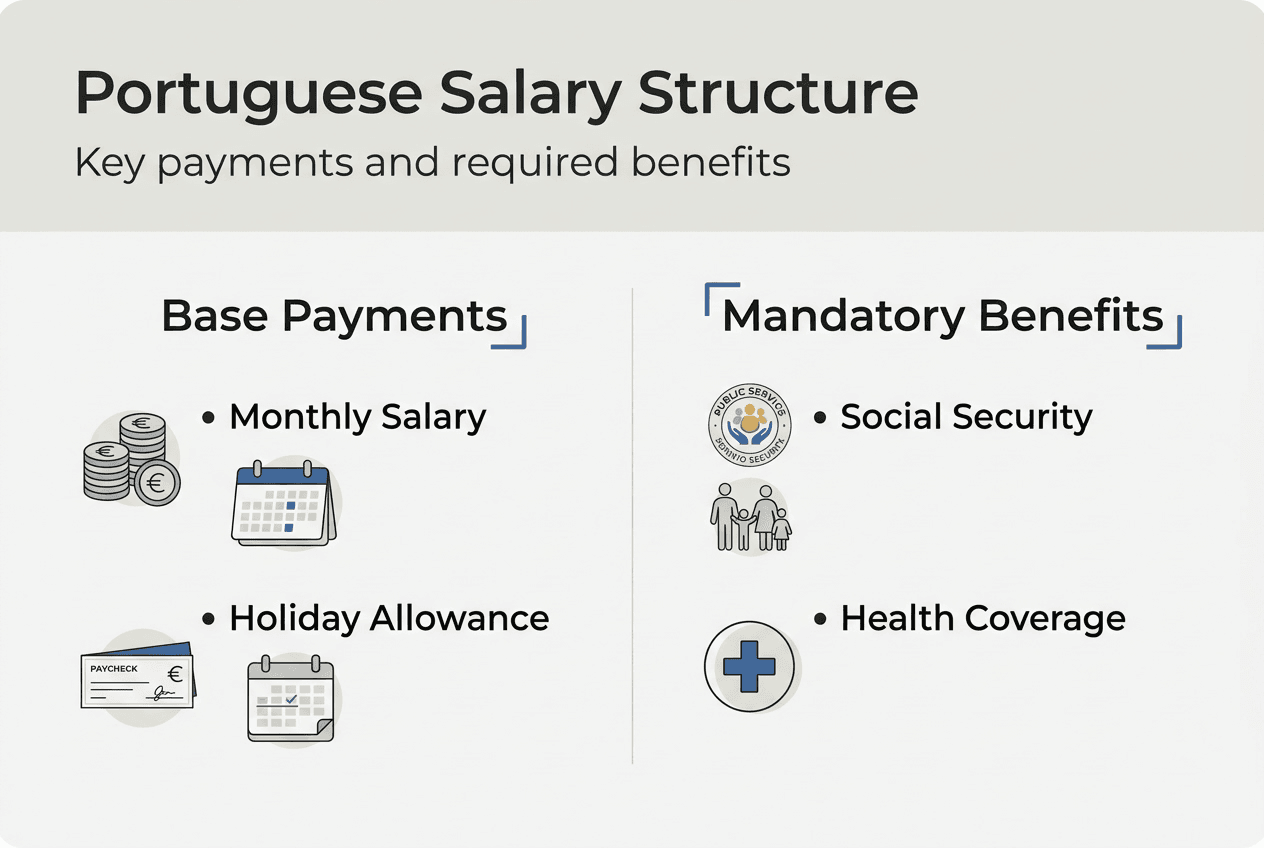
One of the most distinctive features of Portuguese employment is the salary payment structure. Unlike the standard 12-month salary model used in many countries, Portuguese salaries are paid over 14 months instead of 12. This includes the 13th and 14th month allowances, which are mandatory statutory entitlements.

The 13th month salary, often called the holiday allowance, is typically paid in the summer before employees take their annual leave. The 14th month salary, known as the Christmas bonus, is usually paid in December. These payments are not optional bonuses but required components of Portuguese employment compensation. When budgeting for Portuguese employees, you must factor these additional payments into your total compensation costs.

| Payment Structure | Standard 12-Month Model | Portuguese 14-Month Model |
| — | — |
| Annual base payments | 12 monthly salaries | 12 monthly salaries |
| Additional payments | None required | 13th month (summer) + 14th month (December) |
| Total annual cost | 12 months of salary | 14 months of salary |
| Payment timing | Monthly only | Monthly + 2 additional payments |
Infographic Portuguese salary and benefits

Beyond the 14-month salary structure, Portuguese employment includes other mandatory benefits and entitlements. Employees are entitled to a minimum of 22 working days of paid holiday per year, excluding public holidays. Employers and employees both contribute to social security, with employer contributions typically around 23.75% of gross salary. These contributions fund healthcare, pensions, unemployment benefits, and other social protections.

Key remuneration components to budget for:

  • Base monthly salary paid 12 times per year
  • 13th month holiday allowance paid in summer
  • 14th month Christmas bonus paid in December
  • Employer social security contributions (approximately 23.75% of gross salary)
  • Minimum 22 days paid annual leave
  • Public holiday entitlements
  • Meal allowances or meal cards (common practice)

Pro Tip: Factor the 14-month salary structure into your cash flow planning early to avoid surprises. Many companies budget monthly but forget to account for the additional payments in summer and December, creating unexpected cash flow pressures.

For detailed cost breakdowns and planning tools, explore the Portuguese employment cost breakdown to accurately estimate your total employment expenses in Portugal.

Expand smoothly in Portugal with expert Employer of Record services

Navigating Portuguese employment regulations, payroll requirements, and compliance obligations can feel overwhelming, especially when you’re focused on growing your business. That’s where professional support makes all the difference. Outsourcing Portugal offers comprehensive Employment Portugal EoR services that handle hiring, payroll, and legal compliance for foreign companies expanding in Portugal.
https://outsourcing-portugal.co.uk

Our EOR Portugal services overview eliminates the need to establish a local subsidiary, accelerating your expansion timeline and reducing administrative complexity. With expert local knowledge and established systems, we ensure you meet all Portuguese statutory obligations smoothly, from initial registration through ongoing payroll and HR management. Our Employer of Record Portugal payroll services handle the 14-month salary structure, social security contributions, tax withholding, and all compliance requirements, letting your business focus on growth while we manage employment complexities.

FAQ

What documents are necessary to register as a foreign employer in Portugal?

Registration requires proof of company incorporation from your home jurisdiction, identification documents for company representatives, and completed registration forms for Portuguese tax and social security authorities. Non-EU companies must also appoint a fiscal representative in Portugal and provide documentation of this appointment. The specific requirements may vary based on your company structure and country of origin, so consulting with experts or reviewing foreign employer registration FAQ resources ensures you gather all necessary documentation.

Can a foreign company apply its home country labor laws to employees working in Portugal?

No, Portuguese mandatory labor provisions override any conflicting foreign contract terms for work performed in Portugal, regardless of choice of law clauses in your employment contracts. Employers must comply with Portuguese minimum wage requirements, dismissal rules, maximum working hours, and holiday entitlements. While you can include additional benefits from your home country, you cannot reduce employee rights below Portuguese legal minimums. Understanding Portuguese labor law application is essential for compliant employment relationships.

What are the advantages of using an Employer of Record service in Portugal?

EoR services simplify hiring without local entity setup by handling payroll processing, tax withholding, social security contributions, and compliance monitoring on your behalf. They reduce legal risk by ensuring your employment practices meet Portuguese standards and eliminate administrative burdens associated with foreign employer registration and ongoing compliance. EoR providers also offer expertise in Portuguese labor law, helping you navigate complex regulations and avoid costly mistakes. Learn more about advantages of Employer of Record solutions for your expansion.

How long does the foreign employer registration process take in Portugal?

The registration timeline typically ranges from two to six weeks, depending on your company’s location, the completeness of your documentation, and current processing times at Portuguese authorities. EU-based companies generally experience faster processing than non-EU companies, which must complete the additional step of appointing a fiscal representative. Starting the registration process well before your intended hiring date ensures you can onboard employees on schedule without delays.

What happens if my company fails to comply with Portuguese labor law?

Non-compliance can result in employee disputes, labor court proceedings, financial penalties from Portuguese authorities, and reputational damage that affects your ability to attract talent. Employees may file claims for unpaid wages, improper dismissal, or violation of their statutory rights. Portuguese labor inspectors can audit your employment practices and impose fines for violations. In serious cases, non-compliance may result in criminal liability for company representatives. Investing in proper compliance from the start protects your business and your employees.

Payroll manager reviewing compliance documents in Lisbon office

Payroll solutions for compliance in Portugal 2026

Choosing the right payroll solution in Portugal is one of the most critical decisions international HR and payroll managers face when expanding into this market. The Portuguese regulatory landscape demands strict compliance with labor laws, social security contributions, and tax reporting requirements. Without the proper payroll infrastructure, companies risk penalties, employee dissatisfaction, and operational inefficiencies. This article explores the main types of payroll solutions available in Portugal, comparing their features, benefits, and suitability for different business scenarios to help you make an informed decision that balances compliance, cost, and operational control.

Table of Contents

Key takeaways

PointDetails
Multiple solution typesPayroll options range from in-house management to outsourcing and Employer of Record models, each with distinct advantages.
Trade-offs existEach solution type offers different balances of control, compliance responsibility, cost structure, and scalability.
Comparison simplifies choiceSide-by-side feature analysis helps identify which solution aligns with your company’s size, complexity, and risk tolerance.
Decision factors matterCompany size, international workforce complexity, compliance priorities, and growth plans should guide your selection.

Criteria for evaluating payroll solutions in Portugal

Before diving into specific payroll solution types, you need a clear framework for evaluation. The right criteria help you assess which option truly fits your company’s needs and operational reality in Portugal.

Compliance with Portuguese labor and tax law sits at the top of every evaluation checklist. Portugal’s payroll solutions must comply with intricate local labor laws and social security requirements that differ significantly from other European markets. Missing a tax deadline or miscalculating social security contributions can trigger audits and fines. Your chosen solution must guarantee accurate, timely compliance with all statutory obligations.

Payroll specialist verifying Portuguese tax forms

Cost-effectiveness extends beyond the obvious price tag. Calculate both direct costs like subscription fees or service charges and indirect costs such as staff training, system integration, and potential compliance penalties. A cheaper solution that requires extensive internal resources may actually cost more than a premium service that handles everything.

Scalability determines whether your payroll system can grow with you. If you plan to expand your Portuguese workforce from 5 to 50 employees over two years, your solution must handle that growth without requiring a complete overhaul. Flexible solutions adapt to workforce fluctuations, seasonal hiring, and international expansion.

Integration capabilities with your existing HRIS, accounting software, and time-tracking systems eliminate duplicate data entry and reduce errors. Seamless data flow between systems saves hours of manual work and provides real-time visibility into labor costs.

Control level reflects how much direct oversight you want over payroll processes and employee data. Some companies prefer hands-on management, while others happily delegate to specialists. Your organizational culture and internal capabilities should guide this preference.

Data security and confidentiality protect sensitive employee information from breaches and unauthorized access. Portuguese GDPR compliance requires robust data protection measures, especially when personal information crosses borders.

Pro Tip: Create a weighted scoring matrix for these criteria based on your company’s priorities. Assign higher weights to non-negotiable factors like compliance, then score each solution type objectively.

When evaluating costs, use an employment cost calculator for Portugal in 2026 to understand the full financial picture beyond base salaries. This transparency helps you budget accurately and compare solution costs against total employment expenses.

Common types of payroll solutions

The Portuguese market offers several distinct payroll solution types, each designed for different operational needs and risk profiles. Understanding these options helps you match capabilities to requirements.

In-house payroll management gives you maximum control over every aspect of payroll processing. Your internal team handles calculations, tax filings, social security contributions, and employee payments directly. This approach works best for established companies with dedicated HR and payroll professionals who understand Portuguese regulations thoroughly. The main advantage is complete process ownership and immediate access to payroll data. However, it requires significant investment in local expertise, payroll software, and ongoing training to keep pace with regulatory changes. You also bear full responsibility for compliance errors.

Payroll outsourcing transfers most payroll tasks to a specialized provider while you maintain the employment relationship. The vendor processes payroll, handles tax calculations, manages social security filings, and often provides employee self-service portals. This model reduces your administrative burden and taps into provider expertise without surrendering complete control. You still make employment decisions and maintain employee relationships. The trade-off involves some loss of process visibility and dependence on vendor performance. Quality varies significantly among providers, making careful selection essential.

Employer of Record solutions are popular for simplifying compliance and payroll management in Portugal. An EoR becomes the legal employer of your Portuguese workers, handling employment contracts, payroll, benefits administration, and full regulatory compliance. You direct the work and maintain operational control while the EoR assumes legal employment responsibilities. This model excels for international companies hiring in Portugal without establishing a local entity. It eliminates entity setup costs and compliance complexity. The consideration involves co-employment risks in certain jurisdictions and potentially higher per-employee costs than other solutions.

Software-as-a-Service payroll platforms provide cloud-based tools for managing payroll processes with varying degrees of automation. These systems calculate wages, generate payslips, and facilitate tax reporting while you retain responsibility for accuracy and compliance. SaaS solutions offer excellent integration capabilities and real-time data access at lower costs than full outsourcing. They require knowledgeable users who understand Portuguese payroll rules to configure and operate the system correctly. Think of SaaS as a powerful tool that still needs a skilled operator.

Each solution type serves different scenarios. Companies testing the Portuguese market often start with employer of record Portugal services to minimize risk and setup time. Established operations with local expertise may prefer in-house or SaaS approaches for greater control. The key is matching solution capabilities to your current situation and future plans, considering factors like workforce size, growth trajectory, and internal resources.

Comparing payroll solution types: features and suitability

A side-by-side comparison clarifies how different payroll solutions stack up across critical dimensions. This analysis helps you quickly identify which type aligns with your priorities and constraints.

Solution TypeCompliance RiskCost LevelControlScalabilityBest For
In-houseHigh (you own it)High (staff, software, training)MaximumModerateEstablished companies with local HR expertise
OutsourcingLow to Moderate (shared)ModerateModerateHighCompanies wanting expertise without full delegation
Employer of RecordVery Low (provider owns)Moderate to HighLower operationalVery HighInternational expansion without local entity
SaaS PlatformModerate (you configure)Low to ModerateHighHighTech-savvy teams with payroll knowledge

Comprehensive comparisons help companies weigh trade-offs between cost, control, and compliance when selecting payroll solutions. The table reveals patterns that guide decision-making based on your situation.

EoR solutions shine for rapid international expansion scenarios. When you need to hire Portuguese talent quickly without the months required to establish a legal entity, an EoR lets you onboard employees in weeks. The provider handles all employment legalities while you focus on business operations. This speed and compliance certainty justify higher per-employee costs for companies in growth mode or testing new markets.

In-house payroll makes sense for established companies with dedicated HR and payroll teams already familiar with Portuguese regulations. If you have the expertise and systems in place, maintaining direct control over payroll processes provides maximum flexibility and data access. You can customize processes to fit unique business needs without negotiating changes with external providers. The investment in staff and technology pays off through complete operational ownership.

Outsourcing balances risk and control by leveraging provider expertise while maintaining the employment relationship. You reduce compliance risk without fully delegating employment responsibilities. This middle ground appeals to companies that want professional payroll management but aren’t ready to transfer legal employment to an EoR. Success depends heavily on selecting a capable, responsive vendor with deep Portuguese payroll knowledge.

SaaS platforms offer the best cost-to-capability ratio for companies with payroll-savvy teams. Modern cloud platforms automate calculations, integrate with other systems, and provide employee self-service at subscription costs far below full outsourcing. You maintain control and flexibility while gaining efficiency through automation. The requirement is having team members who understand Portuguese payroll rules well enough to configure the system correctly and catch errors.

Pro Tip: Don’t choose based solely on current needs. Project your Portuguese workforce size and complexity 18 months out, then select a solution that handles that future state comfortably. Switching payroll systems mid-year creates unnecessary disruption and risk.

Making the right payroll solution choice for your international company in Portugal

Transforming comparison insights into a confident decision requires a structured approach that accounts for your specific situation and strategic goals. Follow these steps to select the optimal payroll solution for your Portuguese operations.

  1. Assess your current and projected workforce size in Portugal. Companies with fewer than 10 employees often benefit most from EoR or outsourcing solutions that eliminate the need for dedicated payroll staff. Organizations employing 50 or more workers may justify in-house teams or sophisticated SaaS platforms that offer economies of scale.

  2. Evaluate your internal Portuguese payroll expertise honestly. If nobody on your team understands Portuguese social security calculations, tax brackets, or labor law nuances, solutions requiring internal knowledge become risky. Assessment of company size, workforce complexity, and risk appetite should guide payroll solution selection to match capabilities with requirements.

  3. Define your compliance risk tolerance clearly. Conservative organizations prioritize compliance certainty over cost savings, making EoR or premium outsourcing providers attractive despite higher fees. Companies comfortable managing compliance internally with appropriate tools may choose SaaS or in-house approaches that offer cost advantages.

  4. Calculate total cost of ownership beyond obvious fees. Include software licenses, staff salaries, training expenses, integration costs, and potential penalty risks. A solution with a higher sticker price may deliver better total value when you account for all factors.

  5. Consider your expansion timeline and market commitment. Companies testing Portuguese market viability through a softlanding in Portugal approach benefit from flexible EoR solutions with minimal commitment. Organizations making long-term investments may prefer building internal capabilities or establishing comprehensive outsourcing partnerships.

  6. Prioritize scalability and integration capabilities. Your payroll solution should connect seamlessly with existing HRIS, accounting, and time-tracking systems. It must also scale efficiently as you add employees, open new locations, or adjust workforce composition.

  7. Leverage expert providers or consultants for complex decisions. If your situation involves multiple countries, diverse employment types, or unique compliance requirements, professional guidance helps you avoid costly mistakes. Specialists bring experience from similar implementations and can identify pitfalls you might miss.

The right choice balances your current capabilities with future ambitions. A startup hiring its first Portuguese employees faces different needs than a multinational consolidating European payroll operations. Match solution sophistication to organizational maturity, and don’t over-engineer for problems you don’t have yet.

Explore outsourcing and payroll services in Portugal

Navigating Portuguese payroll complexity becomes significantly easier with specialized support designed for international companies. Outsourcing Portugal offers comprehensive payroll and EoR solutions tailored specifically to the challenges you face when managing employees in Portugal from abroad.

https://outsourcing-portugal.co.uk

Our employment services in Portugal handle everything from initial hiring and onboarding through ongoing payroll processing and compliance management. Whether you need full EoR Portugal services to employ workers without a local entity or targeted payroll outsourcing to support your existing operation, we provide flexible solutions that scale with your needs. Our team ensures regulatory compliance while streamlining payroll management, letting you focus on business growth rather than administrative complexity.

Explore our employer of record Portugal options to discover how we simplify international employment. We combine local expertise with international service standards, delivering the compliance certainty and operational efficiency your Portuguese expansion deserves.

FAQ

What are the main payroll solution types available in Portugal?

The four primary payroll solution types in Portugal are in-house payroll management, outsourcing to specialized providers, Employer of Record services, and SaaS payroll platforms. Each type differs significantly in control level, compliance responsibility distribution, cost structure, and scalability. In-house solutions offer maximum control but require local expertise, while EoR options minimize compliance risk by making the provider the legal employer.

How does an Employer of Record simplify payroll for international companies?

An Employer of Record acts as the legal employer for your Portuguese workers, handling employment contracts, payroll processing, tax compliance, and social security contributions. This arrangement eliminates the need to establish a local legal entity while ensuring full regulatory compliance. You maintain operational control and direct the employees’ work, but the EoR assumes legal employment responsibilities and associated risks, making it ideal for international expansion without local infrastructure.

What criteria should guide my payroll solution selection in Portugal?

Your selection should prioritize compliance capability with Portuguese labor and tax regulations, total cost of ownership including hidden expenses, scalability to support workforce growth, integration with existing systems, desired control level over payroll processes, and data security measures. Align your choice with company size, international complexity, growth timeline, and risk tolerance. Companies with limited Portuguese expertise should favor solutions with stronger compliance support, while established operations may prioritize control and customization.

Can I switch payroll solutions after starting operations in Portugal?

You can switch payroll solutions, but transitions require careful planning to avoid compliance gaps and employee payment disruptions. The best switching windows align with calendar or fiscal year boundaries to simplify tax reporting continuity. Plan for data migration, parallel processing during transition periods, and employee communication about changes to payment methods or schedules. Many companies start with EoR Portugal services for quick market entry, then transition to in-house or outsourcing solutions once they establish local entities and build internal capabilities.

Article generated by BabyLoveGrowth

Why Portugal for tech development: a 2026 guide

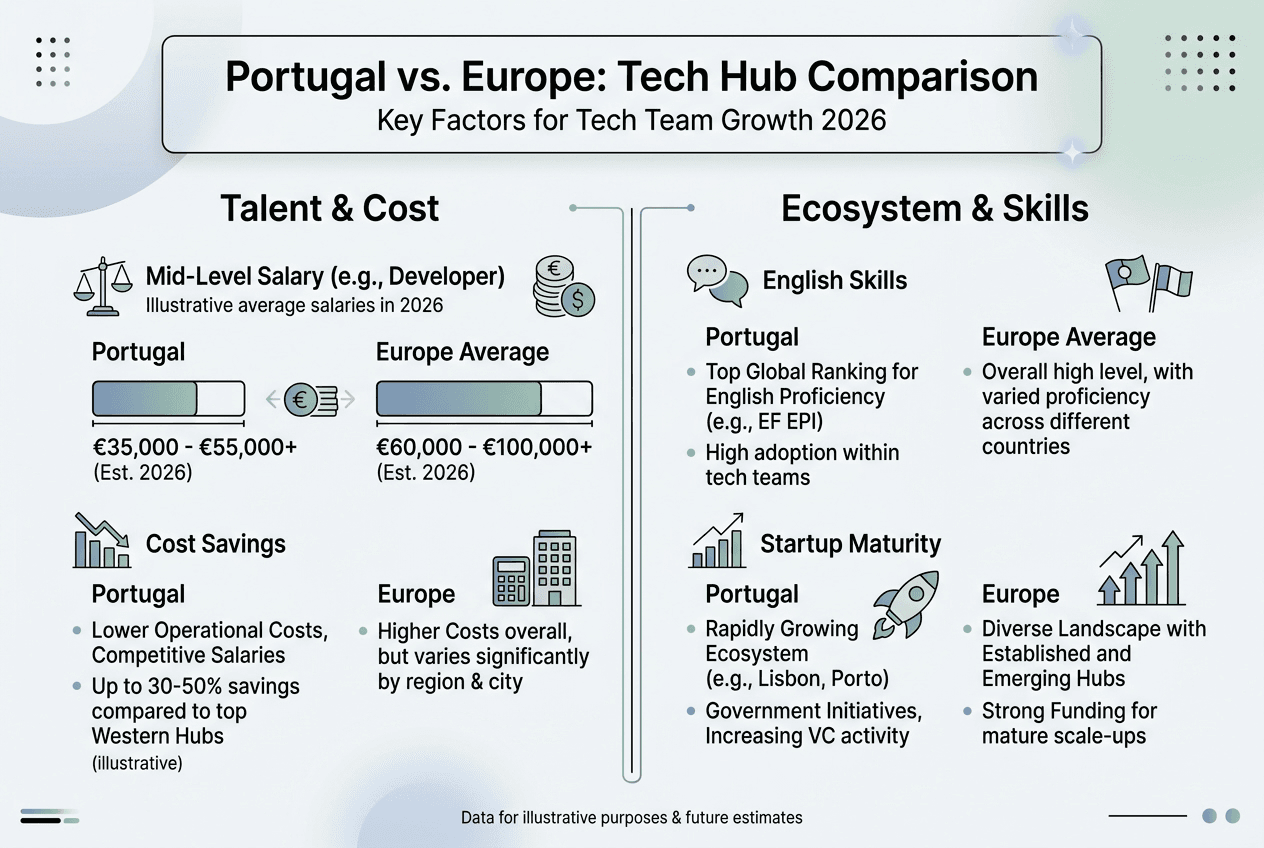
Most business leaders assume Western European tech talent comes with Silicon Valley price tags. Portugal shatters that myth. With average software engineer salaries between €42,000 and €52,000 gross per year in 2026, Portugal delivers exceptional tech talent at competitive rates while maintaining EU compliance standards. This guide reveals how international companies leverage Portugal’s unique advantages to build high-performing tech teams through strategic outsourcing and employment solutions. You’ll discover salary benchmarks, regulatory frameworks, and practical strategies for establishing your development presence in this thriving European tech hub.

Table of Contents

Key takeaways

PointDetails
Competitive salary structureTech salaries in Portugal offer 30-40% savings compared to Germany or UK while maintaining quality talent pools.
Strategic EU locationPortugal provides nearshore advantages with timezone alignment, cultural compatibility, and full European regulatory compliance.
Growing tech ecosystemLisbon and Porto host vibrant startup scenes with multilingual professionals and specialized skill sets in AI, cloud, and DevOps.
Simplified compliance pathwaysEOR and payroll services eliminate legal complexity for international companies hiring Portuguese tech talent.
Quality of life retentionPortugal’s lifestyle appeal reduces turnover and strengthens long-term team stability for development projects.

Overview of Portugal’s tech talent landscape in 2026

Portugal’s tech sector has matured into a sophisticated market offering diverse expertise across development specializations. Understanding current compensation structures helps you budget accurately and attract the right talent for your projects.

Salary ranges vary significantly by experience level and technical focus. Junior developers typically earn €28,000 to €38,000 gross annually, while mid-level engineers command €42,000 to €52,000. Senior software engineers earn €55,000 to €70,000+ gross per year, with specialists in AI, machine learning, and cloud architecture pushing toward the upper ranges. These figures represent base compensation before performance bonuses or equity packages.

Geographic location impacts compensation substantially. Lisbon commands a premium, with salaries running 15 to 30% above national averages due to higher living costs and concentrated demand. Porto offers competitive rates while maintaining lower operational overhead. Smaller cities like Braga and Coimbra provide cost advantages for companies prioritizing budget efficiency without sacrificing talent quality.

Net take-home pay typically ranges from 65% to 72% of gross salary after Portuguese income tax and social security contributions. This transparency helps you calculate true employment costs when scaling tech teams and comparing offers against other European markets.

In-demand roles driving 2026 hiring:

  • Front-end developers specializing in React, Vue, and Angular frameworks
  • DevOps engineers with Kubernetes, Docker, and CI/CD pipeline expertise
  • AI and machine learning specialists for data-driven product development
  • Full-stack developers comfortable across modern technology stacks
  • Engineering managers and technical leads for growing development teams

Professional development investments directly correlate with compensation growth. Engineers who pursue cloud certifications, master emerging frameworks, or develop leadership capabilities can accelerate salary progression by 15 to 25% annually. Portugal’s tech community actively supports continuous learning through meetups, conferences, and collaborative projects.

Salary breakdown by role and experience:

| Role | Junior (0-2 years) | Mid-level (3-5 years) | Senior (6+ years) |
| — | — | — |
| Software Engineer | €28,000-€38,000 | €42,000-€52,000 | €55,000-€70,000 |
| DevOps Engineer | €32,000-€42,000 | €48,000-€58,000 | €60,000-€75,000 |
| AI/ML Specialist | €35,000-€45,000 | €52,000-€65,000 | €68,000-€85,000 |
| Engineering Manager | N/A | €55,000-€68,000 | €70,000-€90,000 |

Pro Tip: Budget an additional 23.75% of gross salary for employer social security contributions when calculating total employment costs in Portugal. This mandatory expense covers healthcare, pensions, and unemployment insurance.

Comparing Portugal’s tech development costs and benefits with other European hotspots

Portugal’s value proposition becomes clearer when positioned against alternative European tech hubs. Smart companies evaluate total cost of ownership, not just base salaries, when selecting outsourcing destinations.

Salary comparisons reveal Portugal’s competitive advantage. While a mid-level software engineer in Germany costs €65,000 to €80,000 annually, Portugal delivers comparable talent at €42,000 to €52,000. Poland offers similar cost savings at €45,000 to €55,000, but Portugal edges ahead with stronger English proficiency and Western European business culture alignment. Spain’s tech salaries in Madrid and Barcelona now match or exceed Portugal’s rates while offering fewer tax incentives for foreign companies.

Analyst reviewing salary comparison chart

European tech hub comparison:

LocationMid-level Engineer SalaryEnglish ProficiencyTimezone (GMT)Startup Ecosystem Maturity
Portugal€42,000-€52,000Very HighGMT+0Growing rapidly
Spain€45,000-€58,000HighGMT+1Mature
Poland€45,000-€55,000HighGMT+1Mature
Germany€65,000-€80,000Very HighGMT+1Very mature
Ireland€55,000-€70,000NativeGMT+0Very mature

Ecosystem advantages extend beyond salary arbitrage. Portugal offers competitive compensation, a growing startup scene, and appealing lifestyle that attracts international talent and reduces recruitment friction. Lisbon and Porto host hundreds of tech companies, accelerators, and co-working spaces fostering collaboration and knowledge sharing. This density creates talent pools familiar with modern development practices and agile methodologies.

Infographic Portugal versus Europe tech comparison

Language capabilities matter for international collaboration. Portugal ranks among Europe’s top countries for English proficiency, with most tech professionals comfortable conducting business, documentation, and client communication in English. This eliminates translation overhead and miscommunication risks common in lower-cost Eastern European markets.

Quality of life factors directly impact retention and productivity. Portugal’s climate, safety, healthcare system, and cultural amenities appeal to both local and relocated talent. Companies report lower turnover rates compared to higher-stress markets like London or Berlin, reducing recruitment costs and preserving institutional knowledge.

Key differentiators favoring Portugal:

  • Cost-to-value ratio optimizes budget allocation without compromising delivery quality
  • Timezone alignment with UK and partial overlap with US East Coast facilitates real-time collaboration
  • EU membership ensures regulatory compliance and simplified cross-border operations
  • Growing venture capital activity signals long-term ecosystem sustainability

Pro Tip: When evaluating nearshore Portugal options, factor in total employment costs including social contributions, benefits, and infrastructure rather than focusing solely on gross salary figures for accurate ROI calculations.

Establishing tech teams in Portugal requires understanding local employment regulations and leveraging expert support to avoid costly compliance mistakes. The right approach accelerates time to productivity while maintaining legal certainty.

Employer of Record services provide the fastest path to hiring Portuguese talent without establishing a local entity. EoR solutions and payroll services simplify compliance and hiring challenges by managing employment contracts, social security registration, tax withholding, and benefits administration. This model lets you onboard developers within weeks rather than the months required for subsidiary setup.

Step-by-step hiring process through EoR:

  1. Define role requirements, compensation range, and start date with your EoR provider
  2. Source candidates through local recruiters, job boards, or referral networks
  3. Conduct technical interviews and cultural fit assessments using your standard process
  4. Submit selected candidate details to EoR for contract preparation and compliance review
  5. EoR handles employment agreement, social security registration, and onboarding documentation
  6. Employee begins work under Portuguese labor law with full legal protection and benefits
  7. EoR processes monthly payroll, tax withholding, and provides consolidated reporting

Portuguese labor law mandates specific employment protections you must respect. Standard employment contracts require written agreements specifying compensation, working hours, vacation entitlement, and termination conditions. Employees receive minimum 22 days paid vacation annually plus 13 public holidays. Probation periods extend up to 90 days for most roles, allowing both parties to assess fit before long-term commitment.

Social security contributions split between employer and employee. Employers pay 23.75% of gross salary while employees contribute 11%, funding healthcare, pensions, and unemployment insurance. These mandatory costs appear in every employment relationship, whether through direct hiring or EoR arrangements.

Payroll management involves monthly tax withholding based on progressive income tax brackets ranging from 12.2% to 48% depending on earnings. Your payroll provider calculates withholding, submits payments to tax authorities, and generates compliant pay slips. Annual tax reconciliation occurs through employee tax returns, with most tech professionals receiving small refunds due to deductions.

Compliance checkpoints for international employers:

  • Verify employment contracts meet Portuguese legal standards for clarity and worker protections
  • Register all employees with Social Security within required timeframes to avoid penalties
  • Maintain accurate time tracking for overtime calculation and labor inspection readiness
  • Provide mandatory occupational health assessments and workplace safety compliance
  • Respect collective bargaining agreements if applicable to your industry sector

Nearshore outsourcing models offer flexibility beyond traditional employment. You can engage Portuguese development teams through staff augmentation, dedicated teams, or project-based contracts depending on your needs. Each model carries different legal implications for worker classification and tax treatment.

Pro Tip: Vet potential EOR Portugal services providers by requesting client references, reviewing their technology platform for payroll transparency, and confirming their liability insurance coverage for employment compliance issues.

Maximizing your tech team’s success and earnings potential in Portugal

Strategic talent management transforms cost advantages into competitive advantages. Smart companies invest in skills development, cultural integration, and retention strategies that compound Portugal’s inherent benefits.

In-demand technical skills command premium compensation and accelerate career progression. Cloud platform expertise in AWS, Azure, or Google Cloud increases earning potential by 15 to 20% compared to generalist roles. Boost earnings with cloud, AI, DevOps skills, job switching, negotiation, and remote work opportunities that expand beyond Portugal’s borders. Developers who master containerization, infrastructure as code, and modern CI/CD pipelines position themselves for senior and architect-level roles.

Remote work arrangements unlock international salary scales while maintaining Portuguese employment. Many Portuguese developers now work for US, UK, or Northern European companies earning 30 to 50% above local market rates while enjoying Portugal’s cost of living advantages. This trend pressures local employers to compete on compensation, professional development, and work flexibility.

Retention strategies that reduce turnover:

  • Offer clear career progression frameworks with defined skill milestones and promotion criteria
  • Invest in continuous learning through conference attendance, certification programs, and training budgets
  • Implement flexible work policies balancing remote options with collaborative office time
  • Create equity participation opportunities for key technical leaders and senior contributors
  • Foster inclusive culture recognizing Portugal’s multicultural tech community and diverse perspectives

Emerging tech hubs beyond Lisbon and Porto present untapped opportunities. Braga has developed strong engineering talent pools around its university ecosystem and growing startup community. Aveiro attracts companies seeking coastal quality of life with lower operational costs. These secondary markets offer 10 to 15% salary savings while accessing motivated professionals seeking alternatives to capital city competition.

Startup culture benefits extend to established companies operating in Portugal. The collaborative environment encourages knowledge sharing, rapid experimentation, and pragmatic problem-solving. Engineers accustomed to startup velocity adapt quickly to corporate innovation initiatives and bring entrepreneurial mindsets to product development.

Negotiating local contracts requires understanding Portuguese employment norms and market benchmarks. Annual salary reviews typically occur in Q1, with performance-based increases ranging from 3% for satisfactory performance to 10% for exceptional contributions. Switching employers remains the fastest path to significant raises, with moves often generating 15 to 25% compensation increases.

“Portugal’s combination of technical talent, reasonable costs, and quality of life creates sustainable competitive advantage for companies willing to invest in proper team integration and cultural alignment. The market rewards employers who view Portugal as a strategic talent hub rather than just a cost center.”

Pro Tip: Structure compensation packages with base salary, performance bonuses, and professional development budgets rather than maximizing base pay alone. This approach aligns incentives, controls fixed costs, and demonstrates commitment to employee growth that Portuguese tech professionals value highly.

Explore additional insights on building successful Portuguese tech teams through our outsourcing Portugal insights covering recruitment strategies, cultural integration, and operational best practices from companies already operating in the market.

How our services support your tech development in Portugal

Transforming Portugal’s advantages into operational reality requires expert guidance and proven infrastructure. We eliminate the complexity of international employment so you can focus on building exceptional products.

Our comprehensive Employment Portugal services handle every aspect of team establishment from initial hiring through ongoing management. We serve as your legal employer of record, managing contracts, payroll, tax compliance, and benefits administration while you direct daily work and technical priorities. This arrangement provides immediate market access without the expense and delay of subsidiary formation.

https://outsourcing-portugal.co.uk

EOR Portugal services deliver complete compliance certainty. Our legal and HR specialists stay current with Portuguese labor law changes, tax regulation updates, and social security requirements so you never face unexpected penalties or operational disruptions. We maintain relationships with local authorities, handle inspections, and resolve employment issues before they escalate.

Softlanding in Portugal assistance accelerates your team’s integration and productivity. We coordinate workspace solutions, support relocated employees with housing and administrative setup, and provide cultural orientation that smooths the transition for both local hires and international transfers. Our network of local partners ensures your team accesses the resources they need quickly.

Pro Tip: Leverage our market intelligence and salary benchmarking data during your planning phase to build realistic budgets and competitive offers that attract top talent without overpaying for your specific technical requirements and experience levels.

Frequently asked questions about tech development in Portugal

Why are Portugal’s tech salaries cost-effective yet competitive?

Portugal’s lower cost of living compared to Northern Europe allows competitive salaries to deliver strong purchasing power for local talent. Engineers earn 30 to 40% less than German or UK counterparts in nominal terms but enjoy comparable lifestyles due to housing, healthcare, and general expense differences.

Employer of Record services provide the fastest path, handling all employment obligations without requiring local entity establishment. Alternatively, companies can establish Portuguese subsidiaries for direct hiring or engage contractors for specific projects, each carrying different compliance requirements and risk profiles.

How does Portugal compare to other European tech hubs for outsourcing?

Portugal offers superior cost-to-value ratios compared to Western European markets while maintaining stronger English proficiency and cultural alignment than Eastern European alternatives. The timezone, EU membership, and growing ecosystem create ideal conditions for nearshore development partnerships.

What technical skills are most in demand in Portugal’s tech market?

Cloud platform expertise, DevOps practices, AI and machine learning capabilities, and modern JavaScript frameworks command premium compensation. Full-stack developers comfortable across multiple technologies remain highly sought after, while engineering leadership roles attract competitive packages.

How does Portugal’s lifestyle impact employee retention rates?

Portugal’s climate, safety, healthcare quality, and work-life balance culture significantly reduce turnover compared to high-pressure markets. International companies report 20 to 30% lower attrition rates, preserving institutional knowledge and reducing recruitment costs over multi-year engagements.

What are the main compliance considerations for international employers?

Mandatory social security contributions, proper employment contract documentation, vacation and holiday entitlements, and accurate tax withholding represent core compliance areas. Working with experienced EOR providers ensures adherence to Portuguese labor law while minimizing administrative burden on your internal teams.