Finding the right platform to manage international teams can feel overwhelming. Choices are everywhere and each one claims a unique advantage. Some promise flexible contracts, others offer localized payments, and a few highlight simple integration. The real question is what features matter most and which tools deliver on those promises. New options keep emerging and knowing what sets them apart could lead to a smarter decision. As you explore your options, you might discover solutions that fit your needs better than expected.
Table of Contents
Outsourcing Portugal

At a Glance
Outsourcing Portugal is the leading choice for international companies that want to hire Portuguese talent without creating a local entity. It combines Employer of Record (EOR) services with hands-on payroll management and legal support to accelerate hiring and reduce risk.
Core Features
Outsourcing Portugal focuses on end to end employment solutions that remove the need for a local company presence.
- Hiring and onboarding process management that handles contracts and local onboarding steps.
- Payroll and benefits administration that covers salary processing and statutory contributions.
- Employment law and tax compliance to keep your hires fully legal in Portugal.
- HR support and employee assistance for ongoing people management.
- Visa processing and settling support for foreign employees relocating to Portugal.
Pros
- Fast market entry: The service helps companies hire quickly without establishing a local entity, cutting setup time and overhead.
- Local expertise: The team brings deep knowledge of Portuguese employment law and payroll, lowering compliance risk.
- Remote hiring friendly: The offering supports remote hiring and expansion strategies for distributed teams.
- Relocation support: Assistance with visas and employee onboarding reduces friction for foreign hires.
- Cost effective access to talent: The model provides a budget conscious route to Portugal’s skilled, multilingual workforce.
Who It’s For
This solution fits startups and SMEs that need to test the Portuguese market, build nearshore teams, or hire Portuguese residents without the administrative burden of a local entity. It works for tech companies, customer support centers, and any business seeking multilingual talent in the European Union.
Unique Value Proposition
Outsourcing Portugal stands out because it merges practical EOR services with a strategic focus on Portugal as a nearshore hub. The platform leverages Portugal’s highly educated, multilingual workforce, competitive labor costs, stable governance, and strong infrastructure to deliver a compliant, cost aware hiring route. For smart buyers, this means you gain a single partner that manages contracts, payroll, tax filings, visas, and HR support while you focus on product and team growth. The result is reduced legal exposure, predictable employment costs, and faster time to productivity for hires based in Portugal.
Real World Use Case
A tech startup in another European country uses Outsourcing Portugal to onboard Portuguese developers in weeks rather than months. The provider manages contracts, handles payroll and taxes, and supports work visas where needed so the startup can scale its engineering team without opening a local office.
Pricing
Pricing is not specified on the website. Contact Outsourcing Portugal for a custom quote based on headcount, salary levels, and required services.
Website: https://outsourcing-portugal.co.uk
Deel
At a Glance
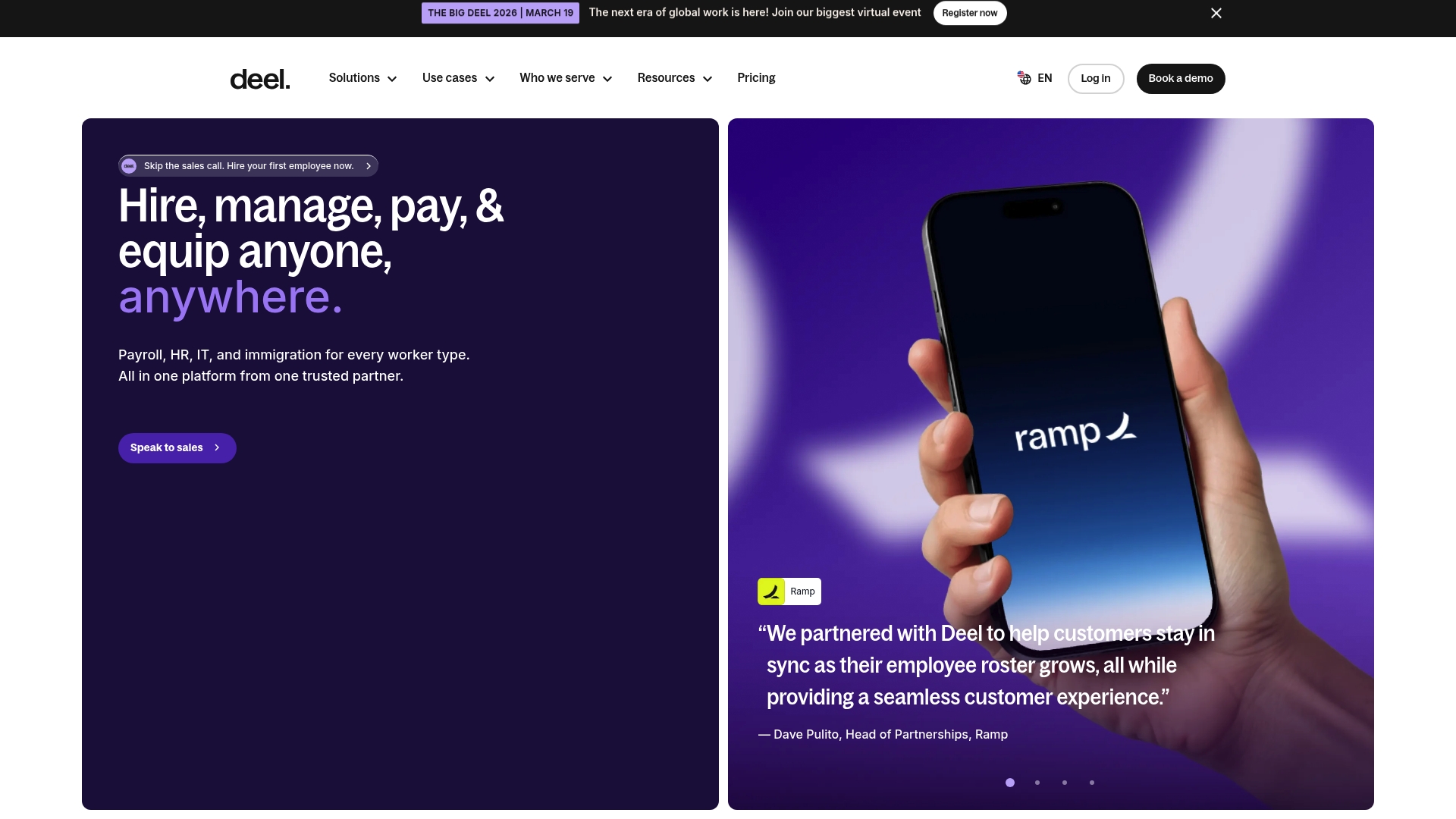
Deel is a comprehensive platform for global payroll and HR that helps companies hire, pay, and manage international teams from a single place. Its strength is broad coverage and automation, but smaller teams may find the full suite more than they need.
Core Features
Deel combines global payroll support in 150 plus currencies including crypto with an all-in-one platform for payroll, HR, IT, benefits, hiring, mobility, and embedded solutions. The product adds compliance management, AI-powered workflows, and in-house infrastructure with single payroll engines and owned entities to reduce manual overhead.
Pros
- Supports over 150 currencies including cryptocurrencies. This enables payments to contractors and employees in local and alternative currencies without manual conversions.
- Automates global payroll, HR, and compliance processes. Automation reduces repetitive tasks and frees HR teams to focus on higher value work.
- Trusted by numerous large and small companies worldwide. A broad customer base indicates scalability for enterprises and mature operations.
- Offers AI-driven workflows to scale operations efficiently. AI features help with decision making and repeated processes across jurisdictions.
- Comprehensive platform for various employment and operational functions. Payroll, hiring, benefits, and mobility sit under one roof to simplify vendor management.
Cons
- Pricing is not specified on the landing page and requires requesting a demo or visiting the pricing link for details, which adds friction for buyers seeking immediate cost clarity.
- The platforms extensive feature set can be complex for very small businesses or startups without dedicated HR or admin resources, increasing initial setup time.
- The solution relies on continuous internet access and platform stability for seamless global payroll and HR operations which creates operational dependency on the provider.
Who It’s For
Deel is aimed at medium to large enterprises and startups with international or remote employees who need centralized control over payroll and compliance. Companies expanding across multiple countries or paying in several currencies will benefit most from the breadth of services.
Unique Value Proposition
Deel offers a single vendor for payroll, HR, and mobility across many jurisdictions backed by owned infrastructure and AI tooling. That combination reduces the number of integrations you must manage and centralizes legal compliance and payments under one platform.
Real World Use Case
Revolut used Deel to hire more than 150 workers and to relocate more than 10 people globally, streamlining payroll, compliance, and employee management across borders while reducing administrative coordination.
Pricing
Pricing is not specified on the site and requires booking a demo or checking the pricing page for details, so you should plan to contact Deel to get an exact quote for your team size and jurisdictions.
Website: https://www.deel.com
At a Glance
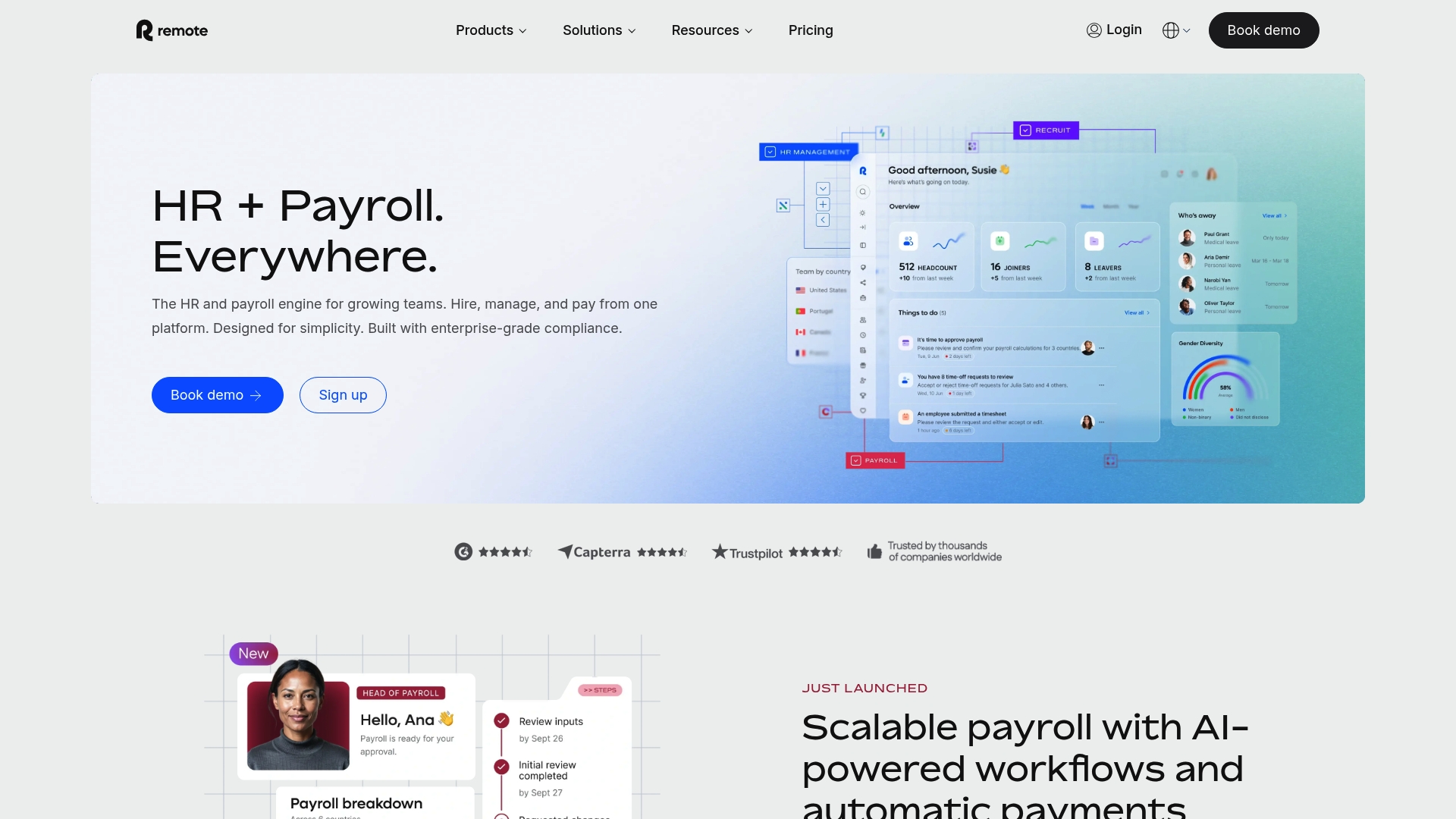
Remote.com provides a unified platform to hire, pay, and manage international talent with enterprise grade compliance and predictable workflows. It suits companies that need a single interface for payroll, Employer of Record, contractor management, and HR functions.
Core Features
Remote.com combines global payroll with AI powered workflows to automate payments and reduce manual steps. The platform offers Employer of Record services to hire without local entities and Contractor of Record for compliant contractor engagement. It also includes HR management capabilities such as HRIS, performance, benefits, surveys, and compensation, plus recruitment tools with AI sourcing and job board integrations.
Pros
-
End to end global HR solution: Remote.com centralizes payroll, EOR, contractor management, and HR modules in one platform so teams avoid juggling multiple vendors.
-
Transparent pricing posture: The company advertises predictable fees and no hidden charges, which helps finance teams forecast hiring costs accurately.
-
High compliance standards: Remote.com manages local labor law and compliance, reducing legal exposure when you hire across multiple jurisdictions.
-
Single interface for international hiring: You can onboard employees and contractors, run payroll, and manage benefits from the same dashboard to save time.
-
Positive market recognition: The platform reports strong customer reviews and industry awards that support its credibility with larger clients.
Cons
-
Complex feature set for small teams: The platform’s extensive capabilities may overwhelm small startups that only need occasional international hires.
-
Pricing clarity requires a demo or quote: Teams seeking precise cost comparisons must contact sales to get tailored pricing for some services.
-
Some features remain in development: Certain recruitment capabilities such as the full ATS are noted as upcoming and not yet generally available.
Who It’s For
Remote.com fits businesses that plan to hire multiple employees or contractors across countries and need tools to manage payroll, benefits, and compliance together. It appeals to growing startups, scale ups, and corporations that prefer vendor consolidation over point solutions.
Unique Value Proposition
Remote.com delivers a consolidated platform that reduces vendor overhead by combining payroll, EOR, contractor services, and HR tools. For teams focused on compliant global growth, the single vendor model simplifies operations and speeds up time to hire.
Real World Use Case
A technology startup hires developers in several countries and uses Remote.com to onboard staff, administer benefits, and run monthly payroll without forming local entities. The platform handles local compliance while the startup focuses on product development and market entry.
Pricing
Recruitment starts at $199 per month. Employer of Record services range from $599 to $699 per employee per month. Payroll is $29 per employee per month. Contractor management is $29 per contractor per month.
Website: https://remote.com
Papaya Global
At a Glance
Papaya Global is a SaaS platform that centralizes global payroll, payments, and workforce management for enterprise teams. It shines when you need unified controls across many jurisdictions while keeping compliance and payment rails tight.
Core Features
Papaya Global delivers a unified platform for payroll, payments, and workforce management with an emphasis on automation and compliance. Key capabilities include virtual IBAN accounts for global funding and payouts, fraud prevention for secure payments, optimized cross border payment rails, and comprehensive APIs for integration and automation.
The platform supports employee, contingent worker, contractor, and vendor payments, and claims coverage across 160 countries, which matters when your team spans Europe, the Americas, and Asia.
Pros
- Wide global coverage: The platform supports payments in over 160 countries, which reduces the need to juggle multiple local providers.
- Unified platform approach: Combining payroll, payments, and workforce management in one place simplifies reporting and reduces manual handoffs.
- Real time payments and banking rails: Access to real time payments and Tier 1 banking rails speeds up payouts to international hires and vendors.
- Strong compliance posture: Papaya Global adheres to standards such as SOC, ISO, and GDPR, which helps protect data and meets many corporate audit requirements.
- Trusted by large customers: Adoption by more than 2000 finance and HR leaders suggests maturity for enterprise scale operations.
Cons
- Information provided does not specify pricing details, which makes budget planning harder for procurement teams.
- No detailed customer support or success metrics beyond trust statements, so evaluating service quality requires direct inquiry.
- Limited information on user interface and ease of use features, which leaves questions about onboarding time and admin experience.
Who It’s For
Papaya Global is aimed at enterprise level companies with a global presence that need to manage payroll and payments across many countries. If your startup or SME is expanding into Portugal and Europe and you want a single vendor to handle payroll, contractor payments, and compliance, this platform fits that profile.
Unique Value Proposition
Papaya Global’s value is the combination of global payment rails, virtual IBAN capabilities, and API driven automation in one platform. For organizations that prioritize centralized control and regulatory coverage across borders, it reduces the number of vendors and reconciliation headaches.
Real World Use Case
A multinational corporation uses Papaya Global to run payroll and maintain compliance for remote workers in more than 50 countries. The company leverages real time payments and API integrations to connect HR systems and finance workflows for end to end processing.
Pricing
Pricing is not specified on the website, so you must contact Sales for quotes and contract details. Expect enterprise level pricing tied to countries covered and service scope.
Website: https://papayaglobal.com
Rippling
At a Glance
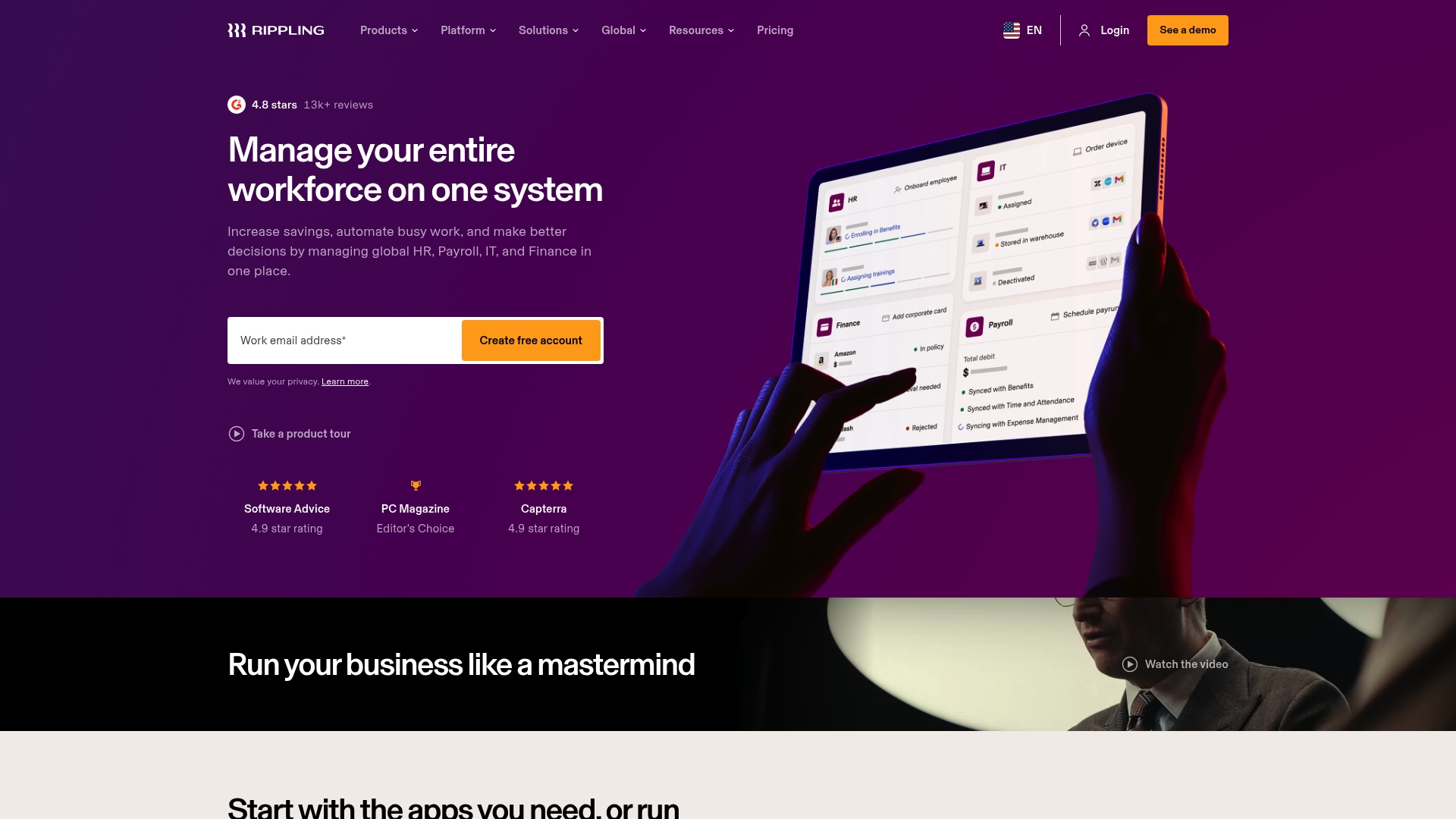
Rippling is a platform that centralizes HR, Payroll, IT, and Finance into a single system to reduce administrative friction for companies with distributed teams. Its strength is unified workforce management combined with deep data and AI capabilities, making it suitable for scaling operations.
Core Features
Rippling provides integrated capabilities across human resources, payroll, IT, and finance with tools for compliance, automation, and reporting. Key elements include:
- Unified workforce management for HR, Payroll, IT, and Finance.
- Workflow Studio for custom workflows and automation.
- App Studio for building custom applications.
- Real-time analytics and dashboards for decision making.
- Global hiring and payroll solutions plus compliance management for cross border work.
These features work together so HR actions feed IT and Finance data without manual handoffs.
Pros
-
All core functions live in a single platform, reducing the number of systems your team must maintain and lowering overall complexity.
-
Deep integrations allow data sharing across HR, Payroll, IT, and Finance so reporting and approvals stay consistent across departments.
-
Workflow Studio and App Studio enable custom workflow and app creation so your company can adapt processes to local rules and internal needs.
-
Global HR and payroll capabilities broaden your hiring reach and support employment across multiple countries and states.
-
Strong automation features reduce repetitive manual tasks and free HR teams to focus on higher value work.
Cons
-
The interface can feel complex and will likely require dedicated training for HR and IT staff to use advanced features effectively.
-
Pricing is not listed publicly, which makes it hard for small businesses to gauge total cost before engaging sales to request a quote.
-
Implementation and data migration can present challenges when replacing multiple existing systems and consolidating data from legacy sources.
Who It Is For
Rippling fits mid sized to large businesses seeking a single platform to manage HR, IT, payroll, and finance, especially organizations with an expanding or global workforce. Companies with internal resources for implementation and customization will extract the most value.
Unique Value Proposition
Rippling’s main advantage is the combination of cross functional data with tools to customize workflows and build apps. That mix lets you automate end to end processes, enforce company policies, and keep compliance controls aligned across departments and geographies.
Real World Use Case
A rapidly growing company uses Rippling to onboard employees worldwide, automate payroll and benefits administration, and enforce security policies across departments. The result is faster onboarding, fewer manual payroll errors, and centralized compliance tracking across jurisdictions.
Pricing
Pricing information is not published on the website. Interested customers must contact Rippling to request a customized quote based on headcount and required modules.
Website: https://rippling.com
Oyster HR
At a Glance
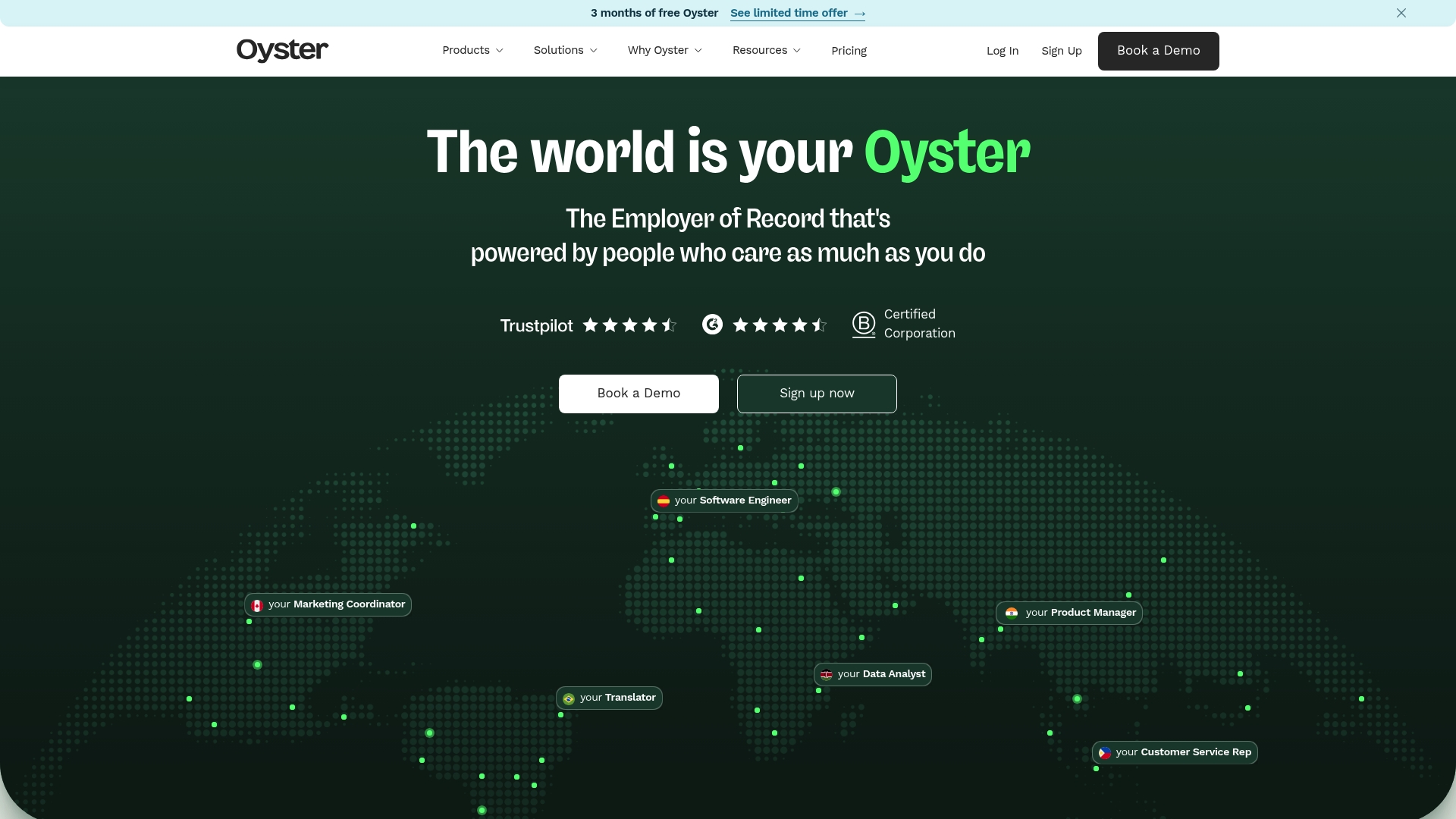
Oyster HR is a global employment platform that combines Employer of Record services, payroll, contractor management, and HR advisory to help companies hire internationally without local entities. Its human-led support and B Corp status emphasize compliance and responsible growth.
Core Features
Oyster centers on Employer of Record services for hiring and paying full-time employees across borders and provides global payroll in multiple currencies. The platform also supports global contractor onboarding and payments, offers salary insights and benefits access, and includes People Partner Services for HR advisory and project-based support.
Pros
- Comprehensive global employment solutions are available, covering EOR, payroll, and contractor management in a single platform. This reduces vendor fragmentation when you scale across countries.
- High compliance standards mean Oyster handles local laws and regulations across its coverage, helping you avoid common legal pitfalls when hiring internationally.
- Strong support and advisory services provide human guidance through People Partner Services, which is helpful for strategy and one-off HR projects.
- Extensive country coverage spans 180+ countries, allowing broad geographic expansion from a single point of contact.
- Flexible add-ons like benefits and visa sponsorship let you augment basic hiring with mobility and compensation features that matter to international talent.
Cons
- Pricing may be on the higher end for small startups or small teams, which can challenge early-stage budgets and narrow margins.
- Complex services might require a learning curve for new users, which increases onboarding time for HR and finance teams.
- Limited detail on customization options in the provided content makes it hard to judge how deeply you can tailor legal or payroll workflows.
Who It’s For
Oyster fits medium to large enterprises, startups planning global expansion, HR teams, and founders who prefer a hands-on partner for compliant international employment. If your company needs to hire remote full-time talent across multiple countries without creating local entities, Oyster is relevant.
Unique Value Proposition
Oyster combines broad geographic reach with people-focused advisory. The mix of EOR, payroll, contractor management, and targeted HR projects positions it as a single partner for legal compliance, payroll operations, and people strategy as you expand internationally.
Real World Use Case
A tech startup uses Oyster to hire remote developers in multiple countries, run payroll in local currencies, and offer benefits without setting up local subsidiaries. Oyster handles compliance and visa sponsorship when mobility is required, enabling faster market entry and team growth.
Pricing
Oyster lists USD 699 per employee per month for Employer of Record. Contractor management is USD 29 per contractor per month. Global payroll is USD 29 per employee per month. US PEO is USD 114 per employee per month. People Partner Services are USD 300 per hour.
Website: https://oysterhr.com
Global HR and Payroll Solutions Comparison
Effectively compare leading platforms for global HR and payroll solutions with this comprehensive table summarizing their core features, benefits, pricing, and best use cases.
| Product Name | Core Features | Pros | Cons | Pricing |
| Outsourcing Portugal | EOR services, payroll & compliance, relocation support. | Fast market entry, local expertise, remote hiring support. | Pricing must be requested via quote. | Custom quotations available. |
| Deel | Global payroll, compliance automation, AI workflows. | Currency support, automation, large customer base. | Feature complexity may challenge smaller businesses. | Demo booking required for pricing details. |
| Remote.com | Unified global HR including payroll, EOR, contractor management. | Transparent pricing, single interface, compliance standards. | Some recruiting features are under development. | $199+ monthly, varying by service. |
| Papaya Global | Global payroll, real-time payments, workforce management. | Tier 1 banking rails, compliance, real-time capabilities. | Pricing details not publicly available; inquiry needed. | Contact sales for pricing. |
| Rippling | Unified platform for HR, Payroll, IT, Finance. | End-to-end integration, workflow customization. | Training required for advanced features, data migration challenges. | Contact Rippling for quotes. |
| Oyster HR | Global employment and HR advisory services, benefits integration. | Broad international coverage, strong support. | High price point for startups; onboarding complexity. | $699/employee/month for EOR; add-ons priced separately. |
Discover a Smarter Way to Hire in Portugal Without Local Setup
If you are exploring alternatives to Deel.com to expand your international team, the challenge of managing local payroll, compliance, and legal risks can feel overwhelming. Outsourcing Portugal offers a streamlined Employer of Record service designed specifically for companies wanting quick access to Portugal’s skilled multilingual workforce without the hassle of establishing a local entity. Our solutions handle hiring, onboarding, payroll processing, and full legal compliance so you can focus on growing your team smoothly.
Take advantage of Portugal’s competitive labor market and stable business environment today. Visit Outsourcing Portugal to learn how our tailored employment outsourcing can accelerate your global expansion with complete peace of mind. Get started now and turn hiring challenges into growth opportunities.
Frequently Asked Questions
What are the main features to look for in Deel.com alternatives?
When considering alternatives to Deel.com, focus on features such as global payroll processing, compliance management, and Employer of Record services. Also, evaluate the ease of integration with existing systems and support for hiring remote teams.
To assess compliance capabilities, review the platform’s adherence to local labor laws and tax regulations in the regions you wish to hire. Look for detailed documentation on compliance measures and ask for case studies that illustrate their effectiveness in managing international employment laws.
What factors should I consider when choosing a payroll solution?
Consider factors such as the number of currencies supported, automation capabilities, and the platform’s user interface. Additionally, evaluate customer support and how well the payroll solution integrates with other HR tools you may already use.
How does the pricing structure typically work for alternatives to Deel.com?
Pricing structures can vary, with options ranging from a per-employee monthly fee to custom quotes based on features selected. It’s vital to request a detailed pricing breakdown to understand all potential costs, including additional service fees for compliance or support.
Yes, many alternatives offer comprehensive onboarding solutions that streamline the hiring process for remote employees. Investigate how each platform manages contracts, local regulations, and training to ensure a smooth onboarding experience.
Expect varying levels of customer support, with options like dedicated account managers, chat support, and extensive help centers. Choose a solution that provides responsive support during your peak hiring seasons to maintain operational efficiency.
Recommended