

Recruitment process outsourcing (RPO) means handing all or part of your hiring to a specialist provider that runs it as your recruiting department. It solves the problem of finding people. If you are hiring in Portugal without a local company, a second problem follows as soon as the offer is accepted: someone has to employ that person legally, run payroll and pay social security. We are Outsourcing Portugal, a Lisbon-based Employer of Record (EOR), and we handle that employment side, with local recruitment alongside it. This guide explains how RPO works, what it costs, when it fits, and how to avoid splitting one hire across two providers.
TL;DR
- RPO is the long-term transfer of some or all of your recruitment process to a specialist provider, not a one-off placement.
- It suits steady or fluctuating hiring volume. For a handful of hires in one new country, a local recruiter plus an EOR is often the simpler set-up.
- Pricing has no public rate card. Fees usually combine a fixed monthly element and a per-hire element, so ask for the full structure.
- In Portugal, finding the candidate is half the job. The legal employer, payroll and social security (23.75% employer, 11% employee) need an owner from day one.
- We are a Portugal-only specialist: once a candidate is selected and the offer agreed, we can hire within 2 days.
Table of Contents
- What recruitment process outsourcing actually is
- What parts of hiring can you outsource?
- How an outsourced recruitment process works
- RPO, a recruitment agency or an in-house team?
- What RPO costs
- What buyers report from RPO
- Hiring in Portugal through an outsourced process
- The step RPO leaves open: who employs the hire?
- When RPO is the right call, and when a lighter model works
- Making an outsourced process work
- Our approach to hiring in Portugal
- Our view: recruit and employ as one decision
- FAQ
- Sources
What recruitment process outsourcing actually is
The World Employment Confederation defines RPO as a service in which a third-party specialist takes on the role of the client’s recruiting department. The provider owns and manages part or all of the recruitment process, and brings the skills, tools and methods to run it.
Three words matter in that definition:
- Owns. The provider is accountable for the process, not just for supplying CVs.
- Part or all. You can outsource a single stage, a single function (say, engineering hiring) or the whole talent acquisition operation.
- Long term. RPO is a standing arrangement that flexes with the number of open roles. It is not a fee per placement.
The market is substantial. The same report puts global RPO at €6.3 billion in 2021, up 22% on 2020, with Europe, the Middle East and Africa accounting for around a third and growing 17%. It attributes the growth to employers’ need to scale hiring up and down at short notice.
What parts of hiring can you outsource?
RPO is modular. A peer-reviewed study of 60 hotels by Nadda, Rafiq and Tyagi shows how companies typically split it: most outsourced only part of recruitment, and the stages handed over most often were CV analysis, recruitment systems and first-round interviews. Respondents saw the most value in outsourcing the hunt for senior managers and executives.
In practice the stages look like this:
| Stage | What the provider does | What you keep |
|---|---|---|
| Workforce planning | Maps roles, timelines and budgets with you | Headcount decisions |
| Sourcing | Writes adverts, searches databases, approaches candidates | Employer brand and role brief |
| Screening | Reviews CVs, runs first interviews and assessments | Final interviews |
| Offer | Coordinates terms and negotiation | Approval of the offer |
| Onboarding | Contract, paperwork, start date logistics | Day-to-day management |
The three common models follow from this table. Full RPO covers the whole process. Project RPO covers a defined burst, such as opening a new site. Selective or hybrid RPO covers the stages you cannot staff yourself. Gartner publishes a playbook for the RPO decision for recruiting leaders weighing these models against their own organisation.
How an outsourced recruitment process works
A well-run engagement follows a predictable sequence.
- Scope the demand. List roles, seniority, locations, volume over the next 6 to 12 months and the hiring managers involved.
- Agree the service model. Decide which stages the provider owns and which stay with you. Write down who signs off shortlists and offers.
- Set the metrics. Time to hire, quality of hire, offer acceptance and cost per hire are the usual ones. Fix the definitions before the first search starts.
- Run the searches. The provider sources, screens and presents shortlists, ideally inside your applicant tracking system so you see the pipeline.
- Select and offer. You interview and choose. The provider helps with the offer and negotiation.
- Onboard and employ. The hire signs a contract with a legal employer and starts. This is the step most RPO providers do not cover when the hire is in a country where you have no entity.
Step six is where international hiring often stalls. A recruiter can find a brilliant backend engineer in Porto, but if you have no Portuguese company, nobody can issue the contract, register the person with social security or run the first payroll.
RPO, a recruitment agency or an in-house team?
The three options solve different problems.
- Recruitment agency. Fills a specific vacancy, usually for a fee per placement. Good for occasional hires. Each search starts from scratch.
- RPO. Operates as an extension of your HR function across many roles, with the provider embedded in your process and reporting on agreed metrics.
- In-house team. Maximum control, but fixed cost. The RPO Association, citing its 2022 research, reports that fewer than 20% of 519 talent acquisition decision-makers believed they could scale their team quickly after a reduction in force, and 80% said ramping up would take longer than a month.
For a company testing Portugal with two to ten hires, a full RPO contract is rarely the efficient shape. A targeted local search combined with an employer of record covers the same ground with less overhead. For a company hiring dozens of people a year across several countries, RPO earns its place, and the Portuguese hires can sit inside it with a local employment partner.
What RPO costs
There is no public rate card for RPO. Providers generally combine two elements:
- a fixed monthly fee that covers the team, systems and management;
- a variable fee per hire, often tied to candidates actually accepting permanent offers.
That is the pattern in the filings and contract surveys that pricing analyses draw on. Figures quoted in vendor blogs vary widely and rarely cite a primary source, so treat any single number as a starting point for your own quotes.
When you compare proposals, ask each provider to price the same scenario: the same roles, the same volumes, the same stages. Then check four things:
- what the fixed fee includes (sourcers, recruitment marketing, technology, reporting);
- how the per-hire fee is triggered and when it is invoiced;
- what happens to fees if a hire leaves in the first months;
- how much notice you must give to scale down or end the contract.
The RPO Association’s 2023 research found that cost is the top reason employers do not use RPO, followed by fear of losing control. Both are manageable with a clear scope and agreed reporting from the outset.
What buyers report from RPO
The RPO Association’s 2026 buyer survey, run with Lighthouse Research & Advisory among 998 employers including 454 active RPO users, found that nearly 70% of buyers report a positive return on investment and a majority say hiring metrics improved. It also found that nearly six in ten employers are considering switching providers or restructuring the engagement, and that the report sorts partnerships into transactional, strategic and transformational tiers.
Two lessons follow for a first-time buyer:
- Define what you want from the partnership at the start. A transactional arrangement (fill these requisitions) and a strategic one (help shape our talent plan) need different contracts and different reporting.
- Plan for review points. If most buyers revisit their set-up, build a scheduled review into yours rather than waiting for friction.
The same report names AI expertise as a top buyer expectation and applicant fraud as a top hiring concern. That has a practical consequence: your applicant tracking system and identity checks matter as much as the sourcing. A free applicant tracking system is one way small teams can keep screening records in one place while they grow.
Hiring in Portugal through an outsourced process
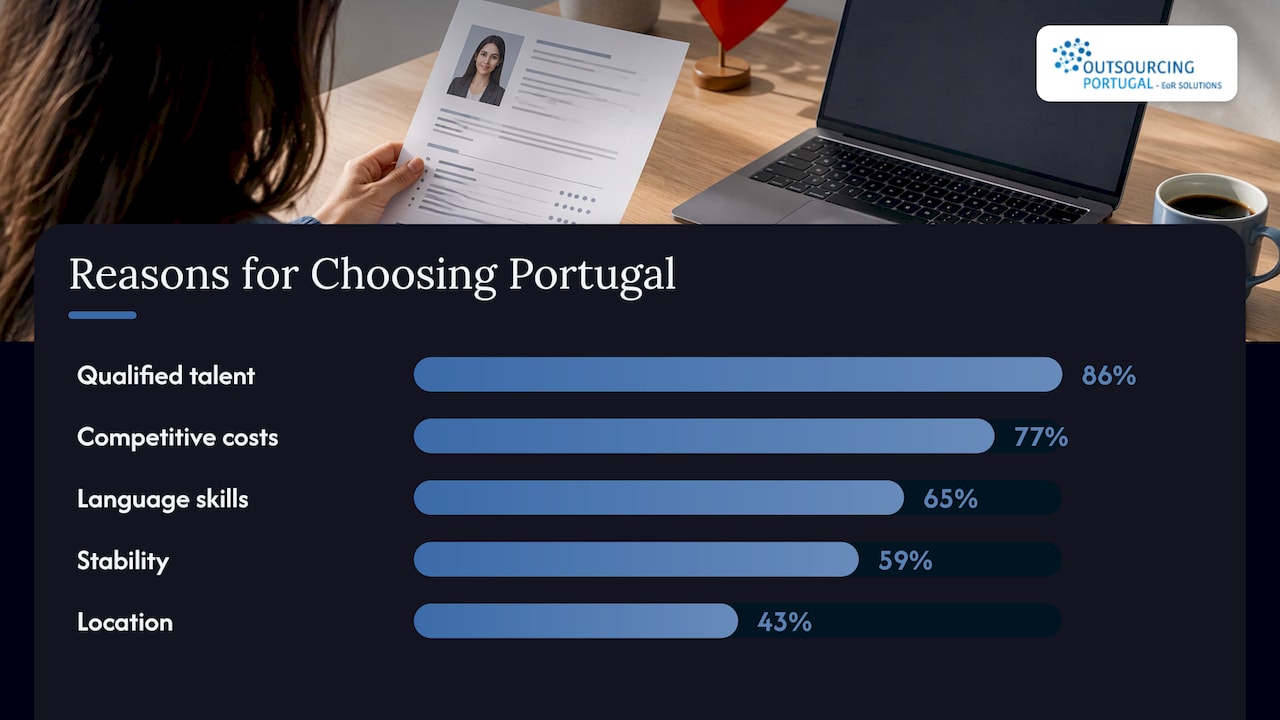
Portugal is a sensible place to build a team, and the data supports it. PortugalGlobal’s 2025 survey of service centres (126 respondents, plus executive interviews) found that companies choose Portugal mainly for qualified local talent (86%) and competitive costs (77%), followed by language skills (65%), stability (59%), location (43%) and time zone (41%). In the same report, IDC data shows 87% of service-centre employees have higher education, and average attrition is 12%. Salaries grew by an average of 5.6% a year over 2021 to 2023, so budget for movement rather than a flat rate.
Two details shape how you recruit there:
- Channels. The report finds employee referrals are now the most common recruitment channel in Portuguese service centres (92%), ahead of university cooperation (67%). A provider with local networks has an advantage over a remote search on a global job board. Our guide to sourcing multilingual talent in Portugal goes into the language side.
- Time zone. Portugal shares the UK and Ireland time zone, which makes daily overlap with London easy and leaves a workable window with the US East Coast.
The report also records that bringing specialised talent from outside the EU runs into bureaucratic hurdles. If your shortlist includes candidates who need a residence route, plan the immigration steps in parallel with the search. Our visa and immigration support is part of the soft landing service.
The step RPO leaves open: who employs the hire?
To employ someone in Portugal you need a Portuguese legal employer. You have two routes:
- Set up a Portuguese company. This makes sense once you have a settled team and long-term plans. It means incorporation, registration, a payroll set-up and ongoing filings. If you are weighing it, this overview of outgrowing your company structure frames the general question of when structure should change.
- Use an Employer of Record. The EOR is the legal employer in Portugal. You choose, direct and manage the person day to day, while the EOR holds the contract, runs payroll and handles social security. You can read how that works in our employer of record guide for Portugal.
The cost base is the same on either route. Employer social security is 23.75% of salary and the employee contributes 11%, on top of the usual income tax withholding. A recruiter who quotes only a placement fee has told you nothing about this part of the budget, so ask for the full employment cost of a hire at your target salary.
This is where we fit. Once you have selected a candidate and agreed the offer, we can hire within 2 days. That is the point of joining recruitment and employment: the candidate you chose can start without a wait for an entity to be created.
When RPO is the right call, and when a lighter model works
Use this as a quick test.
| Your situation | Sensible set-up |
|---|---|
| 1 to 10 hires in Portugal over a year, no local entity | Targeted local recruitment plus an EOR |
| Testing the market before committing | EOR, so you can hire without registering a company |
| 10+ hires a year across several countries | Full or hybrid RPO, with a local employment partner per country |
| A one-off team build, such as an engineering squad | Project RPO or a nearshore team set-up |
| Sales capacity needed quickly | Outsourced SDR or BDR team |
If your need is technical capacity rather than individual employees, our nearshore services cover software development, cloud and DevOps, UX/UI and mobile, and our sales outsourcing covers lead generation, SDR and BDR teams and full-cycle sales.
Making an outsourced process work
A few habits separate engagements that deliver from those that drift:
- Appoint one owner on your side. The provider needs a single person who can approve shortlists quickly. The Nadda study cited above found that lack of communication and poorly monitored outsourced activities were among the main challenges, while a positive organisational culture helped.
- Share the role brief properly. Salary range, reporting line, working pattern, languages and the reason the role exists.
- Meet weekly at first. Review pipeline, drop-off and feedback from hiring managers.
- Agree the employment terms before the search. Salary, benefits and working pattern in Portugal should be settled before candidates are approached, so offers do not stall.
- Keep candidate verification in the process. Applicant fraud is a stated concern among RPO buyers, so identity and reference checks belong in the scope.
Our approach to hiring in Portugal
We are Outsourcing Portugal, a Lisbon-based Employer of Record and part of HRB Solutions Group, which has been in the market for 20 years. We have hired 500+ people, and we work in Portugal only, so our attention is on one country’s law, payroll rules and talent market.
For an international company the practical results are these:
- One competitive monthly fee for the employment service.
- Tailored salary packages with tax optimisation, built within Portuguese rules.
- Personal, human support from people who handle your onboarding and payroll.
- Hiring within 2 days once the candidate is selected and the offer is agreed.
Our Employer of Record service covers hiring, onboarding, payroll, benefits, and legal and tax compliance. If you already have employees and need only the payslips, there is a payroll-only option. Tell us the roles you plan to fill and we will explain how the employment side would work. You can contact us here.
Our view: recruit and employ as one decision
Most advice on recruitment process outsourcing treats hiring as a pipeline that ends at the signed offer. For a company that already has a legal entity in the country, that is a fair view. For a company hiring into Portugal from abroad, the signed offer is where the legal work begins.
We see the two as one decision. The person you choose needs a compliant contract, correct social security registration and accurate payroll from the first day. If recruitment and employment sit with different providers, each handoff adds delay and a place for errors.
That is why we work as a Portugal-only specialist. We know the local rules, we offer local recruitment and we employ the hire, with a single monthly fee and a person you can talk to. Our tailored salary packages are designed to make the most of the tax rules that apply, so the candidate sees a competitive package and you see a clear cost.
Our advice to HR leaders and founders: decide the employment route first, then brief the search. You will make better offers, and the new hire will start sooner.
Outsourcing Portugal Team
FAQ
Is RPO the same as using a recruitment agency?
No. An agency fills individual vacancies and usually charges per placement. RPO is an ongoing arrangement where the provider runs part or all of your recruitment process as your recruiting department, with agreed metrics and reporting.
How much does recruitment process outsourcing cost?
There is no public rate card. Fees commonly combine a fixed monthly fee with a per-hire fee, and the structure differs by provider. Ask each one to price the same roles and volumes so the quotes can be compared fairly.
Can I outsource only part of my recruitment?
Yes. Many employers outsource selected stages such as CV screening, systems or first interviews, and keep final selection in-house. Project and hybrid models exist for exactly this.
Do I need a Portuguese company to hire someone I recruit there?
You need a Portuguese legal employer. That can be your own entity or an Employer of Record. With us, once you have selected a candidate and agreed the offer, we can hire within 2 days, so you can start without waiting for a company to be set up.
Sources
- World Employment Confederation, Economic Report 2023
- RPO Association, 2026 RPO Buyer Trends Report
- RPO Association, What is Recruitment Process Outsourcing?
- Nadda, Rafiq and Tyagi, Effectiveness and Challenges of Recruitment Process Outsourcing
- Gartner, Playbook for Making the RPO Decision
- PortugalGlobal, Service Centres in Portugal 2025
- Associação Portugal Outsourcing, Portugal a nearshore outsourcing destination
Recommended
- Recruiter Job Description: A 2026 Guide for HR Teams
- Best HR Outsourcing Platforms 2026 for HR Leaders
- Best Outsourcing Tools for International Hiring in 2026
- Top 3 recruitoutsource.com Alternatives Agencies 2026
Disclaimer: This article is for general information only and does not constitute legal, tax, or employment advice. Laws and regulations change often. Please consult a qualified professional before making decisions. For Employer of Record services in Portugal, contact Outsourcing Portugal.