Maximize hiring success: the role of employer services in Portugal


TL;DR:

  • Portugal’s strict labor laws and contractor classification risks require specialized employer services for compliance.
  • Employer of Record (EOR), local entity setup, and payroll outsourcing are the main models depending on company size and long-term plans.
  • Due diligence in choosing a provider is vital to avoid hidden costs, compliance gaps, and operational risks.

Portugal looks like an easy win on paper. A stable EU member state, a talented multilingual workforce, and competitive labor costs make it one of Europe’s most attractive nearshore destinations. But strict dismissal laws and misclassification risk make Portugal’s labor environment far more complex than most international HR leaders expect. Skipping specialized employer services is one of the most common and costly mistakes companies make when entering this market. This guide breaks down exactly what employer services are available, which compliance traps to avoid, and how to match the right solution to your expansion strategy.

Table of Contents

Key Takeaways

Point Details
Strict local regulations Portugal enforces complex dismissal and classification laws that elevate compliance risks for international employers.
EOR vs entity setup Employer of Record suits rapid hiring for small teams, while entity setup becomes cost-effective for larger, long-term operations.
Value of specialized support Expert employer services simplify hiring, payroll, and compliance—reducing legal and financial exposure for expanding companies.
Critical due diligence Rigorous partner selection and clear compliance insights are essential for successfully hiring talent in Portugal.

Why employer services matter in Portugal’s talent market

Portugal has earned its reputation as a top nearshore hub, but its employment framework is not forgiving of shortcuts. The country’s labor code is built around strong worker protections, and those protections carry real teeth for employers who don’t know the rules.

Here’s what catches most international companies off guard:

  • No-fault dismissal is prohibited after the probation period ends. You need documented, substantiated grounds to terminate any employee.
  • Notice periods can run up to 240 days depending on seniority and contract type.
  • Severance obligations are legally mandated and calculated based on tenure.
  • Contractor misclassification under Law 12/2013 carries fines exceeding €50,000 and can trigger retroactive employment reclassification.

“Portugal enforces strict dismissal laws and high penalties for contractor misclassification, creating significant legal exposure for foreign employers who rely on informal or freelance arrangements.”

The financial stakes are not abstract. Misclassifying a worker as an independent contractor when they function as a full-time employee can result in back-payment of social security contributions, benefits, and severance, on top of the regulatory fines. For a company running lean operations, that exposure can be catastrophic.

This is exactly why compliance in Portugal hiring has become a strategic priority rather than an afterthought. International HR teams are increasingly turning to payroll outsourcing in Portugal because the alternative, managing Portuguese payroll and employment law in-house without local expertise, is simply not sustainable at scale.

The Europe payroll outsourcing market has been growing steadily as companies recognize that regulatory complexity across EU jurisdictions demands specialized support. Portugal is no exception. For international HR managers, the question is no longer whether to use employer services, it’s which type fits your specific situation.

Main types of employer services in Portugal

Not all employer services are the same, and choosing the wrong model for your stage of expansion can cost you time, money, and legal standing. There are three primary approaches available to foreign companies hiring in Portugal.

1. Employer of Record (EOR)
An EOR becomes the legal employer of your workers in Portugal. Your team members work for you operationally, but the EOR handles contracts, payroll, benefits, and full legal compliance. This is the fastest path to hiring without setting up a local entity. The EOR hiring guide outlines exactly how this model works in practice.

2. Local entity setup
You register a Portuguese subsidiary or branch and hire employees directly. Portugal’s ‘Empresa na Hora’ program allows entity creation in as little as one business day, which is genuinely impressive. However, ongoing compliance, tax filings, and HR administration remain your responsibility.

3. Payroll outsourcing
You maintain the employment relationship but outsource payroll processing and reporting to a local specialist. This works well when you already have a local entity but want to reduce administrative burden.

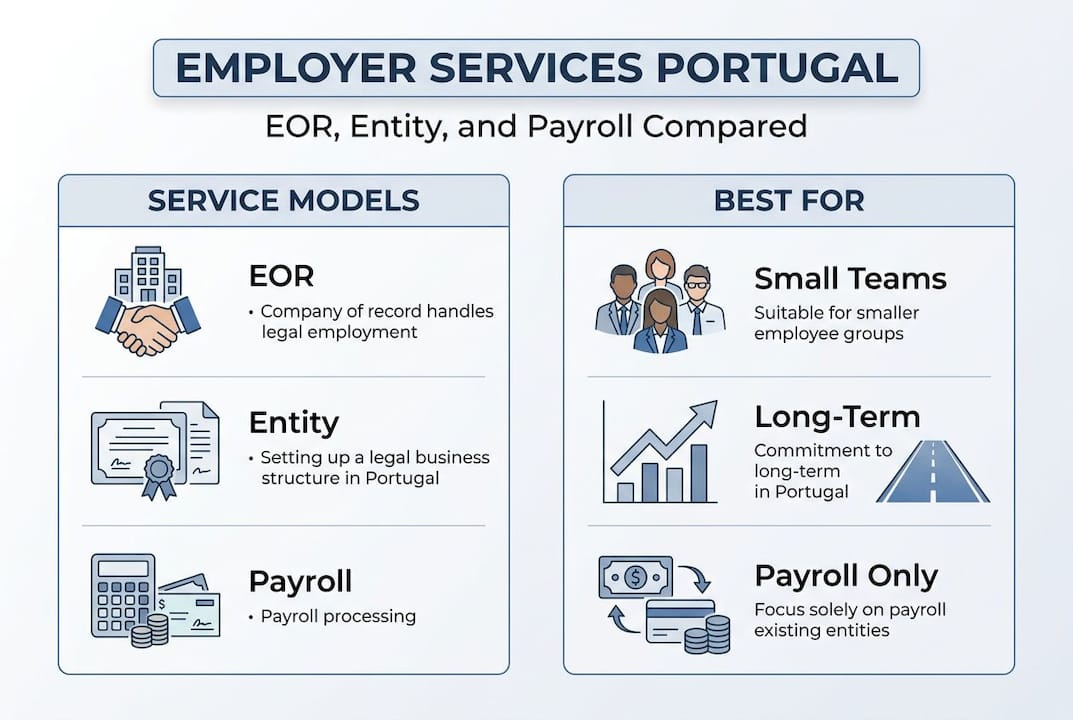
Here’s how the three models compare at a glance:

Service model Best for Speed Cost Compliance coverage
EOR Under 8 employees, short-term projects Fast (days) Higher per-employee Full
Local entity 8+ employees, long-term scaling Slow (weeks/months) Lower at scale Requires active management
Payroll outsourcing Existing entity, admin reduction Moderate Low to moderate Partial

Infographic comparing employer services Portugal

According to cost-effective hiring guidance, EOR is ideal for fewer than 8 employees and short-term projects, while entity setup becomes more cost-effective for larger, long-term teams despite the initial setup delays.

Pro Tip: Portugal’s ‘Empresa na Hora’ is a genuinely fast entity creation tool, but speed of registration does not equal compliance readiness. You still need local HR expertise and a robust payroll process from day one.

For most companies entering Portugal for the first time, employer of record services offer the lowest-risk, fastest path to compliant hiring while you assess whether the market justifies a permanent entity investment.

Professional reviews payroll with coworking details

Key compliance risks and how employer services address them

Compliance in Portugal is not a one-time checkbox. It’s an ongoing operational requirement that evolves with legislation, tax policy, and labor court decisions. Here are the four biggest risk areas international HR teams face:

  • Dismissal law exposure: Post-probation terminations require documented cause. Wrongful dismissal claims are common and expensive.
  • Contractor misclassification: 70% misclassification risk reported by PwC, with fines up to €50,000 under Law 12/2013. This is not a theoretical risk.
  • GDPR data handling: Employee data must be managed under strict EU data protection rules. Payroll systems, HR platforms, and onboarding tools all carry GDPR obligations.
  • Tax regime changes: The removal of Portugal’s Non-Habitual Resident (NHR) tax regime post-2024 has shifted the tax landscape for internationally mobile employees, creating new planning requirements.

“The combination of contractor misclassification exposure, GDPR obligations, and post-NHR tax complexity means Portugal’s compliance environment is more demanding in 2026 than it was just two years ago.”

Reputable employer services address these risks by acting as the legal employer of record, maintaining compliant contracts, managing payroll under Portuguese law, and handling GDPR-compliant data processing. They also stay current on legislative changes so you don’t have to.

Use the payroll compliance checklist to audit your current processes, and review compliance strategies for hiring to understand where your gaps may be.

Pro Tip: Even when using an EOR, you retain responsibility for how intellectual property is managed and how employee data flows between your systems and the EOR’s platform. Demand a clear data processing agreement and IP ownership clause before signing any EOR contract.

The companies that get into trouble are rarely the ones who ignored compliance entirely. They’re the ones who assumed their employer service provider had it covered without verifying the specifics.

How to choose the right employer services in Portugal

Selecting the right employer service is not just a procurement decision. It’s a strategic one that affects your legal exposure, your team’s experience, and your ability to scale. Here’s a practical framework for making the right call.

Step 1: Define your employee count and time horizon.
For fewer than 8 employees or a project under 18 months, EOR is almost always the right answer. For larger, permanent teams, entity setup deserves serious consideration.

Step 2: Assess your risk tolerance.
If your industry involves sensitive data or regulated activities, you need a provider with demonstrable GDPR and sector-specific compliance experience, not just a generic EOR platform.

Step 3: Evaluate provider track record in Portugal specifically.
Portugal’s labor code has unique quirks. A provider with broad European coverage but shallow Portugal expertise is a liability. Ask for case studies and references from Portuguese hires.

Step 4: Map compliance coverage to your needs.
Use the table below to align your situation with the right service model.

Scenario Recommended model Key consideration
Testing the Portuguese market EOR Speed and low commitment
Building a nearshore tech team (10+) Local entity + payroll outsourcing Cost efficiency at scale
Short-term project staffing EOR Flexibility and compliance coverage
Existing entity, growing team Payroll outsourcing Reduce admin, maintain control

As the Portugal EOR decision guide makes clear, EOR versus entity decisions hinge on employee count, time horizon, risk tolerance, and your broader expansion strategy. There is no universal right answer, but there is a right answer for your specific situation.

Step 5: Check for hidden costs.
EOR pricing often looks simple but can include per-employee fees, benefits markups, and exit costs. Get a full cost breakdown before committing.

A candid view: What most guides don’t tell you about hiring in Portugal

Most articles on employer services in Portugal present EOR as the obvious, simple solution and entity setup as the slow, expensive alternative. That framing is too clean.

EOR is fast and genuinely useful, but it comes with real trade-offs that providers rarely volunteer. Co-employment dynamics can create friction around performance management, and IP ownership can become murky when the legal employer is a third party. These are not hypothetical concerns. They surface in practice.

Entity setup looks expensive and slow on a spreadsheet, but for companies building a serious nearshore presence, it creates a level of operational control and employer brand credibility that EOR simply cannot replicate. The companies scaling 20-person tech teams in Lisbon are not doing it through EOR.

The most overlooked risk of all? Assuming your provider handles compliance without verifying it. We’ve seen companies rely on real EOR experience only to discover gaps in GDPR documentation or missing social security filings months later. Due diligence on your employer service partner is not optional. It’s the foundation of everything else.

Next steps: Expert employer services for Portugal expansion

If this article has clarified the landscape, the next move is finding a partner who knows Portugal’s employment market from the inside out.
https://outsourcing-portugal.co.uk

Portugal employer services from outsourcing-portugal.co.uk cover the full spectrum: EOR hiring, payroll management, legal compliance, and onboarding support for international teams. Whether you’re placing your first hire or scaling a nearshore operation, explore Portugal EOR solutions designed for companies at every stage of expansion. The compliance hiring guide is a strong starting point if you want a structured walkthrough before speaking with an advisor.

Frequently asked questions

Do I need a local entity to hire employees in Portugal?

No. EOR solutions for under 8 employees allow you to hire compliantly without entity setup, though larger or long-term teams often benefit from establishing a local entity for cost and control reasons.

What are the risks of hiring contractors in Portugal?

Contractor misclassification is heavily scrutinized in Portugal, with 70% misclassification rates reported and fines exceeding €50,000 under Law 12/2013, making it one of the highest-risk approaches for foreign employers.

How do employer services help with GDPR compliance?

Reputable employer services manage payroll and HR data under GDPR frameworks, acting as data processors and reducing your company’s direct legal exposure under EU data protection law.

Is Portugal’s fast entity setup suitable for all companies?

Portugal’s ‘Empresa na Hora’ enables rapid entity creation in as little as one day, but ongoing compliance obligations mean it’s only the right fit for companies ready to actively manage Portuguese employment law from day one.

Why Choose Portugal for Nearshore Outsourcing Success


TL;DR:

  • Portugal has a strong, diverse workforce with a rapidly developing tech ecosystem.
  • High demand and talent shortages for senior IT roles require strategic hiring and pipeline development.
  • Proactive local partnerships, community engagement, and compliance support are key to long-term success.

Portugal is one of Europe’s most misunderstood outsourcing destinations. Many international business leaders assume it offers only low-cost, entry-level labor, while others believe the talent pool is too thin for serious tech operations. Both assumptions are wrong. Portugal’s workforce is genuinely strong across many disciplines, its tech ecosystem is maturing fast, and its time-zone alignment with Western Europe makes it a natural nearshore fit. But there is a real tension here: the same digital transformation driving demand for Portuguese talent is also creating fierce competition for senior IT professionals. Understanding that duality is the key to building a successful nearshore operation in 2026.

Table of Contents

Key Takeaways

Point Details
Labor market advantage Portugal’s workforce is stable and increasingly attractive for international companies.
IT skills gap Filling advanced tech roles can be challenging due to high competition and industry shortages.
Nearshore strengths Portugal offers a strong tech ecosystem, strategic location, and robust infrastructure for outsourcing.
Success strategies Winning in Portugal means adapting hiring plans, building partnerships, and leveraging expert support.

Portugal’s labor landscape: Opportunities and realities

Portugal’s overall employment picture is healthier than most people expect. The country’s unemployment rate sits between 5.6% and 6.3%, which is below the EU average, signaling a stable and active workforce. That stability matters for HR leaders planning long-term headcount growth, because it suggests lower workforce volatility compared to markets with boom-and-bust hiring cycles.

However, stability at the macro level does not mean easy hiring across every discipline. Portugal’s competitive workforce is genuinely strong in areas like customer support, finance, legal services, and general software development. The challenge appears when you need senior AI, machine learning, or cloud architecture specialists. Demand for these profiles is outpacing supply, and companies that ignore this reality end up with delayed launches and frustrated hiring managers.

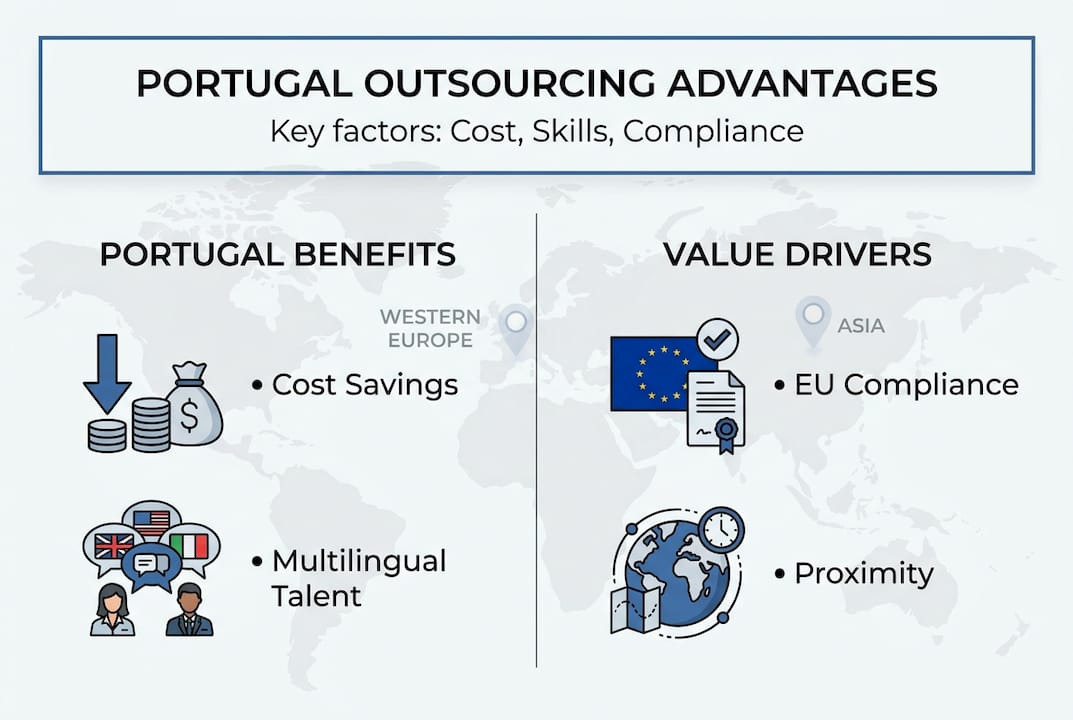
Infographic on Portugal’s nearshore outsourcing drivers

Time-to-fill is a concrete metric worth tracking. IT roles in Portugal can take anywhere from 98 to 127 days to fill, which is significantly longer than general professional roles. If your expansion plan assumes a 30-day ramp, you will miss your targets. Build buffer time into your hiring roadmap from day one.

Role category Avg. time-to-fill Competition level
Customer support 20 to 35 days Moderate
General software dev 45 to 70 days High
Senior IT / AI / ML 98 to 127 days Very high
Finance and admin 25 to 40 days Low to moderate

“Portugal’s labor market is strong for most roles, but IT talent is a different game entirely. Plan your pipeline accordingly or expect delays that compound over time.”

The key reasons companies choose Portugal go beyond cost. Cultural alignment with Western Europe, a high rate of English fluency, and a growing startup scene all contribute. But the smart move is to look beyond Lisbon. Porto has a deep and often underutilized talent pool, and cities like Braga and Coimbra are producing strong graduates in engineering and computer science every year.

Key workforce strengths at a glance:

  • Multilingual professionals with strong English proficiency
  • EU-compliant employment framework with predictable legal standards
  • Growing STEM graduate pipeline from top Portuguese universities
  • Active tech communities in Lisbon, Porto, Braga, and Coimbra

Pro Tip: Do not limit your search to Lisbon. Porto and smaller university cities offer comparable talent with less competition and, in some cases, lower salary expectations.

Key factors driving Portugal’s nearshore outsourcing growth

Portugal’s rise as a nearshore destination is not accidental. Several structural factors have converged to make it one of the most attractive options for international companies looking to build European operations without the overhead of Western European pricing.

First, time-zone alignment is underrated. Portugal operates on Western European Time, which means near-perfect overlap with the UK, France, Germany, and the Netherlands. For companies managing distributed teams, that synchronous working window is enormously valuable. No one is waiting until 2 p.m. for a morning standup.

Second, English fluency is genuinely high. Portugal consistently ranks among the top non-native English-speaking countries in Europe, which removes a major friction point for international teams. Your onboarding materials, Slack channels, and client calls can all run in English without translation overhead.

Third, Portugal’s tech development strengths are growing. The country has attracted major tech investments from companies like Google, Mercedes-Benz, and Volkswagen, which signals ecosystem maturity, not just cost arbitrage. That investment is building local expertise and raising the overall skill ceiling.

Despite these advantages, one common mistake is overlooking Portugal’s depth in advanced digital skills. While 85% of companies report IT talent shortages, which is higher than the global average of 73%, this reflects demand outpacing supply rather than an absence of skilled professionals. The talent exists. You need a smarter strategy to find it.

Top reasons companies choose Portugal for nearshoring:

  1. Skilled, multilingual labor with strong technical foundations
  2. Strategic location with EU membership and Western European time-zone alignment
  3. Competitive labor costs compared to Germany, France, or the UK
  4. Government-backed incentives and a stable regulatory environment
Country Avg. senior dev salary (annual) Time-zone overlap with UK English proficiency
Portugal €35,000 to €55,000 Full overlap Very high
Poland €40,000 to €65,000 1 hour difference High
Romania €30,000 to €50,000 2 hours difference Moderate to high
Germany €70,000 to €95,000 1 hour difference High

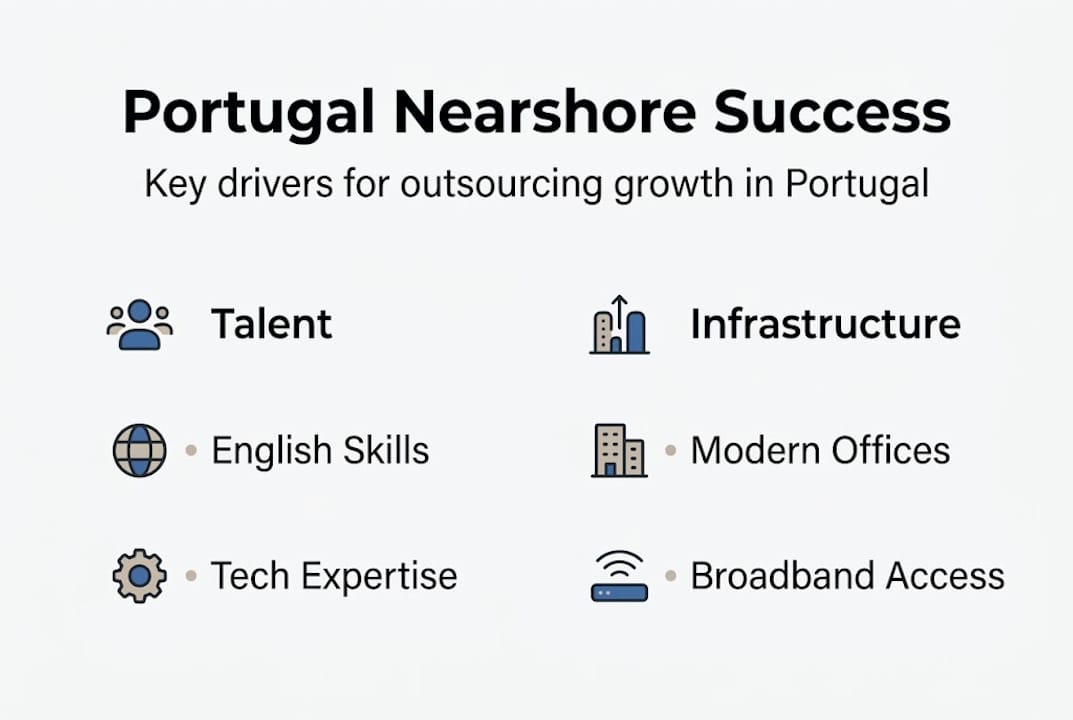
Portugal’s infrastructure advantages also play a real role. Reliable broadband, modern office spaces, and strong transport links between major cities make operational setup straightforward. This is not a market where you are fighting unreliable connectivity or fragmented logistics.

IT manager working with office network cables

Knowing the IT talent gap exists is one thing. Building a strategy around it is another. The 85% IT shortage rate in Portugal, compared to 73% globally, is not a reason to avoid the market. It is a reason to approach it with more precision than your competitors do.

Porto alone reported over 12,400 ICT vacancies in Q3 2024, which illustrates both the scale of demand and the opportunity for companies willing to invest in pipeline development rather than reactive hiring. If you wait until you have an open role to start building relationships, you are already behind.

Strategies to close the IT talent gap in Portugal:

  • Partner with Portuguese universities like Instituto Superior Técnico and Universidade do Porto to access emerging talent early
  • Build upskilling programs that convert strong junior candidates into the senior profiles you need
  • Engage with local tech communities, meetups, and hackathons to identify high-potential professionals before they are actively job-hunting
  • Work with a nearshore partner who already has an established talent network in Portugal
  • Consider hybrid models that blend Portuguese senior leads with junior talent for cost-effective team scaling

Statistic callout: 85% of companies operating in Portugal report IT talent shortages, making proactive pipeline management essential, not optional.

Portugal’s tech industry is not a niche. It is a growing ecosystem with real depth, but that depth requires active cultivation. Companies that treat Portugal as a passive talent market where candidates come to them will struggle. Companies that invest in community presence and employer branding will consistently outperform.

Pro Tip: Join local LinkedIn groups, sponsor tech events in Porto and Lisbon, and engage with Portuguese developer communities on GitHub. Visibility in these spaces dramatically reduces your time-to-fill for specialist roles.

Turning Portugal’s advantages into sustainable business growth

The companies that win in Portugal are not the ones with the biggest budgets. They are the ones with the clearest strategy. Portugal’s outsourcing environment rewards patience, local investment, and flexibility. Companies that parachute in expecting instant results consistently underperform against those that build genuine roots.

The IT talent shortages are real, but Portugal’s labor market remains strong for most roles. The practical implication is that you need a tiered hiring strategy: move fast on general roles, build pipelines for specialist ones, and never stop investing in the talent you already have.

Sustainable actions for long-term outsourcing success in Portugal:

  1. Cultivate local partnerships with universities, staffing agencies, and industry associations to maintain a warm candidate pipeline
  2. Invest in continuous training and certification programs that develop your existing Portuguese team members into senior roles
  3. Adopt flexible outsourcing models that allow you to scale up or down based on project demand without violating Portuguese labor law
  4. Leverage expert EOR solutions to handle employment compliance while you focus on team performance
  5. Track Portuguese employment trends quarterly and adjust your hiring strategy based on real market data, not assumptions

Pro Tip: Build a quarterly review cadence with your HR team specifically for Portugal. Review salary benchmarks, time-to-fill data, and retention rates. Small adjustments made consistently outperform large reactive changes made in a crisis.

The companies that treat Portugal as a long-term strategic asset rather than a short-term cost play consistently report better retention, stronger team cohesion, and faster growth. That is not a coincidence.

What most companies overlook about hiring in Portugal

Here is the uncomfortable truth: most international HR leaders treat Portugal’s IT talent gap as a dealbreaker when it is actually a filter. It filters out companies that are not serious about building real operations and rewards those that are.

The businesses building the strongest teams in Portugal right now are not the ones with the most attractive job postings. They are the ones showing up consistently in local communities, investing in junior talent, and treating Portuguese professionals as long-term partners rather than interchangeable resources. International firms that succeed in Portugal share one trait: they adapted faster than their competitors to local realities.

Ignoring the talent gap does not make it disappear. It just means someone else’s team is hiring the people you needed. The companies that acknowledge the constraint and build around it are the ones that will own Portugal’s tech talent market in the next five years.

How to get expert support for hiring in Portugal

Understanding Portugal’s talent landscape is the first step. Executing a compliant, efficient hiring strategy is where most companies need support.

https://outsourcing-portugal.co.uk

At Outsourcing Portugal, we provide end-to-end hiring, payroll, and EoR solutions for Portugal that remove the legal and administrative complexity from your expansion. Whether you are building a tech team in Porto, scaling a customer support operation in Lisbon, or testing the market before committing to a local entity, our global employment solutions give you the infrastructure to move fast and stay compliant. Start with our step-by-step Portugal hiring guide or contact our team directly to discuss your specific hiring goals.

Frequently asked questions

How long does it take to hire IT talent in Portugal in 2026?

On average, IT roles take 98 to 127 days to fill in Portugal due to high demand and specialist skill shortages. Build this timeline into your hiring roadmap from the start.

Is Portugal a good choice for scaling an international tech team?

Yes, Portugal offers a strong general workforce and a growing tech ecosystem, but expect real competition for senior specialist roles. The 85% IT talent shortage reflects demand, not absence of skill, so proactive pipeline strategies are essential.

What cities in Portugal have the largest IT job opportunities?

Porto and Lisbon have the largest concentration of IT vacancies and the most mature tech talent pools. Porto alone recorded 12,400 ICT vacancies in Q3 2024, making it a primary target for tech hiring.

Are labor costs in Portugal competitive with other EU countries for outsourcing?

Portugal consistently offers a better balance of cost and talent quality than Western European markets like Germany or France, making it one of the most competitive nearshore destinations inside the EU.

How to onboard employees in Portugal: A complete guide


TL;DR:

  • Proper onboarding in Portugal requires compliance with strict legal documentation and notification deadlines.
  • Using local expertise or an Employer of Record can streamline processes, reduce risks, and ensure regulatory adherence.
  • Structured integration and early legal support improve employee retention and prevent costly compliance mistakes.

Hiring your first employee in Portugal without a clear onboarding plan is one of the fastest ways to trigger regulatory fines, delay a start date, or lose a great candidate before they even log in on day one. Portugal’s labor framework is detailed and unforgiving for companies that treat it like a formality. This guide walks HR managers and decision-makers through every stage of the process, from mandatory documentation and Social Security registration to cultural integration and compliance verification. Whether you’re building a nearshore team or hiring a single specialist, the steps here will help you move fast without cutting corners.

Table of Contents

Key Takeaways

Point Details
Start with compliance Meeting Portuguese legal and administrative requirements is essential before onboarding any employee.
Follow detailed steps A step-by-step approach prevents errors and ensures smooth onboarding every time.
Avoid common errors Missing documents or failed registration can cause fines or project delays.
Integrate for success Engaging new hires with structured integration programs increases retention and productivity.
Seek expert support Most international companies benefit from specialized EOR and payroll solutions for efficient onboarding.

Key requirements for onboarding in Portugal

Before you schedule anyone’s first day, you need to confirm that the legal and administrative groundwork is in place. Legal hiring and onboarding in Portugal require specific documentation and compliance steps that differ meaningfully from other EU countries. Missing even one item can stall the entire process.

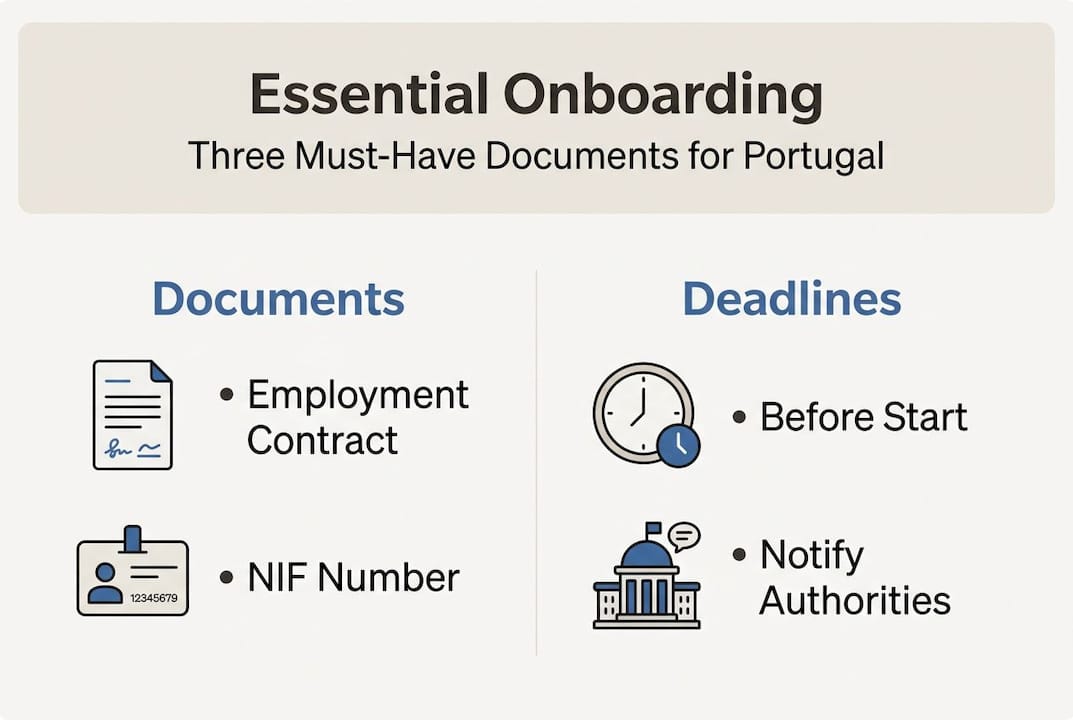
Every new hire in Portugal must have three core identifiers in place: a valid employment contract (contrato de trabalho), a Portuguese tax identification number (NIF, or Número de Identificação Fiscal), and active registration with the Segurança Social (Social Security system). Non-EU nationals also need a valid work permit before onboarding can begin. These aren’t optional extras; they’re the baseline.

Infographic showing Portugal onboarding document checklist

HR teams are also responsible for notifying the relevant authorities within specific deadlines. The employment contract must be communicated to the ACT (Autoridade para as Condições do Trabalho, Portugal’s labor authority) before the employee’s first working day. Payroll setup must be completed so that the first salary is paid on time and includes all mandatory contributions.

Here’s a quick breakdown of the key documents, who owns them, and when they’re due:

Document Responsible party Deadline
Employment contract HR/Legal Before first working day
NIF registration Employee (HR-assisted) Before contract signing
Social Security registration Employer Before first working day
ACT notification HR/Legal Before first working day
Health and safety briefing HR/Operations Day one
Internal policy handout HR Day one

Beyond the table above, HR should prepare a structured orientation package. This includes internal policy documents, a clear explanation of the employee’s role and reporting structure, and any tools or system access they’ll need. Orientation materials should be ready before the employee arrives, not assembled on the fly.

Key items to have ready before day one:

  • Signed employment contract (in Portuguese, or bilingual)
  • NIF confirmation document
  • Social Security registration confirmation
  • Payroll system setup with bank details
  • IT access credentials and equipment
  • Health and safety induction materials
  • Internal HR handbook or policy guide

Getting these right from the start sets a professional tone and signals to your new hire that the company is organized and serious about compliance.

Step-by-step onboarding process in Portugal

Once you’ve collected the right documents, it’s time to walk through onboarding step by step. Each stage of onboarding has associated timelines and legal requirements, so sequencing matters.

  1. Offer acceptance and pre-boarding. Send the signed offer letter and begin collecting the employee’s personal data for contract preparation. Confirm their NIF status. If they don’t have one yet, guide them through obtaining it from the Portuguese Tax Authority (AT).
  2. Draft and sign the employment contract. The contract must comply with Portugal’s Labor Code (Código do Trabalho). Include role, salary, working hours, probation period, and termination conditions. Both parties must sign before the start date.
  3. Register with Social Security. The employer must register the employee with the Segurança Social portal before their first day. This activates their entitlement to healthcare, unemployment benefits, and pension contributions.
  4. Notify the ACT. Submit the employment contract details to the ACT online portal. This step is legally required and must happen before the employee begins work.
  5. Set up payroll. Configure payroll to reflect the correct gross salary, income tax (IRS) withholding rates, and Social Security contributions. In 2026, employer Social Security contributions sit at 23.75% of gross salary.
  6. Day one orientation. Walk the employee through health and safety procedures, data privacy policies, anti-discrimination rules, and company values. Assign a buddy or mentor for the first month.
  7. First month check-ins. Schedule structured touchpoints at week one, week two, and end of month one to address questions and confirm the employee is integrating well.

For international companies managing multiple hires, the comparison below shows where in-house onboarding and outsourcing diverge:

Factor In-house onboarding Outsourced (EOR)
Legal expertise required High Handled by partner
Time to first day 3-4 weeks 1-2 weeks
Compliance risk Higher Lower
Cost for single hire Lower Moderate
Scalability Limited High

Pro Tip: Build a digital onboarding checklist using tools like Notion or a dedicated HRIS platform. Assign each task to a responsible owner with a due date. This removes ambiguity and makes it easy to audit your process if a compliance question comes up later. You can also review the detailed hiring process to align your checklist with local legal expectations.

Ensuring compliance and avoiding common onboarding mistakes

With the onboarding roadmap in hand, don’t overlook common pitfalls that trip up international HR teams. Errors in onboarding can lead to regulatory fines and employee disengagement, both of which are expensive to fix after the fact.

The most frequent mistakes HR teams make when onboarding in Portugal include:

  • Missing the ACT notification deadline. This is one of the most common errors and can result in immediate fines.
  • Incorrect payroll setup. Using the wrong IRS withholding table or failing to account for meal allowances and other mandatory benefits creates payroll errors that are hard to reverse.
  • Incomplete Social Security registration. If the employee isn’t registered before their first day, they have no legal employment status in Portugal.
  • Failing to provide a written contract. Verbal agreements are not enforceable under Portuguese labor law.
  • Overlooking probation period terms. The default probation period varies by contract type and must be explicitly stated.

The consequences go beyond fines. Delayed start dates damage your employer brand. Employees who experience a chaotic onboarding process are significantly more likely to disengage early or leave within the first six months. For international companies, this also creates reputational risk in a market where word travels fast.

“Compliance in Portugal is not a one-time checkbox. It’s an ongoing obligation that begins before the employee’s first day and continues through every payroll cycle.” This is why coordinated handoffs between HR, finance, and legal are non-negotiable.

For compliance steps in Portugal to work smoothly, all three teams need to be aligned on timelines and responsibilities before the hire is confirmed. Finance needs payroll data at least two weeks before the first pay date. Legal needs to review the contract before it’s sent to the candidate.

Pro Tip: Use a pre-boarding phase starting the moment an offer is accepted. Send document requests digitally, verify submissions before the start date, and flag any gaps at least five business days in advance. Pairing this with payroll outsourcing removes a significant layer of administrative risk.

Integrating new employees into the Portuguese workplace

After compliance is covered, supporting new hires’ social and professional integration is essential for retention. Getting the paperwork right is only half the job. The other half is making sure your new employee actually wants to stay.

New employees viewing onboarding checklist together

Effective integration reduces turnover and boosts long-term productivity, and the research backs this up. Companies with structured onboarding programs see up to 82% improvement in new hire retention and a 70% increase in productivity within the first year. Those numbers matter when you’re investing in a new market.

Portugal has a relationship-driven workplace culture. New employees, especially those joining international teams remotely, benefit enormously from being introduced to their colleagues in a structured way. A buddy system, where a more experienced team member is assigned to support the new hire for the first 30 days, dramatically reduces the time it takes to feel connected and productive.

Mandatory onboarding training in Portugal must cover:

  • Health and safety procedures (required by law)
  • Data privacy and GDPR compliance
  • Anti-discrimination and harassment policies
  • Company-specific tools, systems, and workflows
  • Role-specific technical training

For workplace integration tips that go beyond the legal minimum, consider building a first-month milestone tracker for HR to follow:

  • Day 1: Complete legal induction, meet the team, set up systems
  • Week 1: Shadow key colleagues, attend team meetings, complete mandatory training
  • Week 2: Begin independent work with manager check-ins every two days
  • Week 3: First performance conversation and feedback exchange
  • End of month 1: Full integration review, confirm probation progress, address any concerns

This kind of structured support isn’t just good for the employee. It gives HR a clear audit trail showing that onboarding obligations were met and that the company invested in the person’s success from day one.

Why traditional onboarding fails in Portugal—and what actually works

Many multinationals arrive in Portugal with a global onboarding template they’ve used in five other countries and assume it will transfer cleanly. It rarely does. Portugal’s labor law is precise, and the ACT enforces it actively. A template built for the UK or Germany will miss local nuances around contract language, probation terms, and notification timelines.

The counterintuitive lesson we’ve seen play out repeatedly is this: simpler, checklist-driven onboarding with native legal support outperforms elaborate global frameworks every time. The companies that struggle most are the ones that treat Portuguese compliance as an afterthought, something to bolt onto their existing process rather than build around.

“The biggest onboarding failures we see aren’t from companies that don’t care. They’re from companies that assumed Portugal works like everywhere else.”

Local expertise isn’t optional here. It’s the difference between a smooth first day and a regulatory investigation. If you’re serious about cost-effective hiring in Portugal, the investment in local legal and HR support pays back quickly in avoided fines, faster start dates, and better retention.

Streamline onboarding with expert support

If you want to skip trial-and-error and avoid costly onboarding mistakes, specialized support can make the difference. Getting onboarding right in Portugal requires more than a checklist. It requires local knowledge, legal fluency, and the ability to move fast without missing steps.

https://outsourcing-portugal.co.uk

At Outsourcing Portugal, we help international companies onboard employees in Portugal without setting up a local entity. Our Employer of Record Portugal service handles contracts, Social Security registration, payroll setup, and ACT notifications, so your new hire is compliant from day one. Whether you’re hiring one person or building a full team, we handle the complexity so you can focus on the work that matters.

Frequently asked questions

What documents are required to onboard employees in Portugal?

Portugal mandates an employment contract, Social Security registration, a tax number (NIF), and onboarding notifications to local authorities. Specific documentation steps must be completed before the employee’s first working day.

How long does the onboarding process take in Portugal?

Onboarding can typically be completed in one to two weeks if documents are prepared and compliance steps are followed in sequence. Associated timelines and requirements vary depending on the employee’s nationality and contract type.

What are the penalties for non-compliance during employee onboarding?

Regulatory fines, delayed start dates, and loss of work authorization are possible outcomes of compliance failures. Compliance errors can also damage employee trust and increase early turnover.

Is it better to onboard employees in Portugal in-house or use an outsourcing partner?

Large companies and those new to the Portuguese market often benefit from using an Employer of Record to manage compliance and reduce administrative risk. In-house versus outsourced onboarding depends on your team’s local expertise and the volume of hires planned.

Ensure legal compliance when outsourcing employment in Portugal


TL;DR:

  • Portugal’s labor laws extend beyond EU standards, enforcing strict compliance on outsourcing practices.
  • Recent restrictions prohibit outsourcing within 12 months of collective dismissals, with serious penalties for violations.
  • Proper local knowledge and adherence to collective agreements, posted worker regulations, and documentation are essential for legal outsourcing.

International companies entering Portugal through outsourcing often assume that general EU employment standards are enough to keep them compliant. They are not. Portugal has its own Labor Code with rules that go well beyond EU minimums, and violations can trigger serious financial penalties, forced reinstatement of workers, and reputational damage. Two recent legislative updates, specifically around the 12-month outsourcing restriction and collective agreement obligations, have caught many experienced HR managers off guard. This guide walks you through every major compliance layer so you can build your outsourcing strategy in Portugal on solid legal ground.

Table of Contents

Key Takeaways

Point Details
Twelve-month rule You cannot outsource services within a year after certain layoffs or face serious penalties.
Collective agreement protection Outsourced employees are covered by the most favorable collective agreement when they perform core roles over 60 days.
Mandatory notifications Posted and cross-border workers require ACT notification and must follow Portuguese labor rules.
Localization matters Adapting procedures to Portuguese laws prevents common compliance mistakes in outsourcing.

Portugal’s primary employment legislation is the Código do Trabalho, commonly called the Labor Code. For international companies outsourcing employment functions, this code sets the rules on contracts, termination, working time, and the specific conditions under which outsourcing is permitted. It is not a flexible framework. Judges and labor inspectors apply it literally, and ignorance of its provisions is not a valid defense.

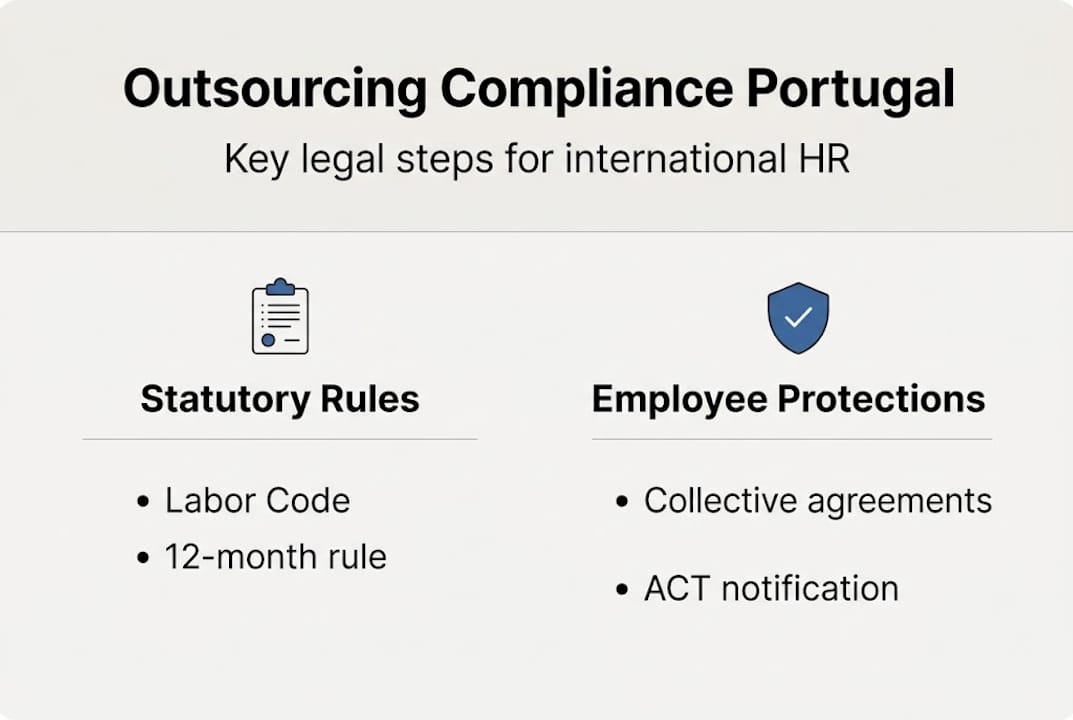
The most significant recent change affects companies that have recently reduced headcount. Under Art. 338-A Labor Code, it is prohibited to outsource services within 12 months of dismissing employees for job extinction or collective dismissal. Violating this rule is classified as a serious offense and carries substantial fines. This is not a technicality. It is a hard stop that applies regardless of how the outsourcing contract is structured.

Beyond this restriction, the Labor Code also governs:

  • Notice periods: Minimum notice requirements vary by seniority and must be honored in any outsourcing transition.
  • Collective bargaining agreements (CBAs): Sector-specific CBAs often set wages, benefits, and working conditions above statutory minimums.
  • Posted worker rules: Workers temporarily assigned to Portugal from abroad must meet Portuguese minimum conditions.
  • Fixed-term contracts: Strict limits apply on duration and renewal, even within outsourced arrangements.

For companies using an Employer of Record model, understanding these layers is essential. Our EOR compliance guide covers how the EOR absorbs these obligations on your behalf, but you still need to understand what those obligations are.

Portugal also maintains a set of mandatory protections that cannot be waived by contract, including minimum wage, paid leave, and anti-discrimination provisions. These apply to all workers in Portugal, regardless of where the employer is incorporated.

Key stat: Portugal’s minimum wage increased to €1,020 per month in 2026, and any outsourcing arrangement must reflect this floor across all covered roles.

The practical takeaway here is that Portugal’s legal framework is layered. You need to track statutory law, applicable CBAs, and any mandatory protections simultaneously. Missing one layer is enough to create liability.

Critical compliance rules for outsourcing employment

With the legal framework covered, it is crucial to recognize the specific dos and don’ts, especially the rules that trip up even seasoned HR managers. Here is a step-by-step overview of the core compliance rules you need to follow.

  1. Check the 12-month window before outsourcing. If your company or the service provider has conducted collective dismissals or job extinction terminations in the past year, outsourcing is prohibited for those functions. Document the dismissal history of any provider you engage.
  2. Define core vs. peripheral activity clearly. Portuguese courts look at whether outsourced tasks are central to the beneficiary company’s business. Outsourcing core functions carries higher legal scrutiny and triggers the collective agreement obligations described below.
  3. Verify the provider’s employment contracts. As the beneficiary company, you can be held jointly liable if the provider’s workers are not properly contracted or paid.
  4. Align with applicable CBAs. Identify which sector-level collective agreement applies to your outsourced workers and confirm that wages and benefits meet or exceed those terms.
  5. Maintain proper documentation. Keep records of service agreements, worker assignments, and payment histories. Labor inspectors can request these at any time.

Pro Tip: Before signing any outsourcing contract in Portugal, ask the provider to confirm in writing that no collective or job extinction dismissals occurred in the past 12 months for the roles being outsourced. This one step eliminates a major liability risk.

“Violations of the 12-month outsourcing restriction are classified as serious offenses under Portuguese law, meaning fines are not discretionary. They are mandatory upon finding a violation.”

For HR managers building their first Portuguese team, our 2026 hiring guide provides a practical overview of the full hiring lifecycle. You should also review the payroll compliance checklist to ensure your payroll setup reflects all statutory and CBA-driven obligations from day one.

A common mistake international HR teams make is applying their home country’s compliance logic to Portugal. What counts as a “serious offense” in Portugal may be treated as a minor administrative issue elsewhere. The reverse is also true. Mapping your existing processes to Portuguese law requires deliberate localization, not just translation.

Employee protections and collective agreements when outsourcing

Beyond basic compliance, Portugal’s laws also address employee rights in outsourced roles, especially regarding collective agreements. This is where many international companies get a genuine surprise.

Under Art. 498-A, when outsourced workers perform services that match the core business of the beneficiary company for more than 60 days, the beneficiary’s collective agreement applies to those workers if it is more favorable than the provider’s agreement. This is not optional. It is a statutory obligation that runs regardless of what the outsourcing contract says.

Business meeting reviewing collective agreement

Scenario Duration Collective agreement that applies
Peripheral task outsourcing Any duration Provider’s CBA
Core business task outsourcing Under 60 days Provider’s CBA
Core business task outsourcing Over 60 days Beneficiary’s CBA (if more favorable)
No CBA at either company Any duration Statutory minimums only

This rule has real financial consequences. If your company’s CBA provides higher wages, more vacation days, or better health benefits than the provider’s CBA, you are obligated to ensure those terms apply to the outsourced workers after 60 days. Failing to do so exposes you to back-pay claims and regulatory fines.

For employees, this is a meaningful protection. It prevents the use of outsourcing as a mechanism to strip workers of rights they would otherwise hold. For you as the hiring company, it means you need to know your own CBA well, not just the provider’s.

Key obligations to track when collective agreements apply:

  • Wage parity: Confirm hourly or monthly rates meet the beneficiary’s CBA minimums after the 60-day threshold.
  • Leave entitlements: Vacation and sick leave rules under the beneficiary’s CBA must be honored.
  • Bonus structures: Some CBAs include mandatory 13th or 14th month payments that must be reflected in outsourced worker compensation.

Our employee benefits list breaks down what Portuguese employees are legally entitled to, including CBA-driven benefits that go beyond the statutory floor.

Special compliance considerations for posted and cross-border workers

Cross-border outsourcing adds another layer of complexity. Here is what you need to know about posted workers and related compliance obligations.

A posted worker is an employee based in another country who is temporarily sent to work in Portugal. This is common in multinational outsourcing arrangements. Portuguese law, aligned with EU Directive 96/71/EC, sets mandatory minimum conditions that posted workers must receive, regardless of where they are employed.

Here is the compliance sequence for posted workers:

  1. Notify ACT (Autoridade para as Condições do Trabalho) before the worker begins their assignment in Portugal. This is a legal requirement, not a courtesy.
  2. Guarantee Portuguese minimum conditions, including minimum wage, maximum working hours, paid leave, and health and safety standards.
  3. Understand that choice-of-law clauses do not override mandatory protections. Even if your contract specifies that another country’s law governs the employment relationship, mandatory Portuguese protections apply in full.
Obligation Applies to posted workers? Notes
ACT notification Yes Required before assignment starts
Portuguese minimum wage Yes €1,020/month in 2026
Portuguese working time limits Yes Max 40 hours/week standard
Portuguese paid leave Yes Minimum 22 working days/year
Home country CBA Conditional Only if more favorable than Portuguese rules

Pro Tip: If you are posting workers to Portugal for longer than 12 months, the full Portuguese Labor Code applies, not just the minimum conditions. Plan your assignment durations carefully.

For companies managing cross-border teams, our workforce mobility guide covers the full spectrum of posted worker obligations and how to structure compliant international assignments.

The ACT notification process is often overlooked by international HR teams who treat it as bureaucratic formality. It is not. Missing this notification is an independent violation that carries its own penalties, separate from any substantive employment law breach.

Infographic of Portugal outsourcing compliance steps

Why most compliance mistakes in outsourcing are avoidable

After working through Portugal’s compliance landscape with dozens of international companies, one pattern stands out clearly: most violations are not caused by bad intent. They are caused by applying home country HR processes to a Portuguese context without localization.

A German company might assume that its rigorous EU compliance framework covers Portugal automatically. A U.S. company might treat Portuguese labor law as broadly similar to at-will employment norms. Both assumptions lead to the same result: missed obligations, fines, and damaged employee relationships.

The fix is not complicated, but it does require deliberate effort. A localized compliance checklist, reviewed by someone who actually knows Portuguese labor law, closes the majority of legal gaps before they become problems. Our detailed compliance guide is built specifically for this purpose.

The companies that get this right are not necessarily the largest or most legally sophisticated. They are the ones that treat Portugal as its own legal environment and find partners who operate within it every day. That local knowledge is worth more than any general EU compliance framework.

Get local support for compliant outsourcing in Portugal

Navigating Portugal’s Labor Code, collective agreement obligations, posted worker notifications, and the 12-month outsourcing restriction is manageable when you have the right support in place.

https://outsourcing-portugal.co.uk

At outsourcing-portugal.co.uk, we help international companies build compliant employment structures in Portugal without the guesswork. Whether you need a full EoR solution to handle all employer obligations on your behalf, or targeted guidance on a specific compliance question, our team is ready to help. If you are ready to move forward or just want to understand your options, contact our experts for a direct conversation about your situation.

Frequently asked questions

What is the 12-month rule for outsourcing after layoffs in Portugal?

Under Art. 338-A of the Portuguese Labor Code, outsourcing is prohibited within 12 months of collective or job extinction dismissals, and violations are classified as serious offenses subject to mandatory fines.

Do Portuguese collective agreements apply to outsourced employees?

Yes. When outsourced staff perform core business tasks for more than 60 days, the beneficiary company’s collective agreement applies if it offers more favorable terms than the provider’s agreement.

What must companies do when posting foreign workers to Portugal?

Companies must notify ACT before the assignment begins, guarantee Portuguese minimum conditions, and recognize that choice-of-law clauses cannot override Portugal’s mandatory employment protections.

How can international HR managers avoid common outsourcing compliance mistakes in Portugal?

Using a localized compliance checklist and partnering with experts who specialize in Portuguese labor law eliminates the vast majority of legal risks before they escalate into penalties or disputes.

Payroll manager reviews paperwork in Lisbon office

Top payroll challenges in Portugal: 5 risks to fix

Hiring in Portugal sounds straightforward until your first payroll cycle reveals a tangle of collective bargaining obligations, misclassification risks, and expat tax complications that nobody warned you about. Even seasoned HR leaders at international companies have been caught off guard by Portugal’s layered labor framework, and the consequences range from back-pay liability to regulatory fines that can seriously dent your expansion budget. This guide walks you through the most critical payroll challenges you are likely to face when hiring through employment outsourcing in Portugal, and gives you practical, actionable ways to get ahead of each one before they become expensive problems.

Table of Contents

Key Takeaways

Point Details
Know sector-specific rules CBAs and overtime laws differ by sector and can override country minimums.
Avoid misclassification Incorrectly classifying employees risks severe fines and ongoing compliance issues.
Plan for expat complexity Non-habitual residency and cross-border tax treaties make expat payroll much harder to manage.
Partner for compliance Outsourcing payroll in Portugal reduces liability and makes legal changes easier to handle.

Common payroll compliance hurdles in Portugal

Portugal’s labor framework is not hostile to foreign employers, but it is detailed. The Labor Code sets baseline rules, and then sector-specific collective bargaining agreements (CBAs) layer additional obligations on top. A CBA is a negotiated agreement between employer associations and trade unions that governs pay, working hours, benefits, and other conditions for workers in a specific industry or sector. The critical point is that CBAs can override legal minimums, meaning your payroll must reflect whichever standard is higher, not simply the statutory floor.

This creates real complexity in practice. A software developer hired in Lisbon and a logistics coordinator hired in Porto may fall under entirely different CBAs, with different minimum salaries, different overtime multipliers, and different rules around paid leave. If your payroll team is applying a single national template across all roles, you are almost certainly underpaying or miscalculating for some of them.

Here are the core compliance obligations that international payroll teams frequently miss:

  • CBA identification per role and location: You must determine which CBA applies before you finalize any employment contract or pay package.
  • Overtime documentation: Portuguese law requires detailed records of overtime hours, and in some sectors, employers must notify labor authorities when overtime exceeds defined thresholds.
  • Mandatory medical evaluations: Workers who regularly perform overtime above certain thresholds are entitled to medical evaluations at the employer’s expense.
  • Payroll reporting obligations: Employers must submit monthly social security declarations and annual income reporting to the Portuguese Tax and Customs Authority (AT).
  • Minimum wage compliance: Portugal’s minimum wage was €870 per month in 2025, but CBAs in sectors like banking, insurance, and technology often set higher floors that supersede this figure.

Understanding compliance in international hiring is not optional. It is the foundation on which every other payroll decision rests.

Pro Tip: Always identify and review the applicable CBA for each role and location before you finalize any offer letter or employment contract. A 30-minute check at the start can prevent months of back-pay corrections later.

Misclassification risks and employee definitions

Worker misclassification is one of the most financially dangerous payroll mistakes an international employer can make in Portugal. The issue arises when a company treats someone as an independent contractor or freelancer when, under Portuguese law, that person qualifies as an employee. The legal and financial exposure is significant.

HR worker reviews employee classification guide

Misclassification is a serious risk for international employers using global EOR arrangements or contractor agreements in Portugal. Portuguese labor inspectors look at the substance of the working relationship, not just what the contract says. If the reality of the engagement looks like employment, it will be treated as employment.

Portuguese courts and labor authorities use the following factors to determine whether a worker is actually an employee:

  1. Control over work: Does the company direct how, when, and where the work is performed?
  2. Exclusivity or near-exclusivity: Does the worker rely on this single client for most of their income?
  3. Provision of tools and equipment: Does the company supply the tools, software, or workspace?
  4. Ongoing engagement: Has the relationship continued for an extended period without a defined project end date?
  5. Integration into the business: Is the worker part of the company’s regular operational structure?

If two or more of these factors apply, Portuguese authorities are likely to reclassify the worker as an employee. When that happens, the employer owes back social security contributions, unpaid benefits, and potentially severance entitlements, all calculated retroactively from the start of the engagement.

“Getting worker classification right from day one is not just a legal formality. It is the single most important decision you make when building a team in Portugal. The cost of getting it wrong is not just financial. It damages trust with the worker and exposes your entire hiring program to scrutiny.” — Senior employment compliance advisor, Lisbon

Reviewing your worker classification guide before onboarding any contractor in Portugal is a step you cannot afford to skip.

Overtime and sector-specific requirements

Overtime rules in Portugal are not one-size-fits-all. The Labor Code sets a general framework, but sector-level CBAs frequently modify overtime rates, caps, and documentation requirements in ways that catch international payroll teams off guard. Getting these wrong does not just create a compliance gap. It creates a financial gap that compounds with every pay cycle.

Under the general rules, overtime is compensated at a premium above the regular hourly rate, and total overtime is capped. Critically, overtime caps of 170 hours per month in certain sectors trigger mandatory medical evaluations for affected employees. This is an employer obligation, not optional, and failure to arrange these evaluations can result in labor inspection findings.

Here is how overtime requirements vary across three common sectors:

Sector Standard overtime premium Annual cap Medical evaluation required?
Technology / IT 25% (1st hour), 37.5% (subsequent) 150 hours Yes, above threshold
Retail / Commerce 25% (1st hour), 37.5% (subsequent) 175 hours Yes, above threshold
Banking / Finance Set by CBA, often higher CBA-defined Yes, above threshold

The banking and finance sector is a good example of why you cannot rely on statutory defaults. The relevant CBA often sets overtime premiums and annual caps that differ substantially from the Labor Code baseline. If your payroll system is not configured with sector-specific rules, it will calculate incorrectly every time.

For compliant payroll solutions in Portugal, the practical answer is to build CBA review into your annual payroll audit cycle, not just at onboarding.

Pro Tip: Schedule a formal payroll compliance audit at least once per year for any sector with complex overtime rules. CBAs are renegotiated periodically, and rates or caps can change without much public notice.

Expat taxation: NHR and double taxation issues

When your team includes international hires or employees relocating to Portugal, payroll complexity increases considerably. Portugal’s Non-Habitual Resident (NHR) tax regime was designed to attract skilled foreign workers by offering favorable flat-rate income tax treatment for up to ten years. However, NHR and double taxation issues frequently complicate salary calculations and withholding for expat employees.

The NHR regime (now transitioning to a successor program called IFICI for new applicants from 2024 onward) can reduce the effective income tax rate significantly for qualifying workers. But eligibility depends on residency status, the nature of the work, and whether the worker has been a Portuguese tax resident in the prior five years. Payroll teams must track each expat’s status individually, because applying the wrong withholding rate creates either an underpayment liability or an overpayment that the employee will need to recover through their annual tax return.

Here is how withholding can differ based on tax status:

Worker type Applicable income tax rate Social security obligation Notes
Standard Portuguese resident Progressive rates up to 48% 11% employee, 23.75% employer Standard payroll treatment
NHR-qualified expat 20% flat rate (qualifying income) Same as above Requires annual NHR confirmation
Treaty-protected expat Reduced or exempt (treaty-dependent) May vary by treaty Requires tax residency certificate

Beyond income tax, expat payroll also raises social security questions. Portugal has bilateral social security agreements with many countries, and a worker seconded from a treaty country may continue contributing to their home country’s system instead of Portugal’s. Failing to identify this correctly means either double contributions or a gap in coverage.

The main expat payroll challenges to track include:

  • Confirming and renewing NHR or IFICI status annually
  • Obtaining and filing tax residency certificates for treaty-protected workers
  • Determining the correct social security regime for each seconded employee
  • Reporting foreign-sourced income correctly on Portuguese tax declarations
  • Managing split-year residency when an employee relocates mid-year

Accessing global employment solutions with local tax expertise is the most reliable way to keep expat payroll accurate and audit-ready.

Pro Tip: Always consult a local payroll specialist before onboarding any expat or cross-border hire. The cost of a one-hour consultation is a fraction of the cost of correcting a year of incorrect withholding.

How employment outsourcing mitigates payroll risks

Understanding these risks is useful. Having a system that prevents them is better. Employment outsourcing, specifically through an Employer of Record (EOR) arrangement, addresses the payroll challenges above in a structured and repeatable way.

Employment outsourcing simplifies payroll in Portugal by placing legal employer responsibilities with a local entity that already has the infrastructure, expertise, and regulatory relationships in place. Here is what that looks like in practice:

  • CBA management: A local EOR maintains up-to-date CBA libraries for all major sectors and automatically applies the correct rates, caps, and benefits to each employee’s payroll record.
  • Misclassification prevention: EOR providers employ workers directly, eliminating the contractor misclassification risk entirely. Every worker is onboarded with a compliant employment contract from day one.
  • Overtime tracking and reporting: Payroll systems used by experienced EOR providers are configured to flag overtime thresholds, trigger medical evaluation reminders, and generate the documentation required by labor inspectors.
  • Expat payroll handling: Local specialists manage NHR registration, social security treaty analysis, and withholding rate verification for each international hire.
  • Centralized reporting: Monthly social security filings, annual AT declarations, and any required labor authority notifications are handled by the EOR, reducing your internal administrative burden significantly.

The financial case is compelling too. Building an in-house payroll team with the depth of knowledge required to manage all of the above typically costs more than outsourcing, especially when you factor in the liability exposure of getting it wrong. Explore outsourced payroll services to see how this model works in practice.

A fresh perspective: The hidden costs of “do-it-yourself” payroll in Portugal

Here is something most guides will not tell you: the companies that struggle most with Portuguese payroll are not the ones that know nothing about it. They are the ones that know just enough to think they can handle it internally.

Building an in-house payroll function for Portugal feels cost-effective on paper. One or two hires, a payroll software license, and a local accountant on retainer. But the real payroll cost analysis almost always reveals hidden expenses that do not show up in the initial budget. CBA interpretation requires specialized legal expertise that a generalist accountant does not have. Audit risk spikes every time a CBA is renegotiated or a new expat joins the team. And the internal time cost of staying current with Portuguese labor law changes is substantial.

One experienced payroll operations leader put it plainly: “The surprise liabilities we see most often are not from companies that ignored compliance. They are from companies that thought their existing team could absorb Portuguese complexity without dedicated support.”

Run a full cost-benefit analysis that includes compliance workload, not just headcount, before committing to an in-house model.

Simplify payroll in Portugal with expert support

Portugal’s payroll landscape rewards preparation and punishes assumptions. The challenges covered here, from CBA complexity to expat tax treatment, are manageable when you have the right partner in place.

https://outsourcing-portugal.co.uk

At outsourcing-portugal.co.uk, we provide full-service Portugal EOR and payroll services designed specifically for international companies that want to hire compliantly without building a local entity from scratch. Our team handles CBA compliance, overtime tracking, expat payroll, and all statutory reporting so your HR team can focus on growth rather than administration. Explore our outsourced payroll solutions and take the first step toward a fully compliant, stress-free payroll operation in Portugal.

Frequently asked questions

What are the biggest payroll compliance risks for international employers in Portugal?

Sector-specific CBAs and misclassification are the top compliance risks, alongside overtime documentation failures and incorrect expat tax withholding. Each of these can trigger retroactive liability.

How can outsourcing payroll help avoid misclassification penalties?

An EOR minimizes misclassification risks by directly employing workers under compliant Portuguese contracts, removing the ambiguity that leads to reclassification findings by labor inspectors.

What challenges do expat hires create for payroll in Portugal?

Managing NHR or IFICI registration, applying the correct withholding rates, and navigating double taxation treaty obligations makes expat payroll significantly more complex than standard domestic payroll.

What is the minimum wage in Portugal in 2026?

Portugal’s minimum wage was €870 per month in 2025, with updated rates expected for 2026. Always verify the current figure before finalizing any offer, since CBAs in many sectors set higher minimums.

Business-friendly outsourcing: a guide for global companies


TL;DR:

  • Business-friendly outsourcing streamlines hiring, compliance, and HR management, enabling faster market entry.
  • Portugal’s strong infrastructure and regulatory framework make it an attractive, cost-effective nearshore option.
  • Choosing the right provider requires careful assessment of experience, compliance support, and adaptability.

Most international companies assume outsourcing means handing over control and hoping for the best. That assumption is wrong, and it costs companies time, money, and talent. Business-friendly outsourcing is a fundamentally different model. It’s built to remove friction, not create it. Whether you’re entering Portugal for the first time or scaling an existing team, this approach handles compliance, payroll, and HR administration so you can focus on results. This guide breaks down exactly how it works, what separates it from traditional outsourcing, and why Portugal has become one of the most attractive destinations for companies using this model.

Table of Contents

Key Takeaways

Point Details
Faster market entry Business-friendly outsourcing lets you launch in Portugal rapidly with minimized legal risk.
Simplified compliance You get expert support to navigate taxes, contracts, and employment law without headaches.
Scalable talent solutions Easily expand or contract your workforce with administrative support tailored to your needs.
Better cost control Transparent pricing and optimized local hiring keep budgets on track for growth and testing.

Defining business-friendly outsourcing

Traditional outsourcing often puts companies in a difficult position. You get a vendor, a contract, and a set of deliverables. What you don’t always get is transparency, local expertise, or flexibility when regulations change. Business-friendly outsourcing is different by design.

At its core, business-friendly outsourcing is a model tailored to help international companies scale faster while reducing administrative friction. It combines legal compliance, HR administration, and talent management into a single, integrated service. Instead of navigating foreign labor laws on your own, your provider handles it. Instead of building a local entity before you can hire, you can start within days.

Infographic summary of outsourcing features and benefits

One of the clearest ways to understand this is through comparison:

Feature Traditional outsourcing Business-friendly outsourcing
Compliance support Limited or reactive Proactive and built-in
Onboarding speed Weeks to months Days to two weeks
Pricing transparency Often opaque Clear and structured
Local market expertise Generic Country-specific
Integration with client HR Minimal Seamless
Ongoing HR admin Separate cost Included

The contrast is significant. Traditional models treat compliance as an afterthought. Business-friendly models treat it as a foundation.

Here’s what a business-friendly outsourcing service typically includes:

  • Compliance support: Ongoing monitoring of local labor law changes and automatic updates to employment contracts
  • Transparent pricing: Fixed or clearly structured fees with no hidden costs
  • Local market expertise: In-country knowledge of hiring norms, salary benchmarks, and workforce culture
  • Ongoing HR administration: Payroll processing, employee records, benefits management, and termination support

Common pitfalls with standard outsourcing in Portugal include misclassifying workers, underestimating mandatory social security contributions, and missing collective bargaining agreement requirements. These aren’t minor issues. They expose companies to audits and fines. Business-friendly outsourcing removes legal burdens and simplifies operational setup in new countries, which is precisely why more global companies are choosing Portugal through this model. The reasons companies choose Portugal go well beyond cost, but having a compliant, efficient entry point makes the decision much easier.

How business-friendly outsourcing works in Portugal

Portugal has a specific business climate that rewards preparation. The country has strong labor protections, a well-developed regulatory framework, and a workforce that consistently ranks among Europe’s most educated and multilingual. A business-friendly outsourcing model is designed to work with these factors, not against them.

Here’s how the process typically unfolds:

  1. Define your hiring needs: Identify roles, seniority levels, and timelines before engaging a provider.
  2. Partner selection and compliance check: Your provider reviews Portuguese labor law requirements specific to your industry and employment structure.
  3. Candidate recruitment and vetting: The provider sources candidates or onboards your pre-selected hires using local employment contracts.
  4. Onboarding and registration: Employees are registered with Portuguese social security, tax authorities, and any relevant professional bodies.
  5. Payroll setup and administration: Monthly payroll runs, tax withholding, and mandatory contributions are handled by the provider.
  6. Ongoing HR support: Performance management, contract amendments, and legal updates are managed continuously.

Portugal’s infrastructure and outsourcing capabilities are a genuine operational advantage. Portugal’s robust infrastructure and support services enable efficient outsourcing operations, from fiber internet coverage to government-backed tech training programs. This isn’t a coincidence. Portugal has invested heavily in making itself a viable nearshore hub.

Coordinator connecting server in Portugal office

For companies considering a sales outsourcing process or a tech team build-out, the combination of local talent quality and structured outsourcing support makes Portugal genuinely competitive against Eastern European and Asian alternatives.

Pro Tip: The most common mistake companies make when entering Portugal is assuming their home-country employment practices translate directly. They don’t. Portuguese law requires specific contract language, mandatory notice periods, and precise calculation of holiday pay and bonuses. A business-friendly provider catches these details before they become legal problems.

Benefits for international companies hiring in Portugal

The business case for business-friendly outsourcing in Portugal is concrete. Let’s look at what companies actually gain.

Metric Traditional approach Business-friendly outsourcing
Market entry time 3 to 6 months 2 to 4 weeks
Legal entity required Yes No
Compliance risk High Managed
Payroll accuracy Variable Guaranteed
Talent access Limited to local network Broad, provider-sourced

The numbers tell a clear story. Speed and risk reduction are the two biggest wins.

Here’s what companies consistently report as concrete benefits:

  • Rapid market testing: Hire a small team in Portugal within weeks to validate your market before committing to a full entity setup
  • Lower employment risk: Your provider assumes employer-of-record liability, reducing your exposure to labor disputes and regulatory penalties
  • Improved compliance: Automatic updates to contracts and payroll when Portuguese labor law changes
  • Scalable HR solutions: Add or reduce headcount without restructuring your legal setup
  • Access to payroll outsourcing benefits: Accurate, on-time payroll with full tax compliance handled end-to-end

Portugal offers competitive costs and simplified legal frameworks for employers using outsourcing services. Average labor costs in Portugal remain significantly below Western European averages while talent quality stays high. For a mid-level software engineer, total employment costs in Portugal can run 40 to 50 percent lower than equivalent roles in Germany or the Netherlands.

The infrastructure for outsourcing in Portugal also means your team operates in a stable, well-connected environment. Reliable power, fast internet, and modern office infrastructure are standard, not exceptions.

Key considerations and best practices

Choosing the right business-friendly outsourcing partner is not a passive decision. The quality of your provider directly determines your legal exposure, your team’s experience, and your operational efficiency.

Here’s how to approach the selection process:

  1. Verify local credentials: Confirm the provider is registered in Portugal and has demonstrable experience with Portuguese employment law.
  2. Request a sample service agreement: Review how they handle contract amendments, terminations, and dispute resolution before you sign anything.
  3. Assess onboarding timelines: A credible provider should be able to onboard your first employee within two weeks of contract signing.
  4. Clarify payroll reporting: Understand exactly what payroll reports you’ll receive, how often, and in what format.
  5. Ask about compliance monitoring: Find out how the provider tracks changes to Portuguese labor law and how quickly those changes are reflected in your contracts.

“Having a clear service agreement and understanding local employment laws is crucial for effective outsourcing. Companies that invest time in reviewing their provider’s compliance framework upfront avoid the vast majority of legal disputes downstream.”

This is reinforced throughout the EoR guide Portugal, which outlines exactly what a compliant employer-of-record arrangement looks like in practice. Understanding local employment laws is non-negotiable for companies hiring through any outsourcing model.

Pro Tip: Watch out for providers who offer unusually low flat fees without explaining what’s included. In Portugal, mandatory employer contributions to social security alone represent around 23.75 percent of gross salary. If a provider’s pricing doesn’t clearly account for this, you’re either being misled or you’ll see surprise invoices later.

Ongoing compliance responsibilities don’t disappear once you’ve signed with a provider. You still need to maintain communication, review payroll reports, and flag any changes in your business structure that could affect employment terms. Treat your outsourcing partner as an extension of your HR team, not a black box.

A practical perspective: What most guides miss

Most guides treat business-friendly outsourcing as a plug-and-play solution. Sign a contract, hand over the work, collect results. That’s a dangerous oversimplification.

What actually drives success is relationship management. The companies that get the most out of outsourcing in Portugal are the ones that invest time in communicating clearly with their provider, sharing business context, and treating the partnership as a two-way exchange. A provider who understands your growth plans can flag compliance issues before they arise and source better talent because they know what you actually need.

Portugal’s unique Portuguese advantages in infrastructure, regulatory support, and workforce culture are real. But they don’t automatically translate into outsourcing success. Local adaptation matters. What works in your home market may require adjustment here, from communication styles to performance review structures.

Our honest advice: prioritize providers who demonstrate adaptability and genuine local insight over those who lead with the lowest price. Cost savings are real in Portugal, but they should be a byproduct of a well-run operation, not the starting point for choosing a partner.

Next steps: Connect with business-friendly outsourcing experts

Business-friendly outsourcing in Portugal gives international companies a faster, safer, and more cost-effective way to build and manage talent. The model works because it handles what slows most companies down: compliance, payroll, and HR administration.

https://outsourcing-portugal.co.uk

At outsourcing-portugal.co.uk, we help global companies hire, onboard, and manage teams in Portugal without the complexity of setting up a local entity. Whether you need EoR in Portugal to employ your first hire compliantly, or you’re exploring nearshore Portugal options for a full team build-out, we have the local expertise to make it work. Reach out today for a tailored consultation and find out how quickly you can get started.

Frequently asked questions

What makes outsourcing ‘business-friendly’?

Business-friendly outsourcing combines compliance, transparency, and integrated HR support to simplify hiring and management for global companies, replacing reactive problem-solving with proactive, built-in solutions.

How does business-friendly outsourcing help test new international markets?

It allows companies to hire, onboard, and manage local talent with minimal risk, faster setup, and full legal compliance, so you can validate a market without committing to a permanent legal entity. Business-friendly providers streamline setup and support market entry from day one.

Is business-friendly outsourcing suitable for both small and large companies?

Yes. Outsourcing services in Portugal are flexible for all company sizes, from startups testing a new market with two hires to multinationals building teams of hundreds.

Does business-friendly outsourcing handle payroll and compliance in Portugal?

Reputable providers cover everything from payroll processing to compliance with Portuguese laws and regulations. Business-friendly outsourcing includes payroll and compliance administration as core service components, not optional add-ons.

How outsourcing drives business expansion: Portugal insights


TL;DR:

  • Strategic outsourcing accelerates expansion, enhances agility, and provides significant cost and productivity benefits.
  • Portugal offers EU-compliant, multilingual talent at 30-40% lower costs than Western Europe, ideal for nearshore outsourcing.
  • Successful outsourcing requires strong governance, clear contracts, and strategic partnerships rather than just cost-cutting.

Outsourcing cuts costs by 40-70% for businesses worldwide, but that headline figure barely scratches the surface of what strategic outsourcing actually delivers. Most business leaders still think of it as a cost-trimming exercise. The reality is sharper: outsourcing is one of the most powerful levers for international expansion, talent access, and operational agility available to SMEs and multinationals today. Portugal has quietly become a standout destination in this story, offering a rare combination of EU compliance, multilingual talent, and competitive pricing that few nearshore markets can match. This guide breaks down the mechanics, the strategy, and the on-the-ground realities.

Table of Contents

Key Takeaways

Point Details
Outsourcing fuels growth Delegating operations to specialized partners enables rapid scaling and agility for businesses expanding internationally.
Portugal delivers unique value Portugal stands out for cost-effective, multilingual, EU-compliant talent in a business-friendly environment.
Strategy and governance matter The most successful outsourcing outcomes come from active oversight, clear goals, and the use of proven internationalization frameworks.
Risk management is essential Managing contracts, performance, and partner relationships minimizes common pitfalls such as cost overruns and quality issues.

Why outsourcing is a catalyst for business expansion

Outsourcing’s reputation as a cost-cutting tool undersells it dramatically. When deployed strategically, it functions as an expansion engine, allowing companies to enter new markets, scale headcount rapidly, and redirect internal resources toward core growth activities. The global outsourcing services market is projected to reach $525 billion by 2030, and that growth is not driven by companies trying to save a few dollars on payroll. It is driven by businesses using outsourcing to move faster, compete harder, and build capabilities they could not afford to develop in-house.

Businesses consistently report 40-70% cost savings alongside measurable productivity gains when outsourcing is structured well. But the productivity story is often more valuable than the savings story. When your internal team stops managing routine HR administration, IT helpdesk tickets, or customer service queues, they redirect energy toward product development, sales, and strategy.

Key business functions commonly outsourced by fast-growing SMEs and multinationals:

  • IT development and software engineering
  • Customer support and multilingual call center operations
  • Payroll processing and HR administration
  • Finance, accounting, and compliance functions
  • Sales development and lead generation
  • R&D and data analytics

The nearshore outsourcing advantages of working with teams in similar time zones and cultural contexts add another layer of value that pure offshore models often sacrifice. Real-time collaboration, shared working hours, and cultural alignment reduce friction and speed up delivery cycles.

“Outsourcing is no longer a tactical cost play. For companies scaling internationally, it is a strategic capability that determines how fast they can grow and how well they can compete.”

For companies exploring sales outsourcing in Portugal, the combination of language skills and European market familiarity creates immediate commercial value. Speed to market matters, and outsourcing compresses the timeline significantly.

Portugal’s unique advantages in the outsourcing landscape

Once you understand outsourcing’s broad power, it is vital to zoom in on destinations that outperform. Portugal is one such standout, and the reasons go well beyond low labor costs.

Multilingual workers at desks in Portuguese office

Portugal delivers 30-40% cost savings versus Western Europe while offering multilingual, EU-compliant talent that Asian offshore markets simply cannot replicate for European-facing operations. That combination of price and compliance is rare. Most cost-competitive markets require you to trade off regulatory certainty or talent quality. Portugal does not force that compromise.

Portugal vs. other outsourcing regions at a glance:

Factor Portugal Western Europe Asia (Offshore)
Cost savings vs. UK/Germany 30-40% Baseline 50-70%
EU regulatory compliance Full Full None
Time zone alignment (CET) Yes Yes No
English proficiency High Varies Moderate
Multilingual workforce Yes Partial Limited
Data privacy (GDPR) Fully covered Fully covered Complex

Infographic shows Portugal outsourcing strengths comparison

Portugal produces over 9,000 IT graduates annually, and its ranking in the Savills EMEA Nearshoring Index consistently places it among the top three European nearshore destinations. Major corporations including Accenture and Volkswagen have established significant operations in Portugal, citing both talent quality and operational cost performance as key drivers.

The Portugal nearshore cost benefits extend beyond salary differentials. Office space, employer contributions, and operational overhead are all materially lower than in London, Amsterdam, or Munich. When you calculate total cost of ownership rather than just headline salaries, the gap widens further.

Portugal’s technology sector has matured rapidly, with Lisbon and Porto now hosting thriving startup ecosystems and established tech hubs that attract talent from across Europe and beyond.

Pro Tip: When evaluating outsourcing partners in Portugal, prioritize those offering pilot programs with defined outcome metrics before committing to long-term contracts. This protects your investment and gives you real performance data before scaling.

Levers for driving expansion with outsourcing: Models, strategy, and frameworks

Selecting Portugal as a destination is only the first move. Understanding and deploying the right model and strategy is what ensures sustainable growth.

Core outsourcing models available to international businesses:

  • Nearshore outsourcing: Teams in geographically close, culturally aligned countries (Portugal for European and US companies)
  • Offshore outsourcing: Lower-cost distant markets, typically Asia or Latin America
  • Employer of Record (EoR): A local legal entity employs your workers on your behalf, handling compliance, payroll, and HR
  • Project-based outsourcing: Defined scope, timeline, and deliverables with a specialist vendor
  • Managed services: Ongoing operational functions handled end-to-end by a partner

For companies entering Portugal without a local entity, the EoR model is particularly powerful. It removes the need to incorporate locally while ensuring full legal compliance from day one.

Strategic frameworks like the AAA Global Strategy (Adaptation, Aggregation, Arbitrage) and the Uppsala Model for internationalization provide structured approaches to deciding what to outsource, where, and when. The AAA framework is especially useful: Adaptation helps you customize for local markets, Aggregation captures economies of scale, and Arbitrage exploits cost and talent differences across geographies.

Steps to integrate outsourcing into your international expansion strategy:

  1. Audit your internal functions and identify non-core activities suitable for outsourcing
  2. Define clear outcome metrics and KPIs before engaging any vendor
  3. Select the right model based on your control, compliance, and scalability needs
  4. Run a structured pilot with defined success criteria before full deployment
  5. Build governance mechanisms including regular reviews and escalation paths
  6. Scale incrementally, using performance data to guide expansion decisions

Understanding how infrastructure impacts outsourcing decisions in Portugal is also critical. Connectivity, office availability, and logistics infrastructure all affect operational performance.

Pro Tip: Never outsource knowledge-intensive, judgment-heavy functions that sit at the core of your competitive advantage. Outsource what scales. Protect what differentiates.

Risks and realities: What business leaders must know before outsourcing

To maximize outsourcing’s rewards, it is crucial to recognize the realities and proactively manage potential downsides.

The numbers are sobering. 70% of IT projects run over budget, and 50% of outsourcing deals fail within five years due to governance and quality issues. Those are not fringe cases. They represent the default outcome when outsourcing is treated as a procurement exercise rather than a strategic partnership.

“Half of all outsourcing deals fail within five years. The cause is almost never the vendor’s technical capability. It is almost always governance, communication, and misaligned expectations.”

The operational outsourcing realities in markets like Portugal are nuanced. Quality and innovation can genuinely improve when you engage the right partner. But outsourcing can also amplify internal inefficiencies if your processes are unclear before you hand them off. A chaotic internal workflow becomes an expensive, chaotic outsourced workflow.

Actionable steps to reduce outsourcing risk:

  • Draft contracts with explicit deliverables, SLAs, and penalty clauses for underperformance
  • Establish transparent KPI dashboards accessible to both parties in real time
  • Schedule quarterly business reviews with senior stakeholders on both sides
  • Include IP ownership clauses and data security protocols from day one
  • Build exit provisions into every contract to avoid vendor lock-in
  • Conduct independent audits of quality and compliance at least annually

AI-related outsourcing introduces additional edge cases worth flagging. Prompt drift and model drift can erode output quality over time without obvious warning signs. Time-to-value compression is real, but so is the risk of deploying AI-assisted outsourcing without adequate oversight from project failure data showing how quickly misaligned AI tools degrade results.

Hidden costs are another consistent trap. Transition costs, training time, management overhead, and rework cycles can quietly consume a significant portion of projected savings if not budgeted for upfront.

Our perspective: What most business leaders miss about outsourcing for expansion

After working with international businesses entering Portugal across multiple industries, one pattern stands out consistently: companies that struggle with outsourcing almost always over-indexed on labor cost and under-invested in vendor relationship quality.

The businesses that succeed treat their outsourcing partners as strategic collaborators, not interchangeable suppliers. They share context, align on vision, and build governance structures that create accountability on both sides. The hidden nearshoring advantages of markets like Portugal are not just about price. They are about cultural proximity, shared business norms, and the kind of working relationship that actually produces innovation rather than just execution.

Scalability and real competitive advantage come from collaboration and strategic fit, not from squeezing the lowest possible rate from a vendor. Decision-makers who prioritize adaptability, shared vision, and measurable value delivery over simple cost comparisons are the ones who build outsourcing relationships that last and grow. Portugal rewards that approach more than most markets.

Accelerate your business expansion in Portugal with trusted outsourcing partners

Now that you are equipped with strategic understanding, here is how you can put it into practice. Building a compliant, cost-effective operation in Portugal does not require setting up a local entity, navigating unfamiliar employment law alone, or spending months on administrative groundwork.

https://outsourcing-portugal.co.uk

Portugal employment and EoR solutions handle the full employment lifecycle, from hiring and onboarding to payroll, compliance, and HR support, so your team can focus on growth. Whether you need to source multilingual talent for a customer-facing operation or build a nearshore tech team, the infrastructure is already in place. Ready to move from strategy to execution? Contact local outsourcing experts to explore your options with no obligation.

Frequently asked questions

What is the most significant benefit of outsourcing for business expansion?

The single largest benefit is rapid scalability combined with 40-70% cost savings, while simultaneously accessing specialized talent that would be costly or slow to hire domestically. Speed and capability together are the real advantage.

Why is Portugal considered a leading nearshore outsourcing destination?

Portugal offers 30-40% cost savings versus Western Europe, a multilingual workforce, CET time zone alignment with European markets, and full GDPR and EU regulatory compliance, making it a uniquely low-risk, high-value nearshore option.

What are the main risks when outsourcing for business growth?

70% of IT projects overrun budget, and vendor lock-in, IP exposure, and quality drift are persistent risks that require robust contracts, transparent KPIs, and active governance from the start.

Which business functions are most suitable for outsourcing during expansion?

IT development, customer service, payroll, and R&D are the top outsourced functions because they offer clear scalability, measurable outcomes, and strong efficiency gains without compromising core competitive advantage.

Employment contract types in Portugal: Key examples for 2026


TL;DR:

  • Portugal’s labor law favors employee stability, requiring clear contract justifications and compliance.
  • Fixed-term contracts carry a high conversion risk if improperly justified or renewed beyond legal limits.
  • Using open-ended contracts or an Employer of Record model offers legal certainty and operational flexibility.

Hiring in Portugal as an international company is rarely straightforward. The country’s labor framework is detailed, protective, and built around clear rules for each contract type. Choose the wrong structure and you risk automatic contract conversion, unexpected indemnity costs, or compliance gaps that surface months later. Get it right, and you gain a stable, motivated workforce with predictable costs and legal certainty. This article walks you through Portugal’s recognized contract types, real-world examples, a side-by-side comparison, and a practical decision framework so your 2026 hiring strategy starts on solid ground.

Table of Contents

Key Takeaways

Point Details
Know contract types Portugal recognizes eight main employment contracts, each with distinct legal rules and business uses.
Justify fixed terms Fixed-term contracts must have valid business reasons or risk being converted to open-ended status.
Balance flexibility vs. compliance Employee protections limit at-will flexibility, so strategic planning is essential for international HR.
Compare before choosing Review contract durations, justification, and conversion risks side-by-side to make informed decisions.
Seek expert support Outsourcing and EOR solutions minimize compliance risks and streamline hiring for global companies.

Understanding Portugal’s employment contract framework

Portuguese labor law operates on a foundational principle: employment relationships are presumed to be stable. Flexibility is permitted, but it must be justified. This is not a system designed for at-will hiring or casual workforce rotation. The law favors the worker’s right to continuity, which means every contract type carries specific obligations for the employer.

Portuguese law recognizes up to 8 distinct contract types, each with specific rules and business justifications. For international companies entering the market, this variety can feel overwhelming at first. But understanding the logic behind each type makes selection much more manageable.

The eight types include:

  • Open-ended (permanent) contracts — the default and most common
  • Fixed-term contracts — time-limited with mandatory justification
  • Uncertain-term contracts — linked to a specific task or event
  • Part-time contracts — reduced hours with written requirements
  • Intermittent contracts — for seasonal or irregular work patterns
  • Temporary agency contracts — through licensed staffing agencies
  • Service commission contracts — for senior management roles
  • Telework contracts — for remote arrangements

For most international companies, the first four categories cover the vast majority of hiring scenarios. The others are specialized and used less frequently.

Pro Tip: Before selecting a contract type, map your actual business need. Are you filling a permanent role, covering a project, or testing a new market? The answer drives everything else in your contract strategy.

If you are new to the Portuguese market, our guide to hiring in Portugal gives a broader overview of the onboarding and compliance landscape. For companies considering an Employer of Record model, the EOR compliance guide explains how to stay fully compliant without setting up a local entity.

The regulatory environment is governed primarily by the Portuguese Labor Code (Código do Trabalho), which sets minimum standards that cannot be waived by contract. Collective bargaining agreements may add further requirements depending on the sector.

Detailed examples: Common contract types in Portugal

Let’s put theory into practice. Here are the four most relevant contract types for international companies, with real-world examples.

Team discussing Portuguese employment contract

Open-ended contracts are the default. There is no expiry date, and they offer the highest level of legal protection for the employee. A tech company hiring a senior software engineer in Lisbon at €3,500 per month would typically use this structure. The probation period is 180 days for most roles, extended to 240 days for senior positions. Termination requires formal process and documented justification.

Fixed-term contracts are used when the business need is temporary and specific. Fixed-term contracts must be justified and convert to open-ended if those conditions are not met. Typical justifications include:

  • Replacing an employee on parental leave
  • Covering a seasonal spike in customer service demand
  • Supporting a defined project with a clear end date

For example, a call center expanding capacity for a 6-month product launch could hire 10 agents on fixed-term contracts at €1,100 per month. But if those contracts are renewed beyond the legal limit without valid justification, they automatically become permanent. That is a conversion risk many HR teams underestimate.

“The automatic conversion rule is one of the most common compliance surprises for international companies entering Portugal. Document your justification thoroughly, every time.”

Uncertain-term contracts are similar to fixed-term but tied to an event rather than a date. A construction firm might use this for a worker hired to complete a specific building phase. The contract ends when that phase concludes, not on a calendar date. The employment cost calculator can help you model total costs across these scenarios.

Part-time contracts must be in writing and specify the agreed hours. A company hiring a part-time HR coordinator for 20 hours per week at €700 per month must document the schedule clearly. Overtime rules apply proportionally.

Pro Tip: For flexible employment strategies that balance legal compliance with operational agility, consider combining open-ended part-time contracts with clear role definitions. This gives you flexibility without the conversion risk of fixed-term arrangements.

The numbered steps for using fixed-term contracts correctly:

  1. Identify the specific temporary business need
  2. Document the justification in writing before signing
  3. Set a clear end date or condition
  4. Track renewal limits and conversion thresholds
  5. Review compliance at each renewal stage

At-a-glance comparison of Portuguese contract types

With the examples in mind, here is a structured comparison to support faster HR decision-making.

Contract type Max duration Justification needed Conversion risk Recommended scenario
Open-ended Unlimited No None Permanent roles, core team
Fixed-term 2 years (renewable to 3) Yes, documented High if unjustified Temporary projects, seasonal
Uncertain-term Until event ends Yes, task-based Medium Event or task-linked work
Part-time Unlimited No None Reduced-hour permanent roles
Intermittent Unlimited No Low Seasonal or irregular demand
Service commission Unlimited No None Senior management roles

A key financial figure every HR manager should know: indemnities are capped at 20x minimum wage or 12 months pay, and Portugal’s 2026 minimum wage is €920 with 14 payments per year. That means the maximum indemnity exposure on a minimum-wage contract is €18,400. For higher earners, the 12-month salary cap applies instead.

Strategic takeaways from this comparison:

  • Open-ended contracts minimize legal risk but require robust termination processes if things change
  • Fixed-term contracts offer flexibility but carry real conversion risk if documentation is weak
  • Uncertain-term contracts suit project-based work but require clear task definitions
  • Part-time contracts are underused by international companies despite their flexibility for testing roles
  • Indemnity caps matter when planning workforce restructuring or market exit scenarios

For a deeper look at how these structures fit within a broader compliance model, the Portugal EOR guide and the HR hiring guide are practical starting points.

Choosing the right contract for your Portugal hires

Selecting the right contract is not just a legal exercise. It is a strategic decision that affects your team’s stability, your cost structure, and your operational agility.

Here is a step-by-step selection framework:

  1. Define the role duration. Is this a permanent position or tied to a specific need? If permanent, open-ended is the only defensible choice.
  2. Assess your justification. For fixed-term or uncertain-term contracts, can you document a clear, specific business reason? If not, do not use them.
  3. Evaluate flexibility needs. Do you need reduced hours or irregular scheduling? Part-time or intermittent contracts may apply.
  4. Calculate total cost exposure. Factor in indemnity caps, social security contributions (23.75% employer rate), and holiday entitlements.
  5. Review collective agreements. Your sector may have specific rules that override the Labor Code minimums.

Probation period risks and employee protections often outweigh flexibility, and compliance strategy must account for this from day one. Many international HR teams focus on the contract start but underinvest in the ongoing compliance monitoring that keeps contracts legally sound.

Pro Tip: Never rely on verbal justifications for fixed-term or uncertain-term contracts. Portuguese labor courts look for written documentation. A one-page internal memo outlining the business justification, signed before the contract is issued, can be the difference between a compliant hire and an automatic conversion.

Common mistakes to avoid:

  • Renewing fixed-term contracts without re-evaluating justification
  • Ignoring sector-specific collective agreements
  • Treating probation periods as a risk-free window for termination
  • Failing to register contracts with social security on time

The hiring compliance guide covers these pitfalls in detail and is worth reviewing before finalizing any contract template.

A fresh perspective: Balancing compliance and flexibility in Portugal

Here is something most hiring guides will not tell you: the flexibility that fixed-term contracts appear to offer is largely theoretical for international companies. In practice, the documentation burden, conversion risk, and employee protection framework mean that chasing flexibility through contract structure often creates more legal exposure than it resolves.

We have seen companies enter Portugal with aggressive fixed-term hiring plans, only to find themselves managing a roster of unintended permanent employees within 18 months. The system is designed this way on purpose. Employee protections limit flexibility but promote stability, making strategic planning essential rather than optional.

The smarter approach is to lean into open-ended contracts for core roles and use an EOR model to manage the compliance overhead. This gives you workforce stability, legal certainty, and the ability to scale without building a local legal team. Our business expansion strategies page explores how companies are doing exactly this across Portugal’s growing tech and services sectors.

Next steps: Streamlining your Portugal hiring with expert support

Portugal’s contract framework rewards companies that plan carefully and document thoroughly. But navigating eight contract types, sector agreements, and evolving labor rules is a real operational challenge for international HR teams.

https://outsourcing-portugal.co.uk

That is where we come in. At outsourcing-portugal.co.uk, we provide Portugal EOR services that handle contract selection, payroll, compliance, and onboarding so your team can focus on growth. Whether you are hiring your first Portuguese employee or scaling a nearshore team, our global employment solutions give you the legal certainty and operational speed you need. Reach out today to discuss your hiring goals.

Frequently asked questions

What are the most common employment contract types used by international companies in Portugal?

Open-ended and fixed-term contracts are most widely adopted for international hiring, with part-time and uncertain-term contracts used for specific operational needs.

How are fixed-term contracts justified, and what happens if justification is weak?

Fixed-term contracts require explicit justification documented in writing; without it, Portuguese labor law automatically converts them to permanent open-ended contracts.

What is the maximum duration for uncertain-term contracts in Portugal?

Uncertain-term contracts have a defined legal maximum and must end when the specific task or event that justified them is complete.

How does Portugal’s employee protection framework affect contract flexibility?

Strict employee protections in Portugal restrict at-will termination and require documented justification, making careful compliance planning essential for all HR teams.

What indemnities are HR managers required to pay on termination?

Indemnity is capped at 20x minimum wage or 12 months’ salary, with Portugal’s 2026 minimum wage set at €920 per month, paid across 14 installments per year.

Top 4 Expressglobalemployment.com Alternatives 2026

Finding the right partner to support global hiring can shape the future of your business. Each provider offers a unique way to manage international teams, from handling payroll to navigating local regulations. Choosing the best fit might seem overwhelming with so many options that promise convenience and trust. Curious about what sets them apart or where you might uncover hidden benefits? The search for the perfect match just became easier as we look at a few standouts helping companies grow beyond borders.

Table of Contents

Outsourcing Portugal

Product Screenshot

At a Glance

Outsourcing Portugal is the leading choice for companies that want to hire Portuguese talent without opening a local entity. Its services cover hiring, payroll, legal compliance, HR, and settling support so you can deploy teams fast and legally.

Core Features

Outsourcing Portugal provides employment and onboarding services including job postings, applicant screening, and contract negotiation. The service includes payroll and benefits management with tax compliance and employee payouts handled for you.

The platform delivers employment law and tax compliance guidance for operations in Portugal and continuous HR support for day to day employee needs. It also offers settling support such as visa handling, bank account opening, fiscal number registration, and social security setup for foreign hires.

Pros

  • Specialized in facilitating market entry without establishing a local entity, allowing you to hire immediately while minimizing legal overhead.
  • Comprehensive services cover legal compliance, payroll, HR, and settling support so your internal team spends less time on administrative work.
  • Expertise in Portuguese employment laws and tax regulations reduces legal risk and speeds up contract setup and onboarding.
  • Assistance with visa processes and settling tasks removes common hurdles for relocating or remote employees.
  • Ability to hire remote Portuguese talent or build nearshore teams gives you access to a highly educated, multilingual workforce.

Who It’s For

This service suits startups, SMEs, and multinational companies that want to test or scale in Portugal without creating a local legal entity. HR leaders and recruitment managers who need compliant hiring, reliable payroll, and practical settling support will find this option especially useful.

Unique Value Proposition

Outsourcing Portugal acts as a single point of responsibility for employment in Portugal. It combines operational payroll management with hands on legal and settling assistance so you avoid fragmented vendors. For sophisticated buyers who value compliance, speed, and clear accountability, this is a superior, industry leading EOR style offering that reduces time to hire and legal exposure.

Real World Use Case

A U.S. based tech company hires Portuguese software developers through Outsourcing Portugal’s employer of record service. The company avoids setting up a legal entity, remains compliant with Portuguese labor rules, and completes visas and bank account setup for relocated hires within weeks.

Pricing

Pricing is not specified on the website. Contact Outsourcing Portugal for a free consultation and a tailored quote based on headcount, contract types, and the level of settling support required.

Website: https://outsourcing-portugal.co.uk

Express Global Employment

Product Screenshot

At a Glance

Express Global Employment helps companies hire, onboard, and manage talent across more than 190 countries using Global Employer of Record services and bespoke compliance support. The firm combines human-led service with technology to cover payroll, benefits, mobility, and legal responsibilities.

Core Features

Express Global Employment offers broad global employment solutions including Global Employer of Record (EOR) services, payroll and taxes management, localized employee benefits design, and visa and work permit handling for mobility. Their service model is built to remove the need for local entities while managing legal and administrative burdens.

Pros

  • Wide country coverage and comprehensive HR solutions. The platform supports hiring and employment administration in more than 190 countries, reducing the complexity of multi-country expansion.

  • Experienced in global compliance and legal issues. Their history and service focus indicate familiarity with diverse employment regulations and cross border requirements.

  • Personalized, human-led support alongside technology. Clients receive hands-on guidance rather than purely automated responses, which helps with complex cases.

  • One stop shop for global employment needs. The offering centralizes EOR, payroll, benefits, and mobility services under one provider to simplify vendor management.

  • Trusted since 2000 with high client retention. Longevity suggests operational stability and relationships with repeat clients.

Cons

  • Details on specific pricing are not provided on the website, which means you must request a quote to understand total cost and fee structure.

  • It is not clear from the available information whether Express Global Employment handles industry specific regulations in every market without prior consultation, which could require extra due diligence.

  • The company appears to focus on medium and large enterprises, so very small startups may find the service scope or minimums misaligned with their needs.

Who It’s For

This service suits medium to large businesses that want to expand internationally without creating local entities and need robust compliance, payroll, and HR support. You work here if your priority is legal accuracy across multiple countries and a partner that manages administrative complexity.

Unique Value Proposition

Express Global Employment combines wide geographic reach with hands on support to offer a single provider for global hiring, payroll, benefits, and mobility. That mix of scale and personalized service is the main advantage for companies seeking predictable cross border employment operations.

Real World Use Case

A US based company wants to hire engineers across Europe and Asia quickly and compliantly. Express Global Employment acts as the EOR, handles local contracts, runs payroll and taxes, and manages visas so the company can onboard staff without opening local subsidiaries.

Pricing

Pricing details are not specified on the public site and are available by request. Prospective clients should contact the team for a customized quote based on countries, headcount, and service scope.

Website: https://expressglobalemployment.com

Papaya Global

Product Screenshot

At a Glance

Papaya Global is a comprehensive platform for global payroll and workforce payments that spans more than 160 countries. It combines payroll processing, contractor payments, and compliance tools into a single system for HR and Finance teams managing international hires.

Core Features

Papaya Global delivers real-time payments, automated payroll processing, and cross-border payments with optimized rails to reduce transfer friction. The platform also includes APIs for integration and industry specific modules for sectors like maritime and iGaming.

The product supports Employer of Record services, contingent workforce management, global benefits, immigration support, and risk management tools to help with regulatory complexity across jurisdictions.

Pros

  • Broad global reach: The platform supports payroll and payments in over 160 countries, which simplifies multi-country operations.
  • Unified workforce coverage: It offers a single system for employees, contractors, vendors, and EoR arrangements to reduce data fragmentation.
  • Advanced automation: Papaya Global uses automation and AI driven workflows to speed processing and reduce manual payroll tasks.
  • Compliance focus: The platform emphasizes high security standards and tools to help comply with local regulations in multiple jurisdictions.
  • Industry flexibility: It provides tailored solutions for specific industries, which helps with sector specific payroll and compliance needs.

Cons

  • The website does not provide detailed pricing information, so you must contact sales for a tailored quote and cost estimate.
  • The platform is feature rich and complex, which means new users typically need onboarding support to use advanced capabilities effectively.
  • The site offers limited direct user testimonials and case studies, which makes it harder to benchmark vendor performance from the page alone.

Who It’s For

Papaya Global is aimed at large enterprises and multinational organizations with extensive international workforce needs. HR and Finance leaders who manage payroll across multiple countries and need centralized compliance and payments capabilities will benefit most.

Unique Value Proposition

Papaya Global bundles global payroll, payments, and EoR in one platform so you do not stitch multiple vendors together. That centralization reduces reconciliation work and creates a single source of truth for international employment costs.

Real World Use Case

A multinational Tech company uses Papaya Global to pay employees and contractors across 50 plus countries, consolidating payroll runs and applying local compliance rules automatically. The result is fewer manual corrections and faster vendor payments.

A second use case is contingent workforce management where HR teams onboard contractors with integrated tax and compliance checks, reducing time to pay and administrative overhead.

Pricing

Pricing is not specified on the website and is likely custom based on services and scale. Expect to request a tailored proposal from Sales that aligns features such as EoR, API access, and country coverage to your deployment.

Website: https://papayaglobal.com

Deel

Product Screenshot

At a Glance

Deel is a global HR and payroll platform built to hire, pay, and support international teams with comprehensive payroll and compliance tools. Its strength lies in centralized management for multi country workforces while offering AI assistance to reduce manual work.

Deel scales from startups to enterprises but carries complexity that smaller local teams should weigh carefully.

Core Features

Deel combines global payroll supporting 150+ currencies, HR, IT, benefits, and mobility into a single platform. The product includes AI powered automation for repetitive workflows and in house compliance logic that offers real time guidance.

The platform runs on proprietary infrastructure with a single payroll engine designed to reduce reconciliation work across jurisdictions. That architecture supports contractors, employees, and cross border payments including cryptocurrencies.

Pros

  • Wide currency support: Deel supports over 150 currencies including cryptocurrencies which simplifies multi currency payroll for international teams.
  • All in one platform: The platform consolidates payroll, HR, IT, benefits, and mobility so you manage core workforce functions from one place.
  • AI assisted scaling: AI powered automation helps reduce repetitive tasks and speeds up global onboarding and payroll runs.
  • Trusted at scale: Deel is used by more than 40,000 companies which demonstrates its ability to serve both startups and large enterprises.
  • Knowledge resources and support: The vendor provides case studies and expert support that help HR teams navigate complex compliance scenarios.

Cons

  • Complexity for small local teams: The broad global focus may introduce unnecessary features and setup work for companies seeking simple local payroll.
  • Setup and customization needs: Certain features and integrations can require additional configuration that increases deployment time for some organizations.
  • Cost considerations for small businesses: The platform’s extensive capabilities can translate to higher costs for smaller operations with limited international needs.

Who It’s For

Deel targets mid sized and large companies expanding or operating internationally that require a reliable partner for payroll, HR, IT, and mobility solutions. HR leaders building nearshore teams in Portugal will value its multi currency payroll and compliance engine.

If you only need basic local payroll, Deel may be more than you require.

Unique Value Proposition

Deel’s unique value is centralized, end to end support for global employment combined with real time compliance logic and proprietary payroll infrastructure. That combination reduces administrative overhead when you run payroll across many countries.

It stands out when you must manage mixed worker types and cross border payments under a single contract and platform.

Real World Use Case

Deel helped Revolut hire more than 150 workers and relocate over 10 people internationally by handling compliance, payroll, and HR tasks across borders. This illustrates how Deel simplifies rapid growth and cross border mobility for high growth finance and tech employers.

Pricing

Specific pricing is not listed openly and is available by contacting sales. Expect pricing to align with a feature rich, enterprise focused platform and to vary by country coverage and service scope.

Website: https://deel.com

Global Employer Solutions Comparison

Here is a comprehensive comparison of leading global employer solutions based on the detailed reviews provided above.

Product Core Features Pros Cons Pricing
Outsourcing Portugal Employment and onboarding, payroll, tax compliance, settling support Specialized in Portuguese market, fast deployment, full legal compliance services Limited to Portugal, pricing not listed Contact for a tailored quote
Express Global Employment Global EOR services, payroll, benefits management, compliance guidance Operates in 190+ countries, personalized support, one-stop solutions Focus on large clients, pricing details unavailable Contact for a tailored quote
Papaya Global Real-time payments, payroll, contingent workforce management, compliance tools Automation and AI, supports 160+ countries, industry modules available Feature complexity requires onboarding assistance, no detailed pricing provided Contact for a tailored quote
Deel Global payroll, HR, benefits, AI-powered automation Supports 150+ currencies, centralized platform for international teams, provides compliance resources Advanced features may exceed needs of smaller businesses, setup requires customization Contact sales for a tailored quote

Compare the above options to identify the solution that best aligns with your business needs and market entry goals.

Discover a Smarter Alternative to ExpressGlobalEmployment.com for Your Portugal Expansion

Expanding internationally presents challenges like complex legal compliance, payroll management, and visa handling as discussed in the article on top alternatives to ExpressGlobalEmployment.com. If you are looking to hire Portuguese talent without the hassle of establishing a local entity you need a partner that simplifies onboarding, payroll, and settlement support while reducing legal risks. Outsourcing Portugal specializes in exactly these pain points by offering a seamless Employer of Record service tailored to Portugal’s unique market advantages.

Benefits you gain with Outsourcing Portugal:

  • Quick deployment of highly educated, multilingual teams
  • Full legal and payroll compliance with minimal administrative burden
  • Support with visas, bank accounts, and social security for foreign hires

Explore how we help companies like yours accelerate growth and reduce overhead at Arquivo de Uncategorized – Outsourcing Portugal.

https://outsourcing-portugal.co.uk

Ready to simplify your expansion into Portugal with trusted local expertise and comprehensive support? Visit Outsourcing Portugal today to start your free consultation and build your nearshore team faster and with confidence.

Frequently Asked Questions

What are the top alternatives to Express Global Employment in 2026?

Outsourcing Portugal, Papaya Global, and Deel are among the prominent alternatives that offer global payroll and HR solutions. Each of these options provides unique features tailored to international hiring and compliance needs.

How can I evaluate which alternative is best for my organization?

Assess your company’s specific needs in areas like payroll management, compliance, and ease of onboarding. Create a checklist of features you prioritize and compare each platform against that list to make an informed decision.

What factors should I consider when switching from Express Global Employment to another provider?

Key factors include legal compliance, cost structure, and the extent of customer support provided. Review each alternative’s offerings and ensure they align with your operational requirements before making the change.

How long does it typically take to onboard new employees using these alternative platforms?

Onboarding times vary by provider, but many platforms aim to complete the process within 30–60 days for new hires. Reach out to your chosen service to understand their specific timelines and processes.

Can I manage employees in multiple countries with these alternatives?

Yes, most of these platforms offer global coverage, enabling you to manage employees across different countries seamlessly. Verify the specific countries each service supports to ensure it meets your international hiring needs.

What are the compliance benefits of using a global employment service?

Global employment services help navigate complex local labor laws and tax regulations, reducing your legal risks. By leveraging these services, companies can ensure compliance is maintained throughout various jurisdictions.

Why Portugal tops call center choices: talent & cost


TL;DR:

  • Portugal offers a multilingual, cost-effective, and EU-compliant alternative for call center operations.
  • The country’s skilled workforce and government incentives support scalable, adaptable, and technologically advanced centers.
  • AI integration and workforce reskilling are shaping Portugal’s future call center landscape.

Most businesses assume the best call center locations are limited to South Asia or Eastern Europe. Portugal quietly breaks that assumption. With millions of multilingual speakers, labor costs running 20 to 40% below northern Europe, and full EU regulatory compliance, Portugal has become one of the most compelling nearshore call center destinations available to international companies today. This guide walks through the talent advantages, cost structure, compliance framework, AI trends, and practical setup considerations that make Portugal worth serious evaluation for your next call center investment.

Table of Contents

Key Takeaways

Point Details
Multilingual talent Portugal provides a highly skilled workforce fluent in multiple languages, ideal for international call centers.
Cost-effective operations Businesses enjoy significant labor cost savings and modern infrastructure compared to other European locations.
EU compliance benefits Portugal’s EU membership guarantees legal labor standards and robust data protection for foreign companies.
AI-driven innovation The rise of artificial intelligence is reshaping Portugal’s call centers, promoting hybrid models and staff reskilling.
Expert support available Specialized providers make setup, hiring, and compliance seamless for global firms entering Portugal.

Multilingual workforce and talent advantages

Portugal’s talent pool is one of its most underrated assets. The country produces thousands of university graduates annually, many of whom speak three or more languages fluently. English proficiency is exceptionally high, particularly among workers under 35. Spanish, French, and German fluency rates are also strong, driven by geographic proximity, cultural exchange, and EU mobility programs.

For call center operations, this matters enormously. You are not just hiring agents who can read a script. You are accessing workers who understand cultural nuance, can de-escalate tense customer interactions, and can switch between languages mid-shift when needed. That kind of flexibility is rare and valuable.

Infographic showing Portugal call center advantages

Portugal’s multilingual workforce is one of the primary reasons international companies are building operations here rather than in more traditional outsourcing markets. The combination of language skills and genuine customer service orientation creates a workforce that performs well on satisfaction metrics.

Here is a snapshot of the language capabilities you can expect from Portuguese call center talent:

  • Portuguese: Native fluency across the entire workforce
  • English: High proficiency, especially in Lisbon and Porto
  • Spanish: Strong fluency due to geographic and cultural proximity
  • French: Widely spoken, particularly among workers with EU mobility experience
  • German: Growing fluency, supported by strong bilateral trade ties

The labor market in Portugal also supports scalable hiring. You can build a team of 10 agents or 500 without hitting the talent ceilings common in smaller European markets. There are plenty of reasons to choose Portugal beyond language alone, including cultural alignment with Western European and North American business expectations.

For companies exploring sales outsourcing options, the combination of persuasive communication skills and multilingual capability makes Portuguese agents particularly effective in outbound and consultative sales roles.

Pro Tip: Focus your initial recruitment efforts in Lisbon and Porto. These two cities concentrate the highest density of multilingual graduates and experienced call center professionals, cutting your time-to-hire significantly.

Cost efficiency and operational benefits

Talent quality means little if the cost structure does not work for your business model. Fortunately, Portugal’s operational savings for call center setup are substantial compared to most Western European alternatives.

Labor costs in Portugal run significantly lower than in Germany, France, the Netherlands, or the UK. When you factor in employer social contributions, benefits, and overhead, the gap widens further. This is not about cutting corners on quality. It is about accessing equivalent or superior talent at a fraction of the price.

Manager reviewing cost comparison in office setting

Here is a rough cost comparison across key European markets for a mid-level call center agent:

Country Avg. monthly gross salary (EUR) Employer social cost estimate
Germany 2,800 to 3,400 ~20% on top
France 2,500 to 3,000 ~42% on top
Netherlands 2,700 to 3,200 ~18% on top
Portugal 1,400 to 1,900 ~23.75% on top

The savings compound quickly at scale. A team of 50 agents in Portugal versus Germany could represent annual savings exceeding 1 million EUR, depending on role complexity and seniority.

Beyond salaries, Portugal’s outsourcing infrastructure is genuinely world-class. Fiber internet coverage is among the highest in Europe. Lisbon and Porto both have modern business parks, reliable power grids, and strong transport links. You are not making infrastructure compromises to access cost savings.

Key operational benefits that support call center setup in Portugal:

  1. Stable telecom infrastructure with high fiber penetration
  2. Government incentives for foreign direct investment
  3. Tax regimes favorable to tech and service sector companies
  4. EU single market access for cross-border service delivery
  5. Proximity to UK and mainland Europe for management travel

For companies building nearshore tech talent teams alongside their call center operations, Portugal’s tech ecosystem adds further value. The same cost efficiencies apply across roles.

Pro Tip: Explore Portugal’s government training grant programs. Several schemes co-fund workforce training costs, which can significantly reduce your ramp-up expenses when onboarding a new call center team.

Regulatory compliance and EU data protection

Cost benefits aside, compliance is critical for call centers. Data handling, recording consent, employee rights, and cross-border data transfers all carry legal weight. Portugal’s legal structure offers unique protections that simplify this complexity for international businesses.

As a full EU member state, Portugal operates under the same regulatory framework as Germany, France, and Sweden. That means GDPR governs all customer data processing, and you benefit from the same legal certainty that larger EU markets offer, at a lower operating cost.

“EU membership ensures regulatory compliance, data protection (GDPR), and stable labor frameworks,” making Portugal a legally secure base for international call center operations.

For call centers specifically, GDPR compliance is not optional. Customer interaction recordings, personal data storage, and cross-border data transfers all require proper legal basis and documentation. Operating from Portugal means your compliance baseline is already set by EU law, reducing the legal engineering required compared to non-EU locations.

Portugal also follows EU labor standards, including minimum wage protections, working time regulations, and employee rights frameworks. This protects you from the reputational and legal risks associated with substandard labor practices.

Here is a summary of the key compliance areas Portugal covers for call center operations:

Compliance area Portugal’s framework
Data protection GDPR enforced at national level
Labor standards EU Working Time Directive applies
Employee rights Portuguese Labor Code (Código do Trabalho)
Cross-border data EU standard contractual clauses apply
Minimum wage Set annually, currently competitive within EU

For companies without a local legal entity, international hiring compliance becomes the central challenge. Employer of Record (EoR) services solve this directly. An EoR acts as the legal employer on your behalf, handling contracts, payroll, and statutory obligations while you direct the work.

Managing payroll outsourcing through a local specialist also ensures accurate social security contributions, income tax withholding, and compliance with Portuguese labor law without requiring you to build internal HR expertise from scratch.

Beyond compliance, technology is reshaping call center operations globally, and Portugal’s adaptation to this shift is worth spotlighting for any company planning a long-term investment here.

AI tools are now automating a significant portion of routine customer interactions. Chatbots handle first-contact queries. Automated voice systems route calls. Sentiment analysis tools flag escalation risks in real time. These are not future trends. They are current operational realities in Portuguese call centers today.

The impact is significant. AI adoption is disrupting routine call center jobs, leading to layoffs in some areas but also creating reskilling opportunities as hybrid human-AI models emerge across the industry. This is not a reason to avoid Portugal. It is a reason to plan your workforce model carefully from the start.

Here is what the hybrid model looks like in practice:

  • AI handles: Tier 1 queries, FAQ responses, appointment scheduling, basic account management
  • Human agents handle: Complex complaints, emotional support, consultative sales, escalations
  • Shared layer: AI provides real-time prompts and knowledge base access to agents during live calls

This model actually increases the value of Portugal’s multilingual, empathetic workforce. When AI handles the routine work, human agents are freed to focus on interactions where language nuance and emotional intelligence matter most. That is exactly where Portuguese agents excel.

Reskilling programs are already active across Portugal’s major call center operators. Workers displaced from routine roles are being trained in AI supervision, data quality management, and complex customer handling. For international tech outsourcing companies, this reskilling momentum means the talent pipeline is adapting in real time.

If you are building a call center in Portugal today, plan for this hybrid reality from day one. Design your workflows to integrate AI tools from the start, and hire agents who are comfortable working alongside technology rather than being replaced by it.

Our take: Navigating Portugal’s strengths and challenges for call center success

Most guides stop at listing Portugal’s advantages. We want to go further, because the companies that struggle here are usually the ones who treated the setup as a simple cost arbitrage play.

Portugal’s strengths are real. The talent is genuine, the costs are competitive, and the compliance framework is solid. But success requires more than showing up. You need a workforce development strategy that accounts for AI integration from the beginning. You need hiring practices that prioritize adaptability, not just language skills. And you need local operational knowledge that goes beyond what a spreadsheet comparison can tell you.

The infrastructure insights available for Portugal are strong, but the nuanced reality is that building a high-performing call center here requires ongoing investment in your people, not just your technology stack.

Pro Tip: Build explicit training pathways for human-AI collaboration into your onboarding program. Agents who understand how to use AI tools as productivity enhancers, rather than viewing them as threats, consistently outperform those who do not.

Partner with local experts who understand both the regulatory landscape and the workforce culture. That combination is what separates successful long-term operations from costly short-term experiments.

Next steps: Unlock Portugal’s call center potential with expert support

You now have a clear picture of why Portugal works for call center operations. The multilingual talent, cost advantages, EU compliance framework, and AI-ready workforce all point in the same direction. The next step is execution.

https://outsourcing-portugal.co.uk

Outsourcing Portugal provides start-to-finish support for international companies building operations here. From EoR services in Portugal that handle legal employment without requiring a local entity, to multilingual recruitment, payroll management, and compliance oversight, the platform covers every operational layer. Explore global employment solutions designed specifically for companies entering the Portuguese market and move from strategy to operational reality faster than you thought possible.

Frequently asked questions

What languages are commonly supported in Portugal’s call centers?

Portuguese, English, Spanish, French, and German are most commonly supported, with Portugal’s multilingual workforce making multi-language operations straightforward to staff.

How does Portugal ensure call center compliance with data protection?

As an EU member, Portugal enforces GDPR and robust labor frameworks, with regulatory compliance protecting both business data and employee rights across all call center operations.

AI adoption is driving hybrid human-AI models and active reskilling programs, with AI disrupting routine jobs while creating new opportunities for workers who adapt to technology-assisted roles.