IT manager reviewing job roles documents

IT Job Description: Roles, Requirements, and 2026 Guide

An IT job is a professional role focused on managing, supporting, and securing an organization’s technology systems, including hardware, software, networks, and data. According to the U.S. Bureau of Labor Statistics, computer and information technology occupations span a wide spectrum, from entry-level support technicians to senior systems architects and research scientists. What ties them together is a shared responsibility: keeping technology working so that the rest of the organization can function.

A well-written IT job description does more than list duties. It signals to the right candidates what the role actually demands, what skills matter most, and what the work environment looks like day to day. Here is what every IT role typically involves:

  • Managing and maintaining hardware, software, and network systems
  • Troubleshooting technical issues and resolving user-reported problems
  • Implementing and monitoring security protocols to protect organizational data
  • Designing, configuring, or improving computer-based systems and applications
  • Providing technical support to employees or external clients
  • Documenting procedures, policies, and system changes for internal reference
  • Collaborating with other departments to identify and meet technology needs

What are the most common IT job roles and their responsibilities?

IT covers a broader range of positions than most people outside the field realize. A help desk technician and a software engineer both work in IT, but their daily tasks, required expertise, and career trajectories look almost nothing alike. Understanding those distinctions is the first step to writing a technology job description that actually attracts the right person.

1. IT support specialist

The IT support specialist is often the first point of contact when something breaks. Their primary focus is keeping employees productive by resolving hardware and software issues quickly. Day-to-day duties include logging service requests, updating ticket status, answering questions about computer systems, and generating login credentials for new hires during onboarding.

Junior support specialists typically handle Tier 1 requests: password resets, software installations, and basic connectivity issues. Mid-level specialists take on more complex diagnostics, while senior specialists often manage ticketing systems, mentor junior staff, and identify recurring problems that point to deeper infrastructure issues.

2. IT specialist

The IT specialist role sits a step above pure support. IT specialists install and configure hardware and software, manage user accounts and permissions, monitor network performance, and implement security protocols. They also coordinate with vendors for equipment purchases and warranties, and they run training sessions on tools and security practices for other staff.

IT specialist configuring network hardware

A mid-level IT specialist typically brings 2–5 years of hands-on experience across system administration, network management, and technical support. Senior IT specialists move into infrastructure planning, aligning technology decisions with organizational goals and communicating updates to non-technical stakeholders.
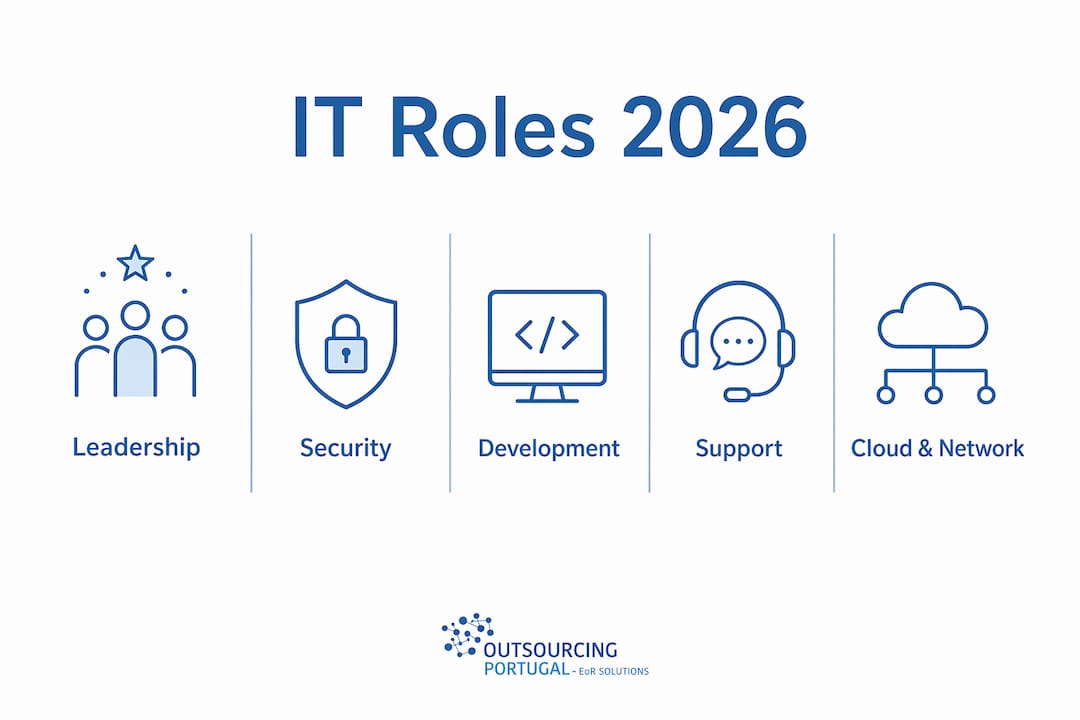
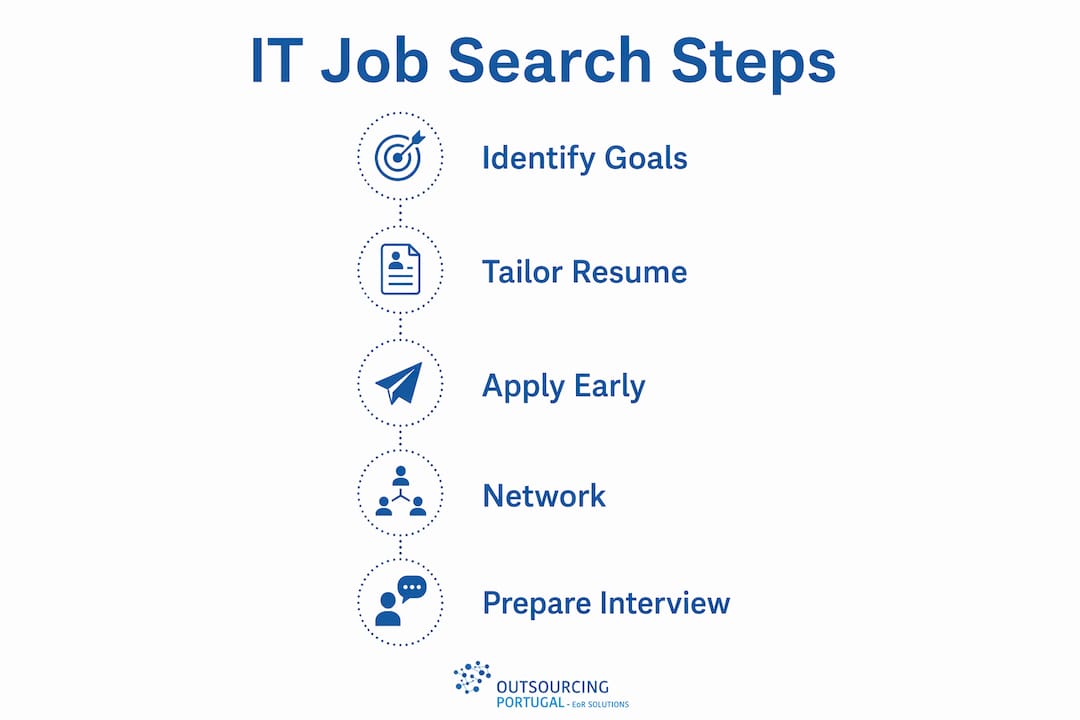
Infographic outlining top IT roles hierarchy

3. Network administrator

Network administrators design, implement, and maintain an organization’s communication infrastructure, including local area networks (LANs), wide area networks (WANs), and cloud-based networks. They test network systems, monitor traffic for anomalies, and respond to connectivity failures. The BLS reports a 2024 median pay of $96,800 for network and computer systems administrators, reflecting the specialized knowledge the role demands.

At the senior level, network administrators take on architecture decisions, evaluate new networking technologies, and often manage a small team of junior administrators.

4. Software developer

Software developers design, build, and test the applications and programs that organizations rely on. The BLS reports that software developers earn a median pay indicative of one of the higher-paying IT career profiles. Junior developers focus on writing and testing code under supervision. Mid-level developers own features independently. Senior developers lead architecture decisions, review code from others, and translate business requirements into technical specifications.

5. Information security analyst

Information security analysts plan and execute measures to protect an organization’s networks and systems from threats. Their responsibilities include monitoring for breaches, running vulnerability assessments, and developing incident response plans. The BLS median pay for this role sits at $124,910, and demand is growing fast as cybersecurity threats multiply.

6. Systems analyst

Systems analysts study how an organization uses technology and then design improvements. They bridge the gap between IT teams and business units, translating operational needs into technical requirements. The BLS reports that computer systems analysts earn a median pay consistent with their specialized role. Senior analysts often lead digital transformation projects and present recommendations directly to leadership.

7. Database administrator

Database administrators create, organize, and secure the systems that store an organization’s data. They protect data from unauthorized access, perform backups, and optimize query performance. The BLS median pay for database administrators and architects is $123,100. Organizations with large data environments, such as financial firms and healthcare systems, rely heavily on this role.

8. Web developer

Web developers build and maintain websites, handling everything from front-end layout and navigation to back-end functionality. The BLS reports that web developers and digital designers earn a median pay reflecting their role in website development. Entry-level developers typically work in HTML, CSS, and JavaScript. Senior developers architect full-stack solutions and often manage deployment pipelines and site performance.

9. Cloud computing engineer

Cloud engineers define, design, build, and maintain systems running on platforms like Amazon Web Services (AWS) and Microsoft Azure. As organizations shift infrastructure off physical servers, demand for cloud expertise has grown sharply. This role often requires familiarity with containerization tools, infrastructure-as-code practices, and cloud security frameworks.

10. IT leadership and management

Senior IT leadership draws on both deep technical backgrounds and strong management skills. IT directors and CIOs create and implement policies, manage budgets, and align technology strategy with business objectives. These roles require stakeholder communication, vendor negotiation, and the ability to translate complex technical decisions into language that executives and board members can act on.


What skills, qualifications, and certifications do IT jobs require?

The skills that matter most in an IT role depend on the specific position, but a consistent set of technical and interpersonal competencies appears across nearly every technology job description.

Technical skills

  • System administration: Managing operating systems (Windows, Linux, macOS), user accounts, and access controls
  • Network troubleshooting: Diagnosing connectivity issues, configuring routers and firewalls, and monitoring network traffic
  • Security protocols: Applying IT security best practices, managing vulnerabilities, and responding to incidents
  • Hardware and software maintenance: Installing, updating, and repairing physical and digital components
  • Cloud platforms: Working with AWS, Microsoft Azure, or Google Cloud for infrastructure and application hosting
  • Scripting and coding: Basic scripting in Python or PowerShell for automation; full programming proficiency for developer roles

Soft skills

Communication and empathy are often the deciding factor between two technically equal candidates, especially in support roles. The ability to explain a complex system failure to a non-technical manager without condescension is a skill that takes real practice. Other soft skills that appear consistently across IT position requirements include:

  • Problem-solving and critical thinking
  • Time management and the ability to prioritize competing requests
  • Customer service orientation, particularly for client-facing or help desk roles
  • Organization and attention to detail when managing multiple projects simultaneously

Education requirements

Most IT roles require at least an associate or bachelor’s degree in information technology, computer science, or computer engineering. Some employers, particularly for developer and analyst roles, prioritize portfolio quality and demonstrated experience over formal credentials. For IT support and specialist positions, relevant certifications often carry as much weight as a degree.

Certifications

Industry certifications provide standardized proof of competency and are especially valuable for candidates without four-year degrees. Commonly required or preferred certifications across IT roles include:

  • CompTIA A+: Entry-level certification covering hardware, software, and troubleshooting fundamentals
  • CompTIA Network+: Validates networking knowledge including protocols, infrastructure, and security
  • CompTIA Security+: Covers core cybersecurity concepts and is often required for security-focused roles
  • Cisco CCNA: Demonstrates networking proficiency and is widely recognized for network administrator positions
  • Microsoft certifications (MCITP, Azure): Relevant for roles involving Microsoft environments or cloud infrastructure
  • ITIL Foundation: Covers IT service management frameworks, valued in enterprise environments

Certifications like CompTIA A+ and Cisco CCNA regularly help candidates compete for roles where they lack a traditional four-year degree. Hiring managers in IT tend to treat a current, relevant certification as evidence of both competency and commitment to staying current.

Pro Tip: When writing an IT job description, list certifications in two tiers: “required” and “preferred.” Requiring CompTIA A+ for a senior network architect role will screen out strong candidates; listing it as preferred keeps the pool open.


What does the IT job market look like in 2026?

The U.S. IT job market remains one of the most active in the country. The BLS projects strong growth across computer and information technology occupations, driven by continued digital transformation, expanding cloud adoption, and rising demand for cybersecurity expertise. Organizations across every sector, from healthcare to finance to manufacturing, are building or expanding their IT teams.

Cybersecurity analyst working in monitoring room

Median salaries for key IT roles (2024 BLS data)

IT Role 2024 Median Annual Pay Typical Entry-Level Education
Software Developers, QA Analysts & Testers $124,910 Bachelor’s degree
Computer Network Architects $123,100 Bachelor’s degree
Information Security Analysts $124,910 Bachelor’s degree
Database Administrators and Architects $123,100 Bachelor’s degree
Computer and Information Research Scientists — Master’s degree
Computer Systems Analysts $96,800 Bachelor’s degree
Network and Computer Systems Administrators $96,800 Bachelor’s degree
Computer Programmers — Bachelor’s degree
Web Developers and Digital Designers — Bachelor’s degree
Computer Support Specialists — Varies

Salary note: IT support roles show the widest pay range across experience levels. According to Indeed, IT support salaries average $44,389 per year, with hourly rates typically ranging from $7–$56 depending on geography, certifications, and experience.

Entry-level positions in support and administration typically sit at the lower end of each role’s range, while senior professionals with specialized certifications or management responsibilities command salaries well above the median. Geographic location also plays a significant role: IT professionals in San Francisco, New York, and Seattle consistently earn more than the national median, while those in smaller markets may earn less.

The cybersecurity segment deserves particular attention. As data breaches grow in frequency and severity, organizations are prioritizing information security analyst hires. This pressure on the talent supply keeps salaries for security-focused roles elevated and makes security expertise one of the most valuable differentiators on any IT resume or job posting.


How to write an effective IT job description

A poorly written job description costs real money. It generates a flood of unqualified applications, buries the role in generic language, and signals to strong candidates that the organization does not know what it actually needs. Clear, bulleted responsibilities and realistic role expectations consistently produce higher-quality applicants.

Structure your description in five sections

  1. Role summary: Two to four sentences describing the position’s core purpose, who the hire will report to, and the team context. Avoid vague phrases like “dynamic environment” or “fast-paced team.”
  2. Key responsibilities: A bulleted list of 8–12 specific duties. Start each bullet with an action verb (install, configure, monitor, troubleshoot). Be specific enough that a candidate can picture a Tuesday afternoon in the role.
  3. Required skills and qualifications: Separate the non-negotiables from the nice-to-haves. List the operating systems, tools, and technologies the person will use on day one.
  4. Certifications and education: State the minimum education level and list required certifications explicitly. If a certification is preferred but not required, say so.
  5. Legal and compliance statements: Include an Equal Employment Opportunity (EEO) statement. Under U.S. federal law, job postings must not discriminate based on race, color, religion, sex, national origin, age, disability, or genetic information. Many organizations also add ADA accommodation language and, where applicable, statements about background check requirements.

Differentiate by experience level

The gap between a junior and senior IT role is not just years of experience. Entry-level roles focus on execution: installing systems, resolving tickets, and following documented procedures. Senior roles require strategic thinking, stakeholder communication, and the ability to align technology decisions with business goals. Your job description should reflect that difference explicitly, not just in the title.

For a junior IT support role, the qualifications section might require a CompTIA A+ certification and one year of experience. For a senior network administrator, you would specify CCNA or equivalent, five or more years of hands-on network management, and experience presenting infrastructure recommendations to leadership.

Specify the work environment clearly

Physical presence requirements belong in the job description, not in the first interview. Many IT roles require on-site access to hardware, server rooms, or physical infrastructure that cannot be managed remotely. Others are fully remote. Candidates who apply without knowing this detail waste everyone’s time. State it plainly in the role summary or in a dedicated “Work Environment” line.

Pro Tip: If the role requires occasional on-site work even when primarily remote, say “primarily remote with monthly on-site visits” rather than just “remote.” Ambiguity here is one of the top reasons candidates withdraw after an offer.

IT specialist job description sample


Job Title: IT Specialist

Reports to: IT Manager

Location: [City, State] / Hybrid

Role Summary: We are looking for an IT Specialist to maintain, configure, and support our organization’s hardware, software, and network systems. You will serve as a primary point of contact for technical issues and work closely with department heads to identify and implement technology solutions.

Key Responsibilities:

  • Install, configure, and maintain hardware, software, and network systems
  • Troubleshoot IT issues and resolve system outages for end users
  • Manage user accounts, permissions, and access controls
  • Monitor network performance and respond to connectivity issues
  • Implement and maintain IT security protocols and data protection measures
  • Coordinate with vendors for equipment purchases and support contracts
  • Document IT policies, procedures, and troubleshooting guides
  • Conduct training sessions on tools and security practices for staff

Required Qualifications:

  • Bachelor’s degree in Information Technology, Computer Science, or a related field, or equivalent experience
  • 2–5 years of experience in IT support, system administration, or a related role
  • Proficiency in Windows, Linux, and macOS operating systems
  • Knowledge of network protocols, firewalls, and security best practices
  • CompTIA A+ or Network+ certification (or equivalent)

Preferred Qualifications:

  • Cisco CCNA or Microsoft Azure certification
  • Experience with cloud platforms (AWS, Azure, or Google Cloud)
  • Familiarity with ITIL service management frameworks

Equal Opportunity Statement: [Company Name] is an equal opportunity employer. We do not discriminate on the basis of race, color, religion, sex, national origin, age, disability, or any other characteristic protected by applicable federal, state, or local law.


For organizations building or expanding IT teams internationally, particularly in European markets, IT recruitment in Portugal follows many of the same structural principles but requires attention to local labor law, contract requirements, and EU compliance standards. Getting the job description right from the start makes that process considerably smoother.

For IT roles that involve documentation, localization, or client-facing content across multiple languages, working with a specialist like Glocco’s IT translation services can prevent costly miscommunication in multinational hiring processes.


Key Takeaways

An IT job description that specifies exact duties, required certifications, experience level, and work environment consistently attracts better candidates than one built on generic language.

Point Details
Salary range varies widely by role BLS 2024 median pay spans from — for support specialists to — for research scientists.
Certifications substitute for degrees CompTIA A+ and Cisco CCNA help candidates without four-year degrees compete for IT roles.
Senior roles require strategic skills Entry-level IT focuses on execution; senior positions demand stakeholder communication and business alignment.
Work environment must be explicit State on-site, hybrid, or remote requirements clearly to avoid mismatched applicants.
EEO language is legally required U.S. job descriptions must include equal opportunity statements to comply with federal anti-discrimination law.

Hiring IT talent across borders? Outsourcing-portugal can help
https://outsourcing-portugal.co.uk

If your organization is building an IT team outside the U.S., getting the job description right is only the first step. Compliance with local employment law, payroll management, and onboarding logistics add layers of complexity that slow down hiring and create legal exposure. Outsourcing-portugal specializes in exactly this: helping international companies hire, onboard, and manage IT professionals in Portugal without setting up a local entity.

Portugal offers a highly educated, English-proficient tech workforce at competitive labor costs, making it one of the most practical nearshore options for U.S. and European companies scaling their IT operations. Outsourcing-portugal handles the Employer of Record (EOR) structure, payroll, and legal compliance so your team can focus on finding the right people.

Explore employment outsourcing services or learn more about EOR solutions in Portugal to see how the process works.


Woman browsing remote job listings at home

How to Find Remote Work in 2026: Top Platforms and Strategies

The fastest path to remote work in 2026 runs through specialized job boards combined with a disciplined, targeted search strategy. Generic boards like Indeed and LinkedIn mix remote and on-site listings, which wastes time. Dedicated platforms cut through that noise. Here are the key platforms and moves that actually work:

  • FlexJobs — paid, hand-screened listings across dozens of industries; zero scams
  • We Work Remotely — one of the largest boards, strongest in tech, design, and marketing
  • Remote.co — curated fully remote roles with visible company remote culture policies
  • Remotive.io — tech and product roles plus an active Slack community for networking
  • Jobspresso — handpicked jobs in tech, marketing, customer support, and design
  • Wellfound — startup and pre-IPO remote roles, often with equity compensation
  • Arc — developer-focused with coding challenges and global reach
  • Contra — freelance and contract marketplace built around independent professionals
  • JustRemote — global listings with strong filters for part-time and fully remote roles
  • The Mom Project — family-friendly remote roles for parents balancing career and home
  • Remote OK — real-time developer and tech feed with salary transparency
  • NoDesk — curated listings plus a newsletter and remote work resource hub
  • Remotive — community-driven curation with a Slack group for tech professionals

Set job alerts on two or three of these platforms, apply within 24 hours of a posting going live, and tailor every application to the specific role. Hiring timelines vary, generally faster for customer support roles and longer for technical positions.

Which remote job platforms should you use in 2026?

Every platform above serves a different kind of job seeker. The table below maps each one to its core niche, job types, and what sets it apart.

Man explaining remote platform categories on whiteboard

Platform Focus / Niche Job Types Standout Feature Pricing
FlexJobs Multi-industry, vetted Full-time, part-time, freelance Hand-screened listings; no scams Paid subscription
We Work Remotely Tech, design, marketing Full-time, contract Large active board; frequent postings Free to browse
Remote.co Diverse, fully remote Full-time, part-time Company remote culture transparency Free
Remotive.io Tech, product, engineering Full-time Slack community + curated listings Free
Jobspresso Tech, marketing, support Full-time, freelance Detailed company info per listing Free
Wellfound Startups, pre-IPO Full-time, equity roles AngelList profile integration Free
Arc Software development Full-time, contract Coding challenges and screening tools Free
Contra Freelance, independent work Contract, gig Profile-driven matching Free
JustRemote Multi-field, global Full-time, part-time, freelance Global filters, real-time updates Free / Premium
The Mom Project Family-friendly careers Full-time, flexible Employer network supporting parents Free
Remote OK Tech, developer-heavy Full-time, contract Real-time feed with salary data Free
NoDesk Tech, marketing, support Full-time Newsletter + resource aggregation Free
Remotive Tech, product Full-time Community-driven curation Free

A few platforms deserve extra context. FlexJobs charges a subscription fee, but its team spends over 200 hours per day verifying listings, which eliminates the scam risk that plagues free boards. Wellfound’s deep integration with AngelList profiles means your startup job search and your professional presence work together automatically. Arc goes further than most developer boards by running coding challenges and screening support before you ever reach a hiring manager. Contra is built differently from the rest: it centers on your independent professional profile rather than a traditional resume, which suits freelancers who want to showcase a body of work rather than a job history.

For job seekers outside tech, Remote.co and The Mom Project fill gaps the developer-heavy boards ignore. Remote.co publishes each company’s remote work policy alongside listings, so you can assess culture fit before applying. The Mom Project connects parents with employers who have explicitly committed to flexible, family-supportive work arrangements.

Pro Tip: Check company career pages directly for your top 20 target employers. Roles posted there often see fewer applicants than the same listing on an aggregator, because most job seekers never look.

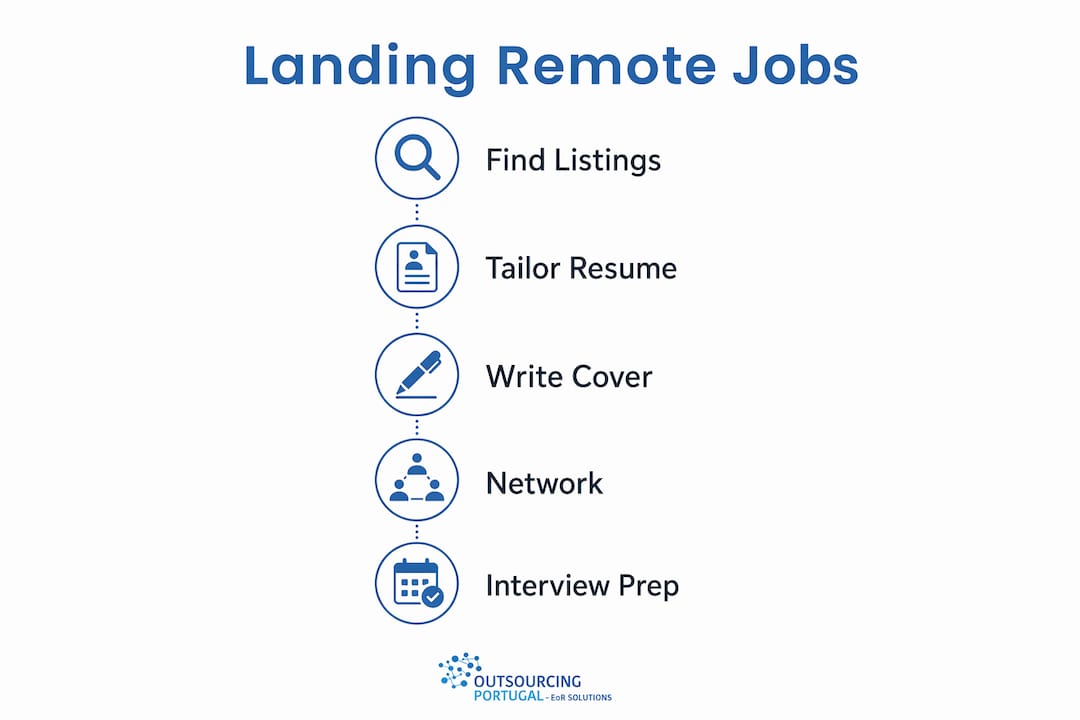
How to actually land a remote job, not just find one

Finding listings is the easy part. Getting hired requires a different approach than a standard office job search.

Infographic outlining key steps to land remote job

Applying to a moderate number of tailored jobs per week is the right volume to maintain quality. Beyond that, cover letter quality drops, applications start to feel generic, and response rates fall. Quality beats quantity every time.

Your resume needs to pass AI screening before a human sees it. Mirror the job posting’s exact language, list tools explicitly (Slack, Notion, Asana, Loom), and lead with quantified results rather than responsibilities. Clean formatting matters too: no tables, text boxes, or multi-column layouts that break applicant tracking systems.

Remote employers weigh written communication skills heavily, often as much as technical expertise. Your cover letter is a live sample of how you’ll communicate on Slack. If it rambles, hiring managers assume your async messages will too. Keep it tight, reference something specific about the company, and connect it directly to your background.

Networking and referrals convert at a higher rate than cold applications. Connect with people at remote-first companies, engage with their content consistently, and aim for warm introductions before you submit anything. A referral doesn’t guarantee an offer, but it gets your resume read by a person instead of a parser.

Identify deal-breakers early: mandatory return-to-office clauses, camera-on-all-day policies, or six-plus hours of daily meetings. Screening these out upfront saves weeks of wasted effort on roles that were never going to work.

Also be ready to speak to your home office setup, your async communication style, and your time zone overlap. Remote companies evaluate your ability to work remotely, not just your credentials. See the remote team onboarding guide for a clear picture of what employers assess during this process.

What fields hire remotely, and how long does it take?

Remote work is not evenly distributed across industries. Information Technology leads in volume, followed by Customer Service and Human Resources. Other fields with consistent remote availability include:

  • Information Technology — software development, DevOps, data engineering, cybersecurity
  • Customer Service — support specialists, account managers, success roles
  • Human Resources — recruiters, HR generalists, people operations
  • Marketing — content, SEO, paid media, brand management
  • Writing and Editing — copywriters, technical writers, editors
  • Project Management — program managers, operations leads
  • Virtual Assistance — executive assistants, administrative coordinators

Thousands of new remote positions post weekly across major platforms. Hiring speed varies sharply by role type. Customer support and entry-level positions typically move in a few weeks. Technical and senior roles can take several months. Executive searches often take longer.

Remote job search timelines generally range from a few weeks to several months, and longer for senior positions. Plan accordingly and don’t treat two weeks of silence as failure.

Location restrictions matter more than many job seekers expect. Some roles require U.S.-based candidates for tax or legal reasons. Others specify core hours in EST or PST. Read every listing’s location section before applying.

Outsourcing-portugal offers a compliant path for global remote hiring

The job boards above serve individual job seekers well. But for companies building remote teams across borders, or for professionals seeking employment through a compliant international structure, a different approach exists.

Outsourcing portugal

Outsourcing-portugal provides Employer of Record services that let international companies hire in Portugal without setting up a local entity. That means payroll, legal compliance, onboarding, and HR support handled end-to-end, with access to Portugal’s multilingual, highly educated workforce at competitive labor costs.

For remote workers, this structure offers employment contracts that meet EU legal standards, full benefits, and clarity on tax obligations. For employers, it removes the compliance risk that comes with hiring across borders independently.

  • Fully compliant employment contracts under Portuguese and EU law
  • Payroll processing and tax filing handled locally
  • Onboarding and HR support for distributed teams
  • Access to Portugal’s talent pool across tech, customer service, and professional services
  • No local entity required to start hiring

If you’re a company building a nearshore team or a professional exploring compliant remote employment in Europe, Outsourcing-portugal is worth a direct conversation.

Key Takeaways

Specialized remote job boards combined with targeted, tailored applications consistently outperform broad searches on general platforms.

Point Details
Use specialized boards Platforms like FlexJobs, We Work Remotely, and Remote OK filter out hybrid and on-site noise.
Apply 10–15 times per week Applying to 10–15 highly tailored jobs per week is optimal for maintaining quality and boosting response rates; mass applying lowers your chances.
Apply within 24 hours Early applicants get significantly more recruiter visibility on most platforms.
Expect realistic timelines Remote job searches typically take a few weeks to several months, with senior positions requiring more time.
Outsourcing-portugal Offers compliant Employer of Record hiring in Portugal for companies building remote teams across borders.

What remote hiring actually rewards in 2026

The conventional advice says apply everywhere and see what sticks. That approach burns people out and produces almost nothing. What actually works is narrower than most job seekers expect.

Remote hiring rewards clarity above almost everything else. When you know exactly which role you’re targeting, your resume, LinkedIn profile, and networking conversations all reinforce the same story. Hiring managers at distributed companies read dozens of applications from qualified people. The ones who stand out aren’t necessarily the most experienced. They’re the ones whose materials make it immediately obvious why this role, at this company, fits their background.

The ATS and AI screening layer has made generic applications nearly invisible. A resume that mirrors the job posting’s language and lists tools explicitly gets past the parser. One that doesn’t, regardless of the candidate’s actual ability, often doesn’t reach a human at all.

Networking feels slow, but it’s the highest-converting activity in a remote job search. A warm introduction from someone inside the company collapses the trust gap that cold applications can’t bridge. The best time to build those relationships is before you need them.

Mother reviewing maternity leave papers

Maternity Leave in Portugal: 2026 Complete Guide

Portugal gives working parents 120 or 150 consecutive days of paid parental leave, with the option to extend by 30 additional days when both parents each take exclusive leave periods. The Portuguese Social Security system funds the allowance directly, replacing lost wages at rates tied to the leave duration you choose. Here is what you need to know at a glance:

  • Initial parental leave: 120 days at 100% of reference remuneration, or 150 days at 80%
  • Shared extension: An extra 30 days (totaling 150 or 180 days) when each parent takes at least 30 consecutive exclusive days, or two separate periods of 15 consecutive days
  • Mandatory maternal recovery: 42 days immediately after birth, non-negotiable
  • Mandatory paternity leave: 28 days total, including 7 consecutive days taken immediately after birth, with the remaining 21 days within 6 weeks of birth
  • Qualifying condition: At least six months of Social Security contributions, consecutive or aggregated, before the leave starts
  • Allowance payment: Paid at 100% for the father’s mandatory 28 days regardless of which overall leave option the family selects

What are your rights to parental leave in Portugal?

Every employed worker in Portugal, whether a salaried employee, a self-employed person, or a legal guardian, holds a legal right to parental leave and the associated allowance under the Portuguese Labour Code. The right applies equally to mothers and fathers, and adoptive parents receive the same entitlements as biological ones.

Man reading parental leave guide

Employers carry clear obligations during this period. They cannot dismiss an employee who is pregnant, on parental leave, or who has recently returned from leave without first obtaining a favorable opinion from the Commission for Equality in Labour and Employment (CITE). If a fixed-term contract expires during leave, the employer must notify CITE and may need to justify the non-renewal.

To qualify for the parental allowance, workers must have contributed for at least six months to the Portuguese Social Security system, either consecutively or in aggregate. Periods registered under equivalent foreign social protection systems count toward this threshold, provided they do not overlap. Self-employed workers face one additional condition: their Social Security contributions must be paid up through the end of the third month immediately before the month in which they stop working due to the birth.

  • Employees must notify employers in writing, backed by a medical certificate or the pregnant worker’s health record
  • The joint declaration for shared leave must reach both employers within 7 days of birth
  • Failure to submit the joint declaration means leave defaults entirely to the mother
  • Workers taking non-shared leave must inform their employer of the duration and start date within 7 days of birth

Pro Tip: Self-employed workers should verify their contribution status at least two months before the expected birth date. A gap in payments can disqualify you from the allowance entirely, and there is no retroactive fix once the leave period begins.

How long is maternity leave in Portugal, and what are the options?

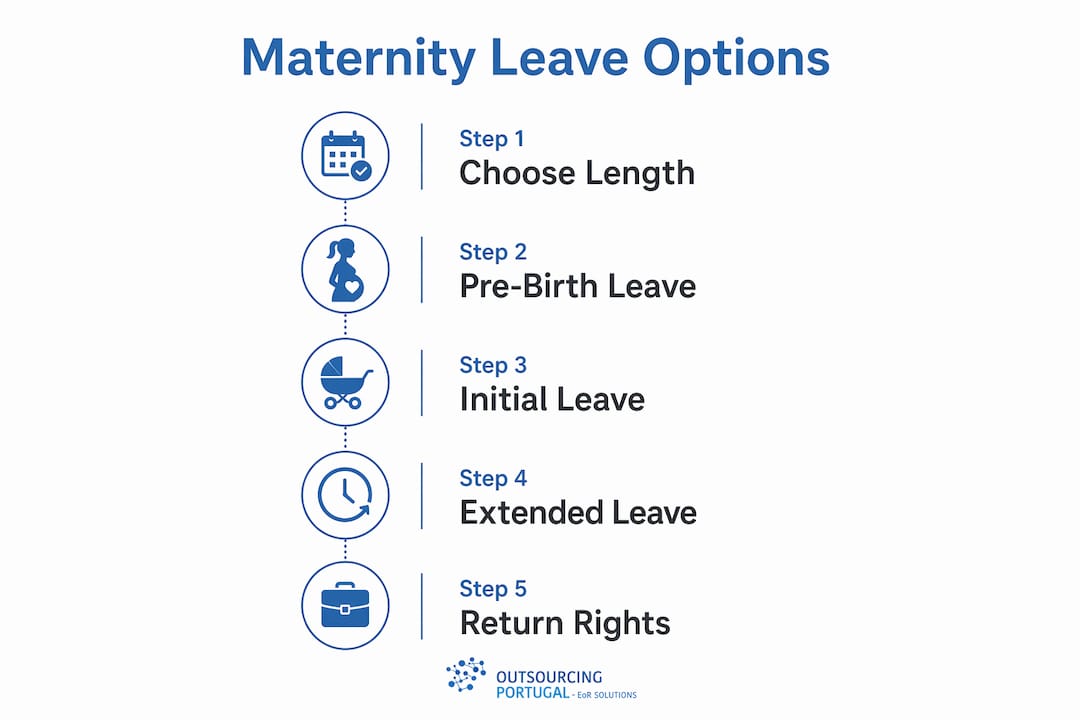
The core choice every family faces is between 120 or 150 consecutive days of initial parental leave. That decision drives both the duration and the payment rate, so it is worth understanding exactly what each path looks like before the birth.

Mothers have up to 30 optional days of leave before the birth, which count toward the 120 or 150 day total. The 42 days immediately after birth are mandatory for the mother and cannot be waived or transferred. Fathers take a mandatory leave period starting immediately after birth, followed by additional days to be used within a set number of weeks. Fathers also have 7 optional working days they can take concurrently while the mother is on her leave.

Infographic outlining maternity leave steps in Portugal

When parents want to unlock the additional extended leave, the sequencing matters. Each parent must take exclusive leave periods after the mother’s mandatory post-birth period. Those exclusive periods cannot overlap. The extra 30 days always come last in the leave sequence, whether one parent takes them alone or both parents split them.

Leave option Duration Payment rate Notes
Standard 120 days 100% No shared extension required
Extended 150 days 80% No shared extension required
Shared extension 180 days 83–90% Requires exclusive periods by each parent
Father’s mandatory leave 28 days 100% Always paid at full rate
Optional pre-birth leave Up to 30 days 100% Counts toward 120/150 day total
Twin bonus +30 days per twin beyond the first Matches chosen rate Added to base duration
  • After the first 120 days, parents who chose the 150 or 180-day option can combine remaining leave days with part-time work
  • The 30-day extension is always the final segment of total leave
  • Parents must submit a joint declaration to their employers within 7 days of birth to activate shared leave

How do maternity, paternity, and shared parental leave actually work?

Maternity leave in Portugal is formally called “initial parental leave exclusively for the mother,” and it covers the period from up to 30 days before birth through the mandatory 42-day post-birth recovery. Those 30 optional pre-birth days are the mother’s choice alone; no medical recommendation is required to take them. Both the optional and mandatory periods are part of the same 120 or 150-day total.

Couple reviewing maternity leave documents

Paternity leave runs on its own track. The first 7 days are mandatory and consecutive, starting immediately after birth. The remaining 21 days must fall within the first 6 weeks. Fathers can also take 7 optional working days concurrently with the mother’s leave, which gives families a window of genuine dual-parent coverage right after birth. All 28 mandatory days are paid at 100% of reference remuneration regardless of which overall leave option the family selects.

Shared leave requires coordination and paperwork. Both parents must each take exclusive periods (not simultaneously) after the mother’s mandatory 42 days. The joint declaration to employers must arrive within 7 days of birth, specifying start and end dates for each parent’s period. Miss that window and the leave defaults to the mother, forfeiting the 30-day extension.

  • Adoption leave follows the same rules and durations as biological parental leave, including access to the parental allowance
  • If one parent becomes physically or mentally incapacitated, or dies, the other parent inherits the remaining leave entitlement
  • For stillbirths, the mother retains a minimum of 120 days of allowance unless she opts for a shorter period, with the mandatory 42-day post-birth period still applying

What extended and special-circumstance leave does Portugal offer?

Beyond the initial parental leave, Portugal provides extended parental leave of up to 3 months per parent, taken alternately, for care of a child living in the household. This extended leave must begin immediately after the initial parental allowance period ends. Payment during extended leave is lower than during initial leave, so families should factor that into their planning.

Adoption and foster care procedures carry their own leave rights. Parents going through adoption or foster care can take time off to attend Social Security services or meet with assessors evaluating potential adopters. That time counts as active employment for Social Security purposes, and there is no cap on how many times it can be taken.

Pregnancy loss is also covered. A termination of pregnancy entitles the mother to a leave period of between 14 and 30 days, with duration confirmed by medical certificate. High-risk pregnancies give workers the right to leave for the duration of the risk, and if the employer cannot reassign the worker to safer duties, the daily allowance equals 65% of reference remuneration.

  • Leave for care of a sick child under 12: a significant number of days per year, or the full hospitalization period
  • Leave for a child over 12: a shorter but meaningful number of days per year
  • Children with a disability or chronic illness: no age cap on the care leave entitlement
  • Grandparents who are legal carers can also take leave to care for a sick or injured minor grandchild, paid at 65%

How is the parental allowance calculated?

The allowance is based on reference remuneration, which is the average gross earnings over a defined prior period used as the standard base for Portuguese Social Security calculations. The payment rate then depends on the leave option chosen.

A concrete example makes this clearer. Suppose a worker’s reference remuneration works out to €2,000 per month. On the 120-day option, the allowance pays 100%, so the worker receives the equivalent of €2,000 monthly throughout. On the 150-day option at 80%, that drops to €1,600 per month. Families who meet the shared-leave conditions and extend to 180 days receive between 83% and 90%, depending on how many exclusive days the father takes.

The qualifying threshold is firm: six months of Social Security contributions, consecutive or aggregated, with remuneration on record. Contributions from equivalent foreign systems count, provided there is no overlap with Portuguese periods. For self-employed workers, contributions must be current through the third month before the birth month.

Leave duration Payment rate Condition
120 days 100% Standard option
150 days 80% Standard option
150 days (shared) 83–90% Each parent takes exclusive periods
180 days (shared) 83–90% Each parent takes exclusive periods
Father’s 28 mandatory days 100% Always, regardless of family option
  • The allowance is paid by Portuguese Social Security, not the employer
  • Workers must apply through the Social Security system; the employer does not process the payment
  • Contribution periods from other EU or equivalent foreign systems can be aggregated to meet the six-month threshold

What rights do you have after returning from leave?

Breastfeeding mothers returning to work are entitled to two daily absences of up to one hour each for breastfeeding, unless a different schedule is agreed with the employer. For multiple births, an additional 30 minutes per extra baby applies. If the baby is not breastfed, parents still have equivalent daily feeding breaks until the child turns one. After the first year, continuing breastfeeding requires a medical certificate to maintain the entitlement.

Breastfeeding mothers also hold exemptions from night work (between 8 PM and 7 AM) for the duration of breastfeeding if it is medically necessary, and from overtime, compressed hours, and flexible working arrangements during pregnancy and the post-birth period. Employers who cannot reassign the worker to daytime duties must pay a daily allowance at 65% of reference remuneration.

Job protection is strong. Pregnant workers and those on or recently returned from parental leave can only be dismissed with a favorable opinion from CITE or by court decision. Parents of children under 12 can request reduced working hours by half, flexible hours, or remote work where duties allow. The employer has 20 days to respond to a written request; silence counts as acceptance.

  • Parents must notify employers 10 days before breastfeeding or feeding breaks begin
  • Leave to care for a sick child under 12 runs up to 30 days per year, or the full hospitalization period
  • Parents of children with disabilities or chronic illness have no age cap on care leave
  • Employees can take up to 4 hours off per quarter to attend school meetings for children under 12

How foreign companies can stay compliant with Portugal’s parental leave rules

Portugal’s parental leave compliance requirements in 2026 are detailed and carry real legal risk for employers who get them wrong. Foreign companies hiring in Portugal without a local entity face the steepest exposure: they must manage Social Security registration, payroll adjustments during leave, and the documentation trail for joint declarations, all under Portuguese Labour Code rules.

Outsourcing-portugal works with international companies to handle exactly this complexity. As an Employer of Record operating under Portuguese law, it manages Social Security contributions, processes leave notifications, and keeps payroll compliant throughout the leave period, including the transition back to work. For companies building nearshore teams in Portugal, that removes the single biggest administrative risk in the employment relationship.

The labor compliance maturity required to manage parental leave correctly goes beyond knowing the rules. It means having systems in place to track contribution periods, flag approaching leave windows, and file declarations on time.

  • Register all employees with Portuguese Social Security before they reach six months of employment
  • Maintain accurate records of reference remuneration for every worker, updated each payroll cycle
  • Process joint declarations within 7 days of birth; calendar this as a hard deadline, not a soft one
  • Never attempt to dismiss or non-renew a contract for a pregnant or recently returned employee without CITE clearance
  • Coordinate with Social Security directly for allowance payments; the employer does not fund the leave allowance
  • Document all breastfeeding break agreements in writing to avoid disputes on return

Pro Tip: Foreign companies using an Employer of Record in Portugal transfer the compliance burden for leave administration, Social Security filings, and employee protections to a local entity that already has the systems in place. For a team of even five employees, that alone justifies the cost.

https://outsourcing-portugal.co.uk

Managing parental leave compliance in Portugal is one of the more complex HR obligations a foreign employer faces. Outsourcing-portugal’s Employer of Record services handle Social Security registration, payroll during leave, and all required declarations, so your team stays protected and your business stays compliant. You can also review the full payroll compliance checklist for hiring in Portugal to see exactly what the obligations look like in practice.

Key Takeaways

Portugal’s parental leave system pays 100% of reference remuneration for 120-day leave and 80% for 150 days, with a 30-day extension available when both parents each take exclusive leave periods after the mandatory 42-day maternal recovery, bringing the total to 180 days.

Point Details
Core leave options Parents choose 120 days at 100% pay or 150 days at 80% pay, with 180 days possible at 83–90% pay if both parents each take exclusive periods, from Portuguese Social Security.
Mandatory periods Mothers must take 42 days post-birth; fathers must take 28 days within 6 weeks of birth.
Shared extension An extra 30 days unlocks when each parent takes at least 30 exclusive consecutive days after the mandatory maternal period.
Qualifying threshold Workers need at least six months of Social Security contributions, consecutive or aggregated, to receive the allowance.
Employer obligations Joint declarations must reach employers within 7 days of birth; dismissal during leave requires CITE approval.
Woman analyzing human resources report at desk

Human Resources Report: Top 10 Types for 2026


TL;DR:

  • HR reporting consolidates workforce data to enable strategic talent decisions and improve business outcomes. Effective reports connect HR metrics directly to organizational performance, aiding faster hiring and retention. Tailoring reports for specific audiences and automating their generation foster meaningful action and continuous improvement.

A human resources report is a structured document that consolidates workforce data and metrics to support talent management, compliance, and strategic decision-making. HR reporting has moved well beyond administrative record-keeping. 65% of senior business leaders now classify HR as a key business enabler, and organizations with strong HR capabilities cut their time to fill critical roles by an average of 17–18 days compared to peers. That gap is not accidental. It reflects the direct connection between disciplined HR analysis reporting and faster, smarter workforce decisions. The ten report types below give HR professionals and business leaders the clearest path to that advantage.

1. What is an HR report and why does it matter?

A human resources report is the formal term for what practitioners also call an HR analysis report or workforce intelligence document. It captures headcount, performance, compensation, compliance, and engagement data in one place. Without it, workforce decisions rely on gut instinct rather than evidence.

Diverse team reviewing HR reports in meeting room

The business case is concrete. Organizations that treat HR as a strategic function reduce hiring delays and improve retention outcomes. The 17–18 day reduction in time-to-fill translates directly into lower vacancy costs and faster team productivity. Every report type below feeds that outcome in a different way.

2. Headcount report

A headcount report tracks the total number of employees across departments, locations, job levels, and employment types at a given point in time. It is the foundation of every other workforce analysis because you cannot plan hiring, budgets, or restructuring without knowing exactly who is on payroll.

Key data points include full-time equivalents, part-time ratios, contractor counts, and open positions. HR leaders use headcount trends to spot growth bottlenecks before they become crises. Run this report monthly at minimum, and tie it directly to your financial planning cycle.

3. Turnover and retention report

A turnover and retention report measures how many employees leave, why they leave, and which teams or roles carry the highest attrition risk. Voluntary versus involuntary separation rates tell very different stories about culture and management quality.

This report is where HR KPI reporting earns its keep. Track 90-day turnover separately from annual turnover. New-hire attrition within the first quarter signals onboarding failures, not just hiring mismatches. Pair exit interview data with manager effectiveness scores to identify the real drivers.

Pro Tip: Segment turnover by tenure band. Losing employees with 2–4 years of experience costs more than losing new hires because institutional knowledge walks out with them.

4. Recruiting pipeline report

A recruiting pipeline report maps every open role from job posting through offer acceptance, showing time-to-fill, source of hire, offer acceptance rate, and cost-per-hire at each stage. It tells you where your hiring process leaks candidates.

Strong HR capabilities reduce time-to-fill by 17–18 days. That improvement comes from knowing exactly which stage slows down and fixing it. If your pipeline report shows a 70% drop-off between phone screen and hiring manager interview, the bottleneck is scheduling or criteria alignment, not candidate quality.

5. Employee satisfaction report

An employee satisfaction report, often built from engagement surveys, pulse checks, or Net Promoter Score tools, measures how employees feel about their work, management, and the organization. It is the leading indicator that turnover reports lag behind.

Satisfaction data becomes useful only when it is segmented. Company-wide averages hide the fact that one department is disengaged while another is thriving. Break results down by team, tenure, and job level. Then act on the findings within 60 days or employees stop believing the surveys matter.

6. HR KPI report

An HR KPI report consolidates the metrics that connect HR activity to business outcomes: time-to-fill, cost-per-hire, turnover rate, absenteeism rate, training completion rate, and internal promotion rate. It is the document HR leaders present to the C-suite.

The challenge is choosing the right KPIs. Only 11% of organizations have a fully embedded skills taxonomy, which is the missing link between talent data and business outcomes like reduced turnover and faster hiring. Without that taxonomy, KPI reports measure activity rather than impact. Build your KPI set around the outcomes your CEO cares about, not the metrics your HRIS generates by default.

7. Workforce demographics report

A workforce demographics report documents the age, gender, nationality, education level, and tenure distribution of your workforce. It is the data foundation for both inclusion planning and workforce continuity risk management.

Demographics are shifting in ways that demand attention. Adults aged 50 and older now make up approximately one-third of the U.S. labor force, and the share of workers aged 65 and older has nearly tripled over the past 25 years. A workforce demographics report that ignores this shift will miss succession risks, benefits design gaps, and the need for age-friendly hiring practices. Organizations that treat the aging workforce as a core labor component, not an edge case, will outperform those that do not.

8. Compliance report

A compliance report documents adherence to labor laws, equal employment opportunity requirements, wage and hour regulations, and data privacy standards. It is not optional. It is the document that protects the organization during audits and litigation.

Compliance reporting requirements vary by jurisdiction, which makes it particularly complex for multinational HR teams. Track I-9 completion rates, EEO-1 filing status, FMLA usage, and GDPR consent records in one consolidated view. Review this report quarterly and after any regulatory change.

9. Training and development report

A training and development report tracks completion rates, skill gap progress, certification status, and the return on investment from learning programs. It connects individual development to organizational capability.

Only 48% of companies run structured reskilling programs, and only 54% use skills-based matching for talent mobility. Those gaps show up directly in training reports when completion rates are high but skill gaps remain unchanged. The fix is aligning training content to a defined skills taxonomy rather than offering programs based on availability.

10. Compensation and benefits report

A compensation and benefits report benchmarks pay levels against market data, tracks total compensation costs, and monitors pay equity across gender, race, and job level. It is the report that prevents both overspending and legal exposure.

HR salaries are projected to rise 1.6% year over year in 2026, driven by demand for analytics and digital fluency. The roles with the highest growth include Senior HRIS Analyst, Compensation Manager, and Benefits Specialist. Your compensation report should reflect those market movements before they become retention problems.

11. Diversity and inclusion report

A diversity and inclusion report measures representation across hiring, promotion, pay, and leadership levels. It goes beyond headcount demographics to track whether inclusion programs actually change outcomes over time.

The most effective D&I reports compare internal representation ratios to external labor market benchmarks. That comparison reveals whether gaps reflect pipeline problems, selection bias, or retention failures. Each cause requires a different intervention, and conflating them wastes resources.

How to use HR reports effectively

The best HR reports do not just present data. They tell a story that connects workforce conditions to business results. Start every report with the business question it answers, not the data it contains.

Only 54% of companies use skills-based matching for talent mobility. That gap means most organizations cannot connect their training data to their hiring outcomes. Closing it requires a shared skills taxonomy that runs across recruiting, development, and performance reports simultaneously.

Automation reduces the administrative burden of report generation significantly. HRIS platforms like Workday, SAP SuccessFactors, and Oracle HCM can schedule and distribute reports automatically, freeing HR teams to focus on interpretation rather than compilation.

Pro Tip: Send your HR KPI report to department heads with one pre-written insight per metric. Managers act on data faster when someone has already done the first layer of interpretation for them.

Generative AI and advanced analytics are changing what HR reports can contain and how fast they can be produced. Nearly 70% of companies now use generative AI, though only 38% consider it highly relevant today. Half expect high or transformational impact from agentic AI in the near future. That gap between adoption and impact is where most HR teams currently sit.

Key trends reshaping staff performance analysis and workforce reporting include:

  • Predictive attrition modeling: AI tools flag flight-risk employees before they resign, giving managers a window to intervene.
  • Real-time dashboards: Static monthly reports are giving way to live workforce data accessible to line managers, not just HR.
  • Skills-based reporting: Organizations are shifting from job-title-based headcount to skills-inventory reporting to support agile talent deployment.
  • Pay equity automation: Compensation reports now run equity analyses continuously rather than annually.
  • Aging workforce tracking: With workers aged 50 and older representing one-third of the labor force, demographic reports now include retirement risk and knowledge transfer readiness scores.

HR professionals with specialized analytics skills command the highest salary growth in 2026. Organizations that invest in those skills now will generate better reports and make faster decisions.

Choosing the right HR reporting approach

The right reporting approach depends on organizational size, data maturity, and the decisions the reports need to support. The table below compares four common approaches.

Approach Ease of use Customization Integration Best for
Manual spreadsheets High High None Small teams, early-stage reporting
HRIS built-in dashboards Medium Medium Native Mid-size organizations with one HRIS
Automated analytics platforms Medium High API-based Multi-system environments needing consolidated data
AI-powered reporting tools Low to medium Very high Complex Large organizations with mature data infrastructure

Start with the approach that matches your current data quality, not your future ambitions. A manual report built on clean data outperforms an AI dashboard fed by inconsistent inputs. Scale reporting sophistication as your data governance matures.

Key Takeaways

Effective HR reporting connects workforce data directly to business outcomes, and organizations that embed a skills taxonomy and automate report generation consistently outperform those that rely on manual, siloed data.

Point Details
Start with clean data No reporting tool compensates for inconsistent or incomplete workforce data inputs.
Prioritize KPIs over volume Report on the metrics your CEO acts on, not every metric your HRIS can produce.
Segment every report Company-wide averages hide the department-level problems that drive turnover and disengagement.
Embed a skills taxonomy Only 11% of organizations have done this, yet it is the link between HR data and business outcomes.
Match tools to data maturity Start simple and scale reporting sophistication as your data governance improves.

Why most HR reports fail to drive change

The uncomfortable truth I have learned from years of working with HR data is this: most HR reports are built to satisfy the person who requested them, not to change the behavior of the person who receives them. A 40-page annual workforce review lands in an inbox, gets skimmed, and changes nothing.

The gap between senior CHROs and broader HR teams is a real and underreported problem. HR professionals with 9–15 years of experience, three levels from the top, are often the most disengaged in the organization. They are the ones who translate CHRO strategy into operational reality. When they are not bought in, reports become compliance exercises rather than decision tools.

The fix is not better software. It is designing reports for the person who needs to act on them. A department manager needs three numbers and one recommendation. A CFO needs cost and risk. A CHRO needs trend lines and competitive benchmarks. One report format serves none of them well. The organizations that get this right build culturally aligned reporting practices that match the decision-making style of each audience.

— Paulo

Outsourcing-portugal: HR reporting and workforce management made practical

Managing HR reports across multiple jurisdictions adds a layer of complexity that internal teams often underestimate. Outsourcing-portugal provides employment outsourcing, payroll management, and HR compliance support for international companies building teams in Portugal, without requiring a local legal entity.

https://outsourcing-portugal.co.uk

From Employer of Record services that handle compliance reporting automatically to payroll documentation aligned with Portuguese labor law, Outsourcing-portugal gives global HR leaders accurate workforce data without the administrative overhead. If your organization is expanding into Portugal or building a nearshore team, explore the employment outsourcing services available through Outsourcing-portugal to see how structured HR support translates into cleaner data and faster decisions.

FAQ

What is an HR report?

An HR report is a structured document that presents workforce data, including headcount, turnover, compensation, and compliance metrics, to support talent management and strategic business decisions.

How often should HR reports be generated?

Headcount and recruiting pipeline reports work best on a monthly cycle, while compliance and compensation reports typically run quarterly. Employee satisfaction reports follow survey schedules, usually twice per year.

What are the most important HR KPIs to track?

The most critical HR KPIs include time-to-fill, cost-per-hire, voluntary turnover rate, absenteeism rate, and internal promotion rate, as these connect HR activity directly to business performance.

How does a workforce demographics report support compliance?

A workforce demographics report documents age, gender, and nationality distribution, which feeds directly into EEO-1 filings, pay equity audits, and age-discrimination risk assessments required under U.S. and EU labor law.

Why do HR reports often fail to produce change?

HR reports fail when they are designed for the person who requested them rather than the person who must act on them. Segmenting reports by audience and including one clear recommendation per metric significantly improves adoption.

HR manager working with hiring tools at desk

Best Outsourcing Tools for International Hiring in 2026

What are the best outsourcing tools for international hiring?

The six platforms that consistently stand out for global recruitment in 2026 are Fountain, Paradox (Olivia), iCIMS, SmartRecruiters, Pin, and Eightfold AI. Each solves a different piece of the international hiring puzzle, from high-volume applicant screening to AI-driven interviews in 24+ languages. Choosing the wrong one costs more than money. It costs time-to-fill, compliance exposure, and candidates who drop off because the process felt built for a different country.

Here is how the six leading outsourcing tools for international hiring compare across the dimensions that actually matter to recruiters:

Tool Best For AI and Automation International Hiring Features Integration Options
Fountain High-volume, fast-paced global teams Automated applicant qualification and workflow rules Multi-country pipeline management, fast screening ATS, HRIS, payroll integrations
Paradox (Olivia / Workday) AI-assisted multilingual candidate interaction Conversational AI chatbot for scheduling and engagement Multilingual candidate communication across time zones Workday, SAP, major ATS platforms
iCIMS Enterprise recruiters needing compliance depth Configurable automation across the hiring funnel Compliance modules, multi-country job distribution Payroll, HRIS, background check systems
SmartRecruiters Distributed teams posting across borders Collaborative hiring workflows with built-in localization Multi-language job posting, cross-border team tools SAP SuccessFactors, Zoom, LinkedIn, DocuSign
Pin AI-driven candidate discovery and outreach Scans over 850 million profiles with precision targeting Personalized outreach campaigns across global talent pools CRM and sourcing stack integrations
Eightfold AI Enterprise-scale multilingual interview automation Automates 80% of recruiter tasks, 24/7 AI interviewing 24+ language support for functional, coding, and soft-skills interviews ATS, HRIS, compliance systems

Standout advantages at a glance:

  • Fountain: Workflow automation rules let recruiters pre-qualify applicants at scale without manual review of every application.
  • Paradox (Olivia): The AI chatbot handles scheduling and candidate Q&A across languages, cutting recruiter time on logistics.
  • iCIMS: Configurable compliance modules adapt to local labor law requirements across multiple jurisdictions.
  • SmartRecruiters: Built-in multi-language job posting and collaboration tools make it the strongest fit for distributed hiring teams.
  • Pin: Profile indexing across 850 million candidates gives sourcing teams a reach that most ATS platforms cannot match.
  • Eightfold AI: Reduces time-to-fill by 33% and automates up to 80% of recruiter tasks while supporting CEFR-based language assessment and STAR-based functional interviews in a single platform.

How do these tools compare on AI, compliance, and integration?

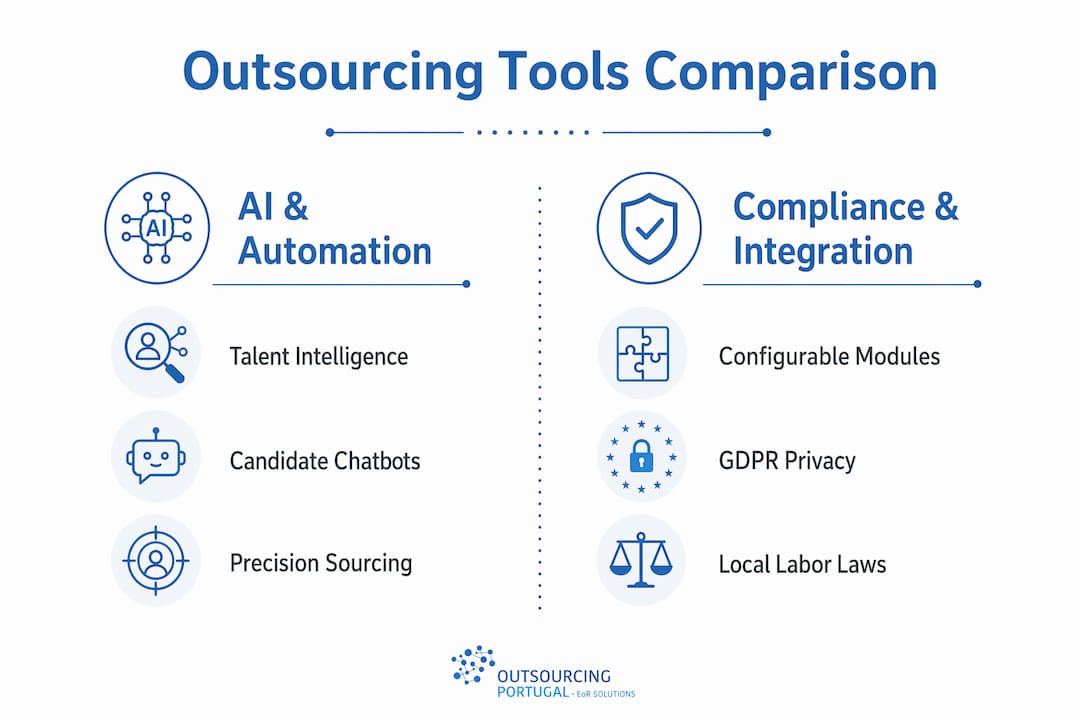
The gap between these platforms becomes clearest when you look at three specific dimensions: what the AI actually does, how the tool handles cross-border compliance, and how cleanly it connects to the rest of your HR stack.

AI and automation depth

Eightfold AI sits at the far end of the automation spectrum. Its Talent Intelligence engine, trained on a large dataset of real-world career trajectories, runs functional, coding, soft-skills, and language assessments inside a single platform. The U.S. Department of Defense uses it. That context matters when evaluating vendor credibility claims.

Hands adjusting AI hiring process documents

Paradox takes a different approach. Its Olivia chatbot focuses on the front end of the funnel: answering candidate questions, scheduling interviews, and keeping applicants engaged across languages without recruiter involvement. It does not replace an ATS; it sits on top of one. Fountain’s automation is more operational, using configurable workflow rules to move applicants through qualification steps automatically, which is why it performs best for high-volume roles where speed matters more than nuance.

Pin’s AI is built for sourcing rather than assessment. Scanning hundreds of millions of profiles with precision targeting, it gives recruiters a starting list that would take substantial time to build manually. The outreach automation then runs personalized campaigns at scale.

International hiring and compliance features

iCIMS leads on compliance configurability for enterprise teams. Its modules can be adapted to local labor law requirements across jurisdictions, and it connects to payroll and background check systems that most large US-based employers already use. SmartRecruiters handles the localization layer differently: its multi-language job posting tools let a single recruiter publish a role across markets without rewriting the description from scratch for each country.

Infographic comparing outsourcing hiring tools features

Global hiring breaks the single-country playbook in four specific places: where you advertise, how you keep candidates organized, how you screen for eligibility, and how you hold candidate data lawfully. The tools that address all four, rather than just one or two, are the ones worth the implementation effort.

Data privacy is not optional. GDPR controls, regional consent management, and lawful data retention windows are features that international outsourcing tools must support to avoid legal exposure. Eightfold AI carries SOC 2, ISO 27001, and ISO 42001 certifications, which puts it ahead of most competitors on documented security posture.

Integration options

SmartRecruiters integrates natively with SAP SuccessFactors, Zoom, LinkedIn, and DocuSign, covering the collaboration and signing workflows that distributed teams depend on. iCIMS connects broadly to payroll and HRIS systems, which matters when a hire needs to move from offer to onboarding without manual data re-entry. Eightfold AI is designed to work alongside existing ATS platforms with minimal IT overhead, and most teams are operational within weeks of deployment.

Key integration considerations:

  • Verify that your current ATS appears on the vendor’s certified integration list before signing a contract.
  • Ask specifically about payroll system connections if you are hiring across more than two countries.
  • Check whether compliance data flows automatically or requires manual export.
  • Confirm that candidate data stays within required geographic boundaries (EU data hosted in EU, for example).

How do you choose the right tool for your hiring needs?

The right global hiring software depends on three variables: your hiring volume, the number of markets you cover, and whether your biggest bottleneck is sourcing, screening, or compliance.

High-volume teams hiring for hourly or frontline roles across multiple countries should look at Fountain first. Its workflow automation handles the repetitive qualification steps that would otherwise require a large coordination team. Recruiters focused on executive or professional roles, where candidate relationship quality matters more than throughput, will get more from Paradox or Pin, both of which prioritize engagement quality and targeted outreach over raw volume.

Enterprise teams with legal and compliance complexity should evaluate iCIMS and Eightfold AI together. iCIMS handles the compliance infrastructure; Eightfold AI handles the interview and assessment layer. Used together, they cover the full funnel from job posting to offer without leaving compliance gaps.

Evaluation checklist before you commit:

  • Does the tool support every country you currently hire in, or plan to hire in within 12 months?
  • Can it post jobs to local job boards in each target market, not just global platforms?
  • Does it handle GDPR consent and data retention automatically, or does that require a separate tool?
  • What is the actual setup timeline? AI interview platforms typically take 2–4 weeks to fully integrate into existing workflows.
  • Is the vendor’s support team available in your time zone, or only during business hours in their home market?
  • What certifications does the vendor hold: SOC 2, ISO 27001, ISO 42001?
  • Does pricing scale by seat, by hire, or by feature tier, and which model fits your hiring cadence?

Pro Tip: Ask every vendor for a reference from a US-based company that hires in at least three countries. A demo looks good for every platform. A reference call reveals the gaps.

Timeline and cost deserve more attention than most buyers give them. A platform that takes three months to deploy and requires custom IT work is not a fast solution, regardless of what the marketing says. Factor in the full cost of implementation, not just the license fee.


What makes international hiring harder than domestic recruiting?

Cross-border hiring is not just domestic recruiting with a passport. Four friction points consistently break standard recruitment workflows when you go global: advertising channels, candidate data organization, eligibility screening, and lawful data retention. Generic applicant tracking systems handle none of these well.

Advertising is the first wall. A job posted on Indeed in the US reaches a different audience than the same role posted on local boards in Germany, Brazil, or the Philippines. Tools that bundle multi-market job board distribution into a single workflow remove a coordination layer that otherwise falls to the recruiter manually.

Data fragmentation is the hidden cost. When sourcing, screening, and scheduling live in separate tools, candidate information gets duplicated, lost, or inconsistently updated. Unifying recruitment data into a single platform reduces administrative overhead and improves hiring velocity by preventing those fragmented workflows. Teams using unified platforms report handling significantly more open roles without adding headcount.

Eligibility screening across markets adds legal complexity that most ATS platforms ignore. Work authorization status, visa requirements, and local qualification standards vary by country and change frequently. Tools that build eligibility screening into the pipeline, rather than treating it as a post-offer step, catch mismatches before they become expensive mistakes.

One distinction that trips up many HR teams: recruiting tools and employment platforms are not the same thing. A recruiting platform finds and qualifies the candidate. An employer of record (EOR) legally employs and pays them. Conflating the two leads to gaps in compliance coverage. The tools covered in this article handle the recruiting layer. The employment and payroll layer requires a separate, dedicated solution.

Language and time zone coordination compound every other challenge. Candidates in Asia-Pacific cannot schedule interviews during US business hours without one party working at an inconvenient time. Asynchronous AI interviewing, as offered by Eightfold AI and Paradox, removes that constraint entirely.


What do US-based companies actually say about these tools?

The clearest signal on tool performance comes from organizations that have moved past the pilot phase. Eightfold AI was named a 2025 Top HR Product of the Year by HR Executive and the HR Tech Conference, a recognition based on documented enterprise adoption rather than vendor self-reporting. Its client base includes the U.S. Department of Defense, which sets a credibility bar that most HR tech vendors cannot match.

SmartRecruiters appears consistently in independent roundups of remote hiring tools for its candidate relationship management and multi-channel job distribution. Its integration with Zoom, LinkedIn, and DocuSign reflects the actual workflow of distributed US hiring teams, where those three tools are already standard.

iCIMS has a long track record with large US employers in regulated industries, where compliance configurability is not a nice-to-have feature but a legal requirement. Its depth of integration with payroll and HRIS systems makes it the default choice for enterprise HR teams that cannot afford data gaps between recruiting and onboarding.

For sourcing-focused teams, Pin’s profile indexing across 850 million candidates addresses a real gap. Most ATS platforms rely on inbound applications. Pin flips that model, giving recruiters a proactive outreach capability that works across markets without requiring a separate sourcing tool.

Paradox’s Olivia chatbot has gained traction specifically in high-volume US retail and logistics hiring, where the volume of candidate inquiries would otherwise require a large coordination team. The multilingual capability extends that use case to international markets where English is not the primary language of applicants. Pairing effective job screening strategies with a conversational AI layer like Olivia reduces drop-off rates at the top of the funnel.


Nearshore hiring in Portugal: a practical complement to your recruiting stack

The tools above handle the recruiting layer. Getting a hired candidate onto payroll in another country requires a different kind of infrastructure, and that is where Outsourcing-portugal offers something the software platforms do not.

https://outsourcing-portugal.co.uk

US-based companies that want to build teams in Europe without setting up a local legal entity have a direct route through Outsourcing-portugal’s employer of record services in Portugal. Portugal gives you an EU-based, English-proficient workforce with competitive labor costs, stable governance, and a track record as a nearshore destination for tech and professional services teams. Outsourcing-portugal handles the employment layer: contracts, payroll, tax compliance, and HR support, so your recruiting tools can focus on finding the right people while the legal and operational infrastructure is already in place.

Key services Outsourcing-portugal provides for US-based employers:

  • Employer of Record (EOR): Full legal employment in Portugal without a local entity, covering compliant hiring and payroll from day one.
  • Payroll management: Local payroll processing with tax filing and benefits administration handled end to end.
  • Legal and HR compliance: Employment contracts, labor law adherence, and ongoing HR support aligned with Portuguese and EU regulations.
  • Onboarding and settlement support: Practical assistance for employees relocating or starting work in Portugal.

For teams already using iCIMS, SmartRecruiters, or Eightfold AI to source and qualify candidates, Outsourcing-portugal provides the EOR infrastructure that converts a qualified candidate into a legally employed team member. That two-layer approach, recruiting platform plus EOR, is how successful international hiring actually works at scale.


Key Takeaways

The most effective approach to international hiring in 2026 combines AI-powered recruiting platforms with a dedicated employment compliance layer, because no single tool covers both the candidate pipeline and the legal employment requirements across jurisdictions.

Point Details
Match tool to bottleneck High-volume teams need Fountain or Paradox; compliance-heavy enterprise teams need iCIMS or Eightfold AI.
AI automation drives efficiency Eightfold AI automates up to 80% of recruiter tasks and reduces time-to-fill by 33% for enterprise hiring teams.
Compliance is a feature, not an add-on Tools must handle GDPR consent, data retention, and eligibility screening across every market you hire in.
Recruiting tools and EOR are separate layers A recruiting platform finds and qualifies candidates; an employer of record legally employs and pays them.
Outsourcing-portugal bridges the gap For US employers hiring in Europe, Outsourcing-portugal provides EOR, payroll, and HR compliance in Portugal.

The part of international hiring tech that most guides get wrong

The conversation around global hiring software almost always focuses on features: how many languages does the AI support, how many profiles can it scan, how many integrations does it have. Those are real questions. But the more consequential question is almost never asked: what happens after you find the candidate?

Most recruiting platforms stop at the offer. The moment a candidate accepts, the tool’s job is done, and the recruiter is left to figure out how to actually employ someone in another country. That gap, between “hired” and “legally on payroll,” is where international hiring fails most often. It is not a software problem. It is a structural one, and no amount of AI automation fixes it.

The teams that get international hiring right treat it as two separate workflows that need to connect cleanly. The recruiting layer, handled by the platforms in this article, gets you to the right candidate. The employment layer, handled by an EOR or local entity, gets that candidate onto a compliant contract with the right tax treatment and benefits. Conflating the two, or assuming the recruiting tool handles both, is the most common and most expensive mistake in global talent acquisition.

There is also a tendency to over-index on AI capabilities when evaluating tools. Eightfold AI’s 24-language support and 80% task automation are genuinely impressive. But a platform that automates interviews in 24 languages while your data retention practices violate GDPR in three of those markets is a liability, not an asset. Compliance infrastructure is the unglamorous foundation that makes everything else work. Evaluate it first, not last.

The cross-border employment complexities that trip up experienced HR teams are rarely about the recruiting tools. They are about what comes after.

IT job seeker organizing printed job listings

How to Find a Job in IT: Your 2026 Career Guide


TL;DR:

  • Targeted job applications, building real project portfolios, and networking increase the chances of securing an IT position in 2026. Referrals significantly boost offer likelihood, and pairing certifications with practical projects enhances credibility. Consistent follow-up and focused outreach help candidates stand out in a competitive market.

Landing an IT job in 2026 requires targeted effort, not volume. The most effective job seekers know how to find a job in IT by applying to 10–15 carefully chosen roles per week, building real project portfolios, and using networking to bypass automated filters entirely. Referred candidates are 4x more likely to secure offers than cold applicants. That single fact reshapes every decision you make about where to spend your time. Certifications like CompTIA Security+ and AWS Solutions Architect matter, but only when paired with demonstrated skills that hiring managers can actually see.

How to find high-quality IT job opportunities

The best IT roles rarely go to the first person who applies on a job board. They go to candidates who show up early, apply through the right channels, and already have a connection inside the company.

Two men networking over coffee in café

LinkedIn remains the dominant platform for IT hiring, but company career pages often post roles before they appear anywhere else. Tech-specific boards attract more qualified applicants and less noise than general job sites. Referrals and alumni networks consistently outperform cold applications as lead sources.

Ghost jobs are postings active for more than 30 days with no real intent to hire. They waste your time and distort your sense of progress. Check the posting date, look for salary transparency, and read the requirements carefully. Vague listings with no specific team details are a red flag.

Platform type Volume Quality Network potential
LinkedIn Very high Medium High
Company career pages Low High Low
Tech-specific job boards Medium High Medium
Alumni and referral networks Low Very high Very high
General job aggregators Very high Low Very low

Pro Tip: Applying within the first 48 hours of a posting dramatically increases your visibility. 80% of applications arrive in the first week, so early movers stand out before recruiters feel overwhelmed.

What makes an IT resume pass ATS filters?

Applicant Tracking Systems, known as ATS, are the first filter between your resume and a human recruiter. They scan for keywords, reject formatting they cannot read, and rank candidates before anyone sees a name.

Infographic illustrating IT job search steps

Resumes with tables, columns, or graphics cause ATS parsers to fail. The system cannot extract your information correctly, so your application disappears. A plain, single-column format with clear section headings is the only safe choice.

Customization is not optional. Mirror the exact language from the job description. If the posting says “cloud infrastructure,” your resume should say “cloud infrastructure,” not “cloud systems.” ATS tools match strings, not concepts.

Follow this checklist before submitting any application:

  1. Remove all tables, graphics, text boxes, and columns from your resume layout.
  2. Copy the job description and highlight every technical skill and tool mentioned.
  3. Add each highlighted term to your resume where it honestly applies.
  4. Quantify at least three achievements with real numbers (users supported, uptime improved, tickets resolved per day).
  5. Write a two-sentence summary at the top that mirrors the job title and core requirement.
  6. Save the file as a plain .docx or .pdf without embedded fonts or special characters.
  7. Read the resume aloud. If a sentence sounds like a job description and not your actual work, rewrite it.

Pro Tip: Paste your resume and the job description into a free keyword comparison tool. The gap between the two lists tells you exactly what to add before you submit.

53% of employers now prioritize skills and certifications over traditional degrees. That means your resume keywords carry more weight than your degree title in many screening rounds.

Do projects matter more than certifications?

Projects beat certifications in most IT hiring conversations. A certification proves you studied a topic. A project proves you can apply it under real conditions, make decisions, and solve problems that do not have a textbook answer.

Employers value adaptability and focused upskilling over broad, unfocused learning. The best approach is to pick one skill gap in a high-demand area and build something that demonstrates it. Cloud and data roles have the clearest market demand right now.

Useful project types by role:

  • Cloud/DevOps: Deploy a personal app on AWS or Azure, document the architecture, and include cost estimates.
  • Cybersecurity: Build a home lab, run a vulnerability scan, and write up your findings as a report.
  • Data analytics: Pull a public dataset from Kaggle, clean it, analyze it, and publish the results in a GitHub repository.
  • IT support: Create a ticketing system simulation or document a network troubleshooting process with screenshots.

Host everything on GitHub. Write a README that explains what problem you solved, what went wrong, and how you fixed it. Hiring managers read those sections specifically to see how you think.

Pro Tip: Pair one strong project with one respected certification. The most respected entry-level credentials are AWS Solutions Architect Associate, CompTIA Security+, and Google Data Analytics. One certification plus one matching project is more convincing than three certifications alone.

How to network for IT jobs without feeling awkward

Networking is relationship-building over time, not asking strangers for favors. The candidates who treat it as a long-term investment consistently access roles that never get posted publicly. Employers often create positions for strong candidates identified through referrals before a job listing ever goes live.

The most effective networking tactics for IT job seekers are specific and low-pressure. Informational interviews, local tech meetups, and LinkedIn engagement all work when done consistently. The goal is to be known before you need something.

Use these steps to build referrals the right way:

  1. Identify 10–15 people in roles you want, including former classmates, professors, and LinkedIn connections.
  2. Send a short, specific message. Reference their work, ask one question, and keep it under five sentences.
  3. After a reply, request a 20-minute call to learn about their team or company. Do not ask for a job.
  4. After the call, send a thank-you note within 24 hours and reference one specific thing they said.
  5. Follow up every 6–8 weeks with something useful: an article, a question, or a project update.
  6. When a role opens at their company, ask directly if they would be comfortable referring you.

Alumni groups from bootcamps, universities, and certification programs are underused. Many companies offer referral bonuses, which gives your contact a financial reason to recommend you. That changes the dynamic entirely.

How should you prepare for IT interviews and follow up?

Technical and behavioral interviews test different things, and most candidates prepare for only one. Technical rounds assess your ability to solve problems in real time. Behavioral rounds assess how you work with people, handle pressure, and communicate decisions.

Prepare for both with equal effort. Use mock interviews through platforms like Pramp or with a study partner. Record yourself answering behavioral questions using the STAR method (Situation, Task, Action, Result) and watch the playback. Most people talk too long and bury the key point.

Key preparation steps:

  • Research the company’s tech stack and prepare one question about a specific tool they use.
  • Prepare three stories that each demonstrate a different skill: problem-solving, collaboration, and learning from failure.
  • Practice one coding or technical exercise daily in the week before the interview.
  • Prepare your salary range in advance using current market data from sources like the Bureau of Labor Statistics or Robert Half’s annual salary guide.

Post-interview follow-up separates candidates more than most people realize. Many candidates fail not because of poor interview performance but because they go silent afterward. Send a thank-you email within 24 hours. Reference a specific moment from the conversation and add one relevant link, such as a project or article that connects to something discussed.

Structured job search approaches typically secure a first IT role in 2–4 months. Passive methods stretch that timeline to 12 months or longer. The difference is almost entirely in the consistency of follow-up and application quality.

Key Takeaways

Targeted applications, real project portfolios, and consistent networking are the three factors that most reliably shorten the time to an IT job offer.

Point Details
Quality over quantity Apply to 10–15 tailored roles per week rather than mass-applying to hundreds.
ATS formatting matters Use a plain, single-column resume with exact keywords from each job description.
Projects outperform certifications alone Pair one respected certification with a documented project to prove practical ability.
Networking unlocks hidden roles Referrals make candidates 4x more likely to get offers and can generate unadvertised positions.
Follow up after every interview A specific, timely follow-up message distinguishes you from candidates who go silent.

What I’ve learned about IT job searches that most guides won’t tell you

The advice most job seekers follow is built for a market that no longer exists. Mass applications, generic resumes, and waiting for recruiters to call back were marginal strategies even five years ago. They are nearly useless now.

What actually works is uncomfortable because it requires patience and precision at the same time. You have to apply less and prepare more. You have to reach out to people before you need them. You have to build things in public before anyone asks you to.

The candidates I see succeed fastest are not the most technically advanced. They are the ones who treat the job search like a project with a clear methodology. They track every application, every contact, and every follow-up. They review what is working and cut what is not. They treat rejection as data, not judgment.

Burnout is real in long job searches. The antidote is not motivation. It is structure. Set a fixed number of applications per week, a fixed number of networking messages, and a fixed time to stop for the day. The skills-based hiring shift means the market rewards people who keep building, not just people who keep applying.

The IT job market in Portugal and across Europe is also worth watching closely. Companies building nearshore tech teams in Portugal are actively hiring English-speaking IT professionals with cloud, data, and support skills. That is a real and growing channel that most job seekers in the UK and US overlook entirely.

— Paulo

IT employment services for job seekers and hiring teams

Finding the right IT role is one side of the equation. For companies building tech teams across borders, the hiring infrastructure matters just as much.

https://outsourcing-portugal.co.uk

Outsourcing-portugal provides employment outsourcing services that connect international companies with Portugal’s multilingual, highly educated IT workforce. From payroll and compliance to onboarding and HR support, the platform handles the operational complexity so hiring teams can focus on finding the right people. Job seekers targeting European IT roles can also use Outsourcing-portugal’s resources to understand how international hiring works and where demand is growing. For companies ready to hire, the best employment outsourcing agencies listed on the platform offer a practical starting point for building compliant, cost-effective tech teams in Portugal.

FAQ

How many IT jobs should I apply to per week?

Apply to 10–15 carefully tailored roles per week rather than mass-applying. Targeted applications consistently produce higher response rates than volume-based approaches.

What certifications help most for entry-level IT jobs?

AWS Solutions Architect Associate, CompTIA Security+, and Google Data Analytics are the most respected entry-level credentials. Pairing any one of them with a documented project strengthens your application significantly.

How do I know if a job posting is a ghost job?

Check the posting date and look for listings active for more than 30 days. Vague requirements, no salary range, and no specific team details are the clearest signs of a ghost listing.

Does networking really help with IT job searches?

Referred candidates are 4x more likely to receive offers than cold applicants. Networking also surfaces roles that never get posted publicly, which is where many of the best opportunities exist.

How long does an IT job search typically take?

A structured search with consistent applications and networking typically produces a first offer in 2–4 months. Passive or unstructured approaches can extend that timeline to 12 months or longer.

Woman preparing Portugal work visa documents at home office

How to Get a Work Visa in Portugal: 2026 Guide


TL;DR:

  • A Portugal work visa, called the D1 residence visa, allows non-EU and non-EEA nationals to live and work in Portugal with an employment contract. The application process involves applying at the Portuguese consulate and completing residence registration with AIMA, with strict document requirements and timelines. Successful applicants must gather certified documents like criminal records, health insurance, proof of accommodation, and obtain a Portuguese tax number before applying.

A Portugal work visa is defined as the D1 residence visa, the primary legal authorization for non-EU and non-EEA nationals to live and work in Portugal under a valid employment contract. Knowing how to get a work visa in Portugal means understanding a two-stage process: first, applying at the Portuguese consulate in your home country, then completing residence permit registration with AIMA (Agência para a Integração, Migrações e Asilo) after you arrive. The process has firm document requirements, specific timelines, and real consequences for missing steps. This guide covers every stage, from eligibility through long-term residence, with current 2026 rules and practical advice for individuals and families making the move.

What are the eligibility criteria and document requirements for the Portugal work visa?

The D1 visa requires a signed employment contract with a Portuguese employer registered with local labor authorities. That contract must comply with Portuguese labor law, including a minimum wage of approximately €870 per month as of 2026. Meeting this threshold is not optional. Consulates reject applications where the salary falls below the legal floor.

Your document checklist covers several categories:

  • Valid passport: Must remain valid for at least three months beyond your intended stay.
  • Employment contract: Signed, meeting Portuguese labor standards, and issued by a registered employer.
  • Criminal record certificate: Must be issued within three months prior to submission and from every country where you lived for more than one year since age 16. Each certificate needs an apostille and a certified Portuguese translation.
  • Health insurance: Coverage must be valid for at least 120 days with a minimum coverage amount of €30,000 to cover your initial period after arrival.
  • Proof of accommodation: A rental agreement, hotel booking, or letter from a host confirming your address in Portugal.
  • Proof of financial means: Bank statements showing you can support yourself during the transition period.
  • Portuguese Tax Identification Number (NIF): The NIF is indispensable for opening a bank account and signing contracts. Many applicants obtain it through a Portuguese representative before they ever board a plane.
  • Completed visa application form and passport photos: Submitted directly to the Portuguese consulate or an authorized visa center.

Pro Tip: Get your NIF before you submit your consulate application. Without it, you cannot open a Portuguese bank account or finalize your employment contract, and some consulates will flag the gap.

Document certification is strict. All foreign documents must carry an apostille stamp and a certified translation into Portuguese. A criminal record certificate that is even one day past the three-month window at the time of submission will trigger rejection. Build that deadline into your preparation calendar.

Hands exchanging certified visa documents and translation

What is the step-by-step process to apply for and receive a Portugal work visa?

The Portugal work permit process follows a clear sequence. Skipping or reordering steps creates delays that can push your start date back by months.

  1. Secure your employment contract. Your Portuguese employer must be registered with Portuguese labor and social security authorities. The contract must meet minimum wage and labor law standards before you submit anything to a consulate.

  2. Obtain your NIF. Apply through a Portuguese consulate in your country or appoint a local representative in Portugal to handle it on your behalf. This number unlocks your ability to open a bank account and finalize financial arrangements.

  3. Gather and certify all documents. Collect criminal records from every relevant country, get apostilles, arrange certified translations, and secure health insurance with the required €30,000 minimum coverage for at least 120 days.

  4. Submit your D1 visa application at the Portuguese consulate. Book your appointment, submit the full document package, pay the application fee of approximately €173, and provide biometric data at the consulate.

  5. Wait for consulate processing. The processing time is typically up to 60 working days. That is roughly three calendar months, so plan your job start date accordingly.

  6. Receive your D1 entry visa. This visa is valid for four months, giving you a window to travel to Portugal and complete the next stage. Four months sounds generous, but AIMA appointment slots fill quickly, so book as soon as your visa arrives.

  7. Travel to Portugal and attend your AIMA biometric appointment. AIMA handles all residence permit processing after the consulate issues your entry visa. Your appointment is typically pre-scheduled, but confirm the date immediately upon arrival.

  8. Submit your residence permit application to AIMA. Bring your D1 visa, employment contract, proof of address, and any additional documents AIMA requests. The work permit must be issued within 90 working days after your residence permit application is filed.

  9. Register with social security and local authorities. After your AIMA appointment, register with the Portuguese Social Security Institute (Segurança Social) and update your address with the local parish council (Junta de Freguesia).

  10. Receive your residence card. AIMA issues the physical Título de Residência card. Processing can take several months, but your legal status in Portugal is protected once the biometric appointment is complete.

Statistic callout: The consulate processing window of up to 60 working days and the AIMA residence permit window of up to 90 working days mean the full process from application to physical card can span six months or more. Factor this into your relocation timeline before you give notice at your current job.

What are common challenges and practical tips when applying for a Portugal work visa?

Infographic illustrating Portugal work visa application steps

Most application failures trace back to document problems, not eligibility issues. The most overlooked requirements are criminal records from multiple countries and missing apostilles. If you lived in three countries since age 16, you need three separate criminal record certificates, each apostilled and translated.

Common pitfalls to avoid:

  • Expired criminal records: Certificates older than three months at the time of submission are automatically rejected. If your consulate appointment is delayed, you may need to request fresh certificates.
  • Missing apostilles: A notarized document without an apostille is not accepted. Verify the Hague Convention status of the issuing country before you assume a notarization is sufficient.
  • No NIF before application: Some consulates will not process your application without proof that you have started the NIF process. Do not leave this step until after you arrive.
  • Outdated visa advice online: The job seeker visa regime changed significantly in late 2025. Old-style job seeker visas are no longer accepted. You need a firm employment contract before applying, not a letter of intent or a job offer still under negotiation.
  • AIMA appointment delays: Slots at AIMA fill up fast. Book your appointment the moment your D1 visa is approved, not after you land in Portugal.

“Many delays in Portugal work visa applications are caused by overlooked requirements: criminal records from all countries of residence, missing apostilles, and documents that expire between preparation and submission. Building a document tracker with expiry dates for each certificate prevents the most common rejection triggers.”

Pro Tip: Appoint a Portuguese legal representative or immigration specialist before you start. They can obtain your NIF remotely, verify document requirements with the specific consulate handling your application, and flag issues before they become rejections.

For families relocating together, each adult family member needs their own criminal record certificates and health insurance documentation. Children require birth certificates with apostilles. Plan for the full family document load from day one, not as an afterthought.

How do the Portugal work visa and residence permit interplay, and what happens after arrival?

The D1 visa and the residence permit are two separate legal instruments. Understanding the difference prevents compliance gaps that can affect your employment and your family’s legal status.

Stage Document Issuing Authority Validity
Entry D1 residence visa Portuguese consulate 4 months
Residence permit application Proof of AIMA filing AIMA Until card issued
Residence card Título de Residência AIMA 2 years (renewable)
Permanent residence Permanent residence permit AIMA After 5 years

The D1 visa gets you into Portugal legally. It does not authorize long-term residence on its own. Once you attend your AIMA biometric appointment and file your residence permit application, your legal status in Portugal is protected even while you wait for the physical card. That distinction matters because AIMA card issuance can take several months, and you need to keep working and accessing services during that gap.

After your residence card arrives, register with the Portuguese Social Security Institute. This registration gives you access to the national health service (SNS) and starts your contribution record, which matters for future benefits and citizenship applications. Your employer handles payroll contributions, but you must confirm the registration is active.

The residence permit is renewable as long as your employment continues. After five years of legal residence, you can apply for permanent residence. Citizenship eligibility follows after that, subject to language and integration requirements. For families planning a long-term move, that five-year clock starts from your first AIMA registration date, not from when you receive your physical card.

For a deeper look at how workforce mobility in Portugal works within the broader compliance framework, the rules around employment contracts and permit renewals are tightly linked.

Key Takeaways

Getting a Portugal work visa requires a valid employment contract, certified documents, and a two-stage process through the Portuguese consulate and AIMA that can take six months or more from start to residence card.

Point Details
D1 visa is the entry route Non-EU nationals need a D1 residence visa backed by a registered employer and compliant employment contract.
Document timing is critical Criminal records must be issued within three months of submission; apostilles and certified translations are mandatory.
Two-stage process with AIMA The consulate issues the entry visa; AIMA issues the residence card after biometrics and permit application.
NIF must come first Obtain your Portuguese Tax Identification Number before submitting your consulate application to avoid stalls.
Five-year path to permanence Legal residence for five years opens the door to permanent residence and eventual citizenship eligibility.

What I’ve learned after watching families navigate Portugal’s immigration system

The single biggest mistake I see is treating the Portugal work visa process as a checklist rather than a timeline. People gather documents in the right order but forget that criminal records expire, apostille services take weeks, and AIMA appointment slots disappear fast. By the time they realize a certificate is three days past the three-month window, they have already paid consulate fees and booked flights.

My honest advice: start the document collection process at least four months before your target travel date. That buffer absorbs the inevitable delays from foreign government offices, translation services, and apostille authorities. Families with children need even more lead time because school enrollment and family reunification paperwork add another layer.

The 2025 changes to the job seeker visa regime caught a lot of people off guard. Advice that was accurate in 2024 is now wrong. If you are reading a guide that mentions applying without a firm employment contract, stop and find a more current source. The current rules require a signed contract before you walk into a consulate.

Local support is not a luxury for families. A Portuguese immigration lawyer or a relocation specialist who knows the current AIMA appointment system will save you weeks of confusion. The employment contract types in Portugal matter too. Make sure your contract structure meets the D1 visa requirements before you sign, not after.

Portugal rewards people who prepare. The country has a genuinely welcoming immigration framework for skilled workers, and the residence-to-citizenship pathway is one of the clearest in the EU. Get the paperwork right the first time, and the rest of the process follows.

— Paulo

How Outsourcing-portugal supports your relocation and employment setup

Relocating for work means managing visa paperwork, employment contracts, payroll registration, and social security compliance at the same time. That is a heavy load for individuals and families who are also packing up a life in another country.

https://outsourcing-portugal.co.uk

Outsourcing-portugal provides Employer of Record services in Portugal that handle the employer-side requirements your D1 visa depends on: registered employment contracts, payroll management, social security registration, and full compliance with Portuguese labor law. For foreign workers whose employers are not yet established in Portugal, an EOR arrangement means your visa-qualifying employment contract is in place from day one. Outsourcing-portugal also supports HR compliance and settlement assistance, so you are not navigating AIMA and Segurança Social alone. Contact Outsourcing-portugal to find out how their employment outsourcing services can simplify your move.

FAQ

What is the D1 visa and who needs it?

The D1 residence visa is the standard work authorization for non-EU and non-EEA nationals moving to Portugal under an employment contract. EU and EEA citizens do not need a visa to work in Portugal.

How long does the Portugal work visa process take?

Consulate processing takes up to 60 working days, and AIMA must issue the residence permit within 90 working days after application. The full process from document preparation to residence card can take six months or more.

Can I work in Portugal while waiting for my residence card?

Yes. Once you complete your AIMA biometric appointment and file your residence permit application, your legal status is protected and you can continue working while the physical card is processed.

What happens if my criminal record certificate expires before my consulate appointment?

You must request a new certificate. Certificates older than three months at the time of submission are rejected, regardless of when they were originally issued.

Can my family join me on a Portugal work visa?

Yes, through family reunification. Each adult family member needs their own documentation, including criminal records and health insurance. Children require apostilled birth certificates. Apply for family reunification through AIMA after your own residence permit is filed.

Businesswoman reviewing Portuguese HR compliance documents

HR Management Company Guide for International Business in Portugal


TL;DR:

  • An HR management company handles core human resources functions like payroll, compliance, and employee relations for businesses. They offer different service models, with cost-effective options such as fractional HR and outsourced solutions for international companies in Portugal. AI tools assist in automating compliance tasks and keeping up with local labor law updates efficiently.

An HR management company is a professional service provider that handles core human resources functions on behalf of a business, covering everything from payroll and compliance to talent management and employee relations. For international companies hiring in Portugal, partnering with the right human resources solutions provider is the difference between smooth operations and costly legal exposure. Dedicated HR partners scale support to match business needs without locking companies into fixed overhead. This guide covers service models, pricing structures, technology integration, and compliance considerations specific to Portugal’s employment environment.

What does an HR management company actually do?

Two HR consultants discussing documents at conference table

An HR management company takes over the people functions that consume internal time and carry legal risk. The industry term for the broadest version of this service is “full-service HR outsourcing,” though providers operate across a spectrum from pure consulting to complete employee management services.

Core service categories include:

  • Payroll processing and tax compliance: Calculating wages, filing contributions, and managing statutory deductions under Portuguese labor law
  • Employee relations and disciplinary support: Handling grievances, performance improvement plans, and termination procedures
  • Recruitment and onboarding: Sourcing candidates, running background checks, and managing new hire documentation
  • Benefits administration: Structuring and managing health, pension, and leave entitlements
  • HR strategy consulting: Aligning people policies with business goals, workforce planning, and leadership development
  • Compliance monitoring: Tracking changes to employment law and updating internal policies accordingly

The distinction between service models matters. HR consulting services deliver advice and project-based support without taking on operational responsibility. Fractional HR providers embed part-time HR expertise into a business on a retainer basis. Full outsourcing transfers day-to-day HR operations entirely to an external team. International companies entering Portugal typically start with fractional HR or an Employer of Record arrangement, then scale toward full outsourcing as headcount grows.

Pro Tip: Before signing with any outsourced HR provider, ask specifically whether they have in-country expertise in Portuguese labor law. Generic HR firms often lack the local knowledge needed for compliant employment contracts under the Portuguese Labor Code.

How do pricing models for HR management companies compare?

Pricing is where most business leaders make their first mistake. They compare the monthly cost of an outsourced provider against a single line item, without accounting for the full cost of an internal hire.

Full-time HR manager salaries typically run from $75,000 to $100,000 per year before benefits, payroll taxes, and overhead. That figure does not include recruitment costs, onboarding time, or the risk of a bad hire. Outsourced human resources solutions eliminate most of that exposure.

Fractional HR engagements start as low as $675 per month, giving growing companies access to senior HR expertise at a fraction of the cost of a full-time hire. That entry point makes fractional HR the most accessible model for small and mid-sized international teams.

Model Typical Cost Best For Key Benefit
Full-time HR hire $75,000–$100,000+/year Large, stable headcount Full internal control
Fractional HR retainer From $675/month Growing teams, variable needs Senior expertise, low overhead
Full outsourcing retainer Varies by scope Complex, multi-country operations End-to-end operational coverage
PEO (per-employee fee) Per-employee monthly rate Companies wanting co-employment Bundled benefits access

Infographic comparing full-time and fractional HR pricing models

Retainer-based fractional HR charges by service scope rather than headcount, which cuts overhead for companies scaling quickly. PEOs charge per employee, which becomes expensive as teams grow. For international companies building Portugal-based teams, the retainer model typically delivers better value at the growth stage.

Pro Tip: Request a scope-of-work breakdown before agreeing to any retainer. Vague retainers lead to scope creep. A clear service schedule protects both sides and makes it easier to evaluate ROI after six months.

What role does AI play in modern HR management services?

AI has moved from a marketing talking point to a functional tool inside HR compliance and performance management workflows. The change is measurable.

AI-integrated compliance tools save 3–5 hours per performance review cycle by automating documentation, flagging policy gaps, and generating audit-ready assessments. For a team running quarterly reviews across 50 employees, that adds up to hundreds of hours recovered annually.

The most effective AI compliance tools follow a three-step workflow:

  • Intake: Collecting case details, employee records, and relevant policy documentation
  • Evaluation: Analyzing inputs against embedded labor law standards and internal policy frameworks
  • Audit-ready assessment: Generating a defensible written output that HR professionals can review, adjust, and approve

AI compliance tools like ARIES embed authoritative labor law databases directly into the evaluation process. They support HR judgment rather than replacing it. The output is a structured recommendation, not an automated decision.

For multinational HR teams managing Portugal-based staff, AI tools solve a specific problem: keeping up with Portuguese labor law updates without requiring constant manual research. Portugal’s Labor Code is detailed, and changes to minimum wage, working time rules, or termination procedures require fast policy updates. AI-assisted monitoring flags those changes before they create compliance gaps.

The workforce compliance workflow for HR teams in 2026 increasingly depends on these tools to maintain audit readiness across multiple jurisdictions simultaneously.

How does compliance shape HR management for international companies in Portugal?

Compliance is the single greatest risk for international companies hiring in Portugal without local HR expertise. Portugal operates under a detailed Labor Code that governs contracts, working hours, termination, and employee protections. Getting any of these wrong creates financial and reputational exposure.

Key compliance areas for international firms include:

  • Employment contracts: Portuguese law requires written contracts specifying role, salary, working hours, and probation terms
  • Working time rules: Standard working hours are capped, with strict overtime and rest period requirements
  • Termination procedures: Dismissal without cause requires specific notice periods and severance calculations
  • Social security contributions: Both employer and employee contributions are mandatory and precisely defined
  • Data protection: GDPR applies fully to employee data held by companies operating in Portugal

Switching to managed HR services or a PEO can cut payroll administration costs by up to 50% through better integration and consolidated compliance management. That figure reflects the real cost of fragmented, manual compliance processes.

The HR best practices guide for Portugal covers the specific compliance requirements that international firms encounter most often. Proactive policy updates, not reactive fixes, define the difference between companies that scale smoothly and those that face labor disputes.

A well-structured HR management firm keeps compliance documentation audit-ready at all times. That means updated employee handbooks, signed policy acknowledgments, and a clear record of any disciplinary or performance management actions. For companies operating across multiple EU jurisdictions, this level of documentation discipline is non-negotiable.

What should you look for when choosing an HR management company?

Choosing the wrong HR partner costs more than staying in-house. The selection criteria below apply specifically to international companies evaluating providers for Portugal-based operations.

  1. Local labor law expertise: Confirm the provider has direct, in-country knowledge of Portuguese employment law, not just generic EU compliance experience.
  2. Service scope alignment: Match the provider’s service catalog to your actual needs. A company with 15 employees in Lisbon does not need the same model as a 200-person nearshore team.
  3. Technology integration: Ask whether the provider uses AI-assisted compliance tools and how they handle policy updates when Portuguese labor law changes.
  4. Engagement model flexibility: The best HR management firms offer fractional, full outsourcing, and Employer of Record options so you can scale the relationship as headcount grows.
  5. Cultural and communication fit: International HR partnerships fail most often on communication, not competence. Confirm the provider works in your time zone and communicates in your operating language.
  6. Transparent pricing: Retainer-based models should come with a clear scope of work. Avoid providers who bundle services without itemizing what is included.
  7. References from comparable clients: Ask for references from international companies of similar size operating in Portugal. Generic testimonials do not tell you what you need to know.

HR as a competitive advantage starts with diagnostics, not assumptions. The right provider begins by understanding your business goals before recommending a service model. That diagnostic step separates genuine HR strategy consulting from commodity HR administration.

The top reasons to outsource HR in Portugal consistently come back to three factors: compliance certainty, cost control, and speed to hire. A provider who cannot demonstrate strength in all three is not the right fit for an international operation.

Key Takeaways

An HR management company delivers the most value when it functions as a strategic partner aligned with your business goals, not just an administrative vendor handling paperwork.

Point Details
Outsourcing cuts costs significantly Fractional HR starts at $675/month versus $75,000–$100,000+ per year for a full-time hire.
Compliance is the primary risk in Portugal Portuguese labor law requires precise contracts, termination procedures, and social security filings.
AI tools save measurable time AI-integrated compliance workflows save 3–5 hours per performance review cycle.
Retainer models outperform per-employee fees Scope-based retainers reduce overhead for growing teams better than PEO per-employee pricing.
Local expertise is non-negotiable Generic HR providers without in-country Portugal knowledge create compliance exposure, not protection.

What I’ve learned about HR partnerships that most guides won’t tell you

The advice you read most often about choosing an HR management company focuses on checklists and pricing comparisons. That is useful, but it misses the thing that actually determines whether the partnership works.

The providers who deliver real value start every engagement with a diagnostic conversation about where the business is going, not just where it is now. I have seen international companies sign with technically capable HR firms and still end up with misaligned policies because nobody asked the right questions at the start. The multinational HR strategies that hold up over time are built on that diagnostic foundation.

The other thing most guides skip is the cost of a bad exit. Switching HR providers mid-growth is expensive and disruptive. Employee records need transferring, payroll systems need migrating, and compliance documentation needs auditing. Choosing carefully at the start is far cheaper than fixing a poor fit later.

My honest recommendation: treat the first three months of any HR outsourcing relationship as a paid trial. Set clear deliverables, review them at 90 days, and make the decision to deepen or exit based on evidence, not optimism. The best HR management firms welcome that structure because they know they can deliver.

— Paulo

Outsourcing-portugal’s approach to HR management in Portugal

Outsourcing-portugal works with international companies that need HR management expertise in Portugal without the overhead of a local entity. The service model covers payroll, compliance, onboarding, and Employer of Record arrangements, all structured around the specific requirements of Portuguese labor law.

https://outsourcing-portugal.co.uk

The engagement model is flexible. Companies can start with a focused compliance and payroll retainer, then expand to full HR outsourcing as their Portugal-based team grows. For companies evaluating their options, the best employment outsourcing agencies for 2026 guide covers the top providers operating in Portugal, with a breakdown of service scope and fit by company size. Outsourcing-portugal’s combination of local legal expertise and scalable service models makes it a practical starting point for any international team entering the Portuguese market.

FAQ

What is an HR management company?

An HR management company is a professional service provider that handles human resources functions for businesses, including payroll, compliance, employee relations, and talent management. Providers range from fractional HR consultants to full-service outsourced HR teams.

How much does outsourced HR management cost?

Fractional HR retainers start as low as $675 per month, compared to $75,000–$100,000 or more per year for a full-time HR manager. The right model depends on team size, service scope, and whether you need in-country compliance expertise.

Why do international companies need specialized HR support in Portugal?

Portugal’s Labor Code sets strict requirements for employment contracts, working hours, termination procedures, and social security contributions. International companies without local HR expertise face significant compliance risk when hiring Portuguese employees.

What is the difference between fractional HR and a PEO?

Fractional HR firms charge a monthly retainer based on service scope, while PEOs charge a per-employee fee and typically act as a co-employer. Fractional HR offers more flexibility and lower costs for growing teams, while PEOs provide bundled benefits access.

How does AI improve HR compliance management?

AI compliance tools automate documentation, flag policy gaps, and generate audit-ready assessments, saving 3–5 hours per performance review cycle. They embed labor law standards directly into the evaluation process, supporting HR decisions without replacing human judgment.

Payroll Fraud: Detection, Prevention, and Response


TL;DR:

  • Payroll fraud involves insiders manipulating payroll systems to steal company funds, often going undetected for an average of 18 months with median losses of $50,000. Small businesses face a higher risk due to fewer internal controls, making segregation of duties and multiple approvals essential for prevention. Detecting and responding quickly with audits and legal action minimizes damage and safeguards payroll integrity.

Payroll fraud is the deliberate manipulation of payroll systems by authorized personnel to steal or divert company funds for personal gain. Unlike external cyberattacks, this threat lives inside your organization, carried out by people with legitimate access to your systems. Median losses reach $50,000 per incident before detection, with the average scheme running 18 months unnoticed. Small businesses face 1.5 times the fraud risk of larger firms, largely because they lack the layered controls that bigger organizations take for granted. Recognizing the types, signs, and countermeasures is the first line of defense.

What are the common types of payroll fraud?

Payroll fraud schemes fall into several distinct categories, each exploiting a specific weakness in your payroll workflow. Knowing how each one operates makes them far easier to spot.

  • Ghost employees. A payroll administrator adds a fictitious worker or keeps a terminated employee active in the system. Paychecks flow to an account the fraudster controls. This scheme is the most common and often runs the longest before detection.
  • Timesheet manipulation. Employees or supervisors inflate hours worked, claim overtime that never happened, or approve each other’s falsified timesheets. In hourly workforces, even small daily additions compound into significant losses over months.
  • Unauthorized pay rate changes. Someone with edit access quietly raises their own salary or a co-conspirator’s pay rate. Without a secondary approval step, these changes can persist through dozens of pay cycles.
  • Direct deposit diversion. A fraudster changes the bank account number on file for an employee, redirecting wages to their own account. This is especially effective when verification steps are absent or bypassed.
  • Benefits and garnishment fraud. Perpetrators manipulate benefit deductions, expense reimbursements, or court-ordered garnishments to redirect funds. This category is often overlooked because it sits at the edge of payroll and HR.

Pro Tip: Require a manager outside the payroll department to approve any changes to bank account details, pay rates, or employee status. A single extra approval step eliminates the most common entry points for fraud.

Each scheme shares one trait: it requires access. The person committing the fraud almost always has a legitimate reason to be in the system, which is exactly why internal controls matter more than perimeter security.

What are the signs of payroll fraud businesses should monitor?

Early detection depends on knowing what normal looks like, so that anything abnormal stands out immediately. 75% of payroll fraud perpetrators displayed behavioral red flags before they were caught. That statistic means the warning signs were visible. They were simply not acted on.

Infographic showing key signs of payroll fraud

Behavioral signals include employees who resist taking vacation, refuse to cross-train colleagues, or react defensively when asked routine questions about payroll records. These behaviors often indicate someone protecting access to a scheme they have built over time.

On the data side, watch for these specific red flags:

  • Payroll expenses growing faster than headcount or revenue
  • Frequent edits to pay records, especially outside business hours
  • Direct deposit changes submitted without supporting documentation
  • Discrepancies between payroll reports and bank reconciliations
  • Employees with no supervisor listed, or supervisors approving their own timesheets
  • Duplicate Social Security numbers, addresses, or bank account numbers across employee records

Audit logs that record pay rate changes, login timestamps, and edit histories are your most reliable detective tool. Review them on a scheduled basis, and flag any after-hours activity for immediate follow-up. Exception reports, which automatically surface unusual transactions, reduce the manual effort required to catch anomalies.

How can businesses prevent payroll fraud through internal controls?

Prevention requires structure, not just trust. The most effective controls separate the people who can create payroll data from those who approve and reconcile it.

  1. Segregate duties. One person should never enter employee data, process payroll, and reconcile accounts. These three functions must sit with three different people or teams. When one person controls all three, ghost employee schemes become nearly undetectable.
  2. Implement role-based access controls. Grant each user only the access their role requires. A timesheet approver does not need the ability to change pay rates. An HR administrator does not need access to bank account fields.
  3. Require secondary approval for sensitive changes. Direct deposit changes, pay rate edits, and new employee additions should all require a second approver who is independent of the person making the change. Verification via the employee’s address of record adds a further barrier to diversion fraud.
  4. Conduct unannounced payroll audits. Surprise audits reduce median fraud losses by 63%. Schedule them irregularly so no one can anticipate and conceal activity before a review.
  5. Reconcile headcount independently. Assign someone outside payroll processing to compare the active employee list against HR records and physical headcount. This low-tech check reliably surfaces ghost employees.
  6. Maintain a complete documentation trail. Every pay change, approval, and system login should generate a timestamped record. This trail supports both internal investigations and any legal action that follows.

Pro Tip: Treat payroll system access the way you treat access to your bank accounts. Limit it, log it, and review it regularly. Most small businesses grant far more access than any individual role requires.

Outsourcing payroll to a third-party provider adds a layer of separation, but it does not eliminate your liability. SOC 2 Type II audits verify a vendor’s platform security, but employers remain responsible for their own internal approval workflows and access credentials. Outsourcing changes who processes payroll. It does not change who owns the risk of internal fraud.

Hands exchanging approved payroll document

What advanced detection technologies can improve fraud identification?

Traditional rule-based fraud detection works by flagging transactions that exceed preset thresholds. It catches obvious violations but misses schemes built on collusion, where two or more people with legitimate access work together to bypass controls.

Graph analytics addresses this gap directly. Rather than evaluating each transaction in isolation, graph analytics maps the relationships between employees, approvers, accounts, and transactions. It identifies patterns like approval rings, where a small group of employees consistently approve each other’s changes, or shared attributes across supposedly unrelated employee records. Graph analytics improves fraud detection precision and recall by 50% compared to rule-based systems. That improvement comes from the ability to perform multi-hop relational analysis, tracing connections across several degrees of separation that a standard query would never surface.

Risk scoring models take this further by combining structural data (who approves whom), financial data (transaction amounts and frequencies), and behavioral data (login times, edit patterns) into a single score per employee or transaction. Machine learning refines these scores over time, reducing false positives and improving the signal-to-noise ratio for investigators.

Detection method What it catches Primary limitation
Rule-based threshold checks Single-actor violations, obvious anomalies Misses collusion and gradual escalation
Audit log review After-hours edits, unauthorized access Requires manual review; reactive
Graph analytics Approval rings, collusion, shared identifiers Requires data integration and governance investment
Risk scoring models Multi-factor behavioral patterns Needs historical baseline data to calibrate

Implementing graph analytics requires clean, integrated data across HR, payroll, and finance systems. Data governance, meaning clear ownership of data quality and access, is a prerequisite. Without it, the models surface noise rather than fraud.

What to do when payroll fraud is detected

Speed and containment define the first 48 hours after discovery. Acting quickly limits further losses and preserves the evidence needed for legal action.

  • Suspend access immediately. Revoke the suspected perpetrator’s system credentials before any investigation conversation takes place. This prevents evidence destruction and stops ongoing transactions.
  • Preserve all audit trails. Do not alter, delete, or “clean up” any records. Forensic investigators and prosecutors need the original data, including logs of who accessed what and when.
  • Engage legal counsel early. Employment law, criminal law, and tax compliance intersect in payroll fraud cases. A DOJ enforcement case involving $38 million in losses over seven years resulted in sentences exceeding 17 years and full restitution orders. The legal consequences are severe, and your response needs to be legally sound from the start.
  • Correct payroll and tax filings. Fraudulent payroll entries affect tax withholdings, Social Security contributions, and reported wages. Work with a tax professional to file amended returns and notify relevant authorities as required.
  • Communicate carefully. Internal communications about the investigation should be limited to those with a direct need to know. External communications, including any public disclosures, should go through legal counsel.
  • Conduct a post-incident review. Once the immediate situation is resolved, audit the controls that failed. Every fraud scheme reveals a gap. Closing that gap is the most productive outcome of a painful experience.

Key Takeaways

Payroll fraud is an insider threat that costs businesses a median of $50,000 per incident and runs undetected for an average of 18 months, making early detection controls the highest-return investment a business can make.

Point Details
Insider threat is primary Most payroll fraud is committed by employees with legitimate system access, not external attackers.
Segregation of duties is non-negotiable No single person should enter, approve, and reconcile payroll without independent oversight.
Surprise audits cut losses sharply Unannounced audits reduce median fraud losses by 63%, making them one of the most cost-effective controls.
Behavioral red flags precede detection 75% of perpetrators showed warning signs before discovery; monitoring behavior is as important as monitoring data.
Graph analytics catches collusion Traditional rule-based systems miss multi-actor schemes; graph analytics improves detection precision by 50%.

What I’ve learned about payroll fraud in small and medium businesses

The most dangerous assumption a business owner makes is that payroll fraud only happens in large, faceless corporations. In reality, small businesses are the most exposed. They have fewer people, which means fewer opportunities to separate duties. They also have higher trust between colleagues, which makes it harder to enforce controls without feeling like you are accusing someone.

The single highest-impact change I have seen small businesses make is treating payroll access the way they treat access to the company bank account. Not everyone needs it. Not everyone should have it. When you limit access and log every action, the deterrent effect alone reduces risk significantly.

Surprise headcount reconciliations are underused and undervalued. Comparing your active payroll list against physical headcount takes an afternoon. It catches ghost employees, terminated workers still receiving pay, and duplicate entries that automated systems often miss. Most businesses that run this check for the first time find at least one discrepancy.

The behavioral warning signs are real and they are visible. An employee who never takes vacation, who handles payroll alone, and who reacts poorly to routine questions about records is telling you something. You do not need a forensic accountant to notice that pattern. You need a culture where oversight is normal, not threatening.

The payroll compliance checklist approach works because it forces you to document what controls exist and who owns them. When you write it down, the gaps become obvious. That documentation also becomes your defense if fraud occurs and you need to demonstrate due diligence.

— Paulo

Payroll security and Outsourcing-portugal’s compliance-first approach

Payroll fraud risk does not disappear when you hire across borders. For international businesses building teams in Portugal, the compliance layer becomes more complex, and the cost of a control gap increases.

https://outsourcing-portugal.co.uk

Outsourcing-portugal provides Employer of Record services in Portugal that build segregation of duties into the payroll structure by design. The EOR model separates the employer of record function from your internal management, creating an independent approval and processing layer that reduces single-point-of-failure risk. Dedicated compliance oversight, documented approval workflows, and regular payroll audits are standard components of the service. For businesses that want to hire in Portugal without setting up a local entity, this structure also addresses the internal control gaps that make payroll fraud possible in the first place. Contact Outsourcing-portugal to assess where your current payroll controls fall short.

FAQ

What is payroll fraud?

Payroll fraud is the intentional manipulation of a payroll system by an authorized person to steal or divert company funds. It is an insider threat, not an external attack.

How long does payroll fraud go undetected?

The median detection time for payroll fraud is 18 months, with median losses of $50,000 per incident. Small businesses face 1.5 times the risk of larger firms.

What are the most effective ways to prevent payroll fraud?

Segregation of duties, role-based access controls, secondary approval for sensitive changes, and unannounced audits are the most effective preventive controls. Surprise audits alone reduce median losses by 63%.

What should I do immediately after discovering payroll fraud?

Revoke the suspect’s system access, preserve all audit logs without alteration, engage legal counsel, and correct any affected payroll and tax filings with the relevant authorities.

Can outsourcing payroll eliminate fraud risk?

Outsourcing payroll to a third-party provider reduces risk by adding separation between processing and approval, but employers remain responsible for their own internal access controls and approval workflows.

Recruiter Job Description: A 2026 Guide for HR Teams


TL;DR:

  • A well-written recruiter job description clearly outlines core responsibilities, expectations, and performance metrics. It should specify volume, recruitment model, and domain-specific skills to attract suitable candidates. Accurate and honest descriptions improve hiring outcomes, especially for specialized roles or international teams.

A recruiter job description defines the duties, skills, and performance expectations required to source, evaluate, and hire qualified candidates for an organization or agency. The term “talent acquisition specialist” is the recognized industry standard for this role, though “recruiter” remains the most widely used label across job boards and HR systems. Getting this document right matters more than most HR teams realize. A vague or generic description attracts the wrong candidates, sets misaligned expectations, and slows down the entire hiring function. This guide gives HR professionals and hiring managers at international companies a clear framework for writing recruiter job descriptions that work in 2026.

What core responsibilities should be in a recruiter job description?

HR team discussing recruitment metrics

A standard recruiter job description covers eight core responsibilities: requisition intake, job posting and sourcing, screening and qualification, interview coordination, assessment and selection support, offer negotiation, pre-close management, and onboarding handoff. Each step represents a distinct phase of the hiring cycle. Leaving any of them out creates gaps that hiring managers and candidates both notice.

The eight responsibilities break down as follows:

  • Requisition intake: Meet with hiring managers to understand role requirements, team context, and success criteria before posting any job.
  • Job posting and sourcing: Write and distribute job postings across relevant channels, then actively source passive candidates through LinkedIn, Boolean search, and niche platforms.
  • Screening and qualification: Conduct initial phone or video screens to assess fit against defined criteria before advancing candidates.
  • Interview coordination: Schedule and manage interview loops, keeping candidates and interviewers informed at every stage.
  • Assessment and selection support: Facilitate structured evaluation processes, including skills tests or panel debrief sessions.
  • Offer negotiation: Draft and present offers, manage counteroffers, and close candidates on compensation and benefits.
  • Pre-close management: Maintain contact with accepted candidates through their notice period to prevent drop-off.
  • Onboarding handoff: Transfer candidate information and context to HR or the hiring team before day one.

Recruiters increasingly rely on structured, evidence-based hiring practices rather than gut instinct. Key performance indicators include time-to-fill, cost-per-hire, offer acceptance rate, and candidate satisfaction scores. Your job description should name the KPIs the role is accountable for, not just list tasks.

Volume expectations also belong in the description. In-house recruiters typically manage 10–25 open requisitions at a time, while agency recruiters handle 5–15 active roles concurrently. That difference shapes workload, tools, and pace. State the expected volume so candidates self-select accurately.

Pro Tip: List ATS proficiency as a named requirement, not a generic “tech-savvy” placeholder. Specify the system your team uses, whether Greenhouse, Workday, or another platform, so candidates know exactly what they are walking into.

Infographic outlining recruiter job process steps

How do skills and qualifications shape an effective recruiter job description?

The skills section of a recruiter job description determines who applies and who self-screens out. Weak skills lists attract generalists. Specific, tiered requirements attract the right level of experience for the role.

Core skills every recruiter job description should include:

  • Communication: Written and verbal clarity for candidate outreach, hiring manager updates, and offer conversations.
  • Organization: Ability to track multiple candidates across multiple roles without dropping context.
  • ATS proficiency: Hands-on experience with applicant tracking systems for pipeline management and reporting.
  • Sourcing techniques: Boolean search, LinkedIn Recruiter, and talent mapping for roles with limited active candidate pools.
  • Inclusive hiring practices: Knowledge of structured interviewing, bias-reduction techniques, and equitable screening criteria.

Qualification expectations shift significantly by seniority level. Entry-level recruiter roles typically require a bachelor’s degree in HR, business, or a related field, plus one to two years of recruiting or HR coordination experience. Mid-level roles add three to five years of full-cycle recruiting experience and demonstrated ATS ownership. Senior roles require the ability to partner with hiring managers on hiring strategy, not just execute tasks. The word “partner” in a job description signals advisory collaboration, not simple task fulfillment. That distinction matters when setting expectations with candidates.

For roles requiring specialized sourcing, add Boolean search and talent mapping as explicit requirements. These are not generic skills. They require practice and domain knowledge to execute well.

Pro Tip: Separate “required” from “preferred” qualifications into two distinct lists. Candidates, especially women and underrepresented groups, are less likely to apply when they do not meet every listed requirement. Keeping the required list tight and honest improves application rates from qualified candidates.

Certifications like SHRM-CP or the Certified Internet Recruiter (CIR) credential enhance recruiter effectiveness in specialized contexts. List them as preferred, not required, unless the role genuinely demands them. Overstating credential requirements narrows your pool without improving hire quality.

What best practices optimize recruiter job descriptions?

The most common failure in recruiter job descriptions is vagueness. Phrases like “manage the full recruitment lifecycle” or “work with stakeholders” tell candidates almost nothing. Specificity is what separates a description that attracts strong applicants from one that generates noise.

Follow these steps to write a description that performs:

  1. Define the recruitment model upfront. Clarity about whether the role is full-cycle or specialized directly shapes performance expectations and candidate suitability. State it in the first paragraph of the job description, not buried in a bullet list.

  2. State volume and scope. Name the number of requisitions the recruiter will manage, the business units they support, and the hiring manager relationships they own. Candidates use this information to judge fit before applying.

  3. Separate recruiting from HR. Recruiting and HR are distinct functions. Recruitment focuses on sourcing and hiring. HR manages broader employee processes. Blurring these in a job description creates operational confusion and attracts candidates with the wrong background. For international companies building remote hiring teams, this separation is especially critical.

  4. Include candidate experience as a named priority. Positive candidate experience correlates with better talent acquisition outcomes. Listing it as a responsibility signals a mature recruitment function and attracts recruiters who take employer branding seriously.

  5. Add salary range and key benefits. Omitting compensation data increases time-to-fill and reduces application quality. Candidates who apply without salary information are more likely to drop out at the offer stage.

  6. Use metrics, not adjectives. Replace “strong communicator” with “maintains candidate response time under 48 hours.” Replace “results-driven” with “achieves offer acceptance rate above 85%.” Metrics set clear expectations and make performance reviews easier.

Pro Tip: Run your draft job description through a readability tool before posting. Descriptions written above a 12th-grade reading level consistently generate fewer applications, particularly from candidates who are not native English speakers. This matters especially for international hiring.

How do recruiter job descriptions differ for specialized roles?

Specialized recruiter job descriptions require a different approach than general talent acquisition roles. A technical recruiter hiring software engineers, a clinical recruiter filling nursing roles, or an executive recruiter sourcing C-suite candidates each needs domain knowledge that a generalist recruiter does not possess.

The table below shows how key elements shift across three common specialization types:

Element Technical recruiter Clinical recruiter Executive recruiter
Domain knowledge Software engineering, cloud infrastructure, DevOps Healthcare licensing, clinical certifications, regulatory compliance Business strategy, board governance, P&L ownership
Sourcing platforms GitHub, Stack Overflow, LinkedIn Health eCareers, NurseRecruiter, professional associations Executive networks, retained search, referral pipelines
Key credential CIR or technical bootcamp background Healthcare HR certification or clinical background SHRM-SCP or executive search firm experience
Pipeline expectation Maintain active pools for recurring engineering roles Build passive candidate lists for hard-to-fill clinical roles Manage long-term relationships with senior leaders
Performance metric Time-to-fill for technical roles, hiring manager satisfaction Licensure verification speed, compliance rate Placement quality, retention at 12 months

Specialist recruiters must demonstrate subject-matter expertise, Boolean searching, talent mapping, and active engagement within professional communities. Maintaining active talent pipelines between searches is critical for these roles. A specialist who starts sourcing from scratch every time a role opens will consistently miss target timelines.

For executive-level recruitment, the job description should reference C-suite hiring competencies explicitly, including the ability to manage confidential searches and engage passive senior leaders. Generic recruiter language does not attract candidates with this background.

Technical certification and domain knowledge are critical for specialist recruiters to credibly evaluate candidates and build trust with hiring managers. A technical recruiter who cannot read a resume for a senior backend engineer role will lose credibility with engineering leaders fast. The job description should reflect that expectation clearly.

Recruitment specialist tasks in specialized roles also include community engagement. This means attending industry conferences, participating in professional forums, and building relationships with passive candidates before a role opens. List this as a responsibility, not an afterthought.

Key Takeaways

A recruiter job description works best when it names specific responsibilities, volume expectations, and performance metrics rather than relying on generic language.

Point Details
Eight core responsibilities Every recruiter job description should cover intake through onboarding handoff without gaps.
Volume benchmarks matter State whether the role manages 10–25 in-house requisitions or 5–15 agency roles to set realistic expectations.
Define the recruitment model Specify full-cycle, sourcing-only, or specialized to attract candidates with the right background.
Separate recruiting from HR Blurring these functions in a job description attracts mismatched candidates and creates operational friction.
Specialization requires domain knowledge Technical, clinical, and executive recruiters need role-specific credentials, platforms, and pipeline strategies listed explicitly.

What I have learned writing recruiter job descriptions for global teams

After working with international companies building recruitment functions across multiple markets, one pattern stands out. The job descriptions that fail are not the ones with too little information. They are the ones that describe an idealized role rather than the actual job.

HR teams often write recruiter job descriptions that list every possible responsibility, then wonder why new hires feel overwhelmed or underperform. The fix is not a shorter list. It is an honest one. If the role requires managing 20 open requisitions while also owning employer branding content and running hiring manager training, say that. Candidates who thrive in high-volume, high-complexity environments will lean in. Candidates who prefer deep, specialized work will self-select out. Both outcomes are wins.

The second pattern I see consistently is the omission of candidate experience as a named priority. Most job descriptions treat candidate communication as implied. It is not. Recruiters who actively manage candidate experience as a deliverable produce measurably better outcomes on offer acceptance and employer brand perception. When you name it in the job description, you attract recruiters who take it seriously.

For international organizations, the stakes are higher. A recruiter operating across time zones, languages, and labor markets needs a job description that reflects that complexity. Vague descriptions attract candidates who underestimate the role. Specific descriptions attract candidates who are ready for it. The employer services dimension of international hiring adds compliance, payroll, and legal layers that a well-written recruiter job description should at least acknowledge, even if those responsibilities sit with a separate team.

— Paulo

How Outsourcing-portugal supports your international recruitment function

International companies hiring in Portugal face a layer of complexity that goes beyond writing a good job description. Payroll compliance, labor law, onboarding logistics, and legal entity requirements all sit alongside the recruiter’s core work.

https://outsourcing-portugal.co.uk

Outsourcing-portugal provides employment outsourcing services that handle the compliance and payroll infrastructure your recruitment team depends on. From Employer of Record services in Portugal to full onboarding support, the platform lets your recruiters focus on sourcing and hiring while the legal and administrative framework stays covered. For HR teams building or scaling a recruitment function in Portugal, that separation of responsibilities is exactly what a well-designed recruiter job description should reflect.

FAQ

What is a recruiter job description?

A recruiter job description defines the duties, skills, qualifications, and performance expectations for a professional responsible for sourcing, screening, and hiring candidates. It covers the full recruitment cycle from requisition intake through onboarding handoff.

How many requisitions should a recruiter manage?

In-house recruiters typically manage 10–25 open requisitions at a time, while agency recruiters handle 5–15 active roles concurrently. Volume expectations should be stated explicitly in the job description to set realistic workload expectations.

What is the difference between a recruiter and an HR generalist?

Recruiting focuses solely on candidate sourcing and hiring, while HR manages broader employee-related processes including performance management, benefits, and compliance. Blurring these roles in a job description creates operational confusion and attracts candidates with mismatched backgrounds.

What skills are required for a specialized recruiter role?

Specialized recruiters need domain knowledge in their target field, Boolean search proficiency, talent mapping skills, and active engagement in relevant professional communities. Certifications like SHRM-CP or CIR strengthen credibility with hiring managers in technical and clinical contexts.

Should a recruiter job description include salary information?

Yes. Including a salary range reduces time-to-fill and improves application quality by filtering out candidates whose expectations do not align with the role. Omitting compensation data increases drop-off rates at the offer stage.