EOR Setup Step by Step: Portugal Hiring Guide


TL;DR:

  • An Employer of Record (EOR) is a third-party company that legally employs workers for foreign businesses, managing contracts, payroll, and compliance. Implementing EOR in Portugal requires thorough internal alignment, legal compliance, and careful onboarding, with the first payroll serving as a crucial validation point. EOR is ideal for quick market entry, but as team size grows, transitioning to a local entity becomes more cost-effective.

An Employer of Record (EOR) is a third-party company that legally employs workers on behalf of a foreign business, handling contracts, payroll, and statutory compliance. The EOR setup step by step process in Portugal runs from internal alignment through first payroll, typically completing in 4–6 weeks from contract signing. For business executives and HR professionals hiring internationally, this structure removes the need to register a local entity while keeping every hire fully compliant with Portuguese labor law. The ACT (Authority for Working Conditions) and Portugal’s Labor Code set the compliance floor. Getting each phase right from the start prevents costly rework later.
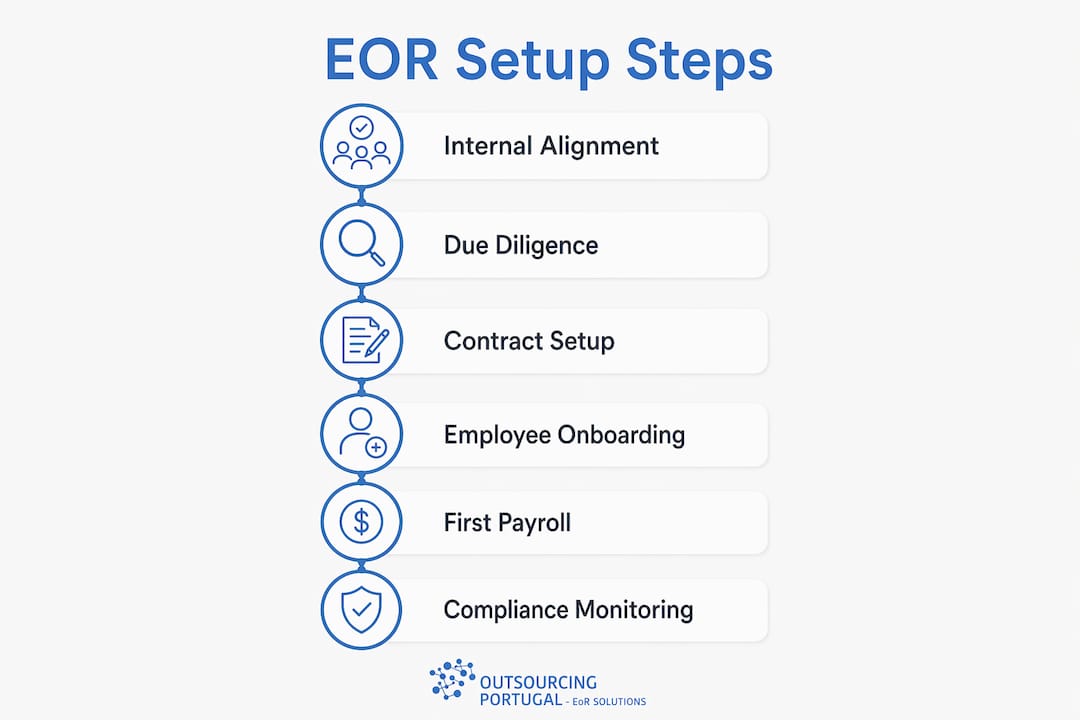
Infographic showing step-by-step EOR setup process in Portugal

What prerequisites must be completed before engaging an EOR in Portugal?

Internal alignment is the single most important factor before any EOR implementation guide can move forward. Finance, Legal, HR, and IT must agree on budgets, headcount plans, employment classifications, and compliance responsibilities before you sign anything with a provider.

Colleagues discussing EOR internal alignment

A single internal go-live owner is not optional. Without a clear internal owner for onboarding governance, decisions slip, compensation structures become misaligned, and contract terms get set incorrectly. Assign one person with authority to track sign-offs across all four departments.

Due diligence on your EOR provider covers three areas: their track record with Portuguese labor law, their payroll infrastructure, and their data security certifications. Verify that the provider registers employment contracts electronically with the ACT, as this is a legal requirement, not a best practice. Check their process for handling work permits and right-to-work verification for non-EU nationals.

Prerequisite Owner Status Check
Budget approval for EOR fees and benefits Finance Signed off before provider contract
Employment classification confirmed Legal Contractor vs. employee decision documented
Hiring plan and start dates confirmed HR Headcount list with target go-live dates
IT access and equipment plan defined IT Provisioning timeline agreed with HR
EOR provider due diligence complete Legal + HR Compliance credentials verified

Pro Tip: Appoint your go-live owner before the first call with the EOR provider. That person should attend every kickoff meeting and own the internal checklist from day one.

Portuguese employment contracts must be written. The mandatory contract content includes employer and employee identification, valid work visa or residence permit details, job description, remuneration, work location, working hours, and start date. Missing any of these elements creates legal exposure for both the EOR and your company.

Every employment contract must be electronically communicated to the ACT. This is a non-negotiable step in the EOR setup process. Your EOR partner handles this filing, but you must confirm it has been completed before the employee’s first day.

A critical legal point that many executives overlook: choice-of-law clauses cannot override mandatory Portuguese employee protections when work is performed primarily in Portugal. Under Rome I regulations, Portuguese labor law applies regardless of what the contract states about governing law. This means benefits, notice periods, and termination rights follow Portuguese standards.

Statutory benefits enrollment covers four areas:

  • Social security registration: The EOR registers the employee with Segurança Social and remits contributions monthly.
  • Workplace accident insurance: Mandatory for all employees in Portugal. The EOR holds this policy.
  • Health insurance: Not legally required but standard practice for competitive hiring. Confirm coverage scope with your EOR.
  • Pension contributions: Covered through social security contributions rather than a separate pension scheme in most cases.

Noncompliance penalties in Portugal range from administrative fines to criminal liability for repeated violations. The ACT conducts inspections and can audit employment records at any time.

Pro Tip: Ask your EOR provider for written confirmation of ACT registration within 48 hours of the employee’s contract being signed. Do not assume it has been filed.

How to execute employee onboarding and documentation collection

EOR engagement enables hiring in days, not months, compared to setting up a local entity. That speed advantage disappears if document collection is slow. Collect the following from every new hire before their start date: passport or national ID, Portuguese tax identification number (NIF), social security number (NISS), bank account details, and any professional qualifications relevant to the role.

The most common onboarding bottleneck is delays in document collection and local bank account setup. Non-EU employees relocating to Portugal often need weeks to open a Portuguese bank account. Build that timeline into your go-live plan and communicate it to the employee on day one of the process.

Follow these steps for a clean onboarding execution:

  1. Send the document checklist to the employee at least 10 business days before their start date. Include a clear deadline and a named contact for questions.
  2. Use a digital signature platform for contract execution. Digital signature tools accelerate contract execution and satisfy Portuguese electronic employment contract requirements.
  3. Confirm benefits enrollment with the EOR before the start date. Social security and accident insurance must be active on day one.
  4. Coordinate IT provisioning in parallel with HR onboarding. The EOR does not issue equipment. Your company retains that responsibility.
  5. Establish an escalation path for employee questions. Payroll queries go to the EOR. Access and equipment issues go to your IT team. Make this clear in the employee welcome communication.

For remote or relocating employees, assign a local contact who can assist with practical steps like NIF registration and bank account opening. This reduces delays that would otherwise push back the first payroll cycle.

Pro Tip: Create a shared onboarding tracker visible to HR, IT, and the EOR. Update it daily during the first two weeks. It eliminates the “who is handling this?” problem that derails most go-lives.

What does the first payroll process involve and how do you validate it?

First payroll is the validation point for every prior step. Parallel payroll runs are the standard approach when migrating existing employees or converting contractors. Run the EOR payroll alongside your current system for one cycle to catch discrepancies before cutting over completely.

Finance sign-off on the first payslip is mandatory. Validate tax withholding rates (IRS in Portugal), social security deductions, net pay calculations, and any benefit contributions. A single error in the first cycle creates trust issues with the employee and triggers correction cycles that delay subsequent payrolls.

Payroll milestone Responsible party Typical timing
Employee data submitted to EOR HR Week 3–4 of implementation
Payroll inputs locked Finance + HR 5 business days before pay date
Draft payslip review Finance 3 business days before pay date
Finance sign-off Finance Director 2 business days before pay date
Payroll executed and payslips issued EOR Pay date
Benefits remittances confirmed EOR Within 5 days of pay date

Post go-live, establish a compliance calendar. This covers monthly social security remittances, quarterly IRS reconciliations, and annual holiday accrual reviews. Your EOR handles the filings, but your Finance team should track deadlines independently as a control measure.

A phased EOR implementation approach covering country decision, contract setup, onboarding, benefits, payroll launch, and governance reduces risk at every stage. Treat each phase as a gate. Do not advance to the next phase until the current one has Finance and Legal sign-off.

Pro Tip: Log your new hire’s official start date and set a 12-month calendar reminder to assess whether entity setup makes more sense than continued EOR reliance. Monitoring entity transition deadlines prevents you from staying on EOR longer than is cost-effective.

Key takeaways

A successful EOR setup in Portugal requires internal alignment across Finance, Legal, HR, and IT before any provider engagement begins, with first payroll serving as the final compliance checkpoint.

Point Details
Assign a go-live owner early One internal owner tracking all sign-offs prevents misaligned contracts and payroll errors.
Written contracts are mandatory Portuguese law requires written contracts filed electronically with the ACT before day one.
Rome I limits contract flexibility Choice-of-law clauses cannot override mandatory Portuguese labor protections.
Document collection drives the timeline Delays in NIF, NISS, and bank account setup are the most common causes of payroll delays.
First payroll needs Finance sign-off Validate tax withholding and statutory deductions before executing the first pay cycle.

What I have learned managing EOR go-lives in Portugal

The executives who struggle most with EOR setup are the ones who treat it as a vendor handoff. They sign the EOR contract, send over a few employee names, and expect the provider to handle everything. That approach fails reliably.

The biggest driver of a clean first payroll is internal alignment across Finance, Legal, and IT before onboarding begins. The EOR provides the legal and payroll infrastructure. Your team provides the governance. Neither side can substitute for the other.

The second pattern I see repeatedly is underestimating the document collection timeline for non-EU employees. A Portuguese NIF takes days to obtain. A bank account can take two to three weeks. If HR sends the document checklist on the employee’s first day, the first payroll will be late. Send it the moment the offer is accepted.

One more point worth stating directly: EOR is the right tool for market entry, short-term projects, and testing Portuguese hiring before committing to a local entity. It is not a permanent substitute for entity setup if you plan to hire more than 10 to 15 people in Portugal long-term. The cost-benefit calculation shifts. Build that review into your governance calendar from the start, and you will make the transition on your terms rather than reactively.

— Paulo

Outsourcing-portugal’s EOR and payroll services for Portugal

International companies hiring in Portugal need a partner with direct experience in Portuguese labor law, ACT compliance, and local payroll execution.
https://outsourcing-portugal.co.uk

Outsourcing-portugal provides end-to-end EOR and payroll services covering contract issuance, social security registration, benefits enrollment, and monthly payroll management. The team handles ACT filings, tax withholding, and statutory remittances so your HR and Finance teams focus on the business rather than compliance administration. For companies ready to hire in Portugal without setting up a local entity, employment and EOR services from Outsourcing-portugal provide a direct path to compliant, fast hiring.

FAQ

What is the typical EOR setup timeline in Portugal?

EOR implementation averages 4–6 weeks from contract signing to first payroll, with employee onboarding typically taking 5–14 business days depending on document readiness.

Does Portuguese law override the governing law in an EOR contract?

Yes. Under Rome I regulations, mandatory Portuguese protections apply to all employees working primarily in Portugal, regardless of any choice-of-law clause in the employment contract.

What documents does an employee need for EOR onboarding in Portugal?

Every employee needs a passport or national ID, a Portuguese tax identification number (NIF), a social security number (NISS), and a local bank account. Non-EU employees may also need a valid residence permit.

Can an EOR issue equipment to employees in Portugal?

No. An EOR handles legal employment and payroll infrastructure, but equipment provisioning remains the responsibility of the client company.

When should a company switch from EOR to a local entity in Portugal?

EOR works well for market entry and small teams. Once headcount grows beyond 10–15 employees in Portugal, the cost and control benefits of a local entity typically outweigh continued EOR reliance. Set a review date at the 12-month mark.

Hiring Contractors: A 2026 Guide for International Teams


TL;DR:

  • Hiring contractors involves ensuring proper classification to avoid legal and tax penalties. It requires clear documentation, written agreements, correct tax forms, and ongoing compliance management. International businesses must adapt to local laws and consider using employer of record services to mitigate risks.

Hiring contractors is defined as engaging self-employed workers on a project or fixed-term basis, without creating an employment relationship. For international businesses, this model delivers access to specialized skills, faster team expansion, and lower overhead than full-time hiring. The catch is compliance. Misclassifying a contractor as an employee triggers tax penalties, back benefits liability, and regulatory scrutiny across every jurisdiction where you operate. Getting classification, contracts, and documentation right from the start is not optional. It is the foundation of every successful contractor engagement.

How do you determine if a worker qualifies as an independent contractor?

Worker classification is the single highest-risk step in hiring independent contractors. The IRS determines classification by assessing the degree of control and independence in the actual working relationship. No single factor decides the outcome. All evidence must be weighed together across three categories.

Professional reviewing IRS Form SS-8 and notes at desk

Behavioral control covers whether your business directs how, when, and where the worker performs tasks. A contractor sets their own schedule, chooses their methods, and works without daily supervision. If you assign specific hours, require attendance at internal meetings, or dictate tools and processes, those behaviors point toward an employment relationship.

Financial control examines how the worker is paid and whether they bear business risk. Contractors typically invoice per project, work for multiple clients, and supply their own equipment. Workers paid a regular salary, reimbursed for all expenses, and barred from working elsewhere look more like employees to the IRS.

Relationship factors include written contracts, benefits, and the permanency of the arrangement. Providing health insurance, paid leave, or stock options to a contractor is a direct red flag. The IRS also considers whether the work performed is a core part of your business operations.

Key classification signals to evaluate:

  • Does the worker control their own schedule and methods?
  • Do they invest in their own tools and equipment?
  • Do they work for multiple clients simultaneously?
  • Is the engagement project-based rather than ongoing and indefinite?
  • Does your contract exclude employee benefits entirely?

When classification is genuinely ambiguous, Form SS-8 allows either party to request an official IRS determination. This process is reserved for contested cases, not routine engagements. Routine use creates delays and draws unnecessary scrutiny.

Pro Tip: Document contractor autonomy in writing from day one. Record that the contractor sets their own schedule, uses their own tools, and operates their own business. This documentation is your first line of defense in any audit.

Misclassification risk drops significantly when contract language aligns with actual work behavior. A contract that says “independent contractor” but describes daily check-ins, assigned equipment, and exclusive work arrangements will not protect you. The IRS looks at reality, not labels.

What documents and steps are required to legally hire a contractor?

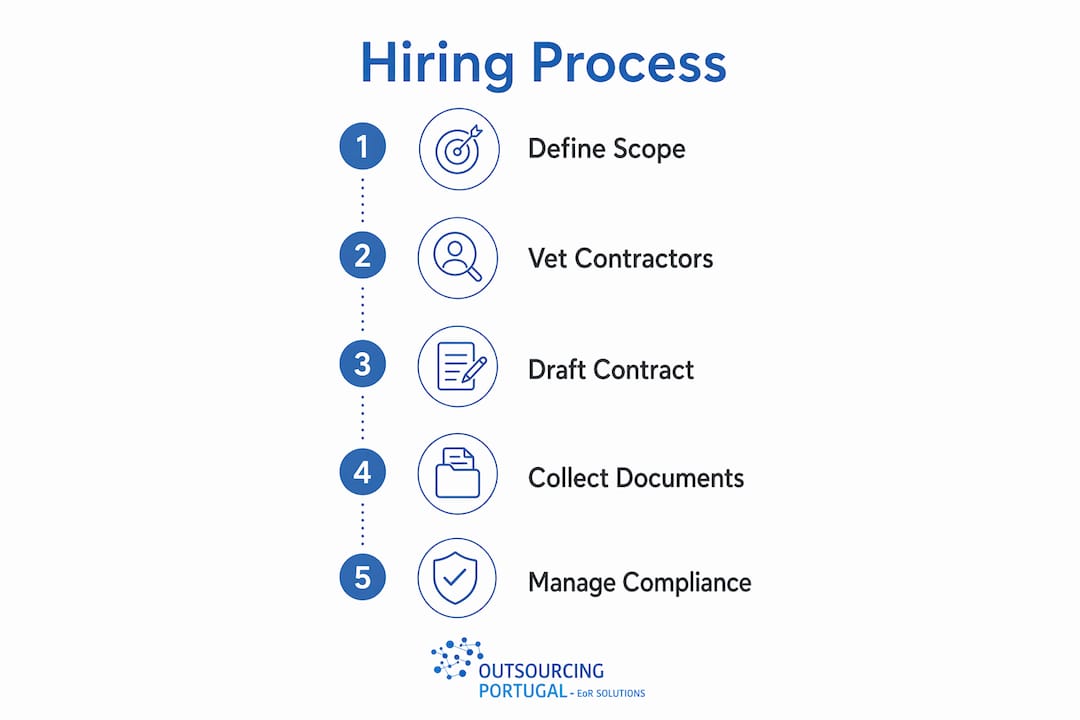
A compliant hiring workflow follows a fixed sequence. Skipping steps creates gaps that surface during audits or payment disputes. The best practice sequence is: confirm classification, create a written agreement, collect tax forms early, and maintain compliance records throughout the engagement.

  1. Confirm contractor suitability. Before drafting any agreement, verify that the worker genuinely qualifies as an independent contractor under the IRS framework. Review the behavioral, financial, and relationship factors described above. If the role requires daily supervision or exclusive availability, reconsider the engagement structure.

  2. Draft a comprehensive independent contractor agreement. The agreement must define the scope of work, deliverables, payment terms, deadlines, intellectual property ownership, and confidentiality obligations. Upwork’s contractor agreement model includes explicit IP assignment clauses, which prevent disputes over who owns work product after the engagement ends. Vague scope language is the most common source of contractor disputes.

  3. Collect the correct tax forms. For US-based contractors, collect Form W-9 before the first payment. For non-US contractors providing services to a US business, Form W-8BEN is typically required to establish foreign status and claim treaty benefits. Collecting these forms late creates year-end reporting problems.

  4. Set up payment and invoicing processes. Define the invoicing schedule in the contract. Require contractors to submit itemized invoices that match the agreed deliverables. This creates a clean paper trail for both tax reporting and dispute resolution.

  5. File Form 1099-NEC for qualifying payments. Filing Form 1099-NEC is required for US contractors paid $600 or more in a calendar year. Missing this filing triggers IRS penalties. Set a calendar reminder for the january deadline each year.

  6. Maintain records for audits. Keep signed contracts, tax forms, invoices, and payment records for a minimum of three years. The SHRM compliance toolkit for independent contractors and gig workers recommends structured recordkeeping systems that separate contractor files from employee files.

Pro Tip: Build a contractor onboarding checklist that mirrors your employee onboarding process in structure but differs entirely in content. Contractors should never receive employee handbooks, benefits enrollment forms, or company equipment without explicit justification documented in the contract.

Compliance differences multiply when hiring contractors internationally. Each country has its own classification tests, tax withholding rules, and social contribution requirements. What qualifies as an independent contractor in the US may be treated as an employment relationship under Portuguese or German labor law.

Infographic outlining key contractor hiring steps vertically

Where can international businesses find and vet qualified contractors?

Sourcing is where most businesses waste time. The right platform depends on the skill type, project complexity, and budget. Freelancer platforms like Upwork, Fiverr, and Toptal each serve different market segments. Upwork suits project-based generalists and mid-tier specialists. Toptal positions itself as a curated network for senior engineers and finance professionals, with a screening process that rejects the majority of applicants. Fiverr works best for defined, repeatable tasks with fixed deliverables.

Beyond platforms, consider these sourcing channels:

  • Industry-specific job boards. Platforms like Dribbble for designers or GitHub Jobs for developers attract specialists who do not actively market on general freelance sites.
  • Professional associations. Organizations like the Project Management Institute or the American Institute of CPAs maintain member directories that include independent practitioners.
  • LinkedIn. Searching for “open to contract work” or “freelance” in profile headlines surfaces candidates who are actively available. LinkedIn also lets you verify employment history and mutual connections.
  • Referrals from your existing network. A warm referral from a trusted colleague cuts vetting time significantly. Ask your current contractors if they know specialists in adjacent areas.

Vetting a contractor requires more than reviewing a portfolio. Check references directly. Ask previous clients whether the contractor met deadlines, communicated proactively, and delivered work that matched the agreed scope. Conduct a short paid test project before committing to a full engagement. A test project reveals work quality, communication style, and reliability faster than any interview.

Write clear job descriptions before posting. Define the deliverable, the timeline, the required skills, and the budget range. Vague postings attract vague applicants. Specificity filters out candidates who are not a genuine fit and saves you screening time.

How do you manage contractor relationships without crossing compliance lines?

Managing an independent contractor differs fundamentally from managing an employee. The goal is to monitor outcomes, not activities. Review deliverables against contract terms. Avoid setting daily schedules, requiring status meetings, or directing how the work gets done. Each of those behaviors weakens the contractor classification.

Payment and tax reporting require consistent attention throughout the engagement:

Task Timing Responsible party
Collect Form W-9 or W-8BEN Before first payment Hiring business
Review and approve invoices Per contract schedule Hiring business
File Form 1099-NEC By january 31 each year Hiring business
Renew or update contract Before scope changes Both parties
Audit recordkeeping files Annually Hiring business

Subcontracting clauses deserve attention in every contract. If a contractor plans to delegate work to others, your agreement must address whether that is permitted and who bears liability for the subcontractor’s output. Confidentiality clauses must explicitly extend to any subcontractors the primary contractor engages.

International contractor management adds a layer of complexity that domestic hiring does not. Payroll and compliance requirements vary by country. Portugal, for example, has specific social security contribution rules and labor code provisions that affect how contractor relationships are structured and documented. Businesses hiring across borders benefit from working with a local compliance partner who understands the specific rules in each jurisdiction. Outsourcing-portugal provides payroll compliance support for international businesses operating in Portugal, covering both contractor and employee engagements.

Review contracts before renewing them. A contractor engagement that started as a short project can drift into an indefinite arrangement that looks like employment. Set a review date at the contract’s midpoint and assess whether the classification still holds.

Key Takeaways

Hiring contractors compliantly requires correct classification, written agreements, proper tax documentation, and consistent recordkeeping from the first day of every engagement.

Point Details
Classification comes first Evaluate behavioral, financial, and relationship factors before drafting any agreement.
Written agreements are non-negotiable Cover scope, payment, IP ownership, and confidentiality in every contractor contract.
Tax forms before first payment Collect Form W-9 for US contractors or Form W-8BEN for non-US contractors before paying.
Manage outcomes, not activities Review deliverables against contract terms without directing daily work methods or schedules.
International rules vary significantly Each country has distinct classification tests and payroll rules; use local compliance support.

What I’ve learned from watching businesses get contractor classification wrong

The most expensive mistake I see international businesses make is not misclassification itself. It is the gap between what the contract says and how the relationship actually operates. A company writes a clean independent contractor agreement, then assigns the contractor a company email address, includes them in the all-hands meeting, and routes their work through the same project management system as full-time staff. That gap is what auditors find.

Classification is determined by evidence of the actual work relationship, not by contract labels. The IRS and labor authorities in most countries look at behavior, not paperwork. A contract that says “contractor” but describes an employment relationship will not protect you when the audit comes.

The second pattern I see is businesses treating contractor compliance as a one-time setup task. They collect the W-9, sign the agreement, and then let the relationship evolve without reviewing whether the classification still holds. Contracts drift. Scopes expand. What started as a three-month project becomes a two-year arrangement with a single client. That is the profile of a misclassified employee, regardless of what the original agreement said.

For businesses expanding into markets like Portugal, the complexity increases further. Portuguese labor law applies a different standard for determining employment status, and the consequences of misclassification under EU regulations are serious. Working with a local compliance partner from the start is not a luxury. It is the most cost-effective risk management decision you can make. The role of compliance in international hiring is not administrative overhead. It is what keeps your contractor model legally defensible.

— Paulo

Contractor hiring in Portugal, handled end to end

International businesses that want to engage contractors or build teams in Portugal without setting up a local entity have a direct path forward through Outsourcing-portugal.

https://outsourcing-portugal.co.uk

Outsourcing-portugal provides employer of record services and full payroll management for foreign businesses operating in Portugal. The platform covers classification guidance, contract structuring, payroll processing, and ongoing compliance monitoring. Portugal ranks among the EU’s most competitive nearshore locations, with a multilingual workforce, stable governance, and labor costs well below Western European averages. For businesses that want to hire compliantly in Portugal without the overhead of a local entity, Outsourcing-portugal handles the legal and operational complexity from day one.

FAQ

What is the main risk of misclassifying a contractor?

Misclassification exposes your business to back taxes, unpaid benefits liability, and regulatory penalties in every jurisdiction where the worker operated. The IRS and most national labor authorities assess the actual working relationship, not the contract label.

Do I need a written contract for every contractor I hire?

A written independent contractor agreement is required for every engagement. The contract must cover scope of work, payment terms, intellectual property rights, and confidentiality obligations before work begins.

What tax form do I collect from a US-based contractor?

Collect IRS Form W-9 from every US-based contractor before making the first payment. For non-US contractors, Form W-8BEN establishes foreign status and is required for US tax reporting purposes.

How is hiring contractors internationally different from domestic hiring?

Each country applies its own classification tests, tax withholding rules, and social contribution requirements. A worker classified as an independent contractor in the US may qualify as an employee under Portuguese or German labor law, requiring a different engagement structure.

When should I use an employer of record instead of hiring a contractor directly?

Use an employer of record when local labor law makes direct contractor engagement legally risky, when the role requires ongoing work that resembles employment, or when you need to hire quickly in a new market without setting up a local legal entity.

Why Multilingual Skills Matter for Global Business


TL;DR:

  • Multilingual skills improve cognitive performance, health, and business communication effectiveness worldwide.
  • They help professionals earn higher salaries, build trust, and access multiple markets more effectively.

Multilingual skills are defined as the ability to communicate effectively in two or more languages across professional and cultural contexts. For business leaders building international teams, the importance of multilingualism goes well beyond translation. Multilingual competence drives hiring decisions, salary outcomes, and the trust that holds cross-border partnerships together. Research from Harvard, the European Commission, and UNESCO confirms that bilingual and multilingual professionals deliver measurable advantages in cognitive performance, cultural fluency, and career earnings. This article explains exactly what those advantages are and how you can apply them.

Why multilingual skills matter for professionals and business leaders

Multilingual skills give professionals a direct edge in cognitive performance, not just communication. A large-scale study of 86,149 adults found that speaking multiple languages is linked to a 50% reduction in accelerated biological aging signs compared to monolinguals. That finding means your workforce’s language skills are not just a cultural asset. They are a measurable health and productivity factor.

Young man studying foreign language at desk

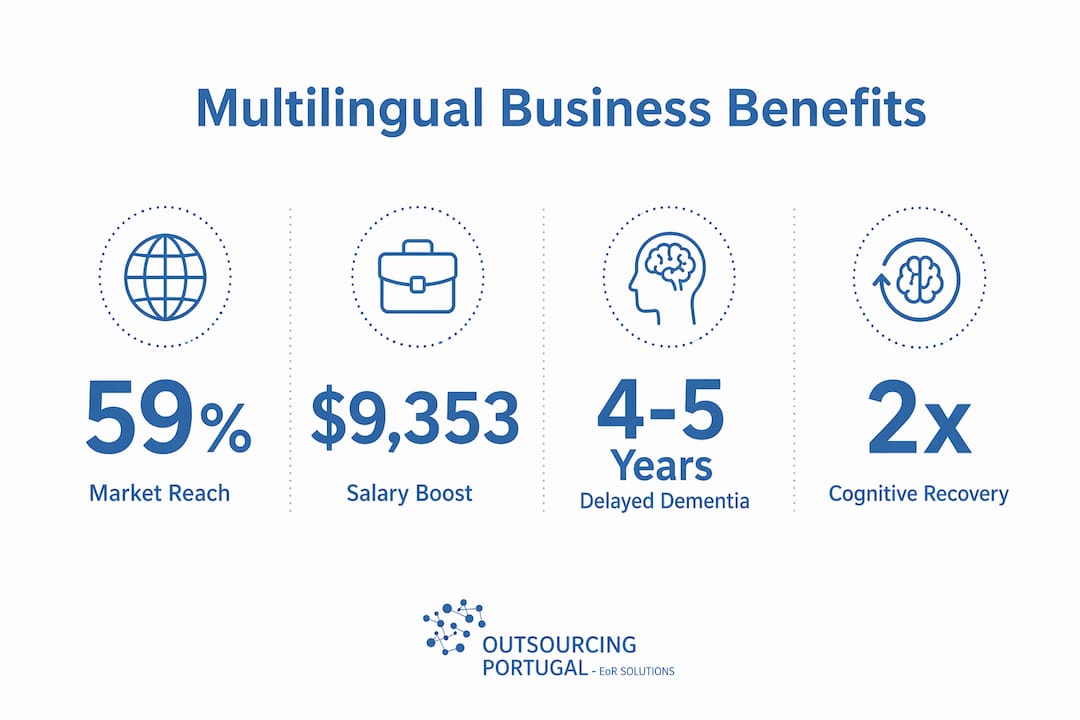
The European Commission recognizes multilingualism as one of eight key competences for lifelong learning. 59% of Europeans speak at least one foreign language, and the EU treats this as a baseline workforce competence for economic competitiveness. For business leaders hiring across borders, that statistic sets the standard your teams need to meet.

The value of bilingual skills also shows up in salary data. Bilingual workers earn an average of $9,353 more per year than monolingual peers. That is a 14.3% salary premium that reflects real market demand for professionals who can operate across languages and cultures.

What cognitive and health benefits do multilingual skills provide?

Bilingual individuals develop dementia symptoms 4–5 years later than monolinguals and recover cognitive abilities twice as often after a stroke. Those are not marginal gains. They represent a fundamentally different cognitive trajectory for people who regularly use more than one language.

The mechanism behind these benefits is the constant mental exercise of managing two language systems. Multilingual professionals build stronger executive functions, including working memory, attention switching, and mental flexibility. These are the same skills that make someone effective in high-pressure negotiations, complex project management, and rapid decision-making.

The cognitive benefits of multilingualism depend on three specific factors:

  • Proficiency: Higher language proficiency produces stronger cognitive effects than surface-level familiarity.
  • Frequency of use: Active daily use of a second language drives the brain-training effect. Passive exposure does not.
  • Grammatical complexity: Languages with more complex grammar structures produce greater cognitive demands and, in turn, greater mental agility gains.

This dose-dependent relationship means the more you use a language, the more your brain benefits. Even short, intensive practice sessions of five or more hours per week can yield measurable cognitive improvements when the language is used regularly in real contexts.

Pro Tip: Schedule at least two live conversations per week in your second language. Reading and listening alone do not activate the executive function benefits that come from real-time language switching.

For business leaders, this has a direct workforce implication. Teams that include multilingual professionals are not just culturally diverse. They tend to think faster, adapt better, and perform more consistently under pressure. The multilingual workforce benefits for HR leaders go far beyond filling language gaps on a call center floor.

Infographic showing multilingual business benefits

How do multilingual skills enhance global business communication?

UN Secretary-General António Guterres calls multilingualism a core value for global communication. The UN’s position is that multilingualism produces greater effectiveness and improved outcomes in international projects by creating harmonious communication across cultures. That is not a soft claim. It is an institutional finding backed by decades of multilateral diplomacy.

In business, the same principle applies at every level of collaboration. Here is how multilingual skills improve international teamwork in practice:

  1. Trust building: Even basic attempts at a client’s local language signal respect. Experts confirm that local language greetings break down cultural barriers and open negotiations that would otherwise stall.
  2. Reduced misunderstanding: Multilingual team members catch cultural subtext that translation tools miss entirely. A phrase that reads as polite in English can read as dismissive in Japanese or Portuguese.
  3. Faster decision cycles: Teams that share a working language move through approvals, feedback, and revisions faster than teams relying on intermediaries or software translation.
  4. Stronger client relationships: Clients who feel understood in their own language stay longer and refer more. Language competence is a retention tool, not just an onboarding one.
  5. Better conflict resolution: Cross-cultural misunderstandings are a primary driver of project failure. Multilingual professionals identify and address those misunderstandings before they escalate.

“Language learning is a slow, relational skill critical for trust and cultural protocol that AI translation cannot replace.” — UNESCO Courier

That UNESCO observation cuts to the heart of why studying languages still matters in an era of machine translation. Tools like Google Translate and DeepL handle transactional text. They cannot read the room, adjust tone for cultural context, or build the relational trust that closes a deal. Human language competence does all three.

For leaders managing multicultural teams in Portugal or across European markets, this distinction is critical. Multilingual team members are your cultural interpreters, not just your language conduits.

What career and business advantages come from bilingual competence?

Multilingual competence is a critical hiring criterion in professional services, finance, technology, and consulting. Employers treat it as a cultural asset that signals adaptability, global awareness, and the ability to work across organizational boundaries.

Factor Monolingual workforce Multilingual workforce
Salary competitiveness Market baseline Up to 14.3% salary premium
Client market reach Domestic or English-only Multi-market and multi-region
Cultural trust with clients Limited without local knowledge High, built through language and context
Hiring attractiveness Standard candidate pool Broader, more competitive talent pool
Cognitive performance Standard executive function Enhanced memory, attention, and flexibility

The business case for multilingual hiring is not abstract. Companies that source multilingual talent for international growth reduce their reliance on external translation services, shorten sales cycles in new markets, and build client relationships that survive leadership changes.

Key advantages for organizations that prioritize multilingual hiring:

  • Access to markets where English-only teams cannot operate effectively
  • Reduced friction in cross-border compliance and regulatory communication
  • Higher employee retention among international hires who feel culturally supported
  • Stronger brand perception in non-English-speaking markets

The EU’s recognition of multilingualism as a core workforce competence reflects what business leaders already know. Language skills are not a bonus. They are a baseline requirement for competing globally.

What are the challenges of developing multilingual skills effectively?

Language acquisition is not a linear process, and the research on early exposure reveals important trade-offs. Early language exposure confers metalinguistic awareness and executive function advantages, but it can cause temporary vocabulary deficits in both languages if the learning environment does not provide strong support in each one. This means the quality of language input matters as much as the quantity.

For adult professionals, the challenges are different but equally real. Vocabulary acquisition in a second language is slower than in a first language. Pronunciation habits from the native language create interference. And professional contexts demand precision that casual language learning does not build.

Practical strategies that work for professionals:

  • Use additive approaches: Add a new language without reducing investment in your primary language. Subtractive approaches, where the first language weakens as the second grows, reduce overall communication effectiveness.
  • Prioritize professional vocabulary: General language courses build conversational fluency. Sector-specific vocabulary in finance, law, or technology requires targeted practice with industry materials.
  • Engage native speakers regularly: Structured conversation with native speakers accelerates pragmatic competence, the ability to say the right thing in the right way for a given cultural context.
  • Measure frequency, not just hours: Five hours of active conversation per week produces stronger results than ten hours of passive listening.

Pro Tip: Pair language learning with your actual work. Attend a client call in the target language, even if you only contribute one or two sentences. Real professional contexts build competence faster than classroom simulations.

The cognitive benefits of multilingualism depend on active usage, proficiency, and grammatical complexity. That means a professional who uses a second language daily in client meetings gains far more than one who studied it for three years and rarely speaks it now.

Key Takeaways

Multilingual skills deliver measurable advantages in cognitive health, business communication, and career earnings, making them a non-negotiable competence for professionals competing in global markets.

Point Details
Cognitive health advantage Bilingual professionals develop dementia symptoms 4–5 years later and recover from strokes twice as often as monolinguals.
Salary premium Bilingual workers earn an average of $9,353 more per year, a 14.3% increase over monolingual peers.
AI cannot replace human language Machine translation handles text but cannot build the relational trust or cultural nuance that closes deals.
Frequency drives benefit Active daily use of a second language, not passive exposure, produces the cognitive and professional gains.
EU baseline standard The European Commission classifies multilingualism as one of eight core competences for workforce competitiveness.

The uncomfortable truth about language skills in global business

Most business leaders I speak with treat multilingualism as a nice-to-have. They assume English covers the gap, and that translation tools handle the rest. That assumption costs them deals they never know they lost.

The research is unambiguous. Language competence is relational, not transactional. When a client in Lisbon, Tokyo, or São Paulo hears you attempt their language, even imperfectly, the dynamic shifts. You are no longer a vendor. You become a partner. That shift does not happen through a translation app.

What I find most underappreciated is the cognitive argument. A multilingual team is not just more culturally aware. It is measurably sharper. The executive function gains from regular language switching show up in problem-solving speed, attention management, and adaptability under pressure. These are exactly the qualities that separate high-performing international teams from average ones.

The professionals who invest in language learning now are building a compounding advantage. The salary premium, the client trust, the cognitive edge. These do not plateau. They grow with use. The leaders who recognize that early will build teams that outperform for years.

— Paulo

Portugal’s multilingual talent gives your business a real edge

International companies that need multilingual professionals without the complexity of setting up a local entity have a clear option. Portugal’s workforce ranks among the most multilingual in Europe, with strong proficiency in English, Spanish, French, and German across technology, finance, and customer service sectors.

https://outsourcing-portugal.co.uk

Outsourcing-portugal provides Employer of Record and payroll services that let you hire compliant, multilingual talent in Portugal without establishing a local entity. From onboarding to payroll compliance, the full employment infrastructure is handled. You get access to a globally competitive workforce with the language skills your international clients expect, and the legal compliance your operations require. Contact Outsourcing-portugal to build your multilingual team in Portugal.

FAQ

What is the main benefit of multilingual skills in business?

Multilingual skills build client trust, reduce communication errors, and open access to markets where English-only teams cannot operate. Bilingual workers also earn an average of $9,353 more per year than monolingual peers.

Can AI translation replace human multilingual skills?

AI translation handles routine text but cannot replicate the relational trust, cultural nuance, or real-time judgment that human language competence provides in high-stakes negotiations and client relationships.

How many languages do you need to speak to gain cognitive benefits?

Speaking even one additional language actively and regularly produces measurable cognitive benefits. The gains depend on proficiency, frequency of use, and grammatical complexity rather than the number of languages spoken.

Why do employers pay more for bilingual professionals?

Employers pay a premium because multilingual professionals expand market reach, reduce reliance on external translation services, and build stronger client relationships in non-English-speaking markets.

How does Portugal’s workforce support multilingual business needs?

Portugal’s workforce is among the most multilingual in the EU, with high proficiency in English, Spanish, French, and German. This makes Portugal a practical nearshore location for companies building international customer-facing or technical teams.

EOR Service Benefits for International Business Leaders


TL;DR:

  • Employer of Record services allow companies to hire internationally within days by handling payroll and legal compliance. They reduce startup costs, eliminate regulatory risks, and offer flexible scaling with transparent pricing. Most businesses underuse EORs by treating them as temporary solutions instead of strategic tools for ongoing global expansion.

An Employer of Record (EOR) is defined as a third-party organization that becomes the legal employer of your workforce in a foreign country, handling payroll, taxes, benefits, and compliance on your behalf. The core EOR service benefits are speed, compliance, and cost control. Entity setup in a new market takes 3–9 months and can cost between $20,000 and $250,000 upfront. An EOR gets you hiring within days at a predictable monthly fee per employee. For international business leaders testing new markets or building distributed teams, the advantages of EOR services are not theoretical. They are measurable and immediate.

1. EOR service benefits start with faster market entry

Traditional market entry requires incorporating a local entity, opening bank accounts, registering for tax, and hiring local legal counsel. That process takes 3–9 months in most jurisdictions. An EOR eliminates every one of those steps.

Professional woman planning market entry in coworking space

44% of organizations use EOR services primarily to avoid entity setup time and costs. That figure reflects a clear shift in how business leaders think about international expansion. Speed is not a luxury. It is a competitive advantage.

With an EOR, your first hire in a new country can be onboarded in days. You test market traction, build a local team, and generate revenue before committing to a permanent legal structure.

Pro Tip: Use an EOR to run a 6–12 month pilot in a new market. If the market performs, you have the data to justify a full entity setup. If it does not, you exit cleanly with no wind-down costs.

2. Compliance assurance eliminates regulatory risk

Every country has its own labor code, payroll tax rules, mandatory benefits, and termination procedures. Getting any of these wrong triggers audits, fines, and reputational damage. An EOR assumes full legal employer responsibility, so those risks transfer away from your business.

EOR providers handle work permits and visa sponsorships as the legal employer of record, without requiring you to own a local entity. This is particularly valuable when hiring specialized talent that needs immigration support.

Worker misclassification is one of the fastest-growing compliance risks in international hiring. Jurisdictions like Canada and Germany have increased penalties for misclassification in 2026, making the legal employer model more critical than ever. An EOR classifies workers correctly, drafts compliant contracts, and files payroll taxes on schedule.

“EOR providers play a vital role in shielding businesses from escalating penalties for worker misclassification internationally.” — EOR industry analysis, 2026

EOR services also reduce permanent establishment risk. When your employees work through an EOR rather than directly for your foreign entity, you reduce the legal footprint that triggers corporate tax obligations in that country.

3. Cost savings that scale with your team size

The financial case for EOR services is strongest for teams of 1–20 employees in a new market. Entity setup costs $20,000–$250,000 upfront, before you hire a single person. EOR fees range from $199–$800 per employee per month, with no capital commitment.

The salary arbitrage compounds the savings further. Hiring a developer in Georgia through an EOR costs approximately $36,000 per year, compared to approximately $110,000 for the same role in the US. That is a 65% cost saving on direct labor alone. The EOR fee is a fraction of that difference.

EOR services convert hiring from a capital expenditure into an operating expense. That shift matters for cash flow, financial forecasting, and board-level reporting. You pay per employee, per month, with no long-term infrastructure commitment.

4. Flexible hiring and clean exits without entity overhead

One of the least discussed EOR service advantages is the exit option. When a market does not perform, winding down a local entity takes months and costs tens of thousands in legal fees. With an EOR, you terminate the service agreement and the employment contracts end cleanly under local law.

This flexibility works in both directions. You can scale a team up from one employee to twenty without changing your legal structure. You can also reduce headcount during a restructure without triggering entity-level consequences.

EOR solutions for employers also remove the administrative burden of offboarding. The EOR handles final pay calculations, statutory severance, and regulatory filings. Your internal team focuses on the business decision, not the paperwork.

5. Benefits management without building HR infrastructure

Statutory benefits vary widely across countries. Portugal mandates paid leave, social security contributions, and specific termination notice periods. Brazil requires a 13th-month salary. Germany mandates co-determination rights for larger teams. An EOR knows these requirements and builds them into every employment contract.

Beyond statutory minimums, supplemental benefits delivered by EOR providers include private health insurance, dental coverage, mental health support, and wellness stipends. These benefits directly affect talent retention and employee satisfaction in competitive hiring markets.

Quality supplemental benefits distinguish higher-performing EOR providers from basic payroll processors. When evaluating providers, ask specifically what supplemental benefits they offer in your target market and at what markup.

Pro Tip: Request a full benefits schedule from any EOR provider before signing. Supplemental benefits often carry a 10–20% admin markup. Knowing this upfront prevents budget surprises after your team is onboarded.

6. Permanent establishment risk reduction

Permanent establishment (PE) is the legal threshold at which a foreign company becomes liable for corporate tax in a host country. Employees working on your behalf in a foreign market can trigger PE status, even without a registered entity. An EOR breaks that link.

Because the EOR is the legal employer, your employees are formally employed by a local entity that is not yours. Your company has a commercial relationship with the EOR, not a direct employment relationship with the local workforce. That structure keeps your corporate tax exposure contained.

PE risk is not hypothetical. Tax authorities in the EU, UK, and APAC have increased enforcement activity against foreign companies with undeclared local operations. Using an EOR is one of the clearest ways to demonstrate that your local presence is a service relationship, not a taxable establishment.

7. Multi-country operations through one provider relationship

Managing employment across five countries means five sets of labor laws, five payroll systems, and five compliance calendars. An EOR with multi-country capability collapses that complexity into one contract and one point of contact.

One EOR relationship handles compliant payroll and benefits administration across jurisdictions, giving your HR and finance teams a single reporting structure. That consolidation reduces errors, speeds up reporting cycles, and cuts the cost of managing multiple local vendors.

For business leaders building nearshore teams across Europe, this is particularly valuable. Portugal, Spain, Poland, and Romania each have distinct labor codes. An EOR that covers all four markets removes the need for country-specific legal counsel at every hiring decision.

8. Access to talent in markets that are hard to enter independently

Some markets are attractive for talent but difficult to enter through traditional entity setup. Regulatory complexity, language barriers, and unfamiliar legal systems make direct hiring impractical for small international teams. An EOR’s existing local infrastructure removes those barriers entirely.

EOR providers maintain registered entities, local legal teams, and payroll systems in their operating markets. You access that infrastructure immediately. This is how EOR services for businesses unlock talent pools that would otherwise require years of local investment to reach.

Portugal is a strong example. The country offers a highly educated, multilingual workforce at labor costs significantly below Western European averages, within the EU regulatory framework. An EOR makes that talent accessible to a US or UK company within days of a hiring decision.

9. Transparent cost structure and predictable budgeting

EOR pricing is straightforward when the contract is written clearly. You pay a monthly fee per employee, covering payroll processing, compliance management, and HR administration. The risk comes from hidden costs in benefits markups and currency conversion margins.

Benefits procurement fees and currency conversion margins are major cost drivers within EOR pricing. A provider that charges a 15% markup on health insurance premiums and a 2% currency conversion spread can add thousands of dollars annually to your cost per employee. Transparent contracts prevent those surprises.

Request a detailed cost breakdown before signing any EOR agreement. Ask for the base service fee, the benefits markup percentage, the currency conversion policy, and any termination fees. A provider that resists that level of transparency is a provider worth avoiding.

Key Takeaways

EOR services reduce international hiring from a multi-month, capital-intensive process to a compliant, day-one operation with predictable costs and no entity overhead.

Point Details
Speed of market entry EOR replaces 3–9 months of entity setup with hiring in days at no upfront capital cost.
Compliance and risk transfer The EOR assumes legal employer status, covering payroll tax, contracts, and misclassification risk.
Cost-effective for small teams For teams of 1–20 employees, EOR fees are far lower than entity setup and maintenance costs.
Flexible scaling and clean exits Teams scale up or down without entity-level consequences, and market exits require no wind-down process.
Transparent pricing matters Always request a full cost breakdown including benefits markups and currency conversion fees before signing.

Why I think most companies underuse EOR services

The businesses I see getting the most value from EOR arrangements are not the ones using it as a stopgap. They are the ones treating it as a deliberate financial and risk management decision from day one.

The most common mistake I observe is treating EOR as a temporary fix while the “real” entity gets set up. That framing misses the point. For teams under 20 people in a single market, a private entity often costs more to maintain than the EOR fee, even after years of operation. The math rarely favors the entity until you hit meaningful scale.

The second mistake is signing with an EOR provider without reading the benefits and currency clauses. I have seen companies budget $600 per employee per month and end up paying $850 once benefits markups and FX spreads are applied. That gap is avoidable with one hour of due diligence before signing.

My practical advice: treat the EOR selection process like a vendor audit, not a procurement checkbox. Ask for references from clients in your target market. Verify that the provider has genuine local legal counsel, not just a reseller arrangement. And check what supplemental benefits they actually deliver, not just what they list in the brochure.

EOR services work best when you choose a provider with real depth in your target market and full transparency on costs. Portugal, in particular, rewards this approach. The labor market is strong, the regulatory environment is stable, and the cost advantages are real. The EOR just needs to be the right one.

— Paulo

Outsourcing-portugal’s EOR and payroll services for Portugal

International companies hiring in Portugal get a market that combines EU compliance, competitive labor costs, and a highly educated English-speaking workforce. Outsourcing-portugal provides EOR and payroll services that cover the full employment lifecycle, from contract drafting and onboarding to monthly payroll processing and legal compliance management.

https://outsourcing-portugal.co.uk

Every engagement includes local legal expertise, compliant employment contracts under Portuguese labor law, and full payroll administration. Outsourcing-portugal handles work permits and social security registration so your team is operational from day one. For business leaders ready to hire in Portugal without the complexity of entity setup, the full service overview covers every step of the process.

FAQ

What is an Employer of Record (EOR)?

An Employer of Record is a third-party company that legally employs workers on behalf of another business in a foreign country, handling payroll, taxes, benefits, and compliance. The client company directs the work while the EOR manages all legal employer obligations.

How quickly can an EOR get a new hire onboarded?

An EOR can onboard a new employee in a foreign market within days, compared to the 3–9 months required to set up a local entity independently. This speed is one of the primary reasons 44% of organizations choose EOR over entity setup.

What does an EOR cost per employee?

EOR service fees typically range from $199–$800 per employee per month, depending on the market and the scope of services included. Always request a full cost breakdown that includes benefits markups and currency conversion fees to avoid unexpected charges.

Does using an EOR reduce permanent establishment risk?

Yes. Because the EOR is the legal employer, your company does not have a direct employment relationship with local workers, which reduces the legal footprint that triggers corporate tax obligations in the host country. This is a recognized risk mitigation strategy in EU, UK, and APAC markets.

Can an EOR handle multi-country hiring?

A multi-country EOR manages compliant payroll, benefits, and HR administration across multiple jurisdictions through one provider relationship. This consolidates compliance management and reduces the cost of maintaining separate local vendors in each country.

Top 3 Agencies for Best Employment Outsourcing Services 2026

Hiring in a new country often leads to slow setup, unclear legal steps, and unpredictable payroll management. Many providers require you to register a full legal entity or only quote prices after long consultations. This comparison lists pricing, market focus, and coverage so you can choose which outsourcing agency fits your speed, compliance, and hiring needs for international teams in 2026.

Table of Contents

Outsourcing Portugal

https://outsourcing-portugal.co.uk

At a Glance

Fast company registration through Empresa na Hora shortens administrative steps for teams entering Portugal. The service pairs Employer of Record arrangements with payroll and visa support. That combination lets international employers start hiring Portuguese talent without opening a full local office.

Core Features

Outsourcing Portugal provides Employer of Record arrangements so you can hire Portuguese residents without creating a local entity, while the provider handles payroll management and tax compliance. The offering also covers visa and settling support for foreign employees and helps build nearshore development teams and sales operations. Sales outsourcing includes lead generation and full-cycle sales support for companies expanding in Portugal.

Key Differentiator

The standout capability is fully compliant, rapid hiring in Portugal that bundles legal, payroll, and HR support into one engagement. That focus reduces the number of external vendors you must coordinate when hiring internationally. The result is a clearer legal footprint and fewer moving parts during initial staffing and onboarding.

Pros

Outsourcing Portugal groups the core administrative tasks most international employers want removed from their plate. Local payroll and tax handling reduces the risk of misfiling or missed contributions, and the provider advertises full compliance with Portuguese employment and social security rules. Dedicated local support for visas, bank accounts, and HR cuts time spent chasing government and banking procedures. Access to Portugal’s multilingual, highly educated workforce and competitive labor costs makes hiring more cost effective for development teams and call centers.

Cons

  • Dependence on local providers for ongoing compliance and HR management can limit your direct control over some processes and slow decision cycles when external partners must act.

Who It’s For

This service fits international companies that want to hire in Portugal without establishing a local company. It also suits startups testing the Portuguese or EU market and tech firms building nearshore teams. Sales teams seeking local lead generation and companies needing visa and settling help will find the model practical.

Unique Value Proposition

Empresa na Hora fast company registration is a concrete option that shortens setup when you do need a local entity. Combined with an Employer of Record model and local payroll handling, that option reduces startup friction and legal overhead. For teams that want to move quickly into Portugal while keeping internal headcount and governance centralized, this shifts administrative burden to local experts.

Real World Use Case

A US software firm hires a four person engineering pod in Lisbon through Outsourcing Portugal as an Employer of Record. The provider manages payroll, social contributions, and visa paperwork while the firm retains day to day engineering management. That approach lets the firm test product-market fit in the EU without forming a Portuguese subsidiary.

Pricing

Not applicable. The website lists services and capabilities but does not publish standard pricing. Engagements are typically quoted per client and per service scope, so you should request a tailored estimate for hiring, payroll, visa, or sales outsourcing work.

Website: https://outsourcing-portugal.co.uk

Adecco Portugal

https://adecco.pt

At a Glance

Adecco Portugal reports more than 850,000 candidates and 1,500 clients across over 20 locations, with 10,000 collaborators at client sites. That network supports large scale staffing and enterprise OnSite deployments. The company pairs recruitment practice with technology to shorten hiring cycles and monitor local hiring trends.

Core Features

Recruitment and talent selection cover permanent hires, mid level and executive searches, plus temporary staffing solutions. The platform includes outsourcing services and OnSite team management alongside learning consultancy to develop team skills. Market insight is provided through the Guia Salarial 2026 salary guide and hiring trend analysis.

Key Differentiator

The main differentiator is the combination of sector specific knowledge and advanced technology to accelerate placements while keeping local market context. That mix targets clients who need both reach and configurable staffing workflows. It applies sector playbooks to recruitment processes to improve role fit.

Pros

A large candidate pool and a broad client base make filling diverse roles easier and faster for many projects. The mix of staffing, outsourcing, and learning modules gives you multiple ways to staff short term projects or scale permanent teams. Regional presence and stated diversity and inclusion commitments help deploy teams across Portugal with local sensitivity.

Cons

  • Dependence on the Portuguese labor market can restrict candidate availability during national downturns.
  • Customization for very large, highly specialized programs may require additional consulting and more lead time.
  • Public marketing and third party summaries remain promotional and do not disclose detailed operational limits or SLA examples.

When It May Not Fit

If you need a purely global SaaS hiring product without a local footprint, this offering may not match your requirements. If your workflows require out of the box automation for every step, you will likely need custom integration work. Large enterprise programs that demand deep bespoke configuration should budget for extra consultancy and longer setup.

Who It’s For

International companies and local firms that want an end to end HR and staffing software approach with strong local recruitment presence will find value. You will benefit when you need temporary workforce management combined with permanent hiring support. The offering suits organizations that prefer vendor backed on site management alongside talent sourcing.

Real World Use Case

A multinational deployed an OnSite team with more than 200 temporary staff while Adecco managed recruitment and day to day workforce administration. That engagement reduced the clients internal hiring burden and helped stabilize operations during a peak period. The case shows how talent reach and operational support work together in practice.

Pricing

Pricing is not published online and is consultative. Contracts reflect the service mix and scale, so you will receive a tailored commercial proposal after scoping and needs assessment.

Website: https://adecco.pt

ManpowerGroup Portugal

https://manpowergroup.pt

At a Glance

ManpowerGroup Portugal reports more than 70 years of experience connecting employers and talent across markets. That history appears in a broad mix of staffing, direct recruitment, and outsourcing services. The operation combines local teams with international reach through the brands Manpower, Experis, and Talent Solutions. This mix positions the firm to handle cross-border hiring while keeping local market knowledge close to the client.

Core Features

The service lineup covers staffing and direct recruitment, operational talent management, and outsourcing of HR services for in-country needs. They supply professional IT resources and manage service delivery for project work and long term assignments. Local teams handle candidate sourcing, placement, and ongoing workforce administration in Portugal and other markets.

Key Differentiator

The firm pairs global scale with local adaptation to place talent where clients need it. That approach lets clients tap international candidate pools while keeping compliance and payroll work with in-country specialists. For multinational hiring projects, this mix reduces the administrative lift for your internal HR team.

Pros

That tenure and global footprint give access to wide talent pools and established recruitment processes. The three-brand structure lets you route enterprise IT needs to Experis while using Manpower for volume hiring. The company also highlights social responsibility and sustainability in its public materials, which matters to employers with ESG priorities. Local presence in Portugal helps with language, compliance, and cultural fit for hires.

Cons

  • Specific customer complaints or detailed service limitations are not listed in the vendor materials.
  • You must contact the local office to get precise service scope and country specific pricing details.
  • The organization focuses on recruitment and talent management and does not sell physical products.

When It May Not Fit

If you require transparent published pricing online, this provider is not the best match. The company typically handles quotes and proposals through direct contact with clients. If your need is a packaged software product or a physical goods supplier, this is the wrong category.

Notable Integrations

Third party platform partners and integration details are not specified in the public materials. Ask your local ManpowerGroup Portugal contact for details about applicant tracking system connections or payroll platforms. They typically disclose integration partners during scoping and contracting.

Who It’s For

Mid sized and large companies that need full talent management and international hiring support will benefit most. Organizations expanding teams in Europe or beyond will get the most value from the cross border recruitment capability. Clients that prefer hands on vendor support for compliance and payroll will find this model appropriate.

Real World Use Case

A multinational wants to grow a technology team across Europe and Asia while avoiding new legal entities. ManpowerGroup Portugal sources specialized developers, places them through its Experis division, and manages local employment administration. The client gains hiring speed and offloads payroll and local compliance tasks to the provider.

Pricing

Pricing details are not published and are available by request. The vendor handles quotes and proposals individually based on role types and scope. Contact the local office to request a proposal for your specific hiring plan.

Website: https://manpowergroup.pt

Comparison of alternatives

For businesses entering the Portuguese market, effectively managing local hiring and compliance is critical; Outsourcing Portugal excels at unifying essential administrative functions under one service. However, Adecco Portugal and ManpowerGroup Portugal offer compelling advantages for other unique use cases.

Administrative coordination

Outsourcing Portugal specializes in simplifying the hiring process by bundling Employer of Record services with payroll management, tax compliance, and visa support, substantially reducing overhead and operational hurdles for new market entrants. Conversely, Adecco Portugal strengthens its proposition with substantial candidate pools and market-specific recruitment workflows, making it particularly attractive for large-scale temporary projects. While Outsourcing Portugal offers clarity and integration for streamlined market entry, Adecco Portugal delivers scalability through its multiple engagement channels and technological integrations.

Cross-border hiring flexibility

ManpowerGroup Portugal focuses on delivering global reach with localized compliance support through its Experis and Talent Solutions divisions. This ensures organizations with multinational ambitions can hire across borders effectively while maintaining adherence to local employment regulations. Outsourcing Portugal emphasizes integrated services for hiring within Portugal, providing tailored assistance and local expertise without requiring clients to operate complex compliance systems themselves. The distinction lies in positioning: ManpowerGroup enhances multinational continuity, whereas Outsourcing Portugal excels in centralized entry facilitation.

Best fit

  • International companies prioritizing simplified hiring in Portugal and administrative relief will appreciate Outsourcing Portugal’s highly focused services.
  • Firms seeking large temporary staffing projects and workforce management should consider Adecco Portugal’s extensive candidate pools and scalable recruitment models.
  • Multinationals requiring cross-border continuity of compliance might prefer ManpowerGroup Portugal’s structured international recruitment support.

Our pick

Outsourcing Portugal, with its unified approach to Employer of Record solutions, payroll management, and visa assistance, stands as a highly effective choice for organizations focused on managing localized recruitment demands efficiently. For setups requiring multinational engagement or larger-scale workforce deployment, the alternatives address those needs effectively. For organizations focusing on rapid simplicity and integrated setups, Outsourcing Portugal remains an excellent solution.

Employment outsourcing services help companies expand operations efficiently by managing local compliance, payroll, and talent acquisition needs.

Service Key Differentiator Best For Price Notable Limitation
Outsourcing-portugal Fully compliant, rapid hiring in Portugal International companies hiring in Portugal Price not published Dependence on local partners for ongoing HR management
Adecco Portugal Sector-specific knowledge coupled with technology Large-scale staffing and recruitment Price not published Reliance on the Portuguese market affects hiring during downturns
ManpowerGroup Portugal Global scale paired with local adaptation Multinational hiring projects Price not published Detailed service scope and pricing only available via contact

How Can Companies Overcome Hiring Challenges in Portugal?

International companies that want to hire in Portugal face complex tasks like legal compliance, payroll management, and visa support. These challenges slow down hiring and add costs, especially when setting up a local entity is not an option. Outsourcing-portugal solves these problems by providing Employer of Record services that handle hiring, onboarding, payroll, and HR support. This lets companies access Portugal’s multilingual, skilled workforce without opening a local office.

Outsourcing-portugal provides:

  • Fast hiring with full compliance
  • Visa and settlement assistance
  • Payroll and tax management in one place

Learn more about their services and simplify your expansion in Portugal.

Outsourcing-portugal lets you focus on managing your team while local experts manage administrative burdens. Check their site and get the support needed to make your hiring plans in Portugal efficient and legally sound.

FAQ

What unique feature does Outsourcing-portugal offer for hiring in Portugal?

Outsourcing-portugal provides fully compliant, rapid hiring in Portugal that combines legal, payroll, and HR support into one engagement. This capability reduces the number of external vendors you must coordinate when hiring internationally. Expect a smoother entry into the Portuguese market.

How does Outsourcing-portugal compare to Adecco Portugal in terms of service offerings?

Adecco Portugal boasts a large candidate pool and offers a mix of staffing, outsourcing, and learning modules. Outsourcing-portugal stands out by enabling rapid hiring without the need to establish a local entity. This makes it ideal for companies looking for quick solutions without extensive setup.

Which service excels in providing visa support for foreign employees?

Outsourcing-portugal offers comprehensive visa and settling support for foreign employees, making it easier for international hires to relocate. This feature is essential for firms wanting to streamline the hiring process in Portugal. Companies should consider this when planning to hire talent from abroad.

Can Outsourcing-portugal help startups testing the Portuguese market?

Yes, Outsourcing-portugal fits international startups that want to test the Portuguese or EU market without establishing a local company. This flexibility allows startups to gauge demand and make informed decisions about future investments in the region.

What should I expect in terms of costs when using Outsourcing-portugal?

Outsourcing-portugal does not publish standard pricing online, as engagements are typically quoted per client and service scope. Companies should request a tailored estimate for hiring, payroll, visa, or sales outsourcing work to get an accurate idea of costs.

What Is Entity Setup? A Guide for Business Professionals


TL;DR:

  • Entity setup creates a legal business identity, determining liability, taxes, and compliance needs.
  • Getting each step right from choosing a structure to regulatory filings saves costs and prevents legal issues.

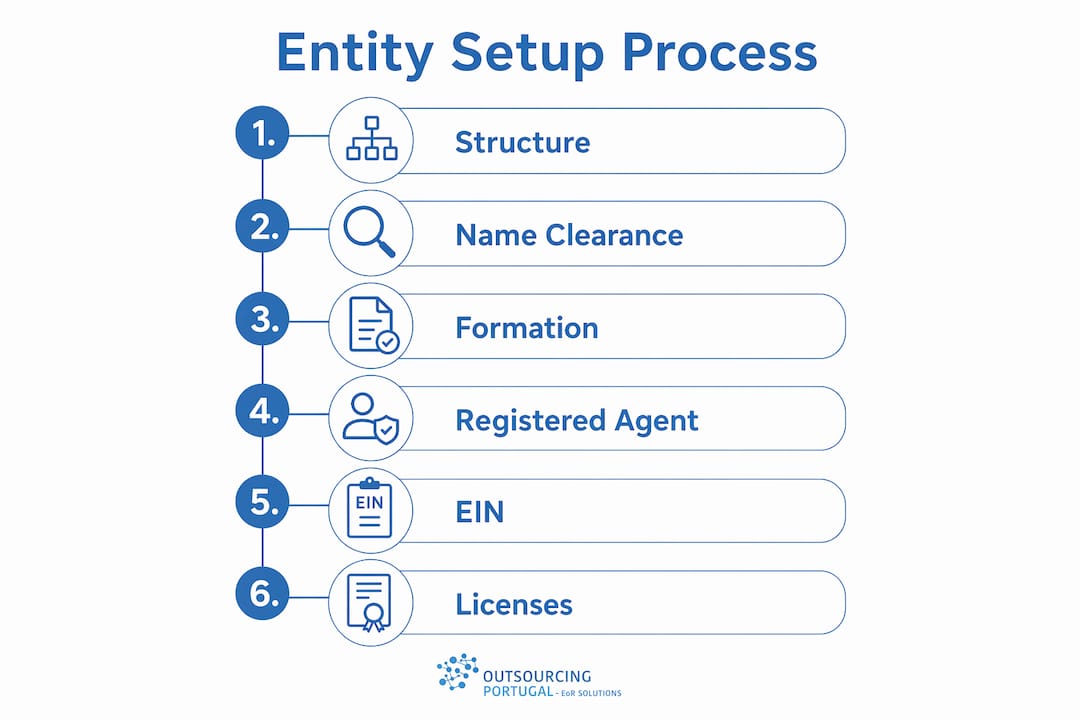
Entity setup is the formal process of creating a legally recognized business entity that defines its legal status, tax responsibilities, and compliance obligations. For business professionals and entrepreneurs entering new markets, understanding what is entity setup means understanding how your company will be taxed, who bears liability, and what regulators expect from day one. The entity setup process covers everything from choosing a business structure to filing formation documents with state authorities and obtaining an Employer Identification Number (EIN) from the IRS. Get it right, and you build a foundation that protects assets and supports growth. Get it wrong, and you face delays, fines, or personal liability exposure.

What is the entity setup process and its key steps?

Entity setup is a sequential legal process, not a single filing. Each step builds on the last, and skipping one creates compliance gaps that are expensive to fix later.

1. Choose your business structure

The structure you select determines your tax treatment, liability exposure, and governance requirements. Business structure determines tax obligations and personal liability. Sole proprietorships offer no separation between personal and business assets, while LLCs and corporations create a distinct legal identity that shields owners from business debts.

Two professionals discussing business structure options

2. Clear your entity name

Name clearance goes beyond a quick state database search. Name clearance requires checking jurisdiction-specific regulations to avoid long-term operational risks. Trademark conflicts with existing registered marks can invalidate your chosen entity name, so a federal trademark search through the USPTO is non-negotiable.

3. File formation documents

Filing formation documents with the Secretary of State or equivalent authority is the legal act that brings your entity into existence. For corporations, this means Articles of Incorporation. For LLCs, it means Articles of Organization. Both require accurate information about the entity’s purpose, structure, and registered agent.

Infographic detailing entity setup steps

4. Appoint a registered agent

A registered agent is a person or company with a physical address in the formation state who receives legal notices on your behalf. Failing to maintain a registered agent with a physical address can result in losing good standing or missing critical legal notices. This is not optional. No registered agent means no valid filing.

5. Obtain an EIN from the IRS

An EIN acts as a social security number for the business and is applied for directly through the IRS. You need it to open a business bank account, handle payroll, and file federal taxes. The application is free and can be completed online in minutes.

6. Secure licenses and permits

Registration may require additional local licenses and permits beyond state incorporation. These vary by industry and location. A restaurant needs health permits. A financial services firm needs regulatory licenses. Identify every requirement before you begin operations.

Pro Tip: File for your EIN immediately after your formation documents are approved. Banks will not open a business account without it, and payroll cannot start until the account exists.

How do different business structures affect liability, taxation, and compliance?

Choosing a structure is the most consequential decision in the entity formation process. Each structure carries a distinct legal personality, tax treatment, and compliance burden.

Structure Legal Separation Tax Treatment Compliance Burden
Sole Proprietorship None Personal income tax Minimal
Partnership Partial Pass-through to partners Moderate
LLC Full Pass-through (default) or corporate election Moderate
C Corporation Full Corporate tax + dividend tax High
S Corporation Full Pass-through (with restrictions) High

The LLC is the most popular structure for small and mid-size businesses because it combines full legal separation with pass-through taxation. That means profits flow directly to owners’ personal returns, avoiding the double taxation that C corporations face. Entities can be taxed as C corps, S corps, or nonprofits depending on state statutes and elections made at formation.

Corporations carry the heaviest compliance load. Corporations as separate legal entities protect owners from personal liability and require defined governance through bylaws or resolutions. Bylaws govern officer responsibilities, board decisions, and shareholder rights. Skipping this governance step creates disputes later.

Three factors drive the structure decision for most business professionals:

  • Liability exposure. If your business carries significant risk, full legal separation through an LLC or corporation is the only responsible choice.
  • Tax efficiency. Pass-through structures avoid double taxation but limit flexibility in how profits are distributed.
  • Funding plans. Venture capital investors require C corporation structures. If you plan to raise institutional capital, form a C corp from the start.

Most entity setup failures are not caused by complex legal problems. They come from predictable, avoidable mistakes made during or immediately after formation.

Common pitfalls include missing signatures, incomplete filings, and failure to submit affidavits or publish notices in certain jurisdictions. New York, for example, requires LLCs to publish formation notices in two local newspapers for six consecutive weeks. Missing this step can result in the LLC losing its authority to operate in the state.

The four pitfalls that cause the most damage:

  • Commingling finances. Mixing personal and business finances can invalidate the liability protection created by entity formation. Courts call this “piercing the corporate veil.” Once pierced, owners become personally liable for business debts, eliminating the main benefit of forming an entity.
  • Inadequate name clearance. Trademark conflicts with existing registered marks can invalidate entity names. A state database search only confirms availability at the state level. Federal trademark registration is a separate system, and conflicts there can force a costly rebrand.
  • Neglecting the registered agent. A lapsed or missing registered agent means legal notices go undelivered. Lawsuits can proceed without your knowledge, and the entity can lose good standing with the state.
  • Ignoring post-formation filings. Beneficial ownership reporting under the Corporate Transparency Act now requires most U.S. entities to file ownership information with FinCEN. Missing this filing carries civil and criminal penalties.

Pro Tip: Open a dedicated business bank account the same week your EIN arrives. This single action creates the paper trail that proves financial separation and protects your liability shield.

The role of legal requirements in business operations extends well beyond the formation date. Annual reports, franchise tax filings, and license renewals are ongoing obligations that keep the entity in good standing.

How does entity setup vary when expanding into international markets?

Cross-border entity formation is where complexity multiplies. Every jurisdiction has its own registration procedures, compliance mandates, and timelines. What works in Delaware does not translate to Singapore, Portugal, or Germany.

Entity setup varies internationally. Different jurisdictions impose unique registration, compliance, and licensing requirements, and local registered office presence is almost always mandatory. In Singapore, for example, a company must appoint a locally resident director. In Portugal, a Sociedade por Quotas (the equivalent of an LLC) requires a minimum share capital and registration with the Conservatória do Registo Comercial.

Key considerations for international entity formation:

  • Local registered office. Most jurisdictions require a physical address in the country, not just a mailing address. This is separate from your registered agent requirement.
  • Tax registration. VAT registration, corporate tax registration, and social security enrollment are typically separate filings from the entity registration itself.
  • Local legal counsel. Formation documents drafted for one jurisdiction are rarely valid in another. Local counsel is not optional. It is the difference between a compliant entity and a filing that gets rejected.
  • Timeline expectations. U.S. LLC formation can take 24 hours in some states. International formations routinely take 4–12 weeks, depending on the jurisdiction and document requirements.

For companies that need to hire talent in a new market quickly, Employer of Record (EOR) services provide a direct alternative. An EOR lets you hire employees in a foreign country without forming a local entity. The EOR acts as the legal employer, handling payroll, tax withholding, and labor law compliance on your behalf. This is particularly valuable when testing a new market before committing to the full cost and time of entity formation.

The workforce compliance workflow for international hires is significantly more complex than domestic hiring. Understanding that complexity before you commit to a structure saves months of remediation work.

Key Takeaways

Entity setup is a multi-step legal process that determines liability protection, tax treatment, and compliance obligations, and getting each step right from the start is far less expensive than fixing mistakes after the fact.

Point Details
Structure drives everything Choose your business structure before filing anything. It determines tax treatment, liability, and governance.
Name clearance is two-step Check both state databases and the USPTO trademark registry before committing to an entity name.
Registered agent is non-negotiable A lapsed or missing registered agent can cost you good standing and leave lawsuits uncontested.
Commingling finances kills protection Keep personal and business finances completely separate to preserve the liability shield your entity creates.
International formation needs local counsel Cross-border entity setup involves jurisdiction-specific rules that generic formation services cannot handle reliably.

What I’ve learned after watching too many entity setups go sideways

Most business professionals treat entity setup as a box to check. File the documents, get the EIN, open the bank account, done. That mindset is exactly why so many entities end up with compliance problems within their first two years.

The part that rarely gets discussed is the governance layer. Formation documents create the entity, but bylaws, operating agreements, and shareholder resolutions define how it actually functions. I have seen LLCs with no operating agreement fall apart the moment a co-founder dispute arose, because there was no documented framework for resolving it. The courts then apply default state rules, which almost never match what the founders actually intended.

The second thing professionals consistently underestimate is the ongoing compliance calendar. Entity formation is a starting line, not a finish line. Annual reports, franchise taxes, license renewals, and now beneficial ownership filings under the Corporate Transparency Act create a recurring compliance burden that requires active management. Missing one filing can cascade into penalties, loss of good standing, and in some states, administrative dissolution.

My honest recommendation: spend as much time on your post-formation compliance calendar as you do on the formation itself. Build a filing tracker on day one. Assign ownership for each recurring obligation. If you are expanding internationally, get local legal counsel before you file anything. The cost of a local attorney is a fraction of the cost of a rejected filing or a compliance breach.

Entity formation is more than paperwork. It establishes governance and long-term legal rights that require precise professional oversight to maintain. Treat it that way from the start.

— Paulo

How Outsourcing-portugal supports your entity setup and market entry

Expanding into Portugal or building a nearshore team in the EU involves exactly the kind of jurisdiction-specific complexity described throughout this article. Outsourcing-portugal provides full-service support for international companies navigating that process, from entity formation guidance and registered agent provision to payroll management and ongoing compliance monitoring.

https://outsourcing-portugal.co.uk

For companies that want to hire Portuguese talent before committing to a full entity, Outsourcing-portugal’s EOR and employment services let you onboard workers compliantly from day one. Portugal offers a highly educated, multilingual workforce, competitive labor costs, and EU-standard legal protections. Whether you are forming a local entity or testing the market through an EOR structure, Outsourcing-portugal has the local expertise to keep you compliant at every stage.

FAQ

What is entity setup in simple terms?

Entity setup is the legal process of creating a business structure, such as an LLC or corporation, that gives your company a distinct legal identity separate from its owners. It involves filing formation documents, appointing a registered agent, and obtaining an EIN from the IRS.

How long does the entity setup process take?

Domestic U.S. entity formation can take as little as 24 hours in states like Delaware or Wyoming. International formations typically take 4–12 weeks depending on the jurisdiction and document requirements.

What is the difference between an LLC and a corporation in entity setup?

Both provide full legal separation between owners and the business, but they differ in tax treatment and governance. LLCs default to pass-through taxation and have flexible management structures. Corporations face corporate-level taxation but are required for companies seeking venture capital investment.

Can I set up an entity in a foreign country without being physically present?

Most jurisdictions allow remote formation through a local registered agent or legal representative, but requirements vary. Some countries require at least one locally resident director or officer, making local counsel essential.

What is an Employer of Record and how does it relate to entity setup?

An Employer of Record is a third-party company that acts as the legal employer for your workers in a foreign jurisdiction, handling payroll, taxes, and labor law compliance. It is the primary alternative to full entity setup for companies that need to hire internationally without the time or cost of forming a local legal entity.

What Is Remote Team Management: A Guide for Global Leaders


TL;DR:

  • Remote team management involves structured digital systems for coordinating dispersed employees toward shared goals. Effective practices include deliberate communication architecture, intentional trust-building, and comprehensive documentation to replace proximity-based knowledge transfer. Structural design, not motivation alone, is essential for the success and scalability of remote teams.

Remote team management is the structured practice of coordinating, motivating, and directing geographically dispersed employees toward shared goals using digital tools, formalized workflows, and deliberate communication systems. Unlike traditional office management, where proximity substitutes for process, virtual team management requires every expectation, norm, and feedback loop to be made explicit. Organizations like GitLab have built entire operating models around this principle, while research from Gallup and the Center for Creative Leadership (CCL) confirms that intentional leadership design separates high-performing distributed teams from struggling ones.

What is remote team management and how does it differ from traditional management?

Remote team management is the practice of coordinating dispersed workers through technology, communication systems, and documented processes rather than physical oversight. In a traditional office, informal hallway conversations, visible body language, and shared physical space carry enormous amounts of operational information. Strip those away and you expose every gap in your management system.

Hands typing on laptop in coworking space

The core shift is from presence-based to outcomes-based leadership. A manager in a co-located office can observe effort directly. A remote team leader must define what success looks like, communicate it clearly, and then trust the process. GitLab, one of the world’s largest all-remote companies with over 2,000 employees across 65 countries, frames this as balancing support with accountability through transparency rather than surveillance.

Three principles define effective remote team leadership. First, technology is not optional infrastructure. It is the operational backbone. Second, communication must be designed, not assumed. Third, documentation replaces the informal knowledge transfer that happens naturally in shared physical spaces. Managers who treat these as secondary concerns consistently report higher turnover, lower engagement, and coordination failures.

What are the essential tools and communication practices for effective remote team management?

Effective virtual team management starts with a deliberate communication architecture. The single most common mistake international managers make is allowing communication to fragment across too many platforms simultaneously. When your team uses email for decisions, a messaging app for quick questions, video calls for updates, and a project tool for tasks, critical information gets lost and people spend more time searching than working.

Infographic showing essential steps for remote team management

GitLab’s communication structure addresses this by funneling work-related communication through defined channels with clear purposes. The practical standard is one primary tool per communication type: one platform for real-time messaging (such as Slack or Microsoft Teams), one for project tracking (such as Jira or Asana), and one for documentation (such as Confluence or Notion). Documented guidelines specify which channel handles which type of message, removing the guesswork that creates friction.

Asynchronous communication deserves more weight than most managers give it. When your team spans Lisbon, London, and Singapore, expecting real-time responses from everyone is both inefficient and exhausting. Asynchronous communication, where messages are sent and responded to on each person’s schedule, allows deep work and respects time-zone differences. Synchronous meetings should be reserved for decisions that genuinely require live discussion, not status updates that could be a written summary.

  • Use one primary messaging platform and document its purpose explicitly
  • Separate synchronous meetings (decisions, relationship-building) from asynchronous updates (status, information sharing)
  • Write communication guidelines into your team handbook so expectations survive personnel changes
  • Record video meetings and share transcripts for team members in different time zones

Pro Tip: Treat your communication channels as part of your team’s operating system. Every channel should have a documented purpose, a response-time expectation, and a clear owner. If a channel has no defined purpose, archive it.

How can managers build and sustain trust and accountability in remote teams?

Trust does not emerge automatically in distributed teams. CCL research is direct on this point: virtual trust requires intentional investment in connectivity, participation norms, and face-to-face interaction, even when that interaction happens through a screen. Managers who assume trust will develop organically, the way it might in a shared office, consistently find their teams underperforming on collaboration and over-relying on individual silos.

Gallup data makes the feedback gap concrete: only 21% of workers receive meaningful feedback weekly, yet engagement rates approach 80% among those who do. For remote teams, where informal feedback moments disappear entirely, this gap widens fast. Weekly one-on-ones with a structured format, not just a casual check-in, are the single highest-return investment a remote manager can make.

GitLab’s model for balancing support and accountability avoids two common failure modes: micromanagement (checking in constantly, monitoring activity metrics) and pure hands-off support (being available but never setting clear performance expectations). The practical approach combines both:

  1. Set explicit outcome-based goals with measurable milestones for each team member
  2. Schedule weekly one-on-ones focused on blockers, progress, and development
  3. Use virtual face-to-face meetings at least monthly to maintain human connection
  4. Acknowledge contributions publicly in shared channels to reinforce recognition
  5. Address performance issues directly and promptly rather than letting them accumulate

“Being a great remote manager is not about increasing communication frequency or control but designing systems that enable autonomy balanced with transparency and accountability.” — GitLab Handbook

Cultural sensitivity adds another layer for international teams. A manager leading employees across Portugal, Brazil, and the Philippines will encounter different norms around directness, hierarchy, and work-life boundaries. Adapting your feedback style and meeting format to cultural context is not softness. It is precision leadership.

What challenges do global distributed teams face and how to overcome them?

Global remote teams face a specific set of challenges that purely domestic remote teams do not. CCL identifies the toughest coordination problems as time-zone based availability rules rather than technology failures. When one team member’s morning is another’s midnight, the question of who accommodates whom becomes a recurring source of friction and quiet resentment.

Participation disparities compound the problem. In a video call with eight people across four time zones, the two people in the “home” time zone naturally dominate. The person joining at 7 AM or 10 PM is already at a disadvantage before the meeting starts. Without explicit facilitation norms, the same voices lead every discussion and the same people disengage over time.

Common challenges and their direct solutions:

  • Uneven participation: Rotate meeting times so no single region always bears the inconvenience. Use written pre-reads so everyone arrives prepared regardless of when they joined.
  • Conflict without resolution: Establish a written escalation path. Remote conflict left unaddressed festers faster than in-person conflict because there are fewer natural repair moments.
  • Trust development: Schedule virtual social time that is genuinely optional and informal. Forced fun backfires. Genuine connection happens in low-stakes, unstructured moments.
  • Holiday and availability confusion: Publish a shared team calendar that includes public holidays for every country represented on the team. Assume nothing about availability.

Pro Tip: When setting up a global team, create a one-page “team operating agreement” that covers core hours, response-time expectations, meeting rotation rules, and holiday policies. Revisit it every six months. Teams that skip this document spend the first year solving the same coordination problems repeatedly.

For managers building nearshoring teams in Portugal, the country’s Western European time zone and high English proficiency reduce many of these friction points significantly, making it a practical choice for teams based in the UK, US, or Northern Europe.

How does documentation replace proximity in scaling remote teams?

Documentation is the infrastructure of remote team culture. GitLab’s experience scaling to thousands of employees across dozens of countries demonstrates that transparent process recording from the start is what separates remote organizations that scale cleanly from those that collapse into chaos as headcount grows.

In a physical office, a new hire learns by observation. They watch how meetings run, how decisions get made, and how conflicts get resolved. In a remote team, none of that ambient learning happens. Every process that is not written down exists only in the heads of the people who created it, and those people will eventually leave, change roles, or simply forget.

The table below shows how documentation replaces common proximity-dependent practices:

Proximity-based practice Documentation-based equivalent
Shoulder tap for quick questions Searchable internal FAQ or team handbook
Observing how decisions get made Recorded decision logs with rationale
Overhearing team updates Async written status updates in a shared channel
New hire shadowing Documented onboarding checklist with video walkthroughs
Informal culture transmission Written team values, norms, and working agreements

The operational benefit extends beyond onboarding. When processes are documented, managers spend less time answering the same questions repeatedly. Team members in different time zones can unblock themselves without waiting for a synchronous response. And when something goes wrong, a documented process makes it far easier to identify where the breakdown occurred.

Reducing timesheet errors and tracking distributed work accurately also depends on documented processes. Teams that rely on memory and informal agreements for time tracking create compliance risks and billing inaccuracies that compound at scale.

Key takeaways

Effective remote team management requires deliberate systems for communication, trust, and documentation rather than adaptations of office-based management practices.

Point Details
Design communication architecture Assign one tool per communication type and document its purpose to prevent fragmentation.
Prioritize meaningful feedback Weekly structured one-on-ones drive engagement; only 21% of workers currently receive this.
Build trust intentionally Virtual face-to-face meetings and explicit participation norms prevent disengagement in global teams.
Solve time-zone friction proactively A written team operating agreement covering core hours and holiday policies prevents recurring coordination failures.
Document everything from day one Written processes replace proximity-based knowledge transfer and make remote teams scalable.

What I’ve learned managing remote teams across time zones

After working with international teams across multiple time zones, the pattern I see most often is managers who are technically competent but structurally unprepared. They know their domain. They care about their people. But they are running a distributed team using mental models built for a shared office, and the mismatch shows up in burnout, missed deadlines, and quiet disengagement.

The insight that changed how I think about this: remote management is a design problem, not a motivation problem. When a team is underperforming, the instinct is to push harder, communicate more, or check in more frequently. But the actual fix is almost always structural. A missing communication guideline. An unclear accountability framework. A process that exists only in someone’s head.

I have also seen managers overcorrect toward pure documentation and process, treating their teams like systems to be optimized rather than people to be led. The research from CCL on intentional connectivity resonates here. The human layer matters enormously. A well-documented team with no genuine trust will still underperform. The goal is both: rigorous systems and genuine human investment.

For managers leading teams in or near Portugal, the cultural compatibility factor is real and underrated. Portugal’s workforce brings strong English proficiency, a collaborative work culture, and a time zone that overlaps cleanly with both the UK and much of the US East Coast. That structural advantage reduces coordination friction before you even write your first operating agreement.

— Paulo

How Outsourcing-portugal supports your remote team strategy

Building a high-performing remote team across borders requires more than good management practices. It requires compliant hiring, accurate payroll, and local legal expertise that most international companies do not have in-house.

https://outsourcing-portugal.co.uk

Outsourcing-portugal’s Employer of Record services in Portugal handle the full employment infrastructure so your managers can focus on leading rather than administering. From onboarding and payroll to HR support and legal compliance, the platform removes the operational complexity that slows down global team expansion. If you are building or scaling a nearshore team in Portugal, Outsourcing-portugal’s employment solutions give you the local presence and compliance coverage to do it without setting up a legal entity. Explore how the platform supports international teams at every stage of growth.

FAQ

What is remote team management in simple terms?

Remote team management is the practice of leading employees who work from different locations using digital tools, structured communication, and documented processes to achieve shared goals. It replaces physical proximity with deliberate systems for accountability and collaboration.

What are the biggest challenges of remote team management?

The most common challenges include uneven participation across time zones, difficulty building trust without in-person contact, and communication fragmentation across too many platforms. CCL research identifies time-zone availability rules as the toughest coordination problem for global teams.

How do you build trust in a remote team?

Trust in remote teams requires intentional investment: weekly one-on-ones, virtual face-to-face meetings, and explicit participation norms. Gallup data shows that employees who receive meaningful weekly feedback have engagement rates approaching 80%, making consistent manager contact the highest-return trust-building practice.

What tools are best for managing remote teams?

The most effective approach uses one platform per communication type: Slack or Microsoft Teams for messaging, Jira or Asana for project tracking, and Confluence or Notion for documentation. GitLab’s model recommends documented guidelines specifying which channel handles which type of communication.

Why is documentation so important for remote teams?

Documentation replaces the ambient knowledge transfer that happens naturally in shared offices. GitLab’s scaling experience shows that written processes, decision logs, and onboarding checklists allow remote teams to grow without losing institutional knowledge or creating bottlenecks around individual team members.

What Is Local Entity Setup? A Guide for Global Businesses


TL;DR:

  • Setting up a local entity in a foreign country grants organizations direct control over employment, contracts, and legal compliance but involves high upfront costs and ongoing management.
  • It is best suited for long-term operations with 15 or more employees, while smaller teams often begin with an Employer of Record to validate the market before transitioning.

Local entity setup is the process of legally incorporating your own company or branch in a foreign country, giving you direct authority to hire employees, sign contracts, and operate under that nation’s laws. Unlike lighter-weight alternatives, this approach places full legal and financial responsibility on your organization. That control comes at a price: upfront costs, administrative complexity, and ongoing compliance obligations that can strain lean international teams. Understanding what local entity setup requires, and when it makes sense, is the first decision any serious global expansion strategy must get right.

What is local entity setup and what does it involve?

Local entity setup, known in corporate law as foreign subsidiary incorporation or branch registration, is the formal creation of a legally recognized business structure in a target country. The three most common structures are a wholly owned subsidiary, a branch office, and a representative office. Each carries different tax treatment, liability exposure, and operational scope. A subsidiary is a separate legal entity, which limits parent company liability. A branch office is an extension of the parent, which means the parent bears direct legal responsibility for its activities.

The local entity registration process follows a predictable sequence, though timelines and costs vary sharply by jurisdiction.

  1. Choose your legal structure. Subsidiaries offer liability protection and are preferred for long-term operations. Branch offices are faster to register but expose the parent to local litigation. Representative offices are the lightest option but are typically restricted from generating revenue.
  2. Prepare and authenticate parent company documents. Articles of incorporation, board resolutions, and shareholder certificates must be notarized, apostilled, and translated into the local language. Small errors in these documents cause costly registration delays that can set your timeline back by weeks or months.
  3. File with the relevant government authority. This typically means a commercial registry, chamber of commerce, or company registrar, depending on the country.
  4. Obtain licenses and regulatory permits. Certain industries, including financial services, healthcare, and telecommunications, require sector-specific approvals before operations can begin.
  5. Open a local corporate bank account. Banking is frequently a bottleneck due to requirements for notarized parent documents, proof of local address, and minimum capital deposit certificates. This step alone can add four to eight weeks to your timeline.
  6. Register for tax, payroll, and social security. Each country has its own employer registration obligations, and missing any one of them creates retroactive liability.

Upfront entity setup costs range from $20,000 to over $250,000 depending on jurisdiction, legal structure, and capital requirements. That figure covers legal fees, government filing fees, director appointments, and bank setup. This is not a one-time expense. It is the entry ticket to a long-term commitment.

Pro Tip: Hire a local corporate attorney before you engage any government authority. Jurisdictions like Portugal, Germany, and Singapore each have procedural quirks that a generalist international lawyer will miss, and one rejected filing can cost you six weeks.

Two professionals discussing budget documents

How does local entity setup compare to Employer of Record services?

The most direct alternative to creating a local business entity is using an Employer of Record (EOR). An EOR is a third-party company that legally employs your workers in a foreign country on your behalf, handling payroll, tax withholding, benefits administration, and local labor law compliance. You retain day-to-day management of the workers; the EOR holds the legal employment relationship.

The cost difference between the two models is significant and often misunderstood.

Factor Local entity setup Employer of Record (EOR)
Upfront investment $20,000 to $250,000+ None
Monthly per-employee cost Varies by payroll provider $299 to $800 per employee
Annual compliance cost $30,000 to $80,000 per country Included in EOR fee
Legal control Full Limited to management direction
Speed to hire first employee 2 to 6 months Days to 2 weeks
Exit complexity High (dissolution process) Low (terminate contract)

Infographic comparing local entity setup and Employer of Record

The math favors an EOR at low headcounts. At scale, the calculus shifts. Setting up a local entity is generally recommended once you have 15 to 25 employees in a single market, because the fixed compliance costs get distributed across a larger workforce, making the per-employee cost competitive with EOR fees.

Several strategic considerations also push toward entity setup beyond pure cost:

  • Brand and contractual credibility. Local clients and government partners in many markets prefer or require contracting with a locally registered entity.
  • Equity and stock options. Granting equity to employees through an EOR is legally complex and often impossible without a local entity.
  • Operational permanence. If you plan to build a long-term team, a local entity signals commitment to the market, to employees, and to regulators.

The hybrid approach is increasingly common among sophisticated global companies. They use an EOR to test the market and validate demand, then transition to a full entity once headcount and revenue justify the investment. Transitioning employees from EOR to entity typically takes two to four months and requires contract novation or termination and rehire, depending on local labor law.

What are the key challenges in managing a local entity?

Creating the entity is only the beginning. Local entity management, the ongoing governance and compliance work required to keep the entity in good standing, is where most international businesses underestimate the burden.

Ongoing compliance costs for a local entity typically run between $30,000 and $80,000 annually per country, covering statutory audits, payroll filings, corporate tax returns, and legal counsel. That figure does not include the internal staff time required to coordinate with local accountants, lawyers, and government agencies.

The most common operational failures in local entity management include:

  • Missed statutory deadlines. Annual returns, tax filings, and beneficial ownership registers each carry their own deadlines. Missing them triggers fines and, in some jurisdictions, director liability.
  • Scattered compliance data. When entity documents, tax registrations, and payroll records live in separate systems or with separate vendors, audits become expensive and stressful.
  • Vendor coordination gaps. Local accountants, payroll providers, and legal counsel rarely communicate with each other. The parent company ends up as the integration layer, which creates risk when internal staff turn over.

Centralized entity management reduces the risk of missed deadlines and improves audit readiness by consolidating entity data and compliance tasks into a single governance framework. Wolters Kluwer’s research on entity management confirms that decentralized workflows increase compliance failures and reduce visibility for corporate auditors. This is the operational argument for investing in entity management software like CT Corporation, Diligent Entities, or Corporater alongside your local legal team.

Pro Tip: Build a compliance calendar on day one of entity registration. Map every recurring filing obligation, its deadline, the responsible vendor, and the internal owner. Review it quarterly. This single habit prevents the majority of penalty events.

When should international businesses decide to set up a local entity?

The decision to pursue local business entity setup should follow a structured evaluation, not a gut feeling about market potential. Businesses that commit to an entity before validating their market often discover that EOR or contractor arrangements would have met their commercial goals at a fraction of the cost and liability.

A disciplined decision process looks like this:

  1. Conduct an internal business needs audit. Define what you actually need a local entity to do. If the answer is “hire two engineers,” an EOR is almost certainly the right tool. If the answer is “sign government contracts and build a 30-person team,” entity setup becomes the logical path.
  2. Validate the market before committing. Use an EOR, a distributor, or a local partner to generate revenue and prove demand. Commit to entity setup only after the market has demonstrated it can support the overhead.
  3. Run a full financial analysis. Model setup costs, annual compliance costs, and exit costs. Exit costs are frequently ignored and can be substantial. Dissolving a foreign subsidiary in France or Brazil, for example, can take 12 to 24 months and require settling all local liabilities first.
  4. Confirm legal and operational prerequisites. Most jurisdictions require a registered local address, at least one local or resident director, and a minimum paid-in capital. Confirm these requirements before starting the registration process, not during it.
  5. Plan the transition if moving from EOR. If you are already using an EOR, map the employee transfer process carefully. Contract novation timelines, social security re-registration, and benefit continuity all need to be managed to avoid employee relations issues.

The international HR management dimension of this decision is often underweighted. Local entities require local HR policies, local employment contracts, and local benefits structures that comply with collective bargaining agreements where applicable. These are not templates you can download. They require local legal review.

Key takeaways

Local entity setup is the right expansion tool only when your market is validated, your headcount justifies the overhead, and your organization has the governance capacity to manage ongoing compliance across borders.

Point Details
Define the right structure first Choose between subsidiary, branch, or representative office based on liability needs and operational scope.
Budget for the full cost Upfront costs range from $20,000 to $250,000+; annual compliance adds $30,000 to $80,000 per country.
Use EOR to validate first Start with an Employer of Record to test the market before committing to entity setup at 15 to 25 employees.
Centralize entity management Consolidate compliance data and deadlines into one governance framework to avoid costly missed filings.
Plan your exit before you enter Model dissolution costs and timelines before committing, since exiting a local entity can take one to two years.

Why timing is everything in local entity decisions

I have worked with international businesses at every stage of global expansion, from first-hire-abroad decisions to multi-jurisdiction restructurings. The single most expensive mistake I see, consistently, is applying the wrong expansion tool to the wrong stage of market development. Companies set up entities in markets they have not yet validated, then spend 18 months trying to dissolve them when the market does not perform. Or they stay on EOR arrangements for 40 employees because “it’s working fine,” paying $400 per employee per month when a local entity would cost half that at scale.

The businesses that get this right treat the EOR-to-entity transition as a planned milestone, not a reactive scramble. They set a headcount trigger, typically 15 to 20 employees, and begin the entity registration process three to four months before they expect to hit it. That way, the entity is ready when the economics demand it, not six months after.

Technology matters more than most people admit. Entity management platforms that centralize your statutory filings, director registers, and compliance calendars across jurisdictions are not a luxury for large multinationals. They are a practical necessity for any company managing more than two foreign entities. The cost of a missed annual return in Germany or a late beneficial ownership filing in the UK far exceeds the cost of the software that would have prevented it.

My honest view: the future of global employment infrastructure will see more companies running hybrid models permanently, using EOR for early-stage markets and local entities for mature ones, managed through a single compliance platform. The businesses building that infrastructure now will have a structural advantage over those that treat each market as a one-off decision.

— Paulo

How Outsourcing-portugal can support your expansion

https://outsourcing-portugal.co.uk

Setting up a local entity in Portugal, or deciding whether you need one at all, requires local expertise that generic international law firms rarely provide. Outsourcing-portugal offers employment and payroll services specifically designed for international companies expanding into Portugal, covering EOR arrangements, payroll compliance, HR support, and entity setup guidance. Whether you are testing the Portuguese market with your first hire or transitioning a 20-person EOR team to a fully owned subsidiary, the platform provides the legal and operational infrastructure to do it correctly. Explore EOR services in Portugal as a starting point, or contact the team directly to map the right structure for your specific headcount and commercial objectives.

FAQ

What is local entity setup in simple terms?

Local entity setup is the process of legally registering your own company or branch in a foreign country so you can hire employees and operate under that country’s laws directly. It gives you full legal control but requires significant upfront investment and ongoing compliance management.

How long does it take to set up a local entity abroad?

The timeline for creating a local business entity typically ranges from two to six months, depending on the jurisdiction, legal structure chosen, and how quickly banking and document authentication steps are completed. Banking alone can add four to eight weeks.

When should I use an EOR instead of setting up a local entity?

An Employer of Record is the better choice when you have fewer than 15 employees in a market, are still validating demand, or need to hire quickly. Entity setup becomes cost-competitive once you reach 15 to 25 employees in a single country.

What are the ongoing costs of managing a local entity?

Annual compliance costs for a local entity, covering audits, payroll filings, tax returns, and legal counsel, typically range from $30,000 to $80,000 per country. These costs are fixed regardless of headcount, which is why scale matters for the economics to work.

Can I transition from an EOR to a local entity later?

Yes, and this is a common path for international businesses. Transitioning from EOR to a local entity typically takes two to four months and involves contract novation or employee rehire, depending on local labor law requirements.

Why Nearshore in Europe: The 2026 Strategic Guide


TL;DR:

  • European nearshoring offers faster project delivery and higher success rates due to close time zone collaboration and cultural alignment. It provides access to top-tier senior talent at 30-50% lower costs, with GDPR compliance reducing legal and data risks. Building teams in Portugal with specialized services ensures a strategic, compliant, and efficient nearshore partnership in 2026.

Nearshore software development in Europe is the practice of partnering with engineering teams in geographically and culturally close countries to extend your product capacity with better collaboration, faster delivery, and access to senior talent at competitive costs. For international business leaders asking why nearshore in Europe makes sense over offshore or local hiring, the answer is measurable: proximity eliminates the coordination failures that quietly destroy offshore projects, while European talent pools deliver the seniority and specialization that local markets cannot supply fast enough. This guide breaks down the operational, financial, and strategic case for European nearshoring in 2026.

Why nearshore in Europe outperforms offshore on collaboration

Time zone alignment is not a convenience. It is a project success variable. Nearshore teams deliver 40% faster project completion and produce 65% fewer communication misunderstandings than offshore equivalents, driven entirely by timezone synchronization. That gap compounds over a six-month engagement into weeks of recovered delivery time.

Offshore models operating across 12-plus hour differences force asynchronous workflows where a question asked at 9 a.m. gets answered the following morning. Offshore 16-hour feedback loops increase rework cycles that erode initial cost savings quickly. Nearshore teams in Poland, Romania, Portugal, and the Czech Republic share 6 to 8 hours of daily overlap with Western European and East Coast US clients, enabling synchronous sprint ceremonies, same-day code reviews, and real-time architectural decisions.

Physical proximity adds a second layer of advantage that offshore cannot replicate. A flight from London to Lisbon or Warsaw takes under three hours. That accessibility makes quarterly on-site visits practical, which builds the interpersonal trust that sustains high-performing remote teams. Nearshore engagements achieve approximately 80% project success rates, compared to 60% for offshore, a gap that reflects the cumulative effect of better communication, faster feedback, and stronger working relationships.

Pro Tip: Schedule at least one on-site kickoff with your nearshore team in the first 30 days. Teams that meet in person during onboarding consistently report stronger alignment on product vision and fewer scope misunderstandings in subsequent sprints.

Factor Nearshore Europe Offshore (Asia/LatAm)
Daily time zone overlap 6 to 8 hours 0 to 2 hours
Project success rate ~80% ~60%
Communication misunderstandings 65% fewer Baseline
Project completion speed 40% faster Baseline
On-site visit feasibility High (under 3 hours flight) Low (10+ hours flight)

What talent pools in European nearshore hubs actually look like

The advantages of nearshore outsourcing extend well beyond cost. Central and Eastern Europe produces engineering talent ranked among the top globally in competitive programming, with countries like Poland, Romania, and Bulgaria consistently placing in the top 20 on HackerRank and Codeforces leaderboards. This is not generalist talent. These hubs have developed deep specializations in fintech, SaaS architecture, cloud infrastructure, cybersecurity, and AI development.

Engineer typing in European home office setting

Poland, Romania, Portugal, Czech Republic, and Bulgaria each carry distinct strengths. Poland leads in enterprise software and fintech. Romania has a strong cloud and DevOps community. Portugal combines strong English proficiency with a growing tech ecosystem and a stable regulatory environment that makes it particularly attractive for companies building customer-facing teams. Bulgaria offers some of the most competitive rates in the EU while maintaining strong output quality.

The financial case for accessing this talent is direct. Senior software engineers in Central and Eastern Europe cost 30 to 50% less than their counterparts in Western Europe or North America, with no measurable compromise on technical output quality. That savings figure applies to senior roles, not junior staff, which is where the real leverage sits for product teams that need architectural ownership rather than task execution.

Key factors that distinguish top-tier European nearshore talent:

  • Domain depth: Engineers in these hubs frequently carry five to ten years of experience in specific verticals, not just general programming skills.
  • Hiring speed: Nearshore partners can onboard vetted senior engineers in two to four weeks, compared to three to five months for equivalent local hires in the UK, Germany, or the Netherlands.
  • Team model: Nearshore development advances from staff augmentation to embedded product teams, meaning you gain engineers who take architectural ownership, not just ticket-takers.
  • English proficiency: Portugal ranks in the top 10 globally for English proficiency among non-native speakers. Poland and Romania score similarly high, enabling precise technical communication without translation overhead.
  • Retention: Nearshore engineers in established hubs report higher job satisfaction than offshore counterparts, reducing the turnover that disrupts long-running product teams.

How GDPR and cultural alignment reduce hidden project risk

European nearshoring carries a compliance advantage that offshore models structurally cannot match. European nearshore teams operate fully under GDPR, which simplifies data protection compliance for both EU-based companies and US companies serving European customers. When your engineering team is already inside the GDPR framework, you eliminate the legal review cycles, data transfer agreements, and audit overhead that offshore arrangements require.

Cultural alignment produces a less visible but equally significant benefit. Engineers in Western, Central, and Eastern Europe share business norms around transparency, direct feedback, and accountability that align closely with how US and UK product teams operate. This shared professional culture reduces the “ticket-taker” dynamic that plagues offshore relationships, where engineers execute instructions without questioning requirements or flagging risks. A nearshore team in Lisbon or Warsaw is more likely to push back on a flawed specification than a team operating across a 12-hour gap with limited context.

Language proficiency reinforces this dynamic. When engineers can articulate technical constraints clearly in English, product managers receive accurate scope assessments rather than optimistic estimates that collapse during QA. That clarity alone prevents the rework cycles that inflate offshore project costs.

Pro Tip: During vendor selection, ask nearshore candidates to walk through a past project where they identified and escalated a technical risk to the client. Teams that can answer this question with specifics are operating as partners. Teams that cannot are operating as contractors.

For companies with cultural compatibility as a priority, Portugal consistently ranks as one of the highest-scoring European nearshore destinations on cross-cultural collaboration metrics.

Nearshore vs offshore Europe: the total cost of ownership comparison

Hourly rate comparisons between nearshore and offshore models are misleading. A developer in Eastern Europe may bill at $45 to $65 per hour versus $25 to $35 for an equivalent offshore role. That differential looks significant until you account for what offshore actually costs in practice.

Infographic comparing nearshore and offshore costs

Offshore projects incur hidden costs from coordination overhead, rework, and extended QA that offset lower hourly rates and produce a higher total cost of ownership than nearshore. A six-month offshore engagement with two rework cycles and a three-week QA extension can consume the entire rate differential and more. Nearshore models eliminate most of that overhead through synchronous collaboration and shared context.

The comparison across key dimensions looks like this:

Dimension Nearshore Europe Offshore Onshore
Hourly rate Moderate Low High
Rework frequency Low High Low
Time-to-hire 2 to 4 weeks 4 to 8 weeks 3 to 5 months
Total cost of ownership Low to moderate Moderate to high High
Regulatory risk Low (EU/GDPR) High Low
Collaboration effectiveness High Low High

Nearshore delivers 30 to 50% cost savings versus onshore hiring while maintaining the delivery speed and quality that offshore cannot reliably provide. For companies scaling product teams in 2026, that combination makes nearshoring the default rational choice rather than a compromise position.

Pro Tip: When evaluating nearshore vs offshore proposals, ask vendors to provide a total cost estimate that includes QA cycles, rework allowances, and project management overhead. Rate-only comparisons consistently understate offshore costs by 20 to 40%.

For a deeper breakdown of how these models compare strategically, the offshoring vs nearshoring analysis from Outsourcing-portugal covers the decision framework in detail.

How to choose nearshore services in Europe and build effective partnerships

Selecting a nearshore partner requires evaluating five factors in order of strategic importance:

  1. Talent pool depth and seniority: Confirm the partner can supply senior engineers with five-plus years of domain experience, not just available headcount. Ask for CVs and conduct technical interviews before signing.
  2. Time zone overlap: Verify that your core working hours align with at least six hours of the partner’s standard day. Anything less reintroduces the asynchronous friction that nearshoring is designed to eliminate.
  3. Technical specialization: Match the partner’s demonstrated expertise to your stack. A fintech product team needs a partner with proven fintech delivery, not general web development experience.
  4. Regulatory compliance: Confirm GDPR compliance, data handling protocols, and employment law adherence. Partners operating through an Employer of Record structure in countries like Portugal provide the cleanest compliance posture for international companies.
  5. Cultural and communication fit: Conduct a working session, not just a sales call, before committing. How a team handles ambiguity and pushes back on unclear requirements tells you more than any reference check.

Once you select a partner, treat the nearshore team as an embedded unit of your product organization. Assign a dedicated internal point of contact, include nearshore engineers in all sprint ceremonies, and give them access to the same product documentation your onshore team uses. Nearshore services for multinational teams work best when the organizational boundary between internal and external is deliberately blurred.

42% of companies in 2026 prioritize engineer quality over rates when selecting nearshore partners. That shift reflects a maturing understanding that the real cost of a bad hire or a misaligned team far exceeds any hourly rate savings.

Key takeaways

European nearshoring delivers superior project outcomes because it combines time zone alignment, senior talent access, and GDPR compliance into a model that offshore cannot replicate at equivalent total cost.

Point Details
Time zone overlap drives success 6 to 8 hours of daily overlap enables real-time collaboration and cuts misunderstandings by 65%.
Senior talent at lower cost Central and Eastern European engineers cost 30 to 50% less than onshore equivalents with no quality drop.
GDPR compliance by default European nearshore teams operate inside EU data protection law, eliminating offshore compliance overhead.
Offshore TCO is higher than it appears Hidden rework, QA, and coordination costs make offshore more expensive than hourly rates suggest.
Partner selection determines outcomes Seniority filters, time zone verification, and treating teams as embedded partners are the decisive success factors.

What I’ve learned after years of watching nearshore partnerships succeed and fail

Most companies approach nearshoring as a cost exercise and then wonder why the results disappoint. The businesses that get the most out of European nearshore partnerships treat them as a talent strategy, not a procurement decision. That distinction changes everything from how you write the brief to how you run the first sprint.

The single most common failure I see is ignoring seniority filters during vendor selection. A partner who quotes a competitive rate but staffs the engagement with mid-level engineers will cost you more in rework and management overhead than a slightly more expensive team of seniors who own their work. Nearshoring as a strategic default in 2026 means access to specialized hubs unavailable locally, but only if you select for specialization rather than availability.

The second failure is treating time zone overlap as a checkbox rather than a design constraint. Six hours of overlap only delivers value if you actually use it for synchronous work. Teams that default to async communication even when overlap exists recreate the offshore problem voluntarily.

Portugal stands out in my experience as a nearshore location that combines the full package: strong English proficiency, EU regulatory alignment, a growing senior tech community, and a business culture that rewards directness. It is not the cheapest option in Europe, but it consistently produces the lowest total cost of ownership when you factor in communication quality and retention.

— Paulo

Build your nearshore team in Portugal with Outsourcing-portugal

Outsourcing-portugal specializes in helping international companies build compliant, high-performing nearshore teams in Portugal without setting up a local entity. From Employer of Record and payroll services to full hiring, onboarding, and HR support, the platform handles every operational layer so you can focus on product delivery.

https://outsourcing-portugal.co.uk

Portugal’s combination of EU regulatory compliance, strong English proficiency, competitive labor costs, and Western European time zone alignment makes it one of the most strategically sound nearshore locations available to international businesses in 2026. Whether you are hiring your first nearshore engineer or scaling a team of 50, Outsourcing-portugal provides the infrastructure to do it correctly. Explore the full employment and nearshore services or review the 2026 hiring guide for Portugal to start building your team.

FAQ

What does nearshoring in Europe mean for a US company?

Nearshoring in Europe means partnering with engineering or operations teams in European countries that share cultural norms and, for East Coast US companies, offer 5 to 6 hours of daily working overlap. It provides access to senior EU-based talent under GDPR compliance without the coordination failures of offshore models.

Which are the top nearshore countries in Europe?

Poland, Romania, Portugal, Czech Republic, and Bulgaria are the leading nearshore hubs in Europe, each with strengths in fintech, SaaS, cloud, and cybersecurity. Portugal is particularly strong for companies prioritizing English proficiency, EU compliance, and Western European time zone alignment.

How much can nearshoring in Europe save compared to onshore hiring?

Senior engineers in Central and Eastern European nearshore hubs cost 30 to 50% less than equivalent onshore hires in Western Europe or North America, with faster time-to-hire and no measurable compromise on technical quality.

Is nearshore better than offshore for software development?

Nearshore achieves approximately 80% project success rates versus 60% for offshore, driven by time zone alignment, cultural compatibility, and synchronous collaboration. Offshore models carry hidden costs from rework and coordination overhead that frequently exceed the savings from lower hourly rates.

How do I start nearshoring in Portugal specifically?

The fastest path is through an Employer of Record provider like Outsourcing-portugal, which handles hiring, payroll, legal compliance, and onboarding without requiring you to establish a Portuguese legal entity. This approach reduces time-to-hire to two to four weeks for vetted senior talent.

What Is Staff Augmentation? A Guide for HR Leaders


TL;DR:

  • Staff augmentation enables businesses to quickly add external professionals managed directly by their internal teams, filling skill gaps without permanent commitments. It offers faster hiring, cost savings, and access to specialized skills, with high flexibility and control over work processes. Companies should treat augmented staff as integrated team members and avoid using augmentation solely to delay core permanent hiring decisions.

Staff augmentation is defined as a flexible workforce strategy where businesses temporarily add external professionals to their internal teams, managed directly by the hiring company, to fill skill gaps or increase capacity without permanent employment commitments. Unlike traditional outsourcing, where a vendor owns the work, staff augmentation keeps you in the driver’s seat. Providers like Second Talent and Pangea AI match vetted candidates within 48 to 72 hours, with augmented staff typically starting in one to three weeks. The core staff augmentation benefits include faster hiring, lower costs, and access to specialized skills that are impractical to hire for permanently.

What is staff augmentation and how does it work?

Staff augmentation works through a structured five-step process that moves from identifying a skill gap to having a qualified professional working inside your team, often within two weeks.

  1. Define requirements. You specify the role, technical skills, seniority level, and expected duration. The more precise this brief, the faster the match.
  2. Receive a shortlist. Staffing providers deliver a vetted candidate shortlist within two to five days. Candidates have already passed technical screening, background checks, and compliance verification.
  3. Interview and select. Your team conducts final technical and cultural interviews. Smart hiring managers always run their own interviews despite vendor vetting, because exact team fit cannot be assessed by a third party alone.
  4. Contract and onboard. Contracts are typically month-to-month or project-based with 30 to 90 day termination notices, giving you flexibility to scale without legal exposure.
  5. Integrate into workflows. Augmented staff join your Slack channels, attend daily standups, commit to your GitHub repositories, and follow your internal architecture standards from day one.

The staffing provider handles payroll, tax filings, benefits administration, and local labor law compliance throughout the engagement. Your team manages the work. This division of responsibility is what makes staff augmentation operationally clean for HR teams managing cross-border hires.

Pro Tip: Negotiate a trial-to-hire clause before signing. Trial-to-hire provisions allow you to evaluate augmented staff over 60 to 180 days before committing to permanent employment, and a poorly negotiated buyout fee can cost 20 to 30% of the candidate’s first-year salary if you skip this step.

Hands sorting payroll documents in office cubicle

What are the main benefits of staff augmentation for businesses?

The advantages of staff augmentation over traditional hiring are measurable, not theoretical.

  • Speed. The median time-to-fill for a senior internal tech role is 22 weeks. Staff augmentation cuts that to one to three weeks. For a product team blocked on a Kubernetes migration or a GenAI integration, that difference is a competitive one.
  • Cost savings. A US-based senior engineer carries a total employment cost of $200,000 to $325,000 annually when you include benefits, payroll taxes, and recruiting fees. Nearshore augmentation costs $48,000 to $180,000 for comparable roles, representing a 30 to 50% reduction. That gap funds additional headcount or product investment.
  • Specialized skills on demand. Niche expertise in areas like GenAI architecture, Kubernetes orchestration, or SOC 2 compliance is rarely justified as a permanent hire for most companies. Staff augmentation gives you access to those skills for exactly as long as you need them.
  • Full management control. Augmented staff report directly to your internal managers and follow your technical standards. This is the defining difference from outsourcing, where a vendor team operates independently.
  • Workforce flexibility. You can scale up or down with 30 to 60 days’ notice without triggering layoffs, severance obligations, or morale damage to your permanent team.
  • Reduced administrative burden. Providers act as the employer of record, handling payroll, benefits, compliance, and worker classification risk entirely.

“The ability to add three senior engineers for a six-month product sprint, then reduce headcount cleanly without a single HR incident, is the operational advantage most business leaders underestimate until they’ve done it once.”

Staff augmentation also reduces hiring risk directly. Replacement guarantees from reputable providers mean that if a placement underperforms, you get a replacement candidate at no additional cost. That protection does not exist with a permanent hire.

Staff augmentation vs outsourcing: what’s the real difference?

The confusion between staff augmentation and outsourcing costs companies real money and control. Here is how the two models compare across the dimensions that matter most to HR and operations leaders.

Infographic comparing staff augmentation and outsourcing

Dimension Staff augmentation Outsourcing
Who manages the work? Your internal managers The vendor’s project managers
IP ownership Stays with your company Can be ambiguous without explicit contracts
Integration Works inside your team and tools Operates as a separate unit
Cost structure Hourly or monthly rate per person Fixed project fee or managed service fee
Control over output Direct, daily Indirect, milestone-based
Flexibility Month-to-month, scalable Tied to project scope or long-term contract

Management and technical control remain entirely with the hiring company under staff augmentation. Augmented staff follow your internal coding standards, security protocols, and product roadmap. In outsourcing, you define outcomes and the vendor decides how to reach them.

The right model depends on your situation. Staff augmentation fits best when you need specific skills integrated into an existing team, when IP sensitivity is high, or when you want to maintain execution direction. Outsourcing fits better when you want to hand off a defined, self-contained function entirely, such as customer support operations or payroll processing.

Pro Tip: If you are hiring across borders, review your workforce compliance workflow before selecting a model. Misclassifying an augmented worker as an independent contractor in a jurisdiction like Portugal or Germany creates tax and labor law exposure that can exceed the cost of the engagement itself.

Independent contractors occupy a third category. They operate with more autonomy than augmented staff, typically own their own tools and processes, and carry their own tax obligations. Staff augmentation sits between contractors and permanent employees: you get the flexibility of contract work with the integration and control of an internal hire.

What types of staff augmentation are available?

Staff augmentation is not a single model. The right type depends on your timeline, skill requirements, and business cycle. Understanding the types of staff augmentation available prevents mismatched engagements that waste budget and time.

  • Short-term capacity augmentation. Used for project surges, product launches, or seasonal demand spikes. Engagements typically run one to six months. A retail technology team scaling for a Black Friday platform upgrade is a classic example.
  • Long-term specialist augmentation. Used when a niche skill is needed continuously but not permanently. A fintech company retaining a PCI-DSS compliance engineer for 18 months while building a payments product fits this model.
  • Skill-based augmentation. Targets a specific technical gap: a data engineering team that needs a machine learning specialist for a defined build phase, or a legal team that needs a contract technology expert for a system migration.
  • Capacity scaling augmentation. Adds volume rather than specialty. A software consultancy winning a large contract may augment with five mid-level developers to meet delivery commitments without permanent headcount growth.
  • IT and engineering augmentation. The most common category globally, covering roles from DevOps engineers and cloud architects to QA specialists and full-stack developers. Providers like Second Talent and Pangea AI specialize in this segment.
  • Professional services augmentation. Covers finance, legal, HR, and marketing roles. Less common than IT augmentation but growing as companies recognize the same flexibility benefits apply outside engineering.

Staff augmentation suits temporary surges and specialized skill gaps far better than it suits permanent leadership or foundational team roles. If you are considering augmenting a CTO function or a core product owner role, a permanent hire or executive search is the more appropriate path. Augmentation complements your permanent team. It does not replace it.

For companies building nearshore teams in Europe, Portugal has emerged as a strong augmentation destination. Its nearshoring service model combines a highly educated, English-proficient workforce with EU-compliant employment structures and competitive labor costs, making it practical for both short-term and long-term augmentation engagements.

Key takeaways

Staff augmentation gives businesses direct control over external talent while offloading compliance, payroll, and hiring risk to specialist providers, making it the most operationally efficient model for filling skill gaps quickly.

Point Details
Speed advantage Augmented staff start in 1 to 3 weeks versus 22 weeks for internal senior hires.
Cost reduction Nearshore augmentation cuts total employment costs by 30 to 50% compared to US-based permanent hires.
Management control Unlike outsourcing, augmented staff report directly to your managers and follow your internal standards.
Contract flexibility Month-to-month contracts with 30 to 90 day notices allow workforce scaling without layoffs or severance.
Trial-to-hire protection Negotiate conversion clauses upfront to avoid buyout fees of 20 to 30% of first-year salary.

Why I think most companies use staff augmentation wrong

I have seen dozens of companies treat augmented staff like temporary contractors: kept at arm’s length, excluded from team rituals, and given access to only the minimum tools needed to complete a task. The results are predictable. Productivity is mediocre, knowledge transfer is minimal, and the engagement ends with nothing retained.

The companies that get real value from staff augmentation do the opposite. They onboard augmented professionals the same way they onboard permanent hires. They give them context on the product roadmap, introduce them to the full team, and include them in retrospectives. Treating external staff as integrated team members rather than isolated contractors is what separates a high-performing augmented team from an expensive disappointment.

The second mistake I see consistently is using augmentation to avoid making a permanent hiring decision. If a role is genuinely foundational to your business, augmentation is a delay tactic, not a solution. The model works best when the need is genuinely temporary or when the skill is genuinely specialized. Using it to fill a core engineering lead role for two years because you cannot agree on a permanent hire is expensive and demoralizing for the person in the role.

My practical advice: plan knowledge transfer from the first week, not the last. Document what your augmented staff build, decide, and configure. When the engagement ends, that knowledge should live in your systems and your permanent team, not in someone’s head walking out the door.

— Paulo

How Outsourcing-portugal supports your staff augmentation needs

https://outsourcing-portugal.co.uk

When staff augmentation crosses borders, compliance becomes the critical variable. Outsourcing-portugal provides Employer of Record and payroll services that handle the full employment infrastructure for augmented staff based in Portugal, including contracts, tax filings, social security contributions, and local labor law compliance. International companies use these services to add Portuguese talent to their teams without establishing a local legal entity. Portugal’s EU membership, English-proficient workforce, and competitive labor costs make it one of the most practical nearshore augmentation destinations in Europe. If you are evaluating EoR services in Portugal for your next augmentation engagement, Outsourcing-portugal removes the compliance complexity entirely.

FAQ

What is staff augmentation in simple terms?

Staff augmentation is when a company temporarily adds external professionals to its internal team to fill skill gaps or increase capacity, with those professionals managed directly by the company rather than by a vendor.

How long does a staff augmentation engagement typically last?

Engagements range from one month to several years depending on the need. Contracts are usually month-to-month or project-based with 30 to 90 day termination notices, giving both parties flexibility.

How is staff augmentation different from outsourcing?

In staff augmentation, your managers direct the work and your company retains IP ownership. In outsourcing, a vendor manages the team and owns the execution process, with your company receiving defined outputs or services.

What roles are most commonly filled through staff augmentation?

IT and engineering roles dominate, including DevOps engineers, cloud architects, full-stack developers, and QA specialists. Professional services roles in finance, HR, and legal are a growing secondary category.

Does staff augmentation save money compared to permanent hiring?

Yes. Companies typically reduce total employment costs by 30 to 50% through staff augmentation by eliminating employer overhead, benefits, and recruiting fees associated with permanent hires.