Manager reviewing contracts at multinational office desk

What Is Contract Management Outsourcing for Multinationals


TL;DR:

  • Contract management outsourcing involves delegating contract lifecycle tasks to external providers who combine expertise, processes, and technology for greater consistency. It offers benefits such as increased capacity, standardized workflows, and cost flexibility, especially for high-volume, multinational companies. Successful outsourcing depends on prior process governance, system integration, and clear performance metrics, with hybrid solutions often providing optimal results.

Most business leaders assume contract management outsourcing is simply a way to hand off paperwork to cheaper labor. It is not. What is contract management outsourcing, really? It is the strategic delegation of contract lifecycle tasks to an external provider that combines specialized people, documented processes, and purpose-built technology to manage contracts more consistently than most internal teams can. For multinationals managing hundreds or thousands of contracts across jurisdictions, this distinction matters enormously. This guide covers the definition, real benefits, honest tradeoffs, and a practical framework for making outsourcing work.

Table of Contents

Key Takeaways

Point Details
More than labor arbitrage Contract management outsourcing delivers standardized workflows and governance, not just cheaper headcount.
Full lifecycle scope Providers handle drafting, negotiation, execution, obligation tracking, and renewals, not just one contract stage.
Integration is the real risk Workflow misalignment between providers and internal systems causes more failures than contract complexity does.
Governance before handoff Predefined templates, approval routing, and escalation rules must exist before any outsourcing engagement begins.
Automation is a real alternative Software-driven in-house models can replicate many outsourcing benefits while preserving control and cost predictability.

What is contract management outsourcing

Contract management outsourcing means delegating contract lifecycle tasks to an external provider who takes operational responsibility for some or all of those functions. The provider does not just execute instructions. It brings a structured delivery model that typically combines specialist legal and commercial expertise, standardized processes, and contract management technology.

The scope of what gets outsourced varies widely. At the narrow end, a company might outsource only contract review and redlining. At the full end, providers handle the entire contract lifecycle, from initial drafting through negotiation, execution, storage, obligation tracking, amendments, and renewals. Understanding this spectrum matters because the operational implications of narrow versus full-scope outsourcing are completely different.

Typical services covered under contract management outsourcing include:

  • Contract drafting and template management — creating first drafts using approved templates and clause libraries
  • Review and redlining — identifying risk, suggesting edits, and negotiating terms with counterparties
  • Execution support — coordinating approvals and managing signature workflows
  • Repository and storage management — organizing executed contracts in searchable, accessible systems
  • Obligation tracking — monitoring key dates, deliverables, and compliance requirements post-signature
  • Renewal and amendment management — flagging expiring contracts and managing changes through their lifecycle

What separates contract management outsourcing from simply hiring a contractor is the managed service model. Providers like those operating KPMG’s legal managed services model combine people, process, and technology to deliver consistency and speed in high-volume contracting environments. You are not buying hours. You are buying a delivery system.

Key benefits of outsourcing contract management

The practical case for outsourcing contract management is strongest when internal teams are stretched, inconsistent, or operating without clear service levels. Here is where the benefits are most concrete.

Freed internal capacity. Legal and commercial teams in multinational companies spend disproportionate time on routine contract tasks that require competence but not senior judgment. Outsourcing accelerates contract review and execution when internal processes lack the staffing or automation to keep pace. Your senior lawyers get back to work that genuinely requires their expertise.

Access to specialist workflows. External providers bring pre-built playbooks, clause libraries, and escalation frameworks that most in-house teams build slowly over years. Those standardized tools reduce inconsistency in how contracts get drafted and reviewed across different business units or geographies.

Specialist updating contract playbook in meeting room

Cost model flexibility. Outsourcing converts fixed headcount costs into variable service costs. For companies with uneven contract volumes across the year, this flexibility can reduce total cost compared to maintaining a fully staffed in-house function year-round. See how proven outsourcing strategies translate this flexibility into measurable savings in practice.

Compliance and quality gains through standardization. When a provider enforces standard templates, review checklists, and approval workflows, the quality floor rises. Ad-hoc contract practices that slip through in busy periods get caught by systematic provider controls.

Infographic comparing outsourcing and in-house benefits

Pro Tip: Before signing with any provider, ask specifically which contract types they have handled in your industry and jurisdiction. A provider with deep experience in SaaS vendor agreements is not automatically equipped for construction subcontracts or regulated financial services contracts.

The benefits of contract outsourcing are real, but they depend entirely on the quality of the engagement setup. Benefits do not arrive automatically. They get built.

Challenges and tradeoffs to take seriously

The risks of contract management outsourcing are not theoretical. They are operational, and most of them stem from underestimating what it takes to integrate an external provider into your contracting workflows.

  1. Loss of institutional context. External providers do not know your business the way your team does. They do not automatically understand which counterparties require special handling, which internal stakeholders are slow to approve, or which contract clauses are non-negotiable for operational reasons rather than legal ones. That knowledge transfer takes time and ongoing investment.

  2. Integration gaps between systems. Providers’ workflows often fail to integrate smoothly with clients’ existing systems. If your contracts live in a CRM, an ERP, and a legacy document management system, getting a provider to work across those environments without creating parallel data silos is genuinely hard. Slow turnaround times often trace back to this problem, not to provider incompetence.

  3. SLA ambiguity. Vague service level agreements create permanent friction. Without clearly defined turnaround standards, quality metrics, and escalation procedures, you lose visibility into whether outsourcing is actually performing better than in-house management did.

  4. Long-term cost unpredictability. Variable pricing models work well at average volumes. But if contract activity spikes significantly, costs can exceed what staffed internal teams would have cost. This requires careful modeling before commitment.

  5. Governance gaps at scale. Multinational outsourcing depends heavily on governance and standardized playbooks. Without jurisdiction-specific rule sets and clear escalation paths, providers default to generic approaches that create compliance risk.

The companies that struggle most with contract outsourcing are not the ones who chose the wrong provider. They are the ones who outsourced a broken internal process and expected the provider to fix it. External providers optimize what you give them. They do not redesign your contracting strategy.

Addressing legal compliance risks before handing off contract responsibilities to any provider is not optional. It is the work that determines whether outsourcing succeeds.

How to choose and implement outsourcing effectively

Getting contract management outsourcing right requires preparation that most companies skip. The work happens before you sign the provider agreement, not after.

Assess your current contract operations honestly

Start by mapping your actual contract portfolio: volume by type, average cycle time, error rates, and bottleneck locations. Operational constraints like weak SLAs, inconsistent approvals, and poor reporting are prime targets for outsourcing. If you cannot describe your current process clearly, you cannot scope a provider engagement accurately.

Define governance before the handoff

This is the step most often skipped and most often regretted. Before any provider touches a contract, you need documented templates and approved clause libraries, defined approval routing by contract type and value, clear escalation triggers for non-standard terms, and named internal contacts for each contract category.

Providers work best when they execute a governance structure you have already designed. They are not governance consultants by default.

Align data and systems deliberately

Data migration and system alignment are critical preparatory steps before outsourcing or CLM platform integration. Cleanse your contract repository before transition. Identify which systems the provider needs to access, in what format, and with what permissions. The contract management software solutions you use internally need to speak the same language as the provider’s tools, or you build a data gap from day one.

Set performance metrics with teeth

Define what good looks like in measurable terms: turnaround time by contract type, error rates per review cycle, SLA adherence percentage. Build quarterly review cadences into the contract. Outsourcing without measurement reverts to faith-based management.

Pro Tip: Structure your provider contract with a 90-day ramp period where performance is measured but not penalized. Providers who resist this clause are telling you something important about their confidence in their own onboarding process.

Evaluation criterion What to assess
Contract portfolio fit Does the provider have documented experience with your contract types?
Technology compatibility Can their platform integrate with your CRM, ERP, or CLM tools?
Governance experience Do they have ready-made playbooks for multinational or regulated environments?
Pricing model clarity Is pricing predictable across volume ranges, or does it spike at higher volumes?
Escalation protocols How are non-standard situations flagged and resolved, and at what speed?

Outsourcing versus automation versus in-house models

Understanding what is contract outsourcing is incomplete without comparing it to the alternatives. Business leaders increasingly face a three-way choice.

Contract automation software solutions offer many of the same benefits as outsourcing while keeping contracts entirely in-house, improving alignment with existing workflows, and giving you greater control and cost predictability. Platforms that automate drafting, routing, e-signature, and obligation tracking can handle significant volume without adding headcount or external dependencies.

The tradeoff is implementation cost and change management. Automation requires internal adoption, configuration investment, and ongoing administration. For companies with strong IT resources and stable contract processes, this is often worth it.

Here is how the three models compare across key dimensions:

Dimension Outsourcing Automation software In-house management
Control Lower High Highest
Cost model Variable Fixed + implementation Fixed headcount
Scalability High High Limited
Compliance support Provider-dependent Tool-dependent Team-dependent
Integration complexity High Medium Low
Time to value Medium Slower Immediate

Situations where outsourcing clearly wins:

  • High contract volume with unpredictable peaks that would strain internal teams
  • Rapid geographic expansion requiring immediate contracting capacity
  • Post-merger integration where two contract processes need temporary unified management
  • Organizations that lack the internal maturity to implement and maintain CLM software

In-house automation tends to win when you have stable processes, strong internal legal operations, and a long-term commitment to building institutional contracting capability. Hybrid models, where internal teams use automation tools and external providers handle overflow or specialized contract types, are increasingly common and often the most practical answer for large multinationals.

My honest take on what makes outsourcing actually work

I have watched enough outsourcing engagements go sideways to form a strong opinion: the companies that benefit most from contract management outsourcing are not the ones with the best providers. They are the ones with the clearest internal processes before they outsource.

What I have seen consistently is that outsourcing rewards preparation. Companies that invest in governance and outsourcing alignment before engaging a provider get dramatically better results than those who treat outsourcing as a way to escape a process they never got under control.

The other thing I believe strongly: post-signature obligation management is where outsourcing adds the most underappreciated value. Most conversations about outsourcing focus on drafting and review. But the post-signature lifecycle is where missed obligations, lapsed renewals, and unmonitored compliance requirements quietly create liability. A good provider tracking those obligations systematically is worth more than a faster first draft.

My advice to any business leader evaluating this: treat your provider selection as a process design exercise, not a vendor sourcing exercise. The question is not “who can do this work?” It is “how do we build a contracting system that produces consistent outcomes at scale?” The answer might be outsourcing, automation, or a hybrid. What it will never be is a quick fix.

— Paulo

Ready to build a smarter outsourcing operation in Portugal?

If this article has clarified what contract management outsourcing involves, the natural next question is where to build that capacity. Portugal has emerged as one of Europe’s most practical nearshore outsourcing destinations for multinationals. Outsourcing-portugal provides employment outsourcing services covering hiring, payroll, HR support, and full legal compliance through Employer of Record structures. That means you can build contract operations, legal support, or administrative teams in Portugal without setting up a local entity.

https://outsourcing-portugal.co.uk

The combination of a highly educated, multilingual workforce, EU regulatory stability, and competitive labor costs makes Portugal a strong choice for companies scaling contract management and operational functions. Whether you need EOR and payroll support or a complete nearshore team structure, Outsourcing-portugal has the local expertise to make it work. Talk to our team to discuss what a Portugal-based outsourcing model looks like for your business.

FAQ

What is contract management outsourcing?

Contract management outsourcing means hiring an external provider to handle contract lifecycle tasks such as drafting, review, negotiation, execution, and ongoing obligation tracking. Providers typically combine specialist people, standardized processes, and contract management technology to deliver these services at scale.

What are the main benefits of outsourcing contract management?

The primary benefits include reduced internal bottlenecks, access to specialist expertise and pre-built playbooks, flexible cost structures, and improved compliance through standardized workflows. The gains are strongest when internal contract processes already have documented governance that a provider can execute against.

What are the biggest risks in contract management outsourcing?

The most common risks are integration gaps between provider and internal systems, loss of institutional knowledge, vague SLAs, and long-term cost unpredictability at higher contract volumes. Most failures trace back to outsourcing a poorly defined internal process rather than provider quality.

How does contract management outsourcing compare to automation software?

Automation software keeps contracts in-house with greater control and cost predictability, but requires implementation investment and internal change management. Outsourcing provides immediate capacity and specialist expertise but introduces integration complexity. Many multinationals use hybrid models combining both.

When should a multinational consider contract lifecycle management outsourcing?

Strong indicators include high and variable contract volumes, rapid geographic expansion, post-merger integration needs, or insufficient internal maturity to implement and maintain CLM software. Companies with stable, well-documented processes often benefit more from automation than from full outsourcing.

HR manager reviews Portuguese labor compliance documents

How to Ensure Labor Compliance When Hiring in Portugal


TL;DR:

  • Hiring international businesses must navigate Portugal’s complex labor laws to ensure compliance from day one.
  • Effective recordkeeping, staff training, and proactive audits are essential to meet ACT inspection priorities in 2026.

Hiring local employees in Portugal as an international business means operating inside one of Europe’s more detailed labor frameworks. Knowing how to ensure labor compliance from day one is not optional. Miss a working-time record, misclassify a contractor, or skip a mandatory payslip component, and you are looking at fines, back payments, and regulatory scrutiny that can derail operations fast. This guide cuts through the complexity with Portugal-specific strategies, covering what the regulators are actually checking in 2026, what documents you must have in order, and how to build a compliance process that holds up under inspection.

Table of Contents

Key Takeaways

Point Details
Know the ACT’s 2026 priorities Inspectors are targeting working time, gender pay gaps, contract regularity, and the private security sector.
Build audit-proof records Digital working-time systems beat spreadsheets; records must be kept for at least five years.
Train before you need to Managers and HR teams need regular updates on Portuguese labor law, not just onboarding orientation.
Run internal audits proactively Identify contract, wage, and scheduling gaps before ACT inspectors do, then fix them immediately.
Use local compliance expertise An Employer of Record or specialist partner removes structural compliance risk for international companies.

How to ensure labor compliance: Portugal’s regulatory framework

Portugal’s labor law sits on a dense foundation. The Código do Trabalho (Labor Code) governs the relationship between employer and employee, and it is supplemented by sector-specific collective bargaining agreements that carry legal weight. For international companies, the complexity multiplies because those agreements vary by industry and can override certain general provisions in the employee’s favor.

The Autoridade para as Condições do Trabalho, known as the ACT, is the national labor inspectorate. It has broad powers: unannounced visits, document requests, employee interviews, and the authority to impose fines or refer cases for criminal prosecution. Understanding what the ACT focuses on in any given year is one of the most underrated labor law compliance tips available to HR teams.

For 2026, the ACT inspection priorities include four headline areas:

  • Working-time organization: Verification that records exist, are accurate, and reflect actual hours worked, including overtime and rest periods.
  • Gender pay equality: Cross-checking compensation data for unjustified pay disparities between male and female employees in similar roles.
  • Contract regularity: Identifying false service provision contracts and fraudulent internship arrangements used to avoid employment obligations.
  • Private security sector: A dedicated national action targeting undeclared work and false service contracts in this regulated industry.

Penalties for violations scale with severity. Undeclared work, for example, carries some of the heaviest fines in the Portuguese system. Beyond financial cost, a formal ACT finding becomes part of your compliance record, which can affect future bids, licensing, and your ability to access public contracts.

Documentation and digital recordkeeping best practices

If the ACT arrives at your office, the first thing they will ask for is documentation. That means your working-time records, employment contracts, payroll data, and recruitment files need to be organized, complete, and immediately accessible. This is where most international companies struggle, not because they are non-compliant in intent, but because their systems were not built for Portuguese regulatory standards.

Here is what you must maintain at minimum:

  • Signed employment contracts that reflect the applicable collective bargaining agreement
  • Shift schedules and daily working-time records for every employee
  • Payslips with mandatory legal components, including social security contributions
  • Recruitment documentation to defend against claims of discriminatory hiring
  • Records of rest periods, overtime approvals, and holiday entitlement

Portuguese law requires five-year record retention for working-time data. That is not a suggestion. It is a baseline for audit readiness and legal defense in disputes.

The recordkeeping format matters just as much as the content. Audit-proof records must be complete, legible, and supported by a methodology the ACT can follow and verify. Informal spreadsheets do not meet this standard. They introduce version errors, can be edited without trace, and fail to demonstrate the integrity required during inspection.

Infographic showing labor compliance steps in Portugal

Recordkeeping method Audit readiness GDPR risk level ACT acceptance
Manual paper timesheets Low Low Conditional
Basic spreadsheets Low Medium Rarely accepted
Dedicated compliance software High Low (with privacy design) Consistent
Integrated HR and payroll platform High Lowest (with proper config) Strongly preferred

Pro Tip: When selecting digital time-tracking software, confirm it logs changes with timestamps and user IDs. This audit trail is exactly what ACT inspectors look for when assessing whether records were manipulated.

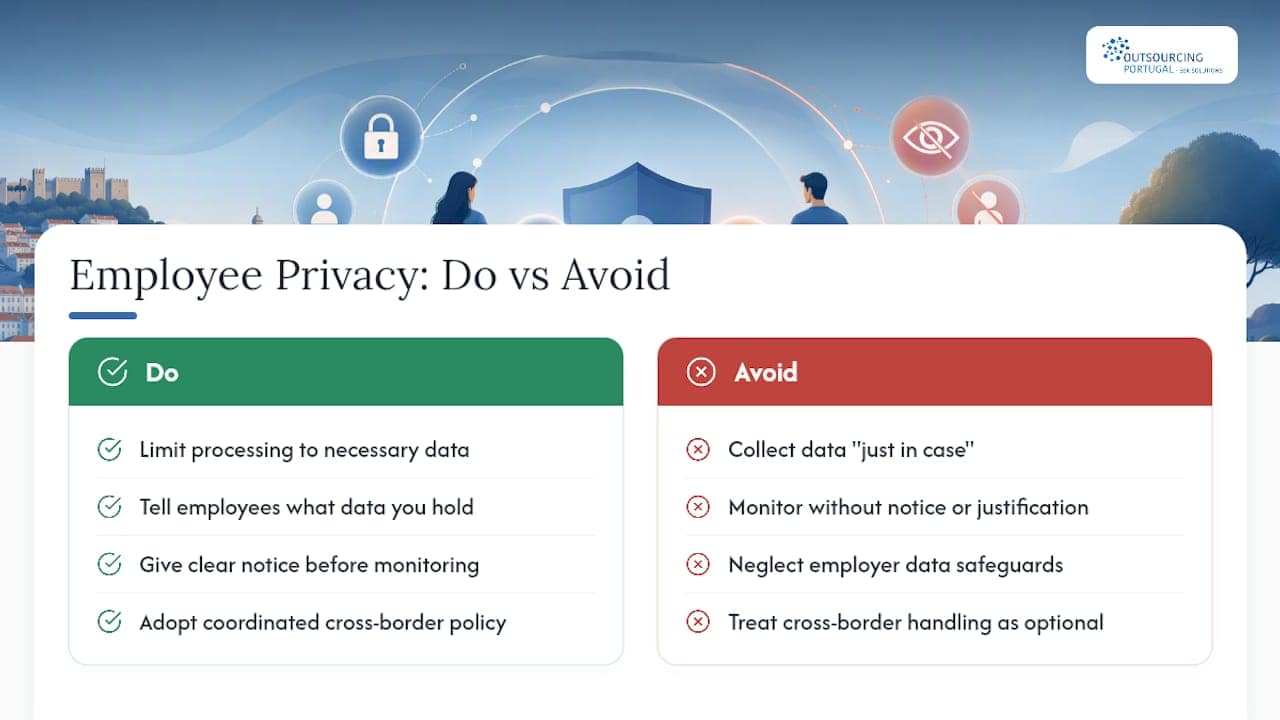
One area that catches international employers off guard is telework monitoring. Privacy-by-design principles apply directly to remote working-time registration. Monitoring tools that are invasive or track productivity beyond what is proportionate violate Portuguese employment law and can trigger GDPR liability. Speaking of GDPR, non-compliance with employee data processing rules can mean fines up to 4% of global turnover. That figure alone justifies a proper data privacy review of your HR systems. For a structured starting point, the hiring compliance checklist from Outsourcing-portugal covers the legal requirements you need to address before onboarding Portuguese staff.

Executing compliance policies through training and audits

Good documentation systems mean nothing if your managers do not know how to use them or what the rules actually require. Ensuring workforce compliance is an organizational discipline, not a one-time setup task. The gap between knowing the law and applying it daily sits directly in how your HR team and line managers have been trained.

Start with a clear HR policy framework that reflects Portuguese law specifically. A global employee handbook adapted with a local addendum is not sufficient. Your Portuguese-law policies should cover:

  1. Working hours and overtime: Portugal’s standard working week is 40 hours. Overtime is legal but must be compensated at specific premium rates and recorded separately.
  2. Rest and break entitlements: Employees are entitled to minimum rest periods between shifts and daily break requirements that vary by contract type.
  3. Discrimination and harassment: Policies must align with the Código do Trabalho provisions on equal treatment, with complaint procedures that employees can actually access.
  4. Disciplinary procedures: Any disciplinary action, including termination, must follow a defined process with written notice and response rights.
  5. Working-time recording responsibilities: Managers need to understand that they are personally accountable for ensuring their team’s records are complete and submitted on time.

Compliance training content should address hours, breaks, discrimination, complaint processes, and documentation to maintain awareness across the workforce. This is not orientation material. It is ongoing. Portuguese labor law updates regularly through legislative changes and new collective bargaining rounds. Your managers need scheduled refreshers, not just onboarding coverage.

Regular internal audits are the operational core of any employment law compliance guide. Running internal audits focused on contract, wage, and scheduling gaps before inspections occur is the standard recommended by employment law specialists. Structure your audits quarterly, with a full review annually. Each audit should produce a written report, document the gaps found, and record the remediation steps taken with completion dates.

Pro Tip: Assign audit ownership to a specific role, not a team. When everyone is responsible, no one is. A named compliance lead in Portugal reduces gaps and creates a single point of accountability that also serves as your ACT contact point during inspections.

Compliance training programs play a measurable role in reducing legal claims. Beyond legal protection, they signal to your Portuguese workforce that your organization operates with integrity, which directly affects retention in a competitive talent market.

Monitoring compliance and preparing for ACT inspections

Ongoing compliance monitoring is where most international companies under-invest. They get the contracts right, set up the payroll system, and then assume the work is done. ACT inspections are not limited to companies with known violations. They follow sector-based national action plans, which means your business can be selected simply because of the industry you operate in.

Compliance officer checks audit documents at workspace

Building a compliance matrix is one of the most effective labor regulation best practices for managing this risk. A compliance matrix maps your specific obligations by employment category, sector, and risk level. For example, a company with both full-time employees and workers on fixed-term contracts needs separate tracking columns, because the rules on renewal limits, notice periods, and termination rights differ significantly.

Key areas to track in your compliance matrix include:

  • Wage equality monitoring: Regular pay analysis by gender and function to identify and close unjustified gaps before the ACT does.
  • Contract classification reviews: Quarterly checks on freelance, fixed-term, and service contracts to verify they meet the legal criteria for that classification. Misclassified workers are among the ACT’s top enforcement targets.
  • Working-time adherence: Real-time monitoring of overtime accumulation and rest period compliance, particularly for shift workers.
  • Mandatory workplace notices: Required labor law postings must be current, visible, and updated when regulations change.

For companies in the private security sector, the 2026 ACT national action creates a specific obligation to prepare evidence of proper employment contracts for all security personnel, proof of mandatory licensing, and documentation that compensation meets sector collective agreement standards. The same logic applies to any sector with a dedicated ACT action plan.

When preparing for an inspection, treat readiness as documentation readiness. ACT inspectors will not accept verbal explanations. They review paper and digital trails. Have a protocol that lets you pull any employee’s complete file, including contract, working-time records, payslips, and training logs, within minutes. The payroll solutions for compliance covered by Outsourcing-portugal offer a strong model for integrating these records into a single auditable system. You can also get detailed guidance from compliance program management resources on documenting your internal processes in a format ACT inspectors can follow.

My honest take on labor compliance in Portugal

I have seen international companies walk into Portugal with strong HR teams and genuinely good intentions, and still find themselves with compliance gaps six months in. The common thread is not ignorance of the rules. It is assuming that what works in their home market translates cleanly.

What I have learned is that Portugal-specific compliance requires a mindset shift, not just a checklist update. The ACT operates differently from most labor inspectorates in Northern Europe or North America. It is methodical, well-resourced, and increasingly data-driven. The 2026 focus on gender pay gaps and contract classification reflects a regulator that is getting more sophisticated, not less.

The technology piece matters, but only if it is implemented with privacy compliance built in from the start. I have seen well-meaning companies deploy time-tracking tools that generated GDPR exposure they did not even know about. The interaction between employment law and data protection in Portugal is tighter than most companies expect.

My strongest advice is this: treat your first internal audit as a genuine discovery exercise. Go into it expecting to find problems, because you will. The businesses that do best long-term are the ones that find and fix their own gaps before an inspector does. That is not pessimism. It is how compliance actually protects business continuity and reputation over time.

— Paulo

How Outsourcing-portugal helps you stay compliant

Managing Portuguese labor law from abroad is genuinely difficult, even with a strong internal HR team. The combination of the Código do Trabalho, sector-specific collective agreements, ACT inspection cycles, GDPR obligations, and payroll complexity creates a compliance burden that grows with every hire.

https://outsourcing-portugal.co.uk

Outsourcing-portugal provides Employer of Record and payroll services specifically designed for international companies hiring in Portugal without a local entity. This means your contracts, payslips, working-time records, and social security filings are managed by specialists who know what the ACT looks for and how to structure your documentation accordingly. From onboarding to ongoing compliance support, the team handles the details that create legal exposure when managed at a distance. If you are building a team in Portugal or reviewing your current compliance posture, this is where a local partner makes a concrete difference.

FAQ

What are the ACT’s main inspection priorities in 2026?

The ACT’s 2026 national inspection actions focus on working-time organization, gender pay equality, contract regularity (including false service contracts), and undeclared work, with a dedicated action targeting the private security sector.

How long must employers in Portugal keep working-time records?

Portuguese law requires working-time records to be stored for a minimum of five years, accessible for ACT audits or use in employment disputes.

What is the risk of GDPR non-compliance in employee data management?

Non-compliance with GDPR in employee data processing can result in fines of up to 4% of global annual turnover or €20 million, whichever is higher.

Can spreadsheets be used for working-time tracking in Portugal?

Spreadsheets are generally not considered audit-proof by ACT standards. They are prone to errors and lack the change-tracking integrity that inspectors require. Dedicated digital systems are strongly preferred.

How does an Employer of Record help with labor compliance in Portugal?

An Employer of Record takes on the legal employer role in Portugal, managing contracts, payroll, working-time records, and regulatory filings in line with Portuguese law, removing structural compliance risk from international businesses that hire locally without a registered entity.

HR manager reviewing spreadsheet in sunlit office

HR Support Step by Step: A Practical 2026 Guide


TL;DR:

  • Inefficient HR support costs organizations more than anticipated by causing delays and mishandled sensitive cases. Implementing a structured, tiered support model with clear workflows, technology, and ongoing refinement builds trust and scale. Proper ownership, documentation, and data-driven adjustments prevent system collapse as organizations grow.

Inefficient HR support quietly costs organizations more than most leaders realize. Employees wait days for answers on basic policy questions, sensitive complaints get mishandled because no one owns the process, and HR specialists burn time on routine queries they never should have seen. A structured hr support step by step approach fixes all of this. This guide gives HR professionals and business leaders a precise framework for building tiered, scalable HR support from the ground up, covering foundational setup, process design, sensitive case handling, and technology selection.

Table of Contents

Key Takeaways

Point Details
Build before you deploy Gather data on common HR request types and define support tiers before touching any technology.
Tier your support model Route low-risk questions to self-service and reserve specialists for high-complexity, high-risk issues.
Treat complaints as trust moments The first response to a sensitive complaint sets the tone for the entire investigation process.
Technology enables, culture decides Ticketing systems and AI tools only work when workflows and ownership are already clearly defined.
Measure first response time Tracking SLA adherence separates genuinely effective HR support from fast-looking but incomplete answers.

HR support step by step: laying the foundation

Before you build anything, you need a clear picture of what you are actually dealing with. Pull at least three months of HR queries from your inboxes, Slack threads, and any existing ticket logs. Categorize them by type: policy questions, payroll inquiries, onboarding requests, leave management, performance concerns, and employee relations issues. This data tells you exactly where your current process breaks and where volume concentrates.

Most organizations discover the same pattern: 60 to 70 percent of HR queries are routine and repeatable. That means the majority of what lands in a specialist’s inbox could be handled through self-service or a general HR contact.

Infographic showing HR request type breakdown by percentage

Defining your support tiers

A tiered service delivery model divides HR questions into three levels based on risk and complexity.

Tier Who handles it Request types
Tier 0: Self-service Employee, via portal or knowledge base Policy lookups, PTO balance checks, form downloads
Tier 1: General HR team HR generalist or coordinator Onboarding questions, basic payroll queries, leave requests
Tier 2: Senior HR specialists Senior HR business partner or legal Investigations, complex ER cases, disciplinary actions

Once you have your tiers defined, identify the technology platforms you need. At minimum, you need a ticketing system for request tracking, a knowledge base for self-service content, and a communication channel employees can access without confusion. You also need to define a single “front door,” meaning one clear entry point where all HR requests come in, whether that is a web form, an email address, or a chat interface.

Pro Tip: Before selecting any tool, map out your most common 20 request types and check whether each one can be answered through self-service. If more than half can, you have a strong case for investing in a knowledge base before anything else.

Building the step-by-step HR support process

With your foundation in place, you can design and deploy the actual HR support workflow. Here is a practical eight-step process.

  1. Analyze and classify current requests. Use your three months of data to build a master list of request types. Tag each with volume, average resolution time, and current handler.

  2. Map each request to a support tier. Match request types to Tier 0, 1, or 2 based on risk and complexity. A policy question about vacation accrual belongs at Tier 0. A complaint about a manager’s behavior belongs at Tier 2.

  3. Build routing rules and escalation paths. Define exactly what triggers escalation from one tier to the next. A Tier 1 request that involves allegations of misconduct, legal exposure, or repeated unresolved issues should automatically escalate to Tier 2.

  4. Set service level agreements. Establish response time targets for each tier. A common starting framework: Tier 0 is immediate, Tier 1 responds within four business hours, and Tier 2 acknowledges within 24 hours with a resolution timeline communicated to the employee.

  5. Build or integrate your support platform. HR ticketing systems categorize requests, automate workflows, and maintain SLA compliance. Configure your routing rules directly into the platform so tickets reach the right person without manual triage.

  6. Pilot with one HR domain. Start with onboarding or leave management. These are high-volume, relatively low-risk functions that let you test the system without exposing the organization to sensitive-case risk during setup.

  7. Collect data and refine. After four to six weeks of piloting, review your ticket data. Where are escalations happening that should not? Where are employees resubmitting because their issue was not resolved? Use that feedback to tighten routing rules and update knowledge base articles.

  8. Scale across other HR functions. Once the pilot domain runs cleanly, roll out the same structure to payroll, performance management, and employee relations. Structured ticketing at scale becomes non-negotiable past roughly 50 to 200 employees.

Pro Tip: Do not launch your knowledge base with 100 articles. Start with the 10 questions your team answers most often. A short, accurate knowledge base beats a large, outdated one every time.

Pairing this HR support workflow with a well-documented onboarding process also reduces first-week confusion for new hires significantly.

New employee reviewing onboarding checklist with HR

Handling sensitive cases within HR support

Sensitive employee relations cases require a separate, more careful process inside your HR support structure. A complaint about harassment or discrimination is not a ticket to be routed and resolved in four hours. It is a trust-building moment, and how you handle the first five minutes shapes everything that follows.

The issue management lifecycle includes identification, documentation, severity assessment, investigation, and resolution. Applied to HR support, that translates into a specific sequence.

  1. Acknowledge immediately. The employee who reports a complaint needs to know it was received, taken seriously, and that someone owns it. Send a written acknowledgment within two hours.

  2. Triage for severity. Assess whether the complaint requires formal investigation. Early triage decides investigation necessity and keeps the process transparent from the start. Not every complaint requires a full investigation, but every complaint requires a documented decision about why or why not.

  3. Assign ownership and build an investigation plan. Name a single investigator. Define the scope, likely witnesses, timeline, and documentation requirements before the first interview takes place.

  4. Conduct the investigation with consistency. Ask the same structured questions to each witness. Document every conversation. Maintain confidentiality by limiting information sharing to those with a genuine need to know.

  5. Maintain communication throughout. Transparent communication during investigations reduces anxiety and speculation. You do not need to share findings in progress, but you should tell the complainant that the investigation is active and give realistic timelines.

  6. Deliver fair outcomes and close the loop. Share the outcome with all relevant parties in writing. Even when you cannot disclose all details, the person who reported the issue deserves to know the process is complete and that action was taken.

  7. Monitor for retaliation and extract learning. Set a 90-day follow-up checkpoint. Check in with the complainant. Clear documentation and confidentiality throughout the process also protect the organization legally if the case is later challenged.

An HR support system that handles routine queries well but fumbles sensitive cases destroys more trust than having no system at all.

Pro Tip: Pre-triage incoming HR requests by risk lane before assigning ownership. This protects specialists from being pulled into routine work and keeps your most experienced people focused on cases that actually need them.

Technology that powers modern HR support

Technology does not replace a well-designed HR support process. It amplifies it. If your routing rules are unclear, a ticketing system just automates the wrong behavior faster. Get the process right first, then pick your tools.

That said, the right technology stack makes a real difference at scale. Here is what to look for:

  • Omnichannel intake. Employees should be able to submit requests through a web portal, email, or chat without changing the outcome. All submissions should land in the same ticketing queue.
  • Automated routing. HR help desks combine ticketing with automation so queries reach the correct team without manual sorting.
  • AI-assisted triage. Newer platforms use intent detection to read incoming requests and suggest routing, draft initial replies, or flag potential sensitive-case indicators before a human reviews the ticket.
  • Confidentiality controls. Sensitive tickets related to investigations or complaints need visibility restrictions so only authorized personnel can see the content.
  • SLA monitoring. Your ticketing platform should alert team members when a ticket is approaching its response deadline, not after it has already been missed.
Platform type Best for Key feature
Dedicated HR help desk Mid to large organizations Built-in HR workflows, compliance logging
IT-adapted ticketing Tech-forward teams Flexible configuration, omnichannel intake
Knowledge base tools Self-service reduction Article analytics, gap identification

A well-maintained knowledge base decreases repetitive HR questions, but it needs continual updates based on actual ticket trends. Review your knowledge base articles quarterly. If a topic keeps generating tickets, the article either does not exist or does not answer the actual question employees are asking.

Pro Tip: Tracking first response time and SLA compliance is critical to distinguish between quick answers and genuinely effective HR support. Speed without resolution is not support.

For companies building nearshore teams in Portugal, Outsourcing-portugal provides a useful international HR management guide that covers how structured HR processes translate across borders.

My take: what actually breaks HR support

I have seen enough HR support builds, from 30-person startups to 2,000-person operations, to know where things consistently go wrong. The problem is almost never the technology. It is unclear ownership and workflows that live in people’s heads instead of documented systems.

In my experience, the most common failure pattern is this: a smart HR team builds informal processes that work well when the same three people are handling everything. Then the company hits 150 employees, someone goes on leave, and the whole system collapses because nobody else knows the unwritten rules. That is a culture and documentation problem, not a software problem.

The other mistake I see constantly is overloading senior HR specialists with routine queries because nobody built the Tier 0 and Tier 1 layers properly. These are your most expensive, most experienced people spending half their day answering vacation policy questions. Technology is a tool, not a substitute for culture and clear workflows. Getting those right first changes everything.

What I have found actually works is treating your HR support system as a living product, not a one-time project. Review your SLAs quarterly. Update your knowledge base based on ticket data. Audit your escalation paths every six months. The organizations that get this right are the ones that measure consistently and iterate without waiting for something to break.

— Paulo

Build better HR support with Outsourcing-portugal

https://outsourcing-portugal.co.uk

If you are building or scaling an HR support function and want external expertise to back you up, Outsourcing-portugal offers fully integrated HR services designed for international organizations operating in Portugal. From employer of record and payroll services to employee relations support and compliance management, the team brings the structure and legal knowledge that makes a tiered HR support system actually work in practice. Whether you are setting up a nearshore team for the first time or trying to reduce internal HR burden at scale, Outsourcing-portugal has the operational depth to support you. Explore the full range of employment and HR outsourcing services available for Portugal-based teams.

FAQ

What does a tiered HR support model look like?

A tiered HR support model routes self-service questions to a knowledge base, general queries to an HR coordinator, and complex or sensitive cases to senior HR specialists. Each tier has defined request types, response times, and escalation criteria.

How do you build an HR support workflow from scratch?

Start by analyzing three months of HR requests to identify volume and type, then map each request category to a support tier, define routing rules, set SLAs, and pilot the system in one HR domain before scaling.

When does a complaint require a formal HR investigation?

Any complaint alleging harassment, discrimination, misconduct, or legal exposure should be triaged for formal investigation. A documented triage decision, regardless of the outcome, protects both the employee and the organization.

What technology do you need for effective HR support?

You need a ticketing system with automated routing, a knowledge base for self-service, and SLA monitoring capabilities. Larger organizations benefit from AI-assisted triage that detects request intent and flags sensitive cases before human review.

How do you measure whether your HR support system is working?

Track first response time, SLA adherence rate, ticket resolution time, and self-service deflection rate. If escalations are increasing without a corresponding rise in headcount or complexity, your Tier 0 and Tier 1 layers need attention.

Portuguese HR manager reviewing compliance checklist

Legal compliance in Portugal: A guide for employment outsourcing


TL;DR:

  • Many international companies mistakenly believe that outsourcing automatically ensures legal compliance in Portugal, which can be costly.
  • Legal compliance requires ongoing attention to evolving laws, regulations, and sector-specific rules to avoid penalties and reputational damage.

Many international companies assume that choosing an outsourcing partner automatically takes care of legal compliance. That assumption is expensive. Portugal has a structured, actively enforced labor law framework, and legal compliance is a continuous process that demands ongoing attention, not just a signature on a service agreement. This guide breaks down exactly what compliance means in the Portuguese context, how to structure your operational cycle, what local labor law restrictions you need to know, and how to draft contracts that protect your business from the outset.

Table of Contents

Key Takeaways

Point Details
Compliance is ongoing Legal compliance in Portugal requires constant monitoring, not a one-time approval.
Map obligations early Identify specific laws and regulations that apply before expanding or outsourcing in Portugal.
Outsourcing has limits There are strict local restrictions on outsourcing after layoffs that all companies must track.
Contract structure matters How you draft contracts impacts your risk of worker misclassification under Portuguese law.
Expert local support helps Partnering with compliance and HR experts reduces risk and accelerates market entry.

Before you can manage compliance, you need to understand what it actually means. Legal compliance is the process of ensuring an organization adheres to the laws that regulate its business activities in a given jurisdiction. That definition sounds simple. The reality is far more layered, especially for a foreign company entering Portugal with no existing legal infrastructure.

Regulatory compliance is a closely related but distinct concept. Legal compliance covers statutory law, civil and criminal codes, and employment legislation. Regulatory compliance focuses on sector-specific rules issued by government agencies or industry bodies. In practice, companies operating in Portugal need to manage both simultaneously. A tech company building a nearshore team, for example, must comply with employment law, data protection regulations under GDPR, sector-specific licensing requirements, and any applicable collective bargaining agreements.

What makes this particularly challenging for global employers is jurisdictional complexity. Rules that apply in your home country may not transfer. Employment protections in Portugal are stronger than in many non-EU markets, and what counts as a compliant contractor relationship in the United States or the United Kingdom may be classified as disguised employment under Portuguese law. Getting this wrong triggers backdated social security contributions, fines, and reputational damage.

Here is a quick summary of why compliance in international hiring is a persistent operational priority, not a one-off task:

  • Employment law in Portugal updates regularly, including proposed changes under new labor legislation as recently as 2026
  • Collective bargaining agreements (CBAs) apply to entire industry sectors and can override standard contract terms
  • Social security registration, withholding obligations, and working time rules must be actively monitored
  • Data protection obligations under GDPR apply the moment you process employee data across borders
  • Inspection campaigns by the Portuguese labor authority are scheduled and well-publicized, leaving little room for “we didn’t know”

“Compliance is not a project with a finish line. It is an operating condition. Companies that treat it as a checklist will find themselves exposed the moment the rules change or an inspector arrives.”

That mindset shift, from project to operating condition, is the most important thing global employers can internalize before entering the Portuguese market.

Now that the fundamentals are clear, let’s break down exactly how companies can approach compliance as an ongoing framework rather than a one-time setup exercise.

Infographic Portugal employment compliance steps

Organizations must identify enforceable obligations, map how those obligations apply to their specific situation, and run a continuous monitoring and audit cycle. The variables that shape your obligation map include your industry, the number of employees you have in Portugal, the geographic scope of your operations, and the sensitivity of the data you process. A company with three remote developers has a very different compliance profile than a contact center with 150 employees.

A practical compliance methodology follows four steps that repeat as your business evolves:

  1. Define scope. Identify which laws, CBAs, and regulations apply to your specific situation in Portugal. This includes labor law, tax law, data protection, sector-specific rules, and any local agreements.
  2. Identify obligations. For each applicable rule, document exactly what the obligation requires, who is responsible for it, and how often it needs to be reviewed or reported.
  3. Translate into internal procedures. Obligations on paper mean nothing without operational processes. Build HR workflows, contract templates, payroll schedules, and documentation standards that make compliance the default behavior.
  4. Continuously monitor and prepare for inspections. Review your compliance posture at least quarterly. Keep records of contracts, payslips, working time logs, and any correspondence with the Portuguese labor authority (ACT). Assume an inspection could happen at any time.

Here is a practical overview of how this cycle maps to common compliance areas in Portugal:

Compliance area Key obligation Monitoring frequency
Employment contracts Written contract required before start date At every hire or contract change
Working time Respect legal maximums; log overtime correctly Monthly payroll review
Remuneration Meet national minimum wage; apply CBA rates Annual or when CBA updates
Social security Register employees and remit contributions Monthly
Data protection GDPR-compliant data processing agreements Annual review plus on change
Outsourcing restrictions 12-month post-layoff prohibition Before each outsourcing decision

Pro Tip: Build a compliance calendar tied to your payroll cycle. Many violations found during ACT inspections are not deliberate breaches but administrative gaps, missing signatures, late filings, or outdated contract clauses. A calendar makes those gaps visible before an inspector does.

The compliance cycle also changes as your business scales. A company that starts with two employees in Portugal and grows to twenty will cross legal thresholds that trigger new obligations. For example, works council rights, mandatory reporting, and certain dismissal procedures only activate above specific headcount thresholds. Review your legal compliance best practices proactively at every growth milestone. For a broader view of how EU employment law shapes your obligations in Portugal, it is worth reviewing the regulatory hierarchy before finalizing your employment structure.

Outsourcing and labor compliance: What Portugal’s law requires

Understanding the general cycle sets the stage for tackling the real-world specifics of labor compliance and outsourcing in Portugal. This is where many international companies run into serious trouble, often because they apply assumptions from other markets to a legal environment that works differently.

The most important restriction to know is this: Portugal prohibits using outsourcing to fill positions that were made redundant due to layoffs for a 12-month period. This rule exists to prevent companies from cycling out employees through redundancy and immediately replacing them with cheaper outsourced labor. Violating it exposes the company to legal challenges from dismissed workers, potential reinstatement orders, and financial penalties.

Director explains outsourcing law at whiteboard

This restriction is especially relevant for companies acquiring or merging with Portuguese operations, and for any business that has recently downsized before initiating an outsourcing arrangement. The 12-month clock starts from the date of the last affected redundancy. Document your timeline carefully.

Beyond this specific restriction, ACT inspection campaigns in 2026 are focused on four main areas:

  • Contract compliance: Are employment contracts written, signed before the start date, and correctly classified?
  • Working time: Are working hours logged accurately, and is overtime properly compensated?
  • Remuneration: Are employees receiving at least the applicable minimum wage and any CBA-mandated rates?
  • Collective bargaining application: Is the correct CBA being applied to the relevant workforce?

These are not random enforcement priorities. They reflect where regulators have found the highest rates of non-compliance in practice. If you are operating or planning to operate in Portugal, these four areas need to be airtight before you hire your first employee.

Here is a comparison of compliant versus non-compliant outsourcing practices to clarify where the line sits:

Scenario Compliant practice Non-compliant practice
Post-redundancy outsourcing Wait 12 months before outsourcing affected roles Outsource the same roles within 12 months of layoffs
Worker classification Hire via EOR or properly classify employees Engage employees as contractors to avoid social security
Contract documentation Written contracts in place before first day Verbal agreements or backdated contracts
Working time Track and compensate overtime correctly Ignore overtime logging for salaried staff
CBA application Identify and apply correct sector CBA Apply generic terms without checking CBA requirements

The hiring costs in Portugal are competitive compared to Western Europe, but those savings disappear quickly if non-compliance results in backdated contributions, legal fees, and fines. Treating compliance as a cost center rather than a cost-saver is one of the most common and avoidable mistakes foreign employers make. Our outsourcing compliance guide goes deeper into each of these areas with actionable checklists.

Drafting contracts and avoiding misclassification in Portugal

Getting your outsourcing structure right relies on more than following restrictions. The next step is contract design and worker classification. This is an area where small errors compound into large liabilities over time.

Portuguese regulators apply a substance-over-form test when assessing whether a working relationship is genuinely a contractor arrangement or a disguised employment contract. The label on the document matters far less than the actual conditions of the working relationship. If you control when someone works, where they work, what tools they use, and whether they can work for other clients, you are almost certainly looking at an employment relationship, regardless of what the contract says.

Drafting service contracts to reflect genuine independence, including the contractor’s autonomy over work methods and hours, a non-exclusivity clause, and payment structured around deliverables rather than time, significantly reduces the risk of reclassification as employment. These are not just legal formalities. They reflect how the relationship actually needs to function for the contractor classification to hold up under scrutiny.

Key criteria regulators use to distinguish genuine contractors from employees:

  • Integration into organizational structure: Does the worker function as part of your permanent team with regular hours and a dedicated role?
  • Economic dependence: Does the contractor derive most of their income from your company alone?
  • Control over work methods: Do you dictate how the work is done, or just the outcome?
  • Equipment and infrastructure: Does your company provide the tools, software, or workspace?
  • Exclusivity: Is the contractor prohibited from working with other clients?

Each of these factors carries weight. One flag alone may not trigger reclassification, but a pattern of control indicators will. Portuguese courts and labor inspectors look at the totality of the relationship, not a single clause.

Pro Tip: Review your contractor relationships every six months. What started as a genuinely independent arrangement can drift into de facto employment as the working relationship deepens. Catch that drift before ACT does.

For international hiring compliance, the safest approach for companies that need a consistent, managed workforce in Portugal is typically an Employer of Record structure rather than a contractor model. This eliminates misclassification risk entirely while keeping your operational flexibility intact.

Why smart compliance goes beyond regulations: Lessons from recent enforcement

Here is an uncomfortable truth that most compliance guides avoid: technically following the rules is not the same as being compliant in any meaningful sense. ACT’s 2026 inspection priorities tell a story about where real-world compliance breaks down, and it is rarely in companies that are deliberately evading the law.

The pattern we see consistently is this: companies enter Portugal with good intentions, use a contract template sourced from somewhere generic, run payroll through a system not calibrated for Portuguese CBA requirements, and then discover during an inspection that their “compliant” setup has had structural errors running for months or years. The enforcement risk is not usually the rogue actor. It is the well-intentioned company that outsourced its compliance thinking along with its workforce.

What separates organizations that handle ACT inspections without incident from those that don’t is not a thicker policy document. It is whether compliance is genuinely embedded in day-to-day operations. That means the HR team knows which CBA applies and why. It means contracts are reviewed when roles evolve, not just when they are created. It means working time records are maintained as a matter of routine, not assembled reactively when an inspector calls.

The 12-month post-layoff outsourcing rule is a perfect illustration of proactive versus reactive compliance. A reactive company discovers the restriction when their legal team reviews a contract days before signing. A proactive company builds the rule into their workforce planning calendar so it never becomes an issue in the first place.

There is also a cultural dimension that pure rule-following misses. Portugal’s labor framework reflects genuine social values around worker protection, job security, and fair compensation. Companies that engage with that framework as a legitimate operating environment, rather than as a bureaucratic obstacle to manage around, build better relationships with local employees, local regulators, and local talent pools. In a competitive talent market, that matters more than you might expect. Review our practical compliance insights to see how this approach translates into operational practice.

Streamline your expansion with specialized compliance support

Navigating Portuguese employment law as a foreign company is genuinely complex. The good news is that you do not need to build that expertise from scratch internally.

https://outsourcing-portugal.co.uk

Our Employer of Record services in Portugal are designed specifically for international companies that want to hire, manage, and retain Portuguese talent without setting up a local entity. We act as the legal employer on your behalf, handling contracts, payroll, social security, CBA compliance, and working time obligations in full alignment with Portuguese law. For companies that want to understand the strategic picture before committing, our resource on EOR compliance solutions walks through how the model works in practice. You can also access our HR compliance best practices guide for a structured checklist covering the 2026 regulatory landscape.

Frequently asked questions

Legal compliance means ensuring a business continuously adheres to all applicable laws and regulations governing its operations in a specific jurisdiction. It is an active, ongoing process, not a one-time setup activity.

Compliance is continuous, not periodic. Companies should monitor obligations on an ongoing basis and formally review their compliance posture at least quarterly or whenever business activities, headcount, or applicable regulations change.

Are there restrictions on outsourcing after layoffs in Portugal?

Yes. Portuguese law prohibits outsourcing work to replace employees made redundant due to layoffs for at least 12 months after the redundancy. This restriction applies regardless of the outsourcing contract structure.

Who enforces employment compliance in Portugal?

ACT inspection campaigns are conducted by Portugal’s labor authority and focus on contracts, working time, remuneration, and correct application of collective bargaining agreements. The Ministry of Labor oversees the broader regulatory environment.

What key contract clauses help prove genuine contractor relationships?

Clauses confirming that the contractor sets their own hours and methods, is not exclusive to one client, uses their own tools, and is compensated for deliverables rather than hours are the strongest indicators of genuine independence under Portuguese law.

Team collaborating in Lisbon tech workspace

How to build a compliant tech team in Portugal


TL;DR:

  • Portugal has become a top nearshore destination for tech teams due to significant cost savings and a positive employment outlook. Companies should choose between EOR, legal entity, or hybrid models based on growth stage, ensuring compliance and streamlined setup. Success depends on strategic talent sourcing, efficient onboarding, and understanding the evolving local market dynamics.

Portugal has quietly become one of Europe’s most attractive destinations for nearshore tech teams, offering 30-50% cost savings versus Western European markets alongside a net employment outlook of +36% for Q1 2026. For technology executives and HR leaders under pressure to scale fast without sacrificing compliance or quality, this guide cuts through the noise. What follows is a structured, practical playbook covering every stage from legal setup and talent sourcing to payroll management and long-term retention, drawn from real market intelligence on Portugal’s evolving tech landscape.


Table of Contents

Key Takeaways

Point Details
Choose the right model EORs offer speed while setting up your own entity brings long-term control for scaling tech teams.
Comply from day one Get a Portuguese tax number (NIF), register locally, and understand Tech Visa and payroll rules before hiring.
Know your market Expect senior tech salaries around €50-75k in Lisbon and 15-20% lower in Porto, plus a 23.75% social security surcharge.
Retention requires more than pay Senior tech talent is scarce and mobile, so combine culture fit, career prospects, and compliance for long-term success.
Local partners accelerate success Leverage experienced local recruiters and EORs to avoid pitfalls, speed up onboarding, and maintain compliance.

Define your tech hiring strategy: EOR vs. entity vs. hybrid

With the case for Portugal established, the next decision is foundational: how do you legally employ people there? Get this wrong and you face compliance exposure, unexpected costs, or painful restructuring later. There are three primary models, each suited to different growth stages.

Infographic comparing EOR and Entity hiring models

Employer of Record (EOR): An EOR is a third-party organization that legally employs your workers in Portugal on your behalf. You direct the work; the EOR handles contracts, payroll, social security contributions, and compliance. Setup takes as little as 1-2 weeks, and you avoid the cost and complexity of incorporating a Portuguese entity. This is the go-to model for companies testing the market, hiring fewer than 10 employees, or needing to move fast.

Legal entity: Setting up a Portuguese subsidiary (typically a Lda., the Portuguese equivalent of a limited liability company) gives you full operational control and can be more cost-effective at scale. Entity incorporation via Empresa na Hora (Company in an Hour) takes roughly 2-4 weeks and costs between €2,000 and €8,000 including professional fees, share capital, and registration costs. This model suits companies committed to Portugal as a permanent hub with 15 or more employees.

Hybrid (phased) approach: Many companies entering Portugal with strong growth ambitions use an EOR for the first 12 to 18 months, then transition to a legal entity once team size and market understanding justify the investment. This phased approach, sometimes called a Build-Operate-Transfer (BOT) model, lets you validate hiring before entity commitment while maintaining full compliance throughout.

Model Setup time Upfront cost Best for
EOR 1-2 weeks Low (service fee) Startups, market testing, 1-10 hires
Legal entity 2-4 weeks €2,000-€8,000 Scale teams, 15+ employees
Hybrid/BOT 12-18 months phased Variable Growth-stage companies

For companies expanding to Portugal from the UK or US for the first time, the EOR model typically removes the highest friction points while keeping the path to entity formation open.

Pro Tip: Don’t let “we plan to hire more later” push you into premature entity setup. Many companies that build a local entity too early end up paying maintenance costs for a structure they underutilize. Start lean with an EOR, then graduate when the team justifies it.


After clarifying your setup strategy, ensure your administrative and compliance requirements are watertight before you make your first hire.

NIF and company registration: Every foreign company operating in Portugal needs a Número de Identificação Fiscal (NIF), which is the Portuguese tax identification number. If you are setting up an entity, you can register via Empresa na Hora in a single business day or complete the process online. If you are using an EOR, this step is handled for you. Either way, the NIF is non-negotiable since it is required for payroll, contracts, and any interaction with Portuguese tax authorities.

Tech Visa program: Portugal’s Tech Visa is a critical tool for companies hiring non-EU talent. However, it comes with meaningful restrictions. To participate, your company must be Portugal-based, certified with a clean record, and tech-focused. Certification takes up to 20 working days. Critically, the program caps non-EU hires at 50% of your total workforce, meaning you must also be actively hiring Portuguese or EU nationals. Companies that plan to staff primarily with non-EU engineers often hit this ceiling faster than expected.

Employer social security and labor law: Portuguese employers contribute 23.75% of gross salary to social security. Employees contribute an additional 11%. The Portuguese Labor Code (Código do Trabalho) governs contracts, termination rules, working hours, and mandatory benefits. Contracts must be written, specify the role and compensation clearly, and include provisions for the legally mandated 13th and 14th month salary payments (holiday and Christmas allowances). Getting these details right from day one prevents costly disputes later.

Here is a sequential compliance checklist for a new market entrant:

  1. Obtain your company NIF (or confirm your EOR handles this)
  2. Register with Portuguese Social Security (Segurança Social)
  3. Draft employment contracts compliant with the Portuguese Labor Code
  4. Confirm Tech Visa eligibility if hiring non-EU engineers
  5. Set up payroll software or confirm EOR payroll handling
  6. Register with the Authority for Working Conditions (ACT) if applicable

When it comes to tech development in Portugal, these administrative steps are not optional extras. They are the foundation everything else is built on.

Pro Tip: Portugal’s bureaucratic processes have improved dramatically in recent years, but translation requirements and notarization can still slow things down for foreign companies. Work with a local legal advisor or your EOR partner to pre-validate all documents before submission, as small errors cause disproportionate delays.


Talent sourcing: Recruitment models and market realities

With your legal and compliance requirements in place, the next challenge is finding and attracting the right engineers. Portugal’s tech talent market is genuinely competitive, and understanding its structure gives you a real advantage.

Direct hire vs. EOR talent pipelines: Direct hiring gives you more control over employer branding and candidate experience but requires you to build local recruitment infrastructure from scratch. EOR and staff augmentation partners typically maintain pre-vetted candidate pipelines, which is particularly valuable for specialized roles. Partnering with local recruiters or EORs is strongly recommended for senior engineering hires, where the market is thinner and hiring cycles run 8 to 12 weeks rather than the 4 to 6 weeks typical for mid-level roles.

Lisbon vs. Porto: Knowing the difference: These two cities are not interchangeable. Lisbon is Portugal’s primary tech hub, home to Web Summit (one of Europe’s largest tech conferences), a dense startup ecosystem, and the largest concentration of senior engineers. Porto is emerging rapidly, with a strong university talent pipeline and a cost advantage: senior developers cost 15-20% less in Porto than in Lisbon. Porto also benefits from proximity to several strong engineering faculties, making it particularly well-suited for companies willing to invest in junior-to-mid talent development.

Salary bands and AI skills premiums: Salary expectations have shifted sharply over the past two years. A senior software engineer in Lisbon carries a loaded cost of €50,000 to €75,000 annually, inclusive of social security and mandatory benefits. Engineers with demonstrated AI/ML skills command a further premium of €10,000 to €15,000 above standard senior rates. Budget for this early to avoid losing candidates mid-process.

“The companies that consistently win top Portuguese tech talent are those that move from first interview to offer within three weeks. Candidates at the senior level are interviewing with three to five employers simultaneously.”

For a broader view of Portugal’s tech industry and how its talent pool compares regionally, the depth and diversity of skills available continues to impress new market entrants. If you are focused on scaling quickly, specialized IT recruitment agencies for scaling can compress time-to-hire significantly by presenting only pre-screened, interested candidates.

Pro Tip: Don’t sleep on Braga and Aveiro for specific tech profiles. These smaller cities house excellent university programs and are producing strong backend and data engineering graduates who are eager for international employer attention and carry lower salary expectations than Lisbon or Porto equivalents.


Step-by-step hiring, onboarding, and payroll management

Once you have identified candidates, execution matters. A disorganized onboarding process signals poor employer quality and increases early churn risk, particularly with senior engineers who have multiple options.

Here is the sequential workflow for compliant, effective hiring and onboarding:

  1. Screen and shortlist: Define technical and cultural criteria before outreach. For senior roles, technical assessments should be efficient and respectful of candidate time (no multi-week take-home projects).
  2. Structured interviews: Include a hiring manager, a technical peer, and if possible, a Portuguese-based team member. Cultural fit matters as much as technical ability.
  3. Issue a written offer: Portuguese law requires written contracts. Specify role title, gross salary, working hours, probation period (up to 180 days for senior roles), and benefits.
  4. Register with Social Security: This must happen before the employee’s first day.
  5. Run compliant payroll: Portugal requires 14 monthly salary payments per year: 12 regular months plus a holiday allowance (typically paid in June) and a Christmas allowance (December). Missing or miscalculating these is a common and costly mistake.
  6. Onboard with documentation: Provide a written contract, employee handbook aligned with Portuguese law, and clear information on tax registration obligations for the employee.

The total employer cost for a senior engineer in Lisbon runs €45,000 to €60,000 per year once you factor in the 23.75% employer social security contribution. Portugal’s loaded salary burden sits at approximately 25-30% above gross pay when you include social security and mandatory holiday provisions.

“Many international companies underestimate the 14-month salary structure. Budgeting on a 12-month basis creates a surprise 16% shortfall in your annual salary cost before benefits are even factored in.”

Pro Tip: Build your salary budgets in loaded cost terms from day one. A senior engineer quoted at €55,000 gross actually costs you closer to €68,000 annually when you factor in employer social security and the two additional monthly payments. This distinction matters enormously when presenting business cases to finance teams.

For teams that are scaling rapidly, managing individual contracts, payroll runs, and compliance reporting across multiple employees becomes complex fast. Purpose-built scaling tech teams services handle this workflow end-to-end and reduce administrative burden on your internal HR team.

Payroll manager reviewing budget spreadsheets


Beyond the basics: Lessons from building and scaling successful tech teams in Portugal

A strong process provides the foundation, but true success requires an insider’s understanding of Portugal’s shifting tech talent terrain. After working with dozens of international companies entering the Portuguese market, several patterns emerge that most generic guides never address.

The EOR vs. entity debate is more nuanced than it looks. Conventional wisdom says “use EOR for small teams, entity for large ones.” In practice, the right answer depends as much on your talent profile as your headcount. If you are hiring senior engineers who take an active interest in employer stability and benefits portability, a legal entity can be a stronger signal of long-term commitment. Conversely, companies that rush into entity setup before achieving product-market fit often find themselves managing Portuguese administrative obligations with no clear revenue to show for it.

The NHR regime change is a real retention risk. Portugal’s Non-Habitual Resident (NHR) tax regime, which offered foreign workers a flat 20% tax rate for 10 years, has ended for new applicants. The NHR regime’s end is driving churn toward competing destinations like Dubai, particularly among senior foreign engineers who relocated to Lisbon specifically for the tax advantage. If your team includes high earners who benefited from NHR, retention conversations should already be happening. The Tech Visa 50% cap compounds this challenge. Companies that built their model around a primarily non-EU workforce may now face mandatory local hiring ratios that require a recruitment pivot.

Portugal vs. Poland: It depends on what you’re optimizing for. Poland offers a deeper senior talent pool and lower costs for certain engineering specializations. However, Portugal consistently outperforms on English proficiency, cultural compatibility with UK and US companies, and time zone alignment with London. For teams where communication quality and collaboration rhythm matter more than raw cost optimization, Portugal remains the stronger choice. This is particularly true for product engineering teams that need to work closely with non-technical stakeholders.

Culture and market understanding are underrated factors. Companies that treat Portugal purely as a cost play tend to see higher churn and lower team cohesion. The engineers who thrive in Portugal’s tech market are collaborative, value work-life balance seriously, and respond well to employers who demonstrate genuine investment in the local ecosystem. Supporting employee attendance at local tech events, offering flexible working arrangements, and being visible in communities like Porto’s or Lisbon’s growing startup scenes all contribute meaningfully to retention. For a detailed view on Portugal for tech development, the long-term opportunity remains strong for companies that approach the market with the right intent.


Take the next step: Build your tech team in Portugal with expert help

Ready to put this step-by-step plan into action? Working with the right on-the-ground partner is the single fastest way to reduce risk, cut setup time, and ensure every hire is fully compliant from day one.

https://outsourcing-portugal.co.uk

At Outsourcing Portugal, we provide end-to-end employment outsourcing services designed specifically for international tech companies entering the Portuguese market. Whether you need best EOR services to hire your first engineer in two weeks or a structured plan for building nearshore teams across Lisbon and Porto, our team handles the legal, payroll, HR, and compliance complexity so you can focus entirely on the work that matters. Portugal’s opportunity window is real and competitive. Let’s make sure your company captures it correctly.


Frequently asked questions

How fast can I set up a tech team in Portugal?

Using an Employer of Record, setup can take as little as 1-2 weeks; forming a legal entity typically takes 2-4 weeks once all documentation is in order.

What is the typical salary for a senior software engineer in Portugal?

A senior developer in Lisbon carries a loaded annual cost of €50,000 to €75,000, with Porto running 15-20% lower than Lisbon across equivalent roles.

How does the Tech Visa process work for hiring non-EU nationals?

Your company must be Portugal-based, certified with a clean compliance record, and focused on tech; certification takes up to 20 working days and the program limits non-EU hires to 50% of your total workforce.

Are there notable risks or challenges in Portugal’s tech hiring landscape?

Senior talent shortages and the end of the NHR tax regime are driving increased churn among experienced engineers, making retention strategy as important as recruitment strategy.

Why choose Portugal over other nearshoring destinations?

Portugal delivers nearshore savings of 30-50% versus Western Europe while outperforming Eastern European alternatives on English proficiency, cultural fit, and time zone compatibility with UK and US operations.

HR manager reviewing onboarding paperwork in Portugal office

Efficient HR onboarding strategies for Portugal new hires


TL;DR:

  • Effective onboarding in Portugal requires pre-arrival compliance measures, cultural integration, and personalized support to foster employee retention. It involves strict legal procedures aligned with the Labor Code, including employment contracts, tax, and social security registrations, completed before the employee’s first day. Utilizing automation tools and local expertise helps streamline this process, ensuring legal compliance and a positive onboarding experience that promotes long-term engagement.

Onboarding a new hire in Portugal is not a form-signing exercise. For international companies, it is a layered process that spans labor law compliance, tax authority registration, cultural integration, and long-term employee experience. Get it wrong, and you risk legal exposure, slow starts, and early attrition. Get it right, and you build a motivated, legally compliant team that sticks around. This article breaks down exactly what HR managers need to know to run a tight, effective onboarding process for new hires in Portugal.

Table of Contents

Key Takeaways

Point Details
Onboarding is strategic Going beyond paperwork, onboarding supports compliance and employee integration for lasting success.
Portugal’s compliance steps HR must fulfill contract, tax, social security, and payroll requirements aligned with the Código do Trabalho.
Integration matters International hires need cultural, language, and network support to thrive in Portuguese organizations.
Automation enhances efficiency Workflow tools streamline onboarding and improve new hire experience by combining compliance and integration tasks.
Avoid common pitfalls Start onboarding processes early and invest in employee experience—not just legal compliance.

What is onboarding? Definitions, misconceptions, and core goals

Many HR teams conflate onboarding with orientation. They are not the same thing, and mixing them up creates real problems in international hiring contexts.

Orientation is the event. It is typically a one or two day session where a new employee receives paperwork, a badge, a laptop, and a tour. Onboarding is the process. It is a structured, multi-week or multi-month program designed to bring a new hire to full productivity, role readiness, and organizational fit. As Grove HR notes, orientation is a one-day information event, while onboarding is a structured process that supports role readiness, relationship building, and longer-term integration. That distinction matters enormously when you are hiring across borders.

Here is a quick comparison to make the difference concrete:

Aspect Orientation Onboarding
Duration 1 to 2 days 30 to 90 days or longer
Focus Information delivery Role readiness and integration
Owner HR admin HR, manager, and team
Output Completed paperwork Productive, engaged employee
Timing Day 1 Starts before Day 1

For international hires in Portugal, the table above has one critical implication: onboarding starts before Day 1. Contract drafting, tax identification number (NIF) registration, and social security enrollment all need to happen in the weeks before a hire sets foot in the office or logs into their first virtual meeting.

What HR managers commonly miss is that the pre-arrival phase carries the highest compliance risk. If those steps are incomplete, the employee cannot legally start work, payroll cannot run, and the company may face penalties.

The dual goals of effective onboarding are:

  • Compliance: Ensuring all legal, tax, and administrative requirements are met under Portuguese law
  • Integration: Ensuring the new hire feels connected, capable, and confident in their role and team

Both goals must be treated with equal seriousness. You can find a detailed breakdown of how these goals play out in a full Portugal onboarding guide that covers the complete process from offer acceptance to role readiness.

“Onboarding that focuses only on paperwork misses the bigger picture: a new hire who is legally set up but feels disconnected will leave within months.”

Mandatory onboarding compliance steps for Portugal

Portugal has a well-defined legal framework for employment. HR managers at international companies need to understand that framework before the first hire starts, not after.

The key piece of legislation is the Código do Trabalho (Labor Code). According to Payoneer’s Portugal hiring guide, HR onboarding must align with the Código do Trabalho and ensure ongoing obligations around employment relationships, with enforcement handled by the labor inspectorate, known as the ACT (Autoridade para as Condições do Trabalho). An audit by the ACT can expose gaps in contracts, registration status, or working-time compliance, all of which carry real financial consequences.

Here is a summary of the mandatory compliance steps:

Step Description Deadline
Employment contract Written contract required under Portuguese law Before Day 1
NIF registration Tax Identification Number for the employee Before payroll run
NISS registration Social security number registration Before Day 1
Tax authority notification Notify the AT (Tax and Customs Authority) Within legal deadline
Work accident insurance Mandatory employer-provided coverage Before Day 1
Payroll setup Integration with Portuguese payroll obligations Before first pay date

As eorHQ explains, international employers must prepare all pre-Day 1 setup items including employment contract terms, tax and social security registrations, and payroll setup so that paperwork does not bottleneck the start date. A delayed registration does not just inconvenience HR. It can push back a hire’s legal start date, delay their first paycheck, and damage trust before the role has even begun.

Here is the numbered compliance sequence HR teams should follow:

  1. Draft and review the employment contract, ensuring it meets Portuguese Labor Code requirements for job title, salary, working hours, and probation period
  2. Apply for the employee’s NIF at the local tax authority or through an authorized representative
  3. Register the employee with the NISS (social security system) before their first working day
  4. Notify the Tax and Customs Authority of the new employment relationship
  5. Arrange mandatory work accident insurance coverage through an approved insurer
  6. Set up payroll to reflect Portuguese obligations including income tax withholding (IRS) and social security contributions
  7. File required declarations with the relevant public entities within the legally mandated timeframes

Pro Tip: Start contract drafting and registrations immediately after offer acceptance, not after the employee has signed. Any delay in this phase creates a downstream delay across every other compliance step.

For a detailed checklist of the legal requirements, the Portugal hiring compliance page lays out each obligation clearly. You can also cross-reference those steps with the payroll compliance checklist to make sure payroll setup is synchronized with your registrations.

Beyond compliance: Integration and ongoing support for international hires

Compliance keeps you legal. Integration keeps your employees. These two goals are not in competition, but far too many international HR teams treat compliance as the finish line. It is not even close to the finish line.

For international hires relocating to or working remotely from Portugal, integration means much more than a team introduction. It covers four key dimensions:

  • Cultural adjustment: Understanding Portuguese workplace norms, communication styles, and professional expectations
  • Language support: Providing access to Portuguese language resources even when the working language is English
  • Family and relocation support: Helping partners and dependents settle in, which directly affects employee retention
  • Network building: Connecting new hires with colleagues, local communities, and professional networks

According to Eres Relocation’s research on Portugal onboarding, core onboarding components for international hires must include both administrative compliance steps and integration support covering culture, language, and network building, because international onboarding gaps often appear before Day 1. That is a striking insight. The most common failure point is not the first week. It is the period between offer acceptance and start date, when an employee has said yes but has not yet received any meaningful support.

“Most international onboarding failures are not caused by bad managers or poor company culture. They are caused by administrative silence in the weeks between offer and start date.”

Practical ways HR teams can support international hires during onboarding include:

  • Assigning a designated onboarding buddy or local team contact before Day 1
  • Providing a welcome pack with cultural, practical, and logistical information about living and working in Portugal
  • Scheduling structured 30, 60, and 90 day check-ins with both HR and the direct manager
  • Sharing access to new hire support portals that centralize equipment setup, IT access, and documentation
  • Offering referrals for housing, schooling, or healthcare for relocating employees
  • Creating a structured peer introduction program within the first two weeks

Pro Tip: Build an onboarding handbook that covers both functional content (role expectations, team structure, tools) and cultural content (company values, communication norms, workplace customs in Portugal). New hires refer to it repeatedly, especially in the first month.

The 30/60/90 day check-in structure deserves special emphasis. The 30-day check-in focuses on early impressions and immediate needs. The 60-day check-in addresses role clarity and team relationships. The 90-day check-in evaluates performance trajectory and ongoing support needs. Each conversation should be documented and tied to a clear action plan. For broader context on creating a supportive HR environment, the Portugal HR best practices guide covers the 2026 compliance landscape in detail.

HR coordinator notes during onboarding check-in

Tools and workflows for efficient onboarding in Portugal

The manual approach to onboarding breaks down quickly when you are managing multiple hires across different countries, time zones, and legal systems. The right tools do not replace human connection. They remove the friction that prevents it.

Workflow automation is now a core feature of modern HR platforms. A well-implemented onboarding workflow connects the onboarding experience to the hiring system and uses multi-step workflows that trigger automatically after offer acceptance. That means no more manual reminders, no missed registration deadlines, and no new hire waiting three days for laptop access because someone forgot to submit a ticket.

When evaluating onboarding tools for Portugal-based hiring, look for these key features:

  • Automated task triggers that activate compliance steps as soon as an offer is accepted
  • Document management with electronic signature capability for contracts and policy acknowledgments
  • Integration with Portuguese payroll systems to synchronize registrations and payment schedules
  • Multi-language support for onboarding portals used by international hires
  • Compliance checklists that map to Portuguese legal requirements
  • Progress tracking dashboards so HR managers can see exactly where each new hire is in the process

Pro Tip: Do not build your compliance checks separately from your welcome portal. When a new hire logs in to complete their NIF registration or upload identity documents, that same platform should also deliver their welcome video, team introduction, and first-week schedule. One seamless experience is far more effective than two disconnected systems.

Onboarding handbooks are another underused tool. According to Portuguese academic research on HR integration, onboarding handbooks are important tools that facilitate integration and socialization of recruits and can include internal norms, regulations, and cultural and functional content. A well-structured handbook covers company values, role expectations, local workplace norms, key contacts, and practical life-in-Portugal information for relocating employees.

For a complete view of how to structure the hiring and onboarding workflow end-to-end, the hiring in Portugal guide for 2026 is a strong operational reference. You can also explore automation onboarding tips for practical ideas on structuring multi-step workflows.

What most HR leaders overlook: Onboarding is a strategic advantage

Here is the uncomfortable truth that most HR teams do not want to face: compliance-only onboarding is a talent retention risk disguised as a legal victory.

When a company invests heavily in getting the contract right, the NIF registered, and the payroll running on time, and then leaves the new hire to figure out everything else on their own, that employee starts counting the days. Not because the company is bad, but because international relocation or a new remote role in a foreign market is genuinely disorienting. Silence reads as indifference.

Payoneer’s analysis of Portugal HR compliance makes clear that HR must treat onboarding as both an employee experience and a compliance workflow tied to employment contract formation, working-time and leave rules, and payroll, tax, and social security responsibilities. These are not separate tracks. They are two sides of the same onboarding investment.

The companies that use onboarding as a competitive differentiator do not just execute compliance faster. They build belonging faster. They assign mentors. They create genuine feedback loops at 30, 60, and 90 days. They treat the first 90 days as an investment period, not an administrative burden.

For international companies hiring in Portugal, the differentiator is even sharper. Portugal has a deep pool of highly educated, multilingual talent. That talent has options. The onboarding experience a company delivers in weeks one through twelve sends a clear signal about what the next two or three years will look like.

For insight into how EU compliance intersects with Portugal-specific obligations, that broader legal context matters when building a scalable onboarding program across multiple EU markets.

Pro Tip: Invest in both automation and personal connection. Use technology to eliminate friction and ensure nothing falls through the cracks. Use people, specifically managers, buddies, and HR partners, to create the moments of belonging that no software can replicate.

Connect onboarding strategy to expert HR support in Portugal

Getting onboarding right in Portugal requires local expertise, fast compliance execution, and a genuine commitment to the employee experience.

https://outsourcing-portugal.co.uk

Outsourcing Portugal helps international companies build and onboard teams in Portugal without the complexity of setting up a local entity. From EoR services in Portugal that handle every compliance obligation on your behalf to smart hiring solutions that accelerate time-to-productivity, the platform is designed for HR managers who need results, not headaches. Whether you are hiring your first Portuguese employee or scaling a nearshore team, expert support makes the difference between an onboarding process that works and one that costs you talent.

Frequently asked questions

What is the onboarding process for international hires in Portugal?

Onboarding in Portugal starts with compliance steps before Day 1, including employment contract drafting, NIF and social security registration, and then moves into integration support covering culture, language, and network building, because gaps often appear before the hire even starts.

How long does onboarding usually take for new hires in Portugal?

Onboarding for international hires typically spans 30 to 90 days, with the pre-Day 1 compliance phase taking 5 to 10 business days depending on registration complexity and document availability.

Infographic showing Portugal onboarding timeline stages

HR must align every onboarding step with the Código do Trabalho and complete contract drafting, payroll setup, NIF registration, social security enrollment, and tax authority notifications before the hire’s official start date.

How can HR support international hires beyond paperwork?

HR should provide cultural, language, and network support alongside structured 30/60/90 day check-ins, and use onboarding handbooks to help new hires navigate workplace norms, as integration gaps commonly emerge in the weeks before Day 1.

Can workflow automation improve the onboarding process in Portugal?

Yes. Workflow automation tools connect compliance tasks, document management, and welcome portals into a single multi-step workflow that triggers automatically after offer acceptance, reducing errors and improving the new hire experience.

Manager reviewing outsourcing documents in Lisbon office

Business process outsourcing: definition, benefits & Portugal


TL;DR:

  • Business process outsourcing involves transferring ownership of entire functions to specialists who manage and deliver results better than in-house teams. Portugal’s multilingual talent pool and EU legal framework make it a strategic location for outsourcing beyond cost savings. Successful BPO requires clear process definitions, strong SLAs, and understanding when to use EOR for compliant hiring in Portugal.

Most people assume BPO means shipping jobs overseas to cut costs. That framing misses almost everything important. Business process outsourcing is really about handing ownership of an entire business function to a specialist who can run it better than you can in-house. For international companies and startups entering Portugal, that distinction matters enormously, because Portugal’s talent pool, language capabilities, and EU legal framework turn BPO from a cost play into a genuine competitive advantage. This article walks you through what BPO really means, how the process works, which model fits your situation, and what separates companies that thrive from those that struggle.

Table of Contents

Key Takeaways

Point Details
BPO means outsourcing processes Business process outsourcing is about handing over process management, not just tasks.
BPO uses measurable SLAs Performance and outcomes are governed by service level agreements to ensure quality and accountability.
HR and payroll are top BPO targets Functions like human resources and payroll are some of the most commonly and effectively outsourced business processes.
EOR enables compliant hiring Employer of Record is a distinct model that helps you hire legally in Portugal without a local entity.
Vendor management matters Success with BPO depends on ongoing governance and vendor relationship, not one-off contracting.

What is business process outsourcing?

Let’s clear up the most common source of confusion right away. Outsourcing a task means paying someone to do a piece of work. Business process outsourcing goes further: you transfer responsibility for an entire process, including the management, quality control, and performance accountability that go with it.

BPO is when an organization delegates one or more business processes to an external provider that owns, administers, and manages the process against measurable performance metrics.

That word “owns” is doing heavy lifting in Gartner’s definition. Your BPO provider does not just execute tasks on your instruction. They take on process ownership, which means they are accountable for outcomes, not just outputs. That changes the commercial relationship fundamentally.

Here is what BPO is not:

  • Staff augmentation, where a contractor fills a seat and follows your team’s direction
  • Freelance work, where you define the deliverable in detail and review every step
  • Simple offshoring, where you replicate your internal team structure in another country

BPO is structured. Engagements typically start with a formal request for proposals, a vendor evaluation phase, and a transition period before steady-state operations begin. The quality bar is defined in a service-level agreement (SLA) before work starts, not after.

Portugal consistently ranks as an attractive BPO destination because of its combination of factors that are genuinely difficult to replicate elsewhere. The country produces a high volume of university graduates with engineering, finance, and languages backgrounds. English proficiency is among the highest in continental Europe, and many professionals also speak Spanish, French, and German fluently. That multilingual depth makes Portugal particularly effective for customer-facing BPO work across European markets.

Types of BPO and common examples

Now that we have the definition pinned down, let us break apart what actually gets outsourced and why different companies choose different starting points.

BPO specialists often draw a line between two broad categories:

  • Horizontal BPO: Process-agnostic functions that any organization in any industry can outsource. Payroll processing, accounts payable, IT help desk, and HR administration all fall here. The expertise involved is functional rather than industry-specific.
  • Vertical BPO: Industry-specialized processes. Insurance claims processing, pharmaceutical regulatory submissions, and telecom billing fall into this category. The provider needs deep sector knowledge, not just process expertise.

Most international companies entering Portugal start with horizontal BPO because the processes are well-defined, outcomes are easy to measure, and the talent available in Portugal’s major cities is well-suited to these functions.

Commonly outsourced functions include finance, HR administration/payroll, procurement/logistics, and help desk/support services, and each of these maps well to the strengths of Portugal’s workforce.

Here is how those functions look in practice, with typical performance metrics:

BPO function What is outsourced Common KPIs
Payroll and HR admin Payslip generation, tax filings, benefits admin Payroll accuracy rate, on-time payment %
Finance and accounting Accounts payable/receivable, reconciliation Days payable outstanding, error rate
IT help desk Tier 1 and 2 support, ticketing First-call resolution rate, average response time
Procurement Vendor management, purchase orders, logistics Cost savings %, purchase order cycle time
Customer support Multichannel contact center, complaint handling CSAT score, average handle time

For companies hiring in Portugal specifically, payroll outsourcing in Portugal is one of the fastest-growing service categories because Portuguese labor law carries specific obligations around social security contributions, holiday entitlements, and termination procedures that require local expertise to manage correctly.

Payroll specialist handling Portugal payroll forms

Pro Tip: Many companies choose processes to outsource based on headcount cost alone. That is the wrong filter. The better question is: “Which processes carry compliance risk that our internal team lacks the local knowledge to manage?” In Portugal, payroll and employment administration almost always surface at the top of that list for foreign companies. For a deeper foundation on this, international payroll explained covers the local specifics in detail.

How the BPO process works: From scoping to SLAs

Understanding BPO at the conceptual level is useful. Knowing how to actually execute one changes your decision-making. Here is the lifecycle of a typical BPO engagement, from the first internal conversation to steady-state operations.

BPO engagements are structured via scope, an RFP/vendor selection process, and service-level agreements that govern how performance is measured throughout the relationship.

Infographic of BPO process steps in Portugal

Step 1: Process scoping
Before you talk to a single vendor, document the current process in detail. Map every input, output, decision point, and exception. Understand your current cost and quality baseline. You cannot write a good SLA for a process you cannot describe precisely.

Step 2: Vendor selection via RFP
Issue a request for proposals to qualified vendors. Your RFP should specify required SLA targets, transition timelines, data security standards, and any local compliance requirements. In Portugal, language capability, familiarity with Portuguese labor law, and EU data protection compliance (GDPR) are non-negotiable evaluation criteria.

Step 3: Contract and SLA negotiation
This stage deserves more attention than most companies give it. The SLA is not just a performance checklist. It defines remedies when performance falls short, escalation procedures, and who owns each process decision. Weak contracts are the most common reason BPO relationships fail.

Step 4: Transition and knowledge transfer
This phase is where engagements are won or lost. Plan for a parallel-run period where both your internal team and the vendor operate the process simultaneously. Budget three to six months for complex processes, not weeks.

Step 5: Steady-state operations and ongoing governance
Once live, performance is reviewed against SLA metrics at agreed intervals. Most mature BPO relationships include monthly operational reviews and quarterly strategic reviews. This cadence prevents small problems from becoming contract-ending disputes.

Here is a sample of SLA metrics across common BPO functions, with realistic target ranges:

Function Metric Typical target
Payroll Payroll accuracy rate 99.5% or higher
IT help desk First-call resolution 70 to 80%
Finance/AP Invoice processing time Under 3 business days
Customer support First-response time Under 4 hours
HR administration Employee query response Within 24 hours

Pro Tip: Many companies review vendor performance only at contract renewal. That is far too late. Build monthly SLA reporting into the contract from day one, and include a right-to-audit clause so you can verify the data independently. Payroll compliance solutions in particular need active monthly oversight because Portuguese tax and social security rules update regularly.

BPO vs Employer of Record: What’s the difference for hiring in Portugal?

This is the question we hear most often from international companies exploring the Portuguese market. The two models serve different purposes, and choosing the wrong one creates both legal and operational problems.

What is an Employer of Record?

An Employer of Record, or EOR, is a legal entity that formally employs workers on your behalf. The EOR handles employment contracts, payroll, tax withholding, social security contributions, and compliance with Portuguese labor law. Your company directs the worker’s day-to-day activities, but the EOR is the legal employer of record.

When firms want to hire workers in Portugal without setting up a local entity, EOR arrangements let them achieve compliant employment quickly without the cost and time of incorporating a Portuguese subsidiary.

The distinction from BPO is structural:

Dimension BPO EOR
What is transferred Ownership of a process Legal employment of specific workers
Who manages outcomes The BPO provider You direct the workers; EOR handles employment law
Best for Non-core business processes Hiring specific talent in Portugal compliantly
Local entity required No No
Worker relationship No direct employment relationship You manage the person; EOR is the legal employer
Portugal compliance Depends on process scope Full employment law compliance built in

When should you choose BPO over EOR, and vice versa?

Choose BPO when:

  • You want to hand off an entire function and be measured on outcomes, not people management
  • The process does not require you to directly supervise individual workers
  • You are outsourcing a non-core function like payroll processing or IT helpdesk

Choose EOR when:

  • You want to hire specific individuals in Portugal who will work as part of your team
  • You need compliant employment contracts and payroll without incorporating locally
  • You are testing the Portuguese market before committing to a full subsidiary

The Employer of Record Portugal model is particularly effective for tech companies that want to hire software engineers or product managers in Lisbon or Porto while maintaining their headquarters elsewhere in Europe or North America. For a detailed walkthrough of how to set this up, the EOR guide Portugal covers the full compliance framework step by step.

Many companies end up using both models at the same time. They use EOR to employ core team members in Portugal and BPO to handle supporting functions like accounting reconciliation or IT support. That combination is increasingly common among fast-growing startups entering the EU through Portugal.

A fresh perspective: What most companies miss when outsourcing in Portugal

Here is the uncomfortable truth that does not make it into most BPO guides: the majority of outsourcing failures in Portugal are not caused by poor vendor selection. They are caused by weak process ownership on the client side.

BPO governance is operationalized through measurable performance metrics and SLAs, and the “process ownership” element is precisely what separates genuinely managed outsourcing from contracting labor on a time-and-materials basis. When international companies enter Portugal and hand off a process without first defining what success looks like in granular detail, they are not really doing BPO. They are just delegating vaguely and hoping for the best.

What we see repeatedly in practice is that companies underestimate the importance of local cultural and legal nuance in their SLA design. Portuguese labor law has strict rules around working hours, notice periods, and termination that differ meaningfully from UK, US, or German employment standards. An SLA written without local legal input often creates obligations the vendor cannot meet legally, or obligations the client cannot enforce locally.

There is also a linguistic dimension that goes beyond fluency. Portugal has strong English capability across professional roles, but the vocabulary of compliance, employment law, and corporate governance carries local specificity. A BPO vendor who speaks excellent English but lacks deep familiarity with Portuguese legal terminology can create real exposure for your business.

The advice we give consistently: treat your BPO relationship as a strategic partnership, not a cost center. Review vendor performance metrics monthly rather than annually. Include penalties and remedies in your SLA that are proportionate and enforceable. And build in a formal process review cycle every six months, even when things seem to be running smoothly. For a broader view of how these principles apply across BPO and EOR solutions in Portugal, Portugal’s combination of talent depth and EU-compliant infrastructure makes it genuinely unique for global teams looking to scale.

The most successful international companies we work with do not come to Portugal primarily to save money. They come for access to a workforce that is highly educated, multilingual, and operating inside the EU’s legal framework. Cost efficiency follows from quality, not the other way around. That mindset shift changes everything about how they structure their outsourcing relationships.

Need help with BPO or compliant hiring in Portugal?

If this article has clarified what BPO really means and how it differs from employment models like EOR, you are already ahead of most companies entering the Portuguese market. The next step is translating that clarity into a structure that works for your specific team and growth plans.

https://outsourcing-portugal.co.uk

At Outsourcing Portugal, we support international companies and startups with the full range of employment and process outsourcing needs, from Portugal EOR services that let you hire compliantly without a local entity, to payroll outsourcing in Portugal that keeps you on the right side of Portuguese labor law every month. Whether you are exploring BPO for the first time or ready to build a nearshore team, explore our global employment solutions for Portugal to find the model that fits where you are right now.

Frequently asked questions

What is the main purpose of business process outsourcing?

BPO helps organizations increase efficiency and access specialist expertise by transferring ownership of non-core processes to external providers, as BPO delegates processes to providers who manage them against defined performance metrics.

Which functions are most commonly outsourced with BPO?

Finance, human resources, IT help desk, payroll, and procurement are most frequently outsourced, with outsourced functions including finance, HR/payroll and procurement ranking among the most common globally.

How does BPO compare to using an Employer of Record (EOR) in Portugal?

BPO transfers ownership of a business process, while EOR legally employs specific workers on your behalf. EOR services are distinct from BPO but are often used together by companies seeking both process efficiency and compliant hiring in Portugal.

BPO improves operational efficiency for defined processes but does not automatically cover employment law compliance. EOR services are the compliant hiring solution for companies that want to employ workers in Portugal without a local entity.

What’s the first step to start BPO for my company?

Identify which processes are non-core and define clear outcome metrics before approaching vendors, since BPO lifecycle considerations include scoping, vendor selection, and SLA-based monitoring from the beginning of the engagement.

Business leader reviewing governance Portugal outsourcing

Strengthen outsourcing outcomes in Portugal through governance


TL;DR:

  • Long-term success in Portugal’s outsourcing market relies on serious governance investment rather than just cost savings.
  • Governance encompasses compliance, reporting, and auditing controls that ensure legal and ethical operation within Portuguese and EU laws.

International companies entering Portugal’s outsourcing market often fixate on one thing: cost reduction. And yes, Portugal offers competitive labor costs relative to Western Europe. But the companies that actually succeed long-term, those that avoid regulatory fines, talent attrition, and reputational damage, share something more important than a favorable wage structure. They invest seriously in governance. This article walks you through the core frameworks, data protection requirements, regulatory dynamics, and practical steps that transform outsourcing in Portugal from a financial gamble into a scalable, risk-managed operation.

Table of Contents

Key Takeaways

Point Details
Governance is vital Effective governance protects against compliance failures and enables sustainable outsourcing in Portugal.
Data protection matters Portugal’s Law No. 58/2019 and GDPR require robust frameworks for handling employee data during outsourcing.
Adapt to regulatory change Flexible governance is essential to keep pace with evolving labor laws and policy debates in Portugal.
Use audit-ready processes Documenting all outsourced employee data handling ensures both legal and operational accountability.
Leverage expert support Partnering with local experts helps navigate governance, compliance, and hiring effectively.

Understanding governance in outsourcing: Core frameworks

Governance in the context of outsourcing employment means something specific. It is not a vague commitment to “best practices.” It refers to the structured system of policies, controls, documentation, and accountability mechanisms that ensure every outsourced employment function operates within legal and ethical boundaries.

For HR managers and business leaders working with Portuguese talent, governance covers three interconnected pillars:

  • Compliance: Ensuring all employment contracts, benefits, termination procedures, and payroll processes align with Portuguese labor law and EU regulations.
  • Reporting: Maintaining clear, traceable records of workforce activity, data handling, and policy changes that regulators can inspect at any time.
  • Auditing: Periodically testing whether your governance controls actually work, not just whether they exist on paper.

These pillars are reinforced by external governance models for outsourcing that treat compliance as an ongoing operational function rather than a one-time legal review. The difference matters enormously in Portugal’s context, where both EU-level and national-level regulations apply simultaneously.

“Governance is not a cost center. It is the infrastructure that protects your investment in a market you do not fully control.”

Portuguese employment law draws from multiple sources: the Labor Code (Código do Trabalho), EU directives, and national implementing acts. Staying compliant with outsourcing legal compliance in Portugal requires knowing which layer applies to which situation. A governance framework connects those layers into a coherent operating model.

According to a detailed review of Portuguese frameworks, governance should include compliance-by-design and audit-ready records for Portugal’s data protection obligations, including both GDPR and the Portuguese implementing measures under Law No. 58/2019.

Pro Tip: Assign a named governance lead internally before you onboard your first Portuguese employee. Without clear ownership, compliance gaps emerge silently and surface only during audits or disputes.

Business leaders often underestimate how much the governance structure they set up on day one shapes everything that follows. A clear escalation path, documented decision logs, and regular cross-functional reviews between legal, HR, and finance are not bureaucratic overhead. They are the mechanisms that keep compliance in international hiring from quietly unraveling as your team scales.

Data protection and compliance: Navigating Portuguese and EU law

Portugal’s data protection landscape adds a critical layer to outsourcing governance. When you outsource employment functions, you inevitably handle personal data: payroll records, performance files, health information for sick leave, and more. This data handling is governed by two interlocking legal frameworks.

HR manager reviewing data compliance checklist

The first is the EU General Data Protection Regulation (GDPR), which sets baseline rights and obligations across all member states. The second is Portugal’s Law No. 58/2019, which implements GDPR at the national level and introduces additional provisions specific to Portuguese employment and administrative contexts.

Here is a practical comparison of what each framework requires:

Requirement GDPR (EU-wide) Law No. 58/2019 (Portugal)
Legal basis for processing Explicit consent or legitimate interest Same, plus specific national conditions for employment data
Data subject rights Access, erasure, portability Same, with specific timeframes under Portuguese rules
Data Protection Officer Required for large-scale processing Required for public entities and specific private processors
Breach notification 72 hours to supervisory authority 72 hours to CNPD (Portugal’s national authority)
Employee monitoring Permitted with proportionality Additional restrictions under Portuguese labor law
Documentation Records of processing activities Same, plus Portuguese-language recordkeeping in some cases

The key practical takeaway is that governance must cover the Portuguese implementation layer whenever outsourcing processes involve personal data. This means your vendor contracts, data processing agreements, and internal policies cannot simply reference GDPR in generic terms. They must specifically address Law No. 58/2019 provisions.

To build GDPR compliance for outsourcing that holds up under Portuguese scrutiny, follow this sequence:

  1. Map your data flows. Identify every category of personal data processed during employment outsourcing, from candidate CVs to payroll files to termination records.
  2. Assign legal bases. Document the legal justification for each data processing activity under both GDPR and Law No. 58/2019.
  3. Draft Portuguese-compliant DPAs. Data Processing Agreements with your outsourcing partner must reference the national implementing act, not just the EU regulation.
  4. Establish a breach response procedure. Breaches must be reported to Portugal’s CNPD within 72 hours. Your governance framework must include a pre-tested response protocol.
  5. Review employee monitoring policies. Portuguese labor law restricts electronic surveillance of employees more strictly than GDPR alone. Governance must reflect these limits explicitly.

Audit-ready documentation is not optional in this context. Audit-ready documentation practices require organizations to maintain accessible records of all processing activities, decisions, and corrective actions taken. In a regulatory inspection, these records are what stand between your business and significant financial penalties.

A useful benchmark: Portuguese companies and their outsourcing partners that invest in compliance-by-design from the start spend roughly 40% less on remediation during audits compared to those that retrofit compliance after the fact. Governance built into your processes at the outset is simply far cheaper than governance bolted on under pressure.

Regulatory uncertainty: Adapting governance to Portugal’s evolving landscape

Portugal’s outsourcing regulatory environment is not static. That is one of the most important things business leaders need to internalize before designing long-term governance strategies. Policy debates actively shape what is permissible, what triggers liability, and what protections workers can claim.

Recent and proposed labor reforms and outsourcing dynamics in Portugal have introduced real tension between employer flexibility and worker protections. Government, employer associations, and union bodies (including the UGT) have openly disagreed about whether current outsourcing allowances should be tightened or expanded. This is not background noise. It directly affects how you structure employment arrangements today.

Here is a timeline of significant regulatory developments affecting outsourcing governance in Portugal:

Year Development Governance impact
2019 Law No. 58/2019 enacted GDPR national implementation; new data obligations for employers
2021 Remote work amendments (Labor Code) New rules on remote worker rights and employer obligations
2023 Digital nomad visa and hiring frameworks Expanded talent pool; new residency and tax compliance considerations
2025 Labor reform debate intensified Proposals to restrict outsourcing following collective redundancies
2026 Ongoing policy negotiation Uncertainty over outsourcing allowances post-redundancy scenarios

The 2025 and 2026 policy debates are particularly significant. There is active policy debate in Portugal about tightening outsourcing allowances, especially in situations where companies have conducted collective redundancies and then sought to outsource the same functions. This creates a specific governance risk: if your organization restructures and then engages an outsourcing partner for equivalent roles, you may face legal challenges and reputational scrutiny.

Adaptable governance strategies for HR managers responding to this uncertainty include:

  • Building regulatory monitoring into your governance calendar. Assign someone the specific responsibility of tracking Portuguese labor law updates and flagging proposed legislation.
  • Scenario planning for restriction scenarios. Model what a tightened outsourcing framework would mean for your operational setup and build contingency protocols.
  • Maintaining transparent documentation of outsourcing rationale. If a restructuring precedes outsourcing activity, documented business justification that clearly distinguishes the two decisions is essential.
  • Engaging local legal counsel proactively. Understanding infrastructure and policy impact on outsourcing decisions requires advisors who follow Portuguese regulatory developments in real time.

Pro Tip: Do not treat Portuguese labor law as a fixed input to your governance model. Build in a quarterly review cycle specifically for regulatory updates, and test your policies against any proposed changes before they are enacted.

Practical governance steps for HR and business leaders outsourcing in Portugal

Understanding the landscape is one thing. Acting on it is another. Here are the governance steps that business leaders and HR managers can implement immediately to reduce risk and build a durable outsourcing operation in Portugal.

  1. Establish a governance charter. Before signing any outsourcing contract, document the governance structure: who owns compliance, who approves policy changes, and how escalations reach senior leadership.
  2. Conduct a pre-engagement legal review. Map your planned outsourcing arrangement against Portugal’s Labor Code, GDPR, and Law No. 58/2019. Identify gaps before they become liabilities.
  3. Build a contract review cadence. Outsourcing contracts should include governance clauses: audit rights, data processing terms, change notification obligations, and compliance warranties from your provider.
  4. Implement audit trails at every touchpoint. From onboarding through payroll to termination, every employment action should generate a traceable record. This is not about distrust. It is about defensibility.
  5. Train your HR team on Portuguese-specific compliance. Generic HR training is not enough. Your team needs to understand how Portuguese notice periods, severance calculations, and collective agreement obligations differ from other markets.
  6. Create a cross-functional governance committee. The most resilient governance structures in outsourcing involve legal, HR, finance, and operations in joint review sessions at least quarterly.

“Governance must balance local compliance, adaptable policies, and audit trails to address shifting regulatory risks in Portugal’s outsourcing landscape.”

One of the most commonly overlooked governance gaps involves handoff points. When responsibility for a compliance task moves from your outsourcing partner to your internal team, or vice versa, documentation of that handoff often disappears. Build explicit transfer records into your governance workflow for every employment function that crosses organizational boundaries.

Pro Tip: Before going live with any outsourced function, run a tabletop exercise simulating a regulatory audit. Walk through what documents you would produce, who would present them, and what gaps you discover. The gaps you find in the exercise are far less painful than the gaps regulators find in an actual inspection.

For organizations scaling their Portuguese operations, partnering with providers that embed compliance into their service delivery is essential. Understanding outsourcing hiring costs and talent in the Portuguese market is part of this equation, but so is understanding the governance capabilities your provider brings to the table.

Infographic showing governance benefits pyramid

Why governance, not cost, drives outsourcing success in Portugal

Here is the uncomfortable truth that most outsourcing conversations avoid: cost savings in Portugal are real, but they are the smallest part of the value equation. Labor arbitrage advantages are real and measurable in year one. But the companies that build durable Portugal operations do not cite cost as the reason they stayed. They cite governance.

The conventional wisdom holds that you outsource to Portugal for the economics, then build compliance structures once things grow. We have seen this approach fail repeatedly. Compliance failures in Portuguese employment are not minor administrative corrections. They trigger back-pay claims, public enforcement actions by the Authority for Working Conditions (ACT), and CNPD investigations that create headlines no European expansion strategy can afford.

What expert compliance insights consistently show is that companies treating governance as a box-ticking exercise underestimate the second-order effects. A single misclassification dispute in Portugal can take 18 to 24 months to resolve through the labor courts. During that period, your management team is distracted, your talent pipeline is damaged, and your expansion timeline is frozen.

Proactive governance, on the other hand, creates three undervalued advantages. First, it builds organizational resilience. When regulations shift, as they clearly are in 2026, governance-mature organizations adapt without crisis. Second, it strengthens your employer brand in Portugal. High-quality Portuguese talent has options. Companies known for operating with integrity and legal rigor consistently attract better candidates. Third, it protects your access to Portugal’s EU-compliant talent pool, which is increasingly valuable for companies operating in regulated sectors like financial services, healthcare technology, and data-intensive industries.

The real return on governance investment is not calculated in euros saved on legal fees. It is calculated in years of uninterrupted, scalable operations built on a foundation that does not crack under regulatory pressure.

Need a trusted partner for compliant outsourcing in Portugal?

If you have reached this point, you already understand that governance is not a checkbox. It is the strategic layer that protects everything you build in Portugal. The question is how to implement it with confidence, especially when you are operating from outside the country without a local entity.

https://outsourcing-portugal.co.uk

That is exactly where working with a specialized provider makes the difference. Outsourcing Portugal offers best EoR services designed specifically for international businesses that need to hire compliantly in Portugal without setting up a legal entity. From day-one compliance with the Labor Code and Law No. 58/2019 through to payroll, HR support, and regulatory monitoring, the platform handles the governance infrastructure so you can focus on building your team. Explore global employment solutions tailored to Portugal’s legal landscape, or start with the practical HR manager’s hiring guide to map your next steps with clarity.

Frequently asked questions

What is the main role of governance in outsourcing employment in Portugal?

Governance ensures legal compliance, risk management, and proper documentation when outsourcing employment functions in Portugal. Specifically, governance should include compliance-by-design structures and audit-ready records that satisfy both GDPR and Portugal’s national data protection obligations.

How does Portugal’s Law No. 58/2019 affect outsourcing governance?

It mandates compliance with local provisions supplementing the EU GDPR, requiring robust data governance in all outsourcing that handles employee information. As the framework confirms, governance must cover the Portuguese implementation layer whenever outsourcing processes involve personal data.

What are the current debates about outsourcing in Portugal?

There is ongoing policy debate over whether to tighten or expand outsourcing allowances in Portugal, particularly following labor reforms and proposals affecting companies that outsource roles after collective redundancies.

How can companies maintain audit-ready records when outsourcing?

By implementing compliance-by-design processes and adopting governance frameworks that track all employee data handling for both Portuguese and EU law compliance. Governance should include audit-ready records specifically designed to satisfy Portugal’s data protection obligations under GDPR and Law No. 58/2019.

Team meeting in bright Lisbon office

Cultural compatibility in outsourcing: success factors for Portugal


TL;DR:

  • Cultural compatibility is a crucial factor in outsourcing success that is often overlooked during initial assessments.
  • Building and maintaining cultural fit require ongoing governance, clear communication norms, and regular recalibration to prevent misalignment.

Firms entering a new outsourcing relationship almost always run the same checklist: labor costs, legal compliance, contract terms, and service-level agreements. What rarely makes that list is cultural compatibility, and that omission is exactly where many otherwise solid outsourcing arrangements begin to break down. Cultural misalignment does not announce itself with a failed project or a missed deadline. Instead, it surfaces slowly through misread emails, decisions that never get escalated, feedback that never lands, and a growing sense that the remote team is operating on entirely different assumptions. For companies outsourcing to Portugal, understanding and actively managing cultural fit is not a soft concern. It is a core success factor.

Table of Contents

Key Takeaways

Point Details
Cultural fit drives outcomes Cultural compatibility determines both the success of entry strategy and sustainability of outsourced operations.
Use evidence-backed metrics Go beyond frameworks; track real-world KPIs like trust and communication effectiveness to measure culture fit.
Make fit an ongoing process Sustain cultural compatibility with regular training, explicit norms, and feedback, not just at launch.
Portugal offers strategic advantages Portugal’s workforce and business culture position it as a leading choice for culturally compatible outsourcing in Europe.

Why cultural compatibility matters in outsourcing

Cultural compatibility in an outsourcing context means more than speaking the same language or sharing a time zone. It refers to the degree of alignment between the values, norms, communication styles, decision-making habits, and professional expectations of a client organization and its outsourced partner. When that alignment is strong, teams move faster. When it is weak, friction builds in every interaction.

“Cultural distance affects internationalization decisions and can reduce subsidiary performance even when overall firm performance effects may be weaker or absent.” This finding, drawn from a meta-analytical review of decades of internationalization research, confirms what experienced HR leaders already sense: cultural friction has measurable operational consequences.

The ways cultural misfit shows up in real outsourcing operations include:

  • Communication breakdowns: Teams interpret directness, formality, or silence differently. A terse email that signals efficiency in one culture signals coldness or disrespect in another.
  • Misaligned expectations: What counts as “done,” who is responsible for escalation, and how much autonomy is expected all vary across cultures.
  • Workflow friction: Meeting norms, documentation habits, and approval processes that work fine domestically can create bottlenecks when applied across cultural boundaries.
  • Innovation stifling: Teams that feel culturally unsafe to challenge decisions or offer alternative ideas simply stop doing it, quietly eroding the value outsourcing was supposed to generate.

Portugal has genuine strengths here. Its workforce is highly educated, widely multilingual, and deeply familiar with Western European and North American business norms. Portugal’s strategic edge lies in that combination of proximity to Western values, English proficiency, and a collaborative work culture that adapts well to international partnerships. But compatibility is never automatic. It requires deliberate effort from day one.

How cultural fit influences remote work and innovation

Once you accept that cultural distance affects performance, the next question is: exactly how does it play out in a modern remote or hybrid outsourcing arrangement? The answer is more nuanced than most leaders expect.

Empirical research shows that cultural characteristics including power distance, individualism, and indulgence moderate both how readily employees adopt remote work practices and how effectively that adoption translates into innovation outcomes. In plain terms, a culture that respects hierarchy and avoids uncertainty will experience remote work differently from one that prizes autonomy and experimentation. Neither profile is inherently better, but they do require different management approaches.

Here is a practical comparison that matters for outsourcing decisions:

Cultural dimension High power distance teams Low power distance teams
Remote decision-making Waits for manager sign-off Acts autonomously, reports after
Feedback style Indirect, face-saving Direct, issue-focused
Meeting participation Defers to seniority Open debate across levels
Innovation contribution Suggestions flow upward only Lateral idea-sharing is common
Response to ambiguity Seeks explicit instructions Comfortable with general direction

Portugal sits in a moderate position on power distance. Portuguese professionals tend to respect organizational structure but are also accustomed to international work environments that require more lateral communication and self-direction. This means they adapt well to Western remote work models, but they benefit from clear expectations around autonomy, escalation, and feedback cycles.

Portuguese professionals in office morning routine

English proficiency also plays a larger role than most HR leaders initially factor in. When team members are highly proficient, miscommunication from language ambiguity drops sharply, and cultural nuances become far easier to navigate. Portugal consistently ranks among the highest in Europe for English proficiency, which removes one of the biggest sources of remote work friction before it even starts.

Pro Tip: Before finalizing any outsourcing vendor in Portugal, include a structured cultural assessment as part of your due diligence. Tools do not need to be elaborate. A short survey measuring communication preferences, attitudes toward hierarchy, and expectations around autonomy will reveal misalignments early, when they are cheap to address. Use the insights from your HR leaders’ guide to culture fit to frame those questions properly.

Assessing cultural compatibility: methods and real metrics

Most HR leaders reach for established frameworks when they need to assess cultural compatibility. Hofstede’s dimensions, the GLOBE study, and similar models are genuinely useful starting points. They give you a structured vocabulary for describing cultural differences and help you anticipate where friction is most likely.

The limitation, however, is significant. These frameworks are built on national averages. They describe what is statistically typical for a population, not what is true for a specific team, company, or individual. As reviewed in internationalization research, empirical effects of cultural distance are mixed across contexts and outcomes. Using a Hofstede score alone to decide whether a Portugal outsourcing arrangement will work is like using national average traffic data to predict whether you will hit congestion on a specific road at a specific time.

What works better is combining those frameworks with real operational data. Here is a step-by-step approach for assessing cultural compatibility before and after outsourcing begins:

  1. Map the dimensions that matter most for your workflows. Identify which cultural traits are most likely to affect your specific processes, whether that is decision speed, feedback culture, or documentation habits.
  2. Interview the team leads, not just the account managers. The people who will actually run the day-to-day work reveal cultural expectations that polished sales presentations never surface.
  3. Run a structured pilot project. Even four to six weeks of real collaboration produces far more useful data than any pre-engagement survey.
  4. Track communication patterns. Measure how often clarification requests appear, how long it takes for decisions to be escalated, and how frequently deliverables require rework due to misunderstood requirements.
  5. Survey trust and psychological safety. Ask team members directly whether they feel comfortable raising concerns or proposing alternative approaches.
  6. Recalibrate at 90-day intervals. Cultural adaptation is not a static state. What worked at launch may need adjustment as the team grows and projects evolve.
Assessment type What it captures Limitations
Hofstede-based scoring High-level cultural tendencies National averages, not team-specific
Communication log analysis Real breakdown rates and patterns Time-intensive to analyze
Trust surveys Psychological safety and escalation habits Requires psychological safety to complete honestly
Pilot project review Actual workflow friction Needs careful design to be representative
Mixed metrics approach Full operational picture Most resource-intensive but most accurate

Measuring culture fit through a mixed approach is not just academic rigor. It is how you avoid discovering a major misalignment six months into a contract when switching costs are high and momentum has been lost.

Hierarchy infographic of culture fit success factors

Best practices for building and sustaining cultural compatibility

Measuring cultural compatibility is only half the work. The other half is actively building and maintaining it throughout the life of the outsourcing relationship. This is where many organizations fall short. They invest in a pre-launch cultural workshop, feel confident the issue is handled, and then let the relationship drift.

Cross-cultural HR management that actually works in the field includes providing cultural intelligence training to both sides of the relationship and setting explicit global communication norms that remove ambiguity about how decisions get made, how feedback is delivered, and what response times are expected. The operative word there is explicit. Assumptions that feel obvious to a London or New York team may be invisible to a Lisbon team operating under different professional norms.

Practical mechanisms that sustain cultural compatibility over time include:

  • Cultural onboarding programs that go beyond general diversity content and address the specific working styles and expectations of both the client and the Portugal-based team.
  • Time-zone fairness policies that rotate meeting schedules rather than defaulting to client-side working hours. This signals genuine respect for the remote team and builds trust at a foundational level.
  • Explicit escalation paths that both sides understand and agree on, so that decisions do not stall because no one is sure who has authority to act.
  • Regular cross-cultural feedback loops that create structured space for either party to flag friction before it becomes embedded in the working relationship.
  • Dedicated culture ambassadors on both sides who monitor relationship health and act as first responders when miscommunication occurs.

Outsourcing HR effectively in Portugal means treating these mechanisms as operational infrastructure rather than optional extras. The firms that get lasting value from their Portugal partnerships are the ones that build these structures in from day one rather than retrofitting them after problems emerge.

For distributed teams specifically, clear written communication standards make a measurable difference. When teams know whether to use synchronous or asynchronous channels for specific types of decisions, response time expectations, and documentation protocols, the cognitive load of cross-cultural navigation drops sharply. Remote team best practices consistently identify written clarity as the single highest-leverage investment for distributed team performance.

Pro Tip: Schedule quarterly culture health checks as a standing agenda item at the executive or program director level. Treat them the same way you treat financial reviews. Ask both sides to report on specific incidents where cultural friction created delays or misunderstandings, and use those examples to update your communication norms and training materials.

What most leaders miss about cultural fit in Portugal outsourcing

Here is the perspective that rarely appears in standard outsourcing guidance: cultural compatibility is not a launch condition. It is a governance discipline.

Most business leaders approach cultural fit as a setup problem. They hire a consultant, run an assessment, deliver a workshop, and mark the box as done. Then the real work starts, and culture management quietly disappears from the operational agenda. Six months later they are puzzled by why a technically capable team is producing work that consistently misses the spirit of the brief.

The research on operationalizing cultural compatibility in international business is clear: firms that treat cultural alignment as an end-to-end operating model issue, covering governance structures, communication protocols, trust-building rituals, and decision-rights between client and supplier, outperform those that treat it as a one-time onboarding event. It is not enough to document norms. Those norms need to be reinforced, tested, and updated as the relationship evolves.

Portugal offers a genuinely favorable starting position. The workforce is skilled, adaptable, and familiar with Western business culture in ways that many alternative nearshore locations are not. But that favorable starting position creates a subtle trap. It makes it easy to underestimate ongoing effort because the surface-level signals look fine. Teams communicate well in English, deliverables arrive on time, and meetings feel productive. The deeper misalignments, around autonomy expectations, feedback culture, or innovation ownership, only surface under pressure.

The firms that build the most durable Portugal outsourcing partnerships use frameworks for culture fit as living tools, not static documents. They revisit assumptions regularly, create safe channels for both sides to surface concerns, and treat cultural recalibration as a normal part of program management rather than a sign that something went wrong.

How Outsourcing Portugal helps you achieve culture fit

Building cultural compatibility into an outsourcing arrangement from day one requires local knowledge, structured processes, and the right operational infrastructure. That is exactly what we provide.

https://outsourcing-portugal.co.uk

Our employment outsourcing solutions are designed specifically for international companies that need more than just cost savings. We support end-to-end cultural alignment, from hiring candidates whose professional profiles match your working style, through structured onboarding that sets shared expectations for both sides. Our Employer of Record services ensure you stay fully compliant with Portuguese labor law while maintaining the cultural and operational governance that makes partnerships work long term. And our detailed guide to onboarding in Portugal gives HR leaders a practical framework for building trust and alignment from the first day of engagement. Talk to our team to explore how we can help you build a Portugal partnership that performs.

Frequently asked questions

How can I assess cultural compatibility with a potential outsourcing provider in Portugal?

Use both standardized cultural frameworks and real-world operational metrics such as trust scores and communication breakdown rates together, since frameworks alone reflect national averages and may miss team-specific dynamics.

Does cultural misfit always lead to failure in outsourced operations?

Not always, but research confirms it increases the risk of lower subsidiary performance, particularly when misfit is allowed to persist post-launch without active management.

What should be included in cross-cultural HR management policies?

Effective policies should cover cultural intelligence training, explicit communication norms, time-zone fairness provisions, escalation path clarity, and regular structured feedback mechanisms for both sides of the relationship.

Is Portugal considered a culturally compatible location for most Western firms?

Portugal is broadly considered a strong cultural match for Western European and North American firms given its flexible workforce and shared business values, but compatibility should always be verified through direct assessment specific to your organization’s working style and team structure.

International HR team meeting in sunlit conference room

International HR management guide for global success


TL;DR:

  • Managing cross-border teams involves navigating complex legal systems, cultures, and payroll structures in each country. Proper international HR management requires tailoring processes to local laws and cultures, especially in Portugal, where strict labor laws and regulations apply. Success depends on implementing modular, compliant systems with local expertise and continuous monitoring to ensure legal adherence and talent retention.

Managing people across borders is nothing like managing them at home. The moment your organization hires a single employee in Portugal, you’re no longer dealing with one legal system, one cultural norm, or one payroll structure. You’re operating inside a web of obligations that multiplies with every country you add. IHRM covers the full employee lifecycle across multiple countries and demands adaptation to different laws, cultures, currencies, and systems. This guide walks HR leaders through the core concepts, the real challenges in Portugal, and the strategies that actually work.

Table of Contents

Key Takeaways

Point Details
IHRM complexity Managing HR internationally is much more complex due to varying laws, cultures, and compliance needs.
Balancing policy Success requires mixing global consistency with local adaptation, especially in legal and cultural areas.
Portugal specifics Portuguese labor laws and workplace culture demand a specialized, informed approach.
Practical compliance Active compliance strategies and real-time system updates are key to smooth global HR operations.
Expert partners Using local HR experts or Employer of Record services can help de-risk and optimize international HR management.

What is international HR management?

International HR management, commonly called IHRM, is not simply domestic HR practiced in more locations. The scope is fundamentally different. Where domestic HR deals with one legal framework, one labor culture, and one currency, IHRM requires simultaneous management of multiple and often contradictory systems. Every process you have at home, from recruitment to termination, must be redesigned or at minimum re-examined for each country you operate in.

IHRM is HR across multiple countries that covers the full employee life cycle and requires adapting to differences in laws, cultures, currencies, and systems. This includes everything from how you write a job posting to how you calculate severance pay.

“International HR management is not a scaled-up version of domestic HR. It is a completely different discipline that demands country-specific knowledge, systems that can flex across borders, and HR professionals who understand that the rules you know at home may be illegal elsewhere.”

Here is a quick comparison of how domestic and international HR differ across key dimensions:

Dimension Domestic HR International HR (IHRM)
Legal framework Single national law Multiple, often conflicting laws
Payroll complexity One currency, one tax code Multiple currencies, tax treaties
Culture Relatively uniform Varies by country and region
Compliance risk Lower, familiar rules High, constantly shifting
Onboarding Standardized process Locally customized by law and norm
Data privacy One national standard GDPR plus local rules

Portugal is a particularly instructive case. The country operates within the European Union framework, which means GDPR applies in full, but Portuguese labor law adds another layer on top of EU-wide rules. For companies coming from the United States, Canada, or non-EU countries, the differences can be significant and costly if ignored.

Key functions and frameworks of international HR management

With an understanding of what IHRM is, it’s essential to examine the main functional areas and strategic frameworks that guide HR teams worldwide.

The key mechanics of IHRM include balancing global consistency with local requirements across hiring, onboarding, rewards and pay, performance management, compliance, and data privacy. Each of these functions requires its own localization strategy.

Infographic comparing domestic and international HR features

Here is how global standards typically compare to Portuguese local requirements:

IHRM Function Global standard approach Portugal-specific requirements
Hiring Standardized job descriptions Must comply with Portuguese anti-discrimination laws
Onboarding Company-wide orientation Mandatory documentation, social security registration
Compensation Market-benchmarked global bands Minimum wage laws, mandatory benefits, 13th month salary
Performance management Annual review cycles Must align with termination law requirements
Compliance General labor law adherence Specific Portuguese Labor Code (Código do Trabalho) obligations
Data privacy GDPR-compliant globally Portuguese Data Protection Authority (CNPD) oversight

The strategic framework most effective for IHRM follows a three-level approach:

  1. Set global non-negotiables. Identify which policies cannot vary, such as anti-harassment standards, ethical conduct codes, and data security protocols. These apply uniformly across all locations, including Portugal.

  2. Define locally flexible zones. Determine which practices must adapt to local law and culture. In Portugal, this includes notice periods, probation terms, mandatory bonuses, and working hour regulations.

  3. Build feedback loops. Establish regular reporting from local HR representatives or partners that flag legal changes, cultural friction points, and compliance gaps before they become problems.

Pro Tip: When entering Portugal for the first time, map every HR function against the Portuguese Labor Code before you adapt your global playbook. Many companies discover that practices legal in their home country, such as at-will employment or certain non-compete clauses, are either restricted or unenforceable in Portugal.

For companies serious about compliance in international hiring, this framework creates a system that scales. You’re not rewriting HR policy from scratch every time you hire in a new country. You’re plugging local requirements into a structure that already knows how to handle them.

Global leadership hiring strategies are also evolving rapidly, with companies prioritizing cultural intelligence alongside technical skills when building international management teams.

Core challenges of international HR management in Portugal

Understanding the general frameworks, let’s focus on the practical challenges HR leaders face when managing teams in Portugal.

The blunt reality is that IHRM is not just “more HR”. It’s HR multiplied by the number of countries, where the hardest parts are compliance execution and system design that keeps global consistency without breaking local rules. Portugal highlights this tension perfectly.

The most common challenges international companies face in Portugal include:

  • Employment contract requirements. Portuguese law requires written employment contracts in most cases. Fixed-term contracts are heavily regulated, with strict rules on when they can be used and how long they can last before converting to permanent status.
  • Termination law. Portugal has some of the most worker-protective termination rules in the EU. Redundancy requires objective justification, and wrongful termination penalties are significant.
  • Working hours and overtime. The standard working week is 40 hours, and overtime must be compensated at premium rates defined by the Labor Code, not by the employer’s discretion.
  • Mandatory benefits. Employees are entitled to a 13th month salary (holiday allowance) and a 14th month salary (Christmas allowance), a meal allowance, and paid vacation of at least 22 working days per year.
  • Social security contributions. Employers contribute 23.75% of gross salary to social security, which must be calculated and remitted correctly each month.
  • Data privacy. GDPR compliance is mandatory, and the Portuguese Data Protection Authority actively monitors compliance. HR data handling, storage, and transfer require careful documentation.

Portugal’s workforce also carries specific cultural expectations that affect HR management. Relationship-building is important in Portuguese professional culture. Employees tend to value job stability and expect managers to communicate with clarity and respect. Flat hierarchies common in tech companies from Northern Europe or North America may need adjustment to match local management norms.

A statistic worth noting: Portugal ranks among the top EU countries for English proficiency and workforce education, with a high percentage of university graduates in technology, engineering, and business fields. This makes it a strong talent market, but also means competition for skilled workers is real and growing.

Portuguese HR professionals discussing office culture

Legal compliance in Portugal is not a one-time setup task. Portuguese labor law is updated regularly, and companies that set up compliant processes in year one often find themselves out of date by year three if they do not maintain active monitoring.

Effective onboarding in multinational companies requires integrating legal, cultural, and operational elements simultaneously, which is a genuinely difficult balance for HR teams that are not based locally.

Pro Tip: Many international companies underestimate the complexity of Portuguese social security registration. The process requires multiple government registrations, and errors in early setup often compound over time, creating significant back-payment liabilities. Getting this right from day one is far cheaper than correcting it later.

Smart strategies for compliance and talent optimization

Having identified where things often go wrong, here’s how to get IHRM right in Portugal through compliance and talent strategies.

The balance between global consistency and local compliance across hiring, onboarding, rewards, performance management, and data privacy is not just a framework challenge. It’s a daily operational reality. Here are the strategies that actually move the needle:

  1. Conduct a Portugal-specific HR audit before your first hire. Map your existing HR processes against the Portuguese Labor Code point by point. Identify every gap and every conflict. This is not optional. Skipping this step is how companies end up facing labor court proceedings within 18 months of entering the market.

  2. Structure contracts correctly from the start. Use fixed-term contracts only when legally justified. Make sure probation periods, notice periods, and grounds for termination are explicitly documented according to Portuguese law, not imported from your home-country template.

  3. Build payroll compliance into your monthly operations. Use a payroll compliance checklist that covers social security contributions, income tax withholding, meal allowances, vacation accruals, and the 13th and 14th month salary calculations. Running this monthly prevents the accumulation of errors that become expensive to unwind.

  4. Invest in local HR expertise or a local partner. The most effective international HR operations in Portugal are not run entirely from headquarters. They include someone, whether an in-house local HR manager or an external partner, who understands how the Lisbon or Porto labor markets actually function, what employees expect, and which regulations are actively enforced.

  5. Create a data privacy compliance framework specific to Portugal. This means documenting your HR data processing activities, ensuring contracts include GDPR-compliant data handling clauses, and appointing a Data Protection Officer if your processing volume requires it.

  6. Build retention into your compensation strategy. Portugal’s talent market is increasingly competitive, especially in technology and customer operations. Companies that only meet minimum wage requirements without offering competitive total compensation packages lose talent to companies that have done the math on what it takes to retain skilled Portuguese workers.

  7. Align performance management systems with legal requirements. In Portugal, documented performance issues are legally necessary before proceeding with certain types of terminations. Your performance management process must therefore do double duty: develop your employees and protect the organization legally.

Pro Tip: Do not translate your home-country employment contract into Portuguese and assume it is legally valid. Portuguese courts will apply Portuguese law regardless of what the contract says. Always have contracts drafted or reviewed by a local labor attorney or a specialized HR services provider.

Why most international HR strategies break down (and how to build smarter systems)

Most IHRM failures we have seen are not caused by ignorance of the law. They are caused by the wrong assumption that good HR policy equals good HR execution. Companies spend significant time and money writing detailed global HR handbooks, only to discover that the handbook does not translate into practice in countries like Portugal.

IHRM is HR multiplied by the number of countries, and the hardest parts are compliance execution and the system design that keeps global consistency without breaking local rules. The emphasis on execution is important. You can know every provision of the Portuguese Labor Code and still fail if your systems, your people, and your processes are not built to act on that knowledge reliably.

The most common breakdown point is what we call “copy and paste HR.” A company succeeds in Germany or the United Kingdom, builds a strong HR system, and then attempts to replicate that exact system in Portugal. The contract templates, the onboarding flow, the performance review process, the termination checklist: all copied, slightly edited, and deployed. Within a year, the company has employees who were technically wrongly classified, contracts that did not meet local requirements, and payroll that was calculated incorrectly.

Modular HR systems are the answer. Instead of one global policy document, build a system that has a global core and local modules. The global core covers values, ethics, and non-negotiable conduct standards. Each local module covers everything that must adapt to local law and culture. Portugal’s module would include termination procedures, mandatory benefits, social security, and cultural onboarding guidance.

Real-time compliance monitoring matters more than most HR leaders realize. Portuguese employment law is not static. When regulations change, companies running on a “set and forget” HR model discover their exposure retrospectively, often after an employee complaint or a government audit. Partnering with someone who tracks Portugal talent and regulatory changes continuously is not a luxury. For international companies with significant Portuguese headcount, it is a core risk management tool.

The final lesson is that local feedback loops outperform centralized control. Your HR team in London or New York is not the best source of ground truth about what is working in Lisbon. Build formal channels for local teams to surface problems, questions, and compliance concerns. Then act on them quickly. Organizations that do this well tend to identify problems when they are small and fixable. Organizations that do not tend to discover them when they are expensive and embarrassing.

Partner with experts for international HR success in Portugal

Moving from theory to practice in Portuguese HR management requires more than good intentions. It requires infrastructure, local expertise, and compliant processes already built and tested.

https://outsourcing-portugal.co.uk

At Outsourcing Portugal, we specialize in helping international companies hire, manage, and retain Portuguese talent without the burden of setting up a local legal entity. Our Employer of Record services in Portugal handle the full employment lifecycle: contracts, payroll, social security, GDPR compliance, onboarding, and ongoing HR support. If you are planning your market entry, our 2026 guide to hiring in Portugal gives you a complete roadmap. And if you are ready to start building your Portuguese team today, our employment outsourcing in Portugal platform connects your global ambitions with local compliance and talent reality.

Frequently asked questions

What makes international HR management different from domestic HR?

International HR management must account for varying laws, cultures, and compliance risks across countries, making it substantially more complex than domestic HR, which operates within a single familiar legal and cultural system.

How can companies balance global HR policy with local compliance in Portugal?

Companies should define global non-negotiables like ethics and data security, then build local modules for everything governed by Portuguese law. The balance between global and local is a design challenge, not a compromise.

What is the most common compliance risk for international HR in Portugal?

The most frequent risk is misapplying home-country employment practices in Portugal, particularly around contract types and termination. IHRM compliance execution across employment law, immigration, and data privacy is where most companies encounter penalties.

How does an Employer of Record (EoR) help with international HR in Portugal?

An EoR acts as the legal employer in Portugal on your behalf, managing payroll, benefits, contracts, and compliance locally so your company can hire and operate without setting up a Portuguese entity.

Why do some international HR strategies fail in Portugal?

Most failures come from copying home-country HR policies without adapting them to Portuguese law and culture. Strategies built on rigid global templates, without real-time compliance monitoring or local feedback, tend to fail silently until they become expensive problems.