Executive reviewing market research reports

Cost-Effective Expansion Tips for Multinational Leaders


TL;DR:

  • Cost-effective global expansion relies on thorough market research, process automation, focused marketing, and nearshore hiring. Leaders should validate markets before investing heavily and use tools like Employer of Record services to reduce setup time and costs. Patience and discipline, rather than speed, ensure sustainable and affordable international growth.

Cost-effective expansion is defined as the practice of scaling operations into new markets while minimizing wasted resources and maximizing return on every dollar spent. For multinational business leaders, this balance between growth ambition and operational discipline is not optional. It is the difference between sustainable global presence and costly overreach. The most successful companies treat cost-effective expansion tips not as a checklist but as an operating philosophy, one built on market intelligence, process efficiency, and deliberate resource allocation from day one.

1. How can strategic market research reduce expansion risks and costs?

Market research is the single most cost-saving investment a company makes before entering a new territory. Without it, you are funding trial and error with real capital. With it, you validate assumptions before committing budget to staffing, infrastructure, or marketing.

Thorough research covers three areas: consumer behavior in the target market, local regulatory requirements, and the competitive environment. Each area surfaces a different category of risk. Consumer behavior tells you whether demand actually exists. Regulatory analysis tells you what compliance will cost. Competitive mapping tells you whether your margins can survive local pricing pressure.

  • Conduct primary interviews with 10–20 potential customers in the target market before any operational commitment.
  • Map local labor laws, tax obligations, and employment regulations early. These costs are frequently underestimated.
  • Analyze competitor pricing and positioning to set realistic revenue projections.
  • Identify distribution or partnership channels that reduce your go-to-market cost.

Pro Tip: Run a 60-day “market listening” phase before any hiring or lease commitments. Use LinkedIn, local business forums, and industry associations to gather intelligence at zero cost.

Validated market research converts guesswork into a business case. Companies that skip this step often discover mismatched demand or regulatory barriers only after spending on setup, which is far more expensive than the research itself.

Two colleagues discussing market research

2. What role does operational efficiency play in cost-effective global expansion?

Operational efficiency is the mechanism that lets you grow revenue without growing costs at the same rate. The goal is not to cut spending across the board. The goal is to remove friction from your processes so that each additional unit of output costs less than the last.

Tool consolidation and automation reduce labor dependency and infrastructure costs by eliminating manual handoffs and the errors that come with them. When your team stops re-entering data between systems or chasing approvals through email, they produce more without additional headcount. That is the core logic of inexpensive scaling techniques applied to operations.

Efficiency lever What it replaces Cost impact
Workflow automation Manual data entry and approval chains Reduces fixed headcount needs
Software consolidation Multiple overlapping subscriptions Cuts licensing and training costs
Native platform integrations Custom-built connectors Lowers IT maintenance spend
Standardized process templates Ad hoc team coordination Reduces onboarding time per hire

Automation enables scaling output without proportional increases in fixed headcount. That means your cost per transaction, per customer, or per hire falls as volume grows. This is the definition of affordable expansion in operational terms.

Pro Tip: Before buying new software, audit your existing tools for unused features. Most enterprise platforms include automation capabilities that teams never activate.

3. Which marketing strategies provide sustainable, budget-friendly growth during expansion?

The most durable customer acquisition channels cost time, not money. Paid advertising delivers attention while the budget runs. Organic channels compound over time and keep working after you stop actively investing in them.

Content marketing can become the largest free acquisition channel within six months of consistent execution. That timeline is achievable for multinational companies entering new markets, provided the content addresses specific, high-intent search queries in the target language and region. Founder-led content, where senior leaders share genuine expertise publicly, builds audience trust faster than brand-level messaging.

The tactics that consistently deliver results without heavy ad spend include:

  • Publishing evergreen content that answers the specific questions your target buyers search for.
  • Participating actively in industry communities, LinkedIn groups, and regional business associations.
  • Running direct outreach campaigns to a focused list of high-fit prospects rather than broad awareness advertising.
  • Building a referral program that rewards existing clients for introductions.

Channel fragmentation dilutes marketing effort. Focusing on a single primary acquisition channel for 60–90 days yields better measurable results than spreading effort across five platforms simultaneously. Pick the channel where your buyers already spend time, commit to it fully, and measure results before adding a second channel.

Consistency is the main obstacle for zero-budget growth. Brands that invest long-term in a single channel achieve compounding growth. Those that rotate channels every few weeks reset their momentum each time.

4. How can multinational companies manage hiring and team setup cost-effectively?

Hiring is where budget-friendly growth strategies most often break down. The labor rate looks attractive on paper, but the total cost of a new hire includes onboarding, management overhead, compliance, and the productivity ramp-up period. Leaders who underestimate these costs find that their savings evaporate within the first quarter.

Decentralized teams incur hidden operational costs when they lack standardized playbooks. Detailed process templates created before hiring reduce overhead by 30–50%. The investment in documentation pays for itself within the first two hires. Every new team member who can onboard from a written playbook rather than through informal knowledge transfer costs less to integrate.

Nearshoring is one of the most effective cost-saving business growth moves available to multinationals. Portugal, for example, offers a highly educated, multilingual workforce at labor costs significantly below Western European averages, within the European Union’s regulatory framework. Companies that expand to Portugal for tech teams gain access to English-proficient talent without the compliance complexity of setting up a local legal entity.

The Employer of Record (EOR) model removes the need to establish a local subsidiary before hiring. An EOR acts as the legal employer in the target country, handling payroll, tax filings, and labor law compliance on your behalf. This approach cuts the time to first hire from months to weeks and eliminates the fixed cost of entity setup. Outsourcing-portugal provides EOR service benefits that let companies hire compliantly in Portugal without a local entity.

  1. Build your onboarding playbook before posting the first job listing.
  2. Document every repeatable process in writing before delegating it to a remote team member.
  3. Evaluate nearshore locations based on total cost, including compliance, not just headline salary rates.
  4. Use an EOR to test a new market before committing to a permanent legal structure.

5. What budgeting approaches optimize spending during global business growth?

Value-based budgeting focuses spending on personnel, security, and digital marketing while cutting inefficiencies in legacy infrastructure and redundant software. This is the opposite of across-the-board cost reduction. It protects the spending that drives growth and eliminates the spending that does not.

A detailed budget that outlines all expansion costs, including marketing, staffing, equipment, and compliance, is the foundation of any cost-saving business growth plan. Budget reviews uncover hidden secondary costs that silently erode capital. These include bank transfer fees, currency conversion losses, duplicate software subscriptions, and informal training costs that never appear in the original forecast.

The categories most frequently underbudgeted in global expansion include:

  • Legal and compliance costs in the new market.
  • Currency risk and international payment fees.
  • Management time spent coordinating across time zones.
  • Productivity loss during the transition period for relocated or newly hired staff.

Review your expansion budget monthly for the first six months. Adjust allocations based on what is actually driving results, not what the original plan assumed would drive results. Successful expansion is less about indiscriminate spending and more about value-based budgeting that prioritizes core business needs.

Key Takeaways

The most cost-effective global expansion combines validated market research, process automation, focused organic marketing, nearshore hiring, and value-based budgeting to grow without proportional cost increases.

Point Details
Validate before committing Run market research before any hiring or infrastructure spend to avoid costly missteps.
Automate to scale affordably Consolidate tools and automate workflows to grow output without adding fixed headcount.
Focus your marketing channel Commit to one acquisition channel for 60–90 days before expanding to a second.
Use EOR for fast, compliant hiring An Employer of Record cuts time to first hire and removes entity setup costs entirely.
Budget for hidden costs Review expansion budgets monthly and account for compliance, FX, and management overhead.

The trade-off most leaders get wrong

The companies I see struggle most with global expansion are not the ones that spend too much. They are the ones that spread too thin. They enter three markets simultaneously, run five marketing channels at once, and hire across four countries before any single operation is profitable. The logic sounds right: diversify risk, move fast, capture share. In practice, it fragments attention and budget until nothing gets enough of either to work.

The counterintuitive truth is that the most affordable expansion ideas are also the slowest ones. Pick one market. Validate it thoroughly. Hire a small team through an EOR so you carry no fixed entity cost. Build one marketing channel until it produces a repeatable result. Then replicate the model in the next market with the lessons from the first.

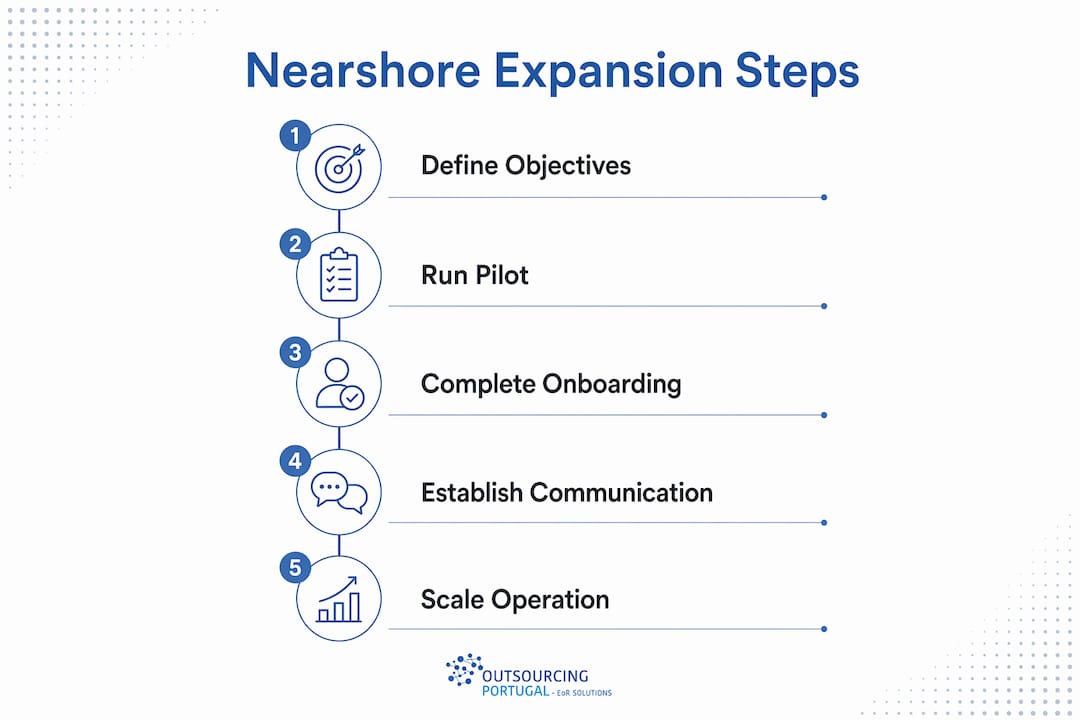
I have watched companies use Portugal as a first nearshore move precisely because it removes so many variables at once. The talent is educated, English-proficient, and available at competitive rates within the EU. The nearshore expansion approach lets you test a decentralized team model without betting the company on it. That is not a small thing when you are managing a global budget under pressure.

The leaders who expand sustainably are the ones who treat patience as a financial discipline, not a personality trait. Speed costs money. Focus saves it.

— Paulo

How Outsourcing-portugal supports cost-effective multinational expansion

Multinational companies that want to hire in Portugal without setting up a local entity have a direct path through Outsourcing-portugal. The platform handles Employer of Record services, payroll compliance, onboarding, and HR support so your team can be operational in weeks rather than months.
https://outsourcing-portugal.co.uk

Outsourcing-portugal works with companies across industries that need to build nearshore teams, test the Portuguese market, or hire Portuguese talent compliantly without the overhead of a local subsidiary. For leaders focused on cost-saving business growth, the combination of Portugal’s competitive labor costs and Outsourcing-portugal’s compliance infrastructure removes the two biggest barriers to affordable expansion. Explore the best employment outsourcing services available for multinational teams, or visit the main employment solutions page to see the full range of EOR and payroll options.

FAQ

What are the most effective cost-effective expansion tips for multinationals?

The most effective approaches combine validated market research, EOR-based hiring, and a single focused marketing channel before scaling to additional markets. These three moves reduce wasted spend at every stage of expansion.

How does an Employer of Record reduce expansion costs?

An EOR eliminates the need to set up a local legal entity, cutting months of setup time and significant fixed costs while keeping hiring fully compliant with local labor law.

Why is channel fragmentation a problem during budget-friendly growth?

Focusing on a single primary acquisition channel for 60–90 days produces better measurable results than splitting effort across multiple platforms. Fragmented channels dilute both budget and team attention.

What hidden costs should multinational leaders budget for during expansion?

The most commonly missed costs include legal and compliance fees, currency conversion losses, international payment fees, and management time spent coordinating across time zones.

How does nearshoring in Portugal support cost-saving business growth?

Portugal offers EU-compliant hiring, a multilingual and highly educated workforce, and labor costs below Western European averages, making it one of the most practical nearshore options for multinationals expanding into Europe.


HR professional reviewing payroll certification papers

Payroll Certification for HR Leaders in Portugal


TL;DR:

  • Payroll certification verifies a professional’s expertise in payroll compliance and reduces legal risks in Portugal. Certified payroll staff ensure accurate reporting, lower penalties, and higher audit readiness for international companies. The most recognized credentials are the CPP, FPC, and regional qualifications like the Pearson BTEC Level 3 Award.

Payroll certification is a formal credential that verifies a professional’s expertise in payroll administration, tax compliance, and workforce regulations. For HR leaders and business leaders managing international payroll in Portugal, certification is not a nice-to-have. It is the clearest proof that your team can handle Portugal’s complex statutory requirements, Social Security contributions, and cross-border reporting obligations without costly errors. The two most recognized global credentials are the Certified Payroll Professional (CPP) and the Fundamental Payroll Certification (FPC), both administered by PayrollOrg. Regional options like the Pearson BTEC Level 3 Award in Payroll Techniques add practical, compliance-focused depth for teams operating within European regulatory frameworks.

1. What is payroll certification and why it matters

Payroll certification is a structured credential that validates knowledge of tax withholding, wage compliance, employee classification, and regulatory reporting. That scope maps directly onto the skills your payroll team needs to operate legally in Portugal. Portugal’s payroll rules require precise handling of Social Security contributions, income tax withholding under the IRS system, mandatory benefits, and monthly reporting to the Portuguese Tax and Customs Authority. A certified professional brings verified competence to each of those tasks, reducing the risk of penalties and audit exposure.

Hands turning pages of payroll compliance manual

Certification also signals credibility to regulators, auditors, and employees. When a multinational company hires staff in Portugal, local authorities expect payroll to be processed accurately and on time. A certified payroll manager gives your organization a defensible record of professional standards.

2. The top payroll certifications for international teams in Portugal

Three credentials stand out for HR professionals and business leaders managing payroll across borders.

  • Certified Payroll Professional (CPP): The CPP is the advanced credential for experienced payroll practitioners. It covers payroll systems, compliance, taxation, management, and auditing. Eligibility requires at least three years of payroll experience within the five years before applying. The CPP suits senior payroll managers and HR directors handling high-stakes compliance decisions.

  • Fundamental Payroll Certification (FPC): The FPC is the entry-level credential. No minimum experience is required, making it accessible to HR generalists, payroll support staff, and professionals transitioning into payroll roles. It covers six content areas weighted by emphasis, including core concepts, compliance, and payroll calculations.

  • Pearson BTEC Level 3 Award in Payroll Techniques: This UK qualification covers statutory payments, tax calculations, family leave, and deductions in a three-day intensive program. While UK-centric, its focus on practical compliance tasks makes it relevant for teams working within European regulatory environments, including Portugal.

The key distinction is scope. The CPP and FPC are U.S.-administered credentials with global recognition, while the Pearson BTEC offers localized, hands-on training closer to European payroll practice.

3. How to prepare for payroll certification exams

Preparation requires understanding the exam structure, costs, and application sequence before you register.

  1. Confirm eligibility. The FPC has no experience requirement. The CPP requires three years of payroll experience within the five years before application. Verify your eligibility before paying any fees.

  2. Review the exam format. The 2026 CPP exam includes 190 multiple-choice questions with a four-hour time limit and a scaled passing score of 300. The FPC follows a similar multiple-choice format with a shorter time window.

  3. Budget for fees. The CPP exam fee is $609. FPC fees are lower, reflecting the entry-level scope. Factor in study materials and any payroll training courses you enroll in before sitting the exam.

  4. Complete the application online. PayrollOrg manages both credentials. You must pay for exams online with PayrollOrg before scheduling your test slot with Pearson VUE. Skipping this step prevents you from booking an exam date.

  5. Schedule your exam with Pearson VUE. Once PayrollOrg authorizes your application, you book your test center or online proctored session through Pearson VUE’s portal.

  6. Plan your study timeline. Most candidates spend 8–12 weeks preparing. PayrollOrg offers official study guides, practice exams, and online payroll certificate prep courses. Supplementing with payroll training courses from accredited providers strengthens your exam readiness.

Pro Tip: Complete your PayrollOrg payment and receive authorization before attempting to book with Pearson VUE. Reversing this sequence causes scheduling delays and can push your exam date back by weeks.

4. Benefits and business impact of payroll certification

Certified payroll professionals deliver measurable value to international companies operating in Portugal.

CPP holders earn approximately $10,000 more per year than uncertified peers. That salary premium reflects the complexity of the role, not just the credential. Certified professionals handle compliance decisions that uncertified staff often escalate or mishandle.

Payroll certifications contribute to better audit readiness, compliance with statutory deductions, benefits administration, and reduce the risk of penalties in multinational company payroll management. For companies operating in Portugal, where Social Security and IRS reporting deadlines are non-negotiable, that risk reduction is direct bottom-line protection.

The business case extends beyond individual salaries. Over 70% of U.S. payroll departments employ at least one CPP to manage complex compliance issues. That adoption rate reflects a clear industry consensus: certified expertise is the standard for professional payroll operations. International companies building teams in Portugal should apply the same standard to their local payroll function.

Key benefits for your organization include:

  • Reduced exposure to fines from late or incorrect Social Security and tax filings
  • Faster audit response with documented, certified payroll processes
  • Higher accuracy in employee classification and statutory deduction calculations
  • Stronger employee trust through accurate, on-time payslips
  • Clearer career paths for HR staff, improving retention

5. Comparing payroll certification options

Choosing the right credential depends on your team’s experience level, your company’s payroll complexity, and your budget.

Certification Cost Validity Recertification Best Fit
FPC Lower than CPP 3 years 60 Credit Hours Entry-level, HR generalists
CPP $609 exam fee 5 years 120 Credit Hours Senior payroll managers
Pearson BTEC Level 3 Varies by provider No expiry listed Not required Practical compliance training

The FPC requires 60 Recertification Credit Hours every three years. The CPP requires 120 Credit Hours every five years. Failing to track and submit those hours means losing your certification status, which requires re-examination or formal reinstatement.

For small and mid-sized international companies entering Portugal, the FPC gives payroll support staff a solid compliance foundation without the experience barrier. For multinationals with dedicated payroll teams, the CPP is the appropriate benchmark. The Pearson BTEC suits professionals who need practical, task-based training on European-style payroll mechanics rather than a formal credential.

Selecting between FPC and CPP ultimately comes down to career stage and job scope. An HR generalist supporting payroll in a 50-person Portugal office benefits most from the FPC. A payroll director managing multi-country payroll across the EU needs the CPP’s advanced scope.

6. How payroll certification integrates with compliance in Portugal

Certified payroll competencies connect directly to the workflows that keep your Portugal operations compliant. The payroll compliance checklist for hiring in Portugal covers statutory deductions, reporting deadlines, and benefits administration. A certified professional knows how to execute each item on that checklist accurately and on schedule.

Certification supports compliance integration in several concrete ways:

  • Audit readiness: Certified professionals document payroll processes to a recognized standard, making it faster to respond to regulatory inquiries from the Portuguese Tax and Customs Authority or Social Security.
  • Statutory deduction accuracy: CPP and FPC curricula both cover deduction calculations in detail, reducing errors in Social Security contributions and income tax withholding.
  • Software integration: Certified payroll managers understand how to configure payroll software to reflect local rules, reducing reliance on manual overrides that introduce errors.
  • Outsourced payroll oversight: When companies use an outsourced payroll provider, a certified internal contact can review outputs, catch discrepancies, and hold the provider accountable.
  • Ongoing education: Both the CPP and FPC require recertification credit hours, which means certified professionals stay current with regulatory changes. Portugal’s labor law evolves regularly, and that ongoing education requirement is a built-in compliance safeguard.

For companies using payroll solutions in Portugal, having a certified professional on your team or working with a provider whose staff holds recognized credentials gives you a clear compliance advantage.

Key Takeaways

Payroll certification is the most direct way to verify that your team can manage Portugal’s statutory payroll requirements accurately, reducing compliance risk and audit exposure.

Point Details
Certification validates compliance skills CPP and FPC credentials confirm expertise in tax withholding, deductions, and regulatory reporting.
Entry vs. advanced credentials FPC suits HR generalists with no experience requirement; CPP requires three years and covers advanced compliance.
Recertification is mandatory FPC requires 60 Credit Hours every three years; CPP requires 120 every five years or credentials lapse.
Certified professionals earn more CPP holders earn approximately $10,000 more per year than uncertified peers, reflecting their compliance value.
Certification reduces business risk Certified payroll staff improve audit readiness and reduce penalty exposure for international companies in Portugal.

Why I think most international companies underestimate payroll certification

Working with international companies setting up operations in Portugal, I see the same pattern repeatedly. Leadership invests heavily in legal entity setup, banking, and office space, then assigns payroll to whoever handled HR admin at headquarters. That person is often capable and well-intentioned, but they are working without a verified framework for Portuguese compliance.

Portugal’s payroll rules are not forgiving. The IRS withholding tables change annually. Social Security rates have specific rules for different employment categories. Reporting deadlines are fixed, and late submissions carry automatic penalties. A certified payroll professional, whether holding a CPP or an FPC, has been tested on exactly this kind of structured, high-stakes compliance work.

The argument I hear against certification is cost and time. The CPP exam alone costs $609, and preparation takes weeks. But compare that to a single penalty from the Portuguese Tax and Customs Authority for incorrect withholding, which can exceed the entire cost of certification many times over.

My recommendation: if you are building a payroll team in Portugal from scratch, require at least one FPC holder on day one. If your payroll complexity spans multiple countries or employment categories, the CPP is the right standard. Treat recertification credit hours as a budget line, not an optional expense. Portugal’s regulatory environment shifts, and your team’s credentials need to shift with it.

— Paulo

Payroll expertise that works for your Portugal operations

International companies managing payroll in Portugal need more than good intentions. They need certified expertise backed by local knowledge.

https://outsourcing-portugal.co.uk

Outsourcing-portugal provides payroll services in Portugal delivered by specialists who understand both Portuguese labor law and the compliance standards that international companies require. From Social Security filings to income tax withholding and monthly reporting, the team handles every element of payroll accurately and on schedule. For companies that want the full employment solution, Outsourcing-portugal’s Employer of Record services let you hire in Portugal without setting up a local entity, with certified payroll management built in from day one.

FAQ

What is payroll certification?

Payroll certification is a formal credential that verifies a professional’s knowledge of payroll administration, tax compliance, and workforce regulations. The two most recognized credentials are the CPP and FPC, both administered by PayrollOrg.

How do I get payroll certified?

Complete the PayrollOrg application online, pay the exam fee, receive authorization, then schedule your exam through Pearson VUE. The CPP requires three years of payroll experience; the FPC has no experience requirement.

How much does the CPP exam cost?

The 2026 CPP exam fee is $609, covering a 190-question multiple-choice exam with a four-hour time limit and a scaled passing score of 300.

How long is a payroll certification valid?

The FPC is valid for three years and requires 60 Recertification Credit Hours to renew. The CPP is valid for five years and requires 120 Credit Hours. Failing to meet recertification requirements results in loss of credentials.

Do I need payroll certification to manage payroll in Portugal?

Certification is not legally required in Portugal, but it is the clearest way to demonstrate that your team meets professional compliance standards. Certified professionals reduce audit risk and penalty exposure for international companies operating under Portuguese labor law.

Payroll Outsourcing for International Business: 2026 Guide


TL;DR:

  • Payroll outsourcing assigns third-party providers to manage wage calculations, taxes, filings, and employee payments globally. It lowers costs, minimizes compliance risks, and ensures local legal adherence through expert oversight and system integrations. Businesses should treat outsourcing as an ongoing partnership, with clear controls and local expertise to maximize its benefits.

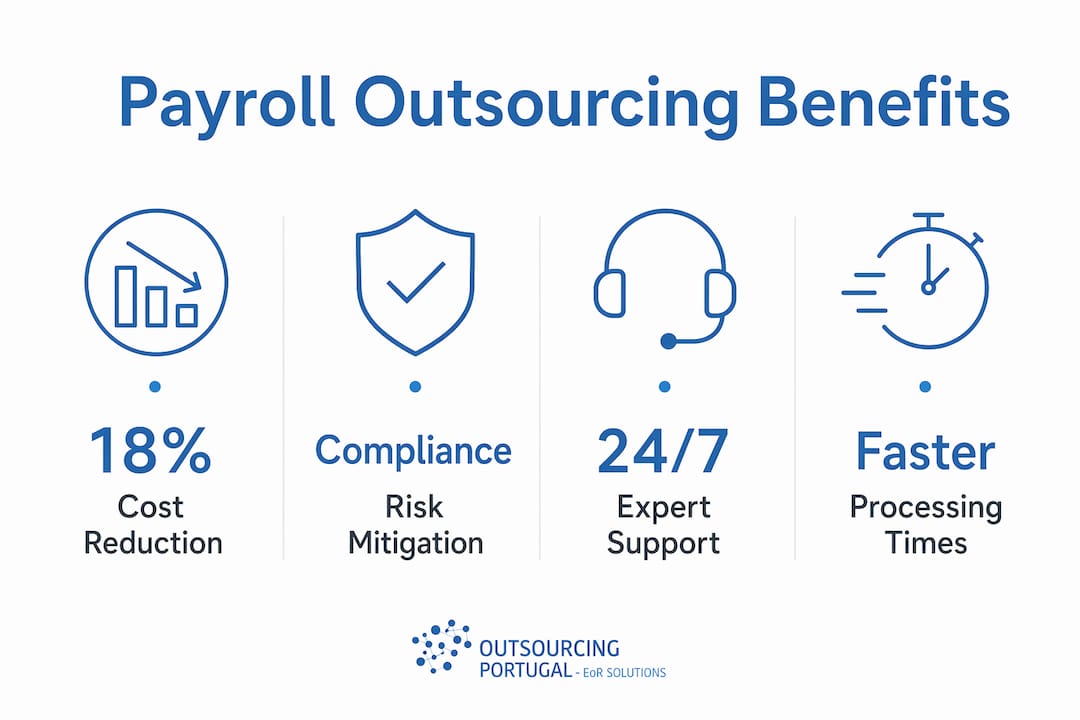
Payroll outsourcing is defined as the practice of delegating your company’s payroll administration to a third-party specialist who handles wage calculation, tax withholding, statutory filings, and employee payments on your behalf. For international businesses entering new markets, this model replaces the need to build costly in-house payroll expertise from scratch. Employers can reduce payroll-related costs by an average of 18% through outsourcing, primarily by cutting administrative overhead and avoiding compliance penalties. That figure alone makes the business case clear before you hire your first overseas employee.

What does payroll outsourcing actually cover?

Payroll outsourcing goes well beyond cutting checks. A full-service provider manages the entire payroll cycle: collecting hours and compensation data, calculating gross and net wages, applying the correct tax withholding rates, processing statutory deductions, and transferring funds to employee accounts on schedule. The provider also handles employer-side filings with tax authorities and social security agencies in each jurisdiction where you operate.

Most providers also include these services within a standard engagement:

  • Year-end tax reporting: Preparation and submission of annual employee tax documents required by local law
  • Compliance monitoring: Automatic updates when tax codes, minimum wage rates, or social contribution rules change
  • Employee self-service portals: Digital access for workers to view pay stubs, tax documents, and leave balances
  • Multi-currency payroll: Processing wages in local currencies across multiple countries from a single platform
  • Statutory benefit administration: Calculation and remittance of pension contributions, health insurance, and other mandated benefits

The critical distinction between payroll outsourcing and payroll software is expert oversight. Software automates calculations but leaves filing, compliance interpretation, and error resolution to your internal team. Outsourcing transfers that execution responsibility to specialists who do this work daily across multiple jurisdictions. For a company entering Portugal or another EU market for the first time, that difference is significant. You can read more about managing international payroll in Portugal to understand what local compliance actually demands.

Pro Tip: Start with a full-service engagement for your first international market. Once you understand local payroll requirements, you can negotiate a narrower scope if your volume justifies it.

Close-up of hands handling payroll paperwork

How does payroll outsourcing reduce costs and risk?

Infographic highlighting payroll outsourcing key benefits

The financial case for outsourcing payroll rests on two pillars: lower operating costs and reduced penalty exposure. Basic payroll processing starts under $100 per month, with per-employee fees typically ranging from $2–$5 monthly for comprehensive solutions. That pricing model is almost always cheaper than the fully loaded cost of an internal payroll specialist, especially when you factor in software licenses, training, and the time your HR or finance team spends on compliance research.

The risk reduction argument is equally strong. 78% of employees would face significant financial difficulty if their paycheck were delayed by just one week. That statistic reframes payroll accuracy as an employee retention issue, not just an administrative one. A single missed payroll cycle in a new market can damage trust with your local workforce before your operation gains traction.

Outsourcing payroll mitigates compliance drift by keeping your payroll automatically aligned with local tax code updates. When Portugal revises its IRS withholding tables or the EU adjusts social contribution rules, your provider absorbs that change. Your team does not need to monitor it.

The table below summarizes the core financial and operational benefits:

Benefit What it means in practice
18% average cost reduction Lower overhead from eliminating internal payroll administration
Penalty avoidance Specialists catch filing errors before tax authorities do
Predictable pricing Per-employee fees make budgeting straightforward as headcount grows
Compliance currency Tax code changes are applied automatically without internal research

Pro Tip: Ask any provider to show you their error rate and penalty history across their client base. A reputable firm will share this data. One that refuses is telling you something important.

What are the key challenges of international payroll outsourcing?

Outsourcing payroll internationally introduces challenges that go beyond the domestic version of the same decision. The most important one is legal: employers remain legally responsible for payroll accuracy and tax deadlines even after outsourcing. The provider executes the work, but the liability stays with you. That means you need internal controls to verify what your provider submits, not just trust that it is correct.

The second major challenge is system integration. A lack of integration between time-tracking and payroll systems leads to manual data reconciliation and the errors that come with it. If your HR platform does not connect directly to your provider’s system, someone on your team manually transfers hours, leave balances, and compensation changes every pay cycle. That manual step is where mistakes happen.

Here are the most common implementation challenges international businesses face:

  • Data migration accuracy: Historical payroll records, employee classifications, and tax IDs must transfer without gaps
  • Parallel run requirements: Switching providers requires parallel payroll runs and extensive data reconciliation to catch discrepancies before going live
  • Year-end timing: Transitioning mid-year creates reporting complexity, since annual tax documents must reflect the full calendar year
  • Local expertise gaps: A provider with strong US or UK operations may lack depth in Portuguese labor law or EU social security rules
  • Customization limits: Standardized service packages may not accommodate your specific bonus structures, commission calculations, or equity compensation

When selecting a provider for Portugal or another EU market, verify their local legal team’s credentials. Ask specifically whether they employ licensed tax advisors in the target country, not just regional generalists. Outsourcing-portugal works with providers who hold in-country expertise across Portuguese employment law, which matters when edge cases arise.

The numbered steps below outline a sound implementation sequence:

  1. Audit your current payroll data for accuracy and completeness before any migration begins
  2. Map your HR and time-tracking systems to confirm API or file-based integration is available
  3. Run parallel payrolls for at least two full cycles before decommissioning your previous system
  4. Assign an internal owner to review provider outputs each pay period and flag discrepancies
  5. Establish an escalation path with your provider for urgent compliance questions

How do you choose the right payroll outsourcing provider?

Provider selection determines whether outsourcing delivers its promised benefits or creates new problems. The evaluation criteria that matter most for international businesses differ from those relevant to domestic companies.

Jurisdiction expertise is the first filter. A provider must demonstrate direct experience with the tax codes, labor laws, and filing requirements of every country where you employ people. Generic claims of “global coverage” are not sufficient. Ask for a client reference in your target market and verify that the reference operates under similar employment structures to yours.

Technology platform quality is the second filter. The right platform offers cloud-based access, automated tax table updates, and direct API integration with major HR systems like Workday, BambooHR, or SAP SuccessFactors. Security certifications matter too. Look for SOC 2 Type II compliance or equivalent, which confirms the provider has audited controls over your payroll data. You can also explore payroll services in Portugal to understand what a well-structured local engagement looks like.

Key evaluation criteria to apply during provider selection:

  • Scope flexibility: Businesses can outsource only high-risk compliance tasks initially while retaining simpler processing in-house. Confirm your provider supports partial outsourcing if that fits your current stage.
  • Support responsiveness: Payroll errors are time-sensitive. Your provider must offer same-day escalation for critical issues, not a 48-hour ticket queue.
  • Reporting and analytics: Monthly payroll reports should include cost-per-employee breakdowns, variance analysis, and compliance status by jurisdiction.
  • Scalability: Confirm the provider can handle your projected headcount growth without renegotiating the entire contract.
  • Transparent pricing: Request a full fee schedule including setup fees, per-run charges, and costs for off-cycle payrolls.

For businesses exploring payroll solutions across multiple European markets, payrolling via NOWJOBS offers a practical model worth reviewing alongside your other options.

Pro Tip: Negotiate a service-level agreement that specifies maximum processing times, error correction windows, and financial remedies if the provider misses a filing deadline. Without it, you have no recourse when something goes wrong.

Key Takeaways

Payroll outsourcing reduces costs, eliminates compliance drift, and frees international businesses to focus on growth rather than administrative execution.

Point Details
Average cost reduction Outsourcing cuts payroll overhead by an average of 18%, primarily through fewer penalties and lower staffing costs.
Legal liability stays with you Employers remain responsible for accuracy and tax deadlines regardless of who processes the payroll.
Integration is non-negotiable Connecting HR and time-tracking systems to your provider eliminates manual reconciliation errors.
Partial outsourcing is valid Starting with high-risk compliance tasks only gives you control while reducing your most costly exposure.
Local expertise matters most Providers must hold in-country knowledge of labor law, not just regional generalist coverage.

What I’ve learned about payroll outsourcing after years of watching companies get it wrong

The most common mistake I see international businesses make is treating payroll outsourcing as a set-and-forget decision. They sign a contract, hand over their data, and assume the problem is solved. Six months later, they discover their provider has been applying the wrong social contribution rate, and the liability has been accumulating the entire time.

The businesses that get the most value from outsourcing treat it as a working partnership. They assign an internal payroll owner who reviews every output before it is finalized. They schedule quarterly reviews with their provider to discuss regulatory changes, headcount shifts, and upcoming compliance deadlines. They ask for data, not just assurances.

The second thing I have learned is that the onboarding phase is where most problems originate. Providers often underestimate the complexity of a client’s existing payroll data, and clients often overestimate how clean their records are. A parallel run period is not optional. It is the only way to catch discrepancies before they become penalties.

My honest recommendation: before you sign with any provider, ask them to walk you through a real compliance failure they experienced with a client and how they resolved it. A provider who has never made a mistake either has not been doing this long enough or is not being honest with you. The ones who can describe a failure clearly and explain what they changed afterward are the ones worth trusting.

Payroll data also contains your most granular workforce cost information. The businesses using it well are running monthly cost-per-department analyses and feeding that data into hiring decisions. Most businesses are not doing this. That gap is a real competitive advantage waiting to be used.

— Paulo

Payroll and employment solutions for international businesses entering new markets

International businesses entering Portugal or other EU markets face a specific challenge: they need payroll compliance from day one, but they do not yet have the local knowledge to verify what “compliant” actually means in practice.

https://outsourcing-portugal.co.uk

Outsourcing-portugal works with international companies at exactly this stage. The platform connects businesses with vetted employment and payroll specialists who hold in-country expertise across Portuguese labor law, tax filings, and EU compliance requirements. Whether you need a full Employer of Record arrangement or targeted payroll support, the right structure depends on your headcount, timeline, and risk tolerance. The best employment outsourcing services for 2026 page outlines the top-rated agencies currently serving international clients in Portugal, with transparent scope descriptions to help you compare options. You can also review the full range of payroll and employment services available through the platform.

FAQ

What is payroll outsourcing?

Payroll outsourcing is the practice of hiring a third-party provider to manage payroll functions including wage calculation, tax withholding, statutory filings, and employee payments. It replaces the need for an internal payroll team and provides access to specialized compliance expertise.

How much does payroll outsourcing cost?

Basic payroll processing starts under $100 per month, with per-employee fees ranging from $2–$5 monthly for comprehensive services. Total cost depends on headcount, the number of jurisdictions covered, and the scope of compliance services included.

No. Employers remain legally responsible for payroll accuracy and tax deadline compliance even after outsourcing. The provider executes the work, but the legal obligation stays with your company.

What is the role of payroll management in international expansion?

Payroll management handles the calculation, payment, and reporting of employee compensation in compliance with local labor and tax law. For international businesses, accurate payroll management is the foundation of legal employment in any new market.

Can I outsource only part of my payroll process?

Yes. Businesses can outsource only high-risk compliance tasks initially while retaining simpler processing in-house. This phased approach gives you control over the transition and reduces your most costly compliance exposure first.

Business owner reviewing outsourcing documents

Online Outsourcing for Business Owners: 2026 Guide


TL;DR:

  • Online outsourcing allows businesses to delegate functions to global talent through internet platforms, reducing costs and speeding up hiring. Managed remote staffing and EOR services offer high control and compliance, making them suitable for core roles, while freelance markets suit short-term tasks. Success depends on building SOPs, defining SLAs, and choosing the right model for each role to ensure efficiency and legal safety.

Online outsourcing is the practice of delegating business functions to skilled external providers through internet-based platforms and managed partnerships. This model gives business owners access to global talent without the overhead of local hiring, office space, or entity setup. Businesses transitioning to managed remote outsourcing report cost savings of up to 70% depending on model and geography. That number reflects a structural shift, not a temporary trend. Whether you need a virtual assistant, a software engineer, or a full finance team, the right outsourcing model determines how fast you scale and how much control you keep.

What are the main models of online outsourcing?

Professionals discussing outsourcing models

Online outsourcing, also called remote outsourcing in managed staffing contexts, falls into three distinct models. Each serves a different business need, and choosing the wrong one costs time and money.

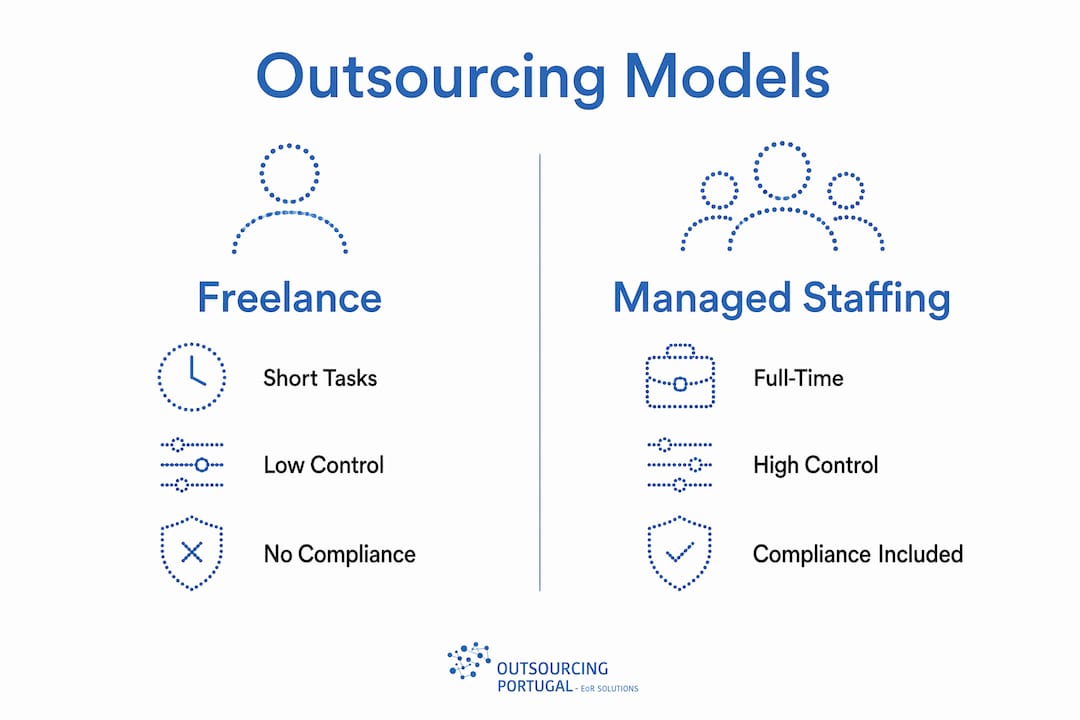
Freelance marketplaces connect you with independent contractors for fixed-price or hourly gigs. These platforms suit one-off creative projects, content production, or short-term technical tasks. Marketplace fees range from 0–20% of the project cost, which affects your total budget. Governance is minimal, and long-term retention is low.

Managed remote staffing places dedicated full-time employees under your operational direction. A third-party provider handles payroll, legal compliance, and HR administration. This model gives you team control without the legal burden of setting up a local entity. EOR models enable fast onboarding with full legal and tax compliance built in.

Employer of Record (EOR) services are a subset of managed staffing where the provider becomes the legal employer on your behalf. This is the most compliant path for hiring across borders. Outsourcing-portugal specializes in exactly this model for companies hiring in Portugal.

Model Best for Control level Compliance handled
Freelance marketplace Short tasks, gig work Low No
Managed remote staffing Dedicated full-time roles High Partial
EOR service Cross-border legal hiring High Full

The key distinction is this: freelance platforms excel at gig work but lack governance and compliance structures needed for strategic hiring. Managed staffing and EOR fill that gap.

Infographic comparing freelance and managed staffing models

How does online outsourcing cut costs and speed up hiring?

Cost reduction is the most cited reason businesses pursue remote outsourcing, and the numbers are real. Eliminating office infrastructure, local recruitment overhead, and employer tax burdens accounts for the bulk of savings. Entry-level remote full-time staff in markets like the Philippines start at around $700/month as of 2026. That figure does not include management fees, but even with those added, the total remains well below equivalent local hiring costs in Western Europe or North America.

Speed is the second major advantage. Deploying a managed remote team typically takes 7–21 days. Traditional recruitment for the same roles takes 4–8 weeks. Individual contractors through EOR services can be onboarded in as little as 48 hours when documentation is ready.

The cost benefits break down across several categories:

  • No office lease, equipment provisioning, or facilities management
  • No local employer social contributions or entity setup fees
  • Reduced recruitment advertising and agency costs
  • Lower onboarding time means faster time to productivity

Pro Tip: Pushing for the fastest possible hire increases turnover risk. Speedy hiring risks quality and raises churn. Managed partners balance speed with candidate vetting, which protects your investment over a 12-month horizon.

Managed remote IT teams specifically reduce total cost of ownership by 30–40% and achieve 85% retention at the 12-month mark. That retention figure matters because replacing a remote hire costs roughly the same as replacing a local one.

What are best practices for successful remote outsourcing?

The most common failure in remote outsourcing is treating external hires as a fix rather than a team extension. Businesses frequently fail when they skip the operational layer and expect remote workers to self-manage without structure. The fix is straightforward: build your standard operating procedures (SOPs) before you hire, not after.

Define your SOPs first

Every repeatable task your remote hire will perform needs a written process. This does not mean a 50-page manual. It means a clear step-by-step document covering inputs, outputs, tools used, and escalation paths. Remote workers perform better with written clarity than with verbal instructions delivered across time zones.

Set SLAs and monitor them

Service-level agreements (SLAs) define what “done” looks like. Without them, you have no objective basis for performance reviews or contract decisions. Governance with SLAs and security protocols like SOC 2 and ISO 27001 maintains operational visibility and mitigates delivery risk. These are not optional for roles that touch sensitive data.

Pro Tip: Schedule weekly check-ins for the first 90 days of any remote hire. Feedback loops in the early stage prevent small misalignments from becoming expensive problems.

Additional practices that separate successful remote teams from struggling ones:

  • Assign a dedicated internal point of contact for each remote hire
  • Use project management tools to track deliverables, not just hours
  • Run structured onboarding for the first two weeks, even for experienced hires
  • Separate one-off freelance tasks from ongoing managed roles in your budget planning

Remote outsourcing success depends on treating remote workers as integrated team members, not isolated contractors. The technology is easy. The management discipline is where most businesses fall short.

Which roles are best suited for online outsourcing?

Role complexity and business criticality determine which outsourcing model fits best. Popular outsourced roles include virtual assistants, software engineers, digital marketers, customer support agents, and finance administrators. Each category has a natural home in either freelance or managed staffing.

Virtual assistant hiring through managed staffing works well for ongoing calendar management, inbox handling, and research tasks that require consistent availability. A freelance marketplace works for a one-time data entry project but not for a VA who needs to understand your business over months.

IT roles sit firmly in managed staffing territory. Software development, QA testing, and DevOps require continuity, IP protection, and security compliance. Managed remote staffing offers better accountability, cultural alignment, and retention than freelance outsourcing for these core functions.

Role category Recommended model Key reason
Virtual assistant Managed staffing Requires consistency and context
Software engineer Managed staffing or EOR IP protection, continuity
Content writer Freelance marketplace Task-based, output-driven
Customer support Managed staffing Brand alignment, training
Finance admin EOR or managed staffing Compliance and data sensitivity
Graphic designer Freelance marketplace Project-based, clear deliverables

The rule of thumb: if the role touches your core product, your customer data, or your financial records, use managed staffing or EOR. If it produces a discrete deliverable with no ongoing access to sensitive systems, a freelance platform is sufficient. You can find proven talent acquisition strategies for tech roles that apply directly to remote team building as well.

Key Takeaways

Managed remote staffing and EOR services deliver the cost savings, speed, and compliance that freelance platforms cannot match for core business functions.

Point Details
Cost savings are real Managed remote outsourcing cuts costs by 50–70% compared to equivalent local hiring.
Speed depends on the model EOR onboarding takes 7–21 days; traditional recruitment takes 4–8 weeks.
SOPs come before hiring Build written processes before your remote hire starts to prevent misalignment.
Role complexity guides model choice Strategic and data-sensitive roles require managed staffing or EOR, not freelance platforms.
Governance protects delivery SLAs, SOC 2, and ISO 27001 compliance are non-negotiable for remote teams handling sensitive work.

What I’ve learned after years of watching remote outsourcing go wrong

Most businesses get the cost math right and the management math completely wrong. They calculate the salary savings, sign a contract, and then wonder why their remote hire is underperforming at month three. The answer is almost always the same: no SOPs, no feedback loop, and no real integration into the team’s daily rhythm.

The other mistake I see constantly is using a freelance marketplace for roles that need managed staffing. A marketplace is a tool for buying a deliverable. It is not a tool for building a team. When a business owner tells me their “outsourcing didn’t work,” I ask one question: did you treat that person like an employee or like a vendor? The answer tells me everything.

Compliance is the area where the stakes are highest and the knowledge gaps are widest. Hiring across borders without an EOR or a proper legal structure exposes you to tax liability, labor law violations, and IP disputes. The EOR service benefits for international business leaders go well beyond convenience. They are a legal shield.

My honest recommendation: start with one managed remote hire in a non-critical role, build your SOP library during that first engagement, and then scale. The businesses that treat remote outsourcing as a system, not a shortcut, are the ones that still have their remote teams two years later.

— Paulo

How Outsourcing-portugal supports your remote hiring goals

Outsourcing-portugal works with international companies that need to hire in Portugal without setting up a local entity. The service covers the full employment cycle: legal onboarding, payroll, HR support, and compliance with Portuguese labor law.

https://outsourcing-portugal.co.uk

Portugal offers a multilingual, highly educated workforce with competitive labor costs inside the European Union. That combination makes it one of the strongest nearshore options for tech, customer support, and professional services teams. Outsourcing-portugal handles the legal and administrative layer so you retain full operational control of your team. If you are ready to build a compliant remote team in Portugal, the top employment outsourcing agencies reviewed by Outsourcing-portugal give you a vetted starting point. You can also review the full EOR workflow in Portugal to understand exactly how fast onboarding works in practice.

FAQ

What is online outsourcing?

Online outsourcing is the practice of contracting external providers through internet-based platforms or managed partnerships to deliver business functions or projects. It covers everything from freelance gig work to full-time managed remote staffing with legal compliance.

How much can a business save with remote outsourcing?

Businesses using managed remote outsourcing report savings of 50–70% compared to equivalent local hiring, depending on the model and the geography of the remote team.

What is the difference between freelance outsourcing and managed staffing?

Freelance platforms suit fixed-price, task-based work with minimal governance. Managed staffing provides dedicated full-time employees with SLAs, compliance, and operational integration, making it the better fit for strategic or ongoing roles.

How long does it take to hire a remote team?

Managed remote teams deploy in 7–21 days through EOR services, compared to 4–8 weeks for traditional recruitment. Individual contractors can be onboarded in as little as 48 hours when documentation is complete.

What roles work best for online outsourcing?

Virtual assistants, software engineers, customer support agents, digital marketers, and finance administrators are the most commonly outsourced roles. Strategic and data-sensitive roles require managed staffing or EOR; discrete creative tasks suit freelance platforms.

Top 3 iberiaeor.com Alternatives Agencies 2026

Finding an employer of record service that blends local expertise, fast onboarding, and bundled HR without creating a legal entity is a challenge in Southern Europe and Brazil. Many competitors force you to open a subsidiary or engage third-party vendors for compliance, which slows hiring and increases risk. This comparison outlines hiring speed, geographic reach, and bundled services across three agencies so you can match one to your expansion plans.

Table of Contents

Outsourcing Portugal

https://outsourcing-portugal.co.uk

At a Glance

According to the company, you can hire in Portugal within days without establishing a local entity using its Employer of Record workflows. The platform bundles payroll, visa support, and local HR into a single engagement. That setup targets fast market entry while keeping a legal footprint minimal.

Core Features

Outsourcing-portugal delivers employment solutions that cover hiring, onboarding, payroll services, and HR support across Portugal and the EU. The offering includes Employer of Record (EOR) services for compliant hiring, nearshore outsourcing options for building development teams, and softlanding services that handle legal compliance, visas, and operational setup. The platform also provides payroll management for tax and social security compliance and local recruitment and office setup support.

Key Differentiator

Local legal and HR expertise is the standout feature that underpins the fast onboarding claim. That expertise lets companies hire without forming a local subsidiary while meeting Portuguese labor and tax rules. The focus on combining legal counsel with HR operations reduces handoffs between vendors.

Pros

Quick market entry lowers the time your core team spends on administrative setup. Compliance support covers Portuguese labor law, payroll taxes, and social security, which reduces legal risk when hiring residents. The service leverages Portugal’s highly educated, multilingual workforce and competitive labor costs to keep operational budgets lean. Outsourcing-portugal adapts for startups, SMEs, and global firms that need nearshore development teams or call center staffing.

Cons

  • Costs can add up depending on the scope and size of the engagement.

Who It’s For

Global companies and startups that want to hire Portuguese residents without creating a local entity will find this useful. Tech firms building nearshore development teams, and companies testing the Portuguese or EU market, fit the model well. Organizations that need visa, payroll, and HR support alongside recruitment will see the most value.

Unique Value Proposition

Softlanding services include visas, legal compliance, office setup, and bespoke recruitment alongside payroll and HR support. Bundling those services into one engagement reduces the number of external vendors you must manage. That setup lets your product and engineering teams focus on delivery while local experts handle employment operations.

Real World Use Case

A US-based tech startup hires a Portuguese software engineer through Outsourcing-portugal’s EOR to avoid opening a subsidiary. The vendor handles the employment contract, payroll, and social security filings. The startup keeps product development on schedule while local teams manage compliance and relocation.

Pricing

Pricing is quote based and depends on scope, team size, and services chosen. Typical engagements include setup fees plus monthly service charges for payroll and HR management. Prospective clients should request a custom estimate that reflects visa, recruitment, and office setup needs.

Website: https://outsourcing-portugal.co.uk

Bridge In

https://bridgein.pt

At a Glance

Bridge In operates fully owned local operations in Portugal. That setup lets them handle payroll, local taxes, and HR under Portuguese law. The firm focuses on Portugal, Spain, and Italy for Employer of Record and market entry services.

Core Features

Bridge In offers Employer of Record services across Portugal, Spain, and Italy, which includes payroll and benefits management and foreign employer registration. They handle company incorporation and provide Build-Operate-Transfer arrangements for teams that may later move to a local subsidiary. The agency also acts as interim management for new subsidiaries while clients establish local governance.

Key Differentiator

Bridge In runs its own local operations in Portugal, which keeps core compliance and back office work inside the company rather than outsourcing it. That ownership shortens coordination with local authorities and reduces handoffs. For companies wanting a single accountable partner on the ground, that local control is the main selling point.

Pros

Bridge In specializes in Southern Europe, so its team knows region-specific employment rules and tax practices. Their in-house staff manages payroll, benefits, and foreign employer registration, reducing the number of third parties you must work with. The firm adapts service scope by growth stage, from pure Employer of Record arrangements to build-operate-transfer projects. Acting as interim management helps companies that lack local leadership during initial months.

Cons

  • Premium service pricing may be a barrier for very early stage startups.
  • Limited to Portugal, Spain, and Italy, which restricts expansion outside Southern Europe.
  • Dependent on local legal and regulatory changes in target countries, which can affect timelines and costs.

When It May Not Fit

If you need immediate full ownership and direct control of a local entity, Bridge In may not match your requirements. Their focus on Southern Europe makes them a poor choice for companies targeting northern or global markets. Smaller teams with tight budgets may find the pricing and service scope too large for their needs.

Who It’s For

Bridge In fits tech or tech-enabled companies, startups, and scale-ups aiming to staff Portugal, Spain, or Italy without forming a legal entity first. It works for teams that want a single vendor to handle payroll, HR, and local compliance. The service suits firms planning to transfer operations to a local subsidiary later.

Real World Use Case

A US SaaS vendor used Bridge In to hire its first three engineers in Lisbon through an Employer of Record contract. Bridge In ran payroll, registered the foreign employer, and provided local HR support while the vendor evaluated office locations. The vendor later moved to a local subsidiary using the build-operate-transfer path.

Pricing

Bridge In does not publish standard prices online. Their pricing is generally positioned at a premium level and often depends on country, headcount, and the chosen delivery model. Prospective clients should request a tailored quote to compare cost against other Employer of Record options.

Website: https://bridgein.pt

PortuGer

https://portuger.com

At a Glance

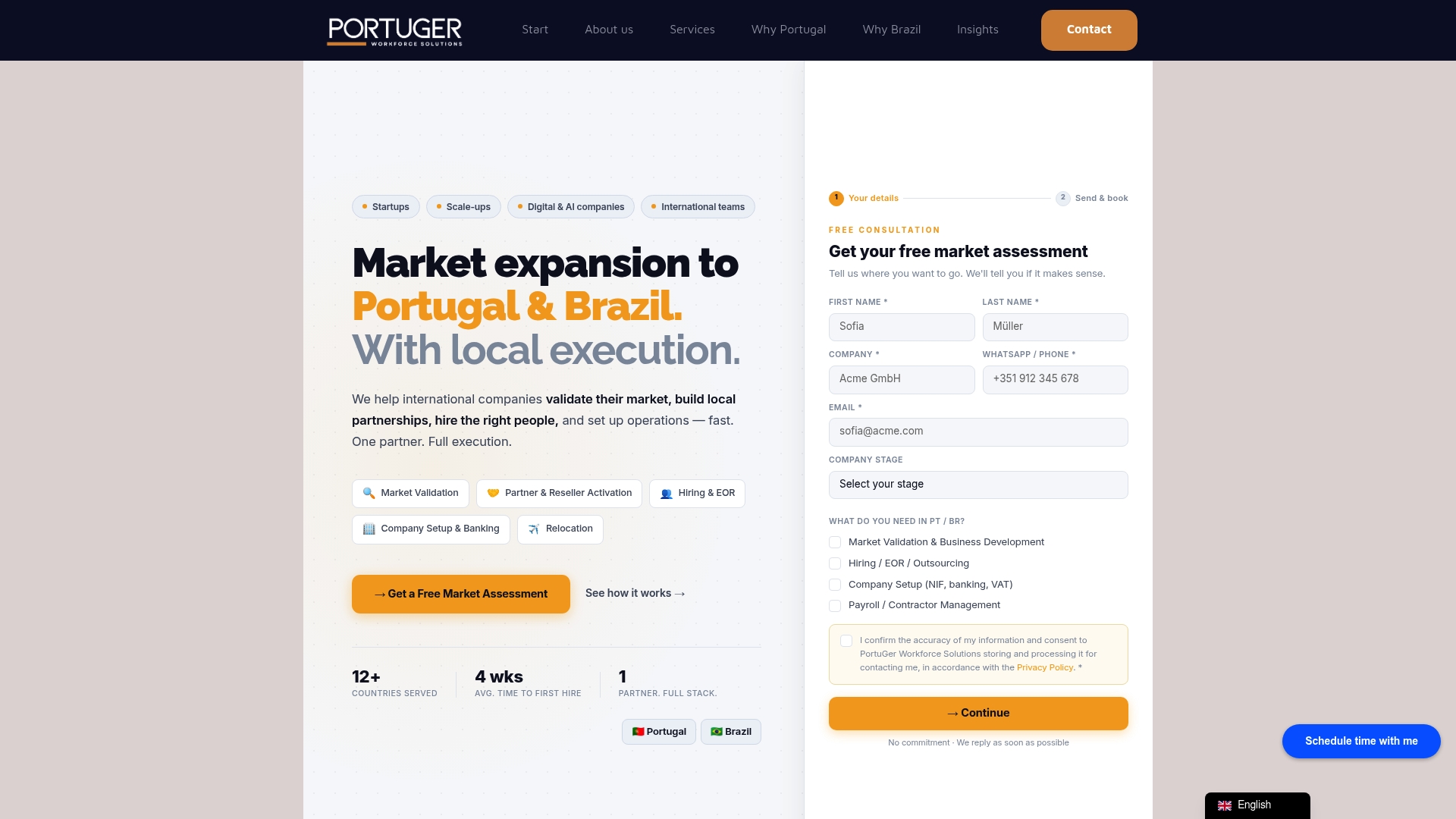
PortuGer reports market validation in 2–4 weeks with real buyer signals. That early validation pairs with hands-on company setup in Portugal and Brazil. The combination favors teams that want a full local presence rather than a paper only market test.

Core Features

PortuGer runs market validation and then moves into company formation and hiring support in Portugal and Brazil. They provide employer of record services, payroll set up that follows local legal and tax rules, and relocation plus soft landing assistance for founders and teams. Operational setup covers banking, tax registration, and ongoing partner coordination for payroll, compliance, and market activation.

Key Differentiator

PortuGer centers its offering on structured, honest local validation followed by full operational execution in Portugal and Brazil. Their process uses clear milestones and deliverables and relies on an on the ground team and network. That combination makes them a provider for companies that plan to build and staff a real local operation.

Pros

Deep local expertise in both countries accelerates operational tasks and reduces back and forth with local authorities. Their emphasis on honest advice means recommendations may favor long term viability over fast wins. The firm follows a structured process with milestones, which keeps founders informed and reduces handover friction to local payroll and compliance.

Cons

  • Service footprint is limited to Portugal and Brazil, so global expansions beyond those markets require another partner.
  • Not suited for companies that only want a token or superficial presence without local legal setup.
  • Clients report the firm’s cautious advice can slow decision cycles for teams hoping for very fast, high risk moves.

When It May Not Fit

PortuGer may not fit if your primary goal is a short term market test without forming a local entity. The service model assumes you want local contracts, payroll, and tax registration. If you need rapid expansion across many countries, their two-country focus will feel narrow.

Who It’s For

Operationally proven companies and international founders expanding into Portugal or Brazil will get the most value. Tech startups and scale ups that want local hires, compliant payroll, and relocation support match the offering well. Multinational teams seeking a sustained local presence will find the operational depth useful.

Real World Use Case

A US SaaS startup used PortuGer for a short validation phase and surfaced local buyer signals during that validation period. They then formed a Portuguese entity, hired a small local team, and handed payroll and compliance to PortuGer. That sequence let the startup scale hiring without gaps in local legal or payroll compliance.

Website: https://portuger.com

Comparison of alternatives

When comparing employer-of-record options for expanding into Portugal, the choice of provider significantly impacts business integration and efficiency. Clients should carefully weigh each service’s strengths and limitations against their operational goals.

Regional Coverage and Expansion Opportunities

Among the options, Bridge In extends its services not only to Portugal but also to Spain and Italy. This wider territorial reach provides an advantage for organizations seeking a multi-country employer-of-record solution in Southern Europe. However, for businesses focused solely on Portugal, Outsourcing-Portugal provides specialized services tailored to the country’s specific legal and labor market requirements. PortuGer, on the other hand, includes Brazil in its service area, making it suitable for organizations targeting both European and South American markets.

Service Structure and Operational Transparency

PortuGer offers a structured approach with defined project milestones, maintaining clear timelines during legal and operational setup. This feature suits companies that prioritize methodical and predictable expansion processes. Conversely, Outsourcing-Portugal focuses on a bundled setup that integrates legal, HR, and payroll management, significantly reducing project complexity for businesses entering just the Portuguese market.

Best fit

  • Expanding into Portugal without establishing a local subsidiary while ensuring compliant operations—opt for Outsourcing Portugal for its integrated services focused on the region.
  • Expanding into Southern Europe—choose Bridge In for its extended presence in Spain and Italy.
  • Requiring a phased and transparent approach during initial validation and setup—utilize PortuGer for its structured project milestones.

Our pick

Outsourcing Portugal emerges as the preferred choice for businesses prioritizing rapid market entry combined with localized compliance expertise. Its integration of legal, HR, and payroll services designed specifically for the Portuguese market minimizes administrative overhead. However, companies targeting multi-country operations or needing in-depth expansion plans might consider other providers to suit their broader strategies.

Employment solutions with a streamlined setup simplify market entry through legal compliance and competitive support.

Product Key Differentiator Best For Pricing Notable Limitation
Outsourcing-portugal Local expertise enables quick onboarding Global companies hiring in Portugal quickly Not disclosed Potential cost escalation with service scope.
Bridge In In-house local operations in Portugal Firms aiming for accountability in Southern EU Not disclosed Restricted to Southern Europe region.
PortuGer Local validation and operational execution Firms setting up full operations in PT/BR Not disclosed Limited to Portugal and Brazil.

Explore Outsourcing-portugal for Reliable IberiaEOR.com Alternatives

Choosing an Employer of Record partner requires navigating labor laws, managing payroll, and ensuring compliance without local entities. Many companies face delays and complexity when expanding into Portugal and the broader Iberian market. Outsourcing-portugal solves these pain points by offering a streamlined EOR service that bundles hiring, payroll, visa support, and HR under one roof. This reduces legal risks and administrative overhead while tapping into Portugal’s skilled, multilingual workforce.

https://outsourcing-portugal.co.uk

If you’re seeking dependable iberiaeor.com alternatives, Outsourcing-portugal delivers fast market entry and full legal compliance. Visit Outsourcing-portugal today to get a custom estimate. Take control of your international hiring with payroll management and employment solutions designed for smooth expansion into Portugal.

FAQ

What are the key benefits of using Outsourcing-portugal?

Outsourcing-portugal allows companies to hire without establishing a local entity, simplifying payroll, visa support, and HR processes. This service targets fast market entry while minimizing legal footprint, making it efficient for global companies. Businesses can expect a quick and compliant hiring process with reduced administrative burden.

How does Outsourcing-portugal compare to Bridge In for hiring in Southern Europe?

Bridge In specializes in Southern Europe, providing local payroll, taxes, and HR management, which can streamline operations for companies in those specific markets. Outsourcing-portugal excels in catering to tech firms needing fast hiring and support for diverse development teams across broader regions. The choice depends on whether your operations will remain concentrated in Southern Europe or may expand further.

What services does Outsourcing-portugal provide for businesses needing HR support?

Outsourcing-portugal delivers comprehensive HR support, which encompasses hiring, onboarding, payroll services, and compliance with Portuguese labor law. Its Employer of Record services ensure legal adherence and streamline administrative processes, allowing businesses to focus on their core operations.

Can I access local recruitment services through Outsourcing-portugal?

Yes, Outsourcing-portugal provides local recruitment services along with payroll and other HR management solutions. This facilitates a smoother hiring process tailored to the specific needs of the Portuguese market.

What considerations should I keep in mind about outsourcing locations when using Outsourcing-portugal?

Outsourcing-portugal thrives in providing solutions for companies aiming to enter the Portuguese and broader EU markets efficiently. Firms looking for immediate full ownership and direct control over local entities may find it beneficial to explore other options, as Outsourcing-portugal focuses on employer of record services.

Remote Team Setup Guide for International Managers


TL;DR:

  • Building remote teams requires a clear operating model, a disciplined tool stack, and structured onboarding processes to ensure efficiency and scalability.
  • Prioritizing written communication, defining norms, and enforcing protocols prevent burnout and foster effective collaboration across time zones.

A remote team is a group of employees working across different locations, time zones, and often countries, coordinated through digital tools rather than a shared office. This remote team setup guide gives managers and HR professionals at international companies a step-by-step framework for building distributed teams that actually perform. The core components are your operating model, your tool stack, your hiring criteria, your onboarding program, and your culture rituals. Get all five right before you hire your first person, and you avoid the expensive rebuilding that derails most distributed teams.

What operating model should your remote team use?

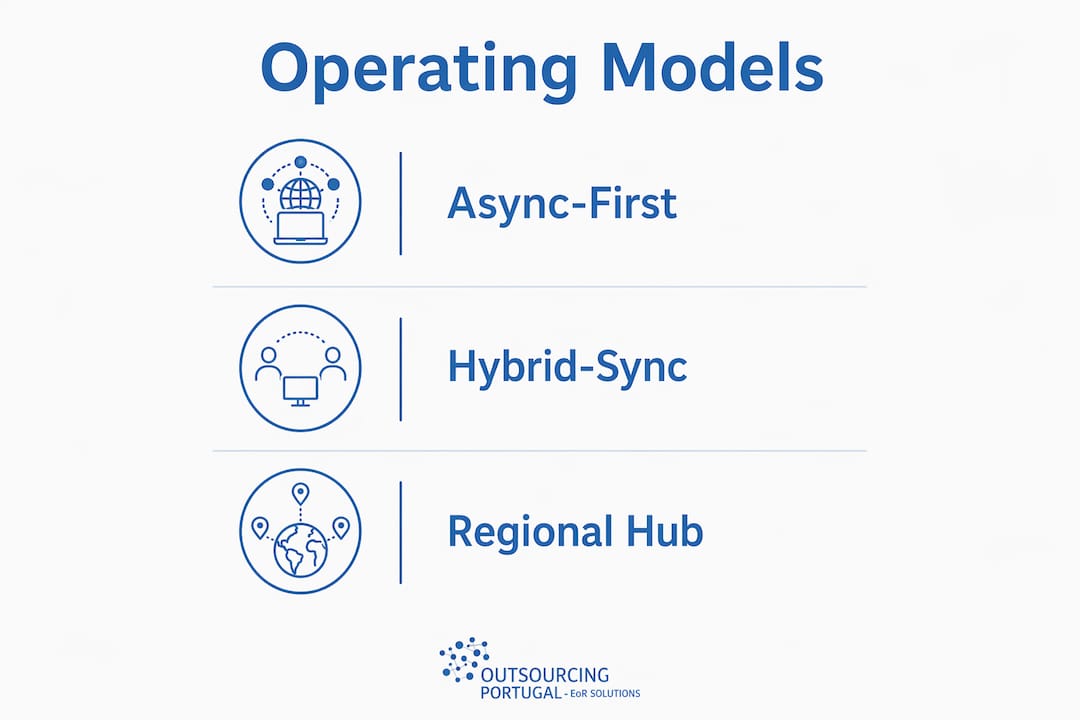
The operating model is the single most important decision in any virtual team management guide. It determines how your team communicates, makes decisions, and ships work across time zones. Three models dominate in 2026.

Colleagues discussing remote team operating models in office

Model Best for Key requirement
Async-first Teams spanning 3+ time zones Written communication discipline
Hybrid-sync Teams within 2–3 time zone overlap Defined meeting windows
Regional hub Teams clustered by geography Overlap hours and shared standups

Teams adopting async-first models report up to 95% asynchronous communication. That figure means the vast majority of decisions, updates, and feedback happen in writing, not in meetings. If your team spans North America and Europe, async-first is not optional. It is the only model that scales without burning people out.

The hybrid-sync model works when your team shares at least four hours of overlap daily. You schedule two or three live meetings per week and handle everything else asynchronously. Regional hub teams, common in nearshore setups like Portugal-based engineering teams, operate more like traditional offices during local hours but still need async protocols for cross-region coordination.

Before you post a single job listing, write down your communication norms. Define which channels carry which types of messages, how quickly people must respond, and how decisions get made when no one replies. Async decision-making protocols that treat silence as consent within a fixed deadline prevent the multi-week delays that kill momentum across global time zones.

Pro Tip: Set your operating model in a one-page document before your first hire. New team members who read it on day one calibrate their behavior immediately, which saves you weeks of correction later.

Infographic illustrating remote team operating models

What are the best tools for remote teams?

The standard remote tool stack in 2026 is Slack for chat, Linear or Jira for project tickets, Notion for documentation, Loom for async video, and Google Meet for synchronous meetings. Using one tool per job function reduces notification overload by roughly one week per month. That is not a minor efficiency gain. It means your team gets back 12 weeks of focused work per year just by eliminating tool sprawl.

Here is how each tool maps to its function:

  • Slack: Real-time chat, channel-based announcements, and direct messages
  • Linear or Jira: Sprint planning, bug tracking, and task assignment
  • Notion: Team wiki, process documentation, and meeting notes
  • Loom: Async video walkthroughs, code reviews, and design feedback
  • Google Meet: Weekly all-hands, 1:1s, and client calls

The tool stack alone is not enough. You need a communication handbook that governs how these tools are used. A communication handbook with explicit response times, such as responding to Slack mentions within four hours, prevents the “always-on” culture that leads to burnout. The handbook should also define meeting load limits, async standup formats, and escalation paths for urgent issues.

Security is non-negotiable for international teams. Require single sign-on (SSO) across all tools, enforce multi-factor authentication (MFA), and use a password manager like 1Password or Bitwarden for shared credentials. A security breach in a distributed team is harder to contain than in an office, so the controls need to be set up before anyone logs in.

Pro Tip: Build your communication handbook in Notion and link it from your Slack workspace description. Every new hire sees it on their first day without you having to send it manually.

How do you hire effectively for remote roles?

Remote hiring has one criterion that outranks all others: written communication. Remote hiring must prioritize written communication skills because candidates who are brilliant in person but cannot write clearly create coordination bottlenecks that slow every project they touch. Your hiring process needs to surface this skill early.

Build a role scorecard before you open any position. The scorecard defines the role’s mission in one sentence, lists three to five expected deliverables for the first 90 days, and specifies decision rights. Decision rights tell the candidate which choices they own independently and which require sign-off. This clarity attracts self-directed candidates and filters out people who need constant supervision.

Follow this sequence when building your remote team:

  1. Hire a senior anchor first. Hiring a strong senior anchor individual first prevents the costly rebuilding that comes from premature mass hiring. This person sets documentation standards, defines process rituals, and models the communication behavior you want the whole team to adopt.
  2. Write a short exercise into the process. Ask candidates to write a one-page strategy document, a technical proposal, or a project postmortem. The quality of their writing tells you more than any interview.
  3. Evaluate async responsiveness. Send candidates a written question by email and observe how quickly and clearly they respond. This is a direct simulation of how they will behave on the job.
  4. Check for time zone compatibility. Confirm the candidate’s working hours overlap with your core team window before extending an offer.

Pro Tip: Use a passive talent sourcing playbook to reach candidates who are not actively job hunting. The best remote workers are often already employed and need a specific reason to move.

What does structured remote onboarding look like?

Structured remote onboarding is a 2–4 week program that begins before the employee’s first day and ends with a completed deliverable. Structured onboarding programs with pre-shipped equipment, scheduled 1:1s, and immediate small deliverables reduce interruptions by 30–50% in the first month. That reduction matters because interruptions in a remote context are expensive. Every question a new hire asks pulls a senior team member out of deep work.

The equipment question is straightforward. Organizations commonly provide a $1,000 home-office stipend per new hire, covering an ergonomic chair, adjustable monitor stand, and keyboard. Ship the equipment before day one or transfer the stipend at least one week before the start date. A new hire who spends their first morning troubleshooting a broken setup loses trust in your organization immediately.

Your onboarding workflow should include:

  • A welcome direct message in Slack sent before 9 AM on day one
  • A pre-built checklist in Notion covering tool access, handbook review, and first-week meetings
  • A buddy assignment pairing the new hire with a peer for informal questions
  • A scheduled 1:1 with their manager on day one, day three, and day seven
  • A first small project or deployment completed by the end of week one

The first deliverable is the most important element. Completing something real in week one builds confidence and signals to the new hire that they are trusted to contribute immediately. For international onboarding specifically, the international onboarding guide from Outsourcing-portugal covers the legal and HR dimensions that domestic onboarding programs typically miss.

How do you build remote team culture that actually works?

Remote culture is built through operating behaviors, not social events. Remote culture is best built through async-only weeks and weekly all-hands rather than virtual happy hours. Async-only weeks, where the team runs for five days without a single scheduled meeting, test whether your processes are genuinely self-sufficient. Most teams discover gaps they did not know existed.

The behaviors that build culture in distributed teams are:

  • Weekly all-hands: A 30-minute video call where leadership shares company updates and team members ask questions publicly
  • Async standups: Daily written updates posted in Slack by each team member covering what they did, what they plan to do, and any blockers
  • KPI reviews: Monthly output reviews focused on results, not activity or hours logged
  • Documentation sprints: Quarterly sessions where the team updates the Notion wiki with new processes and decisions

A centralized documentation culture reduces questions and interruptions while creating institutional memory that survives team turnover. Teams that write things down consistently outperform those that rely on oral knowledge transfer.

Burnout prevention requires explicit rules, not good intentions. Set a policy that no one is expected to respond outside their stated working hours. Publish those hours in each person’s Slack profile. Remove the ambiguity that makes remote workers feel they must always be available.

Performance management in remote teams must measure outputs, not activity. Track what people deliver, not when they log in.

For teams operating across cultures, the multicultural team management guide from Outsourcing-portugal provides specific techniques for managing communication style differences that affect async collaboration.

Key takeaways

Effective remote team setup requires defining your operating model, building a dedicated tool stack, hiring for written communication, and running structured onboarding before you scale headcount.

Point Details
Operating model first Choose async-first, hybrid-sync, or regional hub before hiring anyone.
One tool per function Use Slack, Notion, Linear, and Loom to cut notification overload by roughly one week per month.
Hire a senior anchor first A strong first hire sets documentation standards and prevents costly team rebuilding later.
Ship equipment before day one A $1,000 stipend and pre-shipped gear reduce first-month interruptions by 30–50%.
Build culture through behavior Async-only weeks and weekly all-hands outperform virtual social events for team cohesion.

What most remote team guides get wrong

I have watched international companies make the same mistake repeatedly: they hire fast and build infrastructure later. The logic seems reasonable. You have budget, you have roles to fill, and you want momentum. The result is always the same. Six months in, the team is held together by a tangle of Slack threads, undocumented decisions, and senior people spending half their time answering questions that should be in a wiki.

The fix is not complicated, but it requires discipline before the pressure to hire kicks in. Write your communication handbook first. Define your tool stack and enforce it. Hire your senior anchor and give them four to six weeks to build the documentation foundation before you bring in anyone else. This sequence feels slow. It is actually the fastest path to a team that scales without breaking.

The ergonomic investment is another area where companies underinvest. A $1,000 stipend per hire sounds like a cost. It is actually a productivity purchase. A developer with a proper monitor setup and an ergonomic chair produces more and takes fewer sick days than one hunched over a laptop on a kitchen table.

One more thing: async decision-making protocols are not bureaucracy. They are the mechanism that lets your team move without waiting for a meeting. Treat silence as consent after a fixed deadline. Post the decision in Notion. Move on. Teams that master this ship faster than teams that require consensus on everything.

How Outsourcing-portugal simplifies your remote team setup in Portugal

Building a distributed team across borders means managing employment law, payroll, and compliance in every country where you hire. That administrative load slows down the operational work described in this guide.

https://outsourcing-portugal.co.uk

Outsourcing-portugal handles the legal and HR infrastructure so you can focus on building the team itself. Through Employer of Record services in Portugal, Outsourcing-portugal employs your team members compliantly under Portuguese law, manages payroll, and handles all statutory obligations. You get the talent and the operating model. Outsourcing-portugal handles the entity, the contracts, and the compliance. For companies exploring global employment solutions for Portugal, this approach removes the biggest barrier to building a nearshore team quickly and legally.

FAQ

What is the first step in setting up a remote team?

Define your operating model before hiring anyone. Choose between async-first, hybrid-sync, or regional hub based on your team’s time zones and collaboration needs, then write a communication handbook that governs tool use and response times.

How long should remote onboarding take?

Structured remote onboarding programs last 2–4 weeks and include pre-shipped equipment, scheduled 1:1s, and a first deliverable completed by the end of week one. This structure reduces first-month interruptions by 30–50%.

What tools do remote teams need in 2026?

The standard stack is Slack for chat, Linear or Jira for project management, Notion for documentation, Loom for async video, and Google Meet for live meetings. Using one tool per function reduces notification overload significantly.

Why does written communication matter so much in remote hiring?

Remote teams operate primarily through written async channels, so candidates who cannot write clearly create coordination bottlenecks. A short written exercise during the hiring process is the most reliable way to evaluate this skill.

What is an Employer of Record and why does it matter for remote teams?

An Employer of Record (EOR) is a third-party company that legally employs workers on your behalf in a foreign country, handling payroll, taxes, and compliance. For international companies hiring in Portugal, an EOR removes the need to set up a local legal entity before building your team.

HR manager reviewing EU hiring compliance documents

EU Legal Compliance for Hiring in Portugal: 2026 Guide


TL;DR:

  • EU legal compliance requires companies to follow all binding EU laws across their operations, including Portugal. Non-compliance can lead to severe fines, operational bans, and reputational damage. Establishing a compliance management system and appointing clear ownership helps manage obligations efficiently.

EU legal compliance is defined as the obligation to meet all binding European Union laws, including directly applicable Regulations and nationally transposed Directives, across every aspect of your business operations. For international companies hiring and operating in Portugal, this means navigating a layered framework that covers data protection under GDPR, AI governance under the EU AI Act, sustainability reporting under CSRD, and employment law aligned with Portuguese labor statutes. Non-compliance carries fines up to 4% of global turnover under GDPR alone, plus operational restrictions and reputational damage that can end market access entirely. The stakes in 2026 are higher than ever, and understanding what EU regulatory compliance requires is the first step toward protecting your operations.

EU legal compliance means your company acts in a legally correct, transparent manner across anti-corruption, data protection, sustainability, employment, and competition law. The framework divides into two instrument types, each with different operational implications.

Regulations apply directly and immediately across all EU member states, including Portugal, without any national legislative step. Directives require each member state to pass national legislation within a set transposition period, typically 2–3 years. Portugal then enforces those transposed rules through its own legal code, which means your compliance team must track both the EU source text and the Portuguese implementation.

Instrument How it applies Operational impact
EU Regulation Directly binding, no transposition needed Immediate compliance required on effective date
EU Directive Requires Portuguese national law Monitor transposition timeline and local text
National law Portuguese-specific implementation May add stricter requirements than the Directive

The major compliance domains affecting Portugal-based operations include GDPR for personal data, the EU AI Act for algorithmic hiring tools, CSRD for sustainability disclosures, DORA for digital operational resilience, and the EU Employment Directives covering working conditions and pay transparency.

Pro Tip: Map every tool and process your Portugal team uses against these five domains before your next compliance review. A single AI-powered recruitment platform can trigger obligations under both GDPR and the AI Act simultaneously.

Which EU compliance areas matter most for hiring in Portugal?

Employment law is the most immediate compliance area for any company hiring in Portugal. EU Directives on transparent and predictable working conditions, adequate minimum wages, and work-life balance have all been transposed into Portuguese labor law. Your employment contracts, working-hour policies, and termination procedures must reflect both the EU Directive requirements and the Portuguese Labor Code.

Hands taking notes on Portugal employment law

GDPR governs every piece of employee data you collect, store, or transfer. This includes recruitment data, payroll records, performance files, and any monitoring of remote workers. Processing employee data requires a lawful basis, typically a contractual necessity or legitimate interest, and employees retain rights to access, correction, and erasure.

The EU AI Act introduces a new layer of obligation for companies using algorithmic tools in hiring. Systems that score candidates, screen resumes automatically, or assess emotional states during interviews are classified as high-risk under the Act. High-risk systems require documented risk assessments, human oversight mechanisms, and audit logs available on demand.

Key compliance obligations for hiring and operations in Portugal:

  • Provide written employment contracts that meet EU transparency requirements before or on the first day of work
  • Appoint a Data Protection Officer if your processing of employee data is large-scale or systematic
  • Conduct a conformity assessment for any AI tool used in recruitment or workforce management
  • Implement CSRD sustainability reporting if your company meets the size thresholds (250+ employees or €40 million turnover)
  • Maintain documented training records for all staff with compliance responsibilities
  • Establish a whistleblower channel meeting EU Whistleblower Directive standards

Pro Tip: Review your HR software vendor’s EU AI Act compliance documentation now. If your vendor cannot produce a conformity assessment for high-risk AI features, you share liability for its use.

What are the penalties for non-compliance with EU regulations in Portugal?

Infographic outlining five steps for EU hiring compliance

Financial penalties under EU law are calculated to hurt at scale. GDPR fines reach up to 4% of global annual turnover, with no cap on the absolute euro amount for large multinationals. The EU AI Act sets a separate penalty structure: prohibited AI practices trigger fines of up to €35 million or 7% of worldwide turnover, whichever is higher. Other AI Act violations carry fines up to €15 million or 3%, and providing incorrect information to regulators costs up to €7.5 million or 1%.

Beyond fines, non-compliance triggers operational consequences that can be more damaging than the financial penalty itself. These include:

Consequence Trigger Business impact
License revocation Repeated or severe violations Loss of right to operate in Portugal
EU tender exclusion Compliance failures on record Blocked from public procurement contracts
Market ban Prohibited product or AI practice Forced withdrawal of services from EU market
Reputational damage Public enforcement decisions Customer and partner attrition

Enforcement in Portugal is carried out by the CNPD (the national data protection authority) for GDPR matters, and by sector regulators for financial, AI, and product compliance. The European Commission coordinates cross-border enforcement for the largest cases.

Audit readiness is not optional. Compliance files and exception registers must be maintained continuously so that your team can respond to a regulator’s request within hours, not weeks. Under the AI Act, documentation must be provided immediately upon authority request, with no grace period for assembly.

How can international companies operationalize EU compliance in Portugal?

A Compliance Management System (CMS) is the structural foundation for meeting European compliance requirements at scale. A CMS is not a single software product. It is a documented set of policies, controls, reporting channels, training programs, and escalation procedures that covers all compliance domains from anti-corruption to ESG. Building one requires five concrete steps.

  1. Conduct a compliance gap assessment. Map your current Portugal operations against GDPR, the AI Act, CSRD, DORA, and applicable employment directives. Identify every process, tool, and data flow that touches a regulated domain.

  2. Assign ownership. Each compliance domain needs a named owner with authority to enforce controls. For GDPR, this is typically your Data Protection Officer. For AI Act compliance, assign a technical lead who can produce conformity documentation.

  3. Implement automated digital traceability. Manual reporting no longer meets the audit and disclosure standards required under CSRD and the EU Battery Regulation. Automated governance tools that generate real-time audit trails are now the baseline expectation for 2026 compliance programs.

  4. Build your compliance file. Maintain a central repository containing contracts, risk assessments, training records, incident logs, and exception registers. This file must be structured so that any document can be retrieved and presented to a regulator within one business day.

  5. Extend compliance to your supply chain. Regulatory accountability now extends to third-party vendors and open-source software dependencies. Under DORA, your ICT vendors must meet operational resilience standards, and you bear accountability for their failures. Audit your vendor contracts and require compliance attestations annually.

Continuous monitoring is the final, non-negotiable element. Compliance is an ongoing operational state, not a one-time certification. Schedule quarterly reviews of regulatory updates from the European Commission, the CNPD, and Portugal’s Authority for Working Conditions (ACT) to catch transposition changes before they create gaps.

Pro Tip: Set up automated alerts for Official Journal of the European Union publications in your compliance domains. New Regulations take effect the moment they are published, and waiting for your legal team to flag them manually creates a window of unintentional non-compliance.

Key Takeaways

EU legal compliance in Portugal requires immediate adherence to EU Regulations and active monitoring of Directive transpositions, covering employment law, GDPR, the AI Act, and CSRD.

Point Details
Two-tier legal framework EU Regulations apply immediately; Directives require Portuguese national transposition within 2–3 years.
Five core compliance domains GDPR, AI Act, CSRD, DORA, and employment directives each carry distinct obligations for Portugal operations.
Penalty severity AI Act fines reach €35 million or 7% of turnover; GDPR fines reach 4% of global annual revenue.
Documentation is non-negotiable Compliance files and exception registers must support immediate regulator response, with no assembly delays.
Supply chain accountability International companies bear legal responsibility for the compliance of their ICT vendors and software dependencies.

Why compliance culture beats compliance checklists

Most compliance failures I see in international companies operating in Portugal are not failures of knowledge. They are failures of ownership. A company knows GDPR applies. It knows the AI Act is live. What it lacks is a named person who wakes up every morning treating compliance as their primary operational responsibility, not a quarterly review item.

The shift to automated digital traceability in 2026 is genuinely significant. Companies that built their CSRD and GDPR programs on spreadsheets and manual audits are now structurally behind. Automated governance tools are not a luxury for large enterprises. They are the minimum viable infrastructure for any company with more than 50 employees operating across EU jurisdictions.

The AI Act is the regulation I see most underestimated. Business leaders assume it applies to AI companies, not to companies that use AI tools. That assumption is wrong. If your Portugal HR team uses an AI-powered applicant tracking system, you are an operator under the Act, and operator obligations are substantial. The time to audit your hiring technology stack is before a regulator asks you to.

My strongest recommendation is to treat your legal compliance in Portugal program as a living system with quarterly update cycles, not an annual audit. The regulatory calendar in 2026 is moving faster than most compliance teams are staffed to handle. Build the infrastructure now, assign the ownership clearly, and document everything as if a regulator will read it tomorrow.

— Paulo

How Outsourcing-portugal helps you stay compliant while hiring in Portugal

Managing EU regulatory compliance while building a team in Portugal is a significant operational challenge for any international company without a local entity.

https://outsourcing-portugal.co.uk

Outsourcing-portugal provides Employer of Record services that place the legal employment relationship, payroll obligations, and Portuguese labor law compliance under a locally established entity. This means your company can hire in Portugal without setting up a subsidiary, while a dedicated compliance team handles GDPR-aligned employment contracts, ACT reporting, and EU Directive adherence on your behalf. Outsourcing-portugal also supports onboarding, HR documentation, and audit-ready record-keeping so your compliance file is always current. For international teams ready to hire in Portugal with full legal coverage, explore employment solutions built for EU compliance from day one.

FAQ

EU legal compliance means your business meets all binding European Union laws, including Regulations that apply directly and Directives implemented through national law, across every operational domain from data protection to employment.

Does GDPR apply to employee data in Portugal?

GDPR applies to all personal data processing in Portugal, including employee recruitment records, payroll data, and workforce monitoring. Companies must have a lawful basis for each processing activity and must honor employee data rights.

What fines does the EU AI Act impose?

The EU AI Act sets fines up to €35 million or 7% of worldwide turnover for prohibited AI practices, and up to €15 million or 3% for other violations, whichever amount is higher.

How do EU Regulations differ from EU Directives?

EU Regulations apply directly and immediately in all member states without national legislation. Directives require each country, including Portugal, to pass implementing laws within a defined transposition period, typically 2–3 years.

What is the fastest way to ensure EU compliance when hiring in Portugal?

Using an Employer of Record in Portugal transfers employment law obligations to a locally compliant entity, covering contracts, payroll, GDPR-aligned HR records, and labor authority reporting from the first hire.

Nearshore Team Setup Workflow: Portugal 2026 Guide


TL;DR:

  • A nearshore team setup workflow involves defining capabilities, vetting candidates, launching, and optimizing to accelerate productivity. Proper preparation, phased onboarding, and structured communication ensure successful integration and cost savings. Portugal’s time zone overlap and talent quality support effective nearshore partnerships when workflows are correctly implemented.

A nearshore team setup workflow is a structured, phased process for building a development team in a geographically close country, using time zone alignment, cultural proximity, and shared tooling to reach full productivity faster than offshore alternatives. For international companies targeting Portugal, this workflow covers everything from defining capability profiles to achieving independent sprint ownership. Done right, it delivers 30–50% cost savings compared to onshore hiring while completing projects significantly faster than offshore models. The standard industry term for this model is nearshore outsourcing, and the workflow is what separates companies that integrate teams smoothly from those that stall at month two.

What does a solid nearshore team setup workflow require upfront?

The most common reason nearshore engagements fail is not poor talent. It is poor preparation on the client side. Before you post a single job description, you need four things locked down.

Professional reviewing nearshore team capability profiles

Define capability profiles, not just job titles. A title like “senior backend developer” tells a recruiter nothing useful. A capability profile specifies the stack (Node.js, PostgreSQL), the ownership level (feature lead vs. contributor), and the collaboration style (async-first vs. daily pairing). This specificity cuts shortlisting time and reduces mismatches after onboarding.

Choose your engagement model. Staff augmentation embeds individuals into your existing team under your direct management. A dedicated team model gives you a self-contained unit with its own delivery rhythm. The right choice depends on how much management bandwidth you have and how mature your internal processes are.

Establish decision rights before day one. Define who approves architecture changes, who unblocks deployment issues, and who handles escalations. Without this, nearshore engineers waste hours waiting for answers that should take minutes.

Prepare your technical infrastructure. Git branching conventions, Jira board structure, Slack channel taxonomy, and access provisioning must be ready before the first engineer logs in. Pre-launch operational readiness including documentation, escalation paths, and communication rhythms is critical to avoid productivity stagnation from the start.

Pro Tip: Set written success metrics for 30, 60, and 90 days before you hire. These become your calibration benchmarks, not performance pressure tools.

Infographic showing five phases of nearshore team setup workflow

What are the four phases of an effective nearshore setup?

A proven nearshore team setup workflow runs through four phases: Define, Vet, Launch, and Optimize. Each phase has a clear owner, timeline, and exit criterion.

  1. Define (Weeks 1–2). Lock in capability profiles, engagement model, tooling standards, and your 30/60/90-day success metrics. Produce a one-page onboarding brief covering technical environment, deployment process, communication norms, and decision frameworks. This document is the single most important artifact you will create.

  2. Vet (Weeks 2–4). With a vetted nearshore partner, shortlisting 2–3 senior candidates can happen within 72 hours. Conduct technical screens, then run a 2–3 week pilot project before committing to full hiring. Pilot projects reveal operational and cultural fit issues that references and interviews miss entirely.

  3. Launch (Weeks 4–10). Week one focuses on environment setup, access provisioning, and introductory pairing sessions. Weeks two through four introduce the nearshore engineer to sprint ceremonies, code review standards, and stakeholder communication. By weeks five through eight, the goal is independent feature ownership on non-critical paths. A structured onboarding workflow spans 6–10 weeks, with full velocity typically reached around month three.

  4. Optimize (Month 3 onward). Run a formal retrospective at the 90-day mark. Review rework rates, coordination overhead, and blocker frequency. Adjust sprint cadence, communication rhythms, and ownership boundaries based on real data.

Pro Tip: Treat the first 30 days as a calibration cycle, not a performance review. The goal is to establish baseline velocity and surface workflow friction, not to hit aggressive targets.

Phase Timeline Key Output
Define Weeks 1–2 Capability profiles, onboarding brief, success metrics
Vet Weeks 2–4 Pilot project completed, candidates shortlisted
Launch Weeks 4–10 Environment live, sprint ceremonies running
Optimize Month 3+ Retrospective complete, ownership model confirmed

Portugal’s time zone sits within the Central European Time zone, giving US East Coast teams a 5-hour overlap and UK teams a near-identical working day. That overlap is not a minor convenience. Nearshoring delivers 6–8 hours of daily overlap, enabling real-time collaboration and reducing communication misunderstandings by 65% compared to offshore setups. Same-day issue resolution becomes the norm rather than the exception.

How do you build communication rhythms that actually work?

Communication structure is where most remote team workflows break down. The fix is not more meetings. It is a four-layer rhythm that separates synchronous coordination from asynchronous reference work.

  • Layer 1: Daily stand-up (15 minutes, synchronous). Keep it to blockers and handoffs. Use Slack or Microsoft Teams for the call. Log outcomes in Jira or Linear so the async record is automatic.
  • Layer 2: Sprint ceremonies (weekly or biweekly, synchronous). Planning, review, and retrospective. These are the only meetings where the full team must be present. Schedule them during the overlap window.
  • Layer 3: Async reference channels (Notion or Confluence). Architecture decisions, process documentation, and onboarding guides live here. Engineers consult these without interrupting anyone.
  • Layer 4: Escalation path (on-demand, synchronous). One named contact per side. No group pings for urgent issues. Direct message the escalation contact, who resolves or routes within two hours.

Effective teams differentiate near-sync channels like Slack and Teams from asynchronous reference tools like Notion and Confluence. Teams that blur this line experience meeting fatigue and measurable productivity declines within six weeks.

“The single biggest communication mistake is treating Slack as both a chat tool and a documentation system. It is neither. Use it for coordination, and write everything permanent in Confluence or Notion.”

Cultural alignment accelerates this rhythm. Portugal scores consistently high on English proficiency and shares Western European professional norms with most of its nearshore clients. That cultural compatibility means fewer misunderstandings in sprint planning and faster trust-building in code reviews. Outsourcing-portugal covers this in depth in their guide on cultural compatibility in outsourcing.

What are the most common nearshore setup challenges and how do you fix them?

Most nearshore project management failures trace back to three root causes: unclear escalation paths, insufficient onboarding documentation, and premature goal-setting.

Unclear escalation paths create decision bottlenecks. An engineer in Lisbon who cannot get an architecture decision approved for three days will fill that time with lower-priority work. The fix is a written escalation matrix, shared on day one, with response time commitments attached.

Insufficient onboarding documentation forces new team members to ask questions that should have been answered before they started. Every hour spent answering “where do I find X” is an hour not spent building. A complete onboarding brief covers technical environment, deployment pipeline, communication norms, and decision frameworks.

Premature OKR setting is the most underestimated risk. The first 30 days should be a calibration cycle establishing baseline velocity rather than enforcing rigid targets. Setting aggressive OKRs in week one erodes trust and inflates commitments that the team cannot yet accurately estimate.

  • Monitor these three signals weekly during the first 90 days: blocker frequency (how often engineers are waiting for input), coordination overhead (time spent in meetings vs. building), and rework rate (percentage of completed work that requires revision).
  • If blockers spike, revisit the escalation matrix. If coordination overhead climbs above 20% of working hours, cut a recurring meeting. If rework rises, the issue is almost always unclear acceptance criteria, not engineer quality.

Pro Tip: Run a 2–3 week pilot project before committing to full team hiring. Pilot projects uncover compatibility issues that references and technical screens consistently miss.

Successful nearshore teams evolve beyond execution. Nearshore teams act as embedded product members, owning architecture decisions and contributing to technical roadmaps. That shift from capacity to capability is the marker of a mature nearshore engagement.

Key Takeaways

A nearshore team setup workflow succeeds when preparation, phased onboarding, and structured communication rhythms are in place before the first engineer starts.

Point Details
Prepare before hiring Define capability profiles, decision rights, and tooling standards before posting any role.
Use a four-phase workflow Define, Vet, Launch, and Optimize gives each stage a clear owner and exit criterion.
Calibrate before setting goals Treat the first 30 days as a velocity baseline, not a performance target period.
Separate sync and async channels Use Slack for coordination and Notion or Confluence for permanent reference documentation.
Run a pilot project first A 2–3 week pilot reveals cultural and operational fit issues that interviews cannot surface.

Why I think most companies get nearshore workflows backwards

The companies I see struggle most with nearshore setups share one pattern. They treat the engagement as a cost reduction exercise and then wonder why the team feels disengaged by month two. Leaders who view nearshoring as a productivity multiplier rather than a cost-cutting measure get fundamentally different results. They invest in onboarding quality, not just onboarding speed. They write documentation before day one. They run pilots before scaling. They set calibration cycles instead of OKRs in week one.

Portugal specifically rewards this mindset. The talent pool is technically strong, English proficiency is high, and the time zone overlap with Western Europe and the US East Coast is genuine, not marginal. But none of that matters if you hand a Lisbon engineer a Jira board with no context and expect output in week one.

The operational lesson I keep returning to is this: the workflow you build before the first hire determines the ceiling of what the team can achieve. Rushing the Define phase to save two weeks costs you three months of ramp-up time. Skipping the pilot project to save budget costs you a full hiring cycle when the fit turns out wrong.

Portugal’s nearshore advantages are real and well-documented. Your job is to build the internal workflow that lets those advantages show up in your delivery metrics.

— Paulo

How Outsourcing-portugal supports your nearshore team setup

Building a nearshore team in Portugal requires more than a hiring plan. It requires compliant employment contracts, payroll management, and HR support from day one.

https://outsourcing-portugal.co.uk

Outsourcing-portugal provides Employer of Record services in Portugal that let you hire and onboard Portuguese talent without setting up a local legal entity. Their vetted talent pools reduce time-to-hire, their compliance expertise covers Portuguese labor law, and their payroll management removes the administrative burden from your team. For companies ready to move from workflow planning to execution, Outsourcing-portugal’s employment and setup services are the direct operational next step.

FAQ

What is a nearshore team setup workflow?

A nearshore team setup workflow is a phased process covering capability definition, candidate vetting, team onboarding, and performance optimization for a development team in a nearby country. It typically spans 6–10 weeks to launch and reaches full velocity around month three.

How long does it take to set up a nearshore team in Portugal?

With a vetted nearshore partner, shortlisting senior candidates takes as little as 72 hours, with full onboarding completing within 1–2 weeks. Full team velocity typically arrives at the 90-day mark following a structured 30/60/90-day plan.

What tools are standard for nearshore team collaboration?

Slack and Microsoft Teams handle synchronous coordination, while Notion and Confluence serve as asynchronous reference tools. Jira or Linear manages sprint tracking. Using all four in defined roles prevents meeting fatigue and keeps documentation accessible.

Why is Portugal a strong nearshore location for European and US companies?

Portugal offers 6–8 hours of daily time zone overlap with US East Coast teams, high English proficiency, and a technically skilled workforce. These factors combine to reduce communication friction and accelerate team integration compared to offshore alternatives.

What is the biggest risk in a nearshore team setup?

The biggest risk is premature goal-setting before the team has established baseline velocity. Setting rigid OKRs in the first 30 days erodes trust and produces inflated commitments. A calibration cycle in month one produces more accurate planning data and stronger long-term performance.

What Is Workplace Infrastructure? A Guide for Global Teams


TL;DR:

  • Workplace infrastructure includes physical spaces, digital systems, policies, and well-being programs that enable effective work across all environments. Improving coordination among these components reduces friction, boosts productivity, and supports scalable growth for international organizations. Proper management of invisible policies and cultural norms is essential for successful adoption and long-term performance.

Workplace infrastructure is defined as the integrated system of physical spaces, digital platforms, processes, policies, and well-being programs that enable employees to work effectively across on-site, remote, and hybrid environments. The term covers everything from office lighting and IT networks to governance frameworks and cultural norms. Gensler and TNW both treat this system as the operational backbone of modern organizations, not a background expense. Decision-makers who understand its full scope gain a direct advantage in productivity, retention, and global scalability. This guide breaks down every layer of workplace infrastructure and shows you how to manage it as a competitive asset.

What is workplace infrastructure and why does it matter?

Workplace infrastructure is an integrated system combining physical space, digital platforms, processes, policies, and well-being programs to support productive work across all environments. The industry term for this concept is “workplace infrastructure,” and it maps directly to what facilities managers, IT directors, and HR leaders collectively manage every day. Think of it as the operating system of your organization. Without it running well, every other investment in talent or technology underperforms.

IT specialist managing workplace infrastructure

The importance of workplace infrastructure becomes clear when you look at what breaks without it. Unreliable tools, unclear workflows, and poorly maintained physical spaces all create daily friction. That friction compounds into burnout, attrition, and lost revenue. For international companies managing teams across multiple countries, the stakes are even higher because each location adds its own layer of complexity.

Pro Tip: Before auditing your infrastructure, map every touchpoint an employee encounters from their first day onward. The gaps you find there are your highest-priority fixes.

What are the core components of workplace infrastructure?

Workplace infrastructure components fall into five distinct pillars: physical facilities, IT and digital stacks, communication protocols, organizational governance and standard operating procedures, and talent and well-being programs. Each pillar affects the others. A state-of-the-art office with a broken IT network still produces a dysfunctional work environment. The components only deliver value when they operate as a coordinated system.

The table below summarizes each pillar, real-world examples, and the business impact each one drives.

Infographic showing workplace infrastructure components

Component Examples Business Impact
Physical facilities Office layout, lighting, air quality, ergonomic furniture Cognitive performance, health, and retention
IT and digital stack Cloud platforms, cybersecurity tools, hardware Operational speed and data security
Communication protocols Meeting cadences, messaging standards, reporting lines Clarity, alignment, and decision speed
Organizational governance SOPs, compliance frameworks, HR policies Legal protection and process consistency
Talent and well-being programs Training, mental health support, hydration stations Engagement, output quality, and loyalty

Cross-departmental coordination is the hidden requirement that makes these pillars work together. IT, HR, and real estate teams that operate in silos create redundant processes and conflicting policies. The result is friction that cancels out expensive investments in any single pillar. Coordinating these teams around a shared infrastructure plan is not optional for organizations that want to scale.

Pro Tip: Document every infrastructure asset, software configuration, and SOP in a single shared system. Without a single source of truth, organizations lose money daily through inefficiencies that are invisible until they become crises.

How does workplace infrastructure impact productivity and performance?

Physical infrastructure factors like lighting, air quality, and hydration are direct business performance variables, not comfort perks. Proper hydration alone can increase cognitive performance by up to 14%. That figure puts a reliable water supply in the same category as a software upgrade when measuring return on investment.

Poor infrastructure such as unreliable tools and confusing workflows is a direct contributor to employee burnout and turnover. Friction driven by broken processes creates daily frustration, which accelerates workforce attrition and adds recruiting costs that dwarf the original infrastructure investment. For international companies, replacing a skilled employee in a foreign market is especially expensive when you factor in legal, onboarding, and productivity ramp-up costs.

The business benefits of well-managed workplace infrastructure include:

  • Faster onboarding because processes and tools are documented and consistent
  • Lower attrition rates because employees experience less daily friction
  • Higher output quality because physical conditions support focus and health
  • Faster decision-making because communication protocols are clear and followed
  • Better compliance because governance frameworks are current and enforced

Treating infrastructure as a living system rather than a static cost center is the defining difference between organizations that scale and those that stall. Top organizations manage the infrastructure lifecycle proactively. They audit, update, and retire components before those components become sources of disruption.

What is invisible infrastructure and why does it matter?

Invisible infrastructure is the layer of policies, digital protocols, and cultural norms that shapes how work actually gets done. Gensler defines it as the non-physical elements that significantly affect how work is executed and influence workplace success. You cannot see invisible infrastructure on a floor plan, but you feel it in every meeting, every approval process, and every onboarding experience.

Organizations that integrate invisible infrastructure with their physical and digital systems report higher agility and better absorption of organizational change. Those that focus only on physical renovations or new software deployments find that adoption rates disappoint. The reason is straightforward: if the policy around a new tool is unclear, or the cultural norm is to ignore it, the tool fails regardless of its quality.

Practical examples of invisible infrastructure in action include:

  1. A hybrid work policy that specifies which days teams collaborate in person and which days are remote-first
  2. A digital communication protocol that defines when to use email versus a messaging platform like Slack or Microsoft Teams
  3. A governance framework that sets approval hierarchies for budget decisions across international offices
  4. Cultural norms around response times, meeting length, and documentation standards

Designing policies and digital protocols with the same intentionality as physical space enhances employee experience and accelerates adoption of new ways of working. Misaligned policies make new tools or office designs feel burdensome rather than intuitive. This is the most common reason that expensive office redesigns or software rollouts underdeliver.

Pro Tip: When rolling out a new tool or workspace design, write the policy before the launch date. Teams adopt new systems faster when the rules are clear from day one.

How can international businesses improve workplace infrastructure?

The most effective improvement approach is identifying bottlenecks in communication or reporting before acquiring new technology. Adding tools to a broken process only adds complexity. Fix the workflow first, then choose the technology that supports it. This sequence saves budget and prevents the frustration of a failed rollout.

For international companies managing distributed teams, the infrastructure impacts outsourcing decisions in ways that go beyond office space. Compliance frameworks, payroll systems, and HR governance must adapt to each country’s legal requirements. A company expanding into Portugal, for example, needs to align its existing IT and HR infrastructure with Portuguese labor law, tax obligations, and data protection rules under the EU’s GDPR.

The table below compares common improvement strategies with their expected operational outcomes.

Improvement Strategy Expected Outcome
Audit and document all SOPs Reduces administrative troubleshooting and onboarding time
Align IT, HR, and facilities teams Eliminates redundant processes and conflicting policies
Fix communication protocols before adding tools Increases tool adoption and reduces rollout failure rates
Build a single infrastructure asset registry Prevents revenue loss from untracked system failures
Adapt governance frameworks per country Ensures legal compliance and reduces regulatory risk

Scalability requires building infrastructure that can absorb new team members, new markets, and new regulations without breaking. A checklist for hiring remote teams is one practical starting point for companies expanding across borders. Cultural adaptation is equally critical. Communication norms, decision-making styles, and work-hour expectations vary significantly between markets, and your infrastructure must account for those differences explicitly.

Key Takeaways

Workplace infrastructure is the integrated system of physical, digital, and policy-based components that determines whether your organization operates efficiently or burns resources on preventable friction.

Point Details
Five core pillars Physical facilities, IT stacks, communication protocols, governance, and well-being programs must work together.
Invisible infrastructure matters Policies and cultural norms shape adoption and performance as much as physical or digital tools do.
Fix processes before adding tools Identifying bottlenecks in communication first prevents costly and failed technology rollouts.
Document everything A single source of truth for assets and SOPs reduces daily operational waste and troubleshooting time.
International complexity requires adaptation Governance and compliance frameworks must align with each country’s legal and cultural requirements.

Why most companies are managing infrastructure wrong

The most common mistake I see in international organizations is treating workplace infrastructure as a facilities problem. Leadership signs off on a new office fit-out or a software license, then hands it to IT or real estate and moves on. The invisible layer, meaning the policies, the governance, the cultural norms, gets no design attention at all. Six months later, the new office sits half-empty and the new software has a 30% adoption rate. The investment failed not because the tools were wrong, but because the invisible infrastructure was never built.

The second mistake is managing IT, HR, and real estate as separate functions with separate budgets and separate priorities. Siloed teams create redundant processes and conflicting policies that negate high-end physical or digital investments. I have watched companies spend significantly on ergonomic workstations while their IT helpdesk ran on a ticketing system that took three days to respond. The physical investment was real. The operational friction was realer.

The fix is not complicated, but it requires leadership commitment. Treat infrastructure as a cross-functional discipline with a single owner or steering committee that spans IT, HR, and facilities. Build a living document that tracks every component, its current state, and its next review date. Audit your invisible infrastructure at least once a year. Ask whether your policies still match how your teams actually work, because in fast-moving international organizations, the answer is often no.

— Paulo

How Outsourcing-portugal supports your infrastructure needs abroad

Building workplace infrastructure across borders adds legal, payroll, and compliance complexity that most internal teams are not equipped to handle alone.

https://outsourcing-portugal.co.uk

Outsourcing-portugal provides Employer of Record and payroll services that absorb that complexity directly. Through its EoR model, international companies can hire in Portugal without setting up a local legal entity, while remaining fully compliant with Portuguese labor law, tax obligations, and EU regulations. Outsourcing-portugal manages onboarding, payroll, HR support, and legal compliance as part of a single service. For decision-makers building or expanding teams in Portugal, that means your governance and compliance infrastructure is handled from day one. Visit Outsourcing-portugal’s employment services to see how the model works in practice.

FAQ

What is the workplace infrastructure definition?

Workplace infrastructure is the integrated system of physical facilities, digital platforms, communication protocols, governance frameworks, and well-being programs that enable productive work. It covers both visible elements like office space and IT hardware and invisible elements like policies and cultural norms.

What are the main components of workplace infrastructure?

The five core components are physical facilities, IT and digital stacks, communication protocols, organizational governance and SOPs, and talent and well-being programs. Each component affects the others, so they must be managed as a coordinated system rather than in isolation.

How does workplace infrastructure affect employee productivity?

Physical factors like air quality, lighting, and hydration directly influence cognitive performance and retention. Poor infrastructure such as unreliable tools and unclear workflows drives burnout and turnover, which adds significant recruiting and onboarding costs.

What is invisible infrastructure in the workplace?

Invisible infrastructure refers to the policies, digital protocols, and cultural norms that shape how work is executed. Organizations that design these elements with the same care as physical spaces report higher agility and better adoption of new tools and working methods.

How can companies improve workplace infrastructure for global teams?

The most effective starting point is fixing communication bottlenecks before adding new technology. Companies should also document all SOPs, align IT and HR teams around shared goals, and adapt governance frameworks to meet the legal requirements of each country where they operate.

Business team discussing nearshore expansion plans

Nearshore Expansion Guide for European Business Leaders


TL;DR:

  • Portugal has become Europe’s top nearshore destination in 2026 due to its high English proficiency, EU membership, and GMT alignment with Western Europe. Building a nearshore team involves defining objectives, running pilots, and ensuring compliance through Employer of Record onboarding within 5 to 10 days. Successful expansion requires active management, clear success criteria, and regular KPI monitoring to sustain operations.

Nearshore expansion is defined as building operational teams in geographically close countries to gain cost advantages, access skilled talent, and maintain real-time collaboration. For international executives targeting Europe, Portugal has emerged as the continent’s most compelling nearshore destination in 2026. This guide covers every stage of a successful nearshore investment strategy: from setting objectives and selecting a location to building your team, managing compliance, and scaling for the long term.

What is a nearshore expansion guide and why does it matter?

A nearshore expansion guide gives executives a structured framework to move from concept to operational team without costly missteps. Nearshore outsourcing is defined as delegating work to partners in nearby countries that share similar time zones, combining cost savings with stronger collaboration than offshore models allow. That distinction matters. Offshore teams in Southeast Asia or India often require asynchronous workflows and significant coordination overhead. Nearshore teams in Portugal or Poland operate within one to two hours of Western European headquarters.

Infographic outlining five steps to nearshore expansion

The benefits of nearshore outsourcing go beyond labor cost reduction. Executives gain access to deep talent pools in technology, customer support, and finance, while retaining the ability to visit sites, run joint sprints, and manage escalations in real time. Nearshore expansion requires evaluating strategic fit across workforce availability, infrastructure, geopolitical stability, and operational resilience. Cost is one factor, not the whole equation.

How do you set clear objectives for nearshore expansion?

Defining objectives before selecting a location is the single most important step in any guide to nearshore markets. Executives who skip this stage end up optimizing for the wrong variables, typically labor cost, while underweighting service quality and delivery speed.

Start by identifying which business functions are suitable for nearshore delivery:

  • IT development and QA: High demand for Portuguese engineers with EU data protection compliance built in.
  • Customer support: Portugal’s multilingual workforce covers English, Spanish, French, and German at scale.
  • Finance and back-office operations: Time-zone alignment with London, Amsterdam, and Frankfurt enables same-day resolution cycles.
  • HR and shared services: Stable Portuguese labor law and EU membership reduce cross-border complexity.

Once you identify the functions, define measurable success criteria before signing any contract. Service level agreements should specify response times, defect rates, and delivery velocity. Vague targets like “improve efficiency” produce vague results.

Strategic fit evaluation must also account for split-shoring strategies, where companies balance nearshore and offshore units to manage cost and resilience simultaneously. A customer support team in Lisbon handles European hours; an offshore team in Manila covers Asia-Pacific. That model works only when objectives for each unit are defined separately.

Pro Tip: Write your success criteria as a one-page scorecard before your first vendor call. Share it with every candidate partner. Partners who push back on the metrics are telling you something important about their operational maturity.

How does Portugal compare to other European nearshore markets?

Portugal consistently ranks among Europe’s top nearshore destinations for technology and customer operations. The key selection criteria for any nearshore location are time-zone alignment, labor market depth, language capability, legal framework, and total employment cost.

Criterion Portugal Poland Romania Bulgaria
Time zone (vs. GMT) GMT+0/+1 GMT+1/+2 GMT+2/+3 GMT+2/+3
EU membership Yes Yes Yes Yes
English proficiency Very high High High Moderate
Tech talent pool Large, growing Very large Large Moderate
Labor cost vs. Western Europe Competitive Moderate Low Very low
Political stability Very high High Moderate Moderate

Portugal’s combination of very high English proficiency, EU legal framework, and GMT alignment with London makes it the strongest fit for UK and Northern European companies. Poland offers a larger tech talent pool but higher costs and greater time-zone distance for Atlantic-facing businesses.

When evaluating a nearshore partner, assess four dimensions beyond their sales pitch:

  • Delivery maturity: How many clients of similar size have they served? Ask for references, not case studies.
  • Governance model: Who owns escalation? Is there a named account lead with authority to resolve issues?
  • Retention strategy: What is their annual attrition rate? High attrition destroys institutional knowledge.
  • Compliance infrastructure: Do they operate as a licensed Employer of Record, or do they subcontract employment?

Pro Tip: Request a sample employment contract and payroll report from any EOR partner before signing. The quality of those documents tells you more about operational rigor than any capability presentation.

Outsourcing-portugal publishes a detailed breakdown of why nearshore in Europe works for service firms and tech teams, with 2026 market context included.

How do you build and onboard a nearshore team in Portugal?

Building a nearshore team in Portugal follows a defined sequence. European companies that succeed start with business context and success metrics, then select team structures before moving to onboarding. Skipping steps creates gaps that surface six months later as performance problems.

Step 1: Define team structure and capability profiles

Map each role to a specific output, not a job title. A “senior developer” means different things in different organizations. Define the deliverable, the tools required, and the collaboration cadence expected.

Hands outlining nearshore team roles on chart

Step 2: Run a paid pilot before full commitment

A 2–3 week paid pilot with milestone definitions at months 1, 3, and 6 validates operational readiness and reduces risk. The pilot reveals how well the team integrates, not just whether they have the right skills. Operational compatibility, including communication rhythm, governance, and escalation protocols, matters more than technical ability alone.

Step 3: Complete EOR onboarding

EOR onboarding in Portugal typically takes 5–10 business days. That window covers contract drafting under the Portuguese labor code, Social Security registration, tax registration, and insurance setup. Contracts must comply with Portuguese labor law and include all mandatory registrations.

Verify the NIPC on every employment contract and payroll document. The NIPC is the Portuguese tax identification number for legal entities. It must match the actual EOR entity registered in Portugal. Mismatches create compliance exposure that takes months to resolve.

Step 4: Establish communication infrastructure

Assign a dedicated integration lead on both the client side and the nearshore side. Set weekly cadence calls, define escalation paths, and document decision rights in writing. Teams that skip this step spend the first 90 days negotiating process instead of delivering work.

Milestone Target Key metric
Day 30 Team operational Onboarding complete, first deliverable submitted
Day 60 Rhythm established SLA compliance above baseline
Day 90 Full integration Escalation rate declining, output at target

Pro Tip: Treat the 90-day ramp as a formal project with a named owner and weekly status reports. Teams that treat ramp as informal tend to drift past the 90-day mark without hitting baseline performance.

How do you scale and sustain a nearshore operation?

Scaling a nearshore team requires a different mindset than building one. The risks shift from setup errors to contract rigidity and performance drift.

Employment contracts in Portugal default to indefinite terms in most cases. Fixed-term contracts carry legal limits on duration and renewal. That structure affects how quickly you can scale up or restructure a team, so plan headcount growth in stages rather than large cohorts.

Key practices for sustainable scaling include:

  • Monitor KPIs monthly, not quarterly. Early detection of output decline or attrition spikes gives you time to intervene before client impact occurs.
  • Build a skills matrix for each team. As your business evolves, the skills you need will shift. A documented matrix makes gap analysis faster and hiring decisions cleaner.
  • Review your split-shoring balance annually. If your nearshore team is performing well, consider whether functions currently handled offshore could move nearshore for better coordination.
  • Maintain contract hygiene. Confirm that payroll, Social Security contributions, and tax filings align with the registered EOR entity. Administrative errors compound over time.
  • Invest in retention. Competitive compensation, clear career paths, and regular performance conversations reduce attrition. Replacing a trained nearshore employee costs more than retaining one.

Nearshoring is not a cost arbitrage exercise that runs itself. Treat it as an operational model that requires active management, governance reviews, and periodic renegotiation of terms as your team grows.

Key Takeaways

Successful nearshore expansion in Portugal requires defined objectives, a phased pilot approach, rigorous EOR compliance, and active performance management at every stage of growth.

Point Details
Define objectives first Identify functions, set measurable SLAs, and document success criteria before selecting a location.
Portugal leads in Europe GMT alignment, high English proficiency, EU membership, and competitive labor costs make Portugal the top nearshore choice for UK and Northern European firms.
Pilot before committing A 2–3 week paid pilot validates operational fit, communication rhythm, and governance, not just technical skills.
EOR onboarding takes 5–10 days Contract drafting, Social Security, tax registration, and insurance setup complete within two weeks under Portuguese labor law.
Scale with contract awareness Portuguese contracts default to indefinite terms; plan headcount growth in stages and monitor KPIs monthly to catch problems early.

What I’ve learned from watching nearshore expansions succeed and fail

The executives who struggle most with nearshore expansion share one pattern: they treat the pilot as a formality. They select a partner, run two weeks of introductory calls, and declare operational readiness. Six months later, they are managing a team that technically delivers but never fully integrated into the parent organization’s workflow.

The pilots that work are the ones where the client sends a real project, not a test exercise. Real projects expose real friction: who makes decisions when the integration lead is unavailable, how the team handles an urgent client escalation at 4 PM Lisbon time, whether the communication tools and access permissions were actually set up correctly. Those details do not surface in a demo environment.

Portugal specifically rewards executives who invest in the legal and payroll setup from day one. I have seen companies spend months untangling compliance issues because they assumed their EOR partner handled everything automatically. Verifying the NIPC, confirming Social Security registrations, and reviewing the first payroll run are not bureaucratic details. They are the foundation that everything else sits on.

The future of European nearshoring points toward Portugal absorbing more of the mid-market demand that previously went to Eastern Europe. Wage growth in Poland and Romania has narrowed the cost gap, while Portugal’s infrastructure, English proficiency, and political stability have improved. Executives who build nearshore teams in Portugal now are positioning ahead of that shift, not chasing it.

— Paulo

Portugal nearshore services from Outsourcing-portugal

Outsourcing-portugal provides employment outsourcing, Employer of Record, payroll management, and entity setup services for international companies building teams in Portugal. The platform handles the full compliance stack so your team can focus on delivery from day one.

https://outsourcing-portugal.co.uk

Whether you are hiring your first Portuguese employee or scaling a team of 50, Outsourcing-portugal covers EOR and payroll services including contract drafting, Social Security registration, tax filings, and ongoing HR support. For executives who want to move fast without legal exposure, the employment outsourcing platform connects you to compliant hiring in 5–10 business days. You can also review the nearshore team-building guide to align your internal planning with Portugal-specific best practices before your first hire.

FAQ

What is nearshore expansion?

Nearshore expansion is building operational teams in geographically close countries that share similar time zones. It combines cost savings with real-time collaboration, unlike offshore models that rely on asynchronous workflows.

Why is Portugal a top nearshore destination in Europe?

Portugal offers GMT alignment with Western Europe, very high English proficiency, EU legal compliance, and competitive labor costs. Those factors make it the strongest fit for UK and Northern European companies seeking European nearshore talent.

How long does EOR onboarding take in Portugal?

EOR onboarding in Portugal typically takes 5–10 business days. That window covers contract drafting, Social Security registration, tax registration, and insurance setup under Portuguese labor law.

What contract types apply to nearshore employees in Portugal?

Employment contracts in Portugal default to indefinite terms. Fixed-term contracts carry legal limits on duration and renewal, which affects how quickly companies can scale or restructure nearshore teams.

How do you validate a nearshore pilot?

A paid pilot of 2–3 weeks with defined milestones at months 1, 3, and 6 validates operational readiness. Operational compatibility, including communication cadence and escalation protocols, matters more than technical skills alone.