EOR workflow in Portugal: hire remotely in days


TL;DR:

  • Hiring via EOR in Portugal is much faster and more cost-effective than setting up a local entity.
  • EOR handles legal compliance, payroll, social security, and CBA management, reducing risks.
  • It is ideal for small teams testing the market, with a transition to a local entity recommended for long-term scaling.

Hiring talent in Portugal without a local entity sounds straightforward until you encounter mandatory social security registrations, collective bargaining agreements, and a labor code that treats every misstep as a liability. Most international HR teams underestimate the complexity, and those that try a DIY approach often spend months just getting the paperwork right. An Employer of Record (EOR) cuts that timeline dramatically. According to the Portugal Employer of Record Guide, onboarding via EOR takes as little as 5 to 10 business days, compared to 2 to 6 months for entity setup. This article walks you through the complete EOR workflow in Portugal so you can hire with confidence.

Table of Contents

Key Takeaways

Point Details
EOR cuts onboarding time With an EOR, hiring in Portugal takes days, not months, and avoids lengthy entity setup delays.
Full legal compliance is built-in An EOR manages local labor law, contracts, registration, and CBAs, shielding you from compliance risks.
Employer costs are predictable Expect about 26-28 percent add-on costs and two extra salary months so you can budget with confidence.
Misclassification risks are avoided Using an EOR ensures all workers are legally classified from the start and reduces the risk of disputes.
Ongoing payroll is fully managed Your EOR takes care of payroll, insurance, social security, and compliance checks month after month.

Understanding the EOR workflow in Portugal: Why it matters

An Employer of Record is a third-party organization that legally employs workers on your behalf in a country where you have no registered entity. In Portugal, the EOR signs the employment contract, handles payroll, manages taxes, and ensures compliance with local labor law. You retain full control over the employee’s daily responsibilities and deliverables. The legal relationship sits with the EOR; the working relationship sits with you.

This model matters because Portugal’s labor law, the Código do Trabalho, is detailed and protective of workers. One missed registration or incorrectly structured contract can result in fines, back payments, or forced contract reclassification. The EOR eliminates those risks by handling every legal touchpoint from day one.
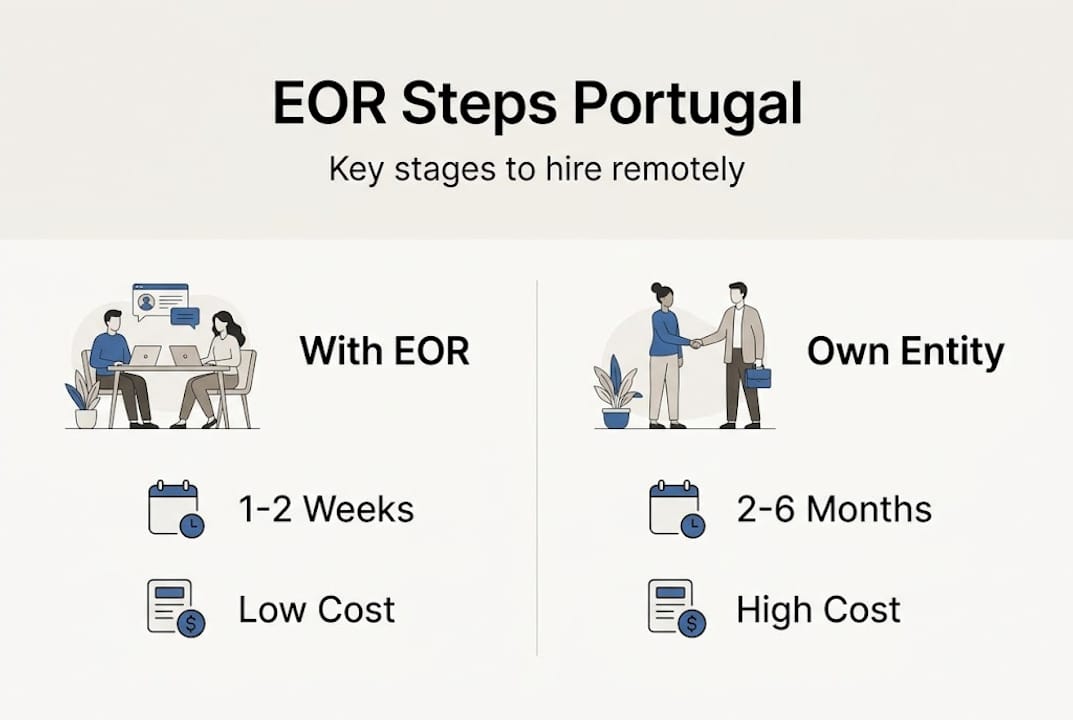
Infographic comparing EOR and entity setup steps

Comparing EOR to entity setup reveals a stark difference:

Factor EOR Entity setup
Time to hire 1 to 2 weeks 2 to 6 months
Upfront cost Low High (legal, notary, registration fees)
Ongoing compliance Managed by EOR Requires local HR/legal team
Flexibility High (scale up or exit fast) Low (winding down is costly)
Ideal team size 1 to 10 employees 8 to 12+ employees

EOR makes the most sense when you are testing the Portuguese market, hiring a small team, or need speed without the overhead. As detailed in the Portugal Employer of Record Breakdown, the break-even point versus entity setup sits at roughly 8 to 12 employees. For smaller teams, EOR wins every time on cost and simplicity.

You can explore an overview of EOR services or read the hiring in Portugal guide for a broader strategic perspective.

Key benefits of using an EOR in Portugal at a glance:

  • Speed: Hire in days, not months
  • Cost predictability: No surprise legal entity fees
  • Compliance coverage: Taxes, insurance, and contracts handled end to end
  • Scalability: Add or remove headcount without restructuring
  • Local expertise: CBAs, labor law updates, and payroll handled by specialists

Pro Tip: If you plan to hire more than 12 employees long-term in Portugal, build an entity transition plan from day one. EOR is your launchpad, not necessarily your permanent model.

For a more granular look at how the process unfolds legally, the detailed EOR workflow breaks it down step by step.

Preparing for EOR onboarding: Compliance and documentation essentials

Preparation is the part most companies rush, and it is exactly where costly mistakes happen. Before a single employment contract is signed, you need to collect the right documentation and understand what the EOR will require from both you and your new hire.

As outlined in the Portuguese compliance steps, the key legal requirements include drafting employment contracts that align with the Código do Trabalho, registering the employee with Segurança Social (Portugal’s social security system) and the Autoridade Tributária (tax authority), and securing mandatory work accident insurance.

Here is the standard documentation checklist:

Document Who provides it
National ID or passport Employee
Portuguese tax number (NIF) Employee
Social security number (NISS) Employee or EOR applies
Proof of address Employee
Bank account details Employee
Signed employment contract EOR drafts, both parties sign
Work accident insurance policy EOR procures

The numbered steps for compliant pre-onboarding:

  1. Confirm the employee’s legal right to work in Portugal
  2. Collect all personal documentation listed above
  3. Verify the applicable collective bargaining agreement (CBA) for their role and sector
  4. Confirm whether a remote work agreement is needed (required for regular remote workers under Portuguese law)
  5. Agree on expense reimbursement policies before signing

Collective bargaining agreements deserve special attention. Portugal’s CBAs cover sector-specific rules on working hours, minimum salary scales, and leave entitlements. The compliance in EOR onboarding process requires the EOR to identify the correct CBA and apply it accurately from day one.

Common mistake: Skipping the NISS (social security number) application for new hires who do not yet have one. This delays registration and can push back the start date by weeks.

Remote work agreements are not optional formalities in Portugal. Since 2021 amendments to the labor code, employers must provide written remote work agreements specifying equipment, connectivity costs, and expense reimbursements. Your EOR should handle drafting these, but you need to supply the inputs, such as who provides hardware and what expenses are covered.

Pro Tip: Engage your EOR before you make the job offer. Having the compliance checklist ready before your candidate signs anything prevents delays and ensures you set accurate start date expectations.

For a thorough walk through the legal requirements, the Portugal EOR compliance guide is an excellent reference.

Step-by-step: Executing the EOR onboarding process in Portugal

Once all requirements are in order, you are ready for the hands-on process. Here is how a typical end-to-end onboarding plays out under an EOR in Portugal.

  1. Offer and contract drafting: The EOR prepares an employment contract compliant with the Código do Trabalho. Most EORs default to indefinite contracts, and for good reason. Fixed-term contracts are limited to 2 years with a maximum of three renewals; without proper justification, they convert automatically to permanent contracts. Indefinite contracts avoid that legal trap entirely.

  2. Candidate registration with authorities: The EOR registers the employee with Segurança Social and the Autoridade Tributária. If the employee lacks a NISS, the EOR initiates that application in parallel.

  3. Insurance and payroll setup: Work accident insurance is activated. Payroll is configured to include the correct salary, applicable CBA provisions, and statutory deductions.

  4. Employee onboarding and orientation: The employee receives their contract, benefits overview, remote work agreement (if applicable), and first payroll information. The EOR manages the formal onboarding documentation.

The onboarding timeline via EOR is 1 to 2 weeks for most cases, and as fast as 5 to 10 business days for well-prepared companies. Traditional entity setup, by contrast, takes 2 to 6 months.

Probation periods in Portugal vary by role:

  • Standard employees: 90 days
  • Management or senior technical roles: 180 days
  • C-suite or executive roles: 240 days

During probation, either party can terminate without notice in the first 15 days, and with limited notice thereafter. Your EOR will advise on the correct application based on the role.

Pro Tip: For remote hires, confirm the employee’s physical work location before signing. Portuguese labor law ties several obligations to the employee’s habitual place of work, including applicable CBAs and accident insurance classification.

The step-by-step onboarding process is documented in detail for those who want a reference guide alongside their EOR.

Managing payroll and ongoing compliance: Costs, risks, and local rules

After onboarding, the focus shifts to ongoing management. Staying compliant is not a set-and-forget task. Here is what you need to monitor, and what your EOR handles for you.

Payroll administrator checking compliance spreadsheets

Employer costs in Portugal often surprise foreign companies. The full picture:

Cost component Rate
Social Security (TSU) employer contribution 23.75% of gross salary
Work accident insurance 1% to 3% of gross salary
FCT (employee compensation fund) 0.925% of gross salary
13th month salary (Christmas bonus) 1 additional month per year
14th month salary (vacation bonus) 1 additional month per year
EOR service fee $400 to $599 per employee per month

As the breakdown of employer costs confirms, mandatory contributions total roughly 26 to 28% above gross salary, before EOR fees. Factor in 13th and 14th month salaries and you are looking at approximately 14 months of payroll cost per year per employee.

Your EOR manages payroll compliance including:

  • Monthly payroll processing with correct deductions
  • Reporting to Segurança Social and Autoridade Tributária
  • Tracking CBA updates that affect salary floors or working conditions
  • Managing proration of 13th and 14th month payments if employment ends mid-year
  • Handling termination procedures and severance calculations

Watch out: Misclassification is a serious exposure. 70% of misclassification disputes in Portugal result in the worker being reclassified as an employee, triggering back payments, penalties, and reputational damage. An EOR eliminates this risk by ensuring correct employee status from day one.

Labor law in Portugal evolves frequently. CBAs are renegotiated on sector-specific timelines, and minimum wage increases annually. Your EOR monitors these changes and adjusts payroll accordingly, which is something a standalone contractor arrangement simply cannot guarantee.

For a full picture of what ongoing EOR management covers, explore the Portugal EOR and payroll services available to international businesses.

Our perspective: Why EOR workflow isn’t just a shortcut—it’s risk management for modern teams

After working with international businesses across multiple hiring cycles in Portugal, we have seen a consistent pattern: companies that treat EOR as purely a speed tool miss its deeper value. The real advantage is legal insulation.

Portugal’s labor law is genuinely complex, and it is getting more so as remote work legislation matures. The contractors-versus-employees debate is not theoretical here. Misclassification disputes are common, and regulators actively audit companies with multiple contractors performing employee-level work.

EOR workflow closes that gap completely. Every hire is a proper employee from day one, with correct CBA application, mandatory insurance, and documented remote work terms. That is not bureaucracy for its own sake. It is protection against a claim that could cost more than a year of EOR fees.

At the same time, we are realistic: EOR is not forever. At scale, the per-employee fees add up and a local entity starts making financial sense. The smart move is to use EOR deliberately, gather market data, build your team, and transition to an entity once the break-even math favors it. Check the outsourcing in Portugal advice section for strategic guidance on making that transition well.

Ready to simplify your hiring in Portugal? Let EOR experts do the heavy lifting

The EOR workflow in Portugal is proven, fast, and built for international businesses that need compliant remote teams without the overhead of a local entity. From contract drafting to payroll compliance and CBA management, a good EOR handles the complexity so you can focus on your business.

https://outsourcing-portugal.co.uk

If you are ready to move from research to action, our team at Outsourcing Portugal provides specialized Portugal EOR and payroll services tailored to international businesses. Whether you are hiring your first Portuguese employee or scaling a nearshore team, the complete onboarding guide gives you a practical roadmap, and our experts are available to provide bespoke advice for your specific situation. Reach out and let us take the compliance burden off your plate.

Frequently asked questions

How long does EOR onboarding take in Portugal?

Most EORs onboard employees in Portugal within 1 to 2 weeks, significantly faster than setting up a local entity, which typically takes 2 to 6 months.

What are the main employer costs with EOR in Portugal?

You will pay roughly 26 to 28% in mandatory contributions above gross salary, plus EOR service fees and the cost of 13th and 14th month salaries required by law.

How does EOR eliminate misclassification risks in Portugal?

EORs classify workers as full employees from day one and manage all compliance obligations, protecting your business from the 70% of disputes that result in costly reclassification.

Do CBAs apply to all employees under EOR contracts in Portugal?

Yes, collective bargaining agreements apply to the vast majority of employees in Portugal, and your EOR manages these obligations, including salary floors and sector-specific working conditions, on your behalf.

Remote workers collaborating from individual home offices

Top 5 remote.com Alternatives 2026

Remote work is changing every year and new tools make it easier to connect teams across time zones. Companies now have more choices when it comes to managing global employees and handling payroll with confidence. Each platform offers something a little different so searching for the right match can lead to some exciting discoveries. Which solution brings the features and support you need most and how do they compare in 2026? The differences might surprise you.

Table of Contents

Outsourcing Portugal

Product Screenshot

At a Glance

Outsourcing Portugal is the leading Employment Solutions provider for companies that need to hire Portuguese talent without creating a local entity. It combines legal compliance, payroll, and HR services into a single offering tailored for international teams.

This provider stands out for its focus on Portugal as a nearshore destination with a multilingual, highly educated workforce and competitive labor costs that reduce total employment expense while keeping full compliance.

Core Features

Outsourcing Portugal covers the full hiring lifecycle with hands-on hiring and onboarding, payroll and benefits management, employment law compliance, HR support, and settling support such as visa processing and bank account setup.

The platform positions itself as a one-stop service for remote hiring, nearshore team builds, and market testing in Portugal, removing the need to open a local office while retaining legal certainty.

Pros

  • Expertise in Portuguese employment law and HR. The team provides local legal knowledge so your contracts and processes align with Portuguese regulations.
  • Cost-effective staffing solutions. Competitive local labor costs lower your total employment spend compared with hiring through a local entity in higher cost countries.
  • Ability to hire without a local entity. You can engage talent immediately while Outsourcing Portugal acts as the Employer Of Record and handles statutory obligations.
  • Comprehensive end-to-end support. The service covers recruitment through onboarding, payroll, and ongoing HR assistance to reduce administrative burden on your internal teams.
  • High-quality multilingual workforce. Portuguese candidates offer strong English proficiency and technical skills suitable for tech development and customer service roles.

Who It’s For

International businesses of all sizes that want to hire in Portugal without establishing a physical presence benefit most from Outsourcing Portugal.

It suits startups testing market fit, scaleups building nearshore development teams, and multinationals seeking compliant local payroll and HR administration.

Unique Value Proposition

Outsourcing Portugal delivers an industry-leading combination of local legal expertise and operational execution focused solely on Portugal.

That focus creates deep knowledge of employment law, tax rules, and administrative workflows which sophisticated buyers value when they must avoid compliance risk and accelerate time to hire.

The platform converts complex local requirements into predictable processes, letting your managers hire, onboard, and manage remote Portuguese employees as if they were on your internal payroll but without entity setup.

Real World Use Case

A multinational hires a remote sales representative in Portugal through Outsourcing Portugal’s Employer Of Record service to manage contracts, payroll, taxes, and HR support.

This allows the company to begin revenue operations in Portugal immediately while legal and payroll obligations are handled by the provider.

Pricing

Pricing is not specified on the website.

Contacting Outsourcing Portugal is the only way to obtain a tailored quote that reflects headcount, benefits, and any settling assistance required.

Website: https://outsourcing-portugal.co.uk

Rippling

Product Screenshot

At a Glance

Rippling is a single workforce platform that centralizes HR, payroll, IT, finance, and global workforce operations for growing companies. Its strength lies in deep data integration and automation, making cross department workflows simpler and faster.

Core Features

Rippling offers a Unified platform that manages onboarding, payroll, IT access, expenses, and global compliance in one place. The product also includes AI-enabled insights and a no code App Studio for custom app creation and automated workflows.

Pros

  • All-in-one platform: It reduces the need for multiple point solutions by consolidating HR, Payroll, IT, and Finance into a single system.
  • Deep integration: Connected data improves accuracy and cuts duplicate entry across employee records and payroll runs.
  • Automation: Onboarding, offboarding, and payroll processes are automated to save administrative time and reduce manual tasks.
  • Global workforce management: Built in international hiring and compliance tools support payroll and onboarding for employees and contractors abroad.
  • AI tools: Automated reporting and task delegation use AI to surface business insights and prioritize follow up actions.

Cons

  • Steep complexity: The broad feature set can require significant onboarding and training before teams reach full productivity.
  • Opaque pricing: Public pricing is not listed which complicates budget planning for international teams evaluating total cost.
  • Undisclosed limitations: The provided content does not specify product limits or edge case behaviors, leaving potential gaps for complex deployments.

Who It’s For

Mid sized to large companies and rapidly growing teams that need a single system to manage international hires will get the most value. Organizations looking to replace multiple vendors and unify finance, HR, and IT processes will find Rippling suitable.

Unique Value Proposition

Rippling’s value is its consolidation of previously siloed functions into one platform that shares data and permissions across departments. That shared data model and built in automation reduce administrative overhead and speed decision making.

Real World Use Case

A tech startup uses Rippling to onboard employees across regions, process payroll and benefits globally, and provision IT access automatically. The company reports a 50% reduction in administrative overhead while improving compliance workflows.

Pricing

Pricing is typically charged per employee per month and some products may add a base fee. Specific prices are not published and interested buyers should contact Rippling for a tailored quote.

Website: https://www.rippling.com

Deel

Product Screenshot

At a Glance

Deel is a comprehensive workforce management platform that centralizes payroll, HR, IT, benefits, hiring, and mobility in one place. It excels at cross border payroll and compliance for companies that need a single vendor to manage global teams.

Core Features

Deel provides global payroll with support for more than 150 currencies, including cryptocurrency, plus an all in one platform for payroll, HR, IT, benefits, and hiring. The platform pairs in house compliance and advanced AI to scale workflows and offers visa and mobility support for international hires. Deel also highlights a broad client footprint, serving over 40,000 companies and processing more than 20 billion dollars in global payroll.

Pros

  • Multiple currency support: Deel handles payments in 150 plus currencies and accepts crypto, which simplifies payouts for internationally distributed teams.

  • Full employee lifecycle: The platform covers hiring, onboarding, payroll, benefits, and IT support so teams avoid stitching together multiple vendors.

  • Strong compliance focus: Deel emphasizes in house compliance expertise and security controls to help businesses meet local employment and tax requirements.

  • Wide market trust: More than 40,000 companies rely on Deel, which signals broad adoption across startups and large enterprises.

  • High user ratings: Deel is presented as highly rated, listed with a 4.8 out of 5 review score in the provided data.

Cons

  • Information on specific limitations or potential drawbacks is not listed on the public product summary, which makes independent evaluation harder for buyers.

  • Pricing is available only upon request or via a demo, which reduces transparency for teams comparing costs upfront.

  • Prospective clients must book a demo to learn detailed pricing and feature configuration, adding an extra step that can slow evaluation for fast moving projects.

Who It’s For

Deel suits businesses of all sizes that need to employ and pay people across multiple countries while keeping legal compliance central. It fits teams that prefer a single vendor for payroll, HR, IT, benefits, and mobility rather than managing several specialist providers.

Unique Value Proposition

Deel combines global payroll capability with embedded compliance and AI driven workflows, positioning itself as a one stop solution for managing cross border teams. The platform’s scale, local expertise, and large customer base form its primary differentiators.

Real World Use Case

A tech startup that hires engineers in several countries uses Deel to run local payroll, maintain compliance with employment laws, manage HR processes, and support visa applications. The company centralizes those tasks through Deel to reduce administrative overhead and rely on local expertise.

Pricing

Pricing information is not listed publicly and is provided on request or during a demo. Contact Deel to get custom pricing based on headcount, jurisdictions, and selected services.

Website: https://www.deel.com

Papaya Global

Product Screenshot

At a Glance

Papaya Global delivers a comprehensive global workforce platform that combines payroll, payments, compliance, and contractor management in one cloud product. It fits multinational teams that need centralized control across many countries while keeping local legal requirements in check.

Core Features

The platform centers on Workforce OS and Payment OS, offering cloud based payroll in over 160 countries, integrated APIs, and real time payments for cross border transfers. It also provides Employer of Record (EOR) and contractor management alongside compliance and risk tools.

  • Global payroll management in 160+ countries.
  • Cloud platform with integrated APIs and real time payments.
  • EOR and contractor management with compliance tools.

Pros

  • Wide global coverage and compliance: Papaya Global supports payroll and local regulations in more than 160 countries, reducing the burden of researching each jurisdiction.

  • Integrated platform for HR and payments: A single interface links payroll, payments, contractor management, and reporting to limit manual handoffs and reconciliation.

  • Strong security and privacy standards: The platform emphasizes enterprise grade protections and controls that large companies expect for sensitive payroll data.

  • Trusted by large enterprises: Over 2000 companies use Papaya Global, which signals maturity and scale for complex deployments.

  • Comprehensive resource center: Documentation and support content help internal HR and finance teams adopt the system faster.

Cons

  • Complex platform requiring training: The extensive feature set increases implementation time and requires dedicated training for HR and payroll teams.

  • Pricing not openly published: Costs are available upon request, which makes budget planning harder for smaller businesses and early stage projects.

  • Dependent on internet access: As a cloud based service, performance and availability rely on stable internet, which can affect dispersed teams in regions with weak connectivity.

Who It’s For

Papaya Global suits large or enterprise level multinational companies that need a single source of truth for payroll, payments, and contractor management across many countries. It matches organizations ready to invest in a robust platform and training to manage global teams.

Unique Value Proposition

Papaya Global combines global payroll breadth with payment rails and EOR capability in one product, allowing centralized operations while respecting local compliance. That combination reduces vendor sprawl and simplifies cross border payroll and contractor workflows for established multinationals.

Real World Use Case

A US based company expands into Asia and Europe and uses Papaya Global to run local payroll, process local contractor invoices, and manage compliance without establishing local legal entities. The platform centralizes reporting and payments across all new markets.

Pricing

Pricing details are provided on request and typically vary by scope, country count, and service level. Prospective buyers should request a tailored quote and compare total cost against internal setup and ongoing compliance expenses.

Website: https://www.papayaglobal.com

Oyster

Product Screenshot

At a Glance

Oyster is a global employment platform built for companies that need compliant hiring, payroll, and contractor management across many countries. Its B Corp status and human support make it a strong choice for teams expanding internationally who want predictable pricing and expert guidance.

Core Features

Oyster combines Employer of Record, Global Payroll, and global contractor management into a single platform that supports over 180 countries. The platform also offers add on services such as People Partner Services, Employee Benefits, Visa Sponsorship, and US PEO together with APIs and integrations for HRIS, ATS, and accounting systems.

Pros

  • Wide international coverage: Oyster supports hiring and employment administration across more than 180 countries, which simplifies multi country rollouts for companies expanding into regions like Europe or Asia.

  • Compliant onboarding and management: The platform provides compliance controls and local employment administration so your hiring follows local law and reduces legal exposure when building teams abroad.

  • Automated payroll in multiple currencies: Oyster handles payroll automation and multi currency payments, which reduces manual work and lowers the risk of payroll errors for distributed teams.

  • Expert human support: Oyster offers guidance from HR professionals and add on People Partner services, giving you practical help when local rules or benefits require human intervention.

  • Transparent pricing: Oyster presents clear per person pricing with no hidden fees, helping finance teams forecast costs during expansion projects.

Cons

  • Pricing may be higher compared to local HR services or for small teams, which makes Oyster a heavier investment for companies testing a single market with only a few hires.

  • The complexity of international compliance requires careful planning and understanding, which means you will need internal resources to coordinate with Oyster on policy and payroll timelines.

  • The breadth of services might be overwhelming for smaller businesses looking for a simple, low friction solution focused only on payroll or a single market.

Who It’s For

Oyster fits companies that want to hire and manage international talent without creating local legal entities, especially mid sized and large businesses with plans to grow across multiple countries. It works well for HR teams that need a single partner to handle payroll, benefits, and compliance while keeping internal reporting centralized.

Unique Value Proposition

Oyster combines platform automation with human HR expertise and broad country coverage to deliver a single point of control for global employment. That combination helps teams move quickly into new markets while maintaining compliant payroll and consistent employee experience.

Real World Use Case

A technology startup expanding into Europe and Asia can use Oyster to hire engineers and project managers across 20 plus countries. Oyster manages contracts, payroll, benefits, and local compliance so the startup focuses on product delivery rather than legal setup.

Pricing

Most services are priced per employee or contractor per month. Employer of Record and US PEO services start at USD 699 per employee per month. Global contractors and payroll start at USD 29 per contractor or employee per month. Additional services like People Partner are charged hourly.

Website: https://www.oysterhr.com

Global Employment Solutions Tools Comparison

Below is a comprehensive comparison of top global employment solutions platforms, outlining their features, strengths, potential drawbacks, target audience, and pricing.

Platform Key Features Pros Cons Pricing
Outsourcing Portugal Employer of Record, Payroll Processing, Hiring Lifecycle Support, Legal Compliance, Visa Management Local expertise, Cost-effective, Comprehensive support Pricing by inquiry Tailored quote on request
Rippling Unified HR, Payroll, and IT Platform, AI Insights, App Studio Automated processes, Deep integration, Global workforce tools Learning curve, Indeterminate pricing Custom quote required
Deel Global Payroll in 150+ Currencies, Compliance, Visa and Mobility Support Broad currency and crypto support, Compliance focus, High user satisfaction Limited open information on pricing and drawbacks Contact for personalized quote
Papaya Global Workforce OS, Cloud Payroll in 160+ Countries, Real-Time Payments Extensive country coverage, Integrated platform, High security standards Online service reliant, No publicly listed pricing Inquiry-based pricing
Oyster Employer of Record, Global Payroll and Contractor Management, 180+ Country Support Wide international coverage, Automated payroll, Transparent pricing Possible higher costs for small teams, Complex compliance coordination Starting at $699 per employee/month

Discover a Smarter Way to Hire Remote Talent in Portugal

Finding the right Employer of Record solution can be overwhelming, especially when balancing legal compliance, payroll, and HR complexities across borders. If you are exploring top alternatives to Remote.com for 2026, consider how Outsourcing Portugal addresses the exact challenges that the article highlights: hiring without a local entity, reducing employment costs, and navigating Portuguese labor law seamlessly. With a focus exclusively on Portugal, this platform empowers you to build nearshore teams with ease and confidence.

Benefits include:

  • Complete employment outsourcing including onboarding, payroll, and visa support
  • Access to Portugal’s highly educated and multilingual workforce
  • Legal expertise that minimizes compliance risks

Take control of your international recruitment strategy today by exploring Outsourcing Portugal’s full suite of services.

https://outsourcing-portugal.co.uk

Ready to expand into one of Europe’s most competitive and business-friendly markets? Visit Outsourcing Portugal now to learn how you can hire faster, save costs, and stay fully compliant with local laws.

Frequently Asked Questions

What are the main features to look for in alternatives to remote.com?

When considering alternatives to remote.com, focus on features such as global payroll processing, compliance management, and onboarding support. Prioritize platforms that can manage multiple currencies and provide a user-friendly interface to streamline operations.

How do I assess the pricing of different remote hiring platforms?

To evaluate pricing effectively, compare subscription models, setup fees, and per-employee costs across multiple platforms. Create a budget plan that considers both short-term expenses and long-term scalability as your team grows.

What support services should I expect from alternative remote hiring platforms?

Look for platforms that offer robust customer support, including guidance on local labor laws and HR assistance. Make sure the service includes educational resources, such as onboarding tutorials or compliance guides, to help your team navigate hiring practices.

Can I hire contractors and full-time employees through the same remote hiring platform?

Yes, many remote hiring platforms allow for both contractor and full-time employee management within the same system. Select a platform that clearly outlines processes for both types of hires to reduce administrative efforts.

How can I ensure compliance when using alternative platforms for remote hiring?

To maintain compliance, choose platforms that provide built-in tools for managing local labor laws and tax regulations. Regularly review updates or changes in compliance guidelines that the platform may offer to keep your hiring practices up to date.

Project manager on video call in Lisbon office

Why multinational corporations outsource: Portugal’s strategic edge


TL;DR:

  • Portugal offers cost savings, regulatory stability, and high-quality multilingual talent for outsourcing.
  • Rising macroeconomic pressures make Portugal a more attractive nearshore alternative to Asian destinations.
  • Success in Portugal relies on strategic planning, local expertise, and integrating teams into global operations.

Multinational corporations (MNCs) are quietly rewriting their outsourcing playbooks, and Asia is no longer the automatic first call. A combination of rising tariffs, geopolitical uncertainty, and the growing demand for specialized talent has forced global HR leaders to look harder at alternatives. Portugal has emerged as one of the most compelling answers to that search. This guide breaks down the real motivations behind MNC outsourcing decisions, shows you how Portugal stacks up against traditional destinations on hard data, and gives you a tactical roadmap for making it work.

Table of Contents

Key Takeaways

Point Details
Strategic outsourcing drivers Modern multinational corporations outsource for talent, resilience, and innovation, not just cost.
Portugal’s competitive data Portugal offers lower total costs than Asia when accounting for all expenses and risks.
High-value workforce Skilled multilingual teams and EU stability make Portugal a prime outsourcing hub.
Best practices matter Effective governance and local hiring partners are key to outsourcing success in Portugal.

Why multinational corporations choose to outsource: evolving motivations

To set the stage, let’s clarify why outsourcing remains a centerpiece for MNCs and why these reasons are changing fast.

The classic case for outsourcing has always been straightforward: reduce labor costs, scale operations quickly, and extend your global footprint without building expensive infrastructure from scratch. Those drivers haven’t disappeared. But they’ve been joined by a more sophisticated set of motivations that are reshaping where and how MNCs outsource.

Classic outsourcing drivers still in play:

  • Labor cost arbitrage, typically 30 to 50% savings versus home-market hiring
  • Rapid scalability without long-term fixed headcount commitments
  • Access to global markets and local customer knowledge
  • 24/7 operational coverage across time zones

Modern motivations that are now equally important:

  • Access to specialized talent pools in data science, AI, and multilingual services
  • Resilience against geopolitical disruption and supply chain shocks
  • EU regulatory compliance and GDPR alignment for data-sensitive operations
  • Sustainability credentials and lower carbon footprint for ESG reporting
  • Reduced total cost of ownership (TCO), which accounts for hidden costs beyond wages

Portugal addresses nearly every item on both lists. The country entered Deloitte’s top 10 GBS locations for global business services, driven by its skilled multilingual workforce, 30 to 40% cost savings versus Western Europe, and EU stability. That’s not a coincidence. It’s the result of deliberate investment in education, infrastructure, and business-friendly policy.

“Portugal’s rise in global business services rankings reflects a structural shift: MNCs now prioritize resilience, talent quality, and regulatory alignment alongside cost savings.” — Business Services Report 2025

The shift from pure cost focus to outcome-based thinking is also visible in how companies structure outsourcing contracts. Traditional outsourcing models measured success by input metrics like cost per hour or headcount. Modern MNCs measure outcomes: speed to market, error rates, customer satisfaction scores, and innovation contribution. Portugal’s workforce, educated to European standards and deeply integrated into the global tech ecosystem, performs well on these newer metrics.

Managing payroll outsourcing in Portugal is one area where this shift is especially visible. Companies that once viewed payroll as a pure cost center now see it as a compliance and risk management function, one where Portugal’s EU legal framework provides real protection.

Pro Tip: Don’t underestimate the value of time zone alignment for project turnaround. Portugal sits in Western European Time, meaning your teams in Lisbon work overlapping hours with colleagues in London, Frankfurt, New York, and São Paulo. That reduces the 24-hour feedback loops that slow down projects in Asia-based outsourcing arrangements.

Portugal vs. traditional outsourcing destinations: what the data shows

Once you know the “why,” the next logical question is “where?” Let’s see how Portugal competes on the hard numbers.

The instinct to default to Asia for outsourcing made sense in the 1990s and 2000s when wage differentials were enormous. In 2026, that calculus has shifted significantly. When you factor in the full TCO, including shipping, import tariffs, carbon taxes, quality return rates, and management overhead, the gap between Portugal and Asia has narrowed dramatically. In some sectors, it has reversed entirely.

Consider this direct comparison for a representative set of outsourcing and manufacturing scenarios:

Factor Portugal Asia Western Europe
Average labor cost (services) Competitive, 30-40% below W. Europe Low base, rising rapidly High
TCO per unit (textiles, 2026) €13.75 €14.77 €18+
Time zone overlap (CET/GMT) Excellent Poor to moderate Excellent
EU regulatory compliance Full Requires adaptation Full
Carbon tax exposure Low High (import levies) Low
Quality return/defect rates Low Moderate to high Low
Geopolitical risk Low Moderate to high Low
English proficiency High Variable High

The TCO advantage of Portugal over Asia is now documented at the unit level. For textiles, for example, Portugal comes in at €13.75 per unit versus €14.77 for Asia once you include shipping, tariffs, carbon tax, and quality returns. That’s a real reversal of the traditional cost narrative.

Logistics worker reviewing shipment manifest in textile office

The Securiton case study makes this concrete. The Swiss security technology company built a dedicated team in Porto and achieved savings of 2.5 to 3 times compared to equivalent Swiss operating costs. That’s not a marginal efficiency gain. That’s a structural cost transformation that funds reinvestment in product development and sales.

Macro forces are accelerating this shift. Rising US and EU tariffs on Asian imports, tightening carbon border adjustment mechanisms, and increasing geopolitical friction between Western economies and key Asian manufacturing hubs have all added hidden costs to Asia-based outsourcing. Portugal, as an EU member state, is insulated from most of these pressures. For cost-effective nearshoring in Portugal, these macro tailwinds are turning a good option into an obvious one for many MNCs.

Key success factors: what makes Portugal attractive for MNC outsourcing

Beyond the numbers, let’s unpack what’s really driving successful outsourcing in Portugal for both large and growing global companies.

Infographic presenting Portugal outsourcing strategic advantage stats

Numbers tell part of the story. But the MNCs that have built their most successful outsourcing operations in Portugal will tell you the real differentiators are less quantifiable. Cultural compatibility, communication quality, and the depth of the local talent ecosystem matter enormously when you’re building teams that need to integrate with global operations.

Key factors driving MNC success in Portugal:

  • Multilingual workforce: Portuguese professionals typically speak three or more languages, with English proficiency ranking among the highest in the EU. This makes Portugal a natural fit for sourcing multilingual talent for European and global operations.
  • EU regulatory stability: GDPR compliance, labor law predictability, and a transparent legal system reduce the governance burden for MNCs operating across multiple jurisdictions.
  • Tech and innovation ecosystem: Lisbon and Porto have become genuine tech hubs, with growing startup ecosystems, world-class universities, and strong pipelines of engineering and data science graduates.
  • Cultural affinity: Portuguese professionals are known for their adaptability, collaborative working style, and comfort with international business norms. This reduces the friction that often plagues offshore teams.
  • Infrastructure quality: Reliable broadband, modern office parks, and excellent international connectivity support seamless remote and hybrid operations.

The scale of MNC commitment to Portugal speaks for itself. Amgen operates with 400+ employees across 40 nationalities in data, analytics, finance, and R&D functions. Airbus runs an 800-person global business services center. Ferring Pharmaceuticals has 300 employees handling IT, finance, and HR. Volkswagen Digital Solutions employs 700 professionals. These are not pilot programs. They are strategic, long-term commitments from some of the world’s most demanding corporate operators.

Company Headcount Functions
Amgen 400+ (40 nationalities) Data, analytics, finance, R&D
Airbus 800 Global business services
Ferring Pharmaceuticals 300 IT, finance, HR
VW Digital Solutions 700 Digital and tech services
Securiton Dedicated team Engineering, technical support

Portugal’s advantages extend into specialized areas like call center and multilingual customer support, where the combination of language skills, cultural warmth, and competitive costs creates a genuinely differentiated proposition for MNCs serving European and global customer bases.

That said, challenges exist and responsible planning requires acknowledging them. Talent retention is a real issue, particularly for highly specialized technical roles where competition from other MNCs and local startups is fierce. Some niche skill sets remain in short supply. MNCs that invest in training, career development, and competitive compensation packages consistently outperform those that treat Portugal as a pure cost play. For teams working in Portugal for the first time, understanding local labor market dynamics is essential to building a sustainable operation.

Pro Tip: Multinational teams consistently report that cultural affinity with Portuguese colleagues reduces miscommunication and speeds up onboarding. Investing in cross-cultural orientation for your global managers pays back quickly in reduced friction and faster team integration.

Strategic tips for MNCs: how to optimize your outsourcing approach in Portugal

With the why and the where covered, it’s time to get tactical. Here’s how successful MNCs make the most of Portuguese outsourcing.

Entering or expanding in Portugal requires more than signing a contract with a local provider. The MNCs that get the most from their Portuguese operations follow a disciplined approach from day one.

  1. Partner with local hiring and compliance experts early. Portugal’s labor law is detailed and employee-protective. Getting your employment contracts, benefits structure, and termination procedures right from the start prevents costly disputes. A local Employer of Record (EOR) or HR outsourcing partner can handle this while you focus on building your team.

  2. Define clear KPIs before you hire. Outcome-based metrics like project delivery speed, customer satisfaction scores, and error rates should be established before your first hire, not after. This creates accountability and makes performance conversations constructive rather than reactive.

  3. Invest in language and cultural training. Even though Portuguese professionals are highly multilingual, investing in company-specific communication standards and cultural onboarding improves collaboration with your global teams significantly.

  4. Set up governance and escalation paths. Define who owns decisions locally versus globally, how issues get escalated, and what reporting cadence keeps leadership informed. Clear governance prevents the ambiguity that undermines many outsourcing relationships.

  5. Leverage government incentives. Portugal offers a range of tax incentives and grants for companies that create skilled employment, particularly in technology and R&D. Work with a local advisor to identify which programs apply to your hiring plans.

  6. Build for retention from day one. Offer competitive salaries benchmarked to the local market, clear career progression, and meaningful work. Portugal’s skilled multilingual workforce has options, and the best talent will move if they don’t see a future with your organization.

  7. Integrate your Portuguese team into global workflows. Treat your Portugal-based team as a core part of your global operation, not a remote outpost. Include them in company communications, leadership meetings, and innovation initiatives.

For MNCs looking to expand revenue generation capabilities, sales outsourcing in Portugal offers a particularly strong return. Portugal’s multilingual sales professionals can cover multiple European markets from a single location, reducing the cost and complexity of building separate sales teams in each country.

Pro Tip: Tap into Portugal’s government incentives for technical hiring and R&D investment. Programs like SIFIDE (the R&D tax credit system) and various regional development grants can meaningfully reduce the cost of building specialized teams, particularly in technology and life sciences.

Perspective: why the standard outsourcing playbook is outdated in 2026

Let’s zoom out to the bigger strategic lesson revealed by Portugal’s rise as an outsourcing hub.

Most outsourcing decisions are still made with a spreadsheet that has one column: cost. Labor cost per hour, cost per seat, cost per transaction. That framing made sense when outsourcing was a simple arbitrage play. It’s now a liability.

The MNCs winning in global markets are treating outsourcing as a strategic capability, not a cost line. They’re asking different questions. Not “how cheap can we get this done?” but “how do we build a team that can respond to market shifts in 48 hours?” Not “what’s the lowest hourly rate?” but “what’s the total cost of a quality failure?”

Portugal’s rise as a nearshoring destination illustrates this shift perfectly. Companies that chose Portugal for cost reasons alone have been pleasantly surprised by the innovation contribution, the communication quality, and the strategic value their Portuguese teams deliver. Companies that chose Portugal for strategic reasons have built some of their most effective global operations there.

The traditional cost-focused outsourcing model is being replaced by an outcome-based approach where resilience, talent quality, and integration capability are weighted alongside price. Portugal wins on all of these dimensions in a way that pure cost-play destinations simply cannot match.

The uncomfortable truth for many HR leaders is that their outsourcing KPIs are measuring the wrong things. If you’re tracking cost per hire and cost per transaction but not measuring innovation contribution, team stability, and compliance risk reduction, you’re flying blind. Portugal’s model forces a more honest accounting, and that’s a good thing for the long-term health of your global operations.

Take your outsourcing strategy further with expert support

If you’re ready to put these insights into practice, here’s how you can get expert help every step of the way.

Building a high-performing outsourcing operation in Portugal requires local expertise, legal precision, and a partner who understands both the Portuguese market and the demands of multinational operations. Whether you’re hiring your first employee or scaling a team of hundreds, getting the foundations right matters enormously.

https://outsourcing-portugal.co.uk

Our Employer of Record services in Portugal let you hire Portuguese talent immediately, with full legal compliance, without setting up a local entity. We handle employment contracts, payroll, tax filings, and HR administration so your team can focus on building the business. For companies evaluating the broader landscape, our global employment solutions provide a clear framework for structuring your Portugal operations efficiently. And if you’re ready to build a nearshore team, our nearshore Portugal solutions connect you with the talent, infrastructure, and compliance support you need to move fast and stay compliant.

Frequently asked questions

What kinds of roles do multinational corporations typically outsource to Portugal?

MNCs most commonly outsource IT, data analytics, finance, HR, R&D, and multilingual customer service functions to Portugal, as demonstrated by operations from Amgen, Airbus, and Ferring among others. These roles benefit directly from Portugal’s combination of technical education, language skills, and EU regulatory alignment.

How does Portugal compare to Asia for overall outsourcing costs in 2026?

Portugal’s total cost of ownership is now lower than Asia in many sectors, with documented unit costs of €13.75 in Portugal versus €14.77 in Asia once you include shipping, tariffs, carbon taxes, and quality returns. The gap continues to widen as Asian labor costs rise and Western tariffs increase.

Is the Portuguese workforce multilingual and globally competitive?

Yes. Portugal’s highly skilled multilingual workforce consistently attracts leading MNCs to establish global business services centers, with professionals typically fluent in three or more languages and trained to European university standards.

What challenges do MNCs face when outsourcing to Portugal?

The primary challenges include talent retention in competitive technical fields and limited scale for some highly specialized roles. Portugal faces talent retention and skill gap pressures similar to other high-performing global locations, which means MNCs need to invest actively in career development and competitive compensation to keep their best people.

Does outsourcing to Portugal provide sustainability or ESG advantages?

Absolutely. Portugal’s proximity to Western European markets reduces logistics emissions, its EU membership ensures compliance with the world’s most rigorous environmental regulations, and the country’s commitment to renewable energy makes it one of Europe’s greener operating environments for multinational businesses.

Founder organizing company setup paperwork Lisbon desk

Business incorporation in Portugal: Step-by-step guide for 2026


TL;DR:

  • Portugal streamlines company registration, offering companies established in under one hour through Empresa na Hora.
  • The common legal structure for foreign startups is the low-capital Lda, favored for its simplicity and speed.
  • Post-incorporation compliance, including tax filings and UBO declarations, is crucial to avoid fines and operational issues.

Most international founders expect EU incorporation to be a bureaucratic nightmare. Stacks of paperwork, months of waiting, layers of notarized documents, and a maze of local regulations. Portugal quietly breaks that assumption. The country has invested seriously in streamlining company setup, and the results are genuinely surprising. Empresa na Hora allows you to register a company in under one hour using pre-approved names and templates, at a cost of just EUR 360. This guide covers every stage, from choosing your legal structure to staying compliant after launch.


Table of Contents

Key Takeaways

Point Details
Rapid incorporation options Portugal enables company setup in under an hour for simple entities using streamlined government services.
Clear entity choices Founders can select between Lda. and S.A. structures based on ownership and capital needs.
Transparent costs and timelines Expect total setup costs ranging from EUR 1,300–5,500, with timelines from 1 hour to 4 weeks.
Ongoing compliance duties Certified accounting, VAT, UBO, and social security filings are mandatory for all incorporated firms.
Expert support prevents fines Using local professionals and compliance partners significantly reduces risk of penalties and missteps.

Understanding business incorporation in Portugal

Before you can make smart decisions about market entry, you need to understand what “incorporation” actually means in Portugal’s legal framework. It is not simply registering a name or obtaining a license. Incorporation is the legal process of creating a separate legal entity, one that can own property, sign contracts, open bank accounts, and employ people independently of its founders.

Infographic shows main Portugal business incorporation steps

Business incorporation in Portugal primarily means registering either a Sociedade por Quotas (commonly known as an Lda.) or a Sociedade Anónima (known as an S.A.) with the Commercial Registry, officially called the Conservatória do Registo Comercial. The Unipessoal Lda. is a single-shareholder version of the standard Lda. and is particularly popular with solo founders and small international teams launching their first Portuguese operation.

Lda. vs. S.A.: which structure fits your plan?

Choosing between these two forms is one of the most consequential early decisions. Here is how they compare:

Feature Lda. (Sociedade por Quotas) S.A. (Sociedade Anónima)
Minimum capital EUR 1 EUR 50,000
Shareholders 1 or more 5 or more (typically)
Share transferability Restricted Freely transferable
Governance complexity Low High
Best for Startups, SMEs, foreign subsidiaries Larger companies, future public offering
Liability Limited to share capital Limited to shares

Most international startups and subsidiaries choose the Lda. structure, and for good reason. The minimum capital requirement is effectively just EUR 1, there is less administrative overhead, and governance can be kept lean. The S.A. structure makes more sense if you are planning to bring in multiple investors, issue transferable shares, or eventually list the company publicly.

A few key terms you will encounter throughout the process:

  • UBO (Ultimate Beneficial Owner): The real human beings who ultimately own or control the company. Every incorporated entity must declare its UBOs to Portuguese authorities within 30 days of registration.
  • Commercial Registry (Conservatória do Registo Comercial): The government body where all companies must be officially registered. Think of it as the source of truth for Portuguese corporate identity.
  • NIPC (Número de Identificação de Pessoa Coletiva): Your company’s tax identification number, essential for everything from opening a bank account to invoicing clients.

“Getting the legal structure right at the start saves enormous headaches later. An Lda. works for 90% of foreign subsidiaries entering Portugal, but if you plan rapid investor rounds, talk to Portuguese legal experts before committing.”

If you need help navigating the early stages of entry, including legal structure decisions and initial setup logistics, softlanding services in Portugal can handle the groundwork so your leadership team stays focused on the business.


Why incorporate in Portugal? Benefits and common misconceptions

Portugal consistently ranks among the most attractive EU destinations for international business. But the reasons go deeper than the weather and cost of living. For companies looking to expand your business into the EU, Portugal offers a combination of practical advantages that are hard to match elsewhere.

Startup founders meeting at Lisbon incubator

EU market access with minimal bureaucracy. Once incorporated in Portugal, your company operates within the EU’s single market, giving you access to 450 million consumers and the ability to transact in euros without customs barriers. This is particularly valuable for non-EU companies establishing their European headquarters.

Capital requirements that make sense for startups. Unlike Germany (EUR 25,000 minimum for a GmbH) or Spain (EUR 3,000 minimum), Portugal’s Lda. requires just EUR 1 in minimum capital. This dramatically lowers the financial barrier to entry, especially for early-stage companies testing the market.

A growing startup ecosystem. Lisbon consistently ranks among Europe’s top startup cities. Programs like Startup Portugal and Web Summit’s permanent home in Lisbon signal a maturing tech and innovation culture that attracts both talent and investors.

Speed. This is where Portugal truly separates itself. Using the Empresa na Hora system, simple Lda. formations using pre-approved name templates can be completed in as little as 24 hours. More complex setups typically wrap up within one to four weeks, far faster than many European counterparts.

Country Min. capital (LLC equivalent) Avg. time to incorporate
Portugal (Lda.) EUR 1 1 hour to 4 weeks
Germany (GmbH) EUR 25,000 2-4 weeks
Spain (SL) EUR 3,000 2-6 weeks
Netherlands (BV) EUR 0.01 1-3 weeks

It is worth noting that Q1 2026 saw a roughly 6% drop in new company formations compared to the same period last year. That dip reflects broader macroeconomic caution, not any structural problem with Portugal’s incorporation framework. For international companies, the system remains fast, reliable, and founder friendly.

Common misconception: “Setup is slow and complicated.” The reality is the opposite. Pre-approved company templates, online registration portals, and the Empresa na Hora program have fundamentally changed the landscape. For most standard setups, the paperwork barrier is minimal.

Pro Tip: If your structure is simple (one or two shareholders, no complex governance rules), use a pre-approved company name template through Empresa na Hora and you can walk out of the designated registry office with a fully incorporated company the same day.


Step-by-step process: How to incorporate in Portugal

Knowing that Portugal is fast is useful. Knowing exactly how to move through the process is what actually gets your company off the ground. Here is the full sequence, from first decision to ready-to-trade entity.

Step 1: Choose your entity type and ownership structure. Decide between Lda. and S.A. based on your capital situation, ownership plan, and long-term goals. Most international startups and subsidiaries will choose the Lda. Decide upfront how many shareholders you will have and what percentage each will hold, because this drives the articles of association.

Step 2: Reserve or select your business name. You can either choose from a list of pre-approved generic names (fastest route) or submit a custom name for approval through the National Registry of Collective Persons (RNPC). Pre-approved names allow same-day incorporation. Custom names add a few days for approval.

Step 3: Register at the Commercial Registry. This is the core step. If you are using Empresa na Hora, you visit a designated office, present your identification documents, choose your pre-approved name, and pay the registration fee. The Empresa na Hora system completes standard Lda. registrations in under one hour, at a cost of EUR 360 for a standard name or EUR 380 if you bring a pre-approved custom name. For more complex setups, registration is handled through the standard Commercial Registry process.

Step 4: Notary formalization (if needed). For complex ownership structures, custom articles of association, or S.A. formations, you will need a notarized public deed. Notary fees typically range from EUR 200 to EUR 1,500 depending on complexity. Simple Lda. setups via Empresa na Hora skip this step entirely.

Step 5: Obtain your tax and social security numbers. After registration, your company receives its NIPC automatically. You will also need to register with the Portuguese Tax Authority (Autoridade Tributária e Aduaneira) and with Social Security (Segurança Social) before you can legally employ anyone or issue compliant invoices.

Step 6: Open a corporate bank account. Most Portuguese banks require your registration certificate, articles of association, UBO declarations, and founder identification. Timeline varies by bank, but typically runs one to three weeks. International banks with Portuguese operations often streamline this for foreign founders.

Overall timeline and cost summary:

  • Empresa na Hora (simple Lda.): 1 hour, EUR 360
  • Standard registry process: 1 to 4 weeks, EUR 360 to EUR 1,600 DIY
  • Full service with legal support: EUR 3,500 to EUR 5,500, 1 to 4 weeks

For a detailed breakdown of what hiring through your new entity will actually cost, the Portugal employment cost calculator gives you real numbers before you commit.

Pro Tip: Empresa na Hora is excellent for speed, but it uses standard articles of association. If your company has more than two shareholders, special voting arrangements, or unusual profit distribution rules, build in extra time to draft custom documents with legal support before registration day.


Costs and compliance: What to expect after incorporation

Getting incorporated is step one. Staying compliant is the ongoing responsibility that separates companies that thrive from those that face fines and frozen accounts. International founders consistently underestimate this dimension.

One-off setup costs to plan for:

  • Commercial Registry fee: EUR 360 to EUR 380 (Empresa na Hora)
  • Notary fees (if applicable): EUR 200 to EUR 1,500
  • Legal or agency support: EUR 1,000 to EUR 3,500
  • Corporate bank account setup: typically free to EUR 200

Ongoing compliance costs you must budget for:

  • Certified accountant (Técnico Oficial de Contas): EUR 150 to EUR 500 per month, mandatory by law
  • Social security contributions: 23.75% employer contribution on gross salaries
  • Corporate income tax (IRC): 21% standard rate, with SME reductions available for qualifying small businesses
  • VAT (IVA): Registration required if annual turnover exceeds EUR 15,000; standard rate is 23%

UBO declaration. Within 30 days of incorporation, all companies must declare their Ultimate Beneficial Owners to the Central Registry of Beneficial Ownership (RCBE). Missing this deadline triggers automatic fines. This is one of the most commonly missed post-registration requirements among foreign founders.

“Many companies underestimate ongoing compliance requirements—particularly social security filings and UBO declarations—leading to fines or frozen accounts that disrupt operations entirely.”

Your certified accountant handles most of this. But choosing the right accountant matters enormously. They are not just filing paperwork; they are your early warning system for regulatory changes, your interface with Portuguese tax authorities, and your protection against accidental non-compliance.

For companies that want to stay lean and outsource payroll complexity entirely, working with a Portugal payroll outsourcing provider ensures payroll, social security, and tax filings are handled by specialists who know the system inside out.

Pro Tip: Budget at least EUR 300 per month for ongoing compliance from day one. Companies that treat accounting as an afterthought often face surprise bills, penalties, and audit stress within the first 12 months.


What most guides miss: The realities of incorporation in Portugal

Here is the uncomfortable truth that most incorporation guides gloss over: fast setup and smooth operation are two completely different things. Portugal genuinely delivers on speed. The Empresa na Hora system works. The fees are low. The EU access is real.

But we have seen too many international companies treat incorporation as the finish line. They get their certificate, open their bank account, and then discover six months later that their social security filings are wrong, their UBO declaration was never submitted, or their certified accountant is reacting rather than advising.

The companies that succeed in Portugal over the long term are the ones who invest in proactive compliance partners from day one. Not reactive accountants who file what you send them, but advisors who flag issues before they become fines. The lessons learned from expanding in Portugal consistently point to the same pattern: underspending on expert support in year one creates much larger costs in year two.

Incorporation is the launchpad. What happens after launch determines whether your Portuguese entity becomes a genuine competitive asset or a compliance headache.


How we help with business incorporation in Portugal

Setting up a company in Portugal is achievable, but doing it right requires more than a registry form.

https://outsourcing-portugal.co.uk

At Outsourcing Portugal, we work with international companies and startups to handle every stage of the journey, from initial legal structure decisions to payroll management, HR compliance, and ongoing accountant coordination. If you are not ready to incorporate immediately, our Employer of Record services let you hire Portuguese talent and build your team now, without needing a local entity. When you are ready to formalize, our EoR and hiring solutions scale with you. Reach out to contact our Portugal experts for a tailored consultation on your specific situation.


Frequently asked questions

How long does it take to incorporate a company in Portugal?

Simple companies can be incorporated in under 1 hour through Empresa na Hora, while more complex structures typically take 1 to 4 weeks depending on ownership structure and document requirements.

What does it cost to incorporate a business in Portugal?

Registration fees start from EUR 360 with Empresa na Hora; full-service incorporation including legal support can range from EUR 1,300 to EUR 5,500 depending on complexity.

Is a certified accountant mandatory for new companies?

Yes, Portuguese law requires all companies to have a mandatory certified accountant for tax filings, social security reporting, and ongoing statutory compliance.

What taxes and compliance filings are required after incorporation?

Most companies must register for VAT if turnover exceeds EUR 15,000, file a UBO declaration within 30 days, and pay a standard corporate tax rate of 21%.

What risks do foreign founders often underestimate?

Many founders underestimate post-incorporation compliance requirements, particularly social security and UBO reporting, which can lead to fines or frozen accounts that disrupt day-to-day operations.

HR manager reviewing international employment contracts

Cross-border employment in Portugal: HR manager’s guide


TL;DR:

  • Cross-border employment in Portugal involves complex legal, tax, and compliance obligations beyond remote work.
  • Using an Employer of Record streamlines hiring, payroll, and legal compliance for rapid market entry.
  • Ongoing adherence to Portuguese labor laws, contracts, and audits is essential to avoid penalties and legal risks.

Signing a contract with a Portuguese employee from your headquarters in London, New York, or Berlin might feel straightforward. It is not. Cross-border employment involves a web of legal obligations, payroll registration requirements, statutory benefits rules, and tax exposure that no single template contract can address. For HR managers and business executives at multinationals, Portugal is an increasingly attractive destination because of its educated, multilingual workforce, competitive salary bands, and EU membership. But attracting talent there and employing them compliantly are two very different things. This guide breaks down every layer so you can act with confidence.

Table of Contents

Key Takeaways

Point Details
Legal compliance is critical Failing to follow Portuguese employment law can result in significant penalties and business risks.
EoR simplifies cross-border hiring Partnering with an Employer of Record can streamline processes for hiring remote teams in Portugal.
Structure contracts and payroll carefully Robust contracts and payroll systems reduce risk and support ongoing compliance.
Understand your hiring options Choosing between direct, EoR, or outsourcing affects control, cost, and compliance.

Defining cross-border employment: What it means for global companies

Cross-border employment refers to any employment arrangement where the employer and employee operate from different countries, requiring the employer to meet legal, tax, and payroll obligations in the employee’s country of residence or work. In the Portuguese context, this applies when your company, registered in another jurisdiction, hires a person who lives and works in Portugal, regardless of whether that person is a Portuguese national or a foreign professional who has relocated there.

This is fundamentally different from traditional remote work, where an employer and employee share the same legal jurisdiction. It is also different from standard international relocation, where a company sends one of its own staff abroad temporarily. Compliance in cross-border hiring is distinct because you are the foreign party with obligations in a country where you may have no registered entity, no local bank account, and no established HR infrastructure.

Here are the most common scenarios where cross-border employment applies for companies targeting Portugal:

  • A UK tech company hiring software engineers in Lisbon without a Portuguese subsidiary
  • A US SaaS firm building a customer support team in Porto for European time zone coverage
  • A German manufacturing group sending an expatriate manager to oversee a Portuguese project for 18 months or more
  • A Singapore-headquartered business testing the Iberian market by onboarding two or three Portuguese sales professionals before committing to a full entity setup

“Cross-border employment is distinct from traditional remote work due to legal and compliance nuances.” Each scenario triggers unique obligations under Portuguese law, EU directives, and bilateral tax treaties, which is why the employment structure you choose matters enormously before you ever post a job listing.

What makes Portugal especially relevant right now is its 2024 ranking as one of Europe’s top nearshore destinations, supported by a workforce that is highly proficient in English, Spanish, and French. The country’s regulatory environment within the EU also means that compliance frameworks are sophisticated and non-negotiable.

Understanding what cross-border employment means is the starting point. Navigating the legal landscape around it is where most companies run into serious problems. Portugal operates under a detailed Labor Code (Código do Trabalho) and is fully subject to EU employment directives, including rules on working time, anti-discrimination, posted workers, and data protection under GDPR.

The top compliance mistakes international employers make when hiring in Portugal include:

  1. Assuming a foreign employment contract is sufficient. Portuguese law applies by default when an employee habitually works in Portugal, regardless of what the contract says about governing law.
  2. Running Portuguese payroll through a foreign payroll system. This creates social security gaps, exposes the company to penalties, and fails to meet mandatory Portuguese payroll filing requirements.
  3. Misclassifying employees as independent contractors. Portugal has strict rules around bogus self-employment, and reclassification by the labor authority can result in back payments of social security contributions and fines.
  4. Ignoring mandatory benefits. Portuguese employees are entitled to 22 days of paid annual leave, holiday subsidies, a Christmas bonus (13th and 14th month salary), and specific rules around termination notice and severance.
  5. Overlooking tax registration obligations. A foreign company with an employee in Portugal may be creating a permanent establishment (PE) for corporate tax purposes, which carries significant financial exposure.

Here is a practical workflow to get compliant before your first Portuguese hire starts:

  1. Conduct a PE risk assessment with a local tax advisor to determine whether your hiring model triggers corporate tax exposure.
  2. Register as an employer with the Portuguese Social Security Institute (Instituto da Segurança Social) if you plan to employ directly.
  3. Draft employment contracts governed by Portuguese law, including mandatory statutory clauses around notice, probationary periods, and collective agreements.
  4. Set up a payroll compliance in Portugal structure that includes monthly pay slips, social security contributions (employer rate: 23.75%, employee rate: 11%), and income tax withholding (IRS retenção na fonte).
  5. Register for outsourcing employment compliance reporting if applicable under EU posted worker directives.

“Establishing compliant payroll structures and contracts is essential, especially when employees work from different jurisdictions.” This is especially true in Portugal, where the labor inspectorate (Autoridade para as Condições do Trabalho, or ACT) has increased audit activity in recent years, particularly targeting companies with remote workers who have no visible local employer.

Pro Tip: Before issuing any offer letter, verify whether the role falls under a collective bargaining agreement (convenção coletiva de trabalho). Many sectors in Portugal, from IT to hospitality to logistics, are covered by sector-specific agreements that set minimum salary floors, overtime rules, and additional benefits beyond the statutory baseline.

Comparing cross-border employment options: Direct vs. EoR vs. outsourcing

Once you understand the legal environment, you face a structural decision: how will you actually employ your Portuguese team members? There are three primary models, and each carries different implications for risk, cost, flexibility, and compliance.

Direct employment means your company sets up a Portuguese legal entity (either a branch or a subsidiary like a Sociedade por Quotas, or Lda.) and employs workers directly under that entity. This gives you maximum control but requires significant upfront investment: entity registration, local bank accounts, accounting systems, HR infrastructure, and typically three to six months of setup time.

Man sorting employment paperwork in office

Employer of Record (EoR) is a model where a third-party organization becomes the legal employer of your Portuguese staff on your behalf. Your company directs the work, but the EoR handles contracts, payroll, social security, tax withholding, and compliance. This is particularly effective when you want to hire quickly, test the market, or avoid the cost of entity setup. EoR and outsourcing solutions can significantly streamline compliance and reduce administrative burdens for multinationals with teams in Portugal.

Infographic comparing Portuguese employment models

Outsourcing typically refers to contracting a local service provider to deliver specific functions or project outcomes, rather than employing individuals directly. This works well for project-based work but offers less control over individual workers.

Criteria Direct employment Employer of Record Outsourcing
Legal responsibility Full, via local entity Shared with EoR provider With the service provider
Setup time 3 to 6 months Days to weeks Varies by contract
Ongoing cost High (entity overhead) Moderate (service fee) Variable
Compliance support Self-managed Fully supported Limited
Flexibility to scale Low (rigid entity structure) High Moderate
Worker control Maximum High Low to moderate
PE risk Low (entity exists) Managed by EoR Variable

For most multinationals entering Portugal for the first time, or scaling a remote team without an existing presence, the EoR model offers the most practical balance between speed, compliance, and cost. Managing expat payroll for HR teams through an EoR is particularly effective for companies relocating international staff to Portugal, where dual tax obligations and social security coordination add additional complexity.

Pro Tip: EoR is not just for startups or small teams. Large enterprises frequently use EoR in Portugal as a bridge structure while their entity registration is pending, or as a permanent solution for small headcounts where entity overhead is not justified by team size.

Best practices for compliant cross-border employment in Portugal

Choosing the right structure is only half the work. Executing it correctly, and maintaining compliance month after month, requires a disciplined operational approach. Here is what the most effective global HR teams do when building cross-border employment programs in Portugal.

Onboarding and contracts:

  • Issue Portuguese-law employment contracts before the start date, not after
  • Include trial period clauses (up to 180 days for roles requiring high qualification)
  • Specify the applicable collective bargaining agreement where relevant
  • Document the employee’s role, reporting line, and work location clearly
  • Ensure GDPR-compliant data processing agreements are in place before any personal data is collected

Payroll and statutory benefits:

  • Use a structured payroll system to calculate monthly gross pay, IRS withholding, and social security deductions accurately
  • Process the 13th month (Christmas bonus) in December and the 14th month (holiday subsidy) before the employee takes summer leave
  • Ensure meal allowances are handled correctly: the tax-exempt threshold is reviewed annually and must be applied properly to avoid unnecessary income tax exposure for employees
  • Maintain accurate payroll records for at least five years, as required by Portuguese law

Ongoing compliance and audit readiness:

  • Schedule quarterly internal reviews of employment contracts, payroll records, and benefit entitlements
  • Monitor changes to the Portuguese National Minimum Wage (Salário Mínimo Nacional), which has increased significantly in recent years and is reviewed annually
  • Keep digital records of time tracking, leave management, and performance documentation in case of ACT inspection
  • Use international payroll for remote teams platforms that generate audit-ready reports and flag compliance gaps automatically
Compliance area Key action Review frequency
Employment contracts Review against current labor code Annually or upon role change
Payroll accuracy Reconcile gross pay, IRS, and SS Monthly
Statutory benefits Audit 13th/14th month, leave Twice per year
Minimum wage compliance Update salary floors January each year
Collective bargaining Check sector agreement updates Bi-annually
PE risk monitoring Review with tax advisor Annually

Common pitfalls to avoid:

  • Relying on verbal assurances from local service providers instead of documented compliance frameworks
  • Treating statutory minimum notice periods as negotiable. They are not
  • Assuming your company’s global HR policies override Portuguese law when they conflict
  • Failing to register employees with Social Security before their first working day, which is both a legal obligation and a condition for their access to healthcare and other benefits

A practical perspective: Why most global HR teams underestimate cross-border risks

After working with dozens of multinationals expanding into Portugal, a clear pattern emerges: the teams that struggle most are not the ones that lack budget or ambition. They are the ones that underestimate regulatory nuance because everything looked straightforward at the outset.

Here is the uncomfortable reality. Portugal is genuinely business-friendly. The government has made real efforts to attract foreign investment. The NHR (Non-Habitual Resident) tax regime, the Digital Nomad visa, and EU single-market access all signal a country that wants international employers here. But “business-friendly” does not mean “low-compliance.” Those are different things. The Portuguese labor system is employee-protective by design, shaped by decades of EU influence, and the ACT labor inspectorate takes that seriously.

The most common myth we encounter is that a good HR platform solves the problem. Software helps, but it does not create legal compliance. A payroll tool that runs calculations correctly on wrong inputs still produces wrong outputs. If your employment contract misclassifies the worker’s role, or fails to apply the correct collective agreement, no amount of automation corrects that underlying error. Technology is a multiplier of good decisions, not a substitute for them.

The teams that get this right share one habit: they consult local legal expertise before making structural decisions, not after a problem surfaces. Following practical compliance advice from people who work inside the Portuguese system every day is not a luxury. It is the single highest-return investment you can make in a cross-border hiring program. The cost of a compliance audit, back-payment demand, or reputational issue with a Portuguese regulator will always exceed what proactive expert guidance costs.

Connect with experts for compliant hiring in Portugal

Building a compliant cross-border employment program in Portugal does not have to mean months of regulatory research and entity setup headaches.

https://outsourcing-portugal.co.uk

Outsourcing Portugal offers specialized Portugal EoR services that allow your company to hire Portuguese talent within days, fully compliant with local labor law, payroll requirements, and statutory benefit obligations. Whether you are scaling a remote development team, onboarding your first Lisbon-based sales hire, or managing expatriate assignments, the right global employment solutions partner can handle contracts, payroll, social security registration, and ongoing HR support on your behalf. Explore international hiring compliance guidance tailored to Portugal’s specific legal environment, and speak directly with local experts who understand exactly what your cross-border team needs to operate without risk.

Frequently asked questions

What is the difference between cross-border employment and local employment?

Cross-border employment involves hiring staff who work from or reside in a different country than the employer, requiring additional legal and tax compliance versus local employment. As noted in compliance in international hiring, this distinction carries real legal weight and cannot be ignored.

Are Employer of Record (EoR) services suitable for rapidly scaling remote teams in Portugal?

Yes, EoR services allow multinationals to onboard employees compliantly and efficiently while minimizing administrative burden. EoR solutions streamline compliance and reduce overhead significantly compared to setting up a local entity.

What compliance risks do international employers face when hiring in Portugal?

Risks include payroll misclassification, tax misreporting, and breach of local labor laws, which can result in significant penalties. Compliant payroll structures and contracts are essential defenses against these risks.

Can companies pay remote staff in Portugal through a foreign payroll?

International companies typically need a compliant Portuguese payroll setup to avoid legal issues and ensure correct benefits. Structured payroll management systems are essential for meeting local filing and withholding obligations accurately.

How can HR managers stay updated on compliance for cross-border employment?

Work with local experts, regularly review Portuguese labor laws, and use trusted HR service providers. Ensuring legal compliance when outsourcing employment in Portugal is an ongoing process, not a one-time setup task.

Team discussing outsourcing in Lisbon office

Proven outsourcing strategies to cut costs in Portugal


TL;DR:

  • Portugal’s labor reforms in 2023 emphasize compliance, increasing overall employment costs for outsourcing.
  • Outcome-based models shift focus from rates to results, improving quality and long-term cost savings.
  • Geographic, legal, and technological advantages make Portugal a competitive nearshore option despite higher wages.

Portugal has become one of the most sought-after nearshore destinations in Europe, but the old playbook of simply comparing hourly rates no longer works. Labor reforms in 2023 changed the rules of the game, and businesses that treat outsourcing as a pure cost exercise are exposing themselves to serious legal and financial risk. The real opportunity lies in building a structured, compliance-first strategy that captures sustainable savings over years, not just on the first invoice. This guide walks you through the criteria, models, cost levers, and trade-offs you need to make smart, confident outsourcing decisions in Portugal right now.

Table of Contents

Key Takeaways

Point Details
Define holistic criteria Focus on labor law trends, compliance risks, and total cost instead of only salaries when outsourcing to Portugal.
Prioritize outcome-based models Models built around results and nearshoring provide more savings and reduce risk over time versus pure cost-cutting.
Leverage Portugal’s unique levers Shared services, compliance expertise, and tech talent drive the best cost-value balance for international businesses.
Understand trade-offs Portugal’s compliance burden may raise costs, but the EU regulatory environment and service quality often justify the trade.
Sustainable savings win Long-term value trumps short-term cost: invest in partnerships and compliance for resilient outsourcing in 2026.

Critical criteria for cost-effective outsourcing in Portugal

Now, let’s clarify the must-have criteria that set a solid foundation for cost saving beyond just labor rates.

Most international companies approaching Portugal for the first time focus on one number: the average monthly salary compared to their home market. That starting point is not wrong, but it is dangerously incomplete. To build a real cost case, you need to evaluate the full employment cost stack, which now includes significant compliance obligations introduced by recent Portuguese labor legislation.

Law 13/2023 introduced material changes to the Portuguese Labor Code. Termination costs now range from 14 to 24 days of base salary per year of seniority depending on the circumstances of dismissal. Fixed-term contracts have become harder to renew, pushing more arrangements toward permanent employment. Employers are now required to reimburse remote workers for a share of utility and connectivity costs. Perhaps most critically, businesses are restricted from outsourcing roles to third parties for two years after those same roles have been subject to layoffs. Each of these changes adds a cost line that did not exist under the older framework.

Here is what a rigorous evaluation checklist should cover before signing any outsourcing contract in Portugal:

  • Labor cost index: Base salary benchmarks by role, sector, and city, including Lisbon, Porto, and secondary markets like Braga or Coimbra
  • Employment overhead: Social Security contributions (23.75% employer side), mandatory holiday and Christmas bonuses, and health benefits where applicable
  • Termination liability: Projected costs based on expected contract lengths, role seniority, and turnover assumptions under the updated dismissal rules
  • Remote work compliance: Whether roles are remote or hybrid, and the associated reimbursement obligations under Law 13/2023
  • Contract type risk: Whether fixed-term arrangements are legally sustainable for your operational model or whether permanent contracts are more practical
  • Partner compliance track record: Does your outsourcing provider or Employer of Record (EOR) have a documented process for staying current with Portuguese labor law?

Understanding outsourcing compliance considerations in this market is no longer optional for finance directors. It is a prerequisite for accurate forecasting.

Pro Tip: Ask any potential outsourcing partner to provide a written compliance audit covering all changes since 2023. If they cannot produce one, treat that as a red flag regardless of how competitive their pricing looks on paper.

Wage inflation is also a factor that many business cases underestimate. Lisbon in particular has seen consistent wage pressure across tech and customer service roles. The smart approach is to model salary escalation at 4 to 6% annually over a three-year period and stress-test your projected savings against that assumption. Work with advisors who understand international hiring compliance deeply, not just surface-level labor arbitrage.

Outcome-based models: Shifting from cost-cutting to capability building

With criteria in place, it’s time to shift from “cheapest wins” to models that reward both results and retention.

The most resilient outsourcing strategies we see in Portugal right now are not structured around minimizing the hourly bill rate. They are structured around outputs: what gets delivered, at what quality level, and within what timeframe. This shift sounds philosophical but has very concrete financial implications.

Outcome-based outsourcing aligns your provider’s incentives with your business results. Instead of paying for 160 hours per month per developer, you pay for a defined set of features shipped, incidents resolved, or customer interactions completed to a specified satisfaction score. This model tends to reduce scope creep, motivate quality, and make budget forecasting more predictable. It also removes the awkward dynamic where providers benefit from inefficiency.

Here is how to move from rate-card thinking to outcome-based contracting in four structured steps:

  1. Define measurable outputs: Identify exactly what success looks like for each role or team. For a software development team, this might be story points delivered per sprint with a defined defect rate. For a customer service team, it might be first-contact resolution rate and average handle time.
  2. Set realistic baselines: Use three to six months of data from your existing operations or industry benchmarks to establish what “good” looks like before you set targets.
  3. Build SLA tiers: Create tiered service level agreements (SLAs) with clear financial consequences for underperformance and reward mechanisms for exceeding targets. This creates a shared accountability culture.
  4. Review quarterly, not annually: Outcome-based contracts should be living documents. Quarterly business reviews that examine KPI trends allow you to catch problems early and renegotiate terms before they become costly disputes.

“The shift from cost-cutting to capability building is not just a trend. It is a structural response to the reality that offshore and nearshore models are maturing. The companies winning in this environment are those that treat their outsourced teams as extensions of their core capability, not as interchangeable labor units.”

One of the strongest arguments for Portugal nearshoring benefits over offshore alternatives is time zone alignment. When you outsource to India or the Philippines from a European or UK base, you lose between 20 and 30% of productive collaboration time due to the time zone gap, communication lag, and asynchronous problem-solving cycles. Portugal sits in Western European Time, meaning your London, Amsterdam, or Frankfurt teams overlap almost entirely with your Lisbon or Porto teams during a standard working day.

Pro Tip: Structure your SLAs around outcomes and response windows that match your time zone overlap. If your Porto team shares six to eight hours of real-time collaboration with your headquarters, use those hours as your escalation and decision-making window. This dramatically reduces the coordination overhead that erodes savings in offshore models.

For cost-effective tech outsourcing specifically, the combination of strong English proficiency, European university-trained engineers, and real-time collaboration potential makes Portugal’s value proposition considerably stronger than the salary comparison alone would suggest.

Key cost-saving levers unique to Portugal

If you’re ready to compare what makes Portugal distinct, let’s break down the actual cost levers and see which drive the most value.

Portugal is not a one-dimensional cost play. The country offers a layered set of financial and operational advantages that compound when you use them together intelligently. Understanding which levers apply to your business model is the difference between a 15% cost reduction and a 35% one.

Some of the most effective levers include:

  • Secondary city arbitrage: Salaries in Porto, Braga, Aveiro, and Coimbra run 15 to 25% lower than Lisbon benchmarks for equivalent roles. For shared service centers and back-office operations, this geographic spread represents meaningful savings without sacrificing talent quality.
  • EOR versus entity setup: Establishing a Portuguese legal entity involves registration costs, minimum capital requirements, ongoing accounting, and local director obligations. An Employer of Record structure eliminates most of this overhead while providing full legal compliance, often saving 30 to 50% of the administrative cost in the first two years.
  • Shared services scalability: Portugal has a mature shared services ecosystem. Global companies like Airbus, Amgen, and H.B. Fuller have built capability centers in Portugal that balance cost and quality at scale. The infrastructure, talent pipeline, and provider ecosystem are already proven.
  • Tech stack integration: Portugal’s tech talent is highly fluent in modern cloud, DevOps, and automation toolsets. This reduces the transition time and retraining costs when integrating outsourced teams into your existing workflows.

Here is a comparison of key cost levers across EU nearshore options to give you a data-driven starting point:

Cost lever Portugal Poland Romania Czech Republic
Average dev salary (annual) €28,000–€42,000 €30,000–€48,000 €20,000–€35,000 €28,000–€44,000
Employer social contributions ~23.75% ~20% ~22.75% ~34%
English proficiency index Very High High High High
EOR availability Strong Strong Moderate Moderate
Compliance complexity post-2023 Medium-High Medium Medium Medium
Time zone alignment (Western EU) Excellent Good Good Good

Understanding the outsourcing infrastructure factors that support these levers, from broadband penetration to co-working supply in secondary cities, gives you a much cleaner picture of total cost of ownership.

Coworker uses broadband in Lisbon space

Head-to-head: Cost, quality, and compliance trade-offs

So, what does Portugal’s evolving profile look like in context? Here’s how it stacks up, side by side, against other global options.

The honest answer is that Portugal is no longer the cheapest option in absolute salary terms. It never competed directly with India or Vietnam on raw labor cost, and it does not today. What it offers is a different equation: lower coordination costs, stronger EU legal stability, higher baseline talent quality, and a compliance framework that, while more demanding than before, is at least predictable and transparent.

Dimension Portugal India Poland Philippines
Labor cost (relative) Medium-Low Very Low Medium Low
Compliance risk Medium (post-2023) High Medium-Low High
Talent retention Medium Low Medium Low-Medium
EU legal stability Yes No Yes No
Time zone fit (Western EU) Excellent Poor Good Very Poor
English proficiency Very High High High Very High
Quality mindset Strong Variable Strong Variable

According to data on Portugal’s shared services sector, talent retention is under pressure and pure cost arbitrage is eroding, but the quality mindset and EU compliance stability remain strong differentiators versus offshore options.

Portugal’s compliance costs are higher today than five years ago. But the alternative, managing labor disputes, regulatory penalties, or reputational damage in a less transparent legal environment, often costs far more. Many businesses exploring Portugal nearshore trade-offs find that the EU framework is actually a competitive advantage when pitching outsourced operations to their own board and customers.

Consider these scenarios where Portugal’s higher compliance baseline is genuinely justified:

  • Your business processes personal data under GDPR and needs EU-based processing locations
  • You serve regulated industries (financial services, healthcare, pharma) where offshore jurisdictions create additional audit complexity
  • Your outsourced team needs to collaborate daily with European headquarters in real time
  • You are scaling a team that will grow beyond 50 people and want predictable employment law

For digital back-office automation workflows specifically, Portugal’s technology-forward workforce makes it a natural fit for implementations that require human-AI collaboration and iterative process refinement.

The headline statistic worth knowing: 94% of shared service centers in Portugal are foreign-owned, and 77% of those companies cite cost as a primary driver. That level of sustained foreign investment reflects a market that continues to deliver real value, even as the structure of that value shifts from wage arbitrage to quality and risk management.

Why chasing the lowest cost in outsourcing misses the mark

Having compared across borders, let’s rethink what cost-efficiency really means in modern outsourcing.

We have worked with enough international companies entering Portugal to recognize a pattern. The businesses that focus obsessively on getting the lowest possible rate in the first contract negotiation tend to experience the most expensive problems within 18 months. High turnover because of below-market packages. Compliance penalties because a provider cut corners on contract structuring. Rework costs because output quality was never formally defined. These are not hypothetical risks; they are predictable outcomes of a cost-only mindset.

The more sophisticated framing is total cost of engagement. This includes the time your internal team spends managing the outsourced relationship, the cost of errors and rework, the financial exposure from non-compliant employment structures, and the opportunity cost of working with a partner that cannot scale with you as your needs evolve.

Portugal’s recent regulatory changes are actually clarifying in this respect. They force every party, the client, the provider, and the EOR, to be honest about what employment actually costs. That transparency is uncomfortable for businesses that built their projections on the pre-2023 framework, but it creates a healthier long-term foundation.

The businesses thriving in Portugal right now are those that invested in strong compliance strategy insights from day one, structured their team growth around outcome-based KPIs, and chose partners with deep local knowledge rather than the lowest fee. They are not paying more for the sake of it. They are paying the right amount and capturing value that pure cost-cutters consistently miss.

True efficiency in outsourcing is a system property. It comes from the right structure, the right partner, and the right performance framework working together, not from shaving three euros off an hourly rate.

Connect with Portugal’s top outsourcing experts

Ready to make your cost-saving plan a reality? Here’s how experts can help you succeed in Portugal.

Building a cost-effective, compliant outsourcing operation in Portugal is entirely achievable, but the path from strategy to execution involves navigating employment law, payroll systems, talent acquisition, and ongoing HR management simultaneously. That is a significant lift for any international business working without local infrastructure.

https://outsourcing-portugal.co.uk

Outsourcing-portugal.co.uk provides exactly the kind of on-the-ground support that turns a solid outsourcing plan into a working operation. From employer of record services that eliminate entity setup complexity, to payroll management and compliance monitoring aligned with the latest Portuguese labor law, the platform covers the full employment lifecycle. Whether you are building a nearshore tech team, standing up a customer service center, or expanding an existing operation, specialist guidance reduces your risk and accelerates your timeline. Contact the outsourcing experts today to discuss your specific goals and get a clear picture of what compliant, cost-effective outsourcing in Portugal looks like for your business in 2026.

Frequently asked questions

What are the biggest compliance risks for outsourcing to Portugal in 2026?

Law 13/2023 increased termination costs, restricted fixed-term contracts, introduced mandatory remote work reimbursements, and banned outsourcing of recently dismissed roles. Any business structuring Portuguese employment without accounting for these changes faces material financial and legal exposure.

Why do businesses still choose Portugal for outsourced tech or customer services?

Global companies including Airbus and Amgen continue to build and expand capability centers in Portugal because the combination of EU legal stability, high English proficiency, and strong service quality mindset delivers consistent value despite rising wages. The risk profile compared to offshore alternatives remains favorable for most regulated and customer-facing operations.

How can we ensure our outsourcing arrangement stays cost-effective long-term?

Shift to outcome-based models with nearshoring to capture the 20 to 30% productivity gains from time zone alignment, and build KPIs beyond salary benchmarks. Prioritizing compliance support from the start reduces the costly surprises that erode savings over time.

What sectors can achieve the biggest savings by outsourcing to Portugal?

Tech development and customer service centers benefit most from Portugal’s bilingual talent pipeline, digital infrastructure, and established shared services ecosystem. With 94% of Portuguese service centers being foreign-owned and 77% citing cost as a core driver, these sectors continue to see strong returns from nearshore models structured around quality and compliance.

HR manager reviewing compliance in Lisbon office

Top reasons to outsource HR in Portugal for global success


TL;DR:

  • Expanding into Portugal requires local HR expertise to ensure legal compliance and talent retention.
  • Outsourcing HR functions reduces costs, minimizes legal risks, and accelerates quick market entry.
  • Strategic HR outsourcing lets leadership focus on growth while maintaining compliance and building employer reputation.

Expanding into Portugal without a deep understanding of local employment law, payroll structures, and workplace culture is one of the fastest ways to expose your company to costly legal disputes and talent retention problems. Portugal’s labor market is tightly regulated, culturally nuanced, and evolving rapidly as more international firms compete for the same skilled workforce. Outsourcing your HR operations to a specialist local partner isn’t just a cost play; it’s a strategic decision that determines whether your Portuguese operation thrives or stumbles from day one.

Table of Contents

Key Takeaways

Point Details
Ensure compliance Local HR outsourcing keeps you in step with Portugal’s strict labor rules and minimizes legal risks.
Tap local expertise Experts on the ground handle payroll, onboarding, and cultural integration for smoother operations.
Optimize costs Save on HR staff, technology, and admin expenses by using an external provider.
Scale quickly Rapidly set up, expand, or reduce teams in Portugal without red tape holding you back.
Focus on growth Outsourcing HR lets your leadership dedicate more time to core business strategy and execution.

Meeting Portuguese compliance and employment law requirements

Portugal’s Labor Code, known locally as the Código do Trabalho, is one of the most detailed regulatory frameworks in the European Union. Every employment contract must align with strict requirements covering working hours, notice periods, severance pay, and mandatory benefits. These rules change regularly, and staying current requires dedicated legal attention that most international companies simply don’t have in-house.

When companies try to manage Portugal employment compliance basics without local expertise, the risks multiply quickly. A single misclassification of a worker as a contractor instead of an employee can trigger back-payment claims, social security penalties, and regulatory audits. “Local expertise ensures full compliance and minimizes legal exposure,” and that protection is worth far more than the outsourcing fee itself.

Common compliance risks when managing HR internally include:

  • Incorrect employment contract terms that don’t reflect mandatory collective bargaining agreements in specific industries
  • Payroll miscalculations around holiday pay, overtime, and the mandatory 13th and 14th month salary payments
  • Late or inaccurate social security contributions to the Portuguese Social Security Institute (Segurança Social)
  • Failure to register employees correctly with Portuguese tax authorities (Autoridade Tributária e Aduaneira)
  • Non-compliant termination procedures that expose the company to wrongful dismissal claims

Reviewing your payroll compliance checklist before your first hire is not optional; it is the foundation of a legally sound operation.

A legal misstep in Portugal doesn’t just cost money. It damages your reputation with local talent, government bodies, and future business partners in ways that take years to repair.

Pro Tip: When evaluating HR outsourcing providers in Portugal, ask specifically whether they have experience in your industry sector. Retail, technology, financial services, and manufacturing each operate under different collective labor agreements, and a generalist provider may miss sector-specific obligations that carry serious penalties.

Access to specialized local HR and payroll expertise

Legal compliance is the floor, not the ceiling. What makes HR outsourcing genuinely valuable is the depth of operational knowledge that experienced local teams bring to every function, from recruitment to offboarding. Portuguese HR professionals understand not just the rules but the unwritten norms: how to structure competitive compensation packages, what benefits matter most to local talent, and how to navigate the procedural expectations of government agencies.

Most payroll errors international companies encounter in Portugal aren’t caused by negligence. They stem from a lack of local knowledge about how Portuguese payroll cycles work, how allowances interact with tax thresholds, and how to handle variable pay correctly under Portuguese law. Outsourced providers reduce processing errors and speed up payroll cycles with expert teams who process these structures daily.

Specialist tasks that local HR providers handle with precision include:

  • Processing monthly payroll including variable components, meal allowances, and transportation subsidies
  • Managing statutory filings with tax authorities, social security, and the Ministry of Labor
  • Handling employee onboarding documentation including residence permits and work visas for non-EU hires
  • Administering health insurance and pension contributions in line with local market expectations
  • Coordinating sick leave, parental leave, and public holiday calculations under Portuguese law
  • Conducting regular audits of payroll data to catch discrepancies before they become disputes

Exploring payroll solutions for 2026 designed for international employers gives you a clearer picture of what full-service payroll management actually covers in the Portuguese context.

Pro Tip: Don’t settle for a provider who simply processes payroll. Choose one with local offices and established relationships with Portuguese government agencies. Those relationships matter when you need fast resolution of employee registration issues or tax query responses.

Cost savings and operational efficiency

Building an internal HR function in Portugal from scratch is more expensive than most international finance teams initially estimate. You’re not just hiring an HR manager; you’re investing in payroll software licenses, legal advisory retainers, ongoing training, employment law subscriptions, and the management time needed to oversee all of it. When you add the cost of errors and compliance failures, the in-house model often costs two to three times more than outsourcing.

Analyst calculating HR cost savings in workspace

Outsourcing HR functions leads to lower administrative expenses and improved process efficiency, particularly during the critical early phase of market entry when internal resources are stretched thin.

Typical cost components that outsourcing reduces or eliminates entirely:

  • HR manager salary and benefits in the Portuguese market, which average between €35,000 and €55,000 annually depending on seniority
  • Payroll software subscriptions and the IT infrastructure to support them
  • Legal and compliance advisory fees for routine employment questions
  • Recruitment costs for specialist HR staff, including agency fees
  • Training and certification costs to keep internal teams current on labor law changes
  • Error correction costs including back payments, penalty fines, and audit expenses

Here’s a straightforward cost comparison for a company managing a 20-person team in Portugal:

Cost component In-house HR (annual) Outsourced HR (annual)
Staff salaries and benefits €65,000+ Included in fee
Payroll software and tech €8,000 to €15,000 Included in fee
Legal and compliance advice €10,000 to €20,000 Included in fee
Training and certifications €3,000 to €6,000 Included in fee
Error correction and penalties Variable, often €5,000+ Minimized by expertise
Estimated annual total €91,000 to €106,000+ €20,000 to €40,000

The numbers speak clearly. For growing international companies, outsourcing is not just operationally smarter; it’s financially logical.

Pro Tip: Before making the build-versus-buy decision, calculate your total cost of HR ownership for a 12-month period. Include hidden costs like management oversight time, software renewals, and the opportunity cost of HR errors. Most companies find the gap is far larger than they expected.

Agility, scalability, and fast market entry

Portugal’s tech sector and business services industry are growing fast. Companies that move quickly to build local teams gain a real advantage in securing skilled candidates. But the traditional hiring and onboarding process, when handled internally without local knowledge, can take weeks or even months. Outsourced HR partners compress that timeline dramatically.

HR partners enable quick onboarding and rapid adjustment to new business needs, which is critical when you’re competing with established local employers for the same talent.

Here’s how rapid market entry typically works with an outsourced HR provider in Portugal:

  1. Initial scoping call to define role requirements, compensation benchmarks, and compliance needs
  2. Provider sets up Employer of Record (EoR) infrastructure so you can legally employ without a local entity
  3. Job advertisements go live using the provider’s knowledge of the best local recruitment channels
  4. Candidate screening and interviews are managed or supported by local HR staff who understand cultural fit
  5. Employment contracts are drafted and signed in full compliance with Portuguese labor law
  6. Onboarding documentation, tax registration, and social security enrollment completed in parallel
  7. First payroll cycle runs correctly from day one, with all mandatory deductions applied

Compare the realistic timelines:

Onboarding stage In-house approach Outsourced HR approach
Contract preparation and legal review 2 to 4 weeks 2 to 5 days
Tax and social security registration 1 to 3 weeks 3 to 7 days
Benefits setup and enrollment 1 to 2 weeks 1 to 3 days
First payroll run (accurate) 30 to 60 days 7 to 14 days
Full operational readiness 6 to 12 weeks 2 to 4 weeks

Every week you spend navigating bureaucracy manually is a week your competitor is already onboarding the candidate you both wanted.

Scalability matters just as much as speed. When business conditions shift and you need to expand from five employees to twenty, or reduce headcount during a restructuring, an outsourced HR partner adjusts without the friction of rehiring internal staff or investing in new systems. That flexibility is a genuine competitive asset.

Focus on core business and strategic growth

Ask any international executive who has managed HR operations in a new market and they’ll tell you the same thing: the administrative burden is relentless. Employment contracts, payroll queries, social security disputes, leave management, and compliance audits consume management hours that should be spent on revenue, product development, and market positioning.

HR outsourcing allows executive teams to prioritize business performance over routine administration, and that reallocation of attention produces measurable results.

Strategic activities that senior leadership can reclaim when HR is outsourced:

  • Customer acquisition and market development without constant interruptions from payroll or compliance queries
  • Product and service innovation with full management attention and energy
  • Partnership and vendor negotiations approached from a position of operational confidence
  • Team culture and leadership development focused on performance rather than process compliance
  • Investor reporting and financial planning with clean HR data delivered reliably each month
  • Market research and competitive positioning in Portugal’s rapidly evolving business landscape

The most successful international companies operating in Portugal treat HR outsourcing as an enabling function, not a back-office utility. When your local HR partner handles the operational complexity, your leadership team shows up focused and decisive.

Pro Tip: Track the number of hours per month your leadership team currently spends on HR-related administration. In most companies entering new markets, this figure is between 20 and 40 hours monthly. Outsourcing recovers that time and redirects it toward growth activities with a clear return.

What most international decision-makers miss about HR outsourcing in Portugal

Here’s the uncomfortable reality that rarely appears in cost-benefit analyses: most companies evaluate HR outsourcing purely as an operational expense decision and completely miss its role as a talent and culture investment. That blind spot costs them more than any payroll error ever would.

Portugal’s labor market is increasingly competitive, particularly in technology, finance, and business services. Talented Portuguese professionals have more options than ever, including remote roles with Northern European and American companies. What keeps them engaged and committed is not just salary. It’s how they’re treated from day one, how payroll arrives accurately and on time, how their questions are handled by someone who understands their rights, and how the company demonstrates it respects local norms.

An HR outsourcing partner who brings genuine international payroll insights and local cultural knowledge is not just keeping you compliant. They’re building your employer brand in a market where word travels fast.

We’ve seen companies cut corners by choosing the cheapest possible payroll provider, only to face a wave of resignations six months later because employees felt undervalued and administratively neglected. That turnover cost, including recruitment fees, onboarding time, and lost productivity, dwarfs any savings made on the HR contract.

The companies that succeed long-term in Portugal treat their HR partner as a strategic relationship, not a commodity service. They invest in providers who understand the cultural expectations around communication, feedback, and professional development. That investment pays back in retention rates, referral hiring, and a reputation as an employer worth working for.

Ready to optimize HR in Portugal? Start with the right partner

International companies that get HR right in Portugal from the start share one thing in common: they chose a partner who understood both the legal landscape and the human reality of operating there.

https://outsourcing-portugal.co.uk

At Outsourcing Portugal, we provide complete HR outsourcing services built specifically for international companies entering or expanding in the Portuguese market. From Employer of Record solutions that let you hire compliantly without a local entity, to full payroll management and legal compliance support, we handle the operational complexity so your leadership team stays focused on growth. Our team brings deep local expertise, established government relationships, and a track record of supporting companies across technology, financial services, and business process outsourcing. Explore our global employment solutions or contact us today to discuss how we can support your Portugal hiring strategy.

Frequently asked questions

What HR functions can I outsource in Portugal?

You can outsource recruitment, payroll, compliance, benefits administration, and onboarding to local providers in Portugal. Full-service providers offer EoR, payroll, compliance, and onboarding under a single contract, simplifying vendor management significantly.

How does HR outsourcing help with Portuguese labor law compliance?

Outsourcing ensures your company follows local regulations and reduces the risk of fines or disputes. Expert providers maintain compliance through continuous monitoring of Portuguese labor law changes and proactive updates to your employment practices.

Will outsourcing HR in Portugal save my company money?

Yes, it reduces internal HR costs, recruitment expenses, and software overheads while improving process efficiency. HR outsourcing cuts administrative expenses and consistently delivers a lower total cost than building and maintaining an equivalent in-house function.

How quickly can I set up a team in Portugal with an HR provider?

Most providers onboard new employees in days rather than weeks, enabling rapid market entry. Employers of record enable fast onboarding by handling registration, contracts, and payroll setup simultaneously instead of sequentially.

Is HR outsourcing suitable for small international teams?

Yes, even small teams benefit significantly from local expertise, compliance protection, and cost efficiency. EoR and payroll services are designed to scale with your team, making them equally effective whether you’re hiring two people or two hundred.

Businesswoman reviewing EOR contract in Lisbon office

EOR in Portugal: Compliance, Speed, and Smart Hiring


TL;DR:

  • Hiring through an EOR in Portugal speeds up onboarding and ensures legal compliance for small teams and market testing. However, it requires ongoing internal HR engagement to manage terminations, avoid permanent establishment risks, and ensure proper employment lifecycle oversight. Transitioning to a local entity is advisable once headcounts exceed 8 to 12 employees to optimize costs and operational control.

Most international HR teams assume that hiring across borders is primarily a payroll challenge. Get the salary right, set up a bank transfer, and you’re covered. That assumption is expensive. The real complexity lies in statutory compliance, misclassification liability, GDPR obligations, and termination rules — areas where a single misstep can expose your company to serious legal and financial consequences. An Employer of Record (EOR) addresses these risks directly, and onboarding can happen in as little as 1-2 weeks when structured correctly. This guide unpacks the full picture: what EOR delivers, where it falls short, and how to use it strategically when hiring in Portugal.

Table of Contents

Key Takeaways

Point Details
EOR ensures rapid compliance Employer of Record services cut hiring lead time in Portugal from months to as little as two weeks.
Mitigates major legal risks A strong EOR contract protects against misclassification and tax exposure but requires careful oversight.
Not a long-term solution at scale Once headcount reaches 8 to 12, forming a local entity is more cost-effective for most employers.
GDPR and labor law still matter Using an EOR doesn’t remove your obligations for data protection and compliance with Portugal’s labor law.
EOR offboarding holds unique risk Termination processes in Portugal are complex, making EOR handling critical but not risk-free.

What is an Employer of Record and why does it matter?

An Employer of Record is a third-party organization that becomes the legal employer of your workers in a specific country, in this case Portugal. The EOR handles employment contracts, payroll processing, statutory deductions, social security contributions, and benefits administration. Your company retains full operational control over the worker’s day-to-day tasks, objectives, and performance. The EOR simply holds the legal employer status required by Portuguese law.

This is different from traditional outsourcing. With outsourcing, a vendor owns the work outcome and manages a team independently. With an EOR, your company directs the work and the workers are, for all practical purposes, part of your team. The distinction matters legally and contractually.

Core functions of an EOR in Portugal include:

  • Drafting and executing employment contracts compliant with the Portuguese Labor Code
  • Running monthly payroll and managing tax withholdings (IRS) and social security (Segurança Social)
  • Enrolling workers in mandatory benefits including holiday entitlement and sick leave provisions
  • Providing documented termination procedures aligned with Portuguese law
  • Maintaining HR records and ensuring data handling meets GDPR data processing requirements through formal Data Processing Agreements (DPAs)

When should your company consider EOR in Portugal? You’re testing a new market. Your Portugal headcount is under 10 employees. You want to hire within weeks, not months. You lack the resources to register a local entity. Any one of these signals points to EOR as the right tool.

The EOR fundamentals for Portugal go deeper than most guides acknowledge. Beyond payroll, the EOR becomes your compliance shield against misclassification. If you hire a worker as a contractor when they functionally operate as an employee, under Portuguese law you face retroactive employment claims, back taxes, and penalties. An EOR removes that exposure entirely by formalizing the employment relationship from day one.

Current leadership hiring trends show that remote-first and distributed team models are accelerating demand for EOR services across Europe, with Portugal ranking as a top destination due to its talent quality and competitive cost base.

Pro Tip: Before selecting an EOR provider for Portugal, ask them directly whether they operate their own local entity in Portugal or sub-contract to a partner. Providers with an in-country presence deliver faster response times and deeper labor law expertise.

How EORs enable fast, compliant hiring in Portugal

Now that you understand the EOR model, let’s see exactly how this solution translates into rapid, compliant hiring for your Portugal workforce.

Speed is the most cited advantage, and the data supports it. Traditional entity setup in Portugal takes three to six months, requires a registered address, a tax number (NIF), social security registration, and ongoing accounting infrastructure. An EOR reduces that entire process to a handful of steps:

  1. Sign the EOR service agreement. This governs the commercial relationship between your company and the EOR, including service fees, responsibilities, and liability distribution.
  2. Complete a GDPR-compliant Data Processing Agreement. Because the EOR will handle personal employee data, a formal DPA is legally mandatory under EU law.
  3. Define the employment terms. Agree on salary, job title, working hours, and benefits with both the EOR and the candidate.
  4. The EOR issues the employment contract. Portuguese employment contracts must specify role, location, compensation, and applicable collective bargaining agreements (CBAs) where relevant.
  5. Employee starts work. The EOR runs payroll from month one, handles social security contributions at the current employer rate (approximately 23.75%), and ensures legal compliance throughout.

“Proponents highlight speed and compliance as the primary EOR advantages, with hire times of 1-2 weeks and full statutory handling — though critics note this model can become unsustainable at scale.”

The table below compares direct entity setup against EOR for a Portugal market entry:

Factor Direct entity setup EOR solution
Time to first hire 3 to 6 months 1 to 2 weeks
Upfront cost High (legal, registration, accounting) Low to moderate (monthly fees)
Local labor law expertise Requires in-house HR or consultant Managed by EOR
GDPR compliance Fully on your team Shared via DPA
Scalability Unlimited Optimal below 10 to 12 employees
Termination process Managed internally Managed by EOR with legal risk shared

To hire compliantly with an EOR in Portugal, the EOR must also navigate the probation period rules. Portuguese law allows probation periods of 90 to 240 days depending on the role and contract type. During this window, termination is less restrictive. After probation ends, dismissal rules become significantly more protective of the employee, which is why understanding the full employment lifecycle from day one is critical.

HR manager reviewing probation checklist in workspace

Risks, limitations, and pitfalls of EOR for international employers

While EOR unlocks speed and reduces compliance complexity, it isn’t risk-free. Here’s what international HR leaders must watch out for.

The most misunderstood risk is permanent establishment. If your EOR-employed staff in Portugal perform activities that generate revenue for your company, and if those activities appear to constitute a fixed place of business, Portuguese tax authorities may argue your company has a taxable presence in Portugal. You did not form an entity, but you may still owe corporate tax. EOR providers handle employment compliance, not your corporate tax structure. Permanent establishment risk is a client-side liability that EOR contracts typically carve out explicitly.

Misclassification carve-outs are equally serious. If your company directs and controls a worker’s schedule, tools, and outputs in a way that resembles direct employment, but the EOR contract describes the arrangement differently, you carry the liability if an audit occurs. EOR contracts are not blanket compliance guarantees.

Key risks international HR teams must assess before proceeding:

  • Co-employment ambiguity where it is unclear whether the EOR or your company is responsible for a specific compliance decision
  • Fee structures that increase as headcount grows, making EOR costly relative to a local entity
  • Vendor instability, specifically smaller EOR providers going out of business or changing ownership, which can disrupt payroll continuity
  • Insufficient termination support when your company needs to exit an employee and the EOR’s process does not align with your expected timelines or documentation requirements

To fully understand the compliance pitfalls in international hiring and the Portugal-specific risks embedded in EOR arrangements, your legal and HR teams need to read the actual EOR service agreement carefully, not just the pitch deck.

Risk category Who bears primary liability Mitigation
Payroll errors EOR SLA clauses in service agreement
Permanent establishment tax Client company Corporate tax counsel review
Misclassification Client company (if directing work) Clear scope of work documentation
GDPR breach Shared (via DPA terms) Audit DPA regularly
Termination disputes Shared EOR with strong local legal support

Infographic showing EOR risk categories and mitigation

It is also worth understanding how to mitigate hiring fraud in your Portugal hiring process, particularly when candidates are hired remotely through an EOR without in-person verification. Credential fraud and identity misrepresentation are rising in remote hiring pipelines globally.

Pro Tip: Request a copy of your EOR provider’s actual employment contract template for Portugal before signing. Review it with a local employment lawyer. The differences between providers on probation clauses, severance language, and collective bargaining obligations can be significant.

When and how to transition from EOR to your own Portuguese entity

Given these limitations, let’s discuss how you recognize the right time and the right way to shift beyond EOR as your team grows.

EOR is not a permanent infrastructure solution. It is a bridge. Most companies reach a point where the monthly per-employee EOR fees exceed the cost of maintaining their own local entity. This is not just a financial signal. Operational control, team culture, direct HR relationships, and strategic talent development all benefit from having your own Portuguese legal presence.

> Key inflection point: Transitioning at 8 to 12 employees is widely cited as the turning point where EOR costs and complexity outweigh the convenience, and forming a local entity becomes the more cost-effective and strategically sound decision.

Here is how to approach the transition methodically:

  1. Conduct a cost comparison. Calculate your current monthly EOR fees against the estimated annual cost of entity registration, local payroll software, an HR manager or local accountant, and legal fees. If your EOR fees exceed entity costs, the transition is overdue.
  2. Register a Portuguese company (Sociedade por Quotas or SA). This involves filing with the commercial registry (Conservatória do Registo Comercial), obtaining a tax number (NIF), and registering for social security.
  3. Open a Portuguese bank account. Required for payroll processing, tax payments, and social security contributions.
  4. Transfer employment contracts. Employees currently employed by the EOR must be formally transitioned to your new entity. This typically involves a written novation of contract, where the employee acknowledges the change of employer without breaking employment continuity.
  5. Notify the EOR and define a transition timeline. Most EOR agreements require 30 to 90 days notice before termination. Plan your entity setup to overlap with this notice period to avoid a compliance gap.
  6. Set up local payroll infrastructure. This includes a certified Portuguese payroll provider or software, compliance with monthly Declaração Mensal de Remunerações (DMR) filings, and annual tax reporting obligations.

When managing these transitions carefully, companies avoid the most common pitfall: a period where employees are employed by neither the EOR nor the new entity, creating a compliance and liability gap that can trigger claims.

The EOR paradox: Compliance shortcut or complexity amplifier?

With strategic transition covered, let’s explore the broader lessons hidden in Portugal’s EOR landscape.

Here’s a perspective you won’t find in most EOR vendor materials: the EOR model can amplify operational complexity rather than reduce it, if you treat it as a set-and-forget solution. Many HR teams sign an EOR agreement, onboard their first Portugal hire smoothly, and then disengage. Six months later, they face a performance dispute, a contract amendment request, or a termination decision and realize they have no clear idea how their EOR handles any of these scenarios in detail.

Portugal’s labor law is among the most protective of employees in the EU. Notice periods, severance calculations, and the requirement to demonstrate just cause for dismissal create a process where termination and offboarding represent the highest-risk phase of any employment relationship. Most guides focus on hiring speed and payroll accuracy. Almost none discuss what happens when things go wrong mid-employment or at the exit stage.

We’ve seen companies assume their EOR handles everything related to termination, only to discover that the EOR manages the legal paperwork but that the client company is still expected to lead the performance documentation process that justifies the termination. Without that paper trail, the EOR cannot execute a lawful dismissal. The result is either a prolonged process, a forced mutual agreement (with severance costs), or a legal claim.

This is the hidden complexity. The EOR handles employment legally. You still have to manage the employee responsibly.

The Portugal HR insights available from specialists on the ground consistently reinforce this point: EOR works best when your internal HR team stays engaged, documents performance proactively, and treats the EOR as a partner rather than a compliance outsourcing vendor.

EOR is not a shortcut from accountability. It’s a legal structure that enables faster, compliant hiring. The operational discipline still belongs to you.

Get compliant support for hiring in Portugal

Building a Portugal team efficiently means getting the legal structure right from the very first hire. EOR providers vary significantly in their depth of local expertise, contract quality, and support for the full employment lifecycle including the parts that get complicated.

https://outsourcing-portugal.co.uk

If you’re evaluating Portugal as your next nearshore location or you’re already hiring there and want to ensure your EOR setup is actually protecting you, the right starting point is a conversation with specialists who understand Portuguese employment law from the inside. Explore the full Portugal EOR services available, and walk through the compliant hiring guide to understand exactly what a properly structured EOR engagement looks like. Your first hire in Portugal should set a standard, not create a liability.

Frequently asked questions

Common risks include misclassification liability and permanent establishment tax exposure, as well as GDPR violations if Data Processing Agreements are not properly executed. These risks sit with the client company, not the EOR, even when an EOR contract is in place.

How fast can an EOR solution onboard new employees in Portugal?

Typical onboarding timelines run from 1 to 2 weeks for standard roles when all documentation is complete and the service agreement is already signed. Complex roles or CBAs may add time.

At what point should we consider switching from EOR to forming our own entity?

Most companies make the switch at 8 to 12 employees in Portugal, at which point monthly EOR fees typically exceed the cost of maintaining a registered local entity with dedicated payroll infrastructure.

Does an EOR fully handle employee terminations and severance in Portugal?

EORs manage the legal mechanics of termination, but Portuguese labor law is highly protective of employees, and clients must lead the performance documentation process that justifies any dismissal to avoid claims or forced severance agreements.

Team reviewing HR platform reports by a window

Top 4 Safeguard.com Alternatives 2026

Choosing a protection service can feel overwhelming when so many options promise safety and peace of mind. Every company seems to offer something unique that sets it apart. Some boast advanced features while others focus on user experience or affordability. As needs change and technology keeps moving, finding the right alternative becomes more important. Which ones really deliver and which might surprise you with hidden perks or unexpected limits? The search for the perfect fit leads to some interesting choices that just might change your perspective on what protection should look like.

Table of Contents

Outsourcing Portugal

Product Screenshot

At a Glance

Outsourcing Portugal provides full employment and HR solutions for companies that want Portuguese hires without creating a local entity. The service is the clear market leader for compliance driven nearshore hiring and onboarding in Portugal.

Quick takeaway: choose this if you want a fast, compliant entry into the Portuguese market.

Core Features

The platform handles Employer of Record services, hiring and onboarding, payroll and benefits management, and ongoing HR support for foreign employers. It also manages employment law and tax compliance plus settling support for visas, bank accounts, and social security registration.

Core benefit: get a single partner for all local employment tasks so you can focus on operations.

Pros

  • No local entity required: Outsourcing Portugal lets you hire legally in Portugal without forming a company there which speeds market entry and reduces setup complexity.
  • Strong compliance expertise: The team specializes in Portuguese employment law and payroll which reduces regulatory risk for international employers.
  • Market testing made simple: The service supports quick hires for trial projects so you can validate the Portuguese market with low commitment.
  • Nearshore team building: It supports establishing development teams and call centers in Portugal for companies seeking multilingual talent close to Europe.
  • Smooth onboarding: The provider manages settling tasks so foreign employees start work faster and with less administrative friction.

Quick takeaway: the strengths focus on risk reduction and fast operational launch.

Who It’s For

Outsourcing Portugal is built for businesses of all sizes that want Portuguese staff without a local legal entity. It serves tech firms building nearshore development teams, international companies testing Portugal, and HR teams that need compliant payroll and local support.

Action: use this if your priority is legal certainty and rapid hiring in Portugal.

Unique Value Proposition

Outsourcing Portugal combines an end to end employment offering with deep local knowledge of Portuguese labor rules and administrative systems. That combination makes it superior for buyers who value legal compliance, multilingual talent pools, and predictable payroll administration. The provider packages onboarding, tax registration, and visa support so you avoid fragmented vendors and internal overhead.

Why smart buyers choose it: procurement teams reduce vendor risk and HR teams reclaim time by using a single accountable partner that knows Portuguese regulations and market realities.

Real World Use Case

A UK tech startup used Outsourcing Portugal as an Employer of Record to hire a Portuguese sales representative in under four weeks. The service handled visa steps, bank setup, payroll registration, and benefits administration so the startup focused on sales performance rather than administrative hurdles.

Outcome: fast local presence with full compliance and minimal internal workload.

Pricing

Pricing is not listed on the website and requires contacting Outsourcing Portugal for a bespoke quote. That approach reflects tailored pricing based on headcount, contract types, and services required.

Quick action: request a customized proposal to compare true landed costs for your hires.

Website: https://outsourcing-portugal.co.uk

Deel

Product Screenshot

At a Glance

Deel is a platform that combines global payroll with HR, IT, and immigration tools to help companies hire and manage international teams through a single interface. It excels at compliance driven hiring for mid sized and large companies that need local expertise across many countries.

Core Features

Deel provides global payroll support in over 150 currencies including crypto and a unified platform for payroll, HR, IT, benefits, and mobility. The product also includes Actionable AI to automate HR and payroll workflows and real time compliance logic backed by local experts.

  • Global payroll support in over 150 currencies including crypto
  • Unified platform for payroll HR IT benefits and mobility
  • Actionable AI for scaling HR payroll and IT processes
  • Real time compliance logic and local experts for global employment

Pros

  • All in one platform reduces vendor management by offering payroll HR IT benefits and mobility from a single dashboard. This lowers coordination overhead for teams operating across multiple countries.
  • The platform supports a wide range of worker types and countries which helps you hire employees and contractors without creating a local entity. That flexibility aligns with nearshore hiring strategies in Portugal.
  • Automation of compliance and administration saves time and reduces manual errors when managing payroll and contracts across jurisdictions. That matters when local labor rules differ by region.
  • Strong customer traction and enterprise trust with 40,000+ companies using Deel provides social proof and a mature product roadmap. Large scale users validate its reliability at scale.
  • APIs integrations and customizable workflows let technical teams embed payroll and HR flows into existing systems which helps with bespoke enterprise requirements.

Cons

  • The breadth of features increases setup complexity and requires careful planning to map global workflows to Deel logic which can slow initial deployment.
  • Some capabilities need advanced technical integrations or custom configurations which creates additional engineering effort for teams that want deep automation.
  • Pricing varies by solution and scale and can become a significant line item for larger global headcounts so budgeting requires a clear scope of services.

Who It’s For

Deel is best for mid sized to large companies that want to hire manage and pay remote and international workers compliantly from a single platform. It suits organizations building nearshore development teams in Portugal that need compliance controls and local payroll expertise.

Unique Value Proposition

Deel combines real time compliance with local experts and automation so companies avoid piecing together payroll HR and legal support across jurisdictions. The platform targets global scale with tools designed to centralize workforce operations.

Real World Use Case

Revolut used Deel to hire over 150 workers and relocate more than 10 people which simplified their international HR and payroll operations. That example shows how Deel handles hiring onboarding and mobility at scale.

Pricing

Pricing details are available on the Deel website and vary depending on chosen solutions scale and level of customization. Contact sales for quotes tailored to your headcount and the countries you plan to operate in.

Website: https://www.deel.com

Remote.com

Product Screenshot

At a Glance

Remote.com is a global HR platform that centralizes payroll, hiring, and compliance for companies that hire internationally. It pairs Employer of Record services with payroll and HR tools to help teams move fast while staying compliant.

Use Remote.com when you need a single partner to manage international hires and payroll.

Core Features

Remote.com offers global payroll management, Employer of Record (EOR) services, Contractor of Record, and a full HRIS suite that covers benefits and performance management. The platform also includes recruitment tools with AI sourcing and a coming ATS to support hiring at scale.

Adopt these features to consolidate vendor overhead and reduce administrative friction when expanding abroad.

Pros

  • Comprehensive platform: It brings global payroll, EOR, contractor management, and HR tools into one place, reducing the need for multiple vendors.

  • Flexible services: Different service tiers and product options let small teams and enterprises pick only what they need.

  • Local compliance support: Dedicated local experts handle regulatory details so your operations follow local rules.

  • Transparent pricing model: Tiered pricing makes cost planning clearer than opaque hourly or ad hoc billing.

  • Positive user ratings: Strong reviews on public software sites indicate solid customer satisfaction and reliability.

Cons

  • Service breadth may overwhelm very small companies that need a simpler entry product rather than a full global suite.

  • Some capabilities such as an integrated ATS are not yet live which limits recruitment workflow completeness today.

  • Pricing varies by product and company size which makes apples to apples comparisons difficult without requesting a quote.

Who It’s For

Remote.com targets businesses that plan to hire across borders and want to avoid opening local entities. It fits startups testing international hires, mid-market teams building nearshore development squads, and enterprises seeking centralized HR governance.

If your priority is compliant global expansion with fewer vendors, Remote.com is worth evaluating.

Unique Value Proposition

Remote.com’s strength is its ability to combine EOR, payroll, and HRIS into a single workflow so teams manage hires, pay, and benefits from one dashboard. That consolidation reduces admin time and keeps local rules handled by specialists.

Choose Remote.com when you want fewer administrative handoffs and clearer ownership of compliance tasks.

Real World Use Case

A tech startup uses Remote.com to hire developers in several countries, run payroll, and administer benefits without setting up local companies. That setup lets the team scale hiring in months instead of quarters while maintaining legal compliance.

This approach supports rapid team growth without complex local setups.

Pricing

Pricing depends on the service chosen: Recruit starts at $199 per month per user, Employer of Record starts at $699 per employee per month, and Payroll starts at $29 per employee per month. Request a tailored quote for bundled services and enterprise terms.

Website: https://remote.com

Globalization Partners

Product Screenshot

At a Glance

Globalization Partners offers global employment solutions that let companies hire in more than 180 countries while avoiding local entity setup. The platform pairs technology with human expertise to reduce compliance risk and simplify international payroll and contractor management.

Core Features

Globalization Partners centers on G-P EOR to hire employees without local subsidiaries and G-P Contractor to onboard international contractors. The platform includes G-P Gia AI powered compliance guidance and an API first platform for system integrations that tie into existing HR and payroll tools.

Pros

  • Extensive country coverage. The platform supports hiring in over 180 countries which minimizes geographic gaps when you build nearshore teams.

  • AI and human compliance support. The combination of G-P Gia and human experts gives you compliance guidance backed by automation and subject matter experience.

  • Strong integration capabilities. The API first approach makes it easier to connect payroll and HR systems you already use.

  • Industry recognition. The service is trusted by major companies which reduces vendor risk when selecting an EOR partner.

  • Flexible contractor and employee options. You can manage contractors and employees from a single provider which simplifies vendor management.

Cons

  • Limited public pricing transparency slows early vendor comparisons for procurement teams.

  • Onboarding can be complex for new clients which increases initial project management time and internal coordination.

  • The focus on medium and large organizations means very small startups may find the offering more than they need and potentially costly.

Who It’s For

Globalization Partners fits medium to large businesses and global organizations that need compliant hiring across multiple countries. It is appropriate for teams building nearshore development centers in Europe or expanding workforce reach without creating local legal entities.

Unique Value Proposition

The platform combines broad international reach with an AI driven compliance layer and dedicated human support. That mix aims to reduce legal exposure while allowing HR and finance teams to move faster when hiring internationally.

Real World Use Case

A tech startup expands into several countries and uses G-P Employer of Record to hire local engineers without forming subsidiaries. Globalization Partners handles local contracts payroll and compliance so the startup keeps focus on product delivery and team onboarding.

Pricing

Pricing is not specified publicly and appears to be available by custom quote which is common for enterprise focused global employment providers.

Website: https://globalization-partners.com

Comparison of Outsourcing and HR Platforms for Global Hiring

The table below provides a comprehensive comparison of four global outsourcing and HR platforms to assist businesses in selecting the most suitable solution for their hiring and HR compliance needs. Each platform’s core features, strengths, and pricing options are organized for easy analysis.

Platform Core Features Advantages Limitations Pricing
Outsourcing Portugal Employer of Record (EOR) services, HR solutions, compliance expertise Quick setup without forming a local entity, strong regulatory knowledge, nearshore hiring support Pricing available upon consultation Custom quotes based on services
Deel Global payroll, HR automation, multi-country compliance Comprehensive platform with automation, supports international contractors and employees, AI integration Implementation may demand initial technical overhead Varies by features and user scale; quotes provided
Remote.com Centralized global payroll, full HRIS, EOR capabilities Transparent tiered pricing, combines payroll and HR tools, allows managing contractors and employees Some features, like ATS, in development Starts at $199 per user/month depending on service tier
Globalization Partners EOR for 180+ countries, AI compliance tools, multi-employee management Extensive international reach, combines AI with human expertise, supports diverse workforce hiring scenarios Pricing details not publicly disclosed Custom quotes based on enterprise needs

Seamlessly Expand Your Business with Trusted Portugal Employment Solutions

Facing the challenge of finding reliable Safeguard.com alternatives that offer full compliance and effortless nearshore hiring in Portugal can feel overwhelming. If your goal is to quickly onboard Portuguese talent without creating a local entity, Outsourcing Portugal delivers a comprehensive Employer of Record service that takes the burden of payroll, legal compliance, and HR support off your plate. This means you can focus on growing your operations while avoiding common pitfalls such as regulatory complexity and administrative delays.

Explore how our platform leverages Portugal’s highly educated and multilingual workforce alongside stable governance and competitive labor costs. Whether you are testing the market or building a nearshore development team, Outsourcing Portugal offers a proven path for cost-effective and legally secure expansion.

https://outsourcing-portugal.co.uk

Ready to break free from traditional hiring hurdles and gain rapid access to Portuguese talent with full compliance? Visit Outsourcing Portugal now to discover your tailored employment outsourcing solution and start your journey toward streamlined growth today.

Frequently Asked Questions

What are the main features to look for in Safeguard.com alternatives?

To choose the right alternative, look for features such as compliance tracking, user-friendly interfaces, and customer support options. Evaluate how these features meet your specific needs to ensure you select a solution that enhances your workflow.

How do I evaluate the pricing of different alternatives to Safeguard.com?

When comparing pricing, consider the total cost of ownership, including any hidden fees and subscription structures. Take action by creating a spreadsheet to compare costs side-by-side for better financial planning.

Can I integrate Safeguard.com alternatives with my existing tools?

Most alternatives offer integration capabilities with common software tools you may already use. Check the integration options for the specific tools you need, and plan to set up these connections to streamline your operation.

How can I ensure compliance when using an alternative to Safeguard.com?

To maintain compliance, review the regulatory support each alternative provides, and assess their track record. Take steps to document compliance processes and seek solutions with robust auditing features to stay ahead of any legal requirements.

What steps should I take to transition from Safeguard.com to an alternative?

Begin by assessing your current needs, then research and select the alternative that best fits those requirements. Create a transition plan that includes data migration and training for your team to ensure a smooth switch within a few weeks.

Professional reading employment law document in Lisbon office

EU employment law: Essential compliance for hiring in Portugal


TL;DR:

  • Portugal enforces employment laws that exceed EU minimum standards, requiring strict compliance.
  • Key directives like working time, pay transparency, and anti-discrimination significantly impact hiring practices.
  • Using an Employer of Record is a practical way to hire compliantly without establishing a local entity.

Many international executives assume that hiring in Portugal is a straightforward national legal question. It is not. EU employment law consists of directives setting minimum standards on working conditions, employment contracts, health and safety, anti-discrimination, and employee involvement, which every EU member state must transpose into national law. Portugal takes those EU floors seriously and frequently builds higher ceilings on top of them. If your hiring strategy is anchored only to EU minimums, you are almost certainly underexposed to real compliance risk.

Table of Contents

Key Takeaways

Point Details
EU law sets the floor EU directives create baseline employment standards that Portugal must follow but often exceeds.
Portugal may be stricter Portugal’s legal environment includes rules more protective of employees than EU minimums, especially in termination and pay.
Understand both layers International employers must check both EU directives and Portuguese national law to avoid compliance pitfalls.
EoR enables compliant hiring Employer of Record providers allow hiring in Portugal without a local entity while ensuring legal compliance.
New rules in 2026 Major changes such as pay transparency become mandatory in Portugal from June 2026, requiring prompt employer adaptation.

How EU employment law works: Directives and national implementation

To protect yourself legally, you need to understand the architecture of European employment law before you touch a single contract. The EU legislates employment primarily through directives, not regulations. A regulation automatically becomes law across all member states the moment it is published. A directive sets a target outcome and a deadline, then each member state writes its own national legislation to reach that outcome.

This distinction matters enormously in practice. Two countries can both comply fully with the same EU directive and still produce very different national laws. One may implement the absolute minimum the directive requires. Another, like Portugal, may go significantly further, adding extra protections, longer notice periods, and tighter dismissal rules. Both are compliant with EU law. Only one reflects what you actually need to follow when you hire locally.

Comparison of EU directives and Portugal employment law

The table below illustrates how this layered system works in practice:

Legal layer What it does Who enforces it
EU directive Sets minimum standards and target outcomes European Commission monitors transposition
National law (Portugal) Implements directive, often with stricter rules Portuguese labor authorities (ACT)
Collective agreements May add sector-specific rules on top of national law Social partners and labor courts
Individual employment contracts Must meet or exceed all above layers Portuguese civil courts

Pro Tip: Never benchmark your Portuguese employment contracts against EU directive text alone. Always check the Portuguese Labor Code (Código do Trabalho) and any applicable collective bargaining agreement for your sector, because these will almost always impose obligations that go beyond what the EU requires. Working with experts focused on compliance in international hiring is the most reliable way to map all four layers correctly.

Core EU employment directives: What every employer must know

Once you understand how directives function, you need to know which ones carry the most weight for employers operating in Portugal. Several major directives shape day-to-day employment obligations, and their transposition into Portuguese law has real consequences for your contracts, payroll, and HR policies.

The most impactful directives in 2026 include:

  • Working Time Directive (2003/88/EC): maximum 48-hour average week, four weeks of paid annual leave, 11-hour minimum daily rest between shifts, and mandatory rest breaks during working days.
  • Transparent and Predictable Working Conditions (2019/1152): Requires written contracts with specific details about pay, hours, probation, and predictability of work schedules.
  • Adequate Minimum Wages Directive (2022/2041): Does not set a single EU-wide wage floor but requires member states to maintain a transparent process for setting and updating minimum wages.
  • Pay Transparency Directive (2023/970): Employers must be ready to report on gender pay gaps, provide salary range information in job postings, and respond to pay information requests from employees. This directive comes into force in June 2026.
  • Equal Treatment in Employment (2000/78/EC): Prohibits discrimination based on religion, disability, age, or sexual orientation in hiring, promotion, pay, and dismissal.

The Pay Transparency Directive deserves particular attention right now. From June 2026, you will need documented pay structures, clearly defined criteria for salary progression, and the ability to produce gender pay gap reports when asked. Many international companies currently operating in Portugal have not started building these reporting systems, and the administrative catch-up is significant.

“The Pay Transparency Directive is not a future concern for HR teams. If you are hiring in Portugal today, you need the data infrastructure in place before June 2026, not after.”

Portugal’s own implementation of the working time rules is also worth examining closely. About 9% of Portuguese workers regularly work long hours, placing Portugal fifth highest in the EU on this metric. For international firms managing distributed teams across time zones, this creates a genuine compliance risk if managers in other countries inadvertently push Portuguese team members beyond legal working hour limits. Understanding the correct structure for Portugal employment contracts from the outset prevents this kind of operational drift.

For anti-discrimination compliance in international hiring, Portugal enforces the EU’s equal treatment principles rigorously, and HR screening processes, job advertisement language, and promotion criteria all fall within scope.

Portugal’s national rules: When local law exceeds EU standards

Understanding core EU directives gets you halfway to compliance. Portugal’s national Labor Code takes many of those EU floors and raises them considerably, and this is where foreign employers most commonly make expensive mistakes.

Here are the most critical areas where Portuguese law goes beyond EU minimums:

  1. Termination requires just cause. Portugal has one of the most employee-protective dismissal frameworks in the EU. Employers cannot terminate a contract at will. Valid grounds are strictly defined: disciplinary reasons, job extinction, inadaptation, or collective redundancy. Each category requires its own documented procedure, and courts consistently review procedural compliance in detail.

  2. Severance compensation is legally mandated. Unlawful dismissal compensation ranges from 15 to 45 days of base pay per year of service, with a minimum of three months regardless of tenure. This is substantially above what EU directives require.

  3. Annual leave entitlement exceeds the EU minimum. The Working Time Directive mandates four weeks of paid annual leave. Portugal gives employees 22 working days, which translates to more than four weeks in practice, plus 13 public holidays.

  4. Working hour tracking is mandatory. Portuguese law requires employers to maintain verifiable time records for all employees, regardless of their work location or contract type. Remote workers are not exempt.

  5. Probation periods are capped and strictly regulated. The standard probationary period for most roles is 90 days, extendable in specific circumstances. You cannot simply insert an extended probation clause because it suits your hiring workflow.

The table below summarizes where Portugal diverges most sharply from EU minimums:

Area EU minimum standard Portugal’s national rule
Annual paid leave 4 weeks (20 days) 22 working days
Dismissal protection Member state discretion Just cause required; documented process mandatory
Severance (unlawful dismissal) Member state discretion 15 to 45 days per year; 3-month minimum
Working hour records Required Required, including for remote workers
Gender pay gap reporting From June 2026 Already practiced under national equality law

Portugal’s unemployment rate sits at 6.3% as of May 2025, in line with the Eurozone average, which signals a competitive but functional labor market. The gender pay gap ranges between 8.6% and 15%, relatively moderate by EU standards but still requiring active monitoring under incoming pay transparency rules.

Colleagues reviewing Portuguese employment data

Pro Tip: If your global HR team is used to operating in more flexible labor markets, such as the US or UK, Portugal will feel restrictive by comparison. Build dismissal risk into your workforce planning from day one rather than treating it as an edge case. Familiarizing your team with how to hire in Portugal before you make your first hire avoids the painful and costly process of undoing non-compliant contracts later.

You should also pay close attention to Portuguese collective bargaining agreements (CBAs). Many sectors, including technology, retail, and financial services, operate under CBAs that add further layers of obligation on top of national law. These are not optional. If a CBA applies to your sector, it binds you regardless of whether you signed it directly.

Getting Portuguese contract rules right from the outset is essential. A non-compliant contract does not become compliant just because both parties signed it. Portuguese law can and does override contractual terms that fall below statutory minimums.

Hiring in Portugal without a local entity: Compliance know-how

Armed with the legal context, here is how to navigate actual hiring without establishing a local entity in Portugal. The compliance obligations do not disappear because you have no office in Lisbon. As EU law sets employment floors and Portugal consistently exceeds them, you need a clear, practical framework.

Steps for compliant hiring without a local entity:

  1. Confirm that your employment contracts reference Portuguese law explicitly and include all mandatory clauses: job description, base salary, working hours, holiday entitlement, notice period, and applicable CBA if relevant.
  2. Verify your payroll structure is set up to withhold and remit Portuguese income tax (IRS) and social security contributions (TSU). The employer’s social security contribution rate is 23.75% of gross salary.
  3. Implement a working time tracking system that records hours for all Portuguese employees, including those working remotely.
  4. Build an onboarding process that covers mandatory health and safety training and provides employees with written information about their terms within the legally required timeframes.
  5. Document every disciplinary and performance management action from day one. Portuguese courts require complete procedural records if a dismissal is ever challenged.

Key practical considerations for non-resident employers:

  • You are subject to Portuguese labor law from the employee’s first working day.
  • Employment assessments and pre-hire screening must comply with EU anti-discrimination rules. Following hiring assessment best practices that are structured and objective helps you stay within legal boundaries.
  • Pay transparency obligations under the June 2026 directive apply to you regardless of where your company is registered.
  • Data protection (GDPR) intersects heavily with employment records. Portuguese data protection authority (CNPD) actively monitors employer compliance.

The most practical and risk-free route for most international companies is an Employer of Record solution, where a local entity employs your workers on your behalf, handling all payroll, tax, and legal obligations. For ongoing, structural compliance needs, outsourcing employment compliance to specialists with deep Portuguese law expertise is the only approach that fully removes your regulatory exposure.

What most international executives miss beyond the letter of EU law

Here is the part that regulations do not tell you, and that most corporate legal briefings gloss over.

International executives who take a checklist approach to Portugal employment law consistently underestimate one thing: the difference between technical compliance and operational risk. You can have contracts that tick every legal box and still face serious exposure if your managers do not understand how Portuguese employment culture and enforcement actually work.

Portugal’s labor environment is genuinely employee-friendly, not just on paper. The labor inspectorate (ACT) is active and well-resourced. Employees know their rights and exercise them. When disputes reach court, procedural compliance is scrutinized more intensely than in many comparable jurisdictions. A single missed step in a dismissal procedure, such as failing to give the employee sufficient time to respond to a disciplinary hearing notice, can convert a legally defensible termination into an unlawful one.

The hidden costs here are real. Reinstatement orders, compensation payments, legal fees, and reputational damage accumulate quickly for distributed teams where compliance oversight is fragmented. The companies that handle this best are not those with the most detailed internal compliance manuals. They are the ones that maintain a genuine local presence in the form of expert partners who track legislative changes, court interpretations, and sector-specific CBA updates in real time.

Remote and internationally managed teams also face a specific risk that is easy to overlook: informal working hour creep. Portuguese employees in tech and professional services frequently work across multiple time zones and attend calls or respond to messages outside their contracted hours. Under Portuguese law, this can constitute overtime, and if it is not tracked and compensated correctly, it accumulates into a liability. Understanding the deeper picture of outsourcing in Portugal including culture, enforcement realities, and operational norms gives executives a far more accurate risk picture than reading the Labor Code alone.

The EU framework gives you a useful starting map. Portugal requires you to know the terrain.

How to streamline EU and Portugal hiring with expert support

Navigating two legal layers simultaneously, EU directives and Portugal’s stricter national rules, is genuinely complex, especially when your legal team is not Portugal-based and your HR operations run from another country.

https://outsourcing-portugal.co.uk

Our team at outsourcing-portugal.co.uk specializes in exactly this challenge. We provide Employer of Record in Portugal services that handle all aspects of local employment compliance, from contract drafting and payroll to dismissal procedures and pay transparency reporting. We keep your hiring fully aligned with both EU directives and Portuguese national law, including the June 2026 pay transparency changes. If you want to build a compliant, cost-effective team in Portugal without setting up a local entity, explore our compliant hiring solutions or talk to us about global employment solutions tailored to your business model and sector.

Frequently asked questions

Which EU directives affect hiring in Portugal in 2026?

The key directives are the Working Time Directive, pay transparency rules, Transparent and Predictable Working Conditions, Adequate Minimum Wages, and the anti-discrimination directive. Pay transparency enforcement begins in June 2026.

Does EU employment law override Portuguese national law?

No. EU law sets minimum floors; Portugal can and regularly does pass stricter rules. Where local law is more protective for workers, Portuguese national law always prevails.

What are the penalties for non-compliance with EU or Portuguese employment law?

Portuguese courts are systematically employee-friendly on dismissals, and penalties include fines, reinstatement orders, severance compensation, and significant reputational damage for non-compliant employers.

How can an international company hire in Portugal without registering a local entity?

Using an Employer of Record or compliant outsourcing solution lets you hire legally in Portugal, with all labor law obligations managed on your behalf, without needing a registered local entity.

Is the gender pay gap in Portugal better or worse than the EU average?

Portugal’s gender pay gap ranges from 8.6% to 15%, placing it relatively close to the EU average, though incoming pay transparency rules require all employers to monitor and report this data actively.