Workforce mobility in Portugal: Guide for hiring & compliance

Immigrants now make up 24% of Portugal’s formal workforce and contribute a net €2.2 billion to social security each year. Yet many multinational hiring managers still assume that EU free movement covers every worker they want to relocate or hire in Portugal. It does not. Mobility rules vary sharply depending on whether your candidate holds an EU passport, comes from a Portuguese-speaking CPLP nation, or arrives from outside both blocs entirely. This guide breaks down eligibility, hiring pathways, compliance obligations, and practical strategies so your team can move fast without running into legal trouble.

Table of Contents

Key Takeaways

Point Details
Mobility pathways EU, CPLP, and non-EU nationals all access Portugal’s labor market differently, each with unique legal requirements.
Compliance is critical Strict enforcement and complex regulations mean ethical recruitment and clear documentation are essential for multinationals.
Labor market advantages Portugal’s dynamic workforce and job-to-job mobility can fuel wage growth and company expansion.
Remote work potential Remote work can help overcome Portugal’s internal labor mobility barriers and boost access to international talent.
Practical hiring support EoR and outsourcing platforms can simplify hiring and compliance for global teams in Portugal.

Defining workforce mobility in Portugal

Workforce mobility, in the Portuguese context, means the ability of employees to relocate, transfer, or be hired across borders or within the country itself. It covers three distinct dimensions: cross-border movement of foreign nationals into Portugal, intra-company transfers of existing staff from overseas offices, and internal job-to-job mobility within the Portuguese labor market.

Portugal’s mobility framework is shaped by three overlapping rule sets. EU law governs free movement for European citizens. Portuguese immigration law controls entry and work authorization for everyone else. And local labor market regulations set the floor for wages, working hours, and employment conditions regardless of where a worker originates.

The main worker categories you will encounter are:

  • EU/EEA nationals: Full free movement rights, no work permit required
  • CPLP nationals: Citizens of Portuguese-speaking countries such as Brazil, Angola, Cape Verde, and Mozambique, who benefit from a streamlined mobility agreement
  • Non-EU/Non-CPLP nationals: Subject to standard visa and work permit requirements, including Tech Visas and seasonal permits
  • Posted workers: Employees temporarily assigned from a foreign entity to a Portuguese operation
  • Intra-company transferees: Senior staff or specialists relocated under EU or WTO transfer rules

For a broader overview of how these categories interact with local hiring law, the hiring guide for Portugal covers the full employment lifecycle. The OECD Portugal report also highlights how structural labor market factors influence mobility outcomes at the national level.
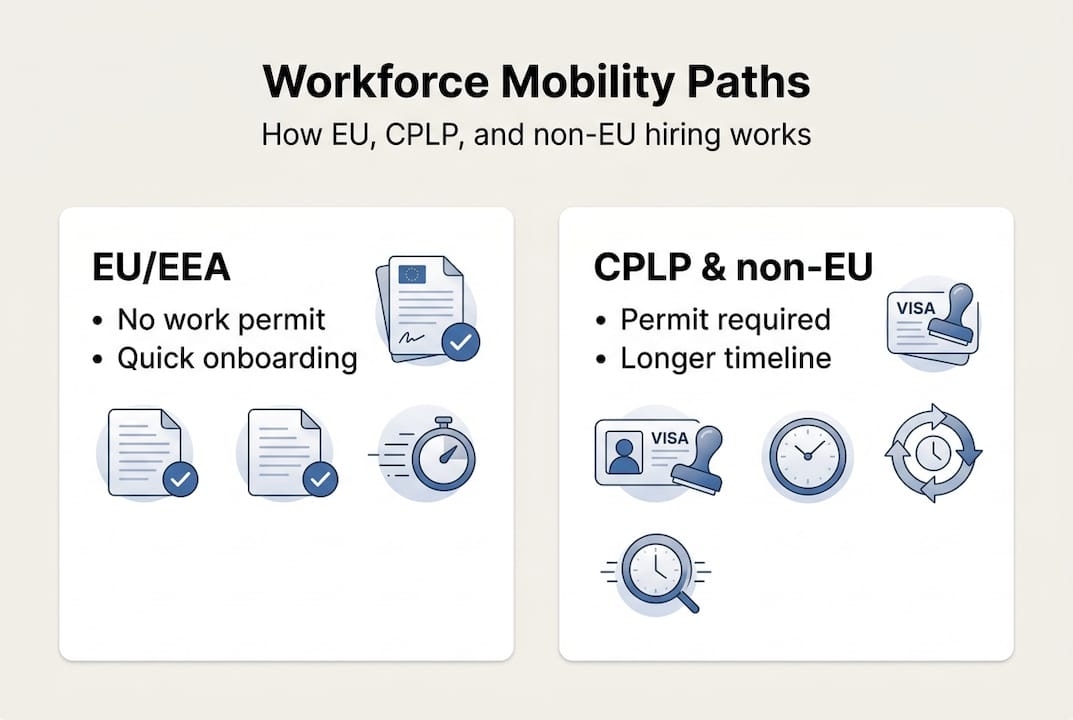
Infographic showing Portugal hiring pathways

Main pathways for workforce mobility: EU, CPLP, and non-EU nationals

Now that you know the main types, see how eligibility and hiring steps differ by origin country.

Worker category Work permit needed Typical timeline Minimum salary requirement
EU/EEA national No Immediate Standard Portuguese minimum
CPLP national In-country conversion 6 to 8 weeks None specified
Non-EU Tech Visa Yes, pre-entry 2 to 4 months Role-dependent
Seasonal worker Yes, pre-entry 1 to 3 months Sector minimum wage
Intra-company transfer Yes, ICT permit 4 to 8 weeks Comparable to local role

EU citizens have free movement rights, meaning you can onboard them in Portugal with no immigration paperwork beyond standard employment registration. That is a genuine competitive advantage when you need to staff up quickly.

EU worker onboarding in Lisbon lounge

The CPLP Mobility Agreement is arguably the most underused hiring tool available to multinationals in Portugal. Nationals from Brazil, Angola, Cape Verde, Mozambique, and other Portuguese-speaking countries can enter Portugal on a passport alone, then convert their status to a work permit in-country within 6 to 8 weeks, with no minimum salary threshold attached. That flexibility makes CPLP talent a strong pipeline for roles where EU candidates are scarce.

For non-EU, non-CPLP nationals, the steps are more structured:

  1. Confirm the role qualifies under the relevant visa category (Tech Visa, seasonal, or standard work visa)
  2. Obtain a job offer and draft a compliant employment contract
  3. Submit the visa application at the Portuguese consulate in the candidate’s home country
  4. Await SEF (immigration authority) processing, typically 2 to 4 months for Tech Visas
  5. Register the employee with social security and tax authorities upon arrival

If you want to skip the entity setup entirely, EoR hiring in Portugal lets you onboard workers under a compliant local employer structure from day one. The detailed hiring guide walks through each visa category in depth.

Employee posting and intra-company transfers

Beyond visas, mobility also includes intra-company transfers. Here is how postings work.

When a foreign company temporarily assigns an employee to work in Portugal, that person becomes a posted worker. The EU ICT Directive and WTO rules govern these arrangements, and the compliance obligations are more detailed than most HR teams expect.

Posting duration Key obligation
From day one Portuguese core terms apply (working hours, rest periods, health and safety)
After 12 months Full host country employment conditions apply, including minimum wage and paid leave
Throughout posting A1 certificate required to confirm home country social security coverage

Posted workers get host country core terms after one year, including minimum wage and holiday entitlements. Before that threshold, you must still comply with Portuguese rules on working time, health and safety, and anti-discrimination. The A1 certificate, issued by the home country’s social security authority, prevents double contributions during the posting period.

Pro Tip: Track posting start dates carefully. Once a worker crosses the 12-month mark, your payroll and benefits obligations shift significantly. Many multinationals miss this trigger and face retroactive penalties.

For companies managing multiple posted workers across different projects, the EoR compliance guide outlines how a local employer of record absorbs these obligations. Teams running sales outsourcing solutions in Portugal also benefit from this structure when rotating staff between markets. The full employment law guide covers posting rules in detail.

With mobility routes covered, let us look at how these trends shape Portugal’s labor landscape and your hiring decisions.

“Immigrants comprise 11.7% of Portugal’s population, 24% of the formal workforce, and contribute €2.2 billion net to social security annually.”

That figure from Portugal hiring data tells you something important: foreign workers are not a marginal segment of the Portuguese economy. They are load-bearing. Removing them would collapse entire sectors, from hospitality and construction to tech and shared services.

Key trends shaping your hiring strategy right now:

  • Unemployment sits around 6%, meaning the domestic talent pool is tight and competition for skilled workers is real
  • Brain drain is ongoing, with Portuguese graduates and mid-career professionals emigrating to higher-wage EU markets like Germany, the Netherlands, and Switzerland
  • Job-to-job mobility is rising, driven by wage growth expectations and a more competitive labor market, which benefits employers who offer structured career paths
  • Foreign direct investment is accelerating, particularly in tech, with multinationals paying premium wages that are reshaping salary benchmarks across sectors

For a deeper look at cost structures and talent availability, the outsourcing talent blog breaks down what you should budget for different roles. If payroll complexity is a concern, payroll outsourcing resources explain how to manage contributions across a mixed workforce of locals and foreign hires.

Compliance, risks, and practical strategies for hiring mobile workers

Understanding market trends is only half the battle. Mastering compliance turns insight into action.

Portugal’s labor authority, the ACT (Autoridade para as Condições do Trabalho), is known for rigorous enforcement. ACT enforces strictly and multinationals face parent liability, meaning your headquarters can be held responsible for violations committed by a Portuguese subsidiary or contractor. That is not a theoretical risk. It has resulted in real fines and reputational damage for global firms.

The most common compliance failures for mobile worker programs include:

  • Misclassifying workers as contractors when the relationship meets the legal definition of employment
  • Skipping social security registration for posted workers who are assumed to be covered by home country systems
  • Ignoring collective bargaining agreements that apply to specific sectors, even for foreign hires
  • Rushing fast-track visa programs without verifying that recruitment practices meet ethical sourcing standards

Pro Tip: Use an Employer of Record (EoR) structure for your mobility hires. An EoR acts as the legal employer in Portugal, handling payroll, social security, tax filings, and contract compliance on your behalf. You retain full operational control while the EoR absorbs the legal risk.

The compliance in hiring resource explains how to build a compliant hiring process from the ground up. The EoR compliance guide goes further, detailing exactly what obligations transfer to the EoR and what stays with you. The employment compliance guide is also worth bookmarking for reference.

Challenges and opportunities: Internal mobility, remote work, and labor market impact

To finish, let us address the practical barriers and potential for companies seeking mobility solutions.

Portugal scores well on international talent attraction but struggles with internal labor mobility. The core problem is structural. High residential mobility barriers from housing costs and transaction taxes make it expensive for Portuguese workers to relocate from, say, the interior to Lisbon or Porto. That limits the domestic talent pool in high-demand urban markets.

For multinationals, this creates both a challenge and an opening:

  • Housing costs in Lisbon and Porto have risen sharply, making relocation packages a real cost factor for international hires
  • Remote and hybrid work models are increasingly enabling cross-border workforce mobility, allowing you to hire talent based outside major cities without requiring relocation
  • Foreign firms paying premium wages attract top Portuguese talent but do not always generate wage spillovers into the broader domestic market, so local salary benchmarks can lag behind what you are used to in other EU markets
  • Digital nomad and D8 visa holders represent a growing segment of mobile workers who contribute economically without entering the formal employment market

The outsourcing infrastructure guide explains how Portugal’s connectivity and digital infrastructure support remote and hybrid team models. The OECD Portugal survey provides the macroeconomic context behind these mobility constraints.

Next steps: Hiring support for workforce mobility in Portugal

Having reviewed the opportunities and barriers, here is how to access professional help to optimize your mobility strategy.

Managing workforce mobility across EU, CPLP, and non-EU channels simultaneously is genuinely complex. Visa timelines, posting obligations, social security certificates, collective agreements, and ACT enforcement all interact in ways that can catch even experienced HR teams off guard.

https://outsourcing-portugal.co.uk

Our EoR services Portugal platform handles the full employment lifecycle for your mobile hires, from contract drafting and payroll processing to social security registration and ongoing compliance monitoring. Whether you are onboarding a CPLP national under the mobility agreement or managing a long-term intra-company transfer, we provide the legal employer infrastructure you need without requiring you to set up a local entity. Reach out to our team via the contact Portugal hiring experts page to discuss your specific workforce mobility needs.

Frequently asked questions

Are EU nationals required to obtain a work permit to work in Portugal?

No. EU nationals work freely in Portugal without a work permit under the EU free movement directive, though standard employment registration with tax and social security authorities is still required.

How does the CPLP Mobility Agreement impact hiring from Brazil or Angola?

CPLP nationals can enter Portugal on a passport and convert to a work permit in-country within 6 to 8 weeks, with no minimum salary requirement attached to the conversion process.

What are the main compliance risks for multinational employers in Portugal?

Foreign employers face strict enforcement by ACT and potential parent liability for violations, making proper documentation, ethical recruitment practices, and correct worker classification essential from day one.

Does job-to-job mobility contribute to wage growth in Portugal?

Yes. Job-to-job mobility is a recognized driver of wage growth in Portugal, and recent labor market trends show workers are increasingly willing to switch employers to capture salary gains.

Can remote work improve workforce mobility in Portugal despite housing barriers?

Yes. Remote and hybrid models are enabling cross-border workforce mobility even where high residential costs and transaction taxes make physical relocation impractical for many workers.

Portugal’s workforce: 23rd globally and rising in 2026

Portugal has quietly climbed to 23rd out of 69 economies in the 2025 IMD World Talent Ranking, and the numbers behind that position tell a story most international HR leaders haven’t fully read yet. Many companies still assume that productivity concerns or language limitations make Portugal a second-tier choice for outsourcing. That assumption is costing them. This guide cuts through the noise with data-backed clarity on Portugal’s real strengths, its genuine challenges, and the practical frameworks you need to make confident workforce expansion decisions.

Table of Contents

Key Takeaways

Point Details
Talent ranking advantage Portugal’s workforce has improved its global talent standing, appealing to international business expansion.
Language proficiency strength High English skills and adaptability make Portugal a leading choice for multilingual teams.
Productivity nuance Productivity varies by sector and firm type, demanding strategic HR planning for optimal results.
Educational alignment matters Matching employee skills to firm needs is essential when leveraging Portugal’s workforce.
Actionable expansion strategies Identify sector strengths and use trusted services for seamless business entry in Portugal.

Understanding Portugal’s competitive position in global talent rankings

Portugal’s rise in global talent rankings isn’t accidental. The country moved up two positions in the 2025 IMD World Talent Ranking, reaching 23rd out of 69 economies. That’s a meaningful shift, not a rounding error.

The IMD methodology matters here. The four-factor ranking framework evaluates investment and development, appeal, readiness, and economic performance. Portugal scores particularly well on infrastructure, landing 16th globally in that category. For HR managers benchmarking European locations, that’s a signal worth taking seriously.

To put Portugal’s position in perspective, consider how it stacks up against comparable European economies:

Country IMD Talent Rank (2025) Infrastructure Rank Notes
Portugal 23rd 16th Strong language skills, EU member
Spain 35th 22nd Larger economy, higher labor costs
Poland 38th 31st Growing tech hub, lower English proficiency
Greece 47th 40th Lower overall competitiveness scores

Portugal outranks several larger European economies. That’s the kind of benchmark data that changes outsourcing conversations. If you want to understand the reasons companies choose Portugal over other nearshore destinations, the ranking context is a strong starting point. For tech-specific expansion, the Portugal tech development guide breaks down sector-level opportunities in detail.

Portugal workforce ranking infographic with comparisons

Language skills and workforce adaptability: Portugal’s unique edge

Once you see Portugal’s talent ranking, the next strategic question is its practical skill set, especially language ability. This is where Portugal genuinely surprises.

Portugal ranks 7th in language skills globally and 6th in the English Proficiency Index. For international companies building cross-border teams, that’s not a minor footnote. It’s a core operational advantage.

Here’s what that proficiency translates to in practice:

  • Tech teams can collaborate directly with English-speaking stakeholders without translation overhead
  • Customer service operations can serve UK, US, and global markets from a single Portuguese hub
  • Project management runs smoother when your nearshore team reads, writes, and speaks the same language as your headquarters
  • Onboarding is faster because documentation, training, and communication don’t require localization

Adaptability goes beyond language. Portuguese professionals consistently score high on cross-cultural collaboration metrics, making integration into international teams faster and less disruptive. If you’re scaling tech teams across borders, that adaptability reduces friction at every stage.

“Portugal’s workforce combines strong English proficiency with genuine cross-cultural flexibility, making it one of the most integration-ready talent pools in Southern Europe.”

For companies already considering expanding into Portugal, language capability is often the deciding factor that converts interest into action.

Pro Tip: When building multilingual business units, prioritize Portuguese talent for roles that require direct client communication. Their proficiency in English, Spanish, and French makes them unusually versatile for pan-European customer operations.

Productivity paradox: The challenges and advantages hidden behind Portugal’s numbers

High adaptability and language skills paint a promising picture, but factual productivity numbers create vital nuance for decision-makers. Portugal’s labor productivity sits 17% below the OECD average. That’s a real gap, and ignoring it would be a mistake.

Woman working on laptop at kitchen counter

But context matters enormously here. The OECD’s 2026 economic survey identifies a specific structural issue: Portugal’s economy is dominated by micro-firms, and those small organizations drag down aggregate productivity figures. Mid-size and large firms tell a very different story.

The productivity paradox is this: Portugal’s education levels have risen significantly, but that rising education hasn’t translated into proportional economic growth. The reason is misallocation. Talented, well-educated workers are often placed in roles that don’t match their capabilities, which suppresses firm-level output.

For international companies, this creates a genuine opportunity:

  • You can capture the talent that domestic firms underutilize. Educated Portuguese professionals in mismatched roles are often eager for better-fit opportunities.
  • Sector selection matters. Tech, finance, and professional services show productivity profiles far above the national average.
  • Firm size context is critical. Outsourcing to or through larger, structured organizations avoids the micro-firm drag entirely.
  • Cost advantages remain real. Even accounting for productivity gaps, Portugal’s labor costs deliver strong value relative to Western European alternatives.

Understanding working in Portugal from an operational standpoint helps you navigate these dynamics before you commit resources. The way infrastructure impacts outsourcing decisions in Portugal also plays directly into productivity outcomes at the firm level.

“The productivity gap in Portugal is real but highly concentrated. International companies that select the right sectors and firm structures consistently outperform the national average.”

Pro Tip: Before finalizing your outsourcing structure, evaluate the size and sector profile of your target workforce. Partnering with mid-to-large organizations or structured service providers insulates you from the micro-firm productivity drag that skews national statistics.

Educational mismatch and evolving skills: What HR leaders must know

Productivity isn’t only about resources. It’s about fit. Portugal’s workforce offers a sharp lesson in how educational alignment shapes outcomes at the firm level.

Research on educational mismatch in Portugal shows a clear pattern: under-education is directly detrimental to productivity, while over-education has a limited positive effect. In plain terms, putting an overqualified worker in a low-complexity role doesn’t generate the productivity boost you might expect. It often generates disengagement instead.

For HR leaders, this has direct implications for workforce planning. Here’s a practical framework for reducing mismatch impact in your Portuguese operations:

  1. Map role complexity before hiring. Define the actual skill requirements of each position before you recruit. Vague job descriptions attract mismatched candidates.
  2. Audit existing team qualifications. If you’re inheriting a team through an acquisition or outsourcing transition, assess qualification levels against role demands immediately.
  3. Design targeted upskilling programs. Where under-education exists, structured training closes gaps faster than replacement hiring.
  4. Create advancement pathways. Over-educated workers stay engaged when they see a clear route to roles that match their full capability.
  5. Use sector benchmarks. Compare your team’s qualification profile against sector norms, not national averages, to get an accurate picture of fit.

For companies focused on career development in Portugal, building these alignment practices into your HR framework from day one prevents the productivity losses that catch many international operators off guard.

“Educational mismatch is a solvable problem. The companies that solve it early build Portuguese teams that consistently outperform national productivity benchmarks.”

Strategic applications: Leveraging Portugal’s workforce for business expansion

Understanding the details is critical, but applying them is transformational. Here’s how to turn Portugal’s workforce insights into effective strategy.

Portugal’s business efficiency and infrastructure rank strongly in IMD’s global competitiveness assessment, which means the operational environment supports what you’re trying to build. The question is how to structure your approach.

Here are the core strategic moves that international companies are using successfully:

  • Start with language-intensive roles. Customer support, technical writing, and client-facing tech roles are natural fits for Portugal’s language-proficient workforce. These deliver immediate ROI.
  • Build nearshore tech teams in Lisbon and Porto. Both cities have mature tech ecosystems with strong university pipelines. The infrastructure impact on talent availability in these hubs is significant.
  • Use an Employer of Record to test before committing. An EOR lets you hire Portuguese talent legally and compliantly without setting up a local entity. It’s the lowest-risk entry point for workforce expansion.
  • Leverage EU membership for regulatory alignment. Portugal’s EU status means GDPR compliance, standardized employment law, and straightforward cross-border data handling.
  • Target mid-size and large firms for outsourcing partnerships. As the productivity data shows, firm size is a strong predictor of output quality. Structure your vendor and partner selection accordingly.
  • Align hiring with sector strengths. Tech, shared services, finance, and professional services consistently outperform Portugal’s national productivity average. These are your highest-value targets.

The Portugal outsourcing benefits extend well beyond cost. When you combine competitive labor pricing with strong language skills, EU compliance, and improving talent rankings, the strategic case becomes compelling across multiple use cases.

Connect with Portugal’s top workforce services

Portugal’s workforce data makes a strong case. Acting on it requires the right operational infrastructure. Whether you’re hiring your first Portuguese employee or scaling a 50-person nearshore team, the compliance and payroll complexity can slow you down if you don’t have local expertise in place.

https://outsourcing-portugal.co.uk

Outsourcing Portugal provides Employer of Record services that let you hire in Portugal legally and compliantly without setting up a local entity. For tech-focused expansion, our nearshore tech talent solutions connect you with vetted professionals in Lisbon, Porto, and beyond. And if payroll complexity is your immediate challenge, our Portugal payroll outsourcing service handles everything from salary processing to tax compliance. The workforce opportunity is real. We make sure you capture it without the operational risk.

Frequently asked questions

How does Portugal’s workforce competitiveness compare to other European countries?

Portugal ranks 23rd out of 69 economies globally, outperforming larger neighbors like Spain and Poland on talent metrics. Its language proficiency and infrastructure scores give it a distinct edge over many Southern and Eastern European peers.

What are the main challenges when outsourcing to Portugal?

Labor productivity runs 17% below the OECD average, driven largely by micro-firm dominance and educational mismatch in certain sectors. Companies that select the right sectors and firm structures consistently avoid these pitfalls.

Is English proficiency a real advantage for international companies in Portugal?

Absolutely. Portugal ranks 6th globally in the English Proficiency Index, which means your Portuguese team can collaborate directly with English-speaking stakeholders from day one without communication barriers.

Are there government initiatives that support workforce competitiveness?

Portugal scores strongly on government efficiency and basic infrastructure in IMD’s methodology, ranking 16th out of 69 economies in that category. That institutional support creates a stable, predictable environment for international workforce operations.

Your payroll compliance checklist for hiring in Portugal

Hiring employees in Portugal without a local entity sounds straightforward until your first payroll cycle reveals a web of labor codes, social security obligations, and monthly reporting deadlines you weren’t prepared for. Missing even one step can trigger fines, back payments, and operational disruption that no HR manager wants to explain to leadership. Portugal’s regulatory framework is rigorous, and foreign employers often underestimate how quickly small errors compound. This guide gives you a practical, step-by-step payroll compliance checklist built specifically for international companies hiring in Portugal remotely, along with a clear comparison of solution types to help you choose the right approach.

Table of Contents

Key Takeaways

Point Details
Know the regulations A clear understanding of Portuguese payroll laws prevents costly mistakes for international employers.
Follow a checklist Using a structured payroll compliance checklist ensures you meet all legal obligations when hiring in Portugal.
Choose the right solution Comparing outsourcing, EoR, and in-house options helps tailor compliance to your business needs.
Avoid penalties Consistent reporting, correct classifications, and professional support minimize compliance risks.
Leverage expert support Working with local payroll specialists and EoR providers streamlines compliance for remote hiring.

Understand Portuguese payroll regulations

Before you process your first paycheck, you need a firm grasp of the legal landscape. Payroll compliance in Portugal requires strict adherence to labor codes and tax laws, covering everything from minimum wage standards to mandatory social security contributions and income tax withholding.

Three government bodies shape the compliance environment you’ll operate in:

  • AT (Autoridade Tributária e Aduaneira): Portugal’s tax authority, responsible for income tax (IRS) withholding and reporting.
  • Segurança Social: The social security system, requiring employer contributions of 23.75% and employee contributions of 11% of gross salary.
  • ACT (Autoridade para as Condições do Trabalho): The labor inspectorate that enforces employment contracts, working hours, and worker rights.

Portugal’s national minimum wage rose to €870 per month in 2026, and employers must also account for mandatory 13th and 14th month salary payments, holiday pay, and overtime rules. These aren’t optional extras. They’re legal requirements baked into the Portuguese Labor Code.

HR assistant reviewing Portuguese payslip at desk

Common mistakes foreign employers make include misclassifying workers as independent contractors, failing to register with Segurança Social before the first payment, and missing monthly DMR (Declaração Mensal de Remunerações) submissions to the tax authority. Each error carries its own penalty tier.

Strong compliance in international hiring starts with understanding these obligations before you hire, not after.

Pro Tip: Schedule quarterly internal audits of your payroll records and use compliance software that flags Portuguese regulatory changes automatically. Portugal updates wage tables and contribution rates regularly, and staying current is far easier than correcting retroactive errors.

Step-by-step payroll compliance checklist

Now that the legal requirements are clear, use this checklist to build a repeatable compliance process for every hire you make in Portugal.

  1. Register as an employer with Portuguese authorities. Before paying any employee, register with AT and Segurança Social. Hiring in Portugal requires timely registration, precise salary calculations, and mandatory contributions. Skipping this step makes every subsequent payroll cycle non-compliant from day one.
  2. Classify employees correctly. Determine whether each worker is an employee (trabalhador por conta de outrem) or a legitimate independent contractor. Misclassification is one of the most audited areas by ACT and carries significant back-payment liability.
  3. Draft compliant employment contracts. Contracts must specify salary, role, working hours, notice periods, and trial period terms in line with the Portuguese Labor Code. Verbal agreements carry no legal weight.
  4. Calculate wages, overtime, and mandatory benefits. Apply the correct gross salary, add the 13th and 14th month payments, calculate overtime at the statutory rate (25% premium for the first hour, 37.5% thereafter), and include any applicable meal allowances.
  5. Withhold and remit income tax (IRS). Apply the correct withholding table based on the employee’s marital status and number of dependents. Submit withholdings to AT monthly.
  6. Submit social security contributions. Pay both employer (23.75%) and employee (11%) contributions to Segurança Social by the 20th of the following month.
  7. File the monthly DMR. International employers must submit payroll reports monthly to Portuguese authorities. The DMR must be filed by the 10th of each month for the previous month’s payroll.
  8. Maintain compliant employee records. Store contracts, payslips, time records, and contribution receipts for a minimum of five years.

Pro Tip: Create a monthly compliance calendar with hard deadlines for each submission. The DMR on the 10th and social security on the 20th are non-negotiable. Missing either triggers automatic penalty notices.

Using payroll outsourcing services can automate most of these steps, reducing the manual burden on your HR team significantly.

Compare payroll compliance solutions for Portugal

With your checklist mapped, the next question is who handles execution. Four main solution types exist, and each carries a different risk and cost profile.

Solution Compliance confidence Admin effort Cost Best for
DIY in-house Low Very high Low upfront, high risk Companies with deep local expertise
Local HR hire Medium High Medium Companies planning long-term entity setup
Payroll outsourcing High Low Medium Companies with existing contracts
Employer of Record (EoR) Very high Minimal Predictable monthly fee Companies without a local entity

Here’s a quick breakdown of the trade-offs:

  • DIY: Full control, but requires fluency in Portuguese labor law. One missed update can cascade into multiple violations.
  • Local HR hire: Builds internal capability but takes time to recruit, onboard, and train. Not practical for fast market entry.
  • Payroll outsourcing: Outsourcing payroll to local experts reduces compliance risks and administrative workload. Works well when you already have employment contracts in place.
  • EoR: The EoR becomes the legal employer on your behalf, handling all registration, payroll, tax, and reporting obligations. You retain day-to-day management of the employee’s work.

You can compare payroll solutions in detail to understand which model fits your current hiring stage and risk tolerance.

Pro Tip: If you’re hiring your first one to five employees in Portugal without a local entity, an EoR is almost always the fastest and most compliant path. It eliminates the need to navigate registration, tax codes, and labor law from scratch.

Deciding factors for remote hiring compliance

Comparisons complete, the right solution depends on your specific situation. Consider these factors before committing.

When outsourcing makes more sense:

  • You already have a Portuguese entity but lack internal payroll expertise.
  • Your team is scaling quickly and needs administrative relief.
  • You want to maintain direct employment contracts while offloading processing.

When EoR is the stronger choice:

  • You have no local entity and no plans to establish one soon.
  • You need to hire quickly, often within days rather than weeks.
  • Compliance risk is a board-level concern and errors are not an option.

Employer of Record services allow companies to hire compliantly in Portugal without a physical presence, making EoR the default recommendation for most international companies entering the market.

Here’s a snapshot of what’s at stake if remote payroll goes wrong:

Compliance error Typical consequence
Late DMR filing Fines starting at €150 per occurrence
Incorrect social security contributions Back payments plus interest
Worker misclassification Retroactive employment benefits owed
Missing employment contract Presumed permanent employment status

These aren’t hypothetical risks. Portuguese labor inspectors actively audit foreign employers, particularly those operating without a registered entity. Reviewing an EoR compliance guide before your first hire gives you a clear picture of what proper setup looks like.

“For companies hiring across borders, the question isn’t whether to prioritize compliance. It’s whether your current setup can sustain it as your team grows.”

What most compliance guides miss about hiring in Portugal

Most checklists stop at initial setup. Register here, submit that, done. But the real compliance risk for international employers isn’t the first payroll cycle. It’s the sixth, the twelfth, the one after a regulatory update you didn’t catch.

Portugal adjusts minimum wage, contribution rates, and withholding tables regularly. A checklist you built in January may be partially outdated by October. Standard guides don’t account for this drift, and that’s where foreign employers quietly accumulate liability.

The hidden advantage of working with a Portugal-based EoR isn’t just the initial setup. It’s the ongoing monitoring. Local partners track regulatory changes as a core function, not an afterthought. Using a Portugal-based Employer of Record eliminates many common compliance errors for overseas companies precisely because compliance is their primary product, not a side task.

We’ve seen companies invest heavily in international hiring compliance frameworks at launch, then let monitoring lapse once operations feel stable. That’s the window where errors accumulate. Treat compliance as a continuous process, not a one-time project.

Pro Tip: Build a quarterly compliance review into your HR calendar. Verify that contribution rates, withholding tables, and contract templates still reflect current Portuguese law. Thirty minutes every quarter prevents months of remediation.

Streamline your Portugal payroll compliance with expert support

Applying this checklist is far easier when you have the right infrastructure behind you. Outsourcing Portugal provides end-to-end employment solutions for international companies hiring in Portugal, from initial employer registration through monthly payroll processing, tax reporting, and ongoing HR support.

https://outsourcing-portugal.co.uk

Whether you need global hiring solutions to scale a remote team quickly or a fully managed best EoR services Portugal arrangement that removes compliance risk entirely, the platform is built for exactly this scenario. You stay focused on your business. We handle the regulatory complexity so your Portugal hires are protected, compliant, and ready to contribute from day one.

Frequently asked questions

Do I need a local entity to manage payroll compliance in Portugal?

No. EoR services allow companies to hire compliantly in Portugal without a physical presence, acting as the legal employer on your behalf and handling all payroll and tax obligations.

Employers must register with AT and Segurança Social, classify employees correctly, calculate wages and mandatory benefits accurately, and submit payroll reports monthly to Portuguese authorities.

What penalties exist for payroll compliance mistakes in Portugal?

Penalties include fines, back payments, and interest charges. Outsourcing payroll to local experts significantly reduces these risks by keeping your processes aligned with current Portuguese law.

How often must payroll reports be submitted in Portugal?

Payroll reports must be submitted monthly to Portuguese tax and social security authorities, with the DMR due by the 10th and social security contributions due by the 20th of each month.

Office team collaborating on talent acquisition

What is talent acquisition and how it drives success

Many HR managers believe talent acquisition is simply another term for recruitment. In reality, it represents a comprehensive strategic framework that aligns workforce planning with business objectives, particularly critical for multinational corporations expanding into Portugal’s dynamic market. For companies seeking to build remote teams while maintaining full compliance, understanding this distinction becomes essential. This article explores what talent acquisition truly means, the unique challenges multinationals face in Portugal, and proven strategies to succeed in remote hiring while ensuring legal compliance.

Table of Contents

Key Takeaways

Point Details
Strategic talent acquisition Talent acquisition is a holistic approach that aligns workforce planning with business goals to create sustainable competitive advantages.
Portugal compliance focus In Portugal, talent acquisition must navigate labor laws, employee protections, and termination procedures to ensure full legal compliance for remote hires.
Remote hiring practices Remote hiring expands talent pools but requires robust sourcing, virtual assessments, digital onboarding, and cross border compliance processes.
Employer of record Adopting EoR services can simplify compliance and payroll when hiring remote workers across borders.
Build talent community Proactively engaging potential candidates through content, webinars, and events creates a ready pipeline before openings.

Understanding talent acquisition: definition and strategic importance

Talent acquisition represents a holistic and strategic approach to sourcing, attracting, selecting, and retaining skilled employees. Unlike traditional recruitment, which focuses on filling immediate vacancies, talent acquisition encompasses long-term workforce planning, employer brand development, candidate experience optimization, and employee retention strategies. This comprehensive framework aligns hiring initiatives with broader business objectives, creating sustainable competitive advantages for organizations operating in global markets.

For multinational corporations, talent acquisition serves as a critical driver of business growth and operational excellence. The strategic nature of this function enables companies to anticipate future skill requirements, build talent pipelines proactively, and adapt quickly to changing market conditions. When organizations expand to Portugal, they gain access to a highly educated, multilingual workforce with strong technical capabilities, making strategic talent acquisition even more valuable.

The distinction between recruitment and talent acquisition becomes particularly important in remote hiring scenarios. Recruitment typically operates reactively, responding to immediate needs with short-term solutions. Talent acquisition, conversely, takes a proactive stance, continuously engaging with potential candidates, nurturing relationships, and building employer brand awareness. This ongoing engagement proves essential when competing for top talent in competitive markets like Portugal’s thriving tech sector.

Remote hiring introduces additional complexity requiring strategic adjustments:

  • Sourcing strategies must leverage digital platforms and global networks effectively
  • Candidate assessment processes need virtual interview protocols and remote skills evaluation
  • Onboarding programs require comprehensive digital resources and cultural integration support
  • Compliance frameworks must address cross-border employment regulations and tax implications

Pro Tip: Build a talent community before you need to hire. Engage potential candidates through content marketing, webinars, and networking events to create a ready pipeline when positions open.

Talent acquisition challenges in Portugal for multinational corporations

Multinational corporations face distinct obstacles when implementing talent acquisition strategies in Portugal, particularly regarding legal compliance and remote work arrangements. Portuguese labor law establishes comprehensive employee protections, mandatory benefits, and specific termination procedures that differ significantly from regulations in other jurisdictions. Hiring in Portugal requires navigating complex labor laws and ensuring full legal compliance for remote employees, making expert guidance essential for success.

Hiring team reviewing résumés in Lisbon office

Cultural considerations significantly impact talent attraction and retention effectiveness. Portuguese professionals value work-life balance, career development opportunities, and organizational culture alignment when evaluating employment opportunities. Companies that fail to recognize these preferences risk losing top candidates to competitors who better understand local expectations. Additionally, communication styles, decision-making processes, and management approaches require cultural adaptation to build effective remote teams.

Competition for skilled multilingual talent has intensified as more international companies recognize Portugal’s advantages. Portugal’s tech industry continues expanding rapidly, creating high demand for software developers, data scientists, and digital marketing specialists. English proficiency among Portuguese professionals ranks among Europe’s highest, making them particularly attractive for multinational operations requiring cross-border collaboration.

Remote hiring amplifies operational challenges that require systematic solutions:

  • Contract management must comply with Portuguese employment law while accommodating remote work arrangements
  • Payroll processing requires accurate calculation of social security contributions, tax withholdings, and mandatory benefits
  • Benefits administration must meet local standards including health insurance, meal allowances, and vacation entitlements
  • Performance management needs clear metrics and regular communication protocols for distributed teams

“The complexity of Portuguese labor regulations combined with remote work compliance creates significant risk exposure for companies without local expertise. Even minor errors in contract terms or payroll calculations can result in substantial penalties and reputational damage.”

Time zone differences, while minimal between Portugal and other European markets, can complicate coordination with operations in Asia or the Americas. Organizations must establish clear communication protocols, overlapping work hours, and asynchronous collaboration tools to maintain productivity. Contact outsourcing Portugal experts to navigate these challenges effectively and build compliant remote teams.

Effective talent acquisition strategies for remote hiring and compliance in Portugal

Successful talent acquisition in Portugal requires systematic approaches addressing both remote work logistics and legal compliance requirements. Organizations should implement structured processes that balance speed with thoroughness, ensuring quality hires while maintaining regulatory adherence.

Follow these steps for effective remote hiring in Portugal:

  1. Define precise role requirements including technical skills, language proficiency, and cultural fit criteria
  2. Develop compelling job descriptions highlighting remote work benefits, career development opportunities, and company culture
  3. Leverage multiple sourcing channels including LinkedIn, local job boards, university partnerships, and professional networks
  4. Implement structured virtual interview processes with behavioral questions, technical assessments, and cultural fit evaluation
  5. Conduct thorough reference checks and background verification appropriate for remote positions
  6. Prepare comprehensive offer packages meeting Portuguese legal requirements and market competitive standards
  7. Execute compliant employment contracts addressing remote work specifics, data protection, and intellectual property
  8. Design robust onboarding programs with digital resources, mentor assignments, and regular check-ins

Implementing Employer of Record services in Portugal streamlines payroll, benefits, and compliance for remote teams. The comparison between EoR and direct employment reveals distinct advantages:

Factor EoR services Direct employment
Setup time 1-2 weeks 3-6 months
Legal entity required No Yes
Compliance responsibility EoR provider Company
Payroll complexity Fully managed Internal resources needed
Scalability High flexibility Limited by infrastructure
Cost structure Predictable monthly fees Variable setup and operational costs

Building employer brand specifically for the Portuguese market accelerates talent attraction significantly. Companies should showcase their commitment to work-life balance, professional development, and inclusive culture through targeted content marketing. Highlighting successful remote team members, sharing company values, and demonstrating career progression opportunities resonates strongly with Portuguese professionals.

Technology integration streamlines candidate screening and onboarding processes. Applicant tracking systems with AI-powered resume screening reduce time-to-hire while maintaining quality standards. Video interviewing platforms enable efficient candidate assessment across time zones. Digital onboarding portals provide new hires with comprehensive resources, reducing administrative burden and improving early engagement.

Infographic comparing talent acquisition and recruitment

Pro Tip: Create a dedicated Portugal talent acquisition playbook documenting your processes, compliance requirements, and cultural insights. This resource ensures consistency across hiring managers and accelerates knowledge transfer as your team grows.

Consider scaling tech teams in Portugal through phased expansion. Start with pilot hires to test processes, gather market intelligence, and refine your approach before committing to larger team builds. This measured strategy reduces risk while building organizational capability. Additionally, sourcing multilingual talent in Portugal provides competitive advantages for companies serving diverse international markets.

How talent acquisition supports business growth for consulting and outsourcing firms in Portugal

Strategic talent acquisition enables faster scaling and reduces costs for service firms expanding in Portugal. Consulting and outsourcing companies depend heavily on human capital quality, making talent acquisition effectiveness directly correlated with revenue growth and client satisfaction. Organizations with mature talent acquisition functions achieve 70% faster time-to-productivity for new hires compared to those using reactive recruitment approaches.

Operational agility represents a critical competitive advantage in dynamic service industries. Companies with robust talent pipelines respond quickly to client demands, scale teams efficiently for new projects, and maintain service quality during rapid growth. This flexibility enables consulting firms to pursue larger contracts confidently, knowing they can staff engagements appropriately. Outsourcing providers similarly benefit from the ability to quickly assemble specialized teams matching specific client requirements.

Compliance adherence minimizes legal risks that could derail business operations:

  • Proper employment classification prevents misclassification penalties and tax liabilities
  • Accurate contract terms protect intellectual property and confidentiality requirements
  • Compliant payroll processing avoids social security disputes and employee grievances
  • Appropriate benefits administration maintains employee satisfaction and regulatory compliance

Employee retention directly impacts profitability for service organizations. Replacing skilled consultants or service delivery professionals costs 150-200% of annual salary when accounting for recruitment expenses, productivity loss, and knowledge transfer requirements. Strategic talent acquisition addresses retention through careful cultural fit assessment, realistic job previews, and alignment between candidate expectations and organizational reality.

The cost-benefit analysis of talent acquisition investment reveals compelling returns:

Metric Traditional recruitment Strategic talent acquisition
Time to fill 45-60 days 25-35 days
Quality of hire score 65-70% 85-90%
First year retention 70-75% 88-92%
Cost per hire €4,500-€6,000 €3,800-€5,200
Revenue per employee €145,000 €178,000

Employee engagement levels increase when organizations demonstrate commitment to strategic talent management. Professionals appreciate working for companies that invest in employer branding, maintain transparent communication, and provide clear career pathways. This engagement translates into higher productivity, better client relationships, and stronger referral networks for future hiring.

For firms expanding to Portugal for tech teams, talent acquisition excellence becomes a market differentiator. Companies known for quality hiring practices attract better candidates, command premium pricing from clients, and build sustainable competitive moats. The investment in talent acquisition infrastructure pays dividends through improved business outcomes, reduced operational risks, and enhanced organizational reputation.

Explore expert talent acquisition support and payroll services in Portugal

Navigating Portugal’s talent landscape requires specialized expertise combining local market knowledge with international best practices. Outsourcing Portugal delivers comprehensive employment Portugal hiring services designed specifically for multinational corporations seeking to build remote teams efficiently while maintaining full compliance. Our solutions eliminate the complexity of cross-border employment, enabling you to focus on core business objectives.

https://outsourcing-portugal.co.uk

Our Employer of Record Portugal services handle all legal, payroll, and administrative responsibilities, allowing you to hire top Portuguese talent within weeks rather than months. We manage employment contracts, monthly payroll processing, tax compliance, social security contributions, and benefits administration. This comprehensive support ensures your remote teams operate smoothly while you maintain complete control over day-to-day management and strategic direction. Contact outsourcing Portugal experts today for a free consultation on optimizing your talent acquisition strategy.

Frequently asked questions

What is the difference between talent acquisition and recruitment?

Talent acquisition represents a strategic, ongoing function focused on long-term workforce planning, employer branding, and organizational culture development. Recruitment operates as a tactical, transactional process addressing immediate hiring needs. Talent acquisition professionals build relationships with potential candidates continuously, even when no positions are open, creating ready pipelines for future needs. This proactive approach reduces time-to-hire and improves quality-of-hire metrics significantly compared to reactive recruitment methods.

How does Employer of Record simplify remote hiring in Portugal?

Employer of Record services act as the legal employer for your Portuguese team members, handling all compliance, payroll, and administrative responsibilities. This arrangement eliminates the need to establish a local entity, dramatically reducing setup time from months to weeks. EoR providers manage employment contracts, tax withholdings, social security contributions, benefits administration, and regulatory reporting. Companies maintain full operational control over daily management while the EoR handles legal and administrative complexity, enabling faster market entry with minimal risk exposure.

What are key compliance considerations when hiring remote employees in Portugal?

Portuguese labor law requires specific contract terms, mandatory benefits, and employee protections that differ from other jurisdictions. Employers must provide written contracts within 60 days, comply with maximum working hour regulations, and respect minimum notice periods for termination. Payroll processing must accurately calculate social security contributions at current rates, apply progressive income tax withholding, and include mandatory benefits like meal allowances and vacation pay. Remote work arrangements require additional considerations around data protection, equipment provision, and health and safety responsibilities. Working with local compliance experts ensures adherence to all requirements while avoiding costly penalties.

International team meeting in Lisbon office

7 key reasons international companies choose Portugal

Selecting the right outsourcing destination has become one of the most strategic decisions for global companies seeking to expand their technical capabilities while managing costs effectively. Portugal has emerged as a leading choice for international businesses looking to establish tech development teams and support centers without the complexity of setting up local entities. This article reveals the specific advantages that make Portugal stand out among European outsourcing destinations, from its cost-effective skilled workforce to streamlined legal frameworks that simplify international hiring. Whether you’re exploring nearshore options or evaluating talent acquisition strategies, understanding Portugal’s unique position will help you make informed outsourcing decisions.

Table of Contents

Key Takeaways

Point Details
Cost effective talent Portugal offers high quality software developers at 30 to 40 percent lower salaries than major European hubs, enabling cost efficient tech teams.
Nearshore advantage Portugal’s proximity to Europe provides favorable time zone overlap, easier travel, and smoother collaboration with headquarters.
Strong legal framework A stable and business friendly legal environment in Portugal simplifies cross border hiring, payroll, and compliance for international teams without local entities.
Robust tech ecosystem A growing tech ecosystem gives access to skilled developers, QA engineers, and technical support to accelerate project delivery.

How to evaluate locations for tech outsourcing

International businesses face complex decisions when selecting outsourcing destinations for technical teams. The evaluation process requires balancing multiple factors that directly impact operational success and long-term viability. Businesses consider cost, talent quality, legal environment, and proximity when choosing outsourcing locations, making the selection process both strategic and multifaceted.

Companies must assess labor costs alongside talent availability to ensure they’re not sacrificing quality for savings. The legal framework in potential destinations determines how easily you can hire, manage payroll, and maintain compliance without establishing a local entity. Geographic location affects time zone compatibility, cultural alignment, and the ability to conduct in-person visits when necessary.

For tech development and support services specifically, certain evaluation factors become critical decision points:

  • Quality and availability of software developers, QA engineers, and technical support specialists
  • Average salary ranges compared to your current operational costs
  • Legal complexity for hiring remote employees or contractors
  • Language proficiency, particularly English fluency for international collaboration
  • Infrastructure quality including internet connectivity and office space options
  • Government stability and business-friendly policies
  • Ease of travel and time zone overlap with headquarters

These criteria form the foundation for comparing potential outsourcing destinations. Portugal’s rise as a preferred location stems from its ability to excel across these evaluation dimensions while offering additional advantages through specialized outsourcing and EOR solutions that simplify international hiring.

Pro Tip: Create a weighted scoring matrix for your top three outsourcing destinations, assigning importance values to each criterion based on your specific business needs. This structured approach removes emotional bias from location decisions.

Cost advantages of outsourcing tech talent in Portugal

Financial considerations drive most outsourcing decisions, and Portugal delivers compelling cost advantages without compromising talent quality. Portugal’s outsourcing costs are notably lower than in Western Europe while offering high-quality talent, creating an attractive value proposition for international companies seeking to optimize their technical workforce spending.

The salary differential between Portugal and other European tech hubs represents substantial savings. A senior software developer in Portugal typically earns 30 to 40 percent less than counterparts in Germany, France, or the UK, while maintaining comparable skill levels and productivity. This cost efficiency extends beyond base salaries to encompass the entire employment cost structure.

Cost Factor Portugal Western Europe Savings
Senior Developer Salary €35,000-50,000 €60,000-80,000 35-40%
Social Security (Employer) 23.75% 25-40% 5-15%
Office Space (per sqm/month) €15-25 €35-50 40-50%
Total Employment Cost Lower by 30-35% Baseline Significant

Beyond direct compensation, operational expenses in Portugal remain competitive. Office space in Lisbon and Porto costs significantly less than London, Paris, or Amsterdam, while offering modern facilities and excellent infrastructure. Social security contributions, while comprehensive, stay below rates in many Western European countries.

Key cost factors that make cost-effective tech talent in Portugal particularly attractive include:

  • Competitive base salaries that attract quality professionals without premium pricing
  • Reasonable employer social security contributions at 23.75 percent
  • Lower cost of living allowing companies to offer attractive packages at reduced expense
  • Affordable office space in major tech hubs like Lisbon and Porto
  • Reduced travel costs due to proximity to other European markets

The cost-benefit equation in Portugal extends beyond simple savings. Companies gain access to educated, motivated professionals who deliver high-quality work at rates that significantly improve project economics. This combination allows businesses to scale technical teams more rapidly while maintaining budget discipline.

Pro Tip: When calculating total cost of ownership for Portuguese talent, factor in reduced recruitment time and lower employee turnover rates compared to saturated markets. These hidden savings often exceed the direct salary differentials.

Portugal’s skilled tech workforce and talent ecosystem

Portugal has cultivated a thriving technology sector supported by strong educational institutions and a growing community of skilled professionals. Portugal hosts a growing ecosystem of highly skilled tech workers and international-friendly hiring conditions, making it an ideal source for technical talent across multiple specializations.

Portuguese tech graduate working in startup

The country’s universities produce thousands of engineering and computer science graduates annually, with programs that emphasize practical skills alongside theoretical knowledge. Major institutions in Lisbon, Porto, and Coimbra maintain partnerships with technology companies, ensuring curricula remain aligned with industry needs. This educational foundation creates a steady pipeline of entry-level and mid-career professionals ready to contribute to international projects.

Portuguese tech professionals demonstrate strong proficiency in multiple programming languages and frameworks. JavaScript, Python, Java, and PHP dominate the local skill landscape, with growing expertise in modern frameworks like React, Angular, and Node.js. Cloud technologies, DevOps practices, and agile methodologies have become standard competencies among Portuguese developers.

The skilled tech workforce in Portugal offers several distinct advantages:

  • High English proficiency, with Portugal ranking among the top non-native English speaking countries
  • Strong mathematical and engineering education foundation from respected universities
  • Growing startup ecosystem that nurtures entrepreneurial and innovative thinking
  • Active tech community with regular meetups, conferences, and knowledge-sharing events
  • Cultural compatibility with Western business practices and work ethics
  • Increasing specialization in emerging technologies like AI, machine learning, and blockchain

Lisbon and Porto have become recognized tech hubs, attracting both local talent and international professionals seeking quality of life combined with career opportunities. The startup scene has exploded over the past decade, with events like Web Summit bringing global attention to Portugal’s technology capabilities. This vibrant ecosystem means companies can tap into experienced professionals who have worked on diverse projects and understand international standards.

The multilingual nature of the Portuguese workforce provides additional value for companies serving multiple markets. Many professionals speak Spanish, French, or German alongside English, enabling them to support customer-facing roles and international collaboration without language barriers.

Pro Tip: Partner with Portuguese universities through internship programs or sponsored projects to identify and develop emerging talent before they enter the competitive job market. This early engagement often leads to higher quality hires and stronger company loyalty.

Navigating employment law and administrative requirements in foreign countries typically presents significant challenges for international companies. Portugal has developed streamlined solutions that remove these barriers, making it remarkably simple for global businesses to hire and manage Portuguese talent. Portugal provides streamlined legal and payroll services for international firms through EoR and local outsourcing providers, enabling rapid team expansion without entity establishment.

Employer of Record services have transformed how international companies access Portuguese talent. An EoR acts as the legal employer for your team members, handling all compliance, payroll, benefits, and administrative tasks while you maintain full operational control. This arrangement allows you to hire Portuguese employees within weeks rather than the months required to establish a local subsidiary.

The Portuguese legal framework for employment offers several advantages for international operations:

  • Clear and stable labor laws that protect both employers and employees
  • Standardized employment contracts recognized across the European Union
  • Reasonable notice periods and termination procedures compared to other EU countries
  • Comprehensive but manageable social security and tax compliance requirements
  • Strong data protection standards aligned with GDPR for sensitive information handling

Onboarding remote employees through employment and payroll services in Portugal follows a straightforward process:

  1. Select your EoR partner and define your hiring requirements and compensation structure
  2. Recruit candidates through local channels or with EoR recruitment support
  3. Provide offer details to your EoR who prepares compliant employment contracts
  4. Complete employee onboarding including tax registration and social security enrollment
  5. Begin operations while your EoR handles ongoing payroll, benefits, and compliance
  6. Maintain direct management and operational control of your team members

Comparing Portugal’s legal and operational ease against other common outsourcing destinations reveals significant advantages:

Factor Portugal Eastern Europe Latin America
EoR Service Availability Extensive Moderate Growing
Legal Compliance Complexity Low Moderate High
Payroll Processing Time 2-3 days 3-5 days 5-7 days
Employment Contract Standards EU standardized Variable Highly variable
Setup Time with EoR 2-3 weeks 3-4 weeks 4-6 weeks

EOR Portugal services eliminate the need for companies to understand intricate Portuguese labor law or establish local accounting infrastructure. Your EoR partner ensures compliance with minimum wage requirements, mandatory benefits, vacation entitlements, and tax withholding obligations. This comprehensive support allows you to focus on business objectives rather than administrative complexity.

The stability of Portugal’s legal environment provides additional confidence for long-term planning. Employment regulations remain consistent and predictable, with changes typically announced well in advance. This stability contrasts sharply with destinations where frequent regulatory shifts create ongoing compliance challenges.

Portugal’s strategic location and business environment

Geography and business climate play crucial roles in outsourcing success, and Portugal’s position offers unique strategic advantages for international operations. Portugal’s location offers strategic proximity to major European markets and convenient communication hours, making it an ideal nearshore destination for companies across Europe and the Americas.

Portugal operates in the Western European Time zone, aligning perfectly with UK business hours and providing substantial overlap with both Central European and Eastern US time zones. This positioning enables real-time collaboration during core business hours, eliminating the communication delays that plague offshore arrangements with significant time differences. Teams in Portugal can participate in morning meetings with US East Coast offices and afternoon sessions with Asian Pacific colleagues.

The country’s multilingual capabilities extend beyond English proficiency. Portuguese professionals commonly speak Spanish due to linguistic similarities and geographic proximity to Spain. French and German language skills are also prevalent, particularly among younger professionals educated in international environments. This linguistic diversity enables Portuguese teams to support customer service and technical support operations across multiple European markets.

Government and regional incentives have made Portugal increasingly attractive for technology companies and outsourcing operations:

  • Tax incentives for qualified technology companies and research and development activities
  • Startup visa programs that facilitate hiring non-EU talent when specialized skills are needed
  • Investment in digital infrastructure including high-speed internet and technology parks
  • Simplified business registration and licensing processes for foreign companies
  • Active promotion of Portugal as a technology and innovation destination

The nearshore Portugal benefits extend to cultural compatibility and business practices. Portuguese professionals understand Western European business culture, communication styles, and work expectations. This cultural alignment reduces friction in team integration and accelerates the onboarding process for new hires joining international teams.

Portugal’s political and economic stability within the European Union provides confidence for long-term investments. The country maintains strong governance, low corruption levels, and consistent policies that support foreign investment and business growth. This stability matters when committing to multi-year projects or building permanent technical capabilities.

Travel accessibility enhances Portugal’s strategic position. Major cities like Lisbon and Porto offer direct flights to most European capitals and key US cities, making in-person visits convenient when needed. The country’s excellent tourism infrastructure means business travelers find high-quality accommodations and amenities at reasonable costs.

Explore expert outsourcing and hiring services in Portugal

Portugal’s combination of cost efficiency, skilled talent, streamlined legal frameworks, and strategic positioning creates an compelling opportunity for international companies seeking to expand their technical capabilities. The advantages outlined throughout this article demonstrate why Portugal has become a preferred destination for tech outsourcing and nearshore development teams. However, successfully establishing operations requires local expertise and established infrastructure to navigate hiring, compliance, and team management effectively.

https://outsourcing-portugal.co.uk

Outsourcing Portugal specializes in removing the complexity from international hiring through comprehensive Employment Portugal services that handle every aspect of team establishment and management. Whether you need complete EOR Portugal services for compliant hiring without entity setup, or full Nearshore Portugal solutions for building dedicated technical teams, expert guidance ensures you maximize Portugal’s advantages while avoiding common pitfalls. Explore tailored solutions designed specifically for international companies ready to leverage Portugal’s exceptional outsourcing environment.

What are the primary benefits of outsourcing tech talent to Portugal?

What makes Portugal cost-effective for tech outsourcing compared to other European countries?

Portugal offers salaries 30 to 40 percent lower than Western European markets while maintaining comparable skill levels and productivity. Combined with lower operational costs and reasonable tax rates, companies achieve significant savings without sacrificing quality.

How does Portugal’s talent pool compare to other outsourcing destinations?

Portuguese tech professionals benefit from strong university education, high English proficiency, and exposure to international standards through the country’s vibrant startup ecosystem. The workforce demonstrates both technical competence and cultural compatibility with Western business practices.

What is the difference between nearshore and offshore outsourcing?

Nearshore outsourcing refers to contracting services in nearby countries with minimal time zone differences, like Portugal for European or US companies. Offshore typically involves distant locations with significant time zone gaps, creating communication challenges that nearshore arrangements avoid.

Can international companies hire in Portugal without establishing a local entity?

Yes, Employer of Record services allow international companies to hire Portuguese employees legally and compliantly without setting up a subsidiary. The EoR handles all employment administration while you maintain operational control of your team.

How long does it take to build a tech team in Portugal?

Using EOR services, companies can hire their first Portuguese employees within two to three weeks. Building a complete team depends on role complexity and hiring volume, but Portugal’s active talent market and streamlined processes enable faster scaling than most European destinations. More details are available in the FAQ about hiring in Portugal.

What language skills do Portuguese tech professionals typically have?

Portuguese professionals rank among the highest in English proficiency for non-native speakers, with many also speaking Spanish, French, or German. This multilingual capability supports both internal collaboration and customer-facing roles across European markets.

IT manager working in Lisbon coworking office

How infrastructure impacts outsourcing decisions in Portugal

Portugal’s infrastructure often flies under the radar in outsourcing conversations, yet it plays a decisive role in determining operational success for international companies. While many leaders focus on labor costs and talent availability, the strength of digital connectivity, logistics networks, and power systems directly influences productivity, scalability, and long-term viability. This guide clarifies how Portugal’s infrastructure landscape shapes outsourcing outcomes, equipping business leaders and HR professionals with the insights needed to make informed location decisions that align with strategic objectives and operational requirements.

Table of Contents

Key Takeaways

Point Details
Digital infrastructure advantage Portugal offers high speed fiber, extensive data center capacity, and low latency that enable cloud based applications, real time collaboration, and data intensive operations.
Lisbon and Porto hubs Lisbon and Porto host the majority of data centers, creating powerful nearshore hubs for IT and BPO services.
Renewable energy edge Renewable energy powers a large portion of the data center footprint, supporting sustainable growth and potentially lower operating costs.
Logistics limits noted Portugal ranks mid tier on the World Bank Logistics Performance Index, indicating reliable but not top tier support for physical operations.

Portugal’s digital infrastructure: the backbone of IT and BPO outsourcing

Portugal’s digital infrastructure stands as a critical competitive advantage for companies considering IT and business process outsourcing locations. The country achieved 71.1% fiber to the home penetration in 2023, ranking third across Europe and providing the high-speed connectivity essential for cloud-based applications, real-time collaboration, and data-intensive operations. This robust digital foundation enables outsourcing firms to deliver services with minimal latency and maximum reliability, directly translating into productivity gains and client satisfaction.

Lisbon and Porto concentrate the majority of Portugal’s 33 data centers, creating powerful hubs for nearshore tech talent and digital services. These facilities benefit from Portugal’s position as a global interconnection point, with submarine cables linking Europe, Africa, and the Americas. The concentration of infrastructure and skilled professionals in these cities reinforces their status as premier outsourcing destinations, attracting multinational companies seeking stable, well-connected operational bases within the European Union.

Renewable energy powers much of Portugal’s data center infrastructure, enabling sustainable scaling that aligns with corporate environmental commitments. Data center investments are projected to contribute €3.7 billion to GDP by 2031 and create 9,400 jobs, demonstrating the sector’s economic significance and growth trajectory. This expansion supports the increasing demand for EOR solutions and employment services as companies establish or expand Portuguese operations.

Digital infrastructure advantages for IT and BPO outsourcing:

  • High-speed fiber connectivity supports seamless video conferencing and cloud application performance
  • Redundant network paths minimize service disruptions and ensure business continuity
  • Strategic geographic position enables low-latency connections to major European markets
  • Growing data center capacity accommodates expanding storage and computing requirements
  • Renewable energy integration reduces operational costs and carbon footprint

“Portugal’s digital infrastructure maturity, combined with competitive costs and EU regulatory alignment, positions it as an increasingly attractive alternative to traditional outsourcing destinations for companies prioritizing reliability and sustainability.”

Pro Tip: Prioritize outsourcing to cities with strong digital infrastructure like Lisbon and Porto for reliability and scalability, ensuring your operations benefit from established connectivity, talent pools, and support ecosystems that minimize technical risks.

The logistics and physical infrastructure landscape: opportunities and constraints

Portugal’s logistics infrastructure presents a balanced picture of capabilities and limitations that directly affect outsourcing operations. The country scores 3.4 on the World Bank Logistics Performance Index for 2023, reflecting mid-tier capabilities that prove adequate for business services sectors but fall short of top European performers. This positioning means companies can expect reliable but not exceptional logistics support for physical operations, adequate for most BPO and IT outsourcing needs where digital connectivity matters more than physical goods movement.

Airport congestion in Lisbon creates practical challenges for international business operations requiring frequent executive travel or urgent in-person meetings. The capital’s single major airport handles growing passenger volumes without sufficient expansion, leading to delays and scheduling difficulties during peak periods. Companies establishing outsourcing operations in Portugal should factor these constraints into travel planning and consider video conferencing as the primary communication method to reduce dependency on air travel infrastructure.

Business traveler waits amid airport congestion

Power grid capacity emerges as a critical constraint for data center expansion and technology-intensive outsourcing operations. Power demands could exceed 8.5 terawatt-hours annually by 2031, raising concerns about grid capacity to support continued growth. This infrastructure bottleneck requires companies to monitor energy availability in their chosen locations and potentially diversify operations across multiple sites to mitigate supply risks.

Infrastructure factor Portugal Ireland Poland
Logistics Performance Index 3.4 3.6 3.5
Airport capacity constraints High (Lisbon) Moderate Low
Power grid reliability Good, capacity concerns Excellent Good
Road network quality Good Excellent Moderate
Port infrastructure Strong Limited Strong

Logistics strengths and weaknesses for outsourcing:

  • Strong port infrastructure supports companies with physical product components
  • Well-maintained road networks enable reliable ground transportation
  • Airport limitations affect international connectivity and executive mobility
  • Power capacity concerns require strategic planning for energy-intensive operations
  • Rail infrastructure lags behind Western European standards but continues improving

Pro Tip: Consider hybrid remote work models and secondary hubs to mitigate physical infrastructure constraints, reducing dependence on Lisbon’s congested airport while accessing talent across Portugal’s regions through flexible working arrangements.

Secondary cities and hybrid models: balancing cost, talent, and infrastructure

Secondary cities like Braga, Aveiro, and Coimbra offer compelling alternatives for outsourcing operations seeking cost advantages and access to emerging talent pools. These locations provide 30-40% lower operational costs compared to Lisbon and Porto, including reduced office space expenses, lower salary expectations, and decreased living costs for relocated employees. Business services operations in these cities access growing university graduate populations while maintaining reasonable proximity to major hubs through Portugal’s compact geography.

Infrastructure maturity in secondary cities lags behind primary hubs, requiring flexible outsourcing strategies that account for these limitations. Digital connectivity remains strong across Portugal, but data center presence, specialized technical support, and logistics infrastructure concentrate in larger urban areas. Companies establishing operations in secondary locations should assess specific infrastructure requirements against available capabilities, ensuring critical needs align with local capacity.

Infographic on Portugal infrastructure pros cons

Hybrid remote models effectively overcome infrastructure gaps by combining local presence with distributed team structures. This approach allows companies to tap talent in secondary cities while maintaining core operations in well-connected hubs, balancing cost efficiency with infrastructure reliability. Remote work capabilities, strengthened during recent years, enable Portuguese professionals to contribute effectively regardless of physical location, reducing infrastructure dependencies for knowledge-based outsourcing.

Advantages and limitations of secondary cities:

  • Significantly lower operational and labor costs improve budget efficiency
  • Access to motivated talent from regional universities and technical schools
  • Less competitive hiring environment compared to saturated major markets
  • Limited data center presence may affect latency-sensitive applications
  • Fewer direct international flight connections complicate business travel
  • Smaller professional networks require more effort to build partnerships

Steps to implement hybrid outsourcing models effectively:

  1. Establish core operations in primary hubs with strong infrastructure and connectivity
  2. Identify specific functions suitable for secondary city locations based on infrastructure needs
  3. Implement robust remote collaboration tools and processes before geographic expansion
  4. Develop clear communication protocols that work across distributed team structures
  5. Create regular in-person gathering opportunities to maintain team cohesion
  6. Monitor infrastructure developments in secondary cities to capitalize on improvements
Factor Primary cities (Lisbon, Porto) Secondary cities (Braga, Aveiro, Coimbra)
Operational costs High 30-40% lower
Digital infrastructure Excellent Good to very good
Talent availability High, competitive Growing, less competitive
Data center presence Strong Limited
International connectivity Excellent Moderate
Office space costs €15-25/sq m €8-15/sq m

Companies can leverage EOR solutions to test secondary city markets without establishing full legal entities, reducing risk while exploring cost advantages. This approach provides flexibility to scale operations based on infrastructure performance and talent availability. Nearshore operations benefit from Portugal’s compact size, enabling teams to collaborate across cities with minimal travel time when in-person interaction becomes necessary.

Practical considerations for leaders and HR: optimizing infrastructure for outsourcing success

Business leaders and HR professionals must systematically evaluate infrastructure factors when making outsourcing location decisions in Portugal. Prioritizing locations with strong digital infrastructure for IT and business process functions leverages productivity gains documented in research. ICT adoption boosts total factor productivity and labor productivity in Portuguese firms, linking infrastructure quality directly to operational success and competitive advantage.

Diversifying outsourcing presence across primary and secondary cities optimizes the balance between cost efficiency and infrastructure reliability. This strategy spreads risk while accessing talent pools across Portugal’s regions, providing scalability options as operations grow. Companies can establish core functions requiring robust infrastructure in Lisbon or Porto while placing cost-sensitive operations in secondary cities, creating a tiered approach that maximizes overall efficiency.

Monitoring ongoing infrastructure investments helps leaders anticipate both risks and opportunities in Portugal’s evolving landscape. Power grid expansions, airport developments, and data center construction directly impact operational viability and growth potential. Staying informed about these trends enables proactive strategy adjustments, ensuring outsourcing operations remain aligned with infrastructure capabilities and avoiding potential bottlenecks.

Infrastructure factors to assess in outsourcing location decisions:

  • Fiber connectivity speeds and redundancy levels for digital operations
  • Data center proximity and capacity for cloud-dependent applications
  • Airport accessibility and flight frequency for required business travel
  • Power supply reliability and capacity for planned operational scale
  • Office space availability and quality in target price ranges
  • Public transportation options for employee commuting and mobility
  • Telecommunications provider diversity for backup connectivity

Pro Tip: Regularly review infrastructure trends and engage with local resources to optimize outsourcing strategy, connecting with working in Portugal experts who monitor developments and provide insights on emerging opportunities and potential constraints.

HR teams should factor infrastructure quality into talent attraction and retention strategies. Employees value reliable connectivity for remote work, accessible transportation for office commutes, and quality of life factors influenced by infrastructure like healthcare facilities and cultural venues. Locations with superior infrastructure support higher employee satisfaction and lower turnover, reducing recruitment costs and maintaining operational continuity.

Sales outsourcing operations particularly benefit from strong digital infrastructure supporting CRM systems, video conferencing, and real-time communication with international clients. Ensuring chosen locations provide the technical foundation for these tools prevents performance issues that could damage client relationships and revenue generation.

Successful outsourcing strategies integrate infrastructure assessment into broader location evaluation frameworks, weighing connectivity, logistics, and power capacity alongside traditional factors like labor costs and talent availability. This comprehensive approach identifies optimal locations that balance multiple priorities, supporting sustainable growth and operational excellence in Portugal’s dynamic outsourcing market.

Explore expert outsourcing services in Portugal

Navigating Portugal’s infrastructure landscape and outsourcing opportunities requires local expertise and established operational capabilities. Outsourcing Portugal specializes in Employment, Employer of Record, payroll, and hiring services designed specifically for international companies establishing or expanding Portuguese operations. Their team understands how infrastructure factors influence outsourcing success and helps businesses select optimal locations, structure operations, and manage talent effectively.

https://outsourcing-portugal.co.uk

Whether you’re evaluating Portugal for the first time or scaling existing operations, professional guidance ensures your strategy aligns with infrastructure realities and maximizes competitive advantages. Contact the experts for a free consultation to discuss your specific requirements and explore how nearshore outsourcing in Portugal can deliver cost-effective, reliable operations supported by robust infrastructure.

Frequently asked questions

What role does Portugal’s digital infrastructure play in outsourcing success?

Portugal’s high fiber penetration and extensive data center presence enable reliable, scalable IT outsourcing operations with minimal downtime and strong connectivity. This infrastructure supports productivity gains that translate directly into competitive advantages for companies choosing Portuguese locations. The digital foundation proves particularly valuable for cloud-based services, real-time collaboration, and data-intensive business processes.

How do airport congestion and power grid issues affect outsourcing in Portugal?

Lisbon airport congestion creates practical challenges for frequent executive travel and urgent in-person meetings, requiring companies to emphasize video conferencing and plan travel carefully. Power grid strain from expanding data centers poses potential capacity constraints that could limit growth in energy-intensive operations without continued infrastructure investment. Companies should monitor these factors and potentially diversify operations across multiple locations to mitigate risks.

Can secondary cities in Portugal effectively support outsourcing operations?

Secondary cities offer significant cost advantages and access to emerging talent pools but have less developed infrastructure than Lisbon and Porto, requiring careful assessment of specific operational needs. Hybrid models combining local presence with remote work effectively overcome infrastructure limitations while capturing cost benefits. Companies can successfully leverage secondary cities for functions with lower infrastructure dependencies while maintaining core operations in primary hubs.

How does Portugal’s logistics infrastructure compare to other European outsourcing destinations?

Portugal’s mid-tier logistics performance proves adequate for business services outsourcing but falls short of top European performers like Ireland or the Netherlands. The country offers strong port infrastructure and good road networks but faces airport capacity constraints and developing rail systems. For IT and BPO outsourcing where digital connectivity matters more than physical logistics, Portugal’s infrastructure supports operational needs effectively.

What infrastructure factors should HR teams prioritize when selecting Portuguese outsourcing locations?

HR teams should prioritize digital connectivity quality to support remote work and collaboration tools, transportation accessibility for employee commuting, and quality of life infrastructure affecting talent attraction and retention. Power reliability matters for office operations and employee productivity, while proximity to airports influences international talent recruitment. Balancing these factors with cost considerations helps identify locations that support both operational efficiency and workforce satisfaction.

Role of compliance in international hiring in Portugal

Hiring internationally in Portugal offers incredible opportunities, but 70% of contractor hires may be misclassified, leading to fines up to €100,000. Many HR managers assume compliance is straightforward, yet Portugal’s layered requirements around payroll taxes, GDPR, labor codes, and work visas create hidden pitfalls. This article clarifies the compliance landscape, explores practical solutions like Employer of Record services, identifies critical risks, and examines emerging 2026 trends. You’ll gain actionable insights to ensure legal adherence and efficient employment practices when expanding into Portugal.

Table of Contents

Key Takeaways

Point Details
No local entity required Foreign companies can hire in Portugal by registering as foreign employers with NIPC and Social Security rather than forming a Portuguese subsidiary.
EOR enables rapid hiring An EOR handles contracts payroll GDPR compliance and adherence so you can hire quickly while remaining compliant.
Key compliance areas Payroll taxes GDPR labor code and work permit rules require careful setup and ongoing monitoring.
Common risks and fines Misclassifying workers can trigger fines up to €100,000 and other penalties.

Understanding Portugal’s international hiring compliance landscape

Foreign companies entering Portugal face a complex compliance framework, but you don’t need a local entity to hire legally. Foreign companies can hire in Portugal without a local entity by registering as foreign employers with NIPC and Social Security numbers, handling payroll, tax withholding (IRS), and contributions. This registration process establishes your legal presence for employment purposes without incorporating a Portuguese subsidiary.

Payroll management represents the backbone of compliance. Employers must contribute 23.75% of gross salary to Social Security, while employees contribute 11%. These rates apply universally across industries and employee types. You’ll also handle IRS tax withholding based on progressive income tax brackets, remitting payments monthly to Portuguese tax authorities. Understanding the employment cost calculator portugal 2026 helps you budget accurately for total employment expenses beyond base salary.

Obligation Type Employer Responsibility Employee Responsibility
Social Security 23.75% of gross salary 11% of gross salary
Income Tax (IRS) Withhold and remit monthly Taxed on progressive brackets
Registration NIPC number, Social Security registration Provide tax identification (NIF)
Reporting Monthly payroll declarations Annual tax return filing

Critical registration and compliance steps include:

  • Obtain NIPC (business identification number) from Portuguese tax authority
  • Register with Social Security as a foreign employer within 24 hours of first hire
  • Secure tax representative if no permanent establishment exists
  • Submit monthly payroll declarations (Declaração de Remunerações)
  • Maintain compliant employment contracts under Portuguese labor code
  • Process work permits for non-EU nationals before employment start

Pro Tip: Designate a local tax representative early in your hiring process. This person becomes your official contact with Portuguese authorities and ensures timely compliance with reporting deadlines, preventing penalties that can reach thousands of euros for late submissions.

How employer of record (EOR) services help ensure compliant international hiring

Employer of Record services transform compliance complexity into simplicity. An EOR manages contracts, payroll, GDPR background checks, and labor code adherence, enabling rapid compliant hiring without entity setup. The EOR becomes the legal employer on paper while you maintain full operational control over daily work activities and performance management.

Typical EOR services cover employment contracts drafted under Portuguese law, monthly payroll processing with tax withholding, Social Security contributions and reporting, benefits administration including mandatory vacation accrual, and ongoing labor law compliance monitoring. Setup timelines average 1-2 weeks from engagement to first payroll, dramatically faster than the 3-6 months required for entity incorporation.

Cost considerations matter for budget planning. Most employer of record portugal providers charge around £599 per employee monthly, plus the actual employment costs. This fee structure makes EOR economically viable for teams under 8-10 employees. Beyond that threshold, entity setup often becomes more cost effective for long-term operations.

EOR services excel in specific scenarios:

  • Testing the Portuguese market with 1-5 initial hires before committing to entity setup
  • Hiring specialized contractors or consultants for project-based work under 18 months
  • Expanding rapidly into Portugal when speed matters more than long-term cost optimization
  • Managing compliance for remote employees while your company lacks Portuguese HR expertise
  • Avoiding the administrative burden of Portuguese payroll and labor law navigation

The eor portugal model handles GDPR compliance for background checks, a critical requirement often overlooked. Portuguese data protection law requires explicit employee consent before processing personal data for employment screening. EOR providers maintain compliant consent workflows and secure data handling procedures that meet CNPD (Portuguese Data Protection Authority) standards.

Pro Tip: Choose EOR over entity setup when you’re hiring fewer than 8 employees or testing market viability for under 3 years. Beyond these thresholds, calculate total cost of ownership. Entity setup involves higher upfront investment but lower per-employee ongoing costs, making it more economical for larger, permanent teams.

Worker misclassification dominates compliance risk discussions. 70% of contractor hires may be misclassified leading to reclassification, back pay, and fines up to €100,000. Portuguese labor law presumes employment relationships when workers demonstrate subordination, integration into company structure, or economic dependence. Courts examine the reality of working conditions, not just contract labels.

Analyst reviewing worker classification legal risks

Misclassification triggers cascading consequences. You’ll owe retroactive Social Security contributions for both employer and employee portions, unpaid vacation and holiday entitlements calculated from the start date, severance payments if the relationship ends, and administrative fines from labor inspectors. The financial exposure compounds quickly, especially for multi-year contractor relationships.

Visa requirements for non-EU nationals create another major risk area. Non-EU hires require work visas with contracts stating visa details; illegal hiring fines up to €10,000. Employment contracts must explicitly reference visa type, validity period, and renewal obligations. Starting work before visa approval constitutes illegal employment, exposing both employer and employee to penalties.

Mandatory compliance obligations extend across multiple domains:

  1. Obtain explicit GDPR consent before processing employee personal data for background checks or HR systems
  2. Submit to labor inspections by ACT (Autoridade para as Condições do Trabalho) with 24-hour notice
  3. Conduct annual equal pay audits comparing compensation across gender for similar roles
  4. Maintain employment contracts in Portuguese or bilingual format with Portuguese version controlling
  5. Provide mandatory health and safety training within first 30 days of employment
  6. Register work accidents with insurance carrier within 24 hours of occurrence
  7. Respect maximum working hours (8 daily, 40 weekly) with documented overtime authorization

Labor inspection consequences vary by violation severity. Minor infractions like incomplete employee records generate warnings and 30-day correction periods. Serious violations including unpaid overtime or missing safety training result in fines from €2,000 to €10,000 per affected employee. Very serious violations like systematic discrimination or illegal hiring trigger fines up to €100,000 plus potential criminal liability for company directors.

“Portuguese labor authorities take worker protection seriously. What seems like a minor paperwork issue in other jurisdictions can escalate to significant penalties here. Documentation standards are high, and inspectors expect immediate access to compliant records.”

The faq hiring in portugal with eor services and payroll resources help you understand common pitfalls. Prevention beats remediation every time. Invest in proper classification analysis upfront, secure work permits before employment starts, and maintain meticulous documentation of all employment decisions and policy communications.

Portugal’s digital labor landscape is evolving rapidly. AI HR tools are now high-risk, requiring bias audits under new 2026 regulations. Companies using AI for resume screening, interview assessments, or performance evaluation must conduct annual audits documenting algorithmic fairness. These audits examine whether AI systems produce discriminatory outcomes based on protected characteristics like gender, age, or nationality. Non-compliance triggers CNPD investigations and potential fines under GDPR frameworks.

Infographic Portugal hiring compliance trends 2026

Pay transparency mandates reshape compensation practices. New laws require salary band disclosures in job postings and annual pay gap reporting for companies with 50+ employees. You must publish minimum and maximum salary ranges for each role advertised, preventing the negotiation disadvantages that perpetuate pay inequity. Annual reports must detail median compensation differences across gender, with explanations required when gaps exceed 5%. This transparency pressure encourages proactive pay equity analysis.

Platform worker classification receives statutory presumption of employment status. Gig economy companies face automatic employee classification unless they prove workers maintain genuine independence. This presumption reverses the burden of proof, requiring platforms to demonstrate that workers control their schedules, set their rates, and work for multiple clients simultaneously. The change aims to extend labor protections to Portugal’s growing platform workforce.

Joint liability rules create unexpected parent company exposure. Foreign parent companies are liable for Portuguese subsidiary labor debts per Constitutional Court ruling. This doctrine pierces corporate veils when subsidiaries fail to pay wages, Social Security contributions, or severance. Parent companies can’t shield themselves through separate legal entities if they exercise operational control over Portuguese hiring and employment decisions.

Compliance Area Pre-2026 Requirement 2026 Requirement
AI HR Tools No specific regulation Annual bias audits mandatory
Salary Transparency Optional disclosure Mandatory salary bands in job posts
Pay Gap Reporting Voluntary for most companies Required for 50+ employees
Platform Workers Case-by-case classification Presumption of employment status
Parent Liability Limited to subsidiary debts Joint liability for labor obligations

These trends demand proactive HR system updates. Review your working in portugal processes against 2026 standards now rather than scrambling for compliance later. Audit existing AI tools for bias, prepare salary band methodologies, and assess parent company exposure if you operate through Portuguese subsidiaries.

Pro Tip: Conduct a pre-emptive ai compliance assessment if you use any automated HR tools. Document your AI systems’ decision logic, test for discriminatory patterns across protected groups, and establish governance procedures for ongoing monitoring. This preparation positions you ahead of enforcement actions and demonstrates good faith compliance efforts.

How Outsourcing Portugal supports compliant international hiring

Navigating Portugal’s compliance landscape becomes straightforward with expert support. Outsourcing Portugal’s EOR and payroll services enable compliant hiring without entity setup, handling the full spectrum of employment obligations from registration through ongoing administration. We manage NIPC registration, Social Security enrollment, monthly payroll processing, tax withholding and remittance, and labor law compliance monitoring.

https://outsourcing-portugal.co.uk

Our country overview of eor portugal services demonstrates comprehensive support across tax compliance, social security contributions, GDPR data handling, labor code adherence, and work visa sponsorship coordination. We provide fast onboarding timelines averaging 7-10 days from engagement to first payroll, avoiding the costly compliance pitfalls that trap companies attempting DIY Portuguese employment.

Key service benefits include:

  • Legal compliance across all Portuguese employment regulations and reporting requirements
  • Cost efficiency through expert management avoiding penalties and misclassification risks
  • Local expertise with native Portuguese HR professionals who understand cultural and legal nuances
  • Scalable solutions supporting everything from single hires to teams of 50+ employees

Our employer of record portugal and payroll services let you focus on business growth while we handle compliance complexity. Whether you’re testing the Portuguese market or building a permanent team, we provide the infrastructure and expertise for confident international hiring.

FAQ

What are the top compliance challenges in international hiring in Portugal?

Registration as a foreign employer, tax and social security compliance, GDPR background checks, and visa requirements for non-EU nationals represent the primary challenges. Misclassification risks between contractors and employees create significant exposure, with 70% of contractor relationships potentially triggering reclassification. Labor inspections by ACT demand immediate access to compliant documentation, catching many foreign employers unprepared.

When should companies prefer an Employer of Record over setting up a local entity?

Employer of Record services suit smaller teams under 8 employees, market testing scenarios, and situations requiring rapid deployment within weeks. Entity setup becomes preferable for long-term operations beyond 3 years or when headcount exceeds 10 employees, as the per-employee cost advantage shifts. Calculate total cost of ownership including setup time, ongoing administration, and compliance risk when making this decision.

What are the penalties for non-compliance in hiring foreign employees in Portugal?

Fines reach €100,000 for worker misclassification, €10,000 for illegal hiring without proper work visas, and variable amounts for GDPR violations depending on severity. Labor inspection penalties range from €2,000 to €10,000 per affected employee for serious violations like unpaid overtime or missing safety training. Beyond financial penalties, you face back pay obligations for unpaid Social Security contributions, vacation entitlements, and potential severance if relationships end, plus significant reputational damage affecting future Portuguese hiring.

How do 2026 digital labor laws affect international companies hiring in Portugal?

New regulations require annual bias audits for AI-powered HR tools used in hiring or performance management. Pay transparency mandates force salary band disclosures in job postings and annual pay gap reporting for companies with 50+ employees. Platform worker presumption automatically classifies gig workers as employees unless you prove genuine independence. These changes demand proactive HR system updates and documentation practices to maintain compliance throughout 2026 and beyond.

Cost-effective hiring guide in Portugal for 2026

Hiring internationally involves balancing cost and compliance, and Portugal offers significant cost savings but with legal nuances to navigate. International companies expanding into Portugal in 2026 face the challenge of controlling employment expenses while meeting strict labor regulations. This guide covers key steps to hire effectively in Portugal, from understanding total employment costs and legal requirements to choosing between entity formation and Employer of Record solutions. You’ll learn how to budget accurately, ensure compliance, and retain talent without overspending.

Table of Contents

Key takeaways

Point Details
Understanding total employment costs Employer social security contributions, mandatory 13th and 14th month pays, and vacation days add approximately 26.63% to gross salary.
Legal compliance essentials Written employment contracts, day-one social security registration, and workplace accident insurance are legally required to avoid fines.
Entity setup vs Employer of Record EOR offers speed and low upfront cost but less control, while entity setup provides more control with higher initial investment.
Onboarding and retention strategies Structured onboarding, mandatory benefits, and career growth opportunities increase retention while controlling costs.
Expert support reduces risk Partnering with employment specialists ensures compliance and optimizes hiring expenses in Portugal’s complex labor market.

Understanding total employment costs in Portugal

Budgeting for Portugal hires requires understanding the full cost picture beyond base salary. Employer social security contributions are 23.75% on gross salary, with total payroll taxes reaching 26.63%. These mandatory contributions fund healthcare, pensions, and unemployment insurance.

Portuguese labor law mandates additional payments that significantly impact your total cost of workforce. Employees receive 13th and 14th month pays, effectively adding two extra salary payments annually. Workers are entitled to 22 working days of paid vacation plus 13 public holidays. These mandatory benefits increase your annual employment cost by roughly 16% beyond the monthly gross salary.

Salary ranges vary by role and seniority. Mid-level tech professionals in Lisbon earn between €30,000 and €45,000 annually, while senior developers command €50,000 to €70,000. When you factor in social security, mandatory pays, and benefits, a €40,000 annual salary translates to approximately €50,650 in total employer cost.

Using an employment cost calculator helps you estimate total hiring expenses accurately. These tools account for:

  • Base gross salary
  • Employer social security at 23.75%
  • Wage guarantee fund at 1%
  • Workplace accident insurance at approximately 1.88%
  • 13th and 14th month payments
  • Paid vacation and public holiday costs

Workplace insurance and the wage guarantee fund add smaller but necessary costs. Workplace accident insurance typically runs 1.88% of gross salary, covering injuries and occupational diseases. The wage guarantee fund protects employees if your company faces insolvency, costing about 1% of payroll.

Pro Tip: Always budget for the full loaded cost, not just base salary. Hidden costs like recruitment fees, onboarding time, and equipment can add another 10% to 15% in the first year.

Legal compliance starts with proper employment contracts. Written contracts are mandatory for fixed-term positions and non-EU employees, though best practice dictates written agreements for all hires. Contracts must specify salary, working hours, job duties, vacation entitlement, and notice periods. Probation periods cannot exceed 90 days for most roles or 180 days for senior management and highly specialized positions.

Social security and tax registrations must occur on the employee’s first working day. You’ll register with the Portuguese Social Security system and obtain a tax identification number for payroll withholding. Missing these deadlines triggers penalties and potential audits. Your registration obligations include:

  • Social security enrollment for employer and employee
  • Tax authority notification of new hire
  • Workplace accident insurance activation
  • Submission of employment contract to labor authorities if requested

Contractor misclassification represents a serious legal risk. Avoid verbal contracts or misclassifying contractors as employees to prevent fines and audits. Portuguese authorities scrutinize working relationships where contractors function as de facto employees. Red flags include exclusive work for one client, fixed working hours, use of company equipment, and lack of entrepreneurial risk. Misclassification can result in retroactive social security payments, fines up to €44,000, and back taxes.

Fixed-term contracts require valid justification under Portuguese law. You cannot use them for permanent operational needs. Valid reasons include temporary workload increases, seasonal work, replacing absent employees, or project-based assignments. Fixed-term contracts can run up to two years with a maximum of three renewals. Exceeding these limits automatically converts the contract to permanent employment.

Workplace protections extend beyond contracts and insurance. You must provide a safe working environment, respect maximum working hours of 40 per week, and honor minimum rest periods of 11 consecutive hours daily. Overtime requires employee consent and cannot exceed 200 hours annually per worker. Termination procedures follow strict rules, with notice periods ranging from 15 to 75 days based on tenure.

“Getting accurate employment contracts in Portugal right from the start protects both employer and employee, preventing costly disputes and ensuring smooth operations.”

Pro Tip: Partner with local legal experts or an EOR provider to navigate Portugal’s complex labor code. Small compliance errors can snowball into major financial and legal problems.

Choosing the best hiring approach: Entity setup vs Employer of Record

Your hiring strategy in Portugal hinges on choosing between forming a local entity or using an Employer of Record. Each approach offers distinct advantages depending on your scale, timeline, and control requirements.

EOR solutions provide speed and low upfront cost but less direct control. An EOR becomes the legal employer, handling payroll, taxes, benefits, and compliance while you manage day-to-day work. This model lets you hire within days rather than months, with no need to establish a Portuguese legal presence. EOR providers charge per-employee monthly fees, typically 8% to 15% of gross salary, making costs predictable and scalable.

Entity setup delivers maximum control and long-term cost savings but requires significant upfront investment. Forming a Portuguese subsidiary involves legal fees, registration costs, and ongoing accounting expenses. Setup takes three to six months and costs €5,000 to €15,000 initially. However, once established, your per-employee costs drop to actual salary plus taxes, eliminating EOR fees. This approach makes financial sense when hiring 10 or more employees or planning multi-year operations.

Infographic showing entity versus EOR hiring in Portugal

Factor Employer of Record Local Entity Setup
Time to hire 1 to 2 weeks 3 to 6 months
Upfront cost Low (minimal setup fees) High (€5,000 to €15,000+)
Ongoing cost per employee 8% to 15% of gross salary monthly Accounting and admin overhead only
Control over operations Limited (EOR is legal employer) Full (you are legal employer)
Best for Testing market, small teams, quick scaling Long-term presence, large teams, maximum control

EOR suits companies testing the Portuguese market, hiring one to five employees, or needing immediate staffing. You avoid entity maintenance, local accounting, and administrative burden. The tradeoff is less control over HR policies, benefits customization, and employee relationships. EOR providers handle compliance, but you depend on their expertise and responsiveness.

Entity formation makes sense for established operations, hiring 10 or more staff, or requiring tight integration with corporate systems. You control every aspect of employment, from benefits design to performance management. Long-term, the cost per employee drops significantly compared to EOR fees. However, you assume full compliance responsibility and administrative overhead.

Hybrid approaches combine both models. Some companies use Employer of Record Portugal services initially, then transition to a local entity once headcount justifies the investment. Others maintain an entity for core staff while using EOR for contractors or specialized roles.

Key considerations when choosing include:

  • Planned headcount over 12 to 24 months
  • Budget for upfront vs ongoing costs
  • Need for control over HR policies and benefits
  • Internal capacity to manage Portuguese payroll and compliance
  • Timeline for becoming operational
  • Strategic commitment to the Portuguese market

Pro Tip: If you plan to hire more than eight employees within 18 months, entity setup typically becomes more cost effective than EOR. Run the numbers using your specific salary ranges and growth projections. For guidance on scaling tech teams in Portugal, compare both models against your expansion timeline.

Onboarding and retaining talent while maximizing cost efficiency

Effective onboarding sets the foundation for employee success and retention. Structure your onboarding to integrate new hires within the first 30 days. Start with pre-arrival preparation: send welcome packets, equipment, and access credentials before day one. On the first day, conduct orientation covering company culture, team introductions, and administrative setup. Week one should focus on role-specific training and early wins.

Your onboarding checklist should include:

  1. Employment contract signing and document collection
  2. Social security and tax registration completion
  3. Equipment provision (laptop, phone, software licenses)
  4. System access and security training
  5. Introduction to team members and key stakeholders
  6. Review of job responsibilities and performance expectations
  7. Assignment of initial projects or tasks

Mandatory benefits form the baseline of your compensation package. Beyond the legally required 22 vacation days, 13th and 14th month pays, and social security coverage, consider cost-effective additions. Meal allowances are tax-advantaged up to €6 per working day. Transportation subsidies enjoy favorable tax treatment. Health insurance supplements the public system and costs €30 to €80 per employee monthly, significantly boosting perceived value.

Onboarding session with employee benefits guides

Employee engagement beyond salary drives retention in Portugal’s competitive talent market. Portuguese professionals value stability and benefits over high bonuses, especially in tech hubs Lisbon and Porto. Career development opportunities, clear advancement paths, and work-life balance matter more than aggressive compensation. Implement regular one-on-ones, skills training budgets, and flexible working arrangements to increase satisfaction without major cost increases.

Probation periods let you assess fit while respecting legal limits. Use the full 90-day probation for most roles or 180 days for senior positions to evaluate performance, cultural alignment, and skill match. Provide clear feedback and measurable objectives during probation. If the fit isn’t right, termination during probation requires minimal notice and no severance, reducing hiring risk.

Retention strategies balance cost control with employee motivation:

  • Offer clear career progression with defined promotion criteria
  • Provide annual salary reviews tied to performance and market rates
  • Create recognition programs celebrating achievements without major expense
  • Enable remote or hybrid work to improve work-life balance
  • Invest in professional development through courses, conferences, or certifications
  • Foster strong team culture through regular team events and communication

Portuguese employment law favors employee stability, making retention more cost effective than replacement. Turnover costs include recruitment fees (15% to 25% of annual salary), onboarding time, productivity loss, and knowledge transfer. Investing in retention through modest benefits and career development typically costs far less than replacing talent.

Pro Tip: Track retention metrics by hire source, department, and manager. Identify patterns in early turnover to refine your hiring and onboarding processes. High turnover in the first six months signals onboarding or role clarity issues, while departures after two years often relate to career growth limitations. For insights on attracting cost-effective tech talent in Portugal’s nearshore market, focus on stability and professional development over purely financial incentives.

How Outsourcing Portugal supports your hiring success

Navigating Portugal’s employment landscape becomes simpler with expert support. After mastering the fundamentals of cost-effective hiring, many international companies turn to specialized partners to implement their strategy efficiently.

https://outsourcing-portugal.co.uk

Outsourcing Portugal offers comprehensive employment services tailored to international firms expanding into Portugal. Their solutions span payroll management, Employer of Record services, entity formation support, and ongoing HR administration. Whether you’re hiring your first Portuguese employee or scaling to a full team, their expertise ensures compliance while controlling costs and accelerating time to productivity. Their EOR Portugal services handle the legal employer responsibilities, letting you focus on managing your team’s work rather than navigating Portuguese labor regulations. By partnering with specialists who understand both international business needs and local requirements, you reduce the risk of costly compliance errors while optimizing your hiring investment.

What is the total cost of hiring an employee in Portugal?

The total cost of hiring an employee in Portugal includes gross salary plus approximately 26.63% in payroll taxes and mandatory benefits. Employer social security contributions account for 23.75% of gross salary, while the wage guarantee fund and workplace accident insurance add roughly 2.88% combined. You must also budget for mandatory 13th and 14th month payments, which effectively add two months of salary annually, plus 22 working days of paid vacation and 13 public holidays. For a €40,000 annual salary, expect total employer costs around €50,650 when including all mandatory contributions and benefits.

Written employment contracts are mandatory for fixed-term positions and non-EU employees, though best practice recommends written agreements for all hires. Contracts must specify salary, working hours, job description, vacation entitlement, probation period, and termination notice requirements. You must register the employee with Portuguese Social Security and the tax authority on their first working day of employment. Verbal contracts should be avoided to prevent legal penalties and compliance issues. Additional required documentation includes proof of workplace accident insurance and, if applicable, work permits for non-EU nationals.

Should I use an Employer of Record or set up a local entity?

EOR is faster and simpler with less control, while entity setup offers more control but higher upfront effort and costs. EOR suits companies testing the Portuguese market, hiring one to five employees, or needing to become operational within weeks. You’ll pay 8% to 15% of gross salary monthly in EOR fees but avoid entity formation costs and administrative burden. Entity setup makes financial sense when hiring 10 or more employees or planning long-term operations, as per-employee costs drop significantly once the initial €5,000 to €15,000 setup investment is complete. Choose EOR for speed and cost certainty, or entity formation for maximum control and long-term savings.

How can I ensure compliance when hiring remote employees in Portugal?

Remote hires require written agreements covering equipment provision, data privacy, expense reimbursement, and working hour expectations to meet legal standards. Your remote work policy must specify who provides and maintains equipment, how you’ll handle internet and utility costs, and data security protocols. Portuguese labor law requires the same protections for remote workers as office-based employees, including maximum working hours, rest periods, and right to disconnect. Maintain clear documentation of remote work arrangements, conduct regular check-ins to ensure compliance with working time regulations, and provide remote workers with the same benefits and career opportunities as on-site staff to avoid discrimination claims.

How to source multilingual talent in Portugal efficiently

Hiring multilingual professionals in Portugal presents unique challenges for international companies seeking to expand or build nearshore teams. Despite Portugal’s reputation for a highly educated, multilingual workforce, sourcing candidates who speak specific languages like German, French, or Spanish requires strategic planning and local market knowledge. Many companies struggle to identify the right talent pools, navigate cultural nuances, and manage compliance requirements. This comprehensive guide walks you through proven strategies to efficiently find, recruit, and retain multilingual talent in Portugal, helping you avoid common pitfalls and accelerate your international growth.

Table of Contents

Key Takeaways

Point Details
German talent shortfall Portugal faces a tight supply of German speakers, creating strong competition for these professionals.
Focus Lisbon and Porto Lisbon is the primary talent hub, followed by Porto, so prioritizing these cities improves sourcing efficiency.
University partnerships Partner with IST, Porto, Minho, and Nova to build long term candidate pipelines through campus events and internships.
Outsourcing and EOR Outsourcing and Employer of Record services can accelerate access to pre vetted multilingual candidates while simplifying compliance.

Understanding the demand and talent landscape in Portugal

Portugal’s multilingual talent market presents both opportunity and challenge for international employers. As of April 2025, Germany faces a structural shortage for German-speaking talent with nearly two jobs per candidate, creating intense competition for these professionals. The market shows 23,457 open positions against only 12,500 qualified German-speaking candidates, illustrating the supply-demand imbalance you’ll encounter.

Geographic concentration significantly impacts your sourcing strategy. Lisbon hosts 55% of Portugal’s multilingual professionals, making it the primary target for recruitment efforts. Porto follows as the second-largest talent hub, while smaller cities offer limited pools of multilingual candidates. This urban concentration means your recruitment activities should prioritize these metropolitan areas for efficiency and results.

Top talent sources in Portugal:

  • Instituto Superior Técnico (IST) in Lisbon produces engineering and technical graduates
  • University of Porto offers strong programs in technology, business, and languages
  • University of Minho excels in engineering and computer science disciplines
  • Nova School of Business and Economics attracts internationally minded students

Understanding language demand patterns helps you allocate resources effectively. German speakers remain the most scarce and sought-after, followed by French and Spanish professionals. English proficiency is widespread among Portuguese graduates, making it a baseline rather than differentiator. Your recruitment timeline should account for these market realities, particularly if targeting niche language combinations.

Infographic shows language demand and sourcing regions

Pro Tip: Map your language requirements against regional talent density before launching campaigns. If you need German speakers, concentrate efforts in Lisbon where international companies have established presence and created language-specific communities.

Partnering with outsourcing Portugal EoR solutions can accelerate access to pre-vetted multilingual candidates while handling compliance complexities. These services maintain existing talent networks and understand regional availability patterns better than companies entering the market independently.

Language Demand Level Candidate Availability Competition
German Very High Low Intense
French High Moderate Strong
Spanish High Moderate Strong
English Universal High Moderate

Preparing your recruitment strategy for multilingual talent in Portugal

Successful multilingual hiring starts with precise requirements definition. Specify exactly which languages your roles require and at what proficiency levels, using frameworks like CEFR (Common European Framework of Reference) to eliminate ambiguity. A customer service role might require C1 German and B2 English, while a technical position could accept B2 German with C1 English. This clarity prevents wasted effort screening unsuitable candidates.

Identify target institutions based on your industry and role requirements. Prioritize universities IST, Porto, and Minho and urban centers such as Lisbon and Porto for pipelines that align with your technical needs. Engineering roles benefit from IST and Minho partnerships, while business positions connect well with Nova and Católica graduates. Establish relationships through career fairs, sponsored projects, or internship programs to build long-term talent pipelines.

University career fair job seeker in Portugal

Understanding Portuguese employment law prevents costly mistakes during hiring. Portugal requires written employment contracts, mandates specific notice periods, and protects employees through strong labor regulations. Salary expectations vary by region and language skills, with Lisbon commanding premium rates. Research local compensation benchmarks for multilingual roles to ensure your offers remain competitive without overpaying.

Critical preparation steps:

  • Create multilingual job descriptions that resonate with Portuguese cultural values
  • Establish salary ranges based on role, language requirements, and location
  • Develop interview processes that fairly assess language proficiency
  • Prepare onboarding materials in relevant languages to support new hires
  • Build employer branding that highlights your company’s international culture

Cultural adaptation strengthens your employer value proposition. Portuguese professionals value work-life balance, career development opportunities, and organizational stability. Your recruitment messaging should emphasize these elements rather than purely financial compensation. Highlighting international exposure, language skill development, and clear advancement paths attracts quality multilingual candidates.

Pro Tip: Audit your current employer branding materials for cultural relevance before launching Portuguese recruitment. Generic international messaging often fails to resonate with local professionals who seek specific career benefits.

Consider whether to expand to Portugal for tech teams through direct entity establishment or leverage existing infrastructure through professional services. Direct hiring offers maximum control but requires significant legal and administrative setup. Outsourcing solutions provide faster market entry with reduced complexity, particularly valuable when testing Portuguese talent or building initial teams.

Executing multilingual talent sourcing effectively in Portugal

Multi-channel sourcing maximizes your candidate reach across Portugal’s fragmented talent market. LinkedIn remains the primary professional network, but Portuguese job boards like Net-Empregos and Sapo Emprego capture local candidates. University career portals connect you directly with recent graduates, while specialized recruitment agencies maintain databases of multilingual professionals actively seeking opportunities.

German-speaking talent requires targeted approaches given the high demand for German speakers drives international recruitment from German-speaking countries to Portugal. Partner with agencies specializing in German language recruitment or tap into German expat communities in Lisbon and Porto. Many German speakers in Portugal originally relocated for lifestyle reasons and actively seek roles leveraging their language skills.

Effective sourcing sequence:

  1. Launch targeted LinkedIn campaigns with Portuguese language ads highlighting your multilingual environment
  2. Post positions on local job boards with clear language requirements and competitive compensation
  3. Activate university partnerships through career services and alumni networks
  4. Engage specialized recruitment agencies for hard-to-fill language combinations
  5. Leverage employee referrals from existing Portuguese team members who understand the local market
  6. Attend job fairs and networking events in Lisbon and Porto to build brand awareness

Structured candidate evaluation ensures you select professionals who meet both language and technical requirements. Conduct initial screenings in the target language to verify proficiency claims, then assess technical skills through practical exercises or case studies. Cultural fit interviews help identify candidates who align with your organizational values and can thrive in international team environments.

Employer of Record services streamline the hiring process by managing contracts, payroll, and compliance requirements. This approach proves particularly valuable when scaling tech teams in Portugal without establishing a legal entity. EoR providers handle administrative complexity while you focus on candidate selection and team integration.

Approach Speed to Hire Setup Cost Control Level Best For
Direct Hiring 3-6 months High Maximum Long-term presence
EoR Services 2-4 weeks Low Moderate Market testing, rapid scaling
Recruitment Agency 4-8 weeks Moderate High Specialized roles

Pro Tip: Implement digital recruiting strategies for German talent that leverage social media targeting and content marketing to attract passive candidates who aren’t actively job searching.

Maintain consistent communication throughout the recruitment process to enhance candidate experience. Portuguese professionals expect timely feedback and transparent information about role expectations, compensation, and career development. Slow or unclear communication drives top candidates toward competing offers, particularly in the competitive German-speaking talent market.

Verifying hiring success and optimizing your approach

Tracking recruitment metrics reveals what works and what needs adjustment in your multilingual hiring process. Monitor time to hire from job posting to offer acceptance, measuring separately for different language requirements. German-speaking roles typically take longer to fill than English-only positions, so separate metrics prevent skewed analysis. Quality of hire assessments at 90 days and six months show whether candidates meet performance expectations.

New hire feedback provides invaluable insights into your recruitment and onboarding effectiveness. Conduct structured interviews at 30, 60, and 90 days to understand their experience from initial contact through integration. Ask specifically about language support, cultural adaptation, and whether the role matches what was communicated during recruitment. This feedback identifies gaps between your messaging and reality.

Key optimization areas:

  • Refine job descriptions based on which versions attract higher quality applicants
  • Adjust sourcing channel investment based on cost per quality hire metrics
  • Improve interview processes where candidate feedback indicates confusion or misalignment
  • Enhance onboarding programs to address common challenges multilingual hires face
  • Update compensation ranges when offer acceptance rates fall below targets

Retention programs tailored to multilingual employees strengthen long-term success. Create language-specific employee resource groups that provide community and networking opportunities. Offer continued language training to help professionals maintain or improve skills in less commonly used languages. Recognize cultural diversity through inclusive policies and celebrations that value different backgrounds.

“The most successful international employers in Portugal invest in localized retention strategies that go beyond salary. They create environments where multilingual professionals feel valued for their unique skills and cultural perspectives, leading to significantly lower turnover rates.”

Stay current on Portuguese employment law changes and market trends through professional services or legal counsel. Compliance requirements evolve, and salary expectations shift as more international companies enter the market. Regular FAQ on hiring with EoR and payroll in Portugal reviews ensure your practices remain competitive and legally compliant.

Benchmark your results against industry standards for multilingual hiring in Portugal. Time to hire for German speakers typically ranges from 8 to 12 weeks, while English-speaking technical roles fill in 4 to 6 weeks. If your metrics fall outside these ranges, investigate whether your compensation, employer branding, or sourcing strategies need adjustment.

Discover expert support for multilingual hiring in Portugal

Navigating Portugal’s multilingual talent market becomes significantly easier with experienced partners who understand local nuances and maintain established candidate networks. Outsourcing Portugal specializes in helping international companies access Portuguese talent through comprehensive Employer of Record and payroll services that eliminate setup complexity.

https://outsourcing-portugal.co.uk

Their employment Portugal EoR and payroll services handle everything from compliant contract creation to monthly payroll processing, allowing you to hire multilingual professionals without establishing a Portuguese entity. This approach proves especially valuable when testing market viability or building initial nearshore teams before committing to permanent infrastructure.

EOR Portugal services overview demonstrates how professional employment solutions accelerate your hiring timeline while ensuring full legal compliance. You gain access to pre-vetted multilingual candidates and benefit from established relationships with universities and recruitment networks across Lisbon and Porto.

For companies pursuing nearshore Portugal outsourcing, these services reduce administrative burden and compliance risk while expanding your talent reach. You focus on building great teams while experts handle the operational complexity of international employment.

FAQ

How do I find qualified multilingual candidates in Portugal?

Focus recruitment on Lisbon and Porto where 55% of multilingual professionals concentrate. Use targeted job boards, build university partnerships with IST and Porto, and engage specialized recruitment agencies for specific language needs. Outsourcing Portugal EoR solutions provide access to pre-vetted candidate networks and handle compliance requirements.

What languages are most in demand among talent pools in Portugal?

German speakers face the highest demand with Germany nearshore report cites a shortage of German-speaking talent in Portugal showing nearly two jobs per qualified candidate. French and Spanish professionals also command strong demand for customer service and business roles. English proficiency is widespread among Portuguese graduates, making it a baseline skill rather than differentiator in most technical and business positions.

How can Employer of Record services ease multilingual hiring in Portugal?

EoR providers handle legal employment contracts, payroll processing, tax compliance, and benefits administration so you can onboard multilingual talent within weeks instead of months. They eliminate the need to establish a Portuguese legal entity while ensuring full compliance with local labor laws. EOR Portugal services overview shows how these solutions simplify managing remote multilingual teams for international companies entering the Portuguese market.

What regions in Portugal have the highest concentration of multilingual talent?

Lisbon hosts 55% of Portugal’s multilingual talent, followed by Porto and other urban centers making these cities your primary recruitment targets. Smaller cities like Braga, Coimbra, and Faro offer limited multilingual candidate pools. Focus sourcing efforts on metropolitan areas where international companies have established presence and created language-specific professional communities that attract and retain multilingual talent.

Employer of record guide Portugal: Hire compliantly

Navigating Portugal’s employment regulations poses significant challenges for international businesses seeking to hire talent without establishing a local entity. Complex compliance requirements, strict termination procedures, and misclassification risks create barriers to efficient talent acquisition. An Employer of Record service removes these obstacles by legally employing workers on your behalf, managing payroll, ensuring regulatory compliance, and handling visa processing. This guide walks you through leveraging EOR services to build compliant teams in Portugal while minimizing legal exposure and administrative burden.

Table of Contents

Key Takeaways

Point Details
Reduce misclassification risk An EOR hires workers as employees from day one, preventing contractor misclassification and related penalties.
Remote work compliance The EOR handles remote work contract clauses, equipment provisions, and expense reimbursements to meet Portuguese regulations.
Visa processing support The EOR manages visa requirements and applications to onboard international hires compliantly.
Total cost visibility Employer costs add 26 to 30 percent of gross salary, and the EOR discloses and manages these charges.

Understanding the employer of record model in Portugal

An Employer of Record acts as the legal employer for workers you select and manage day to day. The EOR holds the employment contract, processes payroll, withholds taxes, manages benefits, and ensures compliance with Portuguese labor law. You retain complete operational control over work assignments, performance management, and business objectives.

This model delivers crucial advantages over direct contractor arrangements. Contractor misclassification cases represent 70% of employment disputes in the UK, with similar risks extending to Portuguese operations. When you engage contractors who function as employees, Portuguese authorities can reclassify the relationship retroactively, triggering substantial penalties and back payments for social contributions.

Working with an employer of record Portugal provider eliminates this exposure entirely. The EOR establishes proper employment relationships from day one, including:

  • Formal employment contracts compliant with Portuguese labor code
  • Proper classification as employees with full statutory protections
  • Mandatory social security registrations and contributions
  • Accurate payroll processing with correct tax withholdings
  • Management of probation periods and termination procedures
  • Compliance with remote work regulations for distributed teams

Probation periods in Portugal typically last 90 days for most roles, extending to 180 or 240 days for senior positions or specific contract types. During probation, either party can terminate with minimal notice. After probation ends, termination requires just cause such as redundancy, performance issues meeting specific legal standards, or company restructuring. The EOR ensures you follow these procedures correctly, protecting both parties.

For remote work arrangements, Portuguese law mandates specific contract clauses, equipment provisions, and expense reimbursements. Your EOR manages these requirements automatically, ensuring contracts reflect current regulations and protecting you from non-compliance penalties.

Pro Tip: Before selecting an EOR provider, verify their track record handling Portuguese labor disputes and their specific expertise with your industry’s compliance requirements. Request case studies demonstrating successful resolution of complex employment situations.

Before engaging workers through an EOR, you need clarity on financial obligations and documentation requirements. Understanding these elements upfront prevents budget surprises and ensures smooth onboarding.

Employer costs in Portugal extend beyond gross salaries. Social charges and taxes add 26-30% to your total employment expense. The table below breaks down typical mandatory contributions:

Infographic of employer costs with contributions and extras

Cost Component Employer Rate Purpose
Social Security 23.75% Pension, healthcare, unemployment insurance
Work Accident Insurance 1-3% Occupational injury coverage
Compensation Fund 1% Termination and redundancy reserves
Meal Allowance Variable Tax-advantaged daily subsidy
Holiday and Christmas Bonuses 2 months salary Mandatory 13th and 14th month payments

These percentages apply to gross salary, making accurate budgeting essential. A €50,000 annual salary generates approximately €13,000 to €15,000 in additional employer costs.

For non-EU citizens, visa and work permit processing adds another layer of preparation. Your EOR handles applications through Portugal’s immigration system, but you must provide:

  • Job offer details and employment contract terms
  • Proof of business activity justifying the hire
  • Employee qualification documents and credentials
  • Housing arrangements or support letters

Processing times vary from 60 to 120 days depending on visa category and application volume. Starting this process early prevents delays in your hiring timeline.

Contract documentation requires specific elements under Portuguese law. Employment agreements must specify work location, remote work arrangements if applicable, probation period length, termination notice requirements, and just cause definitions. Your country overview of eor Portugal services provider drafts these contracts to meet all legal standards.

Termination procedures demand particular attention during preparation. Outside probation periods, you can only terminate for just cause, which Portuguese law defines narrowly. Acceptable reasons include:

  • Documented performance failures after formal warnings
  • Serious misconduct with clear evidence
  • Economic redundancy with proper justification
  • Company restructuring affecting the role

Improper termination triggers severance payments, potential reinstatement orders, and legal fees. Your EOR ensures any future terminations follow correct procedures from the contract’s inception.

Pro Tip: Build a 30% buffer into your hiring budget beyond gross salaries to cover employer contributions, bonuses, and EOR service fees. This prevents cash flow surprises and supports accurate financial planning. Review employment Portugal services for transparent cost breakdowns before committing to specific headcount targets.

Execution: How to engage and manage talent via an employer of record in Portugal

Once preparation is complete, engaging workers through your EOR follows a structured process that ensures compliance at every stage.

  1. Contract finalization begins with your EOR drafting employment agreements that reflect Portuguese labor law requirements. You provide job details, compensation structure, work arrangements, and any special terms. The EOR incorporates mandatory clauses covering probation, termination procedures, remote work provisions, and benefit entitlements. Both you and the employee review the contract before signing. The EOR registers the employment with Portuguese social security and tax authorities, creating the legal employer-employee relationship.

  2. Payroll management transfers to your EOR on the agreed schedule, typically monthly. You approve timesheets and any variable compensation. The EOR calculates gross pay, applies correct tax withholdings, deducts employee social security contributions, processes employer contributions, and transfers net pay to employee accounts. They generate payslips showing all deductions and file required reports with Portuguese authorities. This removes payroll administration from your team while ensuring accuracy.

  3. Termination procedures require careful execution to maintain compliance. Strict termination procedures and notices are legally required outside probation to avoid misclassification penalties. When separation becomes necessary, your EOR guides the process. For performance-based terminations, they help document warnings and improvement plans meeting legal standards. For redundancy situations, they prepare justification documentation and calculate severance entitlements. They handle notice periods, final pay calculations, and required filings with labor authorities.

  4. Remote employee management introduces additional compliance requirements. Portuguese law mandates written remote work agreements specifying work hours, communication expectations, equipment provision, and expense reimbursements. Your EOR ensures contracts include these elements and manages ongoing compliance. They track equipment assignments, process expense reimbursements according to legal limits, and maintain records demonstrating proper remote work management.

Compliance best practices throughout employment include:

  • Maintaining detailed records of all employment decisions and communications
  • Documenting performance discussions and any disciplinary actions
  • Ensuring remote work agreements reflect actual working arrangements
  • Processing contract amendments through your EOR for any role changes
  • Consulting your EOR before making termination decisions

Common mistakes that create legal exposure include treating EOR employees as contractors for operational purposes, making termination decisions without EOR consultation, failing to document performance issues before termination attempts, ignoring remote work compliance requirements, and processing payments outside the EOR payroll system. Each of these errors can trigger misclassification claims or labor law violations.

Your FAQ hiring in Portugal with EOR services resource provides detailed guidance on navigating specific situations that arise during employment.

Verification: Monitoring compliance and managing risks with EOR in Portugal

Ongoing compliance verification protects your business from the substantial penalties associated with employment law violations. Understanding risk profiles helps you appreciate the protection EOR services provide.

Contractor misclassification represents the most significant exposure for international businesses. Misclassification risk is high with contractors, with 70% of cases resulting in reclassification as employees. UK businesses have faced penalties exceeding £73,000 for misclassification, with similar enforcement trends emerging across the EU. Portuguese authorities examine working relationships for signs of employment disguised as contracting, including regular hours, single client dependency, use of company equipment, and integration into business operations.

The comparison below illustrates risk differences between employment models:

Risk Factor Direct Contractor EOR Employment
Misclassification Exposure High: 70% of disputes involve reclassification Eliminated: Proper employee status from start
Termination Liability High: No contract protections for improper separation Managed: EOR ensures just cause procedures
Payroll Compliance Your responsibility: Errors trigger penalties EOR responsibility: Professional processing
Visa Management Your burden: Complex application processes EOR handled: Expert immigration support
Audit Risk Direct exposure to labor inspections Shared: EOR manages responses and documentation

Your EOR conducts ongoing compliance monitoring through several mechanisms. They track regulatory changes affecting employment law and update contracts and procedures accordingly. They maintain audit-ready records of all employment actions, payroll transactions, and compliance filings. They monitor visa expiration dates for non-EU employees and initiate renewal processes proactively. They conduct periodic contract reviews ensuring terms reflect current working arrangements.

Employee checking HR compliance update on desktop

For non-EU employees, visa compliance demands particular attention. Work permits link to specific employers and roles. Any significant job changes may require permit amendments. Your EOR tracks these requirements and manages applications, preventing situations where employees work without proper authorization.

Best practices for maintaining compliance include:

  • Scheduling quarterly reviews with your EOR to discuss any workforce changes
  • Documenting all performance discussions and employment decisions
  • Consulting your EOR before implementing policy changes affecting Portuguese employees
  • Maintaining separate records for contractor relationships to demonstrate clear distinctions
  • Reviewing employee classifications annually to ensure roles haven’t evolved beyond contract terms

Regular compliance verification reduces legal exposure substantially. When authorities conduct inspections or employees raise disputes, proper documentation and procedures provide strong defenses. Your EOR’s expertise becomes particularly valuable during these situations, managing responses and protecting your interests.

Exploring nearshore Portugal outsourcing cost effective tech talent opportunities becomes significantly more viable when compliance risks are properly managed through professional EOR services.

Explore professional employer of record solutions in Portugal

Navigating Portugal’s employment landscape requires specialized expertise that most international businesses lack internally. Outsourcing Portugal delivers comprehensive EOR services designed specifically for companies expanding into Portuguese markets without local entities.

https://outsourcing-portugal.co.uk

Our team manages every aspect of compliant employment, from contract drafting and payroll processing to visa applications and termination procedures. We handle the 26-30% employer contribution burden transparently, ensuring you understand total employment costs upfront. Our compliance experts stay current with Portuguese labor law changes, updating your employment practices automatically.

For businesses testing Portuguese markets or building nearshore tech teams, our services eliminate the complexity and risk of direct hiring. We’ve helped hundreds of international companies establish compliant workforces, avoiding the misclassification penalties and termination disputes that plague businesses attempting direct contractor relationships.

Explore our full range of employment Portugal EOR, payroll, setup and hiring services to understand how we simplify Portuguese expansion. Review our country overview of eor Portugal services for detailed service descriptions. Contact our team to discuss your specific hiring needs and receive customized guidance on building your Portuguese workforce through our employer of record Portugal and payroll services.

Frequently asked questions

What is an employer of record and how does it differ from a contractor?

An EOR legally employs workers on your behalf, establishing formal employment relationships with full labor law protections. Contractors operate as self-employed individuals without employee benefits or protections. This distinction matters because Portuguese authorities reclassify contractor relationships that function as employment, triggering penalties and back payments. EOR employment eliminates misclassification risk entirely by establishing proper employee status from day one.

What termination rules must be followed when using an EOR in Portugal?

Termination outside probation periods requires just cause such as documented performance failures, serious misconduct, economic redundancy, or company restructuring. You must provide advance notice ranging from 15 to 75 days depending on tenure. Improper termination triggers severance payments, potential reinstatement orders, and legal penalties. Your EOR ensures you follow correct procedures, document justifications properly, and calculate any required severance accurately.

Can EOR services handle non-EU employee visas and work permits in Portugal?

Yes, professional EOR providers manage the complete visa application process for non-EU employees. They prepare documentation, submit applications to Portuguese immigration authorities, track processing status, and handle renewals before permits expire. This ensures your employees maintain legal work authorization throughout their employment. Processing typically takes 60 to 120 days, so early initiation prevents hiring delays. Learn more about comprehensive employment Portugal services covering visa management.

What are the typical employer costs when hiring through an EOR in Portugal?

Employer social charges and payroll taxes add approximately 26-30% above gross salaries. This includes 23.75% social security contributions, 1-3% work accident insurance, 1% compensation fund contributions, and mandatory holiday and Christmas bonuses equivalent to two months’ salary. A €50,000 annual salary generates roughly €13,000 to €15,000 in additional employer costs. Your EOR manages these contributions transparently, ensuring accurate budgeting. Review our country overview of eor Portugal services for detailed cost breakdowns specific to your hiring plans.