EU Talent Ranking Explained for HR Decision-Makers


TL;DR:

  • EU talent ranking refers to multiple indexes and tools that assess workforce quality and labor attractiveness across European countries. These rankings are not official or singular; they serve different purposes and should be layered for effective hiring decisions. Combining macro and occupation-level data with practical validation helps companies build sustainable and cost-effective workforce strategies.

When a hiring director asks “what is EU talent ranking,” they rarely get a straight answer. That’s because no single official EU-wide talent leaderboard exists. The term is shorthand for a collection of respected indexes, digital platforms, and occupation-level tools that measure workforce quality and labor market attractiveness across European countries. Understanding which tool serves which purpose is the difference between a smart hiring decision and a misread spreadsheet.

Key takeaways

Point Details
No single official ranking “EU talent ranking” refers to multiple indexes; selecting the right one depends on your hiring intent.
GTCI and Where to Hire lead The Global Talent Competitiveness Index and The Conference Board’s index are the two most widely used frameworks.
EU Talent Pool is a platform, not a ranking It matches non-EU jobseekers to shortage occupations and does not score or rank countries.
Cost does not equal competitiveness Top-ranked countries like Denmark and Switzerland are expensive, proving that talent quality and labor cost move independently.
Combine indexes for real decisions No single ranking captures everything; stack country-level, CHRO-based, and occupation-level data for reliable workforce planning.

What is EU talent ranking, really?

The phrase “EU talent ranking” is not an official term. It describes a category of measurement, not a specific product. HR professionals and business decision-makers use it to refer to any index or framework that scores European countries on workforce quality, skills availability, labor market conditions, or hiring attractiveness. The GTCI methodology is the most cited macro-level example, but it sits alongside CHRO-based surveys, occupation-gap trackers, and EU regulatory platforms that serve entirely different purposes.

The confusion matters because conflating these tools leads to bad decisions. A company using a macro country competitiveness index to decide which job titles are hard to fill in a specific city is using the wrong instrument. Conversely, relying on an occupation-level gap tool to choose between Ireland and Poland as a nearshore location misses the broader picture. Matching the right framework to the right question is the core skill here.

Major indexes ranking European talent

The Global Talent Competitiveness Index

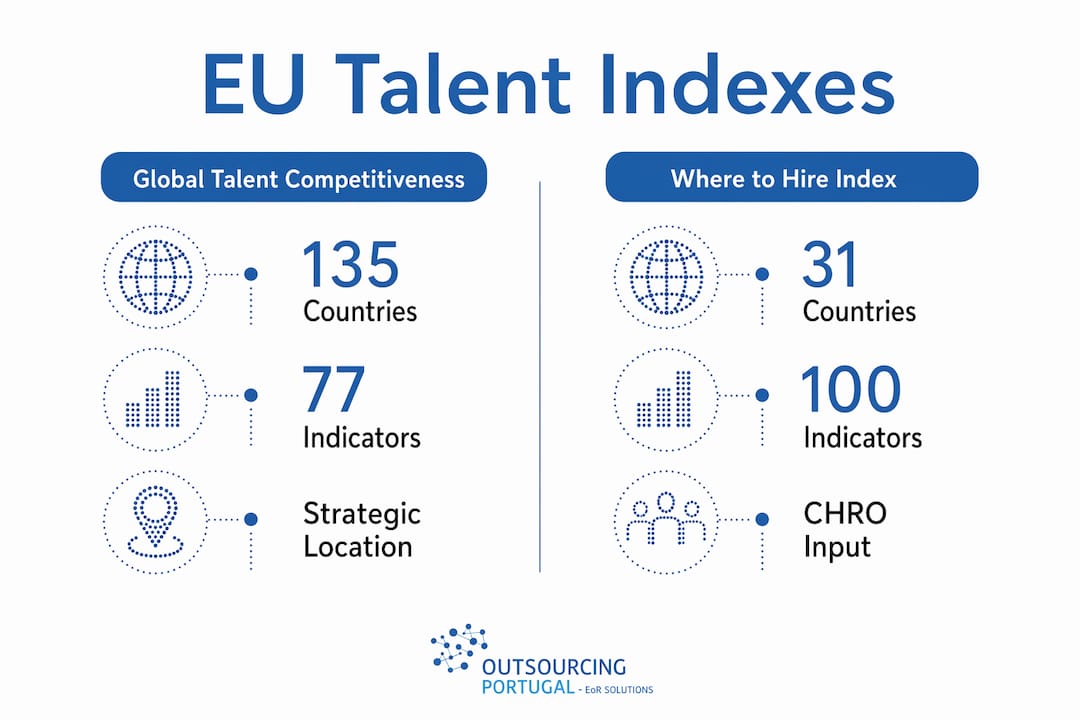
The GTCI is the broadest macro-level tool available. It ranks 135 countries across 77 indicators organized around six dimensions: attract, grow, retain, vocational and technical skills, global knowledge skills, and labor and social protection. For European hiring strategy, the headline finding is striking. Europe dominates the top tier, with 18 of the top 25 countries in the 2025 edition coming from the continent. Switzerland, Denmark, and Finland hold the highest European positions.

Hands pointing at talent competitiveness report

The GTCI is built for strategic location decisions. If you are choosing between establishing a tech team in Lisbon versus Warsaw, this index gives you a structured, multi-dimensional comparison. It does not tell you how hard it will be to find a specific software engineer role in either city.

The Conference Board’s Where to Hire Index

This index takes a different approach. Built with direct CHRO input, it ranks 31 European labor markets across 100 indicators covering skills, availability, cost, productivity, and institutional factors. The executives feeding into this index collectively oversee more than 2.15 million workers and nearly €880 billion in annual revenue. Denmark leads, followed by Switzerland and Ireland.

What distinguishes this tool is its focus on sustainable talent strategy. The Where to Hire Index shifts attention from labor cost to skills productivity and culture fit for long-term performance. It integrates business culture and institutional strength, factors that directly affect retention rates and the stability of long-term workforce investments.

Index Countries covered Primary use case Key differentiator
Global Talent Competitiveness Index 135 globally Strategic location selection 77 indicators, macro workforce health
Where to Hire Index 31 European markets CHRO hiring strategy 100 indicators, business culture and retention
Cedefop TalentGap Index EU member states Role-specific recruitment difficulty Occupation-level gap scoring

Comparison of major EU talent ranking indexes

Pro Tip: Use the GTCI to build your initial country shortlist, then layer the Where to Hire Index to validate which markets offer sustainable hiring conditions before committing to setup costs.

The EU Talent Pool: a platform, not a ranking

A common source of confusion is the EU Talent Pool, which frequently appears in searches alongside talent ranking indexes. They are entirely different things. The EU Talent Pool is an EU-wide matching platform designed to connect third-country residents (people outside the EU) with European employers who have vacancies in shortage occupations.

Key things every employer should know about this platform:

  • It does not score or rank countries in any way
  • It targets non-EU nationals who want to work within the EU
  • It focuses specifically on shortage occupations, not open hiring across all roles
  • It excludes traineeships and apprenticeships from its scope
  • It does not replace national visa requirements or immigration pathways

The EU Talent Pool is a complementary resource, but it is not a standalone immigration pathway or a general hiring tool for all roles. If you are a UK-based company looking to hire Portuguese engineers through an Employer of Record structure, the EU Talent Pool is not the tool you need. It serves employers with very specific recruitment gaps in regulated shortage categories.

Pro Tip: Before registering on the EU Talent Pool, verify that the roles you are trying to fill appear on your target country’s official shortage occupation list. The platform’s value depends entirely on that alignment.

Occupation-level tools: the Cedefop TalentGap Index

Country rankings tell you where talent is concentrated. They do not tell you how difficult it will be to recruit for a specific role in a specific market. That is where the Cedefop TalentGap Index comes in.

The TalentGap Index scores occupational recruitment difficulty on a scale from 1 to 4 across EU member states. It combines skills shortage data with recruitment difficulty factors including required competency levels, wage pressures, and workforce supply dynamics. A role scoring 4 in Germany signals a severe hiring challenge regardless of Germany’s overall talent competitiveness ranking.

Here is how occupation-level data complements country-level indexes:

  • A country may rank highly in macro talent competitiveness yet show extreme shortages in specific technical roles
  • TalentGap data helps HR teams set realistic timelines and budget expectations for specific hires
  • It informs “build vs. buy” decisions by showing where training pipelines exist versus where external sourcing is the only option
  • When combined with the GTCI, it allows teams to identify countries with both strong talent ecosystems and lower role-specific recruitment pressure

Pro Tip: Cross-reference TalentGap scores with salary benchmarks for your target role before finalizing a hiring location. A country with a score of 3 for software developers plus high wage inflation may cost more than a top-tier GTCI country where that role is readily available.

Portugal offers a useful real-world example. Its workforce ranked 23rd globally in 2026, and TalentGap data for mid-level tech and customer support roles sits notably lower than in Northern European markets, reflecting a more accessible hiring environment for those specific functions.

Applying rankings to real workforce decisions

Reading rankings is easy. Applying them is where most companies stumble. HR professionals and workforce strategy teams that use these indexes well follow a structured decision process rather than scanning headlines.

Here is a practical framework:

  1. Define your hiring intent first. Are you choosing a new country to establish a team? Or are you solving a specific role shortage? These questions require different tools. Country selection needs the GTCI or Where to Hire Index. Role-specific planning needs TalentGap data.

  2. Layer your data sources. No single ranking captures everything. Decision-makers who conflate macro country indexes with role-level gap indicators make poorly calibrated hiring forecasts. Use at least two complementary data sources for any significant location decision.

  3. Factor in institutional and cultural fit. The Where to Hire Index explicitly includes business culture and institutional strength because these factors predict retention and long-term workforce stability. A team hired in a market with low institutional trust may be cheaper initially and far more expensive over three years.

  4. Avoid the cost trap. Top-ranked European countries like Denmark and Switzerland are also among the most expensive. Cost and competitiveness do not move together. Chasing the cheapest labor market almost always trades short-term savings for long-term capability gaps.

  5. Validate with operational data. Rankings are strategic directional tools. Before committing to a location, validate index signals with actual recruiter feedback, local salary surveys, and time-to-hire data for your specific roles.

Pro Tip: Build a simple scoring matrix that maps each index dimension (skills, cost, productivity, institutions) to your organization’s specific hiring priorities. Weight the dimensions by importance and score your candidate countries. This turns abstract index data into a defensible, auditable decision.

The rankings above reflect today’s snapshot. Several structural forces are already reshaping what those numbers will look like in five years.

The most significant challenge sits in Europe’s largest economies. Germany, France, Italy, and Spain all rank lower in the Where to Hire Index than their size and economic weight might suggest. Aging workforces, productivity plateaus, and institutional rigidities are eroding their talent competitiveness relative to smaller Nordic and Western European nations.

Digitalization and the AI transition are amplifying existing gaps rather than closing them. Countries with strong STEM pipelines and flexible labor markets are pulling ahead. Those with slower education system adaptation are falling behind faster than macro rankings yet show. The green transition adds another layer of occupational disruption, creating new shortage categories in energy, construction, and manufacturing across nearly every EU member state.

Two underappreciated factors deserve attention:

  • English proficiency increasingly functions as a proxy for international workforce integration. Portugal’s performance here is a genuine competitive differentiator for companies building multilingual teams.
  • Smaller, agile economies consistently outperform larger ones in CHRO-based indexes because institutional flexibility allows faster labor market adjustment than reform-heavy large economies can manage.

My honest take on using these rankings

I’ve spent years watching companies make expensive location decisions based on a single index score pulled from a conference slide. Rankings are genuinely useful. They are also genuinely easy to misread.

What I’ve found consistently is that the companies that use these frameworks best treat them as hypotheses, not answers. They look at a high GTCI score for a country and ask: “What specifically makes this country competitive, and does that map to what we actually need?” A country that scores well on attracting global knowledge workers may still be a poor fit for a company building a customer support function that needs native language speakers.

The cost trap is real and underappreciated. I’ve seen well-resourced hiring teams anchor on low labor cost in a market that ranked poorly on institutional factors, then spend two years rebuilding the team after retention collapsed. Balancing skills, productivity, and culture is not a soft consideration. It is the primary driver of hiring ROI over a three-year horizon.

The most honest advice I can offer: use rankings to structure your thinking and shortlist markets. Then go validate. Talk to people who have hired there. Check the EU outsourcing strategies used by companies already operating in your target market. The data tells you where to look. Real experience tells you what you will find.

— Paulo

Put these rankings to work with Outsourcing-portugal
https://outsourcing-portugal.co.uk

Understanding EU talent rankings is the analytical foundation. Executing on them requires local infrastructure. Outsourcing-portugal helps international companies turn ranking insights into actual hires in Portugal, one of Europe’s most consistently well-ranked talent markets for tech, multilingual support, and professional services. Through EOR and payroll services built specifically for foreign employers, you can hire compliantly in Portugal without setting up a local entity, managing local labor law, or navigating payroll complexity from scratch. Whether you are validating a new market or scaling an existing team, the hiring guide for HR managers is a practical starting point. Contact Outsourcing-portugal to build a workforce strategy grounded in data and backed by local expertise.

FAQ

What does “EU talent ranking” actually mean?

The term refers to multiple indexes and tools that measure talent quality and labor market attractiveness across European countries, not a single official EU list. The most widely used examples are the Global Talent Competitiveness Index and The Conference Board’s Where to Hire Index.

Which European countries rank highest for talent competitiveness?

Switzerland, Denmark, Finland, and Ireland consistently lead major European talent competitiveness indexes. Denmark tops The Conference Board’s Where to Hire Index for 2026, while Switzerland and Finland rank at the top of the GTCI for European markets.

Is the EU Talent Pool the same as an EU talent ranking?

No. The EU Talent Pool is a digital matching platform connecting non-EU jobseekers with employers hiring for shortage occupations. It does not rank countries or measure talent competitiveness in any way.

How should HR teams use talent ranking data in hiring decisions?

Use country-level indexes like the GTCI to shortlist locations, then layer CHRO-based indexes for retention and culture fit, and add occupation-level TalentGap scores for role-specific hiring difficulty. Validate all index signals with local recruiter data before committing to a market.

Does a high talent ranking mean lower hiring costs?

No. The top-ranked EU countries are often among the most expensive labor markets in Europe. Denmark and Switzerland are prime examples, where high talent competitiveness coincides with high salary expectations.


Manager preparing contract in Portugal office

What is employer of record: hiring in Portugal without setup


TL;DR:

  • Most companies believe hiring in Portugal requires establishing a local entity and lengthy bureaucratic procedures, but using an employer of record (EOR) allows legal employment within days without forming a company. The EOR acts as the legal employer, handling contracts, payroll, social security, and statutory benefits, while the client retains operational control over employees. Choosing a reputable EOR with its own Portuguese entity streamlines compliance, reduces setup costs, and enhances speed, making it a practical solution for companies testing or scaling in Portugal.

Most international companies assume hiring someone in Portugal means registering a local entity, appointing an accountant, and waiting months for bureaucratic clearance. That assumption is wrong, and it’s costing businesses real time and money. Understanding what is employer of record changes the equation entirely. An Employer of Record (EOR) lets you hire legally in Portugal within days, with no local company required. This guide explains exactly how that works, what HR professionals need to verify before signing with a provider, and where the model has real limits you should plan around.

Table of Contents

Key Takeaways

Point Details
Legal and operational split EORs handle legal employment while your company manages work and performance control.
Avoid local entity EOR services let you hire in Portugal without forming a local company.
Faster onboarding EOR providers can onboard employees in Portugal within days.
Check provider model Choose EORs with their own Portuguese entity for speed and transparency.
Understand responsibilities Clear internal processes prevent liability confusion between you and the EOR.

Understanding the employer of record role in Portugal

The definition of employer of record is simpler than most HR teams expect. An EOR is a third-party company that becomes the legal employer of your workers in Portugal. It signs the employment contracts, runs payroll, withholds income tax, files contributions to Segurança Social (Portugal’s social security system), and administers statutory benefits. Your company directs the day-to-day work, manages performance, and sets the role requirements. The EOR handles the legal paper trail.

This split is not just contractual. It has real compliance consequences. As legal employer of record, the EOR signs contracts, runs payroll, withholds taxes, and manages benefits, while your company directs work and manages HR policies. If the Portuguese labor authority audits the employment relationship, it is the EOR that answers, not you. That is a meaningful transfer of legal exposure.

Here is what the EOR takes responsibility for in Portugal:

  • Employment contracts compliant with the Portuguese Labor Code (Código do Trabalho)
  • NIF registration (the individual tax identification number required for each employee)
  • Social security registration and monthly contributions
  • IRS withholding (Portugal’s personal income tax, applied progressively)
  • Statutory leave including annual leave, sick leave, and parental leave entitlements
  • Termination management, including severance calculations under Portuguese law

Your company retains control of what the employee actually does. You set KPIs, run performance reviews, assign projects, and decide whether a role should grow or end. You are the operational employer. The EOR is the employer on paper. Understanding that distinction is the most important thing you can know before engaging employer of record services in Portugal.

Key operational advantages of using an employer of record in Portugal

Speed is the first argument for using an EOR. Setting up a Portuguese sociedade por quotas (the local equivalent of a limited liability company) involves a public deed, registration with the Commercial Registry, tax enrollment, and mandatory accounting appointments. That process takes weeks at minimum, and it introduces fixed overhead you carry even if the hire does not work out.

HR specialist handling onboarding at Portugal café

By contrast, hiring in Portugal through an EOR can be completed within days, with the EOR’s Portuguese entity managing registrations, payroll, leave, and terminations, with no local entity required on your side. For companies piloting a new market, testing a nearshore team, or responding to an urgent talent need, that difference in speed is decisive.

The practical advantages extend beyond timing:

  • No entity formation costs: Skip the notary fees, registry charges, and monthly accounting retainers that come with a local subsidiary.
  • Statutory compliance built in: Portugal’s Labor Code includes mandatory bonuses, notice periods, and redundancy rules. Your EOR tracks and applies these automatically.
  • Payroll accuracy: Portugal’s payroll is not simple. The 14-month salary system (with a Christmas bonus and vacation bonus) catches many foreign companies off guard. An EOR handles this correctly from day one.
  • Simplified termination: Terminating an employee in Portugal requires following strict legal procedures. Getting this wrong is expensive. Your EOR manages the process within statutory limits.
  • Benefits administration: Meal allowances, health insurance, and transport subsidies are standard expectations for Portuguese employees. EOR services set these up correctly from the start.

Pro Tip: Before signing with any EOR provider, ask whether they own a registered Portuguese legal entity or whether they subcontract employment through a local partner. Subcontracting adds a layer of opacity that slows onboarding and blurs compliance accountability. Providers with their own Portuguese entity give you clearer lines of responsibility and faster EOR compliance and speed.

A cost-effective hiring approach using an EOR typically costs less in year one than registering and operating a local entity, even accounting for the EOR’s service fee.

Comparing employer of record to other international hiring models in Portugal

The employer of record is one of several models international companies use to hire in Portugal. Understanding where it sits relative to the alternatives helps you choose the right structure for your situation.

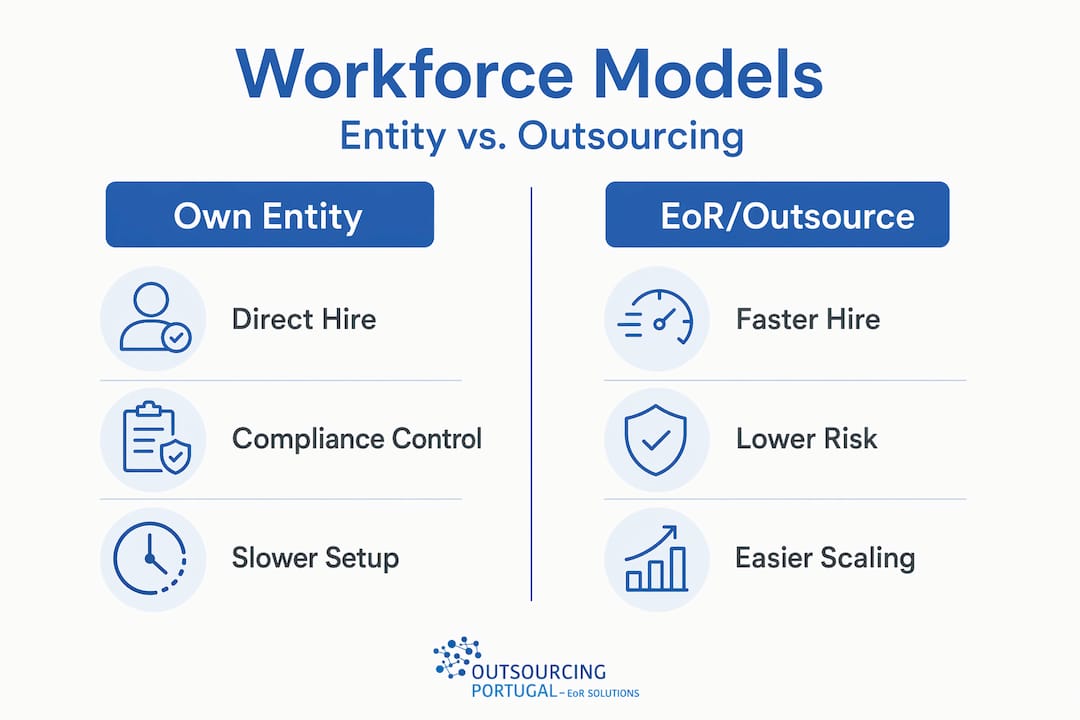
Infographic comparing EOR to other hiring models

Unlike staffing agencies, which only recruit without becoming the legal employer, EORs assume full legal employer status managing payroll, compliance, and contracts. This is a critical distinction. A staffing agency finds you a candidate. The EOR employs that candidate on your behalf. If you engage a recruiter to find talent but have no legal entity in Portugal, you still cannot hire that person without either forming a company or using an EOR.

Hiring model Legal employer Setup time Compliance handled Long-term cost Control retained
EOR EOR company Days Yes, fully Medium (service fee) High (operational)
Staffing agency Client or agency Days Partial Medium Moderate
Own local entity Client company Weeks to months Client responsible High (fixed overhead) Full
Independent contractor N/A Immediate Minimal Low Variable

A few things this table does not capture. The independent contractor route carries serious risk in Portugal. Portuguese labor law applies a test of economic dependence: if a contractor earns more than 80% of their income from one company, they may be reclassified as an employee, triggering back taxes and penalties. EOR arrangements eliminate that risk entirely.

The best EOR services in Portugal also offer advantages over a self-managed local entity when your team is small. If you have two or three people in Portugal, maintaining a full local subsidiary is disproportionately expensive. An EOR absorbs that overhead and scales with your headcount.

Where own-entity formation makes sense is long-term commitment: if you plan to build a team of 30 or more people, the fixed costs of a local entity start to pay off relative to per-head EOR fees. For most international companies testing or growing in Portugal, that threshold is years away.

Practical steps for hiring through an employer of record in Portugal

Knowing how does employer of record work in practice matters as much as understanding the concept. Here is the process as it actually runs:

  1. Assess your hiring scope. How many people, in what roles, for how long? This shapes whether an EOR is right for you or whether a local entity is worth considering.
  2. Choose a provider with a Portuguese legal entity. Verify this directly. Ask for the Portuguese company registration number (NIPC). This confirms they can legally employ workers in Portugal under their own entity.
  3. Sign the service agreement. This document defines your responsibilities and the EOR’s. Read it carefully for clauses on termination liability, indemnification, and data protection under GDPR.
  4. Initiate employee onboarding. The EOR collects the employee’s documents, verifies identity, and prepares a Portuguese law-compliant employment contract.
  5. EOR handles mandatory registrations. The employee is registered with the Autoridade Tributária (tax authority) and Segurança Social. This happens within the EOR’s existing Portuguese entity framework, as confirmed by EOR hiring frameworks that use the provider’s entity for contract signings, payroll, and statutory compliance.
  6. You direct the employee’s work. Once onboarded, the employee works under your day-to-day management. The EOR steps back from operations.
  7. EOR runs ongoing payroll and compliance. Monthly payroll, social security filings, IRS withholding, vacation tracking, and any statutory changes are the EOR’s responsibility for the duration of employment.

Pro Tip: Document your internal split between legal employer tasks and work direction. In any dispute or audit, you want to show clearly that the EOR managed payroll and compliance while your team managed work output. Blurring those lines creates accountability gaps that are difficult to defend.

You can review a detailed EOR hiring workflow in Portugal that walks through documentation requirements and timelines for each stage.

Why embracing employer of record services is a smarter global hiring strategy

Here is something most EOR explainers will not tell you: the fear of losing control through an EOR arrangement is almost always more emotional than rational. HR professionals trained to manage direct employment relationships instinctively resist a structure where someone else signs the contract. But that resistance is based on a misunderstanding of where risk actually lives.

Your real employment risk in Portugal is not in who signs the contract. It is in payroll errors, misclassified workers, non-compliant terminations, and missed social security filings. An EOR that owns a Portuguese entity and has years of local compliance experience reduces that risk significantly compared to a foreign company trying to manage Portuguese labor law from abroad.

The perspective worth holding is this: entity formation signals permanence and commitment. EOR signals agility. Neither is inherently better. The problem is that many companies default to entity formation out of habit, not strategy, and then carry overhead for years before they have the team size to justify it.

Choosing the wrong EOR provider can lead to onboarding delays, compliance risks, and operational headaches that cost far more than their fees. That is not an argument against EOR. It is an argument for doing provider selection seriously. Check the provider’s Portuguese legal registration, ask for sample contracts, understand their escalation process for terminations, and verify that their technology actually tracks Portuguese-specific obligations like the 14-month salary and mandatory notice windows.

Technology matters here more than many buyers realize. Modern EOR platforms that automate payroll calculations, track statutory changes, and flag compliance deadlines are meaningfully better than those relying on manual processes. Ask any provider you evaluate how they handle changes to Portuguese labor law and how quickly those changes appear in your employees’ payroll. A slow or manual answer should concern you.

The companies that get the most from an compliant hiring arrangement treat their EOR as a compliance partner, not a back-office vendor. Regular check-ins, shared documentation, and a clear understanding of who owns each task make the arrangement work. The ones that struggle treat the EOR as a black box and then get surprised by outcomes they could have anticipated.

Discover leading employer of record services in Portugal

Portugal’s combination of English proficiency, EU membership, a skilled workforce, and competitive labor costs makes it one of the best nearshore hiring destinations in Europe. If you are ready to act on that opportunity, getting the EOR relationship right from the start is what separates a smooth expansion from a costly correction.

https://outsourcing-portugal.co.uk

The best EOR services in Portugal combine local legal entity ownership with genuine compliance depth, covering payroll, statutory benefits, terminations, and ongoing regulatory changes without pushing those tasks back onto your team. Whether you are hiring one specialist or building a full nearshore team, the right provider keeps your focus on results while they handle the legal employer requirements. Explore EOR compliance and smart hiring to see how structured, transparent EOR arrangements work in practice, and reach out to discuss a setup tailored to your specific hiring compliance needs.

Frequently asked questions

What does an Employer of Record (EOR) do in Portugal?

An EOR becomes the legal employer of record, handling contracts, payroll, taxes, and statutory benefits, while your company manages employee work and performance.

Can I hire employees in Portugal without setting up a local company using an EOR?

Yes. An EOR’s Portuguese entity handles registrations and compliance on your behalf, so you can hire legally without forming your own local subsidiary.

What are the main risks of using an Employer of Record?

The biggest risks are misunderstanding the legal versus operational responsibility split, and selecting a provider that subcontracts rather than employing directly. Choosing the wrong EOR can create onboarding delays, compliance gaps, and unexpected costs.

How fast can I onboard employees in Portugal using an EOR?

EOR hiring in Portugal can often be completed within days, because the EOR’s existing local entity manages registrations, payroll setup, and statutory compliance without waiting for a new entity to form.

Business team reviewing budget documents together

Cost-saving strategies Portugal: a guide for 2026


TL;DR:

  • Expanding into Portugal requires understanding the true employment costs, including 14 salary payments and social security.
  • Using accurate models like the 1.47x multiplier prevents budget shortfalls and ensures compliance for sustainable growth.

Expanding into Portugal looks straightforward on paper. Competitive salaries, EU membership, a well-educated workforce. But the moment you factor in 14-month salary structures, uncapped social security, and regional tax variables, the real cost picture looks very different from what most back-of-envelope calculations show. The cost-saving strategies Portugal offers are real and significant, but only if you understand the rules of the game first. This guide gives you a precise, 2026-calibrated framework to evaluate hiring options, compare tax structures, and make decisions that protect your budget without sacrificing compliance.


Table of Contents

Key Takeaways

Point Details
Understand total employment cost Budget for gross salary plus 23.75% social security on 14 payments, not 12, to avoid costly underestimation.
Choose right hiring model Use Employer of Record for quick hires and entity formation for scaling beyond 8-10 employees for cost savings.
Leverage regional tax incentives Madeira region offers significantly lower corporate tax rates benefiting SMEs and nearshore operations.
Nearshore advantages Portugal provides developer cost savings, full timezone overlap, and lower turnover compared to other markets.
Optimize compensation structure Use meal allowances within legal limits to reduce social security contributions and improve employee benefits.

Evaluating key criteria to optimize employment costs in Portugal

Before committing to headcount, you need to understand what “employment cost” actually means in Portugal. It is not just the gross monthly salary. Portugal’s total employer cost multiplies base monthly salary by a factor that surprises most first-time employers.

Here is why. Portugal legally mandates 14 monthly salary payments per year, not 12. Two extra months (holiday pay and Christmas bonus) are statutory, not discretionary. On top of that, employer cost multiplier is approximately 1.47x monthly salary once you add the 23.75% social security contribution (TSU) applied across all 14 payments.

Key criteria every international business or HR manager should assess before hiring:

  • Total cost modeling: Calculate annual cost as gross monthly salary multiplied by 14, then add 23.75% TSU on the full amount. Never budget on 12 months.
  • Day-one compliance: Written contracts must be in place and social security registration completed before the employee starts. Penalties for non-compliance are substantial.
  • Probation periods: Portuguese law allows probation periods of 90 to 240 days depending on role seniority. These allow termination without notice or severance, making them a genuine risk-management tool.
  • Meal allowances: Daily meal allowances up to €10.20 per working day are exempt from both social security and income tax. Structuring part of compensation this way reduces your effective employer cost immediately.
  • Stability dividend: Portuguese labor law is stable and predictable. Low turnover rates in Portugal’s workforce reduce your long-term recruitment and onboarding costs more than most employers account for.

Getting these basics right separates companies that budget accurately from those that discover shortfalls six months in.


Manager reviewing payroll paperwork at office desk

Top cost-saving options for hiring and nearshoring in Portugal

Once you understand the baseline costs, the next question is which hiring structure gives you the best value for your specific situation. There is no single right answer, but there is a wrong one: choosing a structure without knowing the trade-offs.

Employer of Record (EOR): An EOR in Portugal lets you hire employees legally within days, without setting up a local entity. The EOR becomes the legal employer, handling payroll, social security, and compliance. Fees typically run 8% to 15% of gross salary per employee per month. This is the right move for early-stage market entry, test hires, or teams of fewer than 5 to 8 people. EOR enables 1 to 3 hires operational in days with higher per-employee fees, while entity setup becomes cost-effective for 10 or more employees with upfront investment and lower ongoing costs.

Entity formation: Setting up a Portuguese entity costs between €5,000 and €15,000 in setup fees, with ongoing accounting running €200 to €500 per month. Once you cross 8 to 10 employees, the per-person EOR fee typically exceeds those fixed costs. Entity formation gives you full control, direct employment relationships, and lower unit costs at scale.

Regional tax incentives in Madeira: This is the option most businesses overlook. The Madeira International Business Centre offers CIT rates as low as 5% for qualifying activities involving non-Portuguese entities, and 10.5% for SMEs more broadly. For nearshore operations or holding structures with significant international client revenue, this is a material saving over mainland rates.

Nearshore development: Portugal’s tech talent rates are competitive within the EU. Senior developers cost 7% to 10% less than equivalent Polish talent, and that gap compounds when you account for reduced rework and lower attrition.

Pro Tip: If you are planning to hire 3 to 5 people to test a market, start with an EOR. Set an explicit review trigger at month 12 or 8 employees, whichever comes first, and evaluate the entity formation math at that point with real payroll data in hand.


Comparing Portugal’s corporate tax and employment costs: mainland vs Madeira region

The difference between hiring on the Portuguese mainland and structuring operations through Madeira can represent tens of thousands of euros in annual tax savings for mid-size businesses. Here is a direct comparison for 2026.

Factor Mainland Portugal Madeira region
Standard CIT rate 19% 14.7% (general)
SME CIT rate (first €50k) 15% 10.5%
Qualifying IBCM activities Not applicable 5%
Social security (employer TSU) 23.75% 23.75%
Salary payments per year 14 14
Regional setup complexity Lower Moderate

Portugal reduced its mainland CIT to 19% in 2026, with SMEs eligible for 15% on the first €50,000 of taxable income. Those are already competitive numbers within the EU. But Madeira’s rates for qualifying nearshore or international business activities push the savings considerably further.

Key points worth noting for your outsourcing planning in 2026:

  • Social security rates are identical across regions. The tax advantage in Madeira is purely at the corporate income level.
  • Madeira’s IBCM (International Business Centre of Madeira) qualification requires substance, meaning actual operations and local employment, not just a registered address.
  • For SMEs billing significant revenue to non-Portuguese clients, the difference between 15% and 5% CIT on qualifying income is not marginal. It is a strategy.
  • Mainland Portugal suits companies prioritizing proximity to Lisbon’s talent pool and established infrastructure. Madeira suits those willing to build regional substance for long-term tax efficiency.

Nearshore development in Portugal: cost benefits and operational advantages

The nearshore development case for Portugal is often presented as a cost story. It is actually a quality and cost story, which is a meaningfully different thing.

Senior developer rates save 7% to 10% compared to Poland. That gap is real but not dramatic in isolation. What amplifies it is the combination of timezone alignment, language proficiency, and cultural fit with UK and Western European clients. Full timezone overlap with the UK means no async delays, no sprint misalignments, and faster decision cycles. These factors compound into reduced delivery time and lower coordination costs that rarely appear on a rate-card comparison.

The quality argument is equally concrete. Portugal’s quality-first approach reduces rework by 20% to 40% compared to offshore India, despite higher hourly rates. When you factor rework into your cost-per-delivered-feature calculation, the Portugal advantage is often larger than the headline rate difference suggests.

Operational advantages worth building into your planning:

  • Timezone overlap: Full working-day alignment with UK and central Europe enables real-time collaboration without process overhead.
  • English proficiency: Portugal consistently ranks among Europe’s top countries for English proficiency, reducing communication friction at the code review, sprint planning, and stakeholder level.
  • Cultural compatibility: Understanding the role cultural fit plays in outsourcing success is underrated. Shared working norms reduce management overhead and improve retention.
  • Team blending: For companies already using Polish development teams, blending Portuguese architect-level leadership with lower-cost Polish execution can optimize both specialization and budget.

Pro Tip: When evaluating Portugal nearshore proposals, ask vendors to include a rework rate metric from recent projects. Teams that track and share this data are almost always the ones where it is low.


Practical tips for maximizing cost savings and compliance when hiring in Portugal

Strategic awareness is useful. A checklist you can act on immediately is better. Here are six practices that materially affect your employment cost and compliance posture.

  1. Structure meal allowances into compensation from day one. Meal allowances up to €10.20 per day are exempt from social security and income tax. For a full-time employee, this represents roughly €2,244 per year in allowances that carry no social security burden. At 23.75% TSU, that is approximately €533 in annual employer savings per employee, before considering the employee-side tax benefit.
  2. Use the full probation period strategically. Probation periods allow no-fault termination and should be treated as a formal evaluation window, not a formality. Set structured review milestones at 30, 60, and 90 days.
  3. Budget on 14 salary payments, not 12. This single adjustment prevents the most common financial surprise for international businesses entering Portugal. A €4,000/month gross role costs you €65,688 annually before TSU, not €57,120.
  4. Plan your EOR-to-entity transition in advance. For smaller teams, HR best practices in Portugal recommend EOR for speed and compliance while scaling. Switching to entity formation at 8 to 10 employees avoids both premature overhead and prolonged EOR fees.
  5. Know your mandatory benefits before making offers. Every employee is entitled to 22 vacation days, a 13th month (holiday bonus), a 14th month (Christmas bonus), and mandatory workplace accident insurance. These are not negotiable and must be priced into your cost model.
  6. Complete day-one registrations without exception. Contracts must be signed and social security registration completed before the first working day. The fines for late registration are disproportionate relative to the administrative effort required to get this right.

“The companies that budget accurately for Portugal are not the ones with better lawyers. They are the ones that asked the right questions before their first hire.”


Why most companies underestimate Portugal’s true employment costs and how to avoid it

Here is the uncomfortable pattern we see repeatedly. A business runs a comparison across European nearshore locations, gets a gross salary figure for a Portuguese developer or account manager, multiplies by 12, adds 23.75%, and calls it the employer cost. That calculation is wrong by approximately 17%.

Many providers miscalculate costs by basing social security on 12 months instead of the mandatory 14 payments. The result is a systematic underestimation of employer obligations that creates budget shortfalls at the worst possible moment, typically when headcount is growing and cash discipline matters most.

The fix is not complicated, but it requires discipline. Use the 1.47x monthly salary multiplier as your standard planning metric, and apply it before any conversation about the business case. Factor in meal allowance structuring from the start, not as an afterthought. And build employment cost budgeting that accounts for the full statutory obligations, not just the base salary.

The companies that get this right do not have superior financial resources. They have a more accurate model. Portugal genuinely is a cost-effective location for employment and nearshoring, but only when you price it correctly. Underestimating costs does not make Portugal cheaper. It makes your expansion more expensive than it needed to be.


Streamline your Portugal expansion with expert employment solutions

Implementing these strategies requires local knowledge, legal precision, and payroll infrastructure that takes years to build. That is what Outsourcing Portugal provides to international businesses at every stage of their Portugal expansion.

https://outsourcing-portugal.co.uk

Whether you need employer of record services to hire your first Portuguese employees within days, entity formation support as your team scales past 10 people, or access to vetted nearshore development talent with full compliance and payroll management handled end-to-end, the team at Outsourcing Portugal brings the local expertise that turns this article’s framework into real operational savings. You focus on building your business in Portugal. The compliance, payroll, HR, and legal obligations are handled by people who do this every day.


Frequently asked questions

What are the total employer costs when hiring in Portugal?

Total employer costs include gross salary across 14 annual payments plus 23.75% social security applied to all payments, resulting in approximately 1.47x the base monthly salary as an annual employer cost multiplier.

How does Portugal’s corporate income tax rate benefit SMEs?

SMEs pay a reduced CIT rate of 15% on the first €50,000 of taxable income, compared to the 19% standard rate, with Madeira offering further reductions to 10.5% and as low as 5% for qualifying international business activities.

What are the main advantages of nearshoring development to Portugal?

Portugal offers 7% to 10% cost savings on senior developer rates compared to Poland, full timezone overlap with UK teams, high English proficiency, and significantly reduced rework rates that lower total delivery costs beyond the hourly rate comparison.

When should a company switch from Employer of Record to entity setup in Portugal?

Companies planning to hire more than 8 employees within 18 months typically benefit financially from entity setup, as entity formation is cost effective from around 10 employees, where fixed running costs fall below ongoing EOR fees.

How can companies reduce social security costs through compensation structuring?

Allocating part of compensation as daily meal allowances up to €10.20 per working day creates a social security and income tax exemption, reducing the employer’s effective TSU burden with no impact on the employee’s take-home value.

Workforce Compliance Workflow: 2026 Guide for HR Teams


TL;DR:

  • Managing workforce compliance requires embedding verification, monitoring, and audits into every stage of employment. Proper governance, automation, and continuous review help organizations stay audit-ready and reduce legal risks. International companies must carefully navigate jurisdictional regulations and leverage specialized services to maintain compliance effectively.

When a Notice of Inspection arrives, you have exactly three business days to produce every workforce compliance record on demand. Miss that window, and fines can reach $28,619 per violation. That is not a hypothetical scenario for international HR teams managing distributed workforces. It is the operating reality in 2026, where federal enforcement has accelerated and regulators are no longer waiting for complaints. A tightly designed workforce compliance workflow is the difference between passing an audit in 72 hours and spending six months in a legal scramble.

Table of Contents

Key Takeaways

Point Details
Build compliance into onboarding Embed I-9 verification and document checks into every hire’s first day rather than treating them as afterthoughts.
Automate expiration tracking Use automated alerts for work authorization renewals, certifications, and re-verifications to prevent lapses.
Conduct quarterly self-audits Schedule internal audits at least every three months to catch errors before regulators do.
Govern your technology Apply role-based access controls and audit logs to every HR and compliance platform you use.
Prepare a digital war room Organize records so you can respond to a government audit notice within the three-business-day deadline.

What your workforce compliance workflow needs first

Before you can design or fix a compliance workflow, you need to understand exactly what regulatory territory you are operating in. For international companies hiring workers in the United States, that means mapping obligations under federal employment eligibility law, wage and hour rules under the Fair Labor Standards Act, state-specific leave and pay requirements, and applicable anti-discrimination statutes.

The foundational documents

Form I-9 sits at the center of employment eligibility compliance. Every U.S.-based employee must have a completed, accurate I-9 on file, regardless of citizenship status. Payroll records, timekeeping data, written offer letters, and signed policy acknowledgments round out the core documentation set. These are not optional records you can reconstruct later. They need to exist, be accurate, and be retrievable within days.

A compliance calendar is one of the most underused tools in HR. It maps every recurring obligation by deadline: I-9 re-verifications, state-mandated harassment training completions, benefits enrollment windows, and payroll tax filings. Without it, your employee compliance process is entirely reactive.

HR specialist adding deadlines to compliance calendar

Technology and governance

Modern HR teams rely on a digital HRIS to manage employee records, and a compliance tracking system to monitor status and flag upcoming deadlines. E-Verify, the government’s electronic employment eligibility verification system, is mandatory for federal contractors and strongly recommended for all other employers. Critically, the technology you use must be governed properly.

Automation without governance does not scale. It creates new failure modes. You need role-based access controls so only authorized staff can view or edit sensitive records, and you need immutable audit logs that show who changed what and when.

Governance Element Why It Matters
Role-based access controls Prevents unauthorized edits to compliance records
Immutable audit logs Provides a verifiable change history for government review
Document version control Protects against policy drift and outdated procedure use
Compliance calendar integration Surfaces deadlines before they become violations

Pro Tip: Before purchasing or upgrading any HR compliance workflow software, audit your current data governance setup first. The best software fails when access controls are inconsistent or audit logs are disabled.

Executing the employee compliance process step by step

A well-run workforce compliance workflow is not a checklist you pull out once a year. It runs every time you hire someone, extend a work authorization, process payroll, or face a government inquiry.

  1. Verify identity and work authorization on day one. The employee completes Section 1 of Form I-9 on or before their first day of work. The employer completes Section 2 within three business days of the start date. For remote hires, the Alternative Procedure for remote verification requires a live video call during which original documents are examined and a specific checkbox is marked. Over 1.1 million E-Verify-enrolled employers have adopted this procedure since August 2023.

  2. Retain document copies from remote verifications. A live video call alone is not enough. Retaining clear copies of identity documents shown during the session is required to maintain an audit-ready trail. Failing to keep copies results in an incomplete record, which auditors treat as a violation.

  3. Track authorization expirations proactively. Set automated alerts for temporary work authorization end dates at least 90 days in advance. The same logic applies to professional certifications, training completions, and any time-limited employee credentials your workforce policy adherence program requires.

  4. Run quarterly internal audits. The DOL recovered $255.9 million in back wages in FY 2023 alone, with a three-year statute of limitations for willful violations. Quarterly self-audits catch overtime miscalculations, misclassification errors, and I-9 discrepancies before they compound.

  5. Correct errors without backdating. If Form I-9 corrections are needed, employees correct Section 1 themselves and employers correct Section 2. Neither party can backdate entries. Corrections must be initialed and dated at the time they are made.

  6. Integrate payroll and timekeeping data into your compliance review. Wage and hour compliance is inseparable from accurate timekeeping. Your HR compliance workflow should pull payroll data into audit reviews so you catch off-clock work, missed meal breaks, or minimum wage gaps alongside eligibility issues.

  7. Build a digital war room for audit responses. When a Notice of Inspection arrives, you have three business days to produce records. A litigation hold policy and pre-organized digital file structure reduce that response from a crisis to a routine task.

Pro Tip: Download your E-Verify records annually. USCIS stopped hosting data older than 10 years as of January 2026, so historical compliance proof can disappear if you wait too long.

Common pitfalls in workforce regulation management

Even experienced HR teams make the same compliance mistakes. Knowing where failures typically occur lets you design workflows that catch problems early.

  • Misunderstanding remote I-9 rules. Many HR teams think a video call completes the alternative verification procedure. It does not. The authorized representative must physically examine original documents, retain copies, and mark the correct checkbox. An authorized representative performing remote inspection bears personal liability for errors, even if they work off-site.

  • Inconsistent recordkeeping across locations. International companies managing multiple office sites often end up with different procedures in each location. One office uses paper I-9s. Another uses a digital system. Neither has a unified audit log. The result is a compliance gap that appears small until a regulator examines all locations simultaneously.

  • Ignoring document retention schedules. I-9 forms must be retained for three years from the hire date or one year after employment ends, whichever is later. Many employers either destroy records too early or keep them indefinitely without a formal schedule, both of which create problems during audits.

  • Reactive compliance culture. Treating compliance as something you handle when a problem surfaces is one of the costliest mistakes a workforce compliance team can make. Embedding preventive controls rather than relying on reactive correction is the defining trait of audit-resistant organizations.

  • Treating automation as a set-and-forget solution. Automated compliance solutions reduce manual errors, but they require governance oversight. Workflows that send alerts or populate records without human review can propagate errors at scale if the underlying data is wrong.

“Compliance should be treated as an ‘always-on’ discipline. Organizations that embed preventive controls into their hiring and HR workflows spend far less time responding to government investigations because they have far fewer violations to explain.”

For international teams, reviewing a payroll compliance checklist specific to your country of operations adds another layer of protection against the wage and hour issues that auditors target most frequently.

Verification, audits, and continuous improvement

Getting a workforce compliance workflow to a functioning state is step one. Keeping it audit-ready over time requires a structured approach to continuous improvement.

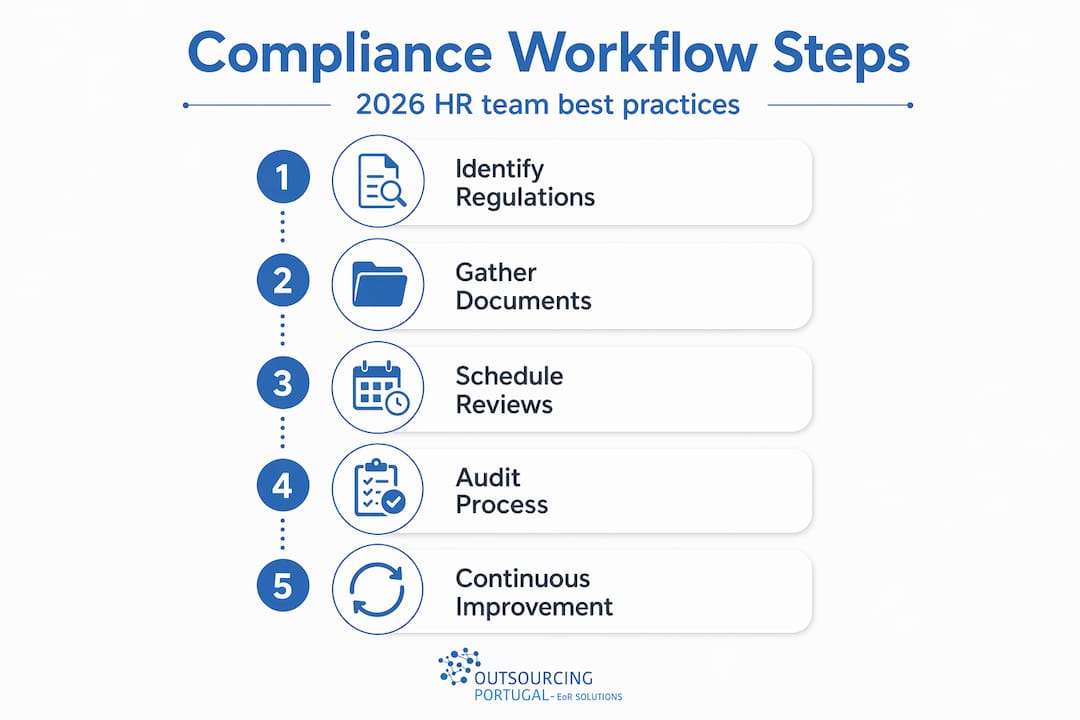
Infographic of compliance workflow steps for HR teams

Building a review schedule

Review Frequency Activity
Monthly Check for upcoming authorization expirations and certification deadlines
Quarterly Full self-audit of I-9 files, payroll records, and policy acknowledgments
Annually Download E-Verify records, update compliance calendars, and review policy changes
After any regulatory change Update workflows, retrain staff, and update HRIS configurations

Using data to find risk before it finds you

Compliance analytics tools built into modern HRIS platforms can flag patterns that manual reviews miss: employees whose authorization expires within 60 days clustered in a single department, or a spike in overtime hours that signals a potential wage violation. These tools work best when the HR compliance workflow is already structured with clean, consistent data entry standards.

Training matters more than most compliance officers acknowledge. When managers understand the “why” behind I-9 procedures, they make fewer errors during onboarding. When payroll staff understand wage and hour rules, they catch miscalculations before they appear in a DOL audit. A culture of workforce policy adherence does not emerge from written policies alone. It comes from regular, practical training tied to real scenarios.

Pro Tip: Treat your compliance training program like a product with version numbers. Every time a regulation changes, release a new training version and track completion rates by department. This gives you documented proof of your good-faith compliance efforts if a violation is ever disputed.

On the technology side, staying current matters. Automated compliance solutions evolve quickly, and a tool that was best-in-class two years ago may lack support for the remote I-9 alternative procedure or current E-Verify APIs. Annual technology reviews should be part of your compliance calendar, not an afterthought triggered by a failed audit.

My take on compliance as a strategic advantage

I’ve worked with international HR teams long enough to notice a consistent pattern. The organizations that struggle most with compliance are not the ones that ignore it. They are the ones that treat it as a once-a-year project. They build an I-9 binder, send out a policy email, and consider the box checked. Then an audit notice arrives in February, and suddenly they are hunting for records from 2022.

The teams that get it right do something fundamentally different. They embed compliance into the employee lifecycle so thoroughly that it stops feeling like a separate function. Onboarding has compliance built in. Payroll reviews include compliance checks. When a work authorization is 90 days from expiring, an alert fires automatically. Nobody has to remember because the system does not rely on memory.

What I’ve found surprising is how much this approach reduces HR team stress, not just legal risk. When you know your records are current, your logs are clean, and your workflows are documented, a government audit becomes a process you manage rather than a crisis you survive.

The automation piece is real, but it is not magic. I’ve seen companies implement automated compliance solutions and immediately relax their oversight. That’s when errors scale. Governance has to travel alongside automation. Every automated alert, every digital record, every access control needs a human owner who reviews it periodically. That is not extra work. That is how you streamline compliance workflow for the long term.

— Paulo

How Outsourcing-portugal supports your compliance workflow

https://outsourcing-portugal.co.uk

Managing a workforce compliance workflow across borders multiplies every risk described in this article. Different jurisdictions, languages, and regulatory frameworks make it easy for critical steps to fall through the gaps. Outsourcing-portugal specializes in removing that risk for international companies hiring in Portugal. Their Employer of Record services handle employment eligibility, payroll compliance, contract management, and ongoing HR regulation management, so your team operates within a fully compliant structure from day one.

Whether you are building a nearshore team in Lisbon or hiring a single specialist, Outsourcing-portugal’s employment and payroll solutions keep your workforce regulation management on track. Speak with their team to find a compliance structure that fits your operations.

FAQ

What is a workforce compliance workflow?

A workforce compliance workflow is the structured set of processes HR teams use to meet employment eligibility, wage, and regulatory requirements across the employee lifecycle. It includes onboarding checks, ongoing monitoring, internal audits, and audit response procedures.

How long do employers have to respond to a government audit notice?

Employers typically have three business days to produce requested records after receiving a Notice of Inspection from ICE or a DOL audit notice. Having pre-organized digital records significantly reduces response time.

What does remote I-9 verification require?

Remote I-9 verification under the Alternative Procedure requires a live video call where original documents are physically presented, copies are retained, and the specific remote verification checkbox on the form is marked. A video call without document copies is not sufficient for audit compliance.

How often should companies run internal compliance audits?

Quarterly internal audits are recommended, particularly for I-9 files and payroll records. The DOL’s three-year statute of limitations for willful wage violations means errors can compound over time if they go undetected.

Can automation replace manual compliance oversight?

Automated compliance solutions reduce errors and flag deadlines efficiently, but they require governance structures including role-based access controls and audit log reviews. Automation without oversight can scale errors rather than prevent them.

Business team reviews EOR alternatives

Top 5 eor-portugal.com Alternatives 2026

Hiring employees in Portugal without forming a local subsidiary typically means juggling payroll, compliance, visas, and onboarding through multiple vendors or slow-moving global EOR platforms. Many international Employer of Record solutions lock pricing behind opaque quotes, limit immigration support, or fail to deliver consistent operational speed for fast scaling teams. This comparison helps you weigh custom pricing, onboarding speed, compliance coverage, and regional flexibility across five Employer of Record providers in Portugal so you can select one that lets you hire and operate locally without unnecessary delays or vendor sprawl.

Table of Contents

Outsourcing Portugal

https://outsourcing-portugal.co.uk

At a Glance

Outsourcing Portugal’s marketing materials advertise Empresa na Hora onboarding in as little as one hour for simple companies. The agency focuses on Employer of Record arrangements so international firms can hire in Portugal without forming a local entity.

Core Features

  • Employer of Record (EOR): Hire Portuguese employees under Outsourcing Portugal’s local employment contracts while the client retains operational control.
  • Payroll management: End-to-end payroll, tax compliance, social security contributions, and benefits administration handled locally.
  • Visa and softlanding services: Support for work visas, banking setup, and onboarding to reduce time-to-productivity for new hires.

Key Differentiator

Specialization exclusively in Portugal with deep local legal, tax, and cultural expertise. That narrow focus gives the team practical experience with Portuguese labor code, local tax authorities, and common immigration pathways.

This concentration lets them accelerate routine tasks such as company registration and onboarding paperwork that generic global EORs often handle more slowly.

Pros

  • Fast onboarding for simple entities. The one-hour figure above applies to straightforward Empresa na Hora cases and can get a basic registration moving the same day.
  • Local compliance covered. The team manages payroll tax filings and social security contributions, which reduces compliance overhead for your finance team.
  • Visa and settlement handled together. Combining immigration support with payroll and banking simplifies getting employees working on site or remotely from Portugal.
  • Cost-conscious approach. Outsourcing Portugal advertises a market-aware price posture and local market knowledge that helps optimize total employment cost.
  • Flexible client fit. Services scale for startups testing the market and for larger firms assembling nearshore development or sales teams.

Cons

  • Focus on Portugal only, which means broader EU expansion will require additional providers or a separate regional strategy.

Who It’s For

Global companies, startups, and SMEs that want to recruit Portuguese talent quickly without creating a local subsidiary. Especially useful for tech teams, sales operations, and shared services looking for nearshore hires and local HR administration.

Unique Value Proposition

Outsourcing Portugal combines EOR contracts with visa, payroll, and softlanding support under one local point of contact. For companies that want a single local operator to manage legal hiring, administrative setup, and immigration logistics, this reduces vendor handoffs and day one confusion.

Real World Use Case

A U.S.-based tech startup uses Outsourcing Portugal to hire three software engineers. The agency handles employment contracts, monthly payroll, social security registrations, and work visa paperwork so the startup begins revenue work within weeks rather than months.

Pricing

Pricing is not listed as fixed packages. Outsourcing Portugal offers custom quotes based on headcount, role complexity, and the level of immigration or settlement support required. Expect a scoped proposal rather than a public rate card.

Website: https://outsourcing-portugal.co.uk

Bridge In

https://bridgein.pt

At a Glance

Employer of Record, business incorporation, and build-operate-transfer support across Portugal, Spain, and Italy are offered by a single team positioned to use Portugal as a gateway for Americas-to-Europe expansion. Their scope targets tech and tech-enabled companies testing regional presence without a local subsidiary.

Core Features

Bridge In bundles local compliance and operational services under one engagement. That minimizes coordination across countryspecific providers and centralizes accountability.

  • Employer of Record services for hiring compliance in Portugal, Spain, and Italy.
  • Payroll management and benefits administration handled locally for statutory accuracy.
  • Business incorporation and soft-landing solutions in Portugal to accelerate legal setup.
  • Build-Operate-Transfer support plus interim local management to hand off operations later.

Key Differentiator

The vendor emphasizes end-to-end local compliance and operational support tailored for market entry across multiple Southern European jurisdictions, with Portugal highlighted as a strategic hub. Compared with Outsourcing-portugal, Bridge In leans into multi-country entry and B-O-T setups rather than a Portugal-first nearshore staffing play.

Pros

  • Specialized local knowledge. The team covers country labor rules across Portugal, Spain, and Italy, which reduces the learning curve for your legal and HR teams.

  • Lower initial commitment. You can hire and operate without forming a subsidiary, which keeps overhead down while you test the market.

  • Operational continuity. Payroll, taxes, and benefits administration are managed under one service umbrella, so month-end reconciliation is simpler for your finance team.

  • Flexible exit path. The build-operate-transfer option lets you move from managed operations to a local entity when scale justifies it.

  • Talent access. Compliant hiring opens local candidate pools while avoiding immediate incorporation costs.

Cons

  • No independent reviews found. There are no third-party testimonials or public case studies in the available data, so objective user feedback is limited.

  • Pricing opacity. Detailed fees are not published, which requires a direct commercial conversation to understand total cost.

  • Service quality dependency. As with many servicebased providers, outcomes depend on the local team’s expertise and the depth of your engagement.

Who It’s For

Scaleup and enterprise tech companies that want to staff and operate in Iberia and Italy without immediate entity formation. Ideal when you need a short runway to test product market fit, build a local presence, or run a regional pilot before investing in a subsidiary.

Real World Use Case

A U.S. SaaS company used Bridge In’s Employer of Record service to hire a local sales team in Portugal. The solution let the company run sales operations, process payroll, and manage benefits while legal incorporation was deferred until hiring targets were met.

Pricing

Pricing varies by service type and scale. Specific costs are not publicly disclosed and require direct contact with Bridge In to produce a tailored quote based on headcount, jurisdiction mix, and whether you select build-operate-transfer.

Website: https://bridgein.pt

PortuGer

https://portuger.com

At a Glance

PortuGer advertises a starting EOR rate of €380 per employee per month, with total employer costs adding gross salary and social security contributions. The vendor frames its offer as an end to end Portugal entry service that pairs legal setup with relocation and operational support.

Core Features

PortuGer combines local company formation, Employer of Record, payroll, relocation, and outsourcing under one engagement.

  • Employer of Record services including contract drafting, payroll processing, and compliance with Portuguese employment rules.
  • Payroll administration covering tax filings and social security contributions for both local hires and expatriates.
  • Company formation support for multiple corporate structures, plus visas, housing assistance, and integration services.
  • Outsourcing options and fractional co founder support to manage local operations and accelerate go to market.

Key Differentiator

The firm emphasizes entrepreneurial experience and local market networks as its primary advantage. That focus is pitched at companies that want hands on operational help rather than a purely transactional payroll provider.

Pros

  • Personalized account handling and tailored solutions mean a named consultant guides legal and operational setup, which helps when requirements shift during onboarding.

  • Deep local knowledge and partner networks with authorities and service providers reduce the number of vendor handoffs for permits and housing.

  • The service scope covers more than payroll. Market entry, relocation, and fractional leadership options let you combine advisory and execution within one provider.

  • Packaging company formation with EOR and relocation can shorten time to hire in Portugal when coordination across multiple vendors would otherwise add weeks.

Cons

  • There are no publicly available third party reviews or client testimonials to validate experience claims, which raises due diligence work for buyers.

  • Limited user feedback in public channels makes it hard to gauge service consistency or post onboarding support quality.

  • Bespoke services carry typical risks: pricing variation, scope creep, and dependency on single point consultants for legal or operational tasks.

When It May Not Fit

If your operation requires industry specific compliance beyond standard employment rules, PortuGer will likely need customization that adds time and cost. Also, if you need audited customer references before signing, the lack of public testimonials will be a friction point.

Who It’s For

International startups and scale ups that need a local partner to open doors in Portugal without forming a full subsidiary. Good fit for teams that value personal service and operational handholding through hiring, payroll, and relocation.

Real World Use Case

A US based SaaS company uses PortuGer to hire and relocate a small product team. PortuGer handled company registration, employment contracts, payroll, and visa coordination so the client could onboard staff and start billable work within weeks.

Pricing

The vendor lists a starting EOR rate of €380 per employee per month. That starting rate does not include gross salary or employer social security contributions, and final quotes vary by role, benefits, and relocation complexity.

Website: https://portuger.com

Skuad (Payoneer Workforce Management)

https://skuad.io

At a Glance

The vendor advertises coverage in 160+ countries and payroll in 70+ currencies, paired with Payoneer integration for cross-border payments. That global span and payments pedigree are the first things clients cite when choosing Skuad over smaller providers.

Core Features

  • Global onboarding and employment management for employees and contractors, with local contract templates and onboarding checklists.
  • EOR, AOR, and CMS service options to match hiring models from full employment to contractor oversight.
  • Payroll processing, benefits administration, visa and immigration support, and candidate screening all under one engagement.
  • Compliance and legal support plus integrations with third-party payroll, HR, accounting, and time tracking tools.

Key Differentiator

Skuad positions its Payoneer relationship as the backbone of its offering, which the company uses to simplify cross-border payables and currency conversion. That partnership is the main reason clients moving into many jurisdictions pick Skuad rather than a local payroll vendor.

Pros

  • Strong global reach. The platform is built so clients can operate across many jurisdictions without opening local entities.

  • Dedicated account managers reduce handoffs. Clients report one named contact for escalations and payroll cycles.

  • Transparent pricing tiers make budgeting easier for hiring plans that mix contractors and employees.

  • Intuitive interface speeds onboarding for HR teams new to international payroll.

Cons

  • Multiple users report invoicing errors and billing disputes and describe poor responsiveness in those cases.

  • Billing issues can require repeated follow ups, which may affect month end reconciliation timelines.

  • For complex local statutory questions you may still need external counsel in certain countries.

When It May Not Fit

If your finance team requires faultless invoicing or immediate dispute resolution, Skuad may create friction because of the billing complaint record. If your project needs same-day fixes for payroll errors, a vendor with a local office and guaranteed SLA might be a better match.

Notable Integrations

  • Third-party payroll systems
  • HR management tools
  • Accounting software
  • Time tracking apps

Who It’s For

HR and legal teams at medium to large enterprises planning multi‑country hiring programs. The platform fits organizations that want a single vendor to handle hiring, payroll, and basic immigration support while keeping finance and HR workflows centralized.

Real World Use Case

A mid sized SaaS company uses Skuad to hire engineers across Asia and Europe. Skuad manages local contracts, processes multi currency payroll, and handles benefits setup, allowing the startup to scale headcount without creating local legal entities.

Pricing

The vendor lists starting fees: $99 per contractor/month for Agent of Record, $19 per contractor/month for Contractor Management System, and from $199 per employee/month for Employer of Record. Volume discounts are available depending on scale and services.

Website: https://skuad.io

Remote

https://remote.com

At a Glance

Owned local legal entities and in house compliance teams across multiple markets let Remote act as the legal employer in country for hires. The vendor markets this capability as the core mechanism that simplifies hiring and payroll for international teams.

Core Features

Employer of Record management for hiring and managing local employees sits alongside global payroll processing and contractor management. The platform includes in house legal, payroll, and compliance teams in many jurisdictions. API access connects payroll and HR workflows to systems such as Workday and BambooHR.

Key Differentiator

Remote’s architecture pairs its legal presence in markets with internal compliance staff, which reduces the vendor coordination you must manage when expanding into new countries. That model shortens the path to local hiring and shifts statutory employment risk to the provider’s local entity.

Pros

  • Fast onboarding workflow. The platform’s interface streamlines documents and contracts so new hires complete setup quickly and without repeated back and forth.

  • Payroll and compliance handled locally. Remote’s local entities and staff manage taxes, statutory filings, and pay runs, which lowers the chance of missed local requirements.

  • Contractor and employee coverage. You can run contractor of record services alongside full employment, which helps teams that mix engagement types across geographies.

  • API-first integrations. The API access listed lets engineering teams automate headcount and payroll updates into existing HR systems.

Cons

  • Support response times vary by region. Several customers report slow or inconsistent responsiveness in some countries, which can slow issue resolution.

  • Payroll delays occur occasionally. The product data indicates there are regional instances of delayed payroll processing, a real operational risk for time sensitive payrolls.

  • Complex local rules still surface. Even with local teams, certain niche compliance issues may require external legal support in specific jurisdictions.

When It May Not Fit

If you need immediate, SLA backed local support in every minor jurisdiction, Remote’s regional variability in support and payroll timing may frustrate you. Large enterprises with internal global HR ops and strict vendor SLAs might find some processes misaligned with existing controls.

Notable Integrations

  • Workday
  • BambooHR
  • HiBob
  • Personio

The vendor also advertises additional integrations for payroll and HR systems that can be connected via API.

Who It’s For

Growing companies and enterprises that need a managed way to hire, pay, and comply in multiple countries without forming local entities. Teams that want mixed contractor and employee management and that can tolerate occasional regional friction will benefit most.

Real World Use Case

A tech startup expanding into Europe and Latin America uses Remote to onboard full time engineers and contractor consultants. Remote’s local entities run payroll and handle statutory filings, letting the startup avoid opening separate subsidiaries while hiring locally.

Pricing

The product data lists pricing as “Not applicable — informational only.” Contact Remote for a custom quote based on employee type, country, and service scope.

Website: https://remote.com

Comparative Analysis

Outsourcing service options for hiring in Portugal include notable offerings from Outsourcing Portugal, Bridge In, PortuGer, Skuad, and Remote. Comparing them across core functionalities reveals distinct tradeoffs and strengths to help companies determine the best fit for their specific needs.

Geographic Focus and Integration Breadth

Outsourcing Portugal excels by focusing exclusively on Portugal, bringing an in-depth understanding of local laws, taxes, and hiring norms. This gives them a speed advantage in tasks like onboarding via Empresa na Hora. Conversely, Bridge In and Skuad offer broader regional and global service coverage, respectively, accommodating firms targeting multiple market entries or maintaining varied jurisdictional operations within a unified platform. While this broader reach introduces operational synergies for multi-country setups, it often comes at the expense of the in-depth agility Outsourcing Portugal offers in a single market.

Service Features and Specialized Offerings

PortuGer provides user-centric service structures, combining tailored local assistance with operational onboarding—a crucial advantage for startups seeking high-touch guidance while establishing their presence. Skuad’s global scope and integrations simplify payroll across diverse geographies, offering significant value for finance teams managing multi-currency transactions. In contrast, Remote’s software supports compliance across its in-house operation areas, ideal for companies preferring automation capabilities. Outsourcing Portugal’s inclusion of visa support aligns uniquely for firms relocating key personnel to Portugal.

Best Fit Recommendations

  • Outsourcing Portugal: Best for firms narrowing their expansion to Portugal, valuing local onboarding efficiency and visa assistance.
  • Bridge In: Best for companies planning simultaneous entry into Portugal, Spain, and Italy while leveraging consolidated compliance and hiring solutions.
  • PortuGer: Suitable for early-stage businesses needing hands-on collaboration in structuring their market initiation phases, tailored around Portuguese networks.
  • Skuad: Recommended for organizations managing global workforce scales with diverse payroll and legal support needs.
  • Remote: Suitable for mid-size firms requiring API-based integrations into existing HR and accounting systems while ensuring in-country compliance.

Our Pick

Outsourcing Portugal’s focus on Portugal provides depth for businesses targeting this region exclusively. The efficiency in onboarding, coupled with their visa services, positions them as the choice provider for operations centralized in this country. However, for regions requiring simultaneous engagements in broader scopes, alternatives like Bridge In or Skuad may better accommodate multi-jurisdictional requirements.

Employer of Record (EOR) Services Comparison

Find the best EOR provider for entering new markets and managing local compliance effectively, by comparing key features and pricing.

Provider Key Features Unique Differentiator Best For Pricing Limitation
Outsourcing-portugal EOR, payroll, visa support, softlanding Exclusive specialization in Portugal Startups and SMEs hiring in Portugal Not disclosed Focuses solely on the Portuguese market
Bridge In EOR, payroll, incorporation, build-operate-transfer (BOT) Multi-country support in Southern Europe Scaleups exploring Iberian and Italian markets Not disclosed Relies on internal expertise—limited third-party reviews exist
PortuGer EOR, payroll, company formation, relocation Tailored local expertise and operational handholding Startups requiring personalized assistance during Portugal market entry From €380 per employee Potential pricing/cost inconsistencies due to customization reliance
Skuad EOR, AOR, CMS, global payroll, cross-border payment Strong global presence with Payoneer integration Enterprises scaling operations in multiple countries From $199 per employee Invoice errors and potential extensive follow-ups for incorrect billing processes
Remote EOR, payroll, contractor management, API access Owned legal entities across multiple countries Growing enterprises balancing employee and contractor management across regions Not disclosed Support response times and payroll accuracy can vary by region

Choose Outsourcing-Portugal for Confident EOR Solutions in Portugal

If you are exploring alternatives for EOR services in Portugal, you likely want to avoid delays, complicated compliance, and multiple vendor handoffs. Outsourcing-portugal offers fast Empresa na Hora onboarding, payroll management, visa support, and full local legal compliance all handled by experts focused exclusively on Portugal. This means you can hire top Portuguese talent quickly without the stress of forming a local entity or juggling fragmented providers.

https://outsourcing-portugal.co.uk

Explore how Outsourcing-portugal simplifies hiring and employment administration so your team can focus on growth. Visit our category page or go straight to our main site to request a tailored quote. Book a consultation now and get your first hires onboarded in days, not months.

Frequently Asked Questions

How does Outsourcing-portugal’s Employer of Record service help with compliance in Portugal?

Outsourcing-portugal simplifies local compliance by managing payroll, tax filings, and social security contributions. Their service covers the end-to-end payroll, tax compliance, and benefits administration, ensuring your operations adhere to local regulations. Expect a streamlined process that lets you focus on your core business without worrying about legal complications.

What is the difference between Outsourcing-portugal and Bridge In’s approach to Employer of Record services?

Bridge In offers Employer of Record services across multiple countries, such as Portugal, Spain, and Italy, which is great for companies aiming for a broader multi-country presence. Outsourcing-portugal, on the other hand, specializes exclusively in Portugal, providing deep local expertise and faster onboarding tailored specifically for hiring in Portugal. If your focus is solely on entering the Portuguese market, Outsourcing-portugal ensures a quicker and more compliant entry.

Can I use Outsourcing-portugal for hiring tech talent in Portugal?

Outsourcing-portugal is suitable for hiring tech talent as their services cater specifically to startups and SMEs looking to recruit quickly. With a fast onboarding process that can enable hiring in as little as one hour for straightforward setups, you can expect to begin operations rapidly and efficiently. This is ideal for tech teams needing agile talent acquisition.

Does Outsourcing-portugal provide relocation services for employees?

Outsourcing-portugal includes relocation services, such as visa support and housing assistance, which are essential for new hires. Their service aims to reduce time-to-productivity by managing not just employment contracts, but also the soft-landing services that help employees settle into Portugal. This means your new hires can start working effectively without the usual relocation hassles.

How much does it cost to use Outsourcing-portugal’s services?

Outsourcing-portugal does not have fixed packages but instead offers custom quotes based on factors like headcount and role complexity. Their market-aware pricing ensures that you receive tailored services that fit your budget while still getting the quality you need. Contact them to receive a scoped proposal that aligns with your hiring needs.

What Is an International Workforce? 2026 Guide


TL;DR:

  • Building a global workforce now involves managing remote workers, expatriates, and contractors across multiple jurisdictions, not just opening offices in new cities. Companies prioritize access to specialized talent, diversity, time zone coverage, and market insights to gain a competitive edge, despite operational challenges and legal risks. Using partners like Employer of Record services and localized benefits strategies are essential for effective, compliant international workforce management.

Building a global team used to mean opening offices in new cities. Today, understanding what is an international workforce means recognizing a far more complex reality. Remote work has dissolved geographic boundaries, the international labor market now spans every time zone, and companies compete for talent across dozens of jurisdictions simultaneously. With 304 million international migrants globally as of mid-2024 and the migrant workforce growing by over 30 million between 2013 and 2022, this is not a niche topic. It is a defining feature of how modern businesses operate and win.

Table of Contents

Key takeaways

Point Details
Definition goes beyond borders An international workforce includes remote workers, expatriates, and contractors spread across multiple countries.
Strategic value outweighs cost Access to specialized global talent, not cost savings, is now the leading driver of international hiring.
Compliance is the highest risk Misclassification and payroll errors across jurisdictions create legal exposure that few companies fully anticipate.
Localization of benefits matters Standardized benefits packages fail internationally. Country-specific frameworks are required for satisfaction and legal compliance.
Agility is the competitive edge Internal mobility and rapid redeployment are the most effective responses to geopolitical talent disruptions.

What is an international workforce, defined

An international workforce is any group of employees, contractors, or contingent workers that a business engages across more than one country. It is not limited to multinational corporations with physical offices abroad. A 40-person tech company in London that employs developers in Portugal, customer support staff in Brazil, and product managers working remotely from Canada has an international workforce. The arrangement, not the headcount, defines it.

The global workforce definition has three common worker types you need to account for:

  • Remote international employees: Workers hired directly by the company but residing in a different country. They are on the local payroll and subject to that country’s labor law.
  • Expatriates: Employees relocated from the home country to work in a foreign office or subsidiary. These arrangements involve work permits, relocation packages, and dual tax considerations.
  • International contractors: Self-employed individuals or agencies engaged on a project or retainer basis. Classification here is critical because what looks like a contractor relationship in one country may be legally treated as employment in another.

The impact of globalization on workforce composition has made all three categories common, even at smaller companies. Remote work technology removed the logistical barrier to hiring across borders, but it did not remove the legal complexity.

Pro Tip: Before you classify anyone as an international contractor, verify how that country defines employment. Several EU member states use economic dependency tests that can reclassify long-term contractors as employees regardless of what your contract says.

Why companies build international teams

The most common misconception about international hiring is that it is primarily about cutting costs. That framing misses the point entirely. According to current research, access to specialized talent is now the leading driver behind international workforce expansion, not labor arbitrage.

The benefits of an international workforce extend across four measurable areas:

  • Specialized talent access: Certain skill sets are geographically concentrated. AI engineers cluster in specific cities. Multilingual support specialists are far more abundant in countries like Portugal than in the UK or US. Building internationally is often the only practical way to find the right person.
  • Diversity in the global workforce: Teams with varied cultural backgrounds consistently approach problems differently, which drives creative problem-solving and reduces groupthink. This is particularly valuable in product development, marketing, and customer-facing roles.
  • Time zone coverage: A team distributed across Europe, the Americas, and Asia Pacific can run near-continuous operations without requiring night shifts. For SaaS companies with global clients, this is a direct service quality improvement.
  • Market intelligence: Employees who live and work in the markets you serve bring ground-level insight that no market research report can replicate. Local hires understand local buying behavior, regulatory context, and competitive dynamics.

Companies that treat workforce infrastructure as strategic rather than administrative report measurable gains in hiring speed, talent retention, and market responsiveness. The competitive advantage is real, but only if you build the operational backbone to support it.

Challenges of an international workforce

Understanding the challenges of an international workforce is where most business leaders underestimate their exposure. The operational complexity is significant, and the legal risks are often invisible until something goes wrong.

Here is a breakdown of the major challenge categories:

Challenge area Core risk Common trigger
Worker misclassification Fines, back taxes, benefit liability Long-term contractors with employee-like schedules
Payroll and tax compliance Penalties for incorrect withholding Multi-country payroll run from a single HQ system
Employment classification Different rules in each jurisdiction Hiring without local legal review
Benefits localization Low satisfaction, legal violations Applying a US-style benefits package globally
Visa and immigration Work authorization failures Delayed permits disrupting project timelines
Cultural communication Disengagement, retention failure Insufficient onboarding for distributed teams

Misclassifying international contractors as employees, or the reverse, is the single most common compliance failure and it carries consequences that include back pay liability, local tax penalties, and in some jurisdictions, criminal exposure for the hiring entity.

Benefits management is nearly as complex. Standardized benefits packages fail globally because healthcare systems, legal mandates, and cultural expectations vary enormously. Employer-paid health insurance is a core expectation in the US where no universal system exists. That same benefit is irrelevant or redundant in Portugal, where public healthcare covers residents. Applying one template across both markets creates both waste and dissatisfaction.

HR manager reviews international benefits documents

Pro Tip: Build a country-specific benefits matrix before you hire your first employee in any new market. Map what is legally required, what is culturally expected, and what competitors in that labor market typically offer. This three-column framework prevents the most common benefits mistakes.

How to manage an international workforce effectively

Knowing how to manage an international workforce well comes down to systems, not effort. Goodwill and communication alone will not protect you from a misclassification penalty or a payroll processing error that leaves 20 employees underpaid.

Here are the core strategies that actually work:

  1. Use an Employer of Record (EoR) for new markets. An EoR becomes the legal employer in a country where you have no entity. They handle payroll, tax withholding, benefits administration, and legal compliance. You manage the work. This eliminates the biggest compliance risks without requiring you to set up a local subsidiary. For HR teams, EU employment law compliance through an EoR is significantly less expensive than managing it in-house.
  2. Localize your compensation and benefits. Compensation benchmarking must be done per market, not against your home country salary bands. A senior developer in Lisbon commands a different salary than one in San Francisco, and both expect benefits that reflect their local legal and cultural context.
  3. Build internal mobility into your workforce plan. 50% of organizations now prioritize internal mobility and rapid redeployment as a direct response to geopolitical talent challenges. If one country becomes difficult to hire in due to visa restrictions or political instability, can you redeploy talent from another market? Build that flexibility deliberately.
  4. Implement purpose-built payroll technology. Multi-country payroll run through a single domestic system almost always creates errors. Platforms that are built for international employee management handle currency conversion, local tax codes, and reporting requirements in a way that generic HR software does not.
  5. Create communication structures for distributed teams. This means documented communication norms, regular all-team touchpoints regardless of time zone, and explicit processes for conflict resolution that account for cultural differences in how disagreement is expressed. Retention in distributed teams depends on belonging, not just compensation.

The comparison below captures two approaches to international workforce management:

Approach Compliance risk Speed to hire Cost to scale
Local entity setup Low once established Slow (3-12 months) High upfront
Employer of Record Low from day one Fast (days to weeks) Variable and scalable
Unstructured direct hire Very high Fast Low short-term, high long-term

Infographic comparing workforce models: entity vs outsourcing

The unstructured direct hire model is still common among early-stage companies that do not yet know what they do not know. It is the model most likely to generate a compliance crisis at the worst possible moment. For companies working on workforce mobility and compliance, the EoR model has become the clear practical standard.

The international workforce trends that matter most right now are not about remote work tools. They are about power, regulation, and intelligence.

  • Geopolitical talent competition: Geopolitics has shifted from trade to talent, with countries actively managing visa pathways, localization quotas, and skills retention as industrial policy. For HR teams, this means workforce planning must now account for geopolitical risk the same way supply chain teams account for logistics risk.
  • AI-driven skill demand shifts: Over 50% of organizations report rising demand for AI-related skills. The international labor market is not just growing. It is rapidly restructuring around human and AI collaboration, making creativity and judgment more valuable than process execution.
  • Regulatory acceleration: 68% of organizations say changing immigration policies are accelerating their international expansion plans, often by pushing them toward markets with clearer, more stable regulatory frameworks. Regulatory certainty has become a hiring location factor.
  • Real-time workforce visibility: Companies are investing in workforce intelligence platforms that provide live data on headcount, compliance status, and engagement across all markets. Decisions that used to take weeks are being made in hours.

“Talent availability is less about quantity and more about matching the right skills at the right time and place.” This framing from current workforce research should reshape how you write your next hiring plan.

My take: stop treating this as a cost play

From everything I have seen working with companies that hire across multiple countries, the biggest and most persistent mistake is treating the international workforce as a cost-reduction mechanism. Companies that lead with “we can pay less if we hire in Country X” are building on the wrong foundation entirely.

The organizations that build genuinely high-performing international teams start with a different question: where does the talent we need actually exist? That question leads you to better decisions, better hires, and better retention. It also forces you to invest properly in compliance, because you recognize that the people you found are worth protecting.

What consistently surprises me is how many leadership teams underestimate the compliance risk until it becomes a legal bill. Global employment compliance requires knowledge of local tax law, labor law, payroll, benefits, and classification rules in every single market you operate in. That is not an HR task you add to someone’s existing job description.

The companies that treat people operations as a core function, not an administrative overhead, are the ones that scale internationally without blowing up. Invest in the right infrastructure early, build agility into your workforce planning, and stop measuring success by how little you spend per employee. Measure it by how fast you can find, hire, and retain the best person for every role, anywhere in the world.

— Paulo

Build your international workforce with confidence

Managing an international workforce does not require you to become an expert in the labor law of every country you hire in. It requires the right partner.

https://outsourcing-portugal.co.uk

Outsourcing-portugal specializes in EoR and payroll services that allow you to hire in Portugal and across the EU without setting up a local entity. From cross-border employment compliance to onboarding and benefits localization, the team handles the operational complexity so you can focus on getting the right people into the right roles. Portugal offers a multilingual, highly educated talent pool, competitive labor costs, and full EU regulatory stability. If you are building an international team and need a nearshore base that works, explore the full employment services that Outsourcing-portugal provides.

FAQ

What is an international workforce?

An international workforce is any group of employees, contractors, or contingent workers that a company engages across more than one country. It includes remote employees, expatriates, and international contractors operating under different legal jurisdictions.

What are the main benefits of an international workforce?

Access to specialized global talent is the primary driver, followed by time zone coverage, cultural diversity in problem-solving, and local market intelligence. Cost savings are a secondary benefit, not the strategic foundation.

What are the biggest challenges of managing international employees?

Worker misclassification, multi-jurisdiction payroll compliance, and benefits localization are the top three risks. Legal penalties from misclassification can include back taxes, benefit liability, and fines under local labor law.

How does an Employer of Record help with international hiring?

An EoR becomes the legal employer in a country where you have no entity, handling payroll, taxes, and compliance on your behalf. This allows companies to hire internationally in days rather than the months required to set up a local subsidiary.

How is AI changing the international labor market?

AI is reshaping skill demand across all markets, with over 50% of organizations reporting rising demand for AI-related skills. It is also enabling faster compliance monitoring and employment law research, giving HR teams better tools to manage international workforce complexity.

How to Manage Multicultural Teams in Portugal


TL;DR:

  • Managing multicultural teams in Portugal requires understanding local norms, labor laws, and building effective communication practices. Leaders must develop cultural intelligence, foster trust through social rituals, and regularly measure psychological safety to ensure inclusion and high performance. Using explicit documentation, adaptable leadership styles, and legal compliance support is essential for ongoing success.

If you’re leading a team in Portugal and your headcount spans three or more nationalities, you already know that standard management playbooks fall short. Knowing how to manage multicultural teams in Portugal requires more than cultural sensitivity training and a good onboarding checklist. It means understanding Portuguese workplace norms, navigating local labor law, and building communication practices that work for someone raised in Lisbon alongside someone who relocated from São Paulo, Warsaw, or Nairobi. Done right, the results are real. Done wrong, the friction compounds quietly until it shows up in attrition and missed deadlines.

Table of Contents

Key takeaways

Point Details
Know the local context Foreign nationals make up roughly 14% of Portugal’s population, making multicultural team dynamics a daily management reality.
Build communication norms early Documenting decisions, roles, and deadlines explicitly bridges the gap between high-context and low-context communicators.
Flex your leadership style Alternating between directive and collaborative approaches based on context keeps all voices engaged and respected.
Use informal rituals strategically Shared meals and social gatherings are not optional extras in Portugal. They build trust that formal meetings cannot replicate.
Measure inclusion, not just output Regular psychological safety surveys catch exclusion problems before they become turnover problems.

How to manage multicultural teams in Portugal: understanding the local context

Portugal is not a homogenous workforce anymore. Foreign nationals account for roughly 14% of residents as of 2026, with significant communities from Brazil, Cape Verde, India, the UK, and across Eastern Europe. If you are managing a team in Lisbon or Porto, there is a very good chance you are already leading a multicultural team whether you have thought about it that way or not.

Portuguese workplace culture carries distinct characteristics that matter for cross-cultural communication skills. Communication tends to be relationship-first. Decisions often move through informal channels before they are formalized in meetings. Hierarchy is present but not rigid, and employees generally expect to be consulted, not just informed. Work-life balance is taken seriously, and the legal framework reinforces it.

Infographic contrasting Portuguese versus international norms

On the legal side, employment law challenges in Portugal stem from real tension between flexibility and control, and between productivity and employee wellbeing. Portugal’s labor code provides strong protections around working hours, termination, and leave entitlements. If you are managing a team that includes employees hired under Portuguese contracts alongside remote workers in other jurisdictions, those differences create friction unless you plan around them. You can get up to speed on the specifics through the EU employment compliance guide published by Outsourcing-portugal.

The single biggest mistake managers make at this stage is over-generalizing. Treating “Portuguese culture” as a monolith, or assuming that a Brazilian team member and a Portuguese colleague share workplace expectations because they speak the same language, produces exactly the kind of blind spots that erode team trust. Cultural intelligence is a developable skill. The goal is not to memorize a country profile. It is to develop the habit of asking each person directly how they prefer to communicate, receive feedback, and handle disagreement.

Cultural dimension Portuguese norm Common contrast (international hires)
Communication style High-context, relationship-oriented Low-context, direct (Northern European, North American)
Decision-making Consensus-leaning, top approval needed Faster, more individual autonomy expected
Feedback delivery Indirect, face-saving preferred Blunt, explicit, task-focused
Work-life expectations Protected by law, culturally valued Variable, often more flexible hours expected

Preparing your team for effective collaboration

Before you run a single team meeting, you need to set up the conditions that make collaboration possible. That work happens before the work.

Manager prepping onboarding in casual workspace

Start with communication infrastructure. Asynchronous tools like Slack, Notion, or Microsoft Teams are standard, but the norms around them are not. A team member from a high-context culture may read a short Slack message as curt or dismissive. Someone from a low-context background may find long emails inefficient. Write out your team’s communication norms explicitly. How quickly should people respond to messages? What belongs in a document vs. a meeting? What counts as a formal decision? These are not self-evident across cultures, and leaving them unwritten creates friction that feels personal but is actually structural.

Psychological safety is not a culture initiative. It is a prerequisite for performance. Build feedback rituals that work for people who would never challenge a manager publicly. Anonymous surveys, structured retrospectives, and one-on-one check-ins are not bureaucracy. They are the mechanism by which you find out what your team actually thinks before problems escalate.

Key preparation steps for managers building inclusive teams in Portugal:

  • Share your own communication style with the team. Model the transparency you want.
  • Run a short team exercise in the first month where each person describes how they prefer to receive feedback, handle conflict, and define “done” on a task.
  • Establish a shared glossary for terms that carry different meanings across cultures. “Urgent,” “soon,” and “almost ready” are interpreted very differently.
  • Set up a clear escalation path for interpersonal conflict that does not require going directly to the manager as the first step.

Pro Tip: Do not wait for a conflict to create your conflict resolution process. Build it during onboarding, when the team is in good spirits and everyone is motivated to make it work.

When it comes to training, cultural awareness programs matter, but only if they are specific. Generic diversity training has a poor track record. The training that works is the kind that teaches managers to recognize their own cultural defaults, not just learn about others. Invest in coaching multicultural teams around concrete scenarios: how to run a meeting where three cultures have completely different expectations about interrupting, or how to give a performance review to someone who experiences direct criticism as deeply shameful.

Leading multicultural teams day-to-day

Once the foundation is in place, you need a repeatable operating rhythm. Here is how to approach the day-to-day leadership of a multicultural team in Portugal.

  1. Set the leadership register deliberately. Effective multicultural leaders switch between directive and collaborative styles based on what the moment requires. In a crisis or when a decision needs to move fast, directive leadership is appropriate and expected. In planning phases or when you need genuine buy-in, collaborative leadership produces better outcomes. The error is staying in one mode regardless of context.

  2. Over-communicate on decisions and documentation. Explicitly documenting decisions, roles, and deadlines is not about distrust. It is about removing the ambiguity that different cultural backgrounds fill in differently. Write down what was decided, who owns what, and by when, after every meeting of consequence. This single habit eliminates more misunderstanding than any amount of team-building.

  3. Build interpersonal connections through Portuguese social rituals. Shared meals and informal gatherings are not optional in Portuguese workplace culture. Skipping them, or treating them as optional, signals to local team members that you are not fully invested. Schedule a team lunch every month. Acknowledge birthdays. Show up to the after-work coffee. These moments build the relational trust that makes difficult professional conversations possible.

  4. Deliver feedback with cultural calibration. A Dutch engineer and a Nigerian project manager may both be excellent at their jobs and have completely different reactions to the same feedback phrasing. Know your people. Pair honest assessment with genuine acknowledgment of contribution. For team members from cultures where direct criticism is face-threatening, use private settings and frame feedback around shared goals rather than individual failure.

  5. Handle disagreement before it calcifies. Multicultural teams generate more creative conflict than homogenous ones, which is a feature, not a bug. The goal is not to suppress disagreement but to surface it early enough to be productive. Weekly check-ins that include a structured round-robin on blockers create the habit of raising problems before they become resentments.

Pro Tip: When a team member consistently goes quiet in group meetings but is vocal one-on-one, that is a signal about cultural communication style, not engagement level. Adjust your format, not your assessment of that person.

Verifying team success and continuous improvement

Managing diverse teams in Portugal is not a project with a finish line. It is an ongoing management practice that requires measurement and adjustment.

The most reliable metric for multicultural team health is psychological safety, specifically whether team members believe they can speak up, make mistakes, and disagree without social penalty. High-performing global teams score 38 to 50 percentage points higher than lower-performing peers across cultural competence dimensions. That gap is not accidental. It is the product of deliberate, consistent leadership.

Watch for subtle exclusion. Microaggressions and subtle patterns of exclusion are among the most corrosive forces in multicultural teams precisely because they are deniable. Someone being talked over in meetings, whose ideas are attributed to someone else, or who is excluded from informal communication channels is experiencing exclusion even if no rule has been broken. Address these patterns directly and quickly.

Run a quarterly team health check that covers the following:

  • Are all team members included in informal communication (not just formal channels)?
  • Do employees from different cultural backgrounds feel their feedback carries equal weight?
  • Is the team aligned on organizational values, and does that alignment feel genuine rather than performative?
  • Are managers keeping up with changes to Portuguese labor regulations that affect the team?

The last point matters more than many managers realize. Portuguese employment law requires ongoing attention to protections around working hours, leave, and termination. A team that includes employees under different contract types or in different jurisdictions needs consistent legal oversight, not just at onboarding but throughout the employment relationship.

There is also a perception gap worth tracking. 89% of executives believe their culture aligns with organizational values, while only 64% of individual contributors agree. That 25-point gap represents the space where inclusion breaks down quietly. Survey your team at every level, and take the results seriously enough to act on them.

My honest take on leading multicultural teams here

I’ve spent years watching international managers arrive in Portugal with genuine goodwill and a real commitment to inclusion, and then struggle in ways they didn’t anticipate. The theory was solid. The execution hit friction in unexpected places.

What I’ve learned is that Portuguese workplace culture has a warmth and a relationship orientation that you cannot shortcut. I’ve seen technically well-run teams fall apart because the manager skipped the lunch, declined the coffee, and communicated primarily through task management software. The team read that as indifference, even when the manager was deeply committed to the work. Social rituals here are not social niceties. They are trust infrastructure.

I’ve also seen the other mistake: managers who lean so hard into cultural sensitivity that they never give direct feedback, never hold anyone accountable, and call it inclusion. That is not inclusion. That is avoidance dressed up as respect. The teams that actually thrive are the ones where the manager has high standards and the cultural intelligence to communicate those standards in ways each person can actually receive.

My contrarian view is this: stop trying to manage culture and start managing communication. Create systems where every person knows exactly what is expected, has a real channel to raise concerns, and sees evidence that their input changes outcomes. Get that right, and the cultural complexity becomes your biggest competitive advantage, not your biggest headache.

— Paulo

Build your multicultural team with the right support

Running a multicultural team in Portugal is demanding enough without also managing payroll compliance, contract differences, and labor law updates across multiple employee types.

https://outsourcing-portugal.co.uk

Outsourcing-portugal provides Employment, Employer of Record, and payroll services designed for exactly this kind of complexity. Whether you are hiring locally for the first time or scaling a team that spans multiple nationalities, the platform handles legal compliance, onboarding, and HR support so you can focus on leading rather than administering. You can also explore the full 2026 hiring guide for HR managers to get a complete picture of what building a compliant, effective team in Portugal actually requires.

FAQ

What makes multicultural team management in Portugal unique?

Portugal’s combination of strong labor protections, a relationship-oriented workplace culture, and a rapidly growing expat population creates a specific management context. Managers need to balance legal compliance with genuine cultural integration, not just procedural onboarding.

How do I handle communication style differences on a multicultural team?

Document decisions, roles, and deadlines explicitly after every significant meeting. This bridges the gap between high-context communicators, who read between the lines, and low-context communicators, who expect everything to be stated directly.

How often should I survey my multicultural team on inclusion?

Quarterly pulse surveys focused on psychological safety and belonging give you enough data to spot trends without survey fatigue. Combine them with monthly one-on-one check-ins for early warning on individual concerns.

What is the biggest leadership mistake on multicultural teams?

Staying in one leadership mode regardless of context. Effective multicultural team leaders switch between directive and collaborative approaches based on what the situation requires, not based on personal preference.

Do Portuguese labor laws apply differently to foreign national employees?

Portuguese labor law applies to all employees working in Portugal under Portuguese contracts, regardless of nationality. Contract type, working hours, termination rules, and leave entitlements are governed by local law, which is why legal compliance oversight is non-negotiable for international teams.

Settlement Assistance Guide for Portugal in 2026


TL;DR:

  • Relocating to Portugal requires navigating multiple government agencies, legal processes, and tax obligations, not just booking a flight and finding housing.
  • Newcomers must carefully select the appropriate visa, obtain a NIF within 48 hours, and prepare for lengthy processing times at AIMA.

Relocating to Portugal as an international professional isn’t as simple as booking a flight and finding an apartment. You’re walking into a process that spans consular appointments, multiple government agencies, new tax obligations, and a housing market with quirks that catch most newcomers off guard. This settlement assistance guide for Portugal breaks down exactly what you need to prepare before you arrive, what to do in your first weeks on the ground, and how to stay legally compliant long after you’ve unpacked. Whether you’re moving independently or with employer support, this is the roadmap you actually need.

Table of Contents

Key takeaways

Point Details
Match your visa to your income Choose between D7, D8, or D2 based on your income source and employment status before applying.
Get your NIF on day one The NIF is required for nearly every legal transaction in Portugal, so obtain it immediately after arrival.
Build time buffers AIMA processing times can exceed a year, so apply early and never plan around ideal timelines.
Know the tax regime changes The NHR program closed in 2024; IFICI now applies to qualified professionals, changing your tax picture significantly.
Use specialist support Housing, legal paperwork, and payroll compliance are areas where professional help prevents costly mistakes.

Your settlement assistance guide for Portugal: start here

The foundation of a successful relocation is matching the right visa to your situation before you even submit an application. Portugal offers several long-stay visa categories for international professionals, and picking the wrong one wastes months.

Here’s a breakdown of the most relevant visa types:

  • D7 (Passive Income Visa): Designed for individuals with stable passive income, including pensions, rental income, or investment returns. You must demonstrate consistent income above a set threshold.
  • D8 (Digital Nomad Visa): Built for remote workers and freelancers. The D8 visa requires income of at least four times Portugal’s national minimum wage, which sits at €920/month in 2026, putting the bar at roughly €3,680/month.
  • D2 (Entrepreneur Visa): For those launching or running a business with Portuguese market ties.
  • Golden Visa alternatives: The traditional property route was largely discontinued, but investment-based routes in venture capital or cultural heritage remain active.

For US citizens specifically, visa-free entry covers stays up to 90 days in the Schengen Area. Professional relocation requires a long-stay residence visa applied for at a Portuguese consulate in your home country.

Documents you’ll need for nearly every visa category:

  • Valid passport with at least six months of remaining validity
  • Criminal background check apostilled from your country of origin
  • Proof of accommodation in Portugal (rental agreement or property deed)
  • Proof of health insurance valid in Portugal
  • Bank statements or financial records demonstrating income above the threshold
  • Completed visa application form with biometric photos

Pro Tip: If you’re a remote worker employed by a foreign company, the D8 is often the clearest path. Review the e-visa Portugal guidance from Outsourcing-portugal before your consulate appointment to avoid documentation gaps.

Visa Type Target Profile Income Requirement
D7 Passive income earners, retirees Approx. €760+/month (minimum wage based)
D8 Remote workers, digital nomads 4x minimum wage (€3,680+/month in 2026)
D2 Entrepreneurs, self-employed Business viability proof required
Golden Visa alternatives Investors Qualifying investment thresholds

Executing your settlement after you arrive

Once your consulate issues a residence visa, the clock starts. That visa is valid for 120 days and allows two entries into Portugal. During that window, you must complete the next phase: applying for your residence permit through AIMA (Agência para a Integração, Migrações e Asilo), the agency that replaced SEF in late 2023.

Here’s the practical sequence most professionals follow:

  1. Obtain your NIF (Número de Identificação Fiscal). This is your Portuguese tax identification number. The NIF is required for lease agreements, bank accounts, utility contracts, and almost every legal and financial transaction. Head to a local tax office (Finanças) or use a fiscal representative if you haven’t arrived yet. Get this done within your first 48 hours.
  2. Open a Portuguese bank account. With your NIF and passport in hand, most major banks will open an account for non-residents or new residents. This is critical for receiving salary payments, paying rent, and meeting financial proof requirements for your permit renewal.
  3. Schedule your AIMA appointment. Book as early as possible. Processing delays at AIMA are real and well-documented, with some residence card applications taking over a year to complete. Your visa’s entry stamp gives you legal grounds to stay while you wait, but you need that appointment on record.
  4. Submit biometrics and documents. At your AIMA appointment, you’ll provide fingerprints, your photo, and a full document package including passport, NIF, proof of income, health insurance, and accommodation proof.
  5. Receive your residence card. First-time cards are typically issued for two years. Renewals follow after that, with the path toward permanent residency opening at the five-year mark.
  6. Finalize housing. Rental contracts in Portugal require your NIF and typically ask for one to three months of deposit upfront. Understand your rights under Portuguese tenancy law before you sign.

Pro Tip: Keep certified copies of every document you submit to AIMA. If records are lost or questions arise during processing, having your own complete file saves significant time. The workforce settlement guide from Outsourcing-portugal walks through each document step in detail.

Residency compliance and tax obligations

Man scanning and organizing certified paperwork

Settling in Portugal isn’t a one-time event. Your legal status depends on ongoing compliance with presence requirements, tax filings, and permit renewals. Getting this wrong can jeopardize everything you’ve built.

Infographic detailing Portugal residency compliance steps

On physical presence, the rule is clear: temporary residents must stay at least 18 months cumulatively within every two-year period to maintain their residence permit. Traveling frequently for work is fine, but you need to track your time carefully.

Tax residency triggers automatically when you spend over 183 days in Portugal within a calendar year or establish Portugal as your habitual residence. Once you’re a tax resident, Portugal taxes your worldwide income. Annual tax filings are generally due between April 1 and June 30 for the prior year’s income.

The tax regime landscape has shifted significantly. Key changes every professional should know:

  • The Non-Habitual Resident (NHR) regime closed to new applicants in 2024. Most retirees now face Portugal’s standard progressive income tax rates.
  • The IFICI regime (Incentivo Fiscal à Investigação Científica e Inovação) replaced NHR’s core appeal for professionals. It targets highly qualified workers in scientific research, technology, and innovation roles.
  • US citizens benefit from a US-Portugal tax treaty that provides mechanisms to avoid double taxation, but you still need to file in both countries. Consult a cross-border tax specialist.

Settling legally in Portugal requires treating residency as a shifting policy framework, not a fixed checklist. Proactive compliance and continuous policy monitoring are what separate professionals who succeed long-term from those who get caught off guard by regulatory changes.

Portugal’s immigration enforcement trends are also tightening. The shift from SEF to AIMA signaled a move toward a more structured, policy-driven framework. The tolerance for informal or delayed compliance is shrinking. Review your permit status and documentation at least annually, well before any renewal deadline.

Local resources and expat support networks

The good news is that you’re not figuring this out alone. Portugal has a well-established ecosystem of support specifically for newcomers, and knowing where to look saves you real time and money.

Government and legal resources:

  • AIMA operates walk-in and appointment-based services across major cities. Lisbon and Porto have the highest capacity but also the longest wait times.
  • The Câmara Municipal (City Hall) in most cities offers newcomer welcome services, including help with registration and basic legal questions.
  • Portugal’s CNAI (National Immigrant Support Centers) provides free legal guidance and interpreter services for residents navigating bureaucratic processes.

Housing: This is where most professionals hit friction. No MLS system exists in Portugal, and many realtors operate without formal credentials, making it genuinely difficult to find reliable rental listings. Platforms like Idealista and Uniplaces serve as starting points, but specialized relocation agencies provide access to off-market properties and vet landlords on your behalf.

Expat communities and integration:

  • Online groups on Facebook and Internations for specific cities (Lisbon, Porto, Algarve) are active and surprisingly useful for real-time housing leads and service recommendations.
  • Language schools offering Portuguese courses are widely available. Even basic conversational Portuguese accelerates your integration and earns real goodwill from locals.
Resource Type Options Available Best For
Legal aid CNAI, private immigration lawyers Permit applications, compliance
Housing search Idealista, relocation agencies Rentals, property purchase
Tax compliance Cross-border accountants, IFICI consultants Tax filings, regime selection
Community support Internations, Facebook expat groups Networking, local tips
Healthcare access SNS (public health), private insurers Routine and emergency care

Pro Tip: Registering with your country’s embassy in Lisbon isn’t just a formality. It gives you access to emergency consular services and keeps you informed about policy changes that could affect your residency status.

My honest take on settling in Portugal

I’ve seen professionals arrive in Portugal with a beautifully organized folder of documents and still run into serious delays because they planned their timelines around best-case scenarios. The gap between “I submitted my application” and “I have my residence card” can genuinely stretch to 12 or 18 months at AIMA. In my experience, the professionals who settle smoothly are the ones who factored that reality into their plans from day one, not the ones who were surprised by it.

The housing market frustrates almost everyone. What I’ve found is that the expats who fare best treat it like a negotiation with an opaque system rather than a transparent marketplace. They hire local help. They move quickly when something good appears. They don’t hold out for perfect.

On taxes, I’d push back on the instinct to wait and see how the IFICI regime plays out for your specific profile. Portugal’s tax framework has changed twice in three years. If you’re a qualified tech professional or researcher, get a specialist to model your situation against the new rules now, not after you’ve filed your first return incorrectly.

The bigger point is this: Portugal rewards people who treat residency as an ongoing responsibility, not a box that gets checked at arrival. The legal environment is manageable, but only if you stay current with it.

— Paulo

How Outsourcing-portugal simplifies your settlement

https://outsourcing-portugal.co.uk

For international professionals relocating with employer backing, or for companies bringing talent into Portugal, the compliance burden is real. Payroll, legal employment registration, permit support, and tax compliance all need to work together from the moment someone touches down.

Outsourcing-portugal provides Employer of Record and payroll services that handle the legal employment framework so your team can focus on work, not paperwork. From NIF acquisition support to contract compliance under Portuguese labor law, the platform covers the full settlement lifecycle. Explore the full employment and hiring services to see how compliant, fast workforce deployment works in practice, whether you’re relocating one senior hire or building an entire nearshore team.

FAQ

What is the income requirement for the D8 Digital Nomad Visa?

The D8 visa requires proof of income at four times Portugal’s national minimum wage. In 2026, that means approximately €3,680 per month in verifiable remote income.

How long does it take to get a residence permit in Portugal?

After submitting your application through AIMA, processing times currently exceed a year in many cases due to administrative backlogs inherited from the SEF-to-AIMA transition in late 2023.

What is the NIF and why does every expat need one?

The NIF is Portugal’s tax identification number and is required for signing rental contracts, opening bank accounts, setting up utilities, and completing most legal transactions. It’s one of the first steps you take after arriving.

Did the NHR tax regime end for new applicants?

Yes. The NHR regime closed to new applicants in 2024. Professionals arriving now should evaluate the IFICI regime, which targets qualified workers in research, technology, and innovation sectors with specific tax incentives.

How many days per year must you spend in Portugal to keep your residency?

Temporary residents must accumulate at least 18 months of physical presence within every two-year period to meet Portugal’s minimum presence requirements for permit renewal.

What Is Contract Management Outsourcing for Multinationals


TL;DR:

  • Contract management outsourcing involves delegating contract lifecycle tasks to external providers who combine expertise, processes, and technology for greater consistency. It offers benefits such as increased capacity, standardized workflows, and cost flexibility, especially for high-volume, multinational companies. Successful outsourcing depends on prior process governance, system integration, and clear performance metrics, with hybrid solutions often providing optimal results.

Most business leaders assume contract management outsourcing is simply a way to hand off paperwork to cheaper labor. It is not. What is contract management outsourcing, really? It is the strategic delegation of contract lifecycle tasks to an external provider that combines specialized people, documented processes, and purpose-built technology to manage contracts more consistently than most internal teams can. For multinationals managing hundreds or thousands of contracts across jurisdictions, this distinction matters enormously. This guide covers the definition, real benefits, honest tradeoffs, and a practical framework for making outsourcing work.

Table of Contents

Key Takeaways

Point Details
More than labor arbitrage Contract management outsourcing delivers standardized workflows and governance, not just cheaper headcount.
Full lifecycle scope Providers handle drafting, negotiation, execution, obligation tracking, and renewals, not just one contract stage.
Integration is the real risk Workflow misalignment between providers and internal systems causes more failures than contract complexity does.
Governance before handoff Predefined templates, approval routing, and escalation rules must exist before any outsourcing engagement begins.
Automation is a real alternative Software-driven in-house models can replicate many outsourcing benefits while preserving control and cost predictability.

What is contract management outsourcing

Contract management outsourcing means delegating contract lifecycle tasks to an external provider who takes operational responsibility for some or all of those functions. The provider does not just execute instructions. It brings a structured delivery model that typically combines specialist legal and commercial expertise, standardized processes, and contract management technology.

The scope of what gets outsourced varies widely. At the narrow end, a company might outsource only contract review and redlining. At the full end, providers handle the entire contract lifecycle, from initial drafting through negotiation, execution, storage, obligation tracking, amendments, and renewals. Understanding this spectrum matters because the operational implications of narrow versus full-scope outsourcing are completely different.

Typical services covered under contract management outsourcing include:

  • Contract drafting and template management — creating first drafts using approved templates and clause libraries
  • Review and redlining — identifying risk, suggesting edits, and negotiating terms with counterparties
  • Execution support — coordinating approvals and managing signature workflows
  • Repository and storage management — organizing executed contracts in searchable, accessible systems
  • Obligation tracking — monitoring key dates, deliverables, and compliance requirements post-signature
  • Renewal and amendment management — flagging expiring contracts and managing changes through their lifecycle

What separates contract management outsourcing from simply hiring a contractor is the managed service model. Providers like those operating KPMG’s legal managed services model combine people, process, and technology to deliver consistency and speed in high-volume contracting environments. You are not buying hours. You are buying a delivery system.

Key benefits of outsourcing contract management

The practical case for outsourcing contract management is strongest when internal teams are stretched, inconsistent, or operating without clear service levels. Here is where the benefits are most concrete.

Freed internal capacity. Legal and commercial teams in multinational companies spend disproportionate time on routine contract tasks that require competence but not senior judgment. Outsourcing accelerates contract review and execution when internal processes lack the staffing or automation to keep pace. Your senior lawyers get back to work that genuinely requires their expertise.

Access to specialist workflows. External providers bring pre-built playbooks, clause libraries, and escalation frameworks that most in-house teams build slowly over years. Those standardized tools reduce inconsistency in how contracts get drafted and reviewed across different business units or geographies.

Specialist updating contract playbook in meeting room

Cost model flexibility. Outsourcing converts fixed headcount costs into variable service costs. For companies with uneven contract volumes across the year, this flexibility can reduce total cost compared to maintaining a fully staffed in-house function year-round. See how proven outsourcing strategies translate this flexibility into measurable savings in practice.

Compliance and quality gains through standardization. When a provider enforces standard templates, review checklists, and approval workflows, the quality floor rises. Ad-hoc contract practices that slip through in busy periods get caught by systematic provider controls.

Infographic comparing outsourcing and in-house benefits

Pro Tip: Before signing with any provider, ask specifically which contract types they have handled in your industry and jurisdiction. A provider with deep experience in SaaS vendor agreements is not automatically equipped for construction subcontracts or regulated financial services contracts.

The benefits of contract outsourcing are real, but they depend entirely on the quality of the engagement setup. Benefits do not arrive automatically. They get built.

Challenges and tradeoffs to take seriously

The risks of contract management outsourcing are not theoretical. They are operational, and most of them stem from underestimating what it takes to integrate an external provider into your contracting workflows.

  1. Loss of institutional context. External providers do not know your business the way your team does. They do not automatically understand which counterparties require special handling, which internal stakeholders are slow to approve, or which contract clauses are non-negotiable for operational reasons rather than legal ones. That knowledge transfer takes time and ongoing investment.

  2. Integration gaps between systems. Providers’ workflows often fail to integrate smoothly with clients’ existing systems. If your contracts live in a CRM, an ERP, and a legacy document management system, getting a provider to work across those environments without creating parallel data silos is genuinely hard. Slow turnaround times often trace back to this problem, not to provider incompetence.

  3. SLA ambiguity. Vague service level agreements create permanent friction. Without clearly defined turnaround standards, quality metrics, and escalation procedures, you lose visibility into whether outsourcing is actually performing better than in-house management did.

  4. Long-term cost unpredictability. Variable pricing models work well at average volumes. But if contract activity spikes significantly, costs can exceed what staffed internal teams would have cost. This requires careful modeling before commitment.

  5. Governance gaps at scale. Multinational outsourcing depends heavily on governance and standardized playbooks. Without jurisdiction-specific rule sets and clear escalation paths, providers default to generic approaches that create compliance risk.

The companies that struggle most with contract outsourcing are not the ones who chose the wrong provider. They are the ones who outsourced a broken internal process and expected the provider to fix it. External providers optimize what you give them. They do not redesign your contracting strategy.

Addressing legal compliance risks before handing off contract responsibilities to any provider is not optional. It is the work that determines whether outsourcing succeeds.

How to choose and implement outsourcing effectively

Getting contract management outsourcing right requires preparation that most companies skip. The work happens before you sign the provider agreement, not after.

Assess your current contract operations honestly

Start by mapping your actual contract portfolio: volume by type, average cycle time, error rates, and bottleneck locations. Operational constraints like weak SLAs, inconsistent approvals, and poor reporting are prime targets for outsourcing. If you cannot describe your current process clearly, you cannot scope a provider engagement accurately.

Define governance before the handoff

This is the step most often skipped and most often regretted. Before any provider touches a contract, you need documented templates and approved clause libraries, defined approval routing by contract type and value, clear escalation triggers for non-standard terms, and named internal contacts for each contract category.

Providers work best when they execute a governance structure you have already designed. They are not governance consultants by default.

Align data and systems deliberately

Data migration and system alignment are critical preparatory steps before outsourcing or CLM platform integration. Cleanse your contract repository before transition. Identify which systems the provider needs to access, in what format, and with what permissions. The contract management software solutions you use internally need to speak the same language as the provider’s tools, or you build a data gap from day one.

Set performance metrics with teeth

Define what good looks like in measurable terms: turnaround time by contract type, error rates per review cycle, SLA adherence percentage. Build quarterly review cadences into the contract. Outsourcing without measurement reverts to faith-based management.

Pro Tip: Structure your provider contract with a 90-day ramp period where performance is measured but not penalized. Providers who resist this clause are telling you something important about their confidence in their own onboarding process.

Evaluation criterion What to assess
Contract portfolio fit Does the provider have documented experience with your contract types?
Technology compatibility Can their platform integrate with your CRM, ERP, or CLM tools?
Governance experience Do they have ready-made playbooks for multinational or regulated environments?
Pricing model clarity Is pricing predictable across volume ranges, or does it spike at higher volumes?
Escalation protocols How are non-standard situations flagged and resolved, and at what speed?

Outsourcing versus automation versus in-house models

Understanding what is contract outsourcing is incomplete without comparing it to the alternatives. Business leaders increasingly face a three-way choice.

Contract automation software solutions offer many of the same benefits as outsourcing while keeping contracts entirely in-house, improving alignment with existing workflows, and giving you greater control and cost predictability. Platforms that automate drafting, routing, e-signature, and obligation tracking can handle significant volume without adding headcount or external dependencies.

The tradeoff is implementation cost and change management. Automation requires internal adoption, configuration investment, and ongoing administration. For companies with strong IT resources and stable contract processes, this is often worth it.

Here is how the three models compare across key dimensions:

Dimension Outsourcing Automation software In-house management
Control Lower High Highest
Cost model Variable Fixed + implementation Fixed headcount
Scalability High High Limited
Compliance support Provider-dependent Tool-dependent Team-dependent
Integration complexity High Medium Low
Time to value Medium Slower Immediate

Situations where outsourcing clearly wins:

  • High contract volume with unpredictable peaks that would strain internal teams
  • Rapid geographic expansion requiring immediate contracting capacity
  • Post-merger integration where two contract processes need temporary unified management
  • Organizations that lack the internal maturity to implement and maintain CLM software

In-house automation tends to win when you have stable processes, strong internal legal operations, and a long-term commitment to building institutional contracting capability. Hybrid models, where internal teams use automation tools and external providers handle overflow or specialized contract types, are increasingly common and often the most practical answer for large multinationals.

My honest take on what makes outsourcing actually work

I have watched enough outsourcing engagements go sideways to form a strong opinion: the companies that benefit most from contract management outsourcing are not the ones with the best providers. They are the ones with the clearest internal processes before they outsource.

What I have seen consistently is that outsourcing rewards preparation. Companies that invest in governance and outsourcing alignment before engaging a provider get dramatically better results than those who treat outsourcing as a way to escape a process they never got under control.

The other thing I believe strongly: post-signature obligation management is where outsourcing adds the most underappreciated value. Most conversations about outsourcing focus on drafting and review. But the post-signature lifecycle is where missed obligations, lapsed renewals, and unmonitored compliance requirements quietly create liability. A good provider tracking those obligations systematically is worth more than a faster first draft.

My advice to any business leader evaluating this: treat your provider selection as a process design exercise, not a vendor sourcing exercise. The question is not “who can do this work?” It is “how do we build a contracting system that produces consistent outcomes at scale?” The answer might be outsourcing, automation, or a hybrid. What it will never be is a quick fix.

— Paulo

Ready to build a smarter outsourcing operation in Portugal?

If this article has clarified what contract management outsourcing involves, the natural next question is where to build that capacity. Portugal has emerged as one of Europe’s most practical nearshore outsourcing destinations for multinationals. Outsourcing-portugal provides employment outsourcing services covering hiring, payroll, HR support, and full legal compliance through Employer of Record structures. That means you can build contract operations, legal support, or administrative teams in Portugal without setting up a local entity.

https://outsourcing-portugal.co.uk

The combination of a highly educated, multilingual workforce, EU regulatory stability, and competitive labor costs makes Portugal a strong choice for companies scaling contract management and operational functions. Whether you need EOR and payroll support or a complete nearshore team structure, Outsourcing-portugal has the local expertise to make it work. Talk to our team to discuss what a Portugal-based outsourcing model looks like for your business.

FAQ

What is contract management outsourcing?

Contract management outsourcing means hiring an external provider to handle contract lifecycle tasks such as drafting, review, negotiation, execution, and ongoing obligation tracking. Providers typically combine specialist people, standardized processes, and contract management technology to deliver these services at scale.

What are the main benefits of outsourcing contract management?

The primary benefits include reduced internal bottlenecks, access to specialist expertise and pre-built playbooks, flexible cost structures, and improved compliance through standardized workflows. The gains are strongest when internal contract processes already have documented governance that a provider can execute against.

What are the biggest risks in contract management outsourcing?

The most common risks are integration gaps between provider and internal systems, loss of institutional knowledge, vague SLAs, and long-term cost unpredictability at higher contract volumes. Most failures trace back to outsourcing a poorly defined internal process rather than provider quality.

How does contract management outsourcing compare to automation software?

Automation software keeps contracts in-house with greater control and cost predictability, but requires implementation investment and internal change management. Outsourcing provides immediate capacity and specialist expertise but introduces integration complexity. Many multinationals use hybrid models combining both.

When should a multinational consider contract lifecycle management outsourcing?

Strong indicators include high and variable contract volumes, rapid geographic expansion, post-merger integration needs, or insufficient internal maturity to implement and maintain CLM software. Companies with stable, well-documented processes often benefit more from automation than from full outsourcing.

How to Ensure Labor Compliance When Hiring in Portugal


TL;DR:

  • Hiring international businesses must navigate Portugal’s complex labor laws to ensure compliance from day one.
  • Effective recordkeeping, staff training, and proactive audits are essential to meet ACT inspection priorities in 2026.

Hiring local employees in Portugal as an international business means operating inside one of Europe’s more detailed labor frameworks. Knowing how to ensure labor compliance from day one is not optional. Miss a working-time record, misclassify a contractor, or skip a mandatory payslip component, and you are looking at fines, back payments, and regulatory scrutiny that can derail operations fast. This guide cuts through the complexity with Portugal-specific strategies, covering what the regulators are actually checking in 2026, what documents you must have in order, and how to build a compliance process that holds up under inspection.

Table of Contents

Key Takeaways

Point Details
Know the ACT’s 2026 priorities Inspectors are targeting working time, gender pay gaps, contract regularity, and the private security sector.
Build audit-proof records Digital working-time systems beat spreadsheets; records must be kept for at least five years.
Train before you need to Managers and HR teams need regular updates on Portuguese labor law, not just onboarding orientation.
Run internal audits proactively Identify contract, wage, and scheduling gaps before ACT inspectors do, then fix them immediately.
Use local compliance expertise An Employer of Record or specialist partner removes structural compliance risk for international companies.

How to ensure labor compliance: Portugal’s regulatory framework

Portugal’s labor law sits on a dense foundation. The Código do Trabalho (Labor Code) governs the relationship between employer and employee, and it is supplemented by sector-specific collective bargaining agreements that carry legal weight. For international companies, the complexity multiplies because those agreements vary by industry and can override certain general provisions in the employee’s favor.

The Autoridade para as Condições do Trabalho, known as the ACT, is the national labor inspectorate. It has broad powers: unannounced visits, document requests, employee interviews, and the authority to impose fines or refer cases for criminal prosecution. Understanding what the ACT focuses on in any given year is one of the most underrated labor law compliance tips available to HR teams.

For 2026, the ACT inspection priorities include four headline areas:

  • Working-time organization: Verification that records exist, are accurate, and reflect actual hours worked, including overtime and rest periods.
  • Gender pay equality: Cross-checking compensation data for unjustified pay disparities between male and female employees in similar roles.
  • Contract regularity: Identifying false service provision contracts and fraudulent internship arrangements used to avoid employment obligations.
  • Private security sector: A dedicated national action targeting undeclared work and false service contracts in this regulated industry.

Penalties for violations scale with severity. Undeclared work, for example, carries some of the heaviest fines in the Portuguese system. Beyond financial cost, a formal ACT finding becomes part of your compliance record, which can affect future bids, licensing, and your ability to access public contracts.

Documentation and digital recordkeeping best practices

If the ACT arrives at your office, the first thing they will ask for is documentation. That means your working-time records, employment contracts, payroll data, and recruitment files need to be organized, complete, and immediately accessible. This is where most international companies struggle, not because they are non-compliant in intent, but because their systems were not built for Portuguese regulatory standards.

Here is what you must maintain at minimum:

  • Signed employment contracts that reflect the applicable collective bargaining agreement
  • Shift schedules and daily working-time records for every employee
  • Payslips with mandatory legal components, including social security contributions
  • Recruitment documentation to defend against claims of discriminatory hiring
  • Records of rest periods, overtime approvals, and holiday entitlement

Portuguese law requires five-year record retention for working-time data. That is not a suggestion. It is a baseline for audit readiness and legal defense in disputes.

The recordkeeping format matters just as much as the content. Audit-proof records must be complete, legible, and supported by a methodology the ACT can follow and verify. Informal spreadsheets do not meet this standard. They introduce version errors, can be edited without trace, and fail to demonstrate the integrity required during inspection.

Infographic showing labor compliance steps in Portugal

Recordkeeping method Audit readiness GDPR risk level ACT acceptance
Manual paper timesheets Low Low Conditional
Basic spreadsheets Low Medium Rarely accepted
Dedicated compliance software High Low (with privacy design) Consistent
Integrated HR and payroll platform High Lowest (with proper config) Strongly preferred

Pro Tip: When selecting digital time-tracking software, confirm it logs changes with timestamps and user IDs. This audit trail is exactly what ACT inspectors look for when assessing whether records were manipulated.

One area that catches international employers off guard is telework monitoring. Privacy-by-design principles apply directly to remote working-time registration. Monitoring tools that are invasive or track productivity beyond what is proportionate violate Portuguese employment law and can trigger GDPR liability. Speaking of GDPR, non-compliance with employee data processing rules can mean fines up to 4% of global turnover. That figure alone justifies a proper data privacy review of your HR systems. For a structured starting point, the hiring compliance checklist from Outsourcing-portugal covers the legal requirements you need to address before onboarding Portuguese staff.

Executing compliance policies through training and audits

Good documentation systems mean nothing if your managers do not know how to use them or what the rules actually require. Ensuring workforce compliance is an organizational discipline, not a one-time setup task. The gap between knowing the law and applying it daily sits directly in how your HR team and line managers have been trained.

Start with a clear HR policy framework that reflects Portuguese law specifically. A global employee handbook adapted with a local addendum is not sufficient. Your Portuguese-law policies should cover:

  1. Working hours and overtime: Portugal’s standard working week is 40 hours. Overtime is legal but must be compensated at specific premium rates and recorded separately.
  2. Rest and break entitlements: Employees are entitled to minimum rest periods between shifts and daily break requirements that vary by contract type.
  3. Discrimination and harassment: Policies must align with the Código do Trabalho provisions on equal treatment, with complaint procedures that employees can actually access.
  4. Disciplinary procedures: Any disciplinary action, including termination, must follow a defined process with written notice and response rights.
  5. Working-time recording responsibilities: Managers need to understand that they are personally accountable for ensuring their team’s records are complete and submitted on time.

Compliance training content should address hours, breaks, discrimination, complaint processes, and documentation to maintain awareness across the workforce. This is not orientation material. It is ongoing. Portuguese labor law updates regularly through legislative changes and new collective bargaining rounds. Your managers need scheduled refreshers, not just onboarding coverage.

Regular internal audits are the operational core of any employment law compliance guide. Running internal audits focused on contract, wage, and scheduling gaps before inspections occur is the standard recommended by employment law specialists. Structure your audits quarterly, with a full review annually. Each audit should produce a written report, document the gaps found, and record the remediation steps taken with completion dates.

Pro Tip: Assign audit ownership to a specific role, not a team. When everyone is responsible, no one is. A named compliance lead in Portugal reduces gaps and creates a single point of accountability that also serves as your ACT contact point during inspections.

Compliance training programs play a measurable role in reducing legal claims. Beyond legal protection, they signal to your Portuguese workforce that your organization operates with integrity, which directly affects retention in a competitive talent market.

Monitoring compliance and preparing for ACT inspections

Ongoing compliance monitoring is where most international companies under-invest. They get the contracts right, set up the payroll system, and then assume the work is done. ACT inspections are not limited to companies with known violations. They follow sector-based national action plans, which means your business can be selected simply because of the industry you operate in.

Compliance officer checks audit documents at workspace

Building a compliance matrix is one of the most effective labor regulation best practices for managing this risk. A compliance matrix maps your specific obligations by employment category, sector, and risk level. For example, a company with both full-time employees and workers on fixed-term contracts needs separate tracking columns, because the rules on renewal limits, notice periods, and termination rights differ significantly.

Key areas to track in your compliance matrix include:

  • Wage equality monitoring: Regular pay analysis by gender and function to identify and close unjustified gaps before the ACT does.
  • Contract classification reviews: Quarterly checks on freelance, fixed-term, and service contracts to verify they meet the legal criteria for that classification. Misclassified workers are among the ACT’s top enforcement targets.
  • Working-time adherence: Real-time monitoring of overtime accumulation and rest period compliance, particularly for shift workers.
  • Mandatory workplace notices: Required labor law postings must be current, visible, and updated when regulations change.

For companies in the private security sector, the 2026 ACT national action creates a specific obligation to prepare evidence of proper employment contracts for all security personnel, proof of mandatory licensing, and documentation that compensation meets sector collective agreement standards. The same logic applies to any sector with a dedicated ACT action plan.

When preparing for an inspection, treat readiness as documentation readiness. ACT inspectors will not accept verbal explanations. They review paper and digital trails. Have a protocol that lets you pull any employee’s complete file, including contract, working-time records, payslips, and training logs, within minutes. The payroll solutions for compliance covered by Outsourcing-portugal offer a strong model for integrating these records into a single auditable system. You can also get detailed guidance from compliance program management resources on documenting your internal processes in a format ACT inspectors can follow.

My honest take on labor compliance in Portugal

I have seen international companies walk into Portugal with strong HR teams and genuinely good intentions, and still find themselves with compliance gaps six months in. The common thread is not ignorance of the rules. It is assuming that what works in their home market translates cleanly.

What I have learned is that Portugal-specific compliance requires a mindset shift, not just a checklist update. The ACT operates differently from most labor inspectorates in Northern Europe or North America. It is methodical, well-resourced, and increasingly data-driven. The 2026 focus on gender pay gaps and contract classification reflects a regulator that is getting more sophisticated, not less.

The technology piece matters, but only if it is implemented with privacy compliance built in from the start. I have seen well-meaning companies deploy time-tracking tools that generated GDPR exposure they did not even know about. The interaction between employment law and data protection in Portugal is tighter than most companies expect.

My strongest advice is this: treat your first internal audit as a genuine discovery exercise. Go into it expecting to find problems, because you will. The businesses that do best long-term are the ones that find and fix their own gaps before an inspector does. That is not pessimism. It is how compliance actually protects business continuity and reputation over time.

— Paulo

How Outsourcing-portugal helps you stay compliant

Managing Portuguese labor law from abroad is genuinely difficult, even with a strong internal HR team. The combination of the Código do Trabalho, sector-specific collective agreements, ACT inspection cycles, GDPR obligations, and payroll complexity creates a compliance burden that grows with every hire.

https://outsourcing-portugal.co.uk

Outsourcing-portugal provides Employer of Record and payroll services specifically designed for international companies hiring in Portugal without a local entity. This means your contracts, payslips, working-time records, and social security filings are managed by specialists who know what the ACT looks for and how to structure your documentation accordingly. From onboarding to ongoing compliance support, the team handles the details that create legal exposure when managed at a distance. If you are building a team in Portugal or reviewing your current compliance posture, this is where a local partner makes a concrete difference.

FAQ

What are the ACT’s main inspection priorities in 2026?

The ACT’s 2026 national inspection actions focus on working-time organization, gender pay equality, contract regularity (including false service contracts), and undeclared work, with a dedicated action targeting the private security sector.

How long must employers in Portugal keep working-time records?

Portuguese law requires working-time records to be stored for a minimum of five years, accessible for ACT audits or use in employment disputes.

What is the risk of GDPR non-compliance in employee data management?

Non-compliance with GDPR in employee data processing can result in fines of up to 4% of global annual turnover or €20 million, whichever is higher.

Can spreadsheets be used for working-time tracking in Portugal?

Spreadsheets are generally not considered audit-proof by ACT standards. They are prone to errors and lack the change-tracking integrity that inspectors require. Dedicated digital systems are strongly preferred.

How does an Employer of Record help with labor compliance in Portugal?

An Employer of Record takes on the legal employer role in Portugal, managing contracts, payroll, working-time records, and regulatory filings in line with Portuguese law, removing structural compliance risk from international businesses that hire locally without a registered entity.